Hiroshima High Courtorder Ikata nuclear reactor to be halted
 A group of people supporting residents opposed to running the No. 3 reactor at the Ikata nuclear power plant applaud Friday outside the Hiroshima High Court after Shikoku Electric Co. was ordered to suspend the unit.
Shikoku Electric again ordered to halt Ikata nuclear reactor over volcano risk
Jan 17, 2020
The Hiroshima High Court on Friday revoked a lower court decision and ordered Shikoku Electric Power Co. to suspend its only operable nuclear reactor in Ehime Prefecture because its preparations for a potential eruption of Mount Aso are inadequate.
The utility has previously claimed the reactor is safe to run because it would have enough advance warning of an eruption to take safety measures.
The high court also said the Nuclear Regulatory Agency’s regulations were unreasonable.
The ruling marks the second time the high court has ordered a halt of the No. 3 reactor at the Ikata nuclear power plant.
The reactor had been shut for regular maintenance work since late December and was likely to restart within a couple of months, but now must remain idled pending an appeal. Shares in the company, which didn’t disclose the court’s reason for issuing the order, plunged on the news, ending the day down 6 percent at ¥957.
The move is the latest in a series of setbacks for an industry still struggling to recover from the Fukushima nuclear disaster nearly nine years ago, with less than a fifth of the nation’s reactors having received approval to operate.
Residents near reactors have been filing numerous lawsuits against nuclear power operations in recent years, leading to some temporary closures. Utilities have generally been successful in getting rulings against them overturned on appeal.
In a statement, Shikoku Electric said the decision by the Hiroshima High Court is “extremely regrettable” and pledged to “promptly file an appeal so that the order can be revoked as soon as possible.”
In making its decision, the court considered whether the operator and the NRA’s regulations and risk estimates for a potential eruption at the caldera of Mount Aso, about 130 km away, were adequate.
Last March, three residents of nearby Yamaguchi Prefecture who had lost a case against the Ikata reactor in the Yamaguchi District Court were appealing the decision made by the Iwakuni branch. The lower court ruled the Ikata plant could continue operating because the probability of a big eruption occurring during the reactor’s life span was low, and the NRA’s safety standards were adequate.
The reactor is currently idled for scheduled inspections and the removal of spent mixed-oxide fuel was completed on Wednesday. It is expected to be restarted on April 27.
A previous order forcing a halt in operations was issued by the Hiroshima High Court in December 2017, citing the risk of Mount Aso erupting. The same court then overturned the decision in September 2018 on appeal, and Shikoku Electric restarted the reactor a month later.
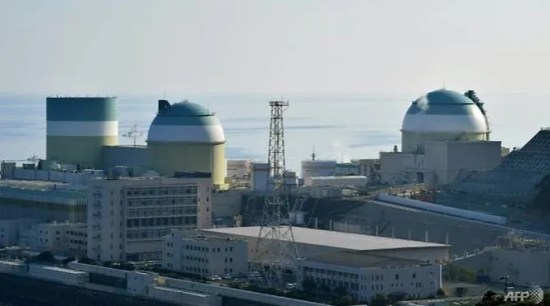 The plant lies near an active faultline, the court ruled.
Japan court halts nuclear reactor restart citing volcano, earthquake risks
17 Jan 2020
TOKYO: A Japanese nuclear reactor near a fault line must remain shut because of the risk of its being struck by earthquakes and volcanic eruptions, a high court ordered on Friday (Jan 17).
All nuclear power stations were shut down after the 2011 Fukushima nuclear accident following a catastrophic tsunami, and many remain closed.
The Japanese public has turned against atomic power, despite Prime Minister Shinzo Abe insisting the nation needs nuclear plants to power the world’s third-largest economy, and the court decision was a boost for the country’s anti-nuclear movement.
The move by the Hiroshima High Court reversed a lower court decision in March that would have allowed the reactor at the Ikata nuclear plant in western Japan to resume operations.
The plant’s operator, Shikoku Electric Power, wanted to resume work at the reactor, which had been halted for routine inspections, and said it will appeal the high court’s ruling.
The case was originally lodged by residents of a neighbouring region who complained the utility failed to properly evaluate the risks posed by a local volcano and seismic faultlines.
High court presiding judge Kazutake Mori revoked the lower court ruling that paved the way for the reactor to come online.
Mori said there was an active fault line near the plant and safety assessments had been insufficient, national broadcaster NHK said.
He also argued it was not logical to assume that volcanic eruptions can be predicted far in advance, as assumed under the national standards for operating nuclear reactors, according to NHK.
“There is a fault line within 2km from the nuclear plant but Shikoku Electric has not conducted thorough surveys, and the way the Nuclear Regulation Authority reached its assessment that there was no problem contained errors and inadequacies,” the judge said, according to NHK.
Shikoku Electric criticised the ruling and stressed the scientific merit of the firm’s argument that it was safe to operate the reactor.
“After closely examining the decision, we will file a petition of objection so that the injunction will be cancelled as soon as possible,” the utility said in a statement.
No long-term prospects in Japan for reusing, storing spent MOX fuel
 A spent nuclear fuel rod is seen stored in a pool at the No. 3 reactor building at the Ikata Nuclear Power Plant in the Ehime Prefecture town of Ikata on Jan. 14, 2020
January 15, 2020
There are no prospects that spent mixed-oxide (MOX) fuel, made by reprocessing spent nuclear material, can be further reprocessed and reused for nuclear power generation in accordance with the Japanese government’s energy policy. Storing such fuel for a long period has thus raised safety concerns.
Shikoku Electric Power Co. showed work to replace and store MOX fuel in the No. 3 reactor building at its Ikata Nuclear Power Plant to media outlets on Jan. 14.
It was the first time that the company has removed spent MOX fuel since it began to use MOX fuel — produced by extracting plutonium and other reusable nuclear materials from spent nuclear fuel and mixing them with uranium — for commercial power generation at the plant.
An employee operated a crane to extract MOX fuel rods, each of which is about 4.1 meters long and weighs some 700 kilograms, from the reactor core and transfer them into a storage pool one by one inside the reactor building.
According to the company, work to extract spent nuclear fuel rods began on the evening of Jan. 13, and will have removed 16 rods by Jan. 16. In early March five new rods will be inserted into the core. The firm will keep cooling down spent MOX fuel in the pool for more than 10 years.
However, the Nuclear Regulation Authority (NRA) has expressed concerns that the storage of spent MOX fuel in the pool over such a long period is highly dangerous. In case of a power blackout, the temperature of the water in the pool could not be maintained at a certain level and it would become unable to cool the fuel just as was the case with the Fukushima nuclear crisis.
“From the viewpoint of safety, it’s undesirable that a large number of such rods are preserved,” said NRA Chairman Toyoshi Fuketa.
Furthermore, spent MOX fuel generates heat about three to five times that generated by ordinary used nuclear fuel. In case of trouble with a cooling system, such MOX fuel would be far more dangerous than conventional spent nuclear material.
Nevertheless, an employee of an electric power company confessed that the firm “has no leeway to think about what it should do after cooling down spent MOX fuel.”
Pools holding spent fuel at nuclear power plants are almost full, and utilities operating atomic power stations are struggling to find places to store the material.
The Federation of Electric Power Companies of Japan (FEPC) intends to use MOX fuel in 16 to 18 nuclear reactors across the country. Tokyo Electric Power Company Holdings Inc. (TEPCO) and Chubu Electric Power Co. had planned to use MOX fuel in the No. 3 reactor at the Kashiwazaki-Kariwa Nuclear Power Plant in Niigata Prefecture, and the No. 4 unit at the Hamaoka Nuclear Power Plant in Shizuoka Prefecture, respectively.
However, such fuel is being used at only four reactors — Ikata’s No. 3 reactor, the No. 3 and 4 reactors at Kansai Electric Power Co.’s Takahama plant in Fukui Prefecture and the No. 3 unit at Kyushu Electric Power Co.’s Genkai complex in Saga Prefecture.
If MOX fuel is used at more reactors, the amount of spent material will keep increasing. However, utilities are dealing with the problem by shifting fuel whose heat generation volume has declined to facilities where the spent fuel is air-cooled.
The government is aiming to reprocess spent MOX fuel to reuse it in an effort to “effectively utilize resources.” If spent nuclear fuel including MOX fuel were to be disposed of as radioactive waste, the government’s atomic power policy based on the assumption that spent nuclear fuel should be reused would waver.
Japan and France are the only countries in the world that are still working on the extraction of reusable nuclear materials from spent MOX fuel. Japan’s Agency for Natural Resources and Energy will have allocated a total of 1.4 billion yen from state budgets in fiscal 2019 and 2020 for basic research on reuse of spent MOX fuel, and will earmark more funds through fiscal 2024.
However, it remains to be seen how far such technology can be developed in the foreseeable future.
“There have been no research achievements enabling the commercial use of the technology,” said an official of the Japan Atomic Energy Agency.
Even if the technology to reuse spent MOX fuel is developed, there is a possibility that sufficient funds will not be secured to put it into commercial use unless idled nuclear power stations are restarted steadily because massive amounts of money are needed just for reprocessing spent nuclear fuel. Many atomic power stations remain offline because safety regulatory standards for such facilities have been stiffened following the outbreak of the Fukushima nuclear crisis in March 2011.
An official of the Agency for Natural Resources and Energy said the reprocessing and reuse of spent MOX fuel is not a priority.
“There is approximately 19,000 metric tons of ordinary spent nuclear fuel that hasn’t been reprocessed in Japan, and priority is placed on reprocessing such material into MOX fuel. The volume of spent MOX fuel is extremely small, and we’re not working fast enough to consider how to reuse such fuel,” said the official.
(Japanese original by Yuichi Nakagawa and Ryoko Kijima, Matsuyama Bureau, and Suzuko Araki, Riki Iwama and Yuka Saito, Science & Environment News Department)
https://mainichi.jp/english/articles/20200115/p2a/00m/0na/029000c
Costs for managing Japan’s nuclear plants to total 13 trillion yen
KYODO NEWS Jan 15, 2020
The total costs to implement government-mandated safety measures, maintain facilities and decommission commercially operated nuclear power plants in Japan will reach around 13.46 trillion yen ($123 billion), a Kyodo News tally showed Wednesday.
The amount, which could balloon further and eventually lead to higher electricity fees, was calculated based on financial documents from 11 power companies that own 57 nuclear reactors at 19 plants, as well as interviews with the utilities.
Two years after the 2011 Fukushima nuclear crisis, the Japanese government introduced new safety standards which made measures against natural disasters and major accidents mandatory for restarting reactors.
The power companies have been given the option of either maintaining their idled nuclear power plants and restarting them once they had implemented the required safety measures, or decommissioning their plants.
But it has become clear either choice required massive costs. Of the total costs, 5.4 trillion yen was for safety measures implemented as of last month at 15 power plants they are trying to restart.
Decommissioning costs for 17 reactors belonging to nine nuclear power plants, which were deemed too expensive to implement safety measures for, totaled around 849.2 billion yen. As the estimated costs for decommissioning the No. 1 to No. 4 reactors at the Fukushima Daiichi nuclear power plant run by Tokyo Electric Power Company Holdings Inc. differ, they were not included in the figure.
Maintenance costs, which will not only apply to restarted plants in operation but also to idled ones and those in the process of being decommissioned, are required for 54 reactors at 17 plants. Those under construction were excluded.
In the six years from fiscal 2013, when the new regulations were introduced, they totaled around 7.2 trillion yen.
The costs include labor, repairs and others considered nuclear power plant expenses as shown in each company’s annual securities report. But plant depreciation costs and a reserve for dismantling facilities were subtracted as they overlapped with some expenses for safety measures and decommissioning.
Maintenance fees will be required every year moving forward and are expected to continue to grow from the annual costs of around 1 trillion yen across the 11 utilities.
The total costs could further rise by several hundred billion yen as money needed to construct anti-terrorist facilities, also required under the new safety standards, was not included in the figures of some of the companies.
The majority of the 17 reactors at nine power plants slated for decommissioning are aging and they also include four at the Fukushima Daini complex, which local officials requested to be scrapped.
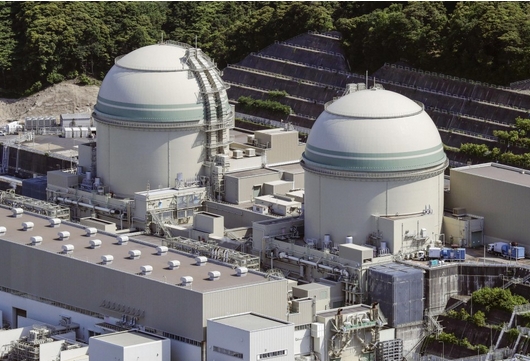 File photo taken from a Kyodo News helicopter on May 30, 2019, shows the No. 3 (L) and No. 4 reactors at Kansai Electric Power Co.’s Takahama nuclear power plant in Fukui Prefecture, central Japan.
The total costs to implement government-mandated safety measures, maintain facilities and decommission commercially operated nuclear power plants in Japan will reach around 13.46 trillion yen ($123 billion), a Kyodo News tally showed Wednesday.
The amount, which could balloon further and eventually lead to higher electricity fees, was calculated based on financial documents from 11 power companies that own 57 nuclear reactors at 19 plants, as well as interviews with the utilities.
Two years after the 2011 Fukushima nuclear crisis, the Japanese government introduced new safety standards which made measures against natural disasters and major accidents mandatory for restarting reactors.
The power companies have been given the option of either maintaining their idled nuclear power plants and restarting them once they had implemented the required safety measures, or decommissioning their plants. But it has become clear either choice required massive costs.
Of the total costs, 5.4 trillion yen was for safety measures implemented as of last month at 15 power plants they are trying to restart.
Work begins to remove spent MOX fuel at Ikata nuclear plant in Ehime
 A pool containing used mixed-oxide fuel that was removed from reactor No. 3 of the Ikata nuclear power plant in Ehime Prefecture on Tuesday
January 15, 2020
MATSUYAMA, EHIME PREF. – Shikoku Electric Power Co. has started removing nuclear fuel, including spent mixed-oxide (MOX) fuel, from a nuclear reactor in western Japan.
The work at the No. 3 reactor at the company’s Ikata nuclear plant in Ehime Prefecture, which began late Monday night, is the first time used MOX fuel, a blend of plutonium extracted from spent nuclear fuel and uranium, has been removed from any commercial nuclear power plant in Japan excluding tests.
A total of 157 fuel assemblies, including 16 MOX fuel assemblies, will be removed. The work is expected to continue through Thursday.
The work was originally scheduled to start at 12 a.m. Monday, but was delayed as the firm was investigating an incident that occurred during preparation work Sunday, in which a control rod was removed from the reactor by mistake and was re-inserted seven hours later.
Japan is not equipped to reprocess spent MOX fuel. Shikoku Electric, therefore, will store the MOX fuel at the power plant for the time being.
In March, five new MOX fuel assemblies will be installed in the reactor.
Control rod mistakenly removed from Ikata reactor in Ehime during maintenance
 Reactor No. 3 at the Ikata nuclear power plant in Ehime Prefecture in April 2018
Jan 13, 2020
MATSUYAMA, EHIME PREF. – During recent maintenance work at the Ikata nuclear power plant that was to include the country’s first removal of spent mixed-oxide (MOX) fuel following full-scale “pluthermal” power generation, a control rod was removed from the reactor by mistake, according to Shikoku Electric Power Co.
The incident involving reactor No. 3 at the plant in Ikata, Ehime Prefecture, caused no loss of control of the nuclear reaction in the unit and no radioactive materials were released, the company said Sunday. The reactor has been shut down since Dec. 26 to perform the maintenance work.
To remove fuel assemblies during the inspection, it was necessary to raise the apparatus at the top of the reactor from which fuel is suspended. While raising the apparatus, a control rod was also lifted out of the reactor along with the fuel assemblies, Shikoku Electric stated.
Control rods are used to suppress nuclear fission, and are inserted in order to halt a nuclear reactor. According to the power company, for fission to be allowed to occur within the reactor, it is necessary to adjust the concentration of boron within the reactor coolant in addition to removing the control rods.
According to Shikoku Electric and prefectural authorities, one of the 48 control rods in the unit was lifted out of the reactor containment vessel accidentally at around 1:20 p.m. Sunday together with the upper part of the apparatus that holds fuel assemblies in place from above and below.
As the apparatus was lifted by crane, a worker noticed that the control rod had also been raised out of the containment vessel. Around seven hours later, the control rod was reinserted into the reactor.
Because the crane’s weight sensor had shown a value typically seen when the control rods are disconnected, the control rods were determined to have been detached from the apparatus and the crane was raised, Shikoku Electric said.
The company had planned to start removing the spent MOX fuel assemblies, which contain a blend of plutonium extracted from spent nuclear fuel and uranium, from the reactor at 12 a.m. Monday. The work is now expected to be delayed due to the company’s investigation into the incident involving the control rod.
Shikoku Electric also announced last Tuesday that in October 2017 it mistakenly conducted an inspection of an emergency air supply filter in the main control room of reactor No. 3 without removing all the fuel from the reactor as stipulated in the safety regulations.
The operation to extract the MOX fuel assemblies is the first such removal to be performed at any commercial nuclear power plant in Japan since an initiative on pluthermal power generation using the mixed fuel was announced in 1997, according to Shikoku Electric.
The government and power firms are promoting pluthermal power generation as part of the nuclear fuel cycle featuring the extraction of plutonium from spent nuclear fuel for reuse. Shikoku Electric started pluthermal power generation in 2010 using 16 MOX fuel assemblies installed in the Ikata No. 3 reactor.
The company had been planning to remove all of them during the reactor maintenance, which is to continue through April 27. The firm will consider reusing the spent MOX fuel, which is expected to be stored at the power plant for the foreseeable future due to a lack of reprocessing facilities in this country.
New report: China soon to join countries where renewables are cheaper than coal
Oil Price 19th Jan 2020, In September of last year Oilprice reported an incredible milestone for renewable energy when solar and wind power became cheaper than coal in most of the world. Now, a new report released this week by Wood Mackenzie Power and Renewables has heralded another milestone: China will soon be added to that list of countries in which coal is no longer more economical than renewable energy.
Radioactive micro-particles still a hazard to the Olympics in Japan
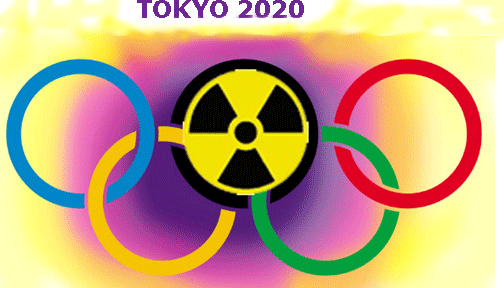 Nukewatch 10th Jan 2020. Hundreds of thousands of people—athletes, officials, media, and spectators—will flood into Japan for the 2020 Olympics.
Soon after the start of the meltdowns in 2011, experts began warning of exposure to radioactive micro-particles or “hot particles”—a type of particle that poses a danger unaccounted for by regulatory agencies. In order to understand the special danger posed by these particles at the Olympics and beyond, we mustfirst understand the current state of radiation exposure standards.
Japan’s Olympics – recovery for Fukushima? rescue for the nuclear industry?

Can Japan’s ‘Recovery Olympics’ heal Fukushima’s nuclear scars?fFukushima’s power plant. Three nuclear reactors melted down, spewing radioactive particles into the air. Jan. 14, 2020, By Keir Simmons, Yuka Tachibana and Henry Austin, FUTABA, Japan — Nine years after “Fukushima” became synonymous with nuclear disaster, the area will help kick off the 2020 Summer Olympics in Tokyo by hosting the opening ceremony’s torch relay near its devastated power plant.
But this symbol of rebirth — part of a planned renaissance for a region ravaged by the strongest earthquake in Japan’s history and deadly tsunami that engulfed entire communities — raises questions of whether nearly a decade is enough time to recover and make the area safe.
Officials in Japan told NBC News they were hopeful that the games, which open on July 24 and have been dubbed the country’s “Recovery Olympics,” would convince skeptics that the answer is yes.
“It’s an opportunity for Japan to change people’s perception, people’s view of Fukushima,” said Naoto Hisajima, the director general of disarmament, nonproliferation and science for Japan’s Foreign Ministry. “The Olympic torch will pass through Fukushima, and there’re going to be Olympic events in Fukushima.”
……… Three nuclear reactors melted down, spewing radioactive particles into the air.
Authorities acted quickly, scrubbing buildings and removing about 4 inches of soil and vegetation from the surrounding area. That lowered radioactivity to levels that are safe for people to be in contact with, according to Dr. Claire Corkhill of the U.K.’s University of Sheffield.
Corkhill’s team is helping plant operators come up with a plan to dispose of the highly radioactive melted cores — the parts of the power plant’s nuclear reactors that contained fuel components, like uranium and plutonium, that generated the heat to produce the power.
They are so toxic that only remotely controlled robots can get to them, but the robots are unable to remove them because “the intense radiation tends to fry their circuits,” she said.
Corkhill said that it will take decades to completely shut down the plant and that the operators still don’t know how to reach the cores.
Space to store the 1 million tons of water — equal to 400 Olympic-size swimming pools — that must be pumped through the reactor to keep the fuel cool is also running out, she warned.
While the water has been treated to remove most of the most dangerous radioactive components, traces of tritium remain.
Japanese authorities have suggested releasing the water slowly into the sea over a number of years, which Corkhill said was standard practice for power stations around the world.
It’s “the most feasible option at the moment,” she said.
Many residents are doubtful, however — particularly fishermen and women who test every catch for radiation…..
Sean Bonner and Azby Brown are part of environmental organization Safecast, which gives Geiger counters to Fukushima residents, as well as other people across Japan, to take radiation readings. It then collates the data and publishes them live on their website, which is an open source for radiation information.
Brown described trust as a “nonrenewable resource.”
“Once you’ve lost it, you don’t get it back,” Bonner said. “So we see our system as a side effect of people desperate to find something they can trust, because they’re not trusting information from the news. They’re not trusting information from authorities or institutions.”
While the cleanup continues, some areas remain off limits. Two miles from the plant, the town of Futaba remains uninhabited. Radiation levels are so high that former residents have to seek special permission to enter the town.
Katushide Okada, 75, said he had run a rose garden in the town since he was 23.
“We left with only what we were wearing,” he said. “We haven’t been able to go home since.”
Okada, who now lives in Tsukuba, about 130 miles to the south, in Ibaragi Prefecture, added, “This is a manmade disaster.”
Radiation hotspots have been found in J-Village, the starting point of the Olympic torch relay, according to Greenpeace.
After conducting its own tests, Greenpeace said radioactive contamination still remained in the parking lot and the nearby forests at the Olympic sports complex in Fukushima Prefecture. …….. Keir Simmons and Yuka Tachibana reported from Futaba, Japan, and Henry Austin from London. https://www.nbcnews.com/news/world/can-japan-s-recovery-olympics-heal-fukushima-s-nuclear-scars-n1114361
No chance of re-using spent mixed-oxide (MOX) fuel, its storage highly dangerous
|
Mainichi 15th Jan 2020, There are no prospects that spent mixed-oxide (MOX) fuel, made by reprocessing spent nuclear material, can be further reprocessed and reused for nuclear power generation in accordance with the Japanese government’s energy policy.
Storing such fuel for a long period has thus raised safety
concerns. The Nuclear Regulation Authority (NRA) has expressed concerns that the storage of spent MOX fuel in the pool over such a long period is highly dangerous. In case of a power blackout, the temperature of the water in the pool could not be maintained at a certain level and it would become unable to cool the fuel just as was the case with the Fukushima nuclear crisis. https://mainichi.jp/english/articles/20200115/p2a/00m/0na/029000c |
|
Japanese High Court rules against nuclear reactor restart
 Japan court halts nuclear reactor restart citing volcano, earthquake risks, Channel News Asia. 17 Jan 2020
TOKYO: A Japanese nuclear reactor near a fault line must remain shut because of the risk of its being struck by earthquakes and volcanic eruptions, a high court ordered on Friday (Jan 17).
All nuclear power stations were shut down after the 2011 Fukushima nuclear accident following a catastrophic tsunami, and many remain closed.
The Japanese public has turned against atomic power, despite Prime Minister Shinzo Abe insisting the nation needs nuclear plants to power the world’s third-largest economy, and the court decision was a boost for the country’s anti-nuclear movement.
The move by the Hiroshima High Court reversed a lower court decision in March that would have allowed the reactor at the Ikata nuclear plant in western Japan to resume operations.
The plant’s operator, Shikoku Electric Power, wanted to resume work at the reactor, which had been halted for routine inspections, and said it will appeal the high court’s ruling.
The case was originally lodged by residents of a neighbouring region who complained the utility failed to properly evaluate the risks posed by a local volcano and seismic faultlines……… https://www.channelnewsasia.com/news/asia/japan-court-halts-ikata-nuclear-reactor-restart-volcano-quake-12274482
Japanese Only Operational Nuclear Reactor Shut
Japanese Only Operational Nuclear Reactor Shut, Increasing Fuel Costs, By Tsvetana Paraskova for Oilprice.com A Japanese high court has ordered local utility Shikoku Electric Power Company to continue idling its only operational nuclear reactor until the company provides a satisfactory proof that the reactor is safe.The extended shutdown of the nuclear reactor would lead to higher fuel costs for the Japanese utility.
Shikoku Electric Power’s only operational reactor at the Ikata nuclear plant in western Japan was taken offline at the end of December for regular maintenance. The utility planned to restart the reactor within two months, but the Hiroshima High Court has just ruled that the utility had not provided sufficient guarantees that the reactor would be safe in case of earthquakes or volcano eruptions……..
Public opposition to nuclear energy is creating uncertainty about how much nuclear generation capacity Japan will restore.
Japan spent an additional annual average of around US$30 billion for fossil fuel imports in the three years after the Fukushima accident, according to EIA estimates.
The country is also looking at alternative energy sources, including hydrogen, in order to reduce its fossil fuels import bill as the future of many of its nuclear reactors is still uncertain. https://oilprice.com/Latest-Energy-News/World-News/Japanese-Only-Operational-Nuclear-Reactor-Shut-Increasing-Fuel-Costs.html
North Korea said it was ‘deceived’ by the US in 18 months of nuclear talks
- North Korea said it has been “deceived” by the United States in the last 18 months of broken down denuclearization talks.
- In a statement published Saturday, a top adviser wrote that despite the positive, personal relationship between President Donald Trump and North Korean leader Kim Jong Un, it was moving on from the “wasted time” spent in negotiations.
- Once-historic nuclear negotiations between the countries have broken down in the last year and a half as North Korea has increasingly rejected Washington’s hand in Pyongyang policy………. https://www.businessinsider.com.au/north-korea-says-deceived-by-the-united-states-2020-1?r=US&IR=T
Fukushima Japan Vows to Achieve 100% Renewable Energy Use in 20 Years
|
Impelled by Reactor Meltdown, Fukushima Japan Vows to Achieve 100% Renewable Energy Use in 20 Years, https://www.goodnewsnetwork.org/fukushima-moves-towards-100-percent-renewable-energy-production/ By Andy Corbley -Jan 11, 2020
Nine years ago, an earthquake and tsunami off the coast of Japan caused one of the most significant nuclear disasters in human history in the area around the Fukushima Daiichi nuclear power plant, where the resulting reactor meltdown led to the evacuation of 150,000 individuals.Now, the local government has vowed to restructure the grid of the north western prefecture to use entirely renewable energy sources by 2040. Fukushima is the third largest administrative district in the country, and uniquely includes a variety of energy resources like prime spots for solar and wind farms, and also opportunities for geothermal power as well. Working to achieve these ambitious goals, Fukushima Prefecture signed a memorandum of understanding in the field of renewables with the Ministry of Environment for the German state of North-Rhine Westphalia, the largest energy-producing state in Germany—and Europe as well—in August of 2017. North-Rhine Westphalia has doubled their renewable energy infrastructure over the last 15 years—growing it to deliver 9% of total energy production. Since 2012, however, Fukushima has tripled its renewable energy production, with solar, wind, water, thermal, and biofuel resources totaling 1,500 megawatts of electricity, delivering a contribution of nearly 18% of Japan’s total yearly energy consumption. Additionally, 300 billion yen ($2.75 billion) for the project has already been fronted by sponsors such as the state-owned Japan Development Bank and Mizuho Bank. The funding will be used to construct 11 solar farms and 10 wind farms over the next 4 years. The new projects also include biomass plants, geothermal stations, even fleets of sea-going windmills. The proposed new grid, spanning 80 kilometers, would reach the Tokyo metropolitan area and contribute 600 megawatts of electricity, replacing much of the power which, up until recently, the city had received from the pair of Fukushima atomic energy plants. Beyond moving away from its robust infrastructure and dependence on atomic energy, Japan is also the third largest importer of coal and natural gas, and a massive change in energy independence would help Japan reach its ambitious goals set forth in the recent UN climate change panel in Madrid last month. The country’s Prime Minister, Shinzo Abe, irrespective of the Fukushima Prefecture’s own energy objectives, is targeting 24% total energy from renewables nationally by 2030. |
|
|
North Korea’s nuclear capabilities already expanding rapidly
|
North Korean nuclear threat is here, The Hill
BY ERIC BREWER, OPINION CONTRIBUTOR — 01/09/20 Kim Jong Un has done a good job keeping the United States guessing about his next nuclear provocation. North Korea had threatened that it would pursue a more hardline “new path” by the end of last year unless the United States dropped its “hostile” policies toward the country. This was followed by promises of a “Christmas gift” in December, which was widely speculated to be the test of a more advanced long range missile system. Kim most recently announced that North Korea would no longer be bound by its own limits on long range missile and nuclear testing, and stated that “the world will witness a new strategic weapon” system soon……..
The days when North Korea was thought of having a handful of nuclear weapons that may not be deliverable with a missile are over. The bigger issue is how the United States and its allies need to adapt to rapidly expanding North Korean nuclear capabilities.
While Trump is right that North Korea has not tested a long range missile since his first summit with Kim back in 2018, North Korea has been busily advancing other elements of its nuclear deterrent. Kim has continued to churn out more nuclear warheads and missiles during this interim period. According to one estimate in 2018, he had as many as 60 warheads, and his stockpile has likely grown since. The pace of North Korean missile testing also kept up with some of the most aggressive years on record.
This included solid rocket missiles, which can be launched faster than their liquid counterparts thus reducing warning time, and missiles that could pose challenges to regional missile defenses, making American allies and regional bases more vulnerable. North Korea has also made progress in developing its own submarine launched ballistic missile. All these advances, made during a period when the relationship between Pyongyang and Washington was supposedly never better, show that Kim is not interested in disarming. Rather, he seeks a robust nuclear arsenal.
This has all occurred in the past year and a half. North Korea conducted what it claimed was its second test of a thermonuclear weapon in 2017, upping the lethality of its force. That same year North Korea also carried out three intercontinental ballistic missile tests, demonstrating that the entire United States is already likely within range of a North Korean attack. While the precise reliability of its reentry vehicle remains unclear, as in the odds that the warhead would survive the intense conditions of flight, any American president will operate under the assumption that North Korea could strike the homeland during a crisis. This is no small victory for Kim………..
There is little the United States can do to stop Kim from going down this pathway of renewed provocations if that is his intention. A subpar deal that provides substantial sanctions relief, but without verifiable limits on his ability to grow the program, is worse than no deal at all. Conversely, raising pressure will not prevent North Korea from building weapons. The task to prioritize now is analyzing how Kim might leverage his increasingly sophisticated capabilities to challenge and undermine deterrence in East Asia, and then begin working with American allies to repair those gaps. Eric Brewer is deputy director of the Project on Nuclear Issues with the Center for Strategic and International Studies. He previously served as director for counterproliferation on the National Security Council staff. https://thehill.com/opinion/international/477514-north-korean-nuclear-threat-is-here
|
|
1 This Month

Protect Sazan Island from the Trump family! https://secure.avaaz.org/campaign/en/protect_sazan_island_from_the_trump_family_loc/?bqFCVab&v=174511&cl=22707147157&_checksum=5e9dde668860e8231c33699735e16a1fbf22ab2cb01da50c999fe8732b9775ef&utm_source=email&utm_medium=blast_email&utm_campaign=174511


Cuba Is Not a Failed State – It Is a Besieged State
PETITION: “Global Appeal to Endorse Palestinian Right of Return of Refugees”
To see nuclear-related stories in greater depth and intensity – go to https://nuclearinformation.wordpress.com
-
Archives
- June 2026 (129)
- May 2026 (306)
- April 2026 (356)
- March 2026 (251)
- February 2026 (268)
- January 2026 (308)
- December 2025 (358)
- November 2025 (359)
- October 2025 (376)
- September 2025 (257)
- August 2025 (319)
- July 2025 (230)
-
Categories
- 1
- 1 NUCLEAR ISSUES
- business and costs
- climate change
- culture and arts
- ENERGY
- environment
- health
- history
- indigenous issues
- Legal
- marketing of nuclear
- media
- opposition to nuclear
- PERSONAL STORIES
- politics
- politics international
- Religion and ethics
- safety
- secrets,lies and civil liberties
- spinbuster
- technology
- Uranium
- wastes
- weapons and war
- Women
- 2 WORLD
- ACTION
- AFRICA
- Atrocities
- AUSTRALIA
- Christina's notes
- Christina's themes
- culture and arts
- Events
- Fuk 2022
- Fuk 2023
- Fukushima 2017
- Fukushima 2018
- fukushima 2019
- Fukushima 2020
- Fukushima 2021
- general
- global warming
- Humour (God we need it)
- Nuclear
- RARE EARTHS
- Reference
- resources – print
- Resources -audiovicual
- Weekly Newsletter
- World
- World Nuclear
- YouTube
-
RSS
Entries RSS
Comments RSS
 nuclear-news