Will the 2020 Tokyo Radioactive Olympics be cancelled as well?
List of sports events affected by the coronavirus outbreak
 Meme made by Christian Roy and Hervé Courtois in 2013
List of sports events affected by the coronavirus outbreak
February 18, 2020
ATHLETICS
World indoor championships in Nanjing from March 13-15 postponed to March 2021.
Hong Kong Marathon on Feb. 9 cancelled.
Asian indoor championships in Hangzhou from Feb. 12-13 cancelled.
Tokyo Marathon on March 1: Restricted to elite runners.
AUTO RACING
Formula One’s Chinese Grand Prix in Shanghai on April 19 postponed. New date not set.
Formula E’s Sanya E-Prix in Sanya on March 21 cancelled.
BADMINTON
China Masters in Hainan from Feb. 25-March 1 postponed. New dates not set.
Asian team championships in Manila from Feb. 11-16: China and Hong Kong withdrew.
BASKETBALL
Women’s Olympic qualifying tournament moved from Foshan to Belgrade, Serbia from Feb. 6-9.
Asia Cup qualifiers postponed: Philippines vs. Thailand on Feb. 20; Japan vs. China on Feb. 21, China vs. Malaysia on Feb. 24. Matches scheduled for Hong Kong moved to opponents’ homes.
BIATHLON
Olympic test event in Zhangjiakou from Feb. 27-March 2 cancelled.
BOXING
Asia-Oceania Olympic qualifier moved from Wuhan to Amman, Jordan from March 3-11.
SPORT CLIMBING
Asian Championships in Chongqing from April 25-May 3 to be relocated.
World Cup in Wujiang from April 18-19 cancelled.
World Cup in Chongqing on April 22 cancelled.
EQUESTRIAN
Hong Kong showjumping leg of Longines Masters Series from Feb. 14-16 cancelled.
FIELD HOCKEY
Hockey Pro League matches between China and Belgium on Feb. 8-9 and Australia on March 14-15 postponed.
India women’s tour of China from March 14-25 cancelled.
Ireland women’s tour of Malaysia in March-April cancelled.
GOLF
US LPGA Tour
Honda LPGA Thailand in Pattaya from Feb. 20-23 cancelled.
HSBC Women’s World Championship in Singapore from Feb. 27-March 1 cancelled.
Blue Bay LPGA on Hainan Island from March 5-8 cancelled.
European Tour
Maybank Championship in Kuala Lumpur, Malaysia, from April 16-19 postponed.
China Open in Shenzhen from April 23-26 postponed.
GYMNASTICS
Artistic World Cup in Melbourne, Australia from Feb. 20-23: China team withdrew.
HANDBALL
Olympic women’s qualifying tournament in Montenegro from March 20-22: China withdrew. Hong Kong declined invitation to attend.
ICE HOCKEY
Chinese clubs in Supreme Hockey League playing home games in Russia.
Women’s Challenge Cup of Asia in Manila, Philippines, from Feb. 23-28 cancelled.
JUDO
Paris Grand Slam on Feb. 8-9: China team withdrew.
Dusseldorf Grand Slam on Feb. 21-23: China team withdrew.
RUGBY
Hong Kong Sevens moved from April 3-5 to Oct. 16-18.
Singapore Sevens moved from April 11-12 to Oct. 10-11.
SAILING
Asian Nacra 17 Championship in Shanghai from March 1-6 moved to Genoa, Italy from April 12-19.
Asian 49erFX Championship in Hainan from March 20-29 moved to Genoa, Italy from April 12-19.
SKIING
Alpine World Cup in Yanqing from Feb. 15-16 cancelled.
SOCCER
Asian Champions League: Matches involving Chinese clubs Guangzhou Evergrande, Shanghai Shenhua, and Shanghai SIPG postponed to April-May. Beijing FC allowed to play from Feb. 18.
Asian women’s Olympic qualifying Group B tournament relocated from Wuhan to Sydney from Feb. 3-13. China vs. South Korea playoff on March 11 moved from China to Malaysia.
AFC Cup: All group stage and playoff matches in east zone delayed to April 7.
Chinese Super League, due to start Feb. 22, delayed.
Asian men’s futsal championship in Ashgabat, Turkmenistan from Feb. 26-March 8 postponed.
SWIMMING
Asian water polo championships in Nur-Sultan, Kazakhstan from Feb. 12-16 cancelled.
Diving Grand Prix in Madrid from Feb. 14-16: China team withdrew.
Diving world series event in Beijing from March 7-9 cancelled.
TENNIS
Fed Cup Asia-Oceania Group I tournament moved from Dongguan to Dubai, United Arab Emirates, from March 3-7.
VOLLEYBALL
Beach volleyball World Cup in Yangzhou from April 22-26 postponed.
WEIGHTLIFTING
Asian Championships from April 18-25 moved from Nur-Sultan, Kazakhstan to Tashkent, Uzbekistan.
WRESTLING
Asian Championships in New Delhi from Feb. 20-23: China, North Korea, Turkmenistan teams withdrew.
OTHERS
Chinese Anti-Doping Agency suspended testing from Feb. 3.
Winter X Games events in Chongli from Feb. 21-23 postponed.
Singapore athlete of the year awards on Feb. 26 postponed.
World Chess Federation’s presidential council meeting moved from China to United Arab Emirates on Feb. 28-29.
Association of Southeast Asian Nations (ASEAN) Para Games in the Philippines from March 20-28 postponed. New dates not set.
XTERRA Asia-Pacific Championships (offroad triathlon, duathlon) in Taiwan from March 28-29 cancelled.
Snooker’s China Open from March 30-April 5 cancelled.
SportAccord summit in Beijing from April 19-24 cancelled. New site to be determined.
Singapore bans spectators at National School Games from January-August.
University Athletic Association of the Philippines postponed all sports events.
Japan prepares for widespread coronavirus outbreak

February 18, 2020
As cases of the coronavirus emerge around the country, Japanese health officials are finding it increasingly difficult to identify the routes of infection. The government has announced it is stepping up screening efforts and will have the capacity to test 3,800 people a day starting on Tuesday.
Health ministry official infected despite no close contact
The number of cases in Japan stands at more than 500 as of writing, including 454 from a quarantined cruise ship docked near Tokyo.
Anxiety surrounding the virus has been palpable for weeks, with citizens throughout the country wearing face masks and carrying alcoholic disinfectant. But the concern reached new levels on Monday, after news broke of a health ministry official testing positive. The man, who is in his 50s, had been working on the quarantined cruise ship, reportedly helping control traffic as infected passengers disembarked. Worryingly, he was infected despite only working for about 10 minutes and maintaining a distance of at least two meters from the passengers.
Japan’s health ministry announced on Monday that one of its officials who had been working on the quarantined cruise ship was infected with the coronavirus.
Pressure on government grows
On Monday, the health ministry announced a directive instructing all municipalities to expand screenings to include people with symptoms who have not traveled to the Chinese provinces of Hubei and Zhejiang. Hubei is the epicenter of the outbreak, and has close business links with Zhejiang.
The measure comes after infections were confirmed among people who had neither been to the provinces nor come into contact with people who had.
Laboratories, quarantine stations, universities, and companies around the country are now increasing their personnel in an effort to meet the new testing requirements. The health ministry says the expanded manpower will enable screening of an additional 1,050 people a day.
The ministry says it will also provide medical institutions that have adequate screening equipment with the chemicals and materials needed to conduct testing.
National testing standard
The ministry also announced a set of standards to help people decide when to seek medical assistance:
- People who display symptoms of the common cold or a temperature above 37.5 degrees Celsius for four days are advised to contact a local medical center.
- People experiencing severe fatigue or breathing difficulties, as well as those with fever, are advised to contact a local medical center.
- People vulnerable to viruses, including the elderly and those with pre-existing conditions, are advised to seek medical assistance if they have cold symptoms or fever for two days. Pregnant women are also advised to seek early consultation.
Additionally, ministry officials are urging people to stay home from school or work if they display any symptoms of the cold.
Clinical trials on HIV drug
Health experts are working around the clock on treatment. While it will be some time before a vaccine is available for widespread use, there are signs that one already existing drug may be effective at combating the virus.
The director of Disease Control and Prevention Center, Norio Omagari, told NHK World that a team of researchers from his organization is conducting clinical trials on a drug commonly used to treat HIV. Omagari says that some patients have recovered after the tests, adding that his team is expediting the process to verify the effectiveness of the treatment.
Social impact
The outbreak is affecting a wide range of activities in business and culture.
Japan’s Imperial Household Agency has canceled Emperor Naruhito’s public birthday greetings, which were schedule for February 23. The event would have marked the emperor’s first birthday since ascending to the throne and thousands were expected to attend. It is the first imperial birthday greeting to be called off since 1996, when there was a hostage crisis at the Japanese embassy in Peru.
Meanwhile, the Tokyo Marathon is planning to cancel entries from the general public. The race will be held on March 1, and about 38,000 people had originally registered to take part.
On the business side, Japanese companies with operations in Hubei Province and other parts of China have been struggling to maintain production. The full extent of the impact of the outbreak is difficult to assess but experts say it will prove to be a major setback for the global economy.
Tokyo marathon cancels mass race over coronavirus scare


Japan’s paralysis over what to do with the nuclear industry’s plutonium wastes
Review the nation’s quest for a nuclear fuel cycle https://www.japantimes.co.jp/opinion/2020/02/20/editorials/review-nations-quest-nuclear-fuel-cycle/#.XlBKh2gzbIU The uncertain fate of the spent mixed-oxide (MOX) fuel removed from two nuclear power reactors in western Japan last month — for the first time since the commercial use of plutonium-uranium fuel in light water reactors began about a decade ago — is yet another sign of the stalemate over the government’s nuclear fuel cycle policy. While the government maintains that all spent nuclear fuel will be reprocessed for reuse as fuel for nuclear reactors, there are no facilities in this country that can reprocess spent MOX fuel so it will remain indefinitely in storage pools at the nuclear plants.
Trump to visit India as salesman for Westinghouse nuclear reactors
 Westinghouse to sign deal for six nuclear reactors in India during Trump’s visit: report HTTPS://THEHILL.COM/POLICY/INTERNATIONAL/INDIA/483820-WESTINGHOUSE-TO-SIGN-DEAL-FOR-SIX-NUCLEAR-REACTORS-IN-INDIA-DURING BY JUSTINE COLEMAN – 02/20/20 U.S. energy company Westinghouse is expected to sign a deal for six nuclear reactors with the state-run Nuclear Power Corporation of India (NPCIL) during President Trump’s trip to the country, Reuters reported.The deal will outline timelines and name the lead local constructor for building the reactors at Kovvada in southern India, according to the news service. Westinghouse to sign deal for six nuclear reactors in India during Trump’s visit: report HTTPS://THEHILL.COM/POLICY/INTERNATIONAL/INDIA/483820-WESTINGHOUSE-TO-SIGN-DEAL-FOR-SIX-NUCLEAR-REACTORS-IN-INDIA-DURING BY JUSTINE COLEMAN – 02/20/20 U.S. energy company Westinghouse is expected to sign a deal for six nuclear reactors with the state-run Nuclear Power Corporation of India (NPCIL) during President Trump’s trip to the country, Reuters reported.The deal will outline timelines and name the lead local constructor for building the reactors at Kovvada in southern India, according to the news service.
India has reportedly been open to receiving nuclear reactors since its 2008 civil nuclear energy pact with the U.S. Last year, the countries announced they had committed to six reactors. Representatives from the U.S. Energy and Commerce departments, Westinghouse, the U.S.-India Strategic Partnership Forum and The Nuclear Energy Institute have met in India for negotiations, Reuters noted. Rita Baranwal, assistant secretary for the Office of Nuclear Energy in the U.S. Department of Energy, told the news service that the team is “optimistic” the agreement will be signed “shortly.” “We are encouraging moving forward with Westinghouse and NPCIL to sign a MoU. It certainly is a private industry-to-private industry, a business-to-business decision,” she said, referring to a memorandum of understanding. Representatives from the U.S. Energy and Commerce departments, Westinghouse, the U.S.-India Strategic Partnership Forum and The Nuclear Energy Institute have met in India for negotiations, Reuters noted. The Hill reached out to Westinghouse and NPCIL for comment. |
|
Indonesian authorities investigate suspected nuclear waste dumping at housing estate
|
Indonesia probes suspected nuclear waste dumping at housing estate, MONGABAY, by Barita News Lumbanbatu, Basten Gokkon on 19 February 2020
Indonesian authorities have launched an investigation into radioactive contamination at a housing estate near a nuclear research reactor outside Jakarta. Officials first discovered elevated radiation levels at the site in late January during a routine check, and suspect the caesium-137 was dumped there from the nearby reactor. Authorities say a cleanup of soil and vegetation from the site has brought radiation levels down; they are also carrying out medical exams of residents living in the area. Environmental activists have renewed their calls for the Indonesian government to refrain from developing nuclear power in the country, given the inability of regulators to police even a research facility.JAKARTA — Authorities in Indonesia have launched an investigation following the discovery of radioactive contamination in an empty lot in a housing complex near a nuclear research facility. The Nuclear Energy Regulatory Agency, or Bapeten, recorded elevated levels of the radioactive isotope caesium-137 from a routine test at the estate in South Tangerang, a satellite city of Jakarta. The agency has since 2013 conducted regular checks in the estate, which is part of a complex that includes a research reactor run by the National Nuclear Energy Agency, or Batan. Radiation levels in the empty lot showed 680 millisieverts (mSv) per hour when experts checked at the end of January. That’s about the same as the maximum level of radiation that workers responding to the Fukushima nuclear plant meltdown in Japan in 2011 were exposed to. The normal level determined by Indonesian regulators is 0.03 mSv per hour. “We found it in the form of shards, so we need to examine it in our laboratory to identify the source of the radioactivity,” said Heru Umbara, a Batan spokesman……. Bapeten said it suspected that radioactive material had been deliberately dumped in the lot, likely from the research reactor some 3 kilometers (1.9 miles) away. Indonesia’s nuclear program is limited to research at three reactors. ….https://news.mongabay.com/2020/02/indonesia-probes-suspected-nuclear-waste-dumping-at-housing-estate/ |
|
Large U.S. nuclear delegation to India to con Indians into buying Small Modular Nuclear Reactors
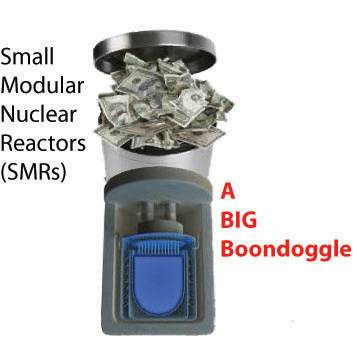 Nuclear ties in focus ahead of Trump visit, Live Mint 18 Feb 2020, Elizabeth Roche Nuclear ties in focus ahead of Trump visit, Live Mint 18 Feb 2020, Elizabeth Roche
|
|
Why India is not defined as a “Nuclear Power”, though it has nuclear bombs
Among the big changes in the global strategic landscape since the Nuclear Non-Proliferation Treaty came into force in 1970 is the expansion of the nuclear club from five to nine. All five nuclear powers at that time were recognised as nuclear-weapon states by the NPT. Since then, four more countries have gate-crashed the exclusive nuclear club: Israel, India, Pakistan and North Korea.
The first three have been de facto nuclear-armed states for decades, and North Korea conducted its first nuclear test in 2006. But because of an Alice-in-Wonderland definition in the treaty—nuclear-weapon states are countries that nuclear-tested before 1 January 1967—they can’t be recognised as nuclear-weapon states. The legal straitjacket means the NPT can’t function as the normative framework for the nuclear policies of four of the world’s nine nuclear-armed states: a triumph of definitional purity over strategic reality. …….. https://nationalinterest.org/blog/buzz/india-has-nuclear-bombs%E2%80%94-its-not-defined-nuclear-power-124721
Taiwan searches for a solution to its nuclear waste problem
The U.S. government has de-funded its deep geological repository at Yucca Mountain, and most nations have yet to begin development of similar facilities. Finland is the closest to successfully completing deep geological repository. Its Onkalo site is now in the final approval stage, and should begin accepting nuclear waste early in this decade.
Executives from U.S. startup Deep Isolation visited Taiwan last fall with an innovative solution that could serve as either interim or permanent storage. Deploying technologies developed in the oil and gas industry, it would use directional drilling approximately 1 kilometer deep and then another kilometer horizontally. The spent fuel would then be lowered down the borehole inside nickel-chromium-molybdenum alloy canisters.
Developed by University of California at Berkeley physicist Richard Muller, the solution is based on proven technologies. The canisters can even be retrieved. The company has yet to utilize the technology in an actual case, though, and Taipower may be wary of being first in the world to implement it.
In the meantime, Taiwan is continuing a search for its own site for a deep geological depository. The Atomic Energy Council hopes to have a site ready by 2055.
For now, however, the focus is on developing interim solutions for the spent fuel in the cooling pools. Both New Taipei City and Taipower are optimistic that solutions can be found.
“The election is over and the noise is quieting down, so maybe now will be a better time to solve the issue,” says Edward H.C. Chang (張學植), director of Tai-power’s Department of Nuclear Backend Management.
Japan wants cruise ship infected separated from country’s total over economy fears
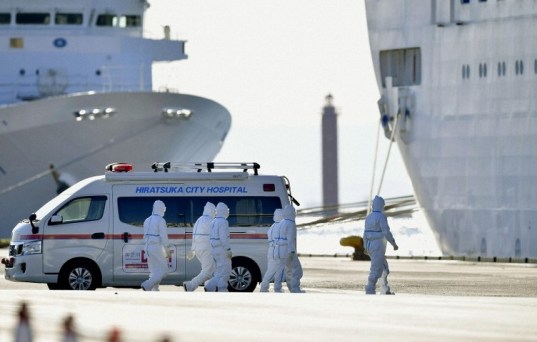
The plutonium dilemma – Japan and UK


 What should be done with Japan’s plutonium now stored in the UK? ~ Research trip report. BY by Caitlin Stronell, CNIC
From September 11 to 21, Ban Hideyuki and Caitlin Stronell from CNIC visited the UK in order to survey opinions on what should be done with Japan’s 21.2 tons of plutonium presently stored at the Sellafield facility in the UK. As Japan does not have an operating reprocessing plant, spent fuel was shipped to the UK and France for reprocessing and fabrication into MOX fuel from the late 1970s. Including Japan’s 21 tons, a total of approximately 140 tons of separated plutonium are held in the UK, which has offered to take ownership of foreign owned plutonium on its soil, subject to acceptable commercial terms. There have already been several such cases of ownership transfers of plutonium. (For example, in January 2017 the UK took ownership of 600 kg of plutonium previously owned by a Spanish utility and 5 kg previously owned by a German organization.)
Last year Japan’s Ministry for Economy, Trade and Industry (METI) announced that a dialogue concerning plutonium between the UK and Japan had begun. Although the details of this dialogue have not been released, ownership transfer may well be one of the discussion points. If Japan does go through with the ownership transfer, it will be an admission that the plutonium, which it has spent vast sums on extracting from the spent fuel, is not a precious resource at all, but material that now has to be disposed of, again at large cost. This would be another heavy blow against Japan’s reprocessing policy. However, how do people in the UK feel about accepting 21 tons of Japanese plutonium? This was what we tried to find out on our research trip.
Closely related to the issue of plutonium in both Japan and the UK is the issue of nuclear waste and we also wanted to find out about how the UK is planning to deal with this issue, especially in terms of siting a Geological Disposal Facility (GDF). Plans to site the GDF in Cumbria were rejected by the Council in 2013 and since then the national government has introduced a new system where smaller communities are able to request that they be considered as a GDF site. We wanted to find out how people were reacting to this and what the prospects are for the government being able to successfully site a GDF under this system.
We spoke to a large range of people directly concerned with these issues, of course anti-nuclear activists, but also a scientist involved in research on direct disposal methods for plutonium, as well as a number of people who work at Sellafield and local councilors for the area. Their answers to the question of what to do with Japan’s 21 tons of plutonium were varied and, in some cases, a little unexpected. For example, I was expecting that Prof. Neil Hyatt of Sheffield University, who is conducting cutting edge research on plutonium disposal, would be more open to accepting Japan’s plutonium, but he expressed some hesitation, saying that if the UK government agrees to take ownership of such a large amount of plutonium, it will break trust with local people by increasing their waste burden.
Divided opinions
We also noticed a split opinion between the two Cumbrian Councillors we interviewed. Cumbria is the county where the Sellafield Site is located and the nuclear industry obviously plays an important part in the local economy and politics………
The NDA is also tasked with siting the GDF for radioactive waste, which has proved to be a difficult task indeed, as it is all over the world, including in Japan where little progress has been made. There have been three attempts so far in the UK to try to decide on a site for the GDF, none of which have yielded results and so a new process for finding a GDF site began in January 2019. This process allows any community, no matter how small, to express an interest in starting a dialogue regarding hosting a GDF. …….
These and many other campaigns led by local communities show that the authorities and industry claims of transparency and safety cannot be trusted and in this sense it was easy to understand comments by Cr. Celia Tibble regarding the public reaction if the UK government were to accept Japanese plutonium. It would be seen as another lie and breach of trust…….
Conclusion
I thought that there were many similarities between the situation in Japan and in the UK regarding nuclear fuel cycle policy. Both countries must deal with massive amounts of plutonium, extracted at huge cost and risk, which now has no apparent use. Both the governments of Japan and the UK try to convince themselves and the world that it can be used as MOX fuel, but without a fabrication plant or sufficient MOX reactors, this solution is totally unconvincing. In the UK, it seems at least some industry people are facing up to this reality. In Japan, however, the government, at least at a policy level, hasn’t even faced up to the reality that plutonium is not a resource. Transferring ownership of its 21 tons of plutonium held in Sellafield to the UK would be an important step in facing up to this reality and could open the door to more practical and constructive discussions on how to reduce the plutonium stockpile. These discussions will not be easy and require an honest and concerted effort on the part of local and national governments, industry, communities and citizens. https://cnic.jp/english/?p=4681
India’s problematic nuclear security
Mapping the Negative Indian Nuclear Security, https://moderndiplomacy.eu/2020/02/14/mapping-the-negative-indian-nuclear-security/ By Rabia Javed, 14 Feb 20, Nuclear security has been a key issue for South Asia for several decades since India conducted its nuclear tests in 1974. Indian struggle to attain the maximum number of weapons is still underway since New Delhi conducted its so called peaceful nuclear test. While living with the kind of achieving the maximum numbers of nuclear weapons by India, the Indian struggle to achieve the maximum is moving steadily forward without great exertion but with abundant support.That is unfortunate.
Overall, the issue mainly revolves around the dangerous bargain that India had with the United States (U.S.) under the civil nuclear cooperation. Countries with major powers has up till now bend the rules for making India’s nuclear program to maintain the cooperation U.S. had with India in nuclear trade. Supporting India was also done with the aim of countering China’s emergence as a super power and controlling its influence. These steps taken in support of India have encouraged New Delhi more in expanding her nuclear weapons program that is already expanding at a higher rate.
By and large, India has on various accounts progressed below par in a comprehensive international reportage, such as the Nuclear Threat Initiative’s Nuclear Security Index. There have been other many reports that have shown that India’s nuclear security is quite under the negative flex. Ignoring these reports, it still is continuing to expand her nuclear forces.
Traditionally, the growing and bulging danger of insider threats also highlights the importance of personnel reliability programs (PRPs).Interestingly such issues exist in Indian facilities at larger scale.
While turning down pages from the past one can found that, CISF man kills 3 colleagues at Kalpakkam atomic plant. The incident occurred was though a fresh example which must have considered as India’s serious shortcomings in securing its nuclear facilities. Where later estimates given by Stockholm International Peace Research Institute found that an estimate of around 110 nuclear bombs are stored in such or same facilities which are being guard by these security forces.
With large number of such incidents that started happening or being covered by mainstream media starting from 1993, there exists another important instance that happened in 2008.
A criminal gang was found in smuggling low grade uranium which can be used in a radiation dispersal device, from India to Nepal. However, in the same year another gang was caught in smuggling such materials that have close connections with an employee at India’s Atomic Minerals Division. Similar lapses had occurred in 2018 where, a uranium smuggling racket was busted by the Kolkata police with one kilogramme of radioactive material which has a market value of INR 30 million ($440,000). All of aforementioned factors highlight the security measure India has up till now in securing its facilities that cannot be ignored.
India is operating a plutonium production reactor, Dhruva, and a uranium enrichment facility that are not subject to IAEA safeguards. India’s build-up of South Asia’s largest military complex of nuclear centrifuges and atomic-research laboratories is somehow threatening efforts related to nuclear security and safety. These facilities will ultimately give India the ability to make more large-yield nuclear arms & hydrogen bombs. The international task force on the prevention of nuclear terrorism is of the view that the possibility of nuclear terrorism is increasing keeping in mind the rapid nuclear development by India. Whereas, U.S. officials and experts are of the view that India’s nuclear explosive materials are vulnerable to theft.
Amusingly, in India, nuclear facilities are guarded by Central Industrial Security Force (CISF) and CISF guard admitted that security at the installations needs more enhancements. Mysterious deaths of Indian nuclear scientists is a matter of concern as some were reported suicide and some were murdered. The possibility of nuclear secrecy gets out in the hands of terrorists cannot be ignored.
Such risks stemmed in part from India’s culture of widespread corruption. India has refused and rebuffed repeated offers of U.S. help in countering such issue and alignments. The U.S. president’s coordinator for arms control and weapons of mass destruction from 2009 to 2013, Gary Samore, stated that:
We kept offering to create a joint security project [with India] consisting of assistance of any and every kind. And every time they would say, to my face, that this was a wonderful idea and they should grasp the opportunity. And then, when they returned to India, we would never hear about it again.”
India has a dangerous history of unsafeguarded sensitive facilities, where exist larger insider threats of nuclear bomb being stolen by insiders with grievances, ill motives, or in the worst case, connections to terrorists.
At the bottom of this entire debate is a disturbing fact concerning how a country can be trusted with uranium and nuclear deals with over dozens of countries ignoring its security issues related to nuclear safety. What might change India’s calculation that more deals and weapons would not equates to more security? The safest route to reduce nuclear dangers on the subcontinent is through concerted efforts to improve relations. A nuclear arsenal built by proliferation, as India did in 1974, is inherently unstable.
5.2-magnitude earthquake near Fukushima
 Japan is rattled by 5.2-magnitude earthquake near Fukushima, Daily Mail UK
- The earthquake struck around 20 miles off the coast of Fukushima province
- Witnesses said they had felt a 10-second long shake during the tremor today
- No tsunami warning has been put in place by Japan’s meteorological agency
By TIM STICKINGS , 12 February 2020 Japan was rattled by a 5.2-magnitude earthquake off the coast of Fukushima province today.
The quake struck just over 50 miles from the city of Fukushima where the nuclear disaster occurred in 2011.
Witnesses said they had felt a 10-second long shake during the tremor at around 7.30pm local time.
No tsunami warning has been put in place by Japan’s meteorological agency.
The US Geological Survey said today’s earthquake had struck at a depth of around 50 miles under the sea.
One witness told earthquake monitoring service EMSC that the quake produced a ‘weak but long shake’ lasting about 10 seconds.
Another said their heater had moved around on its four wheels while making a sound.
Officials in Fukushima prefecture warned residents that there could be aftershocks and directed them to official public safety advice. Energy company TEPCO, which runs four nuclear power plants in the prefecture, said it was awaiting further information about the earthquake’s impact. …..https://www.dailymail.co.uk/news/article-7995301/Japan-rattled-5-2-magnitude-earthquake-near-Fukushima.html
Coronovirus, bats, and the Climate Change connection
 The Wuhan Coronavirus, Climate Change, and Future Epidemics…...TIME, 10 Feb 2020,
Malaysia – a definite NO to nuclear power
 Malaysia won’t use nuclear power, says PM https://www.nst.com.my/news/government-public-policy/2020/02/564295/malaysia-wont-use-nuclear-power-says-pm By Nor Ain Mohamed Radhi – February 10, 2020 Malaysia won’t use nuclear power, says PM https://www.nst.com.my/news/government-public-policy/2020/02/564295/malaysia-wont-use-nuclear-power-says-pm By Nor Ain Mohamed Radhi – February 10, 2020
CYBERJAYA: Malaysia will not use nuclear power as a renewable energy source as the country’s knowledge in the field is inadequate, said Prime Minister Tun Dr Mahathir Mohamad. He said to date, the world has yet to find the best and safest way to dispose of radioactive waste generated. “If you have a nuclear power plant, you will accumulate nuclear waste, which is radioactive, and until now they do not know how to reverse the process. “That is why we cannot use nuclear materials because it stays on for a million years. We do not want this country to be full of such waste thrown all over the place and affecting people. “That is why, until we discover a way of reversing the process, we should not use nuclear materials,” he told reporters after a dialogue session with the French business community in Malaysia here, today. The event was organised by the Chamber of Commerce and Industry France Malaysia. Dr Mahathir during the dialogue was asked on Malaysia’s vision on renewable energy sources, after a pledge by Energy, Science, Technology, Environment, and Climate Change Minister Yeo Bee Yin in September to have Malaysia increase its renewable energy use to 20 per cent by 2025. Dr Mahathir said the country was working on reducing the usage of traditional energy sources namely oil, gas, and coal to lessen the amount of pollution in the air. |
|
1 This Month
26 September – International Day for the Total Elimination of Nuclear Weapons





PLEASE OPPOSE HR 8255 AND S.3639 – bills would accelerate satellite deployment, with no environmental review or safeguards – https://ncstd5li.quorum.us/campaign/169331/
To see nuclear-related stories in greater depth and intensity – go to https://nuclearinformation.wordpress.com
-
Archives
- September 2026 (281)
- August 2026 (330)
- July 2026 (355)
- June 2026 (287)
- May 2026 (306)
- April 2026 (356)
- March 2026 (251)
- February 2026 (267)
- January 2026 (308)
- December 2025 (358)
- November 2025 (359)
- October 2025 (375)
-
Categories
- 1
- 1 NUCLEAR ISSUES
- business and costs
- climate change
- culture and arts
- ENERGY
- environment
- health
- history
- indigenous issues
- Legal
- marketing of nuclear
- media
- opposition to nuclear
- PERSONAL STORIES
- politics
- politics international
- Religion and ethics
- safety
- secrets,lies and civil liberties
- spinbuster
- technology
- Uranium
- wastes
- weapons and war
- Women
- 2 WORLD
- ACTION
- AFRICA
- Atrocities
- AUSTRALIA
- Christina's notes
- Christina's themes
- culture and arts
- Events
- Fuk 2022
- Fuk 2023
- Fukushima 2017
- Fukushima 2018
- fukushima 2019
- Fukushima 2020
- Fukushima 2021
- general
- global warming
- Humour (God we need it)
- Nuclear
- RARE EARTHS
- Reference
- resources – print
- Resources -audiovicual
- Weekly Newsletter
- World
- World Nuclear
- YouTube
-
RSS
Entries RSS
Comments RSS

