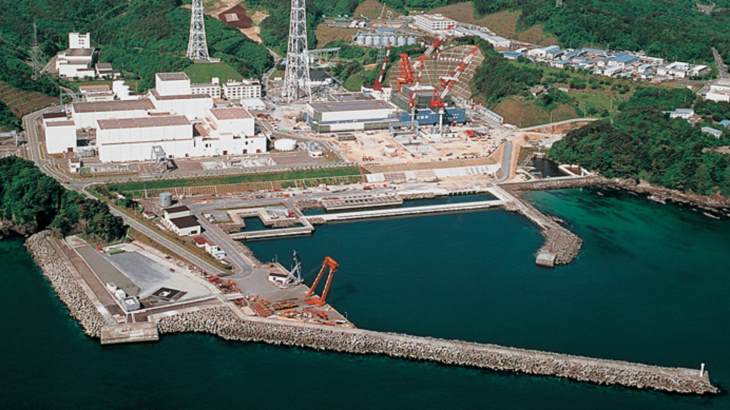
800-meter-long seawall being constructed, as Japan plans to reopen damaged Onagawa nuclear complex
|
Japan’s damaged nuclear reactor set to reopen https://www.aa.com.tr/en/asia-pacific/japan-s-damaged-nuclear-reactor-set-to-reopen/2005798, Quake-hit Onagawa nuclear complex awaits final approval by Miyagi provincial officials, Riyaz ul Khaliq |14.10.2020 ANKARAJapan’s nuclear reactor hit by a 2011 earthquake in the northeastern Miyagi province will resume operations by the end of this year, according to officials, the local media reported on Wednesday.
Miyagi Governor Yoshihiro Murai will formally announce his consent to restart the nuclear reactors at Onagawa complex by the end of the year, the Kyodo News agency said. Early this year, the 825,000-kilowatt reactor, operated by Tohoku Electric Power Company, won the approval of the country’s Nuclear Regulation Authority. All the three reactors were shut down when the massive quake and a 13-meter tsunami hit northeastern Japan on March 11, 2011, flooding the underground floors of the No. 2 unit. Nearly 10,000 people lost their lives while over 4,000 others are still missing. Onagawa nuclear reactor is the second such disaster-ravaged complex, after the Fukushima nuclear disaster, to pass stricter nuclear safety standards. The world has witnessed the worst nuclear disaster in 1986 at Chernobyl in today’s Ukraine. Unlike the Fukushima Daiichi plant of Tokyo Electric Power Company, the Onagawa plant’s emergency cooling system did not fail and underwent no meltdown after hit by the earthquake and tsunami. To restart the Onagawa nuclear reactors, the consent of local government leaders is the last remaining step needed after it cleared a national safety screening in February. Tohoku aims to restart the No. 2 unit of Onagawa nuclear complex in 2022 at the earliest. Currently, a 800-meter-long seawall at the plant is under construction. The operator has already decided to scrap unit No. 1. Murai would be the first governor of a disaster-hit province to allow resumption of a damaged nuclear reactor’s operations. The 2011 earthquake and tsunami triggered one of the world’s worst nuclear crises in Japan’s Fukushima province which caused all of Japan’s 54 reactors to halt. However, since then, nine units at five plants of the country have restarted following regulatory and local approvals. “When the plenary session [of the local assembly] shows its stance, I will make a decision upon hearing the opinions of mayors of cities, towns, and villages within the prefecture,” Murai said. |
Struggling Japanese towns look to nuclear waste storing and the money associated
|
MANSION WITHOUT A TOILET: TOWNS IN JAPAN SEEK TO HOUSE, STORE NUCLEAR WASTE OUT OF NECESSITY, https://www.firstpost.com/tech/science/mansion-without-a-toilet-towns-in-japan-seek-to-house-store-nuclear-waste-out-of-necessity-8904851.html Radioactive waste needs to be stored away for a few centuries in thick concrete structures underground so it won’t affect humans and the environment.
Two remote towns in northern Japan struggling with rapidly graying and shrinking populations signed up Friday to possibly host a high-level radioactive waste storage site as a means of economic survival.
Japanese utilities have about 16,000 tons of highly radioactive spent fuel rods stored in cooling pools or other interim sites, and there is no final repository for them in Japan — a situation called “a mansion without a toilet.”
Japan is in a dire situation following the virtual failure of an ambitious nuclear fuel recycling plan, in which plutonium extracted from spent fuel was to be used in still-unbuilt fast breeder reactors. The problem of accumulating nuclear waste came to the fore after the 2011 Fukushima nuclear power plant disaster. Finding a community willing to host a radioactive dump site is difficult, even with a raft of financial enticements.
On Friday, Haruo Kataoka, the mayor of Suttsu town on the northwestern coast of Hokkaido, applied in Tokyo for preliminary government research on whether its land would be suitable for highly radioactive waste storage for thousands of years. Later Friday in Kamoenai just north of Kamoenai, village chief Masayuki Takahashi announced his decision to also apply for an initial feasibility study. Suttsu, with a population of 2,900, and Kamoenai, with about 800 people, have received annual government subsidies as hosts of the Tomari nuclear power plant. But they are struggling financially because of a declining fishing industry and their aging and shrinking populations. The preliminary research is the first of three steps in selecting a permanent disposal site, with the whole process estimated to take about two decades. Municipalities can receive up to 2 billion yen ($19 million) in government subsidies for two years by participating in the first stage. Moving on to the next stage would bring in more subsidies. “I have tried to tackle the problems of declining population, low birth rates and social welfare, but hardly made progress,” Takahashi told reporters. “I hope that accepting research (into the waste storage) can help the village’s development.” It is unknown whether either place will qualify as a disposal site. Opposition from people across Hokkaido could also hinder the process. A gasoline bomb was thrown into the Suttsu mayor’s home early Thursday, possibly by an opponent of the plan, causing slight damage. Hokkaido Gov. Naomichi Suzuki and local fisheries groups are opposed to hosting such a facility. One mayor in southwestern Japan expressed interest in 2007, but faced massive opposition and the plan was spiked. High-level radioactive waste must be stored in thick concrete structures at least 300 meters (yards) underground so it won’t affect humans and the environment. A 2017 land survey map released by the government indicated parts of Suttsu and Kamoenai could be suitable for a final repository. So far, Finland and Sweden are the only countries that have selected final disposal sites |
|
India’s young anti-nuclear protestors still in trouble, police cases pending, 10 years after teir demonstration
|
Nine years after anti-nuclear stir, youngsters in Kudankulam say they are still losing jobs due to pending police cases, https://www.newindianexpress.com/states/tamil-nadu/2020/oct/12/nine-years-after-anti-nuclear-stir-youngsters-in-kudankulam-say-they-are-still-losing-jobs-due-to-p-2209324.html
Of the 349 cases registered at the time, in which hundreds were booked, 84 are still pending in the Kudankulam, Pazhavoor, Radhapuram and Uvari police stations. By Sreemathi M, Express News Service TIRUNELVELI: Several youngsters from Kudankulam, Valliyur and nearby villages, said they continue to lose job opportunities due to the pending police cases registered against them during the anti-Kudankulam Nuclear Power Project (KKNPP) protests in 2011. Of the 349 cases registered at the time, in which hundreds were booked, 84 are still pending in the Kudankulam, Pazhavoor, Radhapuram and Uvari police stations, said Tirunelveli district police. Since thousands took part in the protests, names often got mixed up and resulted in cases being registered against people who did not join the protests, said Kudankulam Grama Nala Sabha President Arimutharasu. I was not even questioned at the court on whether or not I had taken part in the protest,” he said, adding that the case cost him his previous job, an overseas job offer and one from the KKNPP itself. Another person still battling an open case is Power Singh, a retired school headmaster from Uvari. He was booked in September 2012 – the same month he received the chief minister’s “Best Teacher Award” – and the case against him is still pending. ‘Over 100 cases pending’ Advocate Semmani – one of the 10 lawyers working to close the cases – said that the Valliyur Judicial Magistrate Court had closed several cases, as 3,500 people booked could not be summoned. In 2015-2016, 213 more cases were closed, leaving 35 pending, he said. T Ganesan (52), one of the front-line protesters, said that the protest committee, initially, helped closing several cases. The issue is being stressed now, with numerous petitions from the residents, as the plant has started recruiting labourers. He alleged that the cases had been registered “following a petition from a politician”, who after nine years, has now submitted another petition to close the cases. Despite Superintendent of Police Manivannan’s assurance of providing Police Verification Certificate for minor cases, several youths requested the State government to provide No Objection Certificates (NOCs) to help with their passport clearance for working abroad. |
|
New North Korean missile will prove a big diplomatic headache for US, expert warns
|
New North Korean missile will prove a big diplomatic headache for US, expert warns, 9 News, By Richard Wood • Senior JournalistOct 12, 2020 North Korea’s unveiling of a new intercontinental ballistic nuclear missile (ICBM) will impact global security in the months ahead, according to one expert.
The massive weapon was carried by an 11-axle truck during a military parade in the capital of Pyongyang to mark the 75th birthday of the isolated state’s ruling party on the weekend.
Malcolm Davis, senior analyst at the Australian Strategic Policy Institute, told Nine.com.au the display of the new ICBM shows that the Trump Administration’s talks with North Korean leader Kim Jong-un had failed…….. https://www.9news.com.au/world/north-korea-nuclear-missile-will-test-next-us-president/8c1ee861-4b14-47f9-93c4-e9466d06dfb9
|
|

Ikata nuclear reactor to be shut down – 40 year decommissioning process
Regulator approves Ikata 2 decommissioning plan
Japan’s Nuclear Regulation Authority (NRA) today approved Shikoku Electric Power Company’s decommissioning plan for unit 2 of its Ikata nuclear power plant in Ehime prefecture. Decommissioning of the unit is expected to be completed by 2059.

07 October 2020
Ikata 2 is a 538 MWe pressurised water reactor that began operating in March 1988. It was taken offline in January 2012 for periodic inspections. Shikoku announced in March 2018 that it did not plan to restart the reactor. It said the cost and scale of modifications required to upgrade the 40-year-old unit to meet the country’s revised safety standards made it uneconomical to restart it.
The utility submitted an outline of its plans for decommissioning the unit to the NRA on 10 October, 2018. Shikoku also submitted requests to Ehime prefecture and the municipality of Ikata, as specified under nuclear safety agreements concluded with those authorities.
Following a review, which included a total of seven public meetings, the NRA has today approved the decommissioning plan for Ikata 2.
According to the plan, decommissioning of the unit will take about 40 years and will be carried out in four stages. The first stage, lasting about 10 years, will involve preparing the reactor for dismantling (including the removal of all fuel and surveying radioactive contamination), while the second, lasting 15 years, will be to dismantle peripheral equipment from the reactor and other major equipment. The third stage, taking about eight years, will involve the demolition of the reactor itself, while the fourth stage, taking about seven years, will see the demolition of all remaining buildings and the release of land for other uses.
During the first stage, all fuel is to be removed from the unit. This includes 316 used fuel assemblies that will be sent for reprocessing and 102 fresh fuel assemblies that will be returned to the fuel fabricator.
“In the future, we will obtain the consent of Ikata Town and Ehime Prefecture, based on the safety agreement,” Shikoku said.
Shikoku decided in March 2016 to decommission unit 1 of the Ikata plant, also a 538 MWe PWR, which began commercial operation in September 1977. That unit had been taken offline in September 2011 for periodic inspections. Upgrades costing more than JPY170 billion (USD1.5 billion) would have been needed at the unit in order for it to operate beyond 40 years. The NRA approved Shikoku’s decommissioning plan for Ikata 1 in June 2017. That plan also sees the unit being decommissioned in four stages over a 40-year period.
The utility said, “As with unit 1, we will steadily proceed with the decommissioning of unit 2 with the highest priority given to ensuring safety.”
https://www.world-nuclear-news.org/Articles/Regulator-approves-Ikata-2-decommissioning-plan
China backs Iran nuclear deal, calls for new MidEast forum
China backs Iran nuclear deal, calls for new MidEast forum Bangkok Post, : 11 OCT 2020 BEIJING: China’s foreign minister Wang Yi has called for a new forum to defuse tensions in the Middle East after a meeting with his Iranian counterpart where he reiterated Beijing’s support for Tehran.
Wang and Javid Zarif also reaffirmed their commitment to Iran’s 2015 nuclear deal with world powers, according to the Chinese foreign ministry, an implicit rebuke of the United States for abandoning the accord during their Saturday meeting in China’s southwestern Tengchong city.
Iran has been locked in an acrimonious relationship with Saudi Arabia, the other major Middle Eastern power, over the war in Yemen, Iranian influence in Iraq and Saudi support for Washington’s sanctions on Tehran.
“China proposes to build a regional multilateral dialogue platform with equal participation of all stakeholders,” said the Chinese foreign ministry statement. …… https://www.bangkokpost.com/world/2000307/china-backs-iran-nuclear-deal-calls-for-new-mideast-forum
Kim Jong Un showcases North Korea’s biggest intercontinental missile
Pyongyang advances its weapons technology despite impact of sanctions and coronavirus, Edward White, 11 Oct 20,
Fishing industry chief opposes releasing Fukushima No. 1 water into sea
Fishing industry chief opposes releasing Fukushima No. 1 water into sea, https://www.japantimes.co.jp/news/2020/10/09/national/zengyoren-fukushima-water-sea/ 9 Oct 20, The head of the National Federation of Fisheries Cooperative Associations, or Zengyoren, has voiced strong opposition against releasing treated water containing radioactive tritium from the disaster-stricken Fukushima No. 1 nuclear plant into the sea.
“We are absolutely against ocean release” as a way to dispose of tainted water at Tokyo Electric Power Company Holdings Inc.’s nuclear plant in Fukushima Prefecture, Hiroshi Kishi, head of Zengyoren, said Thursday at a government hearing in Tokyo.
Kishi said that fishermen who are operating along the coast of Fukushima have been suffering from problems caused by the radioactive fallout from the 2011 meltdowns at the plant, such as fishing restrictions, as well as malicious rumors about the safety of farm and marine products there.
If the government chooses to release radioactive water into the sea, a leading option to get rid of accumulating low-level radioactive water at the plant, it will trash all efforts fishermen have so far made to sweep away such rumors and consequently “will have a devastating impact on the future of Japan’s fishing industry,” Kishi stressed.
Toshihito Ono, head of the prefecture’s fishery product processors association, who joined the hearing via a video call, warned that Fukushima’s processed marine products, including products that use ingredients from other prefectures, will become targets of harmful rumors.
In a report released in February, a government panel pointed out that a realistic option would be releasing the tainted water into the ocean after dilution or into the air through evaporation.
Many people fear that both methods will add to the reputational damage suffered by Fukushima products. But treated water storage at the power plant is expected to reach full capacity as early as autumn 2022.
After the hearing, state industry minister Kiyoshi Ejima told reporters, “We find it unadvisable to put off a decision on how to dispose of the water because not much room is left at the plant for tanks containing the water.”
This was probably the last hearing on the water issue, people familiar with the matter said.
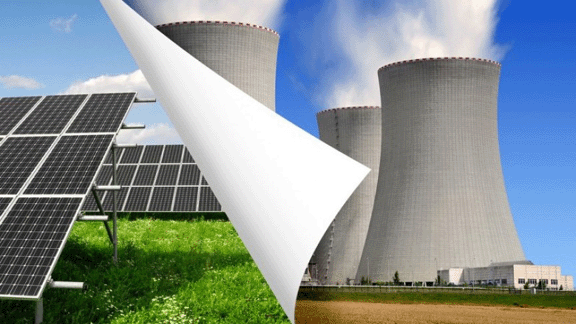
China’s plan for dramatic switch to climate action and renewable energy
|
|
|
Ageing community in Hokkaido town – mayor agrees to survey for nuclear waste dump
|
Graying Hokkaido town applies for nuclear waste dump survey, Japan Times, 9 Oct 20, A small Hokkaido town struggling with depopulation signed up Friday for preliminary research into its land to gauge its suitability for hosting a disposal site deep underground for high-level radioactive nuclear waste, the first municipality to do so in Japan since 2007.Suttsu Mayor Haruo Kataoka submitted the documents for the survey at the quasi-governmental Nuclear Waste Management Organization (NUMO) in Tokyo. Municipalities that undergo the preliminary research, the first of a three-stage process requiring some 20 years in total to select a permanent disposal site, can receive up to ¥2 billion in state subsidies over two years. Prior to Suttsu, the only municipality to apply for a preliminary survey was Toyo in Kochi Prefecture, which submitted documents in 2007. However, the town later withdrew before the research was ever conducted following strong protests by local residents. ……… Meanwhile, government officials are expected later Friday to request Kamoenai village in Hokkaido, which is about 40 kilometers north of Suttsu, to accept research into its land a day after its assembly adopted a petition to host the survey. Suttsu and Kamoenai, with populations of about 2,900 and 820, respectively, have been struggling financially due to a decline in the fishing industry and the aging of their residents. It remains uncertain whether the process of becoming a final disposal site will go smoothly, as Hokkaido Gov. Naomichi Suzuki and members of the fishing industry in the area are opposed to the idea of hosting such a facility……. During its research, NUMO will examine the area to see if it is suited to the disposal of highly radioactive waste, paying attention to volcanoes and fault lines. High-level radioactive waste, produced as a result of extracting uranium and plutonium from spent fuel, must be stored in concrete structures at least 300 meters underground so as not to impact human lives or the environment. Locations near volcanoes and active faults are deemed unfavorable…….https://www.japantimes.co.jp/news/2020/10/09/national/hokkaido-nuclear-waste-dump-survey/ |
|
Kim Jong Un Set to Show Off Nuclear Advances in Message to Trump
|
Kim Jong Un Set to Show Off Nuclear Advances in Message to Trump, By Jon Herskovitz and Jeong-Ho Lee
10 October 2020, North Korean leader Kim Jong Un is expected to hold his biggest military parade in at least two years and show off a nuclear arsenal that poses one of the most daunting security challenges for the winner of the U.S. presidential election.
The event — part of festivities Saturday to mark the 75th anniversary the Workers’ Party of Korea — could showcase the “new strategic weapon” Kim pledged to unveil at the start of the year. ….. https://www.bloomberg.com/news/articles/2020-10-09/kim-jong-un-set-to-show-off-nuclear-advances-in-message-to-trump |
|
Ikata nuclear reactor to be shut down – 40 year decommissioning process
Regulator approves Ikata 2 decommissioning plan, WNN, 07 October 2020 Japan’s Nuclear Regulation Authority (NRA) today approved Shikoku Electric Power Company’s decommissioning plan for unit 2 of its Ikata nuclear power plant in Ehime prefecture. Decommissioning of the unit is expected to be completed by 2059.
Ikata 2 is a 538 MWe pressurised water reactor that began operating in March 1988. It was taken offline in January 2012 for periodic inspections. Shikoku announced in March 2018 that it did not plan to restart the reactor. It said the cost and scale of modifications required to upgrade the 40-year-old unit to meet the country’s revised safety standards made it uneconomical to restart it. ……….
According to the plan, decommissioning of the unit will take about 40 years and will be carried out in four stages. The first stage, lasting about 10 years, will involve preparing the reactor for dismantling (including the removal of all fuel and surveying radioactive contamination), while the second, lasting 15 years, will be to dismantle peripheral equipment from the reactor and other major equipment. The third stage, taking about eight years, will involve the demolition of the reactor itself, while the fourth stage, taking about seven years, will see the demolition of all remaining buildings and the release of land for other uses……. https://www.world-nuclear-news.org/Articles/Regulator-approves-Ikata-2-decommissioning-plan
India test-fires new version of nuclear capable Shaurya missile
India test-fires new version of nuclear capable Shaurya missile, DECCAN CHRONICLE. | AKSHAY KUMAR SAHOO
Oct 4, 2020, Bhubaneswar: India on Saturday successfully test-fired indigenously developed hypersonic nuclear-capable Shaurya missile, an advanced version of Submarine Launched Ballistic Missile (SLBM) K-15 (B-05).
The test was carried out by the Defence Research and Development Organisation (DRDO) from a defence facility off Odisha coast, said reports…..
Call to Indonesia to ratify UN Nuclear Weapons Ban Treaty
 “Indonesia running in circles in bid to ratify anti-nuclear weapons treaty”. Dian Septiari The Jakarta Post Jakarta / Fri, October 2, 2020
Indonesia is still dragging its feet in the ratification of an international treaty to prohibit nuclear weapons that it signed more than three years ago, even as its neighbors have one by one made good on their commitments. Malaysia was the latest to submit its instrument of ratification of the Treaty on the Prohibition of Nuclear Weapons (TPNW) on Wednesday, making it the 46th country to pass the treaty into law. Malaysian Foreign Minister Hishammuddin Hussein said the country’s ratification brought the international community one step closer to amassing the 50 national endorsements needed to bring the treaty into force, Bernama reports.
Adopted on July 7, 2017, the treaty prohibits all activities related to nuclear weapons, including their development, testing, manufacturing, acquisition, possession, stockpiling, use and stationing. In Southeast Asia, Thailand was the first nation to sign and ratify the treaty, only a few months after it was adopted. Vietnam ratified it the following year, followed by Laos in 2019. Indonesian Foreign Ministry spokesperson Teuku Faizasyah said Indonesia was one of the first 50 countries to sign the treaty in 2017, but the ratification itself was still ongoing. “Of course, ratification cannot be done instantly, because it involves many stakeholders and progress is currently a bit constrained by the COVID-19 pandemic,” he said on Wednesday.
………. As the de facto leader of ASEAN, Indonesia is expected to shore up resources against global nuclear proliferation, which the bloc collectively agrees to oppose through the Southeast Asia Nuclear Weapon-Free Zone (SEANWFZ) treaty. As a member of the Non-Aligned Movement (NAM) and a coordinator of its working group on disarmament and nonproliferation since 1994, Indonesia was among cosponsors of the 2017 United Nations General Assembly resolution to enforce the Nuclear Weapons Ban Treaty. Various observers have since called on Indonesia to make good on its
Tokyo Olympic torch relay to start on March 25, 2021 in Fukushima
Same time same place next year …The relay will start from the J-Village soccer training center and last for 121 days while traversing all of Japan’s 47 prefectures. The previous schedule for each region was maintained aside from a one-day adjustment to fit next year’s calendar.

September 28, 2020
The Tokyo Olympic torch relay will start on March 25 in Fukushima Prefecture, Tokyo Games organizers said Monday, in keeping with the plan that was developed prior to the games’ one-year postponement due to the coronavirus pandemic.
The relay will start from the J-Village soccer training center and last for 121 days while traversing all of Japan’s 47 prefectures. The previous schedule for each region was maintained aside from a one-day adjustment to fit next year’s calendar.
The Olympics are slated to open on July 23 next summer followed by the Paralympics on Aug. 24.
Approximately 10,000 runners who had already been selected will be given priority for the nationwide relay. Organizers said they will stick with the local routes and events that were already planned in principle but may make future adjustments according to the status of each region.
The Paralympic torch relay will be held in August.
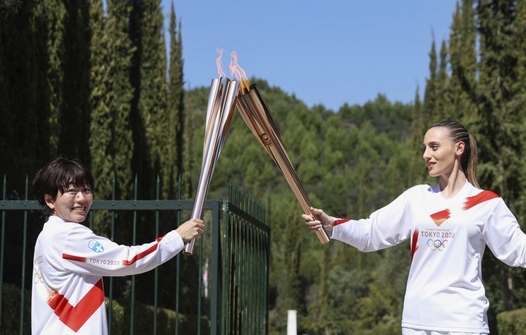
Athens Olympics women’s marathon gold medalist Mizuki Noguchi (L) receives the Tokyo Olympics flame from first runner Anna Korakaki, the 2016 Rio Games shooting gold medalist, in the torch relay in Olympia, Greece, on March 12, 2020.
Organizers had been seeking to shorten the torch relay schedule in order to reduce swelling costs caused by the games’ delay but abandoned the idea after receiving strong disapproval from local governments already banking on the event.
As a result, only reducing the size of the vehicle convoys, staff and pageantry of some of the events connected to the relay are under review as potential areas for cost cutting and streamlining the games.
The Olympic flame was lit earlier this year at the site of ancient Olympia in Greece and arrived in Japan four days before the games were postponed on March 24.
The flame has remained in the host country since and is currently on public display at the Japan Olympic Museum near the main stadium for the games in central Tokyo until Nov. 1.
1 This Month
Chernobyl: The Lost Tapes – A good documentary on Chernobyl on SBS available On Demand for the next 3 weeks– https://www.sbs.com.au/ondemand/tv-program/chernobyl-the-lost-tapes/2352741955560

of the week–London Campaign for Nuclear Disarmament

Tell the Ukrainian Government to Drop Prosecution of Peace Activist Yurii Sheliazhenko
To see nuclear-related stories in greater depth and intensity – go to https://nuclearinformation.wordpress.com
-
Archives
- April 2026 (152)
- March 2026 (251)
- February 2026 (268)
- January 2026 (308)
- December 2025 (358)
- November 2025 (359)
- October 2025 (376)
- September 2025 (257)
- August 2025 (319)
- July 2025 (230)
- June 2025 (348)
- May 2025 (261)
-
Categories
- 1
- 1 NUCLEAR ISSUES
- business and costs
- climate change
- culture and arts
- ENERGY
- environment
- health
- history
- indigenous issues
- Legal
- marketing of nuclear
- media
- opposition to nuclear
- PERSONAL STORIES
- politics
- politics international
- Religion and ethics
- safety
- secrets,lies and civil liberties
- spinbuster
- technology
- Uranium
- wastes
- weapons and war
- Women
- 2 WORLD
- ACTION
- AFRICA
- Atrocities
- AUSTRALIA
- Christina's notes
- Christina's themes
- culture and arts
- Events
- Fuk 2022
- Fuk 2023
- Fukushima 2017
- Fukushima 2018
- fukushima 2019
- Fukushima 2020
- Fukushima 2021
- general
- global warming
- Humour (God we need it)
- Nuclear
- RARE EARTHS
- Reference
- resources – print
- Resources -audiovicual
- Weekly Newsletter
- World
- World Nuclear
- YouTube
-
RSS
Entries RSS
Comments RSS
 nuclear-news