After the nuclear catastrophe began, Date City residents received glass badges that measured radioactivity. About four and a half years of measurements collected from these glass badges were used by Ryugo Hayano, Professor emeritus from the University of Tokyo and Makoto Miyazaki from Fukushima Medical University (FMU) to initially publish two studies in the Journal of Radiological Protection (JRP). Radiation policy makers in Japan often reference the second of these two studies, indicating they trust the data and conclusions it offers. However, earlier this year, Shin-ichi Kurokawa (Professor Emeritus of The High Energy Accelerator Research Organization) and Akemi Shima (resident of Date City) contended that this research and the studies using it, are compromised by serious ethical violations and scientific misconduct.
Date City officials requested the studies subsequent to their adoption of a 5 mSv annual radiation exposure limit, which represents a huge increase of radiation exposure to residents. Date City has also limited decontamination efforts in certain areas, and the former mayor Shoji Nishida, requested that the International Atomic Energy Agency proclaim 5 mSv per year safe, instead of the current 1mSv. More detailed information is coming to light as a new mayor of Date City has been elected.
Kurokawa first raised concerns about the second study in a peer-reviewed August 2018 letter sent to JRP. The JRP, a U.K. journal, has yet to publish Kurokawa’s critique, so he published it on a Cornell University website in December 2018. Kurokawa also published a timeline and further critique of Hayano’s response to the letter in Harbor Business Online in February 2019, original article in Japanese. This research has also been reported on Retraction Watch, a website that tracks published troubled papers, although there are more serious concerns than those RW highlights.
Hayano has admitted (English translation here) to a miscalculation that underestimated doses to Date City residents by three times. Hayano also admits to destruction of the data on which the studies were based, claiming this “deletion” was in accordance with research protocol of the study. But Kurokawa disputes that, pointing out that data destruction is a violation of Japan’s ethical guidelines on handling human data – guidelines that instruct researchers to keep the data as long as possible. This destruction of data, and failure to publish a promised third study, appear to conceal evidence that found very high internal doses of radioactivity in some residents of Date City.
The Date City glass badge experiment
The research used glass badge data from approximately 59,000 Date City residents. These badges, paid for and distributed by Date City, supposedly measured the external radioactivity that each individual was exposed to beginning about August 2011, approximately 5 months after the nuclear catastrophe began, until the summer of 2015. The mayor’s office of Date City provided both the glass badge data and data on internal exposures for individual residents.
According to research protocols agreed to with FMU, Miyazaki and Hayano planned to publish three studies based on these data. The first, comparing individual external doses to survey results of airborne radiation from the Government of Japan, was published in 2016. The second, a prediction of lifetime dose and an evaluation of the effect of decontamination on doses to individuals, was published in 2017. The third study, examining the relationship between external doses and internal doses, will not be published. Instead it has been replaced by a study on a different topic.
Where things went wrong
Bad glass badge data
Perhaps the experiment was doomed from the start as the Miyazaki-Hayano studies admit some residents of Date City may not have worn the glass badges on their bodies or actually lived at the address registered for the badge. Such improper badge use would immediately compromise any conclusions reached concerning individual doses, but the researchers used the data anyway.
Mishandling and destruction of data
In addition to questionable glass badge measurements, Kurokawa contends the Miyazaki-Hayano research suffers from mishandling and destruction of data that violates ethical guidelines:
Residents (research subjects) of Date City were not informed of the content of the research prior to the research commencing, and were not given opportunity to refuse use of their data. Miyazaki, being a municipal advisor on radiation to Date City as well as a study author, should have known how to handle this properly, yet he did not.
Miyazaki and Hayano failed to note that some residents had not consented to use of their data, a fact obvious in the data supplied to them by Date City. They further failed to obtain consent from those residents prior to use of their data.
Hayano presented data before the research protocol was submitted to, and approved by, an FMU Ethics review committee.
Residents were not told of the papers once they were published, nor were they told that the Mayor’s office of Date City had requested the papers be published. This presented a conflict of interest since the Date City Mayor’s office had an agenda (see slides 21 & 26) of encouraging residents to increase “resilience” while living in a contaminated environment. For residents, this means consuming contaminated food and restricting decontamination efforts per Date City’s new 5 mSv annual exposure limit. A few months after Date Mayor Shoji Nishida announced this “resiliency” policy, Miyazaki was hired as radiation advisor to the city.
Miyazaki and Hayano violated research protocol by replacing the third studyoriginally agreed to, with a study that said nothing about internal versus external doses.
At the conclusion of the research, all of the data were destroyed. According to records obtained by an information request filed by Shima, Kurokawa’s co-author of the Kagaku article, Hayano created an integrated database at the request of Date City, but did not share this database with the city. Therefore, when the database was destroyed, Miyazaki and Hayano knew that Date City could not replicate it or the data it contained.
Kurokawa points out that research conducted in Japan must follow the ethical guidelinesbased on the Declaration of Helsinki for proper protocols in handling medical and health research involving human subjects, such as valuing welfare of the research subjects over that of scientific results. FMU approved the Miyazaki-Hayano research papers under these protocols – protocols this research seriously violated by not allowing people to control use of their own data and by destroying the data after publication so that neither researchers nor the research subjects, can access it or replicate the studies.
Underestimation of dose
In addition to the mishandling of data, Kurokawa has discovered discrepancies in the values of cumulative doses in paper 2, which appear to underestimate actual doses. Hayano has, by his own admission, underestimated individual doses by three times. Professor Hayano says that he will issue a correction (corrigendum) for this dose underestimation, but has failed to completely answer the additional serious discrepancies, and the ethical violations of mishandling and destruction of data Kurokawa notes.
Why the “phantom” third study matters
The missing third study was supposed to investigate correlation between external and internal individual doses – a correlation Miyazaki and Hayano had already hypothesizedwould not exist. However, upon reviewing other data in Date City reports, the opposite was found: “[there was very] clear correlation between the external and internal doses…some cases with very high levels of internal exposure measurements.” Kurokawa offers his own hypothesis as to why Miyazaki and Hayano never published a paper on this third research question:
The true reason for not publishing Paper 3 could be the discovery of a clear correlation between the external and internal doses with some residents showing internal exposure measurements of several thousand Bq even since 2015. Not publishing inconvenient results despite receiving the internal exposure dose data from Date City would have to be considered a violation of the Ethical Guidelines. (emphasis added)
This correlation also reveals that Date City’s “resiliency” plan is not protecting its residents. Miyazaki and Hayano’s unwillingness to address internal dose evidence in the Date City data also calls into question Hayano’s other research on internal doses issues such as monitoring of food and whole body scans of children, the last publication of which appears to be in 2015.
Mistaken assumptions based on faulty studies
Japan’s Radiation Council (JRC) on setting standards for protecting people from radiation often references this ethically and scientifically compromised research in discussions, particularly the second paper, which was the focus of Kurokawa’s critical letter. Hayano’s work is often mentioned by other scientists and press as indication that doses from Fukushima radiation are low, that decontamination efforts paid for by Date City funds, might not have been necessary, and that living in an environment contaminated by “low” levels of man-made radiation is acceptable.
Where was the peer-review?
For its part JRP has now determined at this time that a correction for the dose underestimation is all that is needed, while an investigation into the consent issue is conducted. JRP claims to adhere to the Declaration of Helsinki for proper protocols in handling medical and health research involving human subjects. However, data misuse and destruction should require retraction of the papers, not correction.
Kurokawa contends that underestimating 70-year lifetime doses by three times is a severe enough miscalculation that a mere correction will not suffice, implying the conclusions of the papers are now in jeopardy. Hayano is claiming, falsely, that JRPwants a rewrite of the paper. Even if JRP did want a rewrite, it is unclear how Hayano intends to accomplish this since the Date City data on which the original papers were based have been destroyed. Kurokawa states:
There is no way to rewrite a paper when the research has already completed and all the data have been destroyed. Even if Date City were to re-supply the data to FMU, it would be considered new research and a new research proposal would have to be submitted to the Ethics Review Committee at FMU. A resulting paper would no longer be a revised version, but an entirely different paper based on new research. A scientist should never conceal such information, let alone pretend as if what was requested by JRP was a rewritten paper when it was a corrigendum that was actually requested. (emphasis in original English translation)
To date, neither Miyazaki nor Hayano have responded in the customary fashion, which would be to answer Kurokawa’s original letter criticizing their published research point-by-point. Kurokawa has published an analysis of Miyazaki-Hayano paper 1 in the March issue of Kagaku in Japanese, and will be publishing detailed analysis of paper 2 in April 2019.
Thanks to Yuri Hiranuma for input and review of this article and for the translations used to write it. See Yuri’s blog.
Under an envisaged feasibility study program, the Environment Ministry aims to use the soil for public works projects and examine its safety.
The ministry apparently hopes to reduce the amount of tainted soil to be transferred to a planned final disposal facility.
But Fukushima residents continue to have strong safety concerns about radiation eight years after the triple meltdown accident at Tokyo Electric Power Company Holdings Inc.’s <9501> Fukushima No. 1 nuclear power plant, damaged in the March 2011 earthquake and tsunami
This sounds like a good idea. But – can we really be confident about science done by Atomic Energy Agencies , whose brief is to further develop atomic energy?
OXFORD, England (Reuters) 8 Mar 19, – Eight years after the Fukushima nuclear meltdown in Japan, radioactive particles collected from the site are undergoing new forensic investigation in Britain in an effort to understand the exact sequence of events…….
The Japan Atomic Energy Agency (JAEA) is currently collaborating with British researchers to learn more about the state of the radioactive particles created by the meltdown.
Dr Yukihiko Satou from the JAEA oversaw the transportation of particles collected from within the restricted zone, very close to the disaster site, to Britain.
“The particles were fundamentally extracted from those attached to soil, dust and debris,” Satou told Reuters.
Encased in protective tape, the samples were brought to the Diamond Light Source, Britain’s national synchrotron, or cyclic particle accelerator, near Oxford.
Here electrons are accelerated to near light speeds until they emit light 10 billion times brighter than the sun, then directed into laboratories in ‘beamlines’ which allow scientists to study minute specimens in extreme detail.
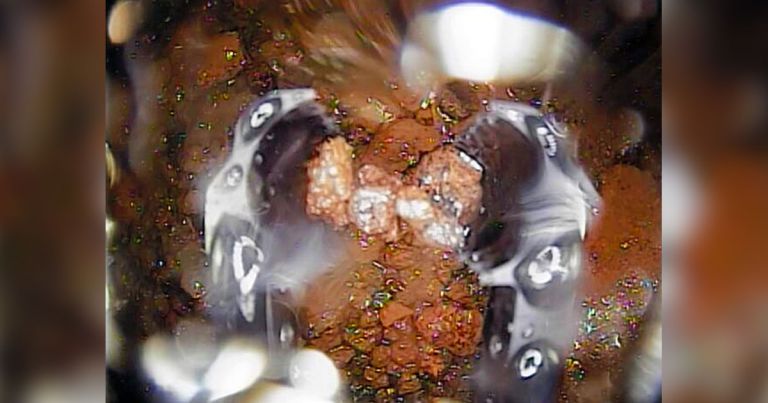
For Fukushima’s nuclear disaster, robots may be the only hope, The 2011 meltdown in Japan is still too hot for humans to handle. Send in the machines. CNet BY ROGER CHENG, MARCH 4, 2019 ………. I’m inside the cavernous top of the Unit 3 reactor in the Fukushima Daiichi Nuclear Power Plant. Yes, that Fukushima Daiichi, site of the world’s worst nuclear disaster.
Unit 3 was one of three reactors crippled on March 11, 2011, after a 9.0 earthquake struck 80 miles off the coast of Japan. (Units 4, 5 and 6 at Daiichi weren’t operating at the time.) The temblor shook so violently it shifted the Earth’s axis by nearly 4 inches and moved the coast of Japan by 8 feet. Eleven reactors at four nuclear power plants throughout the region were operating at the time. All shut down automatically. All reported no significant damage.
An hour later, the tsunami reached shore.
Two 50-foot-high waves barreled straight at Fukushima Daiichi, washing over coastal seawalls and disabling the diesel generators powering the plant’s seawater cooling systems. Temperatures inside the reactors skyrocketed to as high as 5,000 degrees Fahrenheit.
Fuel rods became molten puddles of uranium that chewed through the floors below, leaving a radioactive cocktail of fuel rods, concrete, steel and melted debris. Molten fuel ultimately sank into the three reactors’ primary containment vessels, designed to catch and secure contaminated material.
Next Monday marks the eighth anniversary of the earthquake. Since then, Japanese energy giant Tokyo Electric Power Company, or Tepco, has cleared enough of the rubble on the top floor of the Unit 3 building to allow for my 10-minute visit.
I gaze up at the massive barrel vault ceiling, trying to get a handle on the sheer scale of everything. Radiation levels are too high for me to linger. My quickening pace and breath are betrayed by rapid flapping noises coming from the purple filters on both sides of my respirator mask.
At the far end of the room, there’s an enormous orange platform known as a fuel-handling machine. It has four giant metal legs that taper down, giving the structure a sort of animalistic look. Thin steel cables suspend a chrome robot in the center of the frame. The robot, largely obscured by a pink plastic wrapper, is equipped with so-called manipulators that can cut rubble and grab fuel rods. The robot will eventually pull radioactive wreckage out of a 39-foot-deep pool in the center of the room.
It’s just one of the many robots Tepco is using to clean up the power plant. It’s why I came to Japan this past November — to see how robots are working in one of the most extreme situations imaginable.
The Japanese government estimates it will cost $75.7 billion and take 40 years to fully decommission and tear down the facility. The Japan Atomic Energy Agency even built a research center nearby to mock up conditions inside the power plant, allowing experts from around the country to try out new robot designs for clearing away the wreckage.
The hope is that the research facility — along with a drone-testing field an hour away — can clean up Daiichi and revitalize Fukushima Prefecture, once known for everything from seafood to sake. The effort will take so long that Tepco and government organizations are grooming the next generation of robotics experts to finish the job. …….
Two years ago, Tepco erected a dome over the Unit 3 reactor and fuel pool so that engineers could bring in heavy equipment and now, us.
Roughly 60 feet below me, radiation is being emitted at 1 sievert per hour. A single dose at that level is enough to cause radiation sickness such as nausea, vomiting and hemorrhaging. One dose of 5 sieverts an hour would kill about half of those exposed to it within a month, while exposure to 10 sieverts in an hour would be fatal within weeks.
Unit 3 is the least contaminated of the three destroyed reactors.
Radiation in Unit 1 has been measured at 4.1 to 9.7 sieverts per hour. And two years ago, a reading taken at the deepest level of Unit 2 was an “unimaginable” 530 sieverts, according to The Guardian. Readings elsewhere in Unit 2 are typically closer to 70 sieverts an hour, still making it the hottest of Daiichi’s hotspots.
The reactors’ hostile environments brought most of the early robots to their figurative knees: High gamma radiation levels scrambled the electrons within the semiconductors serving as the robots’ brains — ruling out machines that are too sophisticated. Autonomous robots would either shut down or get snared by misshapen obstacles in unexpected places.
The robots also had to be nimble enough to avoid disturbing the volatile melted fuel rods, essentially playing the world’s deadliest game of “Operation.” At least initially, they weren’t. “Fukushima was a humbling moment,” says Rian Whitton, an analyst at ABI Research. “It showed the limits of robot technologies.”………….. https://www.cnet.com/news/for-fukushimas-nuclear-disaster-robots-may-be-the-only-hope/
RA eyes seabed watch of caldera near Kagoshima nuclear plant, Asahi Shimbun, By CHIKAKO KAWAHARA/ Staff Writer March 3, 2019 The nightmare scenario of a volcanic crater erupting and spewing a pyroclastic flow that engulfs a nuclear plant, causing catastrophic levels of radiation to leak into the atmosphere, doesn’t appear on the horizon … just yet.But the nation’s nuclear watchdog is taking no chances. It plans to install seabed sensors to monitor potential crustal deformations on the Aira Caldera, located just 40 kilometers from the Sendai nuclear power plant in Kagoshima Prefecture.
Little is known of processes that lead to giant eruptions of calderas, or ground depressions formed by volcanic activity, due to a lack of observation data. Such eruptions are extremely rare and occurs every 10,000 years in Japan.
The Aira Caldera, in Kagoshima Bay, was the site of a giant eruption around 30,000 years ago.
The Nuclear Regulation Authority has so far relied on land-based seismic and other sensors to indirectly monitor magma activity and other changes beneath the seabed.
Starting in the new fiscal year from April, the NRA will set up seismic sensors and water-pressure gauges on the seafloor for additional monitoring……..
Huge calderas exist within a 160-km radius of other nuclear plants in Japan, including Kyushu Electric’s Genkai plant in Saga Prefecture, Shikoku Electric Power Co.’s Ikata plant in Ehime Prefecture and Hokkaido Electric Power Co.’s Tomari plant. The NRA intends to conduct studies in those areas, too………http://www.asahi.com/ajw/articles/AJ201903030001.html
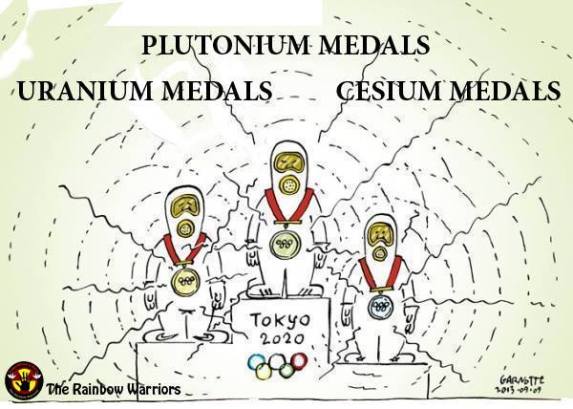
Atomic Balm Part 1: Prime Minister Abe Uses The Tokyo Olympics As Snake Oil Cure For The Fukushima Daiichi Nuclear Meltdowns March 01, 2019,Fairewinds Energy Education, By Arnie Gundersen “……….To determine whether or not Olympic athletes might be affected by fallout emanating from the disaster site, Dr. Marco Kaltofen and I were sponsored by Fairewinds Energy Education to look at Olympic venues during the fall of 2017.We took simple dirt and dust samples along the Olympic torch route as well as inside Fukushima’s Olympic stadium and as far away as Tokyo. When the Olympic torch route and Olympic stadium samples were tested, we found samples of dirt in Fukushima’s Olympic Baseball Stadium that were highly radioactive, registering 6,000 Bq/kg of Cesium, which is 3,000 times more radioactive than dirt in the US. We also found that simple parking lot radiation levels were 50-times higher there than here in the US.
With the upcoming XXXII Olympiad in 2020 hosted by Japan, it is necessary to look into the radioactivity of Olympic venues as well as tourist attractions in the host cities… Since thousands of athletes and millions of visitors are travelling to Japan for the Olympics, there has been widespread concern from the international community about radiation exposure. Therefore, it is important to investigate the extent of radioactive fallout from the Fukushima Dai-ichi incident.
The measured results showed a much higher activity of Cesium-137 in the proposed torch route compared to other areas. Overall, the further away from the Fukushima Dai-ichi Nuclear Power Plant, the lower the radioactivity. The activity of Cesium-137 in Tokyo, the furthest site from the plant, was the lowest when compared to the other sites. Therefore, the activity of Cesium-137 in Tokyo sample was used as the baseline to qualitatively estimate the human exposure to radiation.
At the Azuma Sports Park, the soil and dust samples yielded a range of 78.1 Bq/kg to 6176.0 Bq/kg. This particular Olympic venue is around 90 km from the Nuclear Power Plant. The other sites that are closer to the Nuclear Power Plant like the tourist route, proposed torch route, and non-Olympic samples have higher amounts due to the close proximity to ground zero of the disaster.
… the proposed torch route samples had the highest mean radioactivity due to their close proximity to the plant. Based on the measurement, we estimated qualitatively that the radiation exposure of people living near the Azuma Sports Park area was 20.7 times higher than that of people living in Tokyo. The main tourist and proposed torch routes had radiation exposure of 24.6 and 60.6 times higher, respectively, than in Tokyo…. Olympic officials should consider using the results of this project to decide whether the radioactivity level at the proposed torch route and the Olympic venues are within acceptable level…… https://www.fairewinds.org/demystify/atomic-balm-part-1-prime-minister-abe-uses-the-tokyo-olympics-as-snake-oil-cure-for-the-fukushima-daiichi-nuclear-meltdowns
03/01/2019 | Sonal Patel After the Great Tohoku Earthquake and tsunami, and ensuing crisis at the Fukushima Daiichi nuclear plant in March 2011, Japan issued stringent safety regulations and reviews that affected its entire 50-reactor fleet. It meant that as each Japanese nuclear reactor entered its scheduled maintenance and refueling outage, it could not returned to operation until restart was approved by both Japan’s Nuclear Regulation Authority (NRA) and the central government. Nuclear operators also need consent from governments of local prefectures.
Between September 2013—when Ohi 3 and 4 were shut down—and August 2015, when Sendai 1 and 2 restarted, Japan’s entire reactor fleet went black. In 2013, though there was no consensus on how long the approval process could take, some industry observers forecast reactors under NRA review could be back online within a year. As of December 2018, only nine reactors had restarted. Sixteen others were under review by the NRA, where average review duration stretched beyond 1,000 days, owing to staffing issues. Japan’s fleet of operable reactors, meanwhile, has dwindled to 38, owing to announced retirements.
According to Japan’s Institute of Energy Economics, safety investment costs for the current fleet were estimated at 4.4 trillion yen ($39 billion today) as of April 2018. “Given that detailed designs are still left undecided for severe accident management facilities at some plants, the estimated costs may increase further as safety examinations make progress.”
As we prepare for the eighth remembrance of the March 11, 2011 earthquake, tsunami and triple meltdowns at Fukushima Daiichi, Fairewinds is ever mindful of what is currently happening in Japan.
There has never been a roadmap for Japan to extricate itself from the radioactive multi-headed serpentine Hydra curse that has been created in an underfunded, unsuccessful attempt to clean-up the ongoing spread of migrating radioactivity from Fukushima. Rather than focus its attention on mitigating the radioactive exposure to Japan’s civilians, the government of Japan has sought instead to redirect world attention to the 2020 Olympics scheduled to take place in Tokyo.
Truthfully, a situation as overwhelming as Fukushima can exist in every location in the world that uses nuclear power to produce electricity. The triple meltdowns at Fukushima Daiichiare the worst industrial catastrophe that humankind has ever created.
Prior to Fukushima, the atomic power industry never envisioned a disaster of this magnitude anywhere in the world. Worldwide, the proponents and operators of nuclear power plants still are not taking adequate steps to protect against disasters of the magnitude of Fukushima!……….
……Are the Japanese government and the IAEA protecting the nuclear industry and not the people of Japan by claiming that Fukushima is stable when it is not? Fairewinds’ chief engineer Arnie Gundersen outlines major inconsistencies and double-speak by the IAEA, Japanese Government, and TEPCO claiming that the Fukushima accident is over. Dynamic versus static equilibrium, escalated dose exposures to the Japanese children and nuclear workers, and the blending of radioactive materials with non-contaminated material and spreading this contaminated ash throughout Japan are only a small part of this ongoing nuclear tragedy.
Members of the JOC executive board are up for re-election this summer. There is speculation Takeda…[ Japanese Olympic Committee President Tsunekazu Takeda, who is being investigated for his part in an alleged bribery scandal] will not run, or could be replaced. French investigators believe he may have helped Tokyo win the 2020 Olympics in a vote by the International Olympic Committee.
Takeda has been JOC president since 2001. He is also a powerful IOC member and the head of its marketing commission. He has not stepped aside from either position while the IOC’s ethics committee investigates.
…French authorities suspect that about $2 million paid by the Tokyo bid committee — headed by Takeda — to a Singapore consulting company, Black Tidings, found its way to some IOC members in 2013 when Tokyo won the vote over bids from Istanbul and Madrid… Takeda last month acknowledged he signed off on the payments but denied corruption allegations. An internal report in 2016 by the Japanese Olympic Committee essentially cleared Takeda of wrongdoing.
Tokyo is spending at least $20 billion to organize the Olympics. Games costs are difficult to track, but the city of Tokyo appears to be picking up at least half the bill.
Much of Japan’s focus has been to show that the Fukushima area is safe and has recovered from a 2011 earthquake, tsunami, and the meltdowns at three nuclear reactors.
I think hosting the Olympics in 2020 is an attempt by the Japanese to change the topic. I don’t think people around the world are going to care until 2020 approaches. There is a seven-year window for the Japanese government to work to make Tokyo a showcase for the entire world to view. I think the Japanese government wanted to host the Olympics to improve the morale of the people of Japan after the Fukushima Daiichi accident. Unfortunately, it’s taking people’s attention off of the true cost of the accident, in terms of both money and public health.
Placing the Olympics in Tokyo was and still is a ploy to minimize the consequences of the Fukushima Daiichi meltdowns and to take the public’s attention away from a pressing emergency that still needs resolution for the health and safety of the people of Japan.
Televisions at an electronics store in Tokyo display a news broadcast about a North Korean missile launch in November 2017.
Feb 25, 2019
In a commentary published Saturday in the Rodong Sinmun, the official newspaper of the North’s ruling party criticized what it claimed were “voices for the revision of the constitution and increased military spending and nuclear weaponization” from within the administration of Prime Minister Shinzo Abe.
Japan, the only country to have endured a nuclear attack, has long maintained that it adheres to its three nonnuclear principles of not possessing, not producing and not permitting the introduction of nuclear weapons. However, the government admitted in 2010 that previous administrations had lied to the public for decades about atomic weapons, after a government-appointed panel confirmed the existence of secret Cold War-era agreements allowing the U.S. to bring them into the country.
Japan has ramped up military spending and the acquisition of sophisticated weapons in recent years, spending around 1 percent of its gross domestic product on the Self-Defense Forces — which, given the size of its economy, makes it one of the world’s biggest military spenders.
Experts say Japan, with its civilian nuclear program, fissile materials and existing weaponization technology, could probably develop a small arsenal of nuclear devices within a year if there was motivation to do so.
Date goes whole hog into boar leather business in Fukushima
[Translated by the Japan Times]Wild boar leather is said to breathe well and resist chafing. It is used in Date, Fukushima Prefecture, to make products like babies’ first walking shoes because it is soft and fits well.
The wild boar are captured by local hunters, and their skin goes through radiation testing before and after tanning to confirm safety.
The corporation initially wanted to sell the meat, but they had to give up on the idea because eating wild boar caught in the area was banned after the 2011 core meltdowns at the Fukushima No. 1 power plant.
They came up with the idea of developing leather products after learning about a company in Tokyo’s Sumida Ward that tans wild animal hides. After repeated talks with representatives from the local tourism industry, the corporation began selling leather products in April 2015. It currently employs seven staffers and 16 artisans for the project.
As the government continues to ban shipments of wild animal meat from the region due to radiation concerns, the boar population is growing and causing serious crop damage. Over 1,800 of them have been captured in the city in the six years since the meltdowns.
Teaching about radiation after Fukushima, Bulletin of the Atomic Scientists, By Maxime Polleri, February 26, 2019 ……..In the aftermath of the Fukushima meltdowns, which triggered a released of radioactive pollutants, the Japanese state initially decided to increase the mandatory evacuation trigger from 1 millisievert of radiation exposure per year to 20 millisieverts per year. In other words, the public was forced to accept a new threshold of safety. While this policy caused much scientific and public controversy, 20 millisieverts per year remains the benchmark for what is considered safe in Fukushima. Places like the Centre for Environmental Creation downplay the controversy of a raised threshold of exposure.
Situated in the town of Miharu and opened in July 2016, the center was established by the prefecture of Fukushima, with the financial support of the Japanese government, to conduct research and provide education on radioactive contamination. The center is one of several government-sponsored revitalization projects aimed at rebuilding the trust of people living in Fukushima. Mostly visited by young families, it represents a new approach to risk communication. As a technical advisor explained to me, this approach aims to “deepen the understanding of children about radiation” by allowing visitors to experience information firsthand through interactive games, fun activities, and cute presentations.
Our Friend the Atom (Tomorrow Land) – Walt Disney Treasures
Past efforts to present nuclear science in appealing ways have often blended education with propaganda. The 1957 Disney TV episode Our Friend the Atomis a perfect example of this. What are the dangers of resorting to such forms of explanations in the aftermath of a nuclear disaster? In 2015 and 2017, I spent a total of 14 months in Japan examining the public’s interactive experience at state-sponsored centers and public activities that explain radiation. I found that while the information on radiation is easy to understand, many aspects of its hazards are carefully concealed. In particular, the government’s educational approach shifts the post-Fukushima Japanese public’s attention away from manmade danger and toward a vision of naturalness, technological amusement, and scientific amazement. In doing so, this approach downplays the risk inherent to residual radioactivity in Fukushima.
The naturalness of radiation. One way to neutralize the perceived harmfulness of radiation is to make the phenomenon appear as natural as possible, by emphasizing the radioactivity coming from natural sources. At the Centre for Environmental Creation, one of the most popular attractions is an enormous spherical theater, where visitors are bombarded with sounds and images in a 360-degree multisensory experience that describes radiation as a natural part of daily life. “It can be found everywhere! From the sun’s ray to the mineral in the earth,” claims the theater’s narrator. “Without radiation, no life would exist on Earth!” After these explanations, an enormous Boeing passes above theatergoers’ heads in the cinematic sky, and the amount of radiation exposure received during an intercontinental flight is said to be higher than the level of radiation found in Fukushima. Their necks strained upward, visitors mumble words of apparent relief.
What the theater fails to explain, however, is that there is nothing natural about the radioactive isotopes released during the Fukushima nuclear disaster, and that background radiation has little to do with the hazards of breathing or swallowing fission products—which are not rays, but dust-like particles. For instance, strontium 90, if inhaled or ingested, mimics calcium to enter an individual’s bone marrow and cause lifelong radiation exposure. This exposure can cause mutations in living cells—a permanent alteration that can lead to cancers, genetic problems, or immune disorders.
It’s all fun and games. Information about radiation is often promoted through an enjoyable experience that conceals disturbing aspects of the phenomenon. In front of a giant interactive screen, for example, children can move their bodies to “block” radiation. By selecting the proper material, they can block either radioactive alpha particles, beta particles, or gamma rays. They pretend that their bodies are thick metal plates used to hamper harmful external exposure. By doing so, they collect points, and at the end of the game, the child with the highest score wins.
By transforming radiation protection into a game that focuses on blocking external radiation, children do not learn of the risk of internal contamination from radioactive particles such as cesium 137, which was released in significant amounts by the Fukushima disaster. If internalized, cesium 137 gets distributed throughout the body, irradiating soft tissues such as muscles and ovaries. And because the children’s game blocks radiation in “real time,” there is no mention of any delayed health effects of radiation exposure, such as potential harmful genetic changes.
At the Decontamination Info Plaza, the government promotes similar activities. Situated in the city of Fukushima, the Plaza was established in January 2012 as a joint program between the prefecture of Fukushima and Japan’s Ministry of the Environment. The Plaza’s purpose is to provide information about radiation in general, as well as explanations about monitoring methods, workshops on decontamination, and advice on contaminated sites. Basic information about radiation is presented to the public in a very accessible, visual, and interactive form…….
Radiation is our friend! A third way to downplay the perception of radiation danger is to link radiation with the wonders of science and technology. This was particularly apparent during an April 2016 open house organized by the National Institute of Radiological Sciences, Japan’s leading radiological institute, which is situated in Chiba, east of Tokyo. Titled “I Want to Know More! What Can You Do with Radiation?” the public fair was a popular event at which visitors could see the institute’s research facilities, the latest PET scan technology for medical imaging, and the cyclotrons used in nuclear medicine to produce radioisotopes. A special elevator led down to the Heavy Ion Medical Accelerator, situated in an impressive subterranean facility.
……..At this institute, manmade radiation was effectively linked to technologies that sustain life. For instance, the open house showed how the radiation-related devices at the institute produce particle therapies to treat cancer.
While there was nothing inaccurate about the center’s explanations of radiation as a medical treatment, the information presented was unrelated to the dangers faced during a nuclear disaster. If visitors wanted to hear more about such risks, they had to visit the station called “Impact of Fukushima.” The small station was, however, much less appealing than the other venues. It consisted of four small posters that focused on the decontamination process without explaining the adverse health effects of exposure to manmade radioisotopes.
… Radiation was emphasized as a useful agent that could penetrate the body and kill harmful tumors, as was demonstrated on medical dummies during the event. In the end, by heavily framing radiation information around a beacon of technological wonder, the public opening day glossed over the danger of radioactive contamination and selectively amplified the beneficial aspects of radiation.
Education vs. propaganda. In interviews that I conducted with officials and technical advisors employed at the aforementioned places, I was told that Fukushima is afflicted by “harmful rumors” surrounding the real extent of radiation harm and that this misunderstanding stems from public ignorance of radiological science. It is in this context that government-sanctioned approaches aim to provide “basic information” that will help citizens fear radiation in an “appropriate way,” thereby creating an environment in which people feel they can safely return to Fukushima. While this is a worthy endeavor, the government’s approach emphasizes specific understandings of radioactivity that overshadow the particular risks introduced by manmade radioactive pollutants resulting from a nuclear accident……….. https://thebulletin.org/2019/02/teaching-about-radiation-after-fukushima/
Fierce opposition to recycling radioactive soil from Fukushima http://www.asahi.com/ajw/articles/AJ201902260058.html, THE ASAHI SHIMBUN, February 26, 2019 How to dispose of mountains of soil contaminated by radiation from the 2011 Fukushima nuclear disaster poses a massive headache for the central government.
Officials had long insisted that contaminated surface soil removed after the triple meltdown at the Fukushima No. 1 nuclear power plant would eventually be stored outside of Fukushima Prefecture.
According to one estimate, the total volume of such soil will reach 14 million cubic meters by fiscal 2021. Local entities outside of Fukushima are understandably hesitant about serving as host to such vast quantities of possibly hazardous dirt.
Officials in Tokyo are now hoping to sway local governments to act as hosts by proposing reuse of the contaminated soil for public works projects under certain conditions.
One requirement would be that soil radiation levels below 8,000 becquerels per kilogram, the standard used by the government in classifying whether the waste material requires special treatment, could be used for various construction projects.
This poses a dilemma for Fukushima Prefecture, which fears local residents will be stuck with the problem despite repeated pledges by the government to move all contaminated soil from the prefecture.
Work got under way four years ago to move contaminated soil to intermediate storage facilities in Fukushima Prefecture. As of Feb. 19, the volume of soil transported to those facilities totaled 2.35 million cubic meters.
Initially, the government set a target date of March 2045 for moving all of the contaminated soil outside of Fukushima to a permanent storage facility.
However, discussions have yet to begin on where to build the structure.
Koji Yamada, an Environment Ministry official who has been involved in the issue, conceded it will not be easy to find a candidate municipality for the facility.
“We are now at the stage of trying to obtain understanding from a national perspective,” he said.
Ministry officials say that reusing contaminated soil to reduce the volume that eventually will have to be moved to the final storage facility could win favor from some municipalities.
A panel of experts set up by the Environment Ministry agreed in June 2016 that moving the entire volume of contaminated soil to a final storage facility is unrealistic.
The panel suggested that reducing the volume of contaminated soil by reusing portions deemed safe under radiation standards now in place seemed to offer the best option in finding a candidate site for the final storage facility.
It also proposed ways in which the soil could be reused; for example, in public works projects where the commissioning authority was clearly a responsible body.
The panel also proposed using the soil for the foundations of roads and embankments. It said sufficient quantities were available to ensure stable maintenance over many years.
When the panel met again last December, the members were briefed on the best-case scenario for the development of technology to reduce radiation levels in the soil. The most optimistic forecast was that as much as 99 percent of the debris could eventually be reused.
Under that scenario, only 30,000 cubic meters, or about 0.2 percent of the total volume, would have to be moved to the final storage facility to be buried there.
While Environment Ministry officials say that reusable treated soil would be considered for locations both within and outside Fukushima Prefecture, the only specific proposals made to date have been limited to three municipalities in Fukushima.
Local residents in two of those municipalities, one of which is Nihonmatsu, have mounted petition drives and other activities to block the reuse of contaminated soil in their areas. They contend that allowing such plans to go ahead would be at odds with government promises to store the soil outside of the prefecture.
The fact remains that the bulk of the contaminated soil is stored in Fukushima Prefecture. However, seven other prefectures also have a combined 330,000 cubic meters stored at various locations, such as parks and farmland.
Since August 2018, the Environment Ministry has been trying to determine whether using contaminated soil for land reclamation projects would prove detrimental to the health of local residents.
It has conducted field trials in Nasu, Tochigi Prefecture, and on the grounds of a facility operated by the Japan Atomic Energy Agency in Tokai, Ibaraki Prefecture.
But Nasu resident Masato Tashiro, who has been following the issue, was highly critical of the six-month period authorized to confirm the safety of such soil.
“That is way too short to make such a judgment, considering the fact the soil will be buried for such a long time,” Tashiro said. “Residents fear their health may be impaired over the long-term.”
(This article was written by Teru Okumura and Shintaro Egawa.)
The heads of 21 local governments in Fukushima, Iwate and Miyagi prefectures said in the survey that the “reconstruction Olympics” theme has yet to fully catch on among the public.
Asked whether the slogan has gained public attention, two mayors said “it has not” while 19 mayors said “it mostly has not.” Eighteen said “it has a little” and two said “it has.” The remaining municipality — the Fukushima city of Soma — did not answer.
“The phrase ‘reconstruction Olympics’ was thought up but no substantial progress has been made and the affected areas feel left behind,” said an official of the town of Minamisanriku in Miyagi Prefecture. “We have limited manpower and cannot spare personnel for Olympic events.”
“The sporting event will be held under the banner of the ‘reconstruction Olympics’ but venues are centered on Tokyo,” said an official of Otsuchi, Iwate Prefecture.
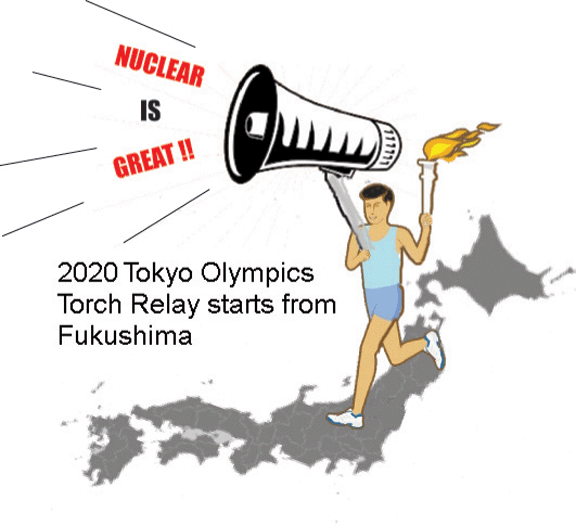
The Tokyo Organising Committee has promoted projects involving the disaster-stricken areas, such as holding baseball and softball games in Fukushima and starting the Japan leg of the Olympic torch relay in the prefecture, which was hit by a nuclear crisis in the wake of the earthquake and subsequent tsunami.
Before the relay, the flame will be displayed in the three northeastern prefectures. The Fukushima city of Iwaki expressed appreciation over the move to highlight the recovery of the affected areas in the Summer Olympics. “Fukushima will be hosting some games and the torch relay will start here. We have been given certain roles to play,” a city official said.
Asked what they expect from the Tokyo Games in a multiple-choice question, the biggest group, of 36 mayors, picked “promoting our progress toward recovery,” while 20 mayors, mainly from Fukushima, chose “overcoming reputational damage.”
“We want to use the Olympics as a chance to regain sales channels for our farm products,” said an official of the Fukushima town of Namie.
Hisashi Sanada, a professor of the anthropology of sport and Olympic history at the University of Tsukuba, said efforts by the central government and the organizing committee to promote reconstruction through the sporting event were “not enough.”
“The state needs to explain in detail to municipalities what kind of support it can offer, and the local governments should also rack their brains about how to link (the Olympics) to regional development,” Sanada said.
Japan earthquake risk: MAGNITUDE 8 earthquake predicted to strike RING OF FIRE near Japan
A MAGNITUDE 8 or 7 earthquake will likely hit Japan along the so-called Ring of Fire in the next 30 years, Japanese geologists have warned. By SEBASTIAN KETTLEY, Express UK , Wed, Feb 27, 2019 A Japanese Government panel said on Tuesday, February 26, the risk of a major earthquake in the near future is high. A magnitude 7 or 8 quake is expected to strike the Japan Trench just off the northeast coast of Japan. The oceanic trench forms part of the Pacific Ring of Fire – a hotspot of volcanic activity and earthquakes along the basin of the Pacific Ocean. Japan’s Earthquake Research Committee said there is at least a 50 percent chance of magnitude 7 to 7.5 earthquake in the Fukushima Prefecture……..
Chances of another earthquake in the region are now up by 10 percent on the last Earthquake forecast released in March 2011. ……
What is the Ring of Fire?The Ring of Fire is a major hotbed of seismic and volcanic activity stretching along the horseshoe-like basin of the Pacific Ocean.
Approximately 90 percent of the world’s earthquakes strike along the Ring of Fire.
And about 75 percent of the world’s active and dormant volcanoes are found in this part of the world.
Disney Educational Video Our Friend, the Atom (1957)
Teaching about radiation after Fukushima, Bulletin of the Atomic Scientists, By Maxime Polleri, February 26, 2019“…………..Ultimately, I have doubts about these education programs – [ Centre for Environmental Creation, Japan] . They are selective in their nature, making only certain aspects of radiation tangible through their public activities, while rarely explaining in detail the dangers of adverse health effects linked with residual radioactivity. From my viewpoint, their purpose seems to be dual: While they aim to shed light on the phenomenon of radiation, they are also covertly looking to defuse the threat of widespread societal unrest, to reclaim political control and economic stability, and to pacify a fearful public—and in ways that are perhaps more beneficial to the state than to affected individuals.
In a community where dangerous residual radioactivity has become a public everyday concern, coming to grips with serious contamination requires more education than ever before. The important word here is education. Not state propaganda disguised as education. There is a fine line between these two, but it is a line that needs to be clearly drawn. While Japanese state approaches are innovative in their interactivity and freedom from jargon, they are less so in their content.
I strongly agree that the existence of state-sponsored educational programs is better than to simply ignore radioactive risk. But mobilizing specific explanations that downplay the real risk faced by citizens is not sustainable. Doing so will reproduce the ignorance, secrecy, and values that led to this disaster. Public well-being, democracy, and science cannot thrive in such context. An unbiased effort to educate people about the specific hazards of radioactive contamination, and correct misunderstandings about the risk of radiation exposure, does not have to be delivered in a dry and clinical manner. It can be as fun and engaging as anything the Japanese centers, exhibits, and public days are already doing.
There is one scene from my time in Japan that I cannot forget: the unadulterated smile of the happy child who had won the contest of blocking radiation. While the kid had learned much about radiation, he had learned little about the complexity of radiation hazards. I could not help thinking of Major Kong straddling the bomb in the film Dr. Strangelove, enjoying the nuclear ride without thinking about it too much, shouting “Yee Haw!” at the top of his lungs. https://thebulletin.org/2019/02/teaching-about-radiation-after-fukushima/







 nuclear-news