Continuing danger and ever escalating costs at the Chernobyl and Fukushima cleanups
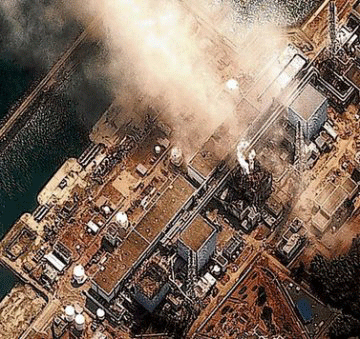 It will be especially dangerous to remove the remaining nuclear fuel because of the high levels of radiation that such substances emit.
conditions [at the Chernobyl plant] are still dangerous for the 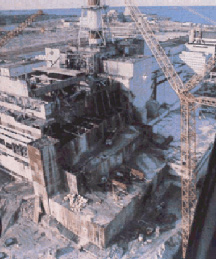 3,500 workers now cleaning up the site. And some 200 tons of nuclear fuel still remain at the bottom of the reactor.
When reactors die, costs keep climbing. Fukushima Diiachi costs to go through the roof.http://nuclearhistory.wordpress.com/2012/09/03/when-reactors-die-costs-keep-climbing-fukushima-diiachi-costs-to-go-through-the-roof/ 4 Sept 12
http://e.nikkei.com/e/fr/tnks/Nni20120815D15HH187.htm Decommissioning Of Fukushima To Be Long, Costly Process FUKUSHIMA (Nikkei)–-The government and Tokyo Electric Power Co. (9501) have made the first revisions to a plan to decommission the crippled Fukushima Daiichi nuclear power plant, but the details remain uncertain.
At the Chernobyl plant, efforts are now in full swing to build a massive shelter to stop the site from releasing radiation into the environment.
Among other matters, the revisions involve adding measures to prevent radioactive water from leaking into the environment. But it is still unclear how much time and money this will actually entail. Continue reading
Cesium 134 and 137 in baby food made in Tolyo
 Cesium from baby food made in Tokyo and Aichi Fukushima Diary by Mochizuki on September 3rd, 2012 · Radiation is starting to be measured from baby food. We are having less and less to feed our babies.
According to the radiation measurement of Yokohama city government, cesium 134/137 are measured from baby food.
The producers are in Tokyo and Aichi. Aichi is the central Japan, 446km from Fukushima plant.
Sample 1
Purchasing date : 8/13/2012
Location : Aichi
Cs-134 : 1.59 Bq/Kg
Cs-137 : 1.83 Bq/Kg
Total : 3.4 Bq/Kg
Sample 2
Purchasing date : 8/27/2012
Location : Tokyo
Cs-134 : ND Bq/Kg
Cs-137 : 1.42 Bq/Kg
Total : 1.4 Bq/Kg
Chernobyl’s children better protected than Fukushima’s: Japan’s health catastrophe
Although thyroid cancer is highly treatable and is operable, this level of exposure for Fukushima’s children is nothing short of catastrophic. There is a scientific consensus that at least 4,000 excess cancer deaths occurred in the wake of Chernobyl’ (a consensus, by the way, not shared by the nuclear industry–surprise!), but careful epidemiologicalstudies sponsored by the Union of Concerned Scientists estimate as many as 25,000 excess cancer deaths.
the health threat of Fukushima, even with these shocking thyroid results known, is being systematically underplayed in the business press.
 The thing is, there has been a consistent downplaying the likely health effects of the Fukushima accident and an over-hyping of nuclear power’s “green” energy profile
FUKUSHIMA–WORSE THAN CHERNOBYL’ FOR KIDS The Paltry Sapien, by Matthew Payne July 21, 2012 The shocking results of the latest epidemiological studies are in from Fukushima and they are not good. As summarized by Michael Kelly at Business Insider, the report indicates:
Of more than 38,000 children tested from the Fukushima Prefecture in Japan, 36 percent have abnormal growths – cysts or nodules – on their thyroids a year after the Fukushima nuclear disaster, as reported by ENENews.
This is startling. The Chernobyl meltdown threw much more atmospheric contamination out but has had a much slower progression in poisoning its local children–only about 1.74 percent of tested children in the test area around Chernobyl’ had thyroid nodules five to ten years after the nuclear catastrophe! How to explain this much higher virulence of radiation contamination in Japan? Well, first, they received a very high dose of radiation–mostly radioactive iodine isotopes. This was to be expected given prevailing wind patterns and the reason why the US NRC advised American nationals to evacuate to a distance of 50 miles, not the 20 to 30kilometers implemented by the Japanese government. That zone was not based on the clear computing modeling available to the Japanese government and it is hard to come to any other conclusion than that the government balked at evacuating the major city of Fukushima in the wake of the tsunami’s chaos. Frankly, even an evacuation zone of fifty miles was inadequate–ENENews has uncovered three children (4, 7, and 10) from one family with pre-cancerous cysts on their thyroids sixty miles from Fukushima Daiichi. Continue reading
Drop in water levels in Fukushima reactors coolant injections
 Tepco: “Unknown whether the flow will recover” — No conclusive evidence of why reactors had sudden drop in water injections August 31st, 2012 By ENENews Follow-up to: Trouble injecting water into Fukushima Reactors 1-3 — Flow falls despite increasing coolant level — Tepco unable to identify cause, thinks pipes are clogged
August 31, 2012 report by Kyodo News translated by EXSKF:
After the amount of water being injected into Reactors 1, 2, and 3′s Reactor Pressure Vessels at Fukushima I Nuclear Power Plant had temporarily dropped below the level specified in the safety regulations, TEPCO announced on August 31 that the company flushed the pipes […] TEPCO will wait and see if the amount of water injected into the RPVs recovers before deciding whether the second flushing is necessary.
[…]
According to TEPCO’s Junichi Matsumoto, “There is no conclusive evidence to narrow down the possible causes, and it is unknown whether the flow will recover.”
Every minute of every day – radiation exposure to Fukushima’s children
He didn’t answer my question about the fuel rods melted out did he?”
No he did not answer that question. ( The molten fuel is still molten, and large amounts of it has leaked through the holes in the base of the pressure vessles. As of September 2011, TEPCO still cannot accurately measure the amount of water in the reactors, the levels have been recently found to be very low and the water keeps leaking from the holes in the bottom of the damaged reactor pressure vessels.
 On completion of “Step 2″ in their road map, the government scrapped the 20km exclusion zone, “welcoming back” women and children.
…most will come back because the government is making false promises. They have no where else to go
“Our government is still telling us that there is no immediate effect on health. Also it is telling us that it will be safe to come back and live in Fukushima within one or two years after the clean up work is done. Children in Fukushima are the most victimized by these government lies. Children in Fukushima are being exposed to radiation everyday and every minute of the day. Only 10% of 300,000 children living in Fukushima Prefecture have evacuated. “
Evacuate Fukushima 福島の子供を守れ Part 07 – DAYS OF INFAMY http://nuclearhistory.wordpress.com/2012/09/03/evacuate-fukushima-%E7%A6%8F%E5%B3%B6%E3%81%AE%E5%AD%90%E4%BE%9B%E3%82%92%E5%AE%88%E3%82%8C-part-07-days-of-infamy/
The Japanese government decides to return all evacuees within 20 km of Fukushima Diiachi …going deeper into the history books 30 September 2011 will also mention this Day of Infamy. When an entire nation abandoned its children at the hands of a Nuclear Mafia that purchased the souls of the very young ones that were supposed to protect them. Continue reading
Corruption in Japan’s The Nuclear and Industrial Safety Agency
 NISA is not effectively fulfilling its obligations related to nuclear safety, and was influencing the public perception of nuclear energy since its birth. NISA is governed by the Japanese ministry in charge of promoting the nuclear power industry, how could the agency be fully committed to ensuring that nuclear power plants were operating safely? No one can wholly serve conflicting interests, and will either choose to emphasize some, and mitigate the others. At some point the desire to increase market saturation or investment becomes an all-important driver of regulations, and the individual end-consumers become far less important to regulatory affairs.
In Japan, “The Atomic Village” has been likened to a cult, where the industry and its regulators are focused on a singular purpose of expanding the nuclear industry
Changing the rules – It’s not just regulatory capture, it’s a whole new game Enformable 30 Aug 12, NISA plans to ok operations at nuclear power plants built above faults Despite its conflict of interest, lack of public trust, and pending abolishment, the Nuclear and Industrial Safety Agency has released plans to accept new nuclear safety rules that OK operations even at nuclear power plants even if active earthquake faults are discovered beneath their structures, reversing its current mandate that reactors must not be built above faults.
NISA has announced new plans to classify faults under nuclear reactors into three types: active faults that could trigger quakes, auxiliary faults that are structurally connected to active faults, and faults deemed weaker than the other two. These last-minute efforts to set new seismic safety criteria have drawn criticism from experts, who suspect it is willfully creating loopholes to ensure the continued operations of nuclear plants.
Mitsuhisa Watanabe, a professor of geomorphology at Toyo University, said it would be hard to distinguish auxiliary faults from rifts with weaker power and both types could cause displacements. “The agency appears to be contemplating how to avoid the decommissioning of reactors just before its disbandment,” he said. Continue reading
Japan likely to go for zero nuclear power, and terminate nuclear reprocessing
Other options under consideration include termination of the commercialization program for “fast-breeder” reactors and of research on the experimental Monju prototype in Tsuruga, Fukui Prefecture. As for the all-important nuclear fuel cycle, the government is actually discussing scaling down its reprocessing and recycling pursuits.
Zero option for nuclear power may be added to revamped energy plan http://www.japantimes.co.jp/text/nn20120903a3.html Jiji Eliminating dependence on nuclear power is expected to be part of the government’s revamped energy policy, officials say.
Prime Minister Yoshihiko Noda will reveal the new policy to his ministers after making a formal decision this month, government officials said Saturday. According to the officials, the government will make the 15 percent option its interim target for nuclear power dependence in 2030 before completely eliminating it from electricity generation at an unspecified date. Continue reading
Japanese online summary tampers with radiation report
 The significance of this difference of expression relates to the fact that dose ranges below 0.20 Gy (200 mSv) are being ignored.
Radiation Effects Research Foundation (RERF) “alters” a Japanese summary of their research paper http://fukushimavoice-eng.blogspot.com.au/2012/08/radiation-effects-research-foundation.html
Japan’s nuclear industry in the grip of the criminal yakuza

 The Nuclear Mafia Derails Democracy in Japan Dissident Voice, by Richard Wilcox / August 31st, 2012
End of the day, factory whistle cries, Men walk through these gates with death in their eyes.
– Bruce Springsteen, “Factory”
Bring us the living dead. People no one will miss.
– Fukushima official’s request to Yakuza
TEPCO’s involvement with anti-social forces and their inability to filter them out of the work-place is a national security issue … Nuclear energy shouldn’t be in the hands of the yakuza. They’re gamblers and an intelligent person doesn’t want them to have atomic dice to play with.
– Japanese Senator1…. The exploitation of labor at nuclear plants depends on the tools of social engineering, of government, mass media and schools. This is the hidden and shameful side of today’s materialist society and belies our complicity in a criminalized culture.Inefficient and corrupt employment practices at the Fukushima Nuclear Power Plant (FNPP) are prolonging the disaster. Tokyo Electric Power Company (Tepco) outsources 90 percent of the work to subcontractors, mainly utilizing Japan’s criminal syndicates, “the Yakuza.” Japan is still a middle class society and most people will not volunteer for nuclear work. Japan risks running out of workers who have not exceeded their legal radiation limits.
Considered to be “Japan’s largest organized crime group” — who are on the radar of the US Treasury Dept. (another big crime group) — the Yakuza offer a service to society by sopping up its losers and giving them a dodgy occupation….. These short video interviews offer a useful introduction into how the Yakuza operate. Tepco’s relationship with the Yakuza is a cesspool of corruption from the highest to the lowest levels in its organization. “A senior National Police Agency officer, speaking on grounds of anonymity said, ‘TEPCO has a history of doing business with the yakuza that is far deeper than just using their labor.’ Continue reading
Japanese renewable energy plan to eliminate nuclear power
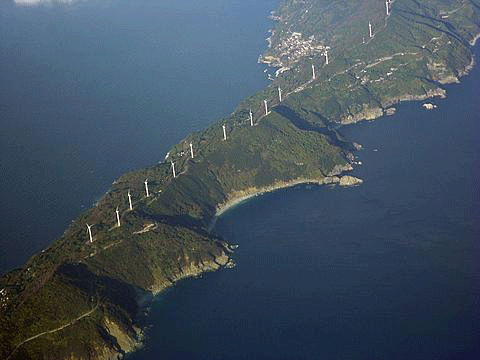 Renewable energy plan sees no nukes Japan Times Sep. 1, 2012 Kyodo, Jiji Environment Minister Goshi Hosono released a new strategy Friday to boost power generation capacity by more than sixfold for four renewable energy categories by 2030 to make it possible to eliminate all nuclear power plants.
Announcing the promotion strategy after the day’s Cabinet meeting, Hosono said his ministry plans to increase the combined annual capacity of electricity generation using offshore wind, geothermal, biomass and tidal power sources to as much as 19.41 million kw by 2030, compared with 2.96 million kw in fiscal 2010.
Specific targets were set at 8.03 million kw for offshore wind power, 3.88 million kw for geothermal power, 6 million kw for biomass power, and 1.5 million kw for tidal power.
In fiscal 2010, offshore wind power generation totaled 30,000 kw, geothermal power 530,000 kw, biomass power 2.4 million kw and tidal power zero.
While the government is studying options to cut nuclear energy’s share of total power generation to zero, 15 percent, or 20 to 25 percent by 2030 in light of the Fukushima nuclear crisis, the strategy is designed to allow for the zero percent option.
Hosono said floating ocean wind power generators should be developed by 2020 to achieve the target of generating the same output as eight nuclear reactors. … http://www.japantimes.co.jp/text/nn20120901a1.html
Secrecy and poor radiation monitoring in Japan’s, (and France’s) nuclear industry
Faced with an ongoing radioactivity which is contaminating Japan’s food and water supply, what should be done? The Nuclear Mafia’s ethos is silken sewn into the socio-political Kabuki theater of a post modern Japanese society, which seems helpless to save itself. Maybe Ambassador Matsumura, with his international political connections of good will, and the Skilled Veterans for Fukushima would be good people to turn to for advice.
The Nuclear Mafia Derails Democracy in Japan Dissident Voice, by Richard Wilcox / August 31st, 2012 “….The Nuclear Workforce French sociologist, Paul Jobin, “began research on Japanese and Taiwanese nuclear plant workers in 2002, mainly at Fukushima Daiichi,” and he did follow up interviews after the Fukushima disaster in 2011.
Jobin notes that:
* Subcontracting labor at nuclear plants in Japan began shortly after their creation, in the mid-1970s. “In France, this trend would develop after 1988, reaching a rate of 80% by 1992.”
* “According to NISA’s data, in 2009, Japan’s nuclear industry recruited more than 80,000 contract workers against 10,000 regular employees.”
* Part time employment is carried out in order to limit labor costs “whether in France or Japan, the nuclear industry nurtures a heavy culture of secrecy concerning the number of irradiated workers.” Continue reading
Japan’s political problems delay appointment of a new nuclear regulatory agency
Nuclear panel limbo Renewable energy plan sees no nukes Japan Times Sep. 1, 2012 Kyodo, Jiji The Diet may not vote on appointments to the new nuclear regulatory
commission before the legislative session ends Sept. 8.
A vote is unlikely in the current session, a senior Diet affairs official in the ruling Democratic Party of Japan confirmed Thursday.
This is because some DPJ members, including ex-Prime Minister Yukio
Hatoyama, oppose appointing Shunichi Tanaka, former acting chairman of the Atomic Energy Commission, as head of the regulatory body, describing him as pronuclear.
There is concern within the DPJ that forcing the votes could cause more lawmakers to quit the party.
Another DPJ executive said holding the votes would be difficult as the opposition parties have boycotted deliberations since the opposition-controlled Upper House passed a censure motion against Prime Minister Yoshihiko Noda on Wednesday.
The government has until Sept. 26 to set up the nuclear regulatory body. If the Diet doesn’t act, Noda has the power to appoint the commission’s members as a stopgap measure.
http://www.japantimes.co.jp/text/nn20120901a1.html
Scandalous nuclear worker conditions in nuclear Japan
The Nuclear Mafia Derails Democracy in Japan Dissident Voice, by Richard Wilcox / August 31st, 2012 “…..Nuclear Situation Prime Minister Noda recently rejected protester’s requests to shut down the nuclear reactors. As the Metropolitan Coalition Against Nukes told Noda in a face to face meeting, “[w]e the people do not believe you” regarding his empty promises to phase out nukes in the future. The Nuclear Mafia are restarting reactors even though they are unnecessary for electricity production. An overwhelming majority of people want to abolish nuclear power. Having contaminated the world with quadrillions of becquerels of radiation (petabecquerels), Tepco is under a pseudo nationalization process that funnels tax money into their pockets yet maintains their autonomy.
Worker Shortage A common practice among workers in nuclear plants is to hide their real exposure rate of radiation. Because there are legal limits of radiation exposure, workers will take off their dosimeters, or cover them with lead. In normal times in Japan workers could also migrate from one plant to the other without indicating previous work experience, and work “under the table.” How long it takes to get sick and or die from such a practice is anyone’s guess. Continue reading
Fukushima Prefecture’s forests contaminated with radioactivity
Fukushima to expand forest areas for radiation decontamination, The Mainichi 30 Aug 12 The Ministry of the Environment accepted a request on Aug. 29 from Fukushima Prefecture to expand forest areas for radiation decontamination from the nuclear plant disaster, ministry officialssaid.
Currently, forest decontamination is limited to areas around 20 meters from where people live, and places where people gather, like camping sites or mushroom-raising facilities. Fukushima Prefecture, which is hit hard by the nuclear disaster and has 70 percent of its area covered by forests, requested an expansion of decontamination
areas…..
. Fukushima Prefecture Vice Gov. Masao Uchibori, who submitted a request to the Ministry of the Environment to push forward with forest decontamination, says, “Even if we decontaminate an area, after a week, two weeks, or a month, the radiation levels return. We think it is because of radioactive material coming from the mountains.”
The national government will study factors including radioactive material movement and buildup in forests, the leaking and spreading of radioactive material from forests to other areas, and the effects on radiation levels from tree-thinning. The Fukushima Prefectural Government, meanwhile, will this fall examine the decontamination effects of tree-thinning over a 10-hectare area. http://mainichi.jp/english/english/newsselect/news/20120830p2a00m0na003000c.html
Report from Japan’s nuclear inquiry panel avoids policy recommendations
Panel avoids tough nuclear power questions / Report refrains from policy suggestions; some members say they needed more time for discussions Daily Yomuiri, Ryosuke Yamauchi and Hironori Kanashima / Yomiuri Shimbun Staff Writers, 30 Aug 12,
A summary report by a government panel of experts that analyzed recent public polls on future nuclear power dependency refrained from making concrete suggestions on a future energy policy, but said most people want to move away from nuclear power. Continue reading
1 This Month





PLEASE OPPOSE HR 8255 AND S.3639 – bills would accelerate satellite deployment, with no environmental review or safeguards – https://ncstd5li.quorum.us/campaign/169331/
To see nuclear-related stories in greater depth and intensity – go to https://nuclearinformation.wordpress.com
-
Archives
- October 2026 (81)
- September 2026 (339)
- August 2026 (330)
- July 2026 (355)
- June 2026 (287)
- May 2026 (306)
- April 2026 (356)
- March 2026 (251)
- February 2026 (267)
- January 2026 (308)
- December 2025 (358)
- November 2025 (359)
-
Categories
- 1
- 1 NUCLEAR ISSUES
- business and costs
- climate change
- culture and arts
- ENERGY
- environment
- health
- history
- indigenous issues
- Legal
- marketing of nuclear
- media
- opposition to nuclear
- PERSONAL STORIES
- politics
- politics international
- Religion and ethics
- safety
- secrets,lies and civil liberties
- spinbuster
- technology
- Uranium
- wastes
- weapons and war
- Women
- 2 WORLD
- ACTION
- AFRICA
- Atrocities
- AUSTRALIA
- Christina's notes
- Christina's themes
- culture and arts
- Events
- Fuk 2022
- Fuk 2023
- Fukushima 2017
- Fukushima 2018
- fukushima 2019
- Fukushima 2020
- Fukushima 2021
- general
- global warming
- Humour (God we need it)
- Nuclear
- RARE EARTHS
- Reference
- resources – print
- Resources -audiovicual
- Weekly Newsletter
- World
- World Nuclear
- YouTube
-
RSS
Entries RSS
Comments RSS

