Facing up to the reality of Fukushima radiation, and its effect on children
The Nuclear Sacrifice of Our Children: 14 recommendations to help radiationcontaminated Japan http://akiomatsumura.com/2012/08/the-nuclear-sacrifice-of-our-children-14-recommendations-to-help-radiation-contaminated-japan.html?utm_source=rss&utm_medium=rss&utm_campaign=the-nuclear-sacrifice-of-our-children-14-recommendations-to-help-radiation-contaminated-japan By Helen Caldicott, M.D. 24 Aug 12
When I visited Cuba in 1979, I was struck by the number of roadside billboards that declared ”Our children are our national treasure.” (Dr. Helen Caldicott is a pediatrician specializing in cystic fibrosis and the founding president of Physicians for Social Responsibility, part of a larger umbrella group that was awarded the Nobel Peace Prize in 1985.)
This resonated with me as a pediatrician, and of course it is true. But as Akio Matsumura said in his article, our children are presently being sacrificed for the political and nuclear agenda of the United Nations, for the political survival of politicians who are mostly male, and for “national security.” The problem with the world today is that scientists have left the average person way behind in their level of understanding of science, and specifically how the misapplication of science, in particular nuclear science, has and will destroy much of the ecosphere and also human health.
The truth is that most politicians, businessmen, engineers and nuclear physicists have no innate understanding of radiobiology and the way radiation induces cancer, congenital malformations and genetic diseases which are passed generation to generation. Nor do they recognize that children are 20 times more radiosensitive than adults, girls twice as vulnerable as little boys and fetuses much more so.
Hence the response of Japanese politicians to the Fukushima disaster has been ludicrously irresponsible, not just because of their fundamental ignorance but because of their political ties with TEPCO and the nuclear industry which tends to orchestrate a large part of the Japanese political agenda.
Because the Fukushima accident released 2.5 to 3 times more radiation than Chernobyl and because Japan is far more densely populated than the Ukraine, Belarus and Russia, and because one million people have died within 25 years as a result of Chernobyl, we expect to see more than one million Japanese casualties over the next 25 years. But the incubation time for cancer after radiation exposure varies from 2 to 90 years in this generation. These facts also apply to all future generations in Japan that will be exposed to a radioactive environment and radioactive food.
It seems that the people in charge in Japan are busily ignoring or covering up these ghastly medical predictions and deciding in their ignorance that people can return to live highly contaminated areas or else remain living there. Even areas of Tokyo are recording dangerous radioactive isotopes that originated in Fukushima in house-dust, in plants, and in street soil. Continue reading
A new breed of anti nuclear protestors in Japan
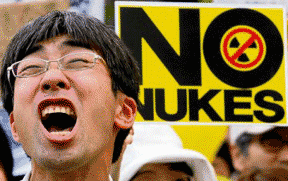 Anti-nuclear protests signal new activism in Japan Knox News, MARI YAMAGUCHI – Associated Press August 26, 2012 TOKYO (AP) — This is Japan’s summer of discontent. Tens of thousands of protesters — the largest demonstrations the country has seen in decades — descend on Tokyo every Friday evening to shout anti-nuclear slogans at the prime minister’s office. Many have never protested publicly before.
The government’s much-criticized handling of the Fukushima nuclear crisis has spawned a new breed of protesters in Japan. Drawn from the ranks of ordinary citizens rather than
activists, they are a manifestation of a broader dissatisfaction with government and could create pressure for change in a political system that has long resisted it.
What started as relatively small protests in April has swollen rapidly since the government decided to restart two of Japan’s nuclear reactors in June, despite lingering safety fears after the meltdowns at the Fukushima Dai-ichi plant triggered by the March 2011 earthquake
and tsunami. Continue reading
42% of Japan’s lawmakers want nuclear power ended by 2030
ASAHI SURVEY: 42% of Diet members want end to nuclear power August 26, 2012 THE ASAHI SHIMBUN Forty-two percent of Diet members favor a government proposal for abandoning nuclear energy by 2030, showing growing support for a drastic policy shift following last year’s nuclear disaster, an Asahi Shimbun survey found. Continue reading
Many students avoided pools over radiation fears FUKUSHIMA
Asia One The Yomiuri Shimbun/Asia News Network 26 Aug 12, – About 1 in 20 primary and middle school students in the city of Fukushima refused to swim in outdoor pools during physical education classes this summer due to radiation fears, according to a municipal board of education survey.
Public primary and middle schools in the city resumed swimming classes at outdoor pools this summer. The classes were cancelled last summer after the outbreak of the crisis at the Fukushima No. 1 nuclear power plant…. http://www.asiaone.com/News/Latest%2BNews/Edvantage/Story/A1Story20120826-367626.html
Radioactive sewerage accumulation in Japan
Paul Langley’s Nuclear History Blog, Asahi Shimbun, By NOBUTARO KAJI/ Japan May 22 2012 http://ajw.asahi.com/article/0311disaster/fukushima/AJ201205220055 Incinerating radioactive sewage sludge could contaminate environment Continue reading
Prominent Japanese spearhead a Bill to abolish nuclear power

 Oe, Sakamoto lead charge for no-reactor bill http://www.japantimes.co.jp text/nn20120824a5.html?utm_source=feedburner&utm_medium=feed&utm_campaign=Feed:+japantimes+(The+Japan+Times:+All+Stories) Kyodo
A group led by Nobel literature laureate Kenzaburo Oe, Academy Award-winning composer Ryuichi Sakamoto and other noted celebrities has launched a nationwide network seeking passage of a bill to abolish all nuclear power plants in Japan.
“We must bring an end to nuclear power plants if humankind is to continue living in the next century,” Oe said during a news conference Wednesday in Tokyo. “By speaking out
loud, we can have the bill passed.”
Group members said they want to see the bill that they have compiled
passed as soon as possible before 2025. Oe and Sakamoto have been leading rallies against nuclear power, with the most recent protest on July 16 drawing what organizers said was an estimated 170,000 people to Yoyogi Park.
Other members of the group include Kenji Utsunomiya, former president of the Japan Federation of Bar Associations, and Tatsuya Murakami, the mayor of Tokai, Ibaraki Prefecture, where the country’s first nuclear reactor was set up in 1957.
In its bill, the group calls nuclear power an extremely fragile system in terms of security, noting the devastating damage that accidents can cause and that no safe method of disposing of nuclear waste has been established.
The group aims to prohibit construction of new nuclear plants and expansion of existing ones, and to abolish all nuclear plants between 2020 and 2025. It also seeks a ban on operation of reactors that are more than 40 years old, as well as a halt to the reprocessing of spent fuel.
Conservatives and right wingers now part of Japan’s anti nuclear movement
“Some in the very right wing of conservative thinkers have become anti-nuclear after 3/11,”.. ”The Friday protests also have some right-wingers. It’s not just lefties,”
“Morality and economic growth are possible without nuclear power,” he concludes.
Nationatalist Japan manga author joins anti-nuclear fight Asahi Shimbun, 25 Aug 12, Japan’s anti-nuclear movement has a new supporter: bestselling nationalist “manga” author Yoshinori Kobayashi, known for his controversial defense of Tokyo’s wartime aggression, has joined the growing ranks of those who want the country to end its reliance on atomic power in the wake of the Fukushima crisis.
The attack from an unexpected quarter comes as Japan tries to decide the role nuclear energy should play in a new national energy portfolio amid growing pressure from voters worried about safety after last year’s Fukushima atomic disaster, the world’s worst in a quarter of a century. Continue reading
Teacher: “I’m lying to a room full of students” — Fukushima City should be evacuated
 http://enenews.com/teacher-im-lying-to-a-room-full-of-students-fukushima-city-should-be-evacuated August 24th, 2012 By ENENews Title: Visiting the end of the world
Source: Australian Broadcasting Corporation
Author: Senator Scott Ludlam, Australian Greens Senator for Western Australia
Date: Aug 24, 2012
[…]
Flash forward to August 2012, with 150,000 people evacuated from places like Iitate. The mood in the region is dark. A young high school teacher downloads the unvarnished truth in a loungeroom in Fukushima City the night before our trip down to the coast.
“I’m lying to a room full of students,” he tells me, daring me to break eye contact. Like many thousands of others, his wife and children now live in temporary accommodation well outside the contaminated area, but Japan has no social security net to speak of and people can’t just walk away from jobs.
Now he is grappling with a hateful dilemma, addressing a room full of students in a city he believes is no longer safe for children. Fukushima City, population 290,000. Kōriyama City, population 336,000. Both of them hit by the plume that carried fission products from the broken reactors to the north-west before the wind swung briefly towards Tokyo. I hesitate, then ask, should this city be evacuated? He pauses a long time before answering, and finally drops his gaze. Yes.
[…]
With a slightly different fall of the dice, the Fukushima meltdowns would have cost the people of Japan their country. Another cruel accident of plate tectonics and it still could.
There is no place on this archipelago for nuclear power, and tens of millions of Japanese now understand this. Everything has changed.
Beyond evacuation zone, high levels of radiation in Fukushima residents
Fukushima Residents With Exposures As High As Chernobyl Areas http://www.simplyinfo.org/?p=7187August 24th, 2012 Two couples from outside the evacuation zones have shown with some of the highest internal radiation exposure to date in Japan. One couple lives in Nihonmatsu, the other in Kawamata-machi.
Kawamata-machi
man 19,507 becquerels
his wife 7,724 becquerels
Nihonmatsu City
man 11,191 becquerels
his wife 6,771 becquerels
Dr. Tsubokura, one of the doctors conducting the exposure scans on residents said these levels are similar to internal exposure seen in Belarus.
The couples have been eating home grown mushrooms, bamboo shoots and local persimmons. The mushrooms were grown on logs from Namie, a highly contaminated area in the evacuation zone. It was not clear if they logs were gathered before the nuclear disaster or not. EX-SKF mentions they may not have understood the risks in doing this. Most of the elderly rely on TV and print newspapers for information, both sources have downplayed the risks in the region.
There may be more instances of high radiation in elderly residents. Many have been reluctant to leave or felt their age would spare them from the long term effects of radiation exposure. It is giving researchers a contrasting group of exposures that hint what could have happened to more residents had food restrictions not been implemented.
Food to hospitals from radiation contaminated area in Japan
 More hospital food will be from contaminated area
They are pushing food from contaminated area even to hospital and senior citizens’ home.
On 8/22/2012, MAFF sent an official request to Public Interest Incorporated Association “Japan medical kyushoku (Lunch) association” to consume more food from the contaminated area.
全国規模での被災地産食品の消費拡大が図られるよう、医療施設、介護・福祉施設において食事提供の業務をされている貴会員の皆様に、被災地産食品の利用の促進を働きかけていただくなどご尽力を賜りますようお願い申し上げます。
<Translate>
In order to improve the consumption of food from disaster area, we request you to actively purchase and consume food from disaster area for medical facilities and nursing facilities.
<End>
When you are hospitalized, you can not choose the origin of food.
JAPANESE FISH FOUND WITH RADIATION 250 TIMES LEGAL LIMIT
, fish Update.com, 25 Aug 12 NEW tests have detected high levels of radioactive cesium on fish caught close to the Japanese Fukushima nuclear power plant badly damaged in a massive earthquake more than 18 months ago.
Some reports suggests that the rock trout caught contained more than 250 times the legal limit.The Japanese government has already banned the sale of most species fish from that area and this is likely to continue in the light of the new tests. A few months ago radiation from the plant was found in fish close to the US West Coast…
http://www.fishupdate.com/news/fullstory.php/aid/18105/FISHupdate_Briefing.html
All Fukushima rice to be checked for radiation
Asahi Shimbun August 24, 2012 By TETSUYA KASAI/ Staff Writer With early rice harvests under way in Fukushima Prefecture, farmers are keeping their fingers crossed that this year’s crop passes government radiation checks.
For the second year following the disaster at the Fukushima No. 1 nuclear power plant, the Fukushima prefectural government is inspecting all bags of rice produced in the prefecture to ensurelevels of radiation are below government limits, which were lowered this year to 100 becquerels per kilogram…. http://ajw.asahi.com/article/0311disaster/fukushima/AJ201208240074
UNSCEAR to investigate radiation impact of Fukushima nuclear disaster
Next December Carl-Magnus Larsson, head of the Australian Radiation Protection and Nuclear Safety Agency, takes over as UNSCEAR chairman.UNSCEAR has been the go-to body for such complex, high-profile investigations since it was established by the UN General Assembly in 1955 under the chairmanship of Australian radiation expert Cecil Eddy…. the Fukushima report .. will be presented to the [United Nations] General Assembly late next year.
Radiation risks high in Japan http://www.theaustralian.com.au/news/health-science/radiation-risks-high-in-japan/story-e6frg8y6-1226456949429 BY: LEIGH DAYTON The Australian August 25, 2012 IT’S hard to believe, but earlier this month the power company that runs Japan’s devastated Fukushima nuclear power plant revealed that five people working on the clean-up had covered their radiation detectors with lead, rendering them useless.
The Tokyo Electric Power Company said the five were contracted by a subcontractor of a – yes – subcontractor and were not even authorised to work at the plant. Other workers were found not to have used dosimeters at all. Continue reading
Shocking increase in amounts of radioactive caesium-137 into Fukushima fish
 Fukushima Fish Soaked In Record Levels Of Radiation MARIO AGUILAR, AUGUST 22, 2012 http://www.gizmodo.com.au/2012/08/fukushima-fish-soaked-in-record-levels-of-radiation/ During last year’s nuclear disaster, the deadly radiation inside Fukushima 1, became one with the surrounding environment, contaminating everything. Things aren’t getting any better. Record quantities of the deadly radioactive isotope caesium-137 have just been discovered in the fisheries around Fukushima.
We’ve known about the untold and nearly inconceivable quantities of caesium-137 released into the surrounding ecosystem for over a year. But these numbers reported by the AFP are still shocking:
The fishes, captured 20 kilometres (12.5 miles) off the plant on August 1, registered 25,800 becquerels of caesium per kilo, Tokyo Electric Power Co. (TEPCO) said — 258 times the level the government deems safe for consumption. The previous record in fish and shellfish off Fukushima was 18,700 becquerels per kilo detected in cherry salmons, according to the government’s Fisheries Agency.
Authorities had hoped things were getting better, and as the AFP reports , they allowed fishermen to get back to work for a trial run as long as they were more than 50km from the disaster site and stuck to shellfish. So far, the experimental catches have proven (relatively) clean. Still, while everyone in the region is understandably eager to get back to normal, let’s hope the wishful thinking doesn’t get out of hand. [AFP ]
Fish found to have record radiation levels, near coast of Fukushima
 Record radiation found in fish off Japan http://www.news.com.au/breaking-news/world/record-radiation-found-in-fish-off-japan/story-e6frfkui-1226456080459#ixzz24P8h1Smb August 22, 2012 RECORD levels of radioactive caesium were detected in fish caught within 20 kilometres of Japan’s damaged Fukushima Daiichi Nuclear Power Station.
The operator Tokyo Electric Power Co said it had found 25,800 becquerels per kilogram of radioactive caesium in greenling, 258 times higher than the government safety standard.
Fishing in waters off the plant has been voluntarily restricted since
the nuclear disaster at the plant, which went into meltdown after the
March 2011 earthquake and tsunami.
Less than a month after the start of the disaster, Tokyo Electric
dumped more than 11,000 tonnes of wastewater containing radioactive
substances into the Pacific.
The previous record of radioactive contamination in fish was 18,700
becquerels per kilogram detected in cherry salmon caught in March,
according to the Fisheries Agency.Wakao Hanaoka, a Greenpeace Japan
official, said the government now needs to carry out a full
investigation of radioactive contamination in a wide range of sea
areas off Fukushima, which has not been done yet.
The organisation’s surveys show higher levels of radioactive
contamination were found in fish and seaweed sampled in areas further
from the Fukushima plant.
Factors that affect the spread of contamination include ocean currents
and seabed configuration, Hanaoka added.
1 This Month





PLEASE OPPOSE HR 8255 AND S.3639 – bills would accelerate satellite deployment, with no environmental review or safeguards – https://ncstd5li.quorum.us/campaign/169331/
To see nuclear-related stories in greater depth and intensity – go to https://nuclearinformation.wordpress.com
-
Archives
- October 2026 (81)
- September 2026 (339)
- August 2026 (330)
- July 2026 (355)
- June 2026 (287)
- May 2026 (306)
- April 2026 (356)
- March 2026 (251)
- February 2026 (267)
- January 2026 (308)
- December 2025 (358)
- November 2025 (359)
-
Categories
- 1
- 1 NUCLEAR ISSUES
- business and costs
- climate change
- culture and arts
- ENERGY
- environment
- health
- history
- indigenous issues
- Legal
- marketing of nuclear
- media
- opposition to nuclear
- PERSONAL STORIES
- politics
- politics international
- Religion and ethics
- safety
- secrets,lies and civil liberties
- spinbuster
- technology
- Uranium
- wastes
- weapons and war
- Women
- 2 WORLD
- ACTION
- AFRICA
- Atrocities
- AUSTRALIA
- Christina's notes
- Christina's themes
- culture and arts
- Events
- Fuk 2022
- Fuk 2023
- Fukushima 2017
- Fukushima 2018
- fukushima 2019
- Fukushima 2020
- Fukushima 2021
- general
- global warming
- Humour (God we need it)
- Nuclear
- RARE EARTHS
- Reference
- resources – print
- Resources -audiovicual
- Weekly Newsletter
- World
- World Nuclear
- YouTube
-
RSS
Entries RSS
Comments RSS

