150 years before people can return to radiation contaminated land
 It takes over 150 yrs for people to come back to Futaba machi, “Decontamination is useless.” http://fukushima-diary.com/2012/10/it-takes-over-150-yrs-for-people-to-come-back-to-futaba-machi-decontamination-is-useless/ by Mochizuki October 20th, 2012 · On 10/16/2012, Assistant Prof. Kimura from Dokkyo medical university had a lecture in the
restration committee of Futaba machi.
In this lecture, he introduced his personal view over the situation that it takes over 150 years for all the citizens to come back to the town even though they consider the half-life and the shielding effect of the ground.
He adds this is on the assumption that they don’t decontaminate the town, but he also added it’s useless to decontaminate this highly contaminated land. In Futaba machi, the lowest atmospheric dose is 0.3μSv/h but the highest reading is over20μSv/h.
Fukushima Diary reveals – Japan to restart another nuclear plant
 [Express] Another nuclear plant will be restarted http://fukushima-diary.com/2012/10/express-another-nuclear-plant-will-be-restarted/ by Mochizuki October 22, 2012
民主党の細野豪志政調会長は21日、薩摩川内(さつませんだい)市内の街頭演説で、九州電力川内原発の再稼働を明言しました。詳しくは明日の「しんぶん赤旗」で。
― 赤旗政治記者さん (@akahataseiji) 10月 21, 2012
<Translate>
On 10/21/2012, Hosono, the policy chief of Democratic Party of Japan had a soapbox oratory, then stated they are going to restart Sendai nuclear plant of Kyushu electric power. (Sendai nuclear plant is in Kagoshima prefecture, Kyushu)
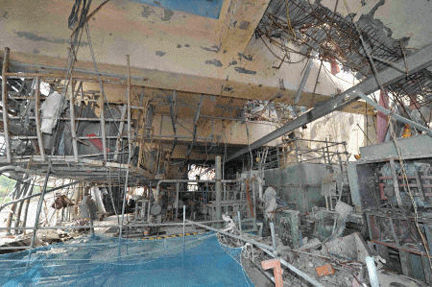
Authorities keeping quiet about Fukushima reactor 4’s dire situation
Fukushima Daiichi’s Reactor 3 and 4 are waterlogged, cracked and just one major earthquake jolt away from a catastrophe that one expert said could be “of biblical proportions.”
 Fukushima’s Hot Water: Now Fallout in Our Kitchens? On The Issue, by Kimberly Robertson, 21 Oct 12, Information about radioactive fallout from Japan has been in very short supply since the unprecedented triple nuclear meltdowns at Fukushima Daiichi on March 11, 2011.
“Nuclear meltdown” is a term for a catastrophic reaction in a nuclear reactor that has overheated. The uncontrolled heat damages the reactor itself, causing an uncontrolled release of life threatening radioactive material, also known as “radioactive fallout” into the environment.
At Fukushima this happened three times, an unprecedented catastrophe.With the 67th anniversary of the atomic bombing of Hiroshima in August 2012, it was strange to realize that Japan unwittingly dropped an even deadlier bomb on itself. Fukushima contained over 100 times more cesium-137 alone than Hiroshima, and there are literally hundreds of dangerous radionuclides in the “mix.” Continue reading
Sinking ground under Fukushima nuclear reactor 4 brings catastrophic risk
 Fukushima threatens Global Human Survival The Canadian, 21 OCTOBER 2012 : BY SUBRATA “…..is Fukushima still a threat? It seems that it is, and on a potentially devastating level. Mitsuhei Murata, who served his country as Ambassador to both Senegal and
Switzerland, explained in a recent interview that far from the situation at the Fukushima Daiitsu plant improving, it is actually worsening in an alarming way: the ground beneath the plant’s number 4 reactor is sinking.
Mr Murata implied that the whole structure is on the verge of collapse. He wrote to the Secretary General of the United Nations stating unequivocally that the fate, not only of Japan, but of the rest of the world depends on the No. 4 reactor.
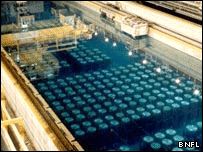
The cooling pool still contains more than fifteen hundred spent fuelrods. The collective power of these “spent” rods is 37 million curies. By comparison, the release of nuclear material at Three Mile Island, Pennsylvania (an INES level 5 event) amounted to approximately
2.5 million curies. In other words, there are nearly 15 Three Mile Islands sitting in the severely compromised Unit 4.
The ground beneath Unit 4 has sunk by about 31.5 inches already. Further sinking, or a minor earthquake could cause the entire structure to collapse, draining the pool and causing a meltdown of potentially catastrophic proportions. Some scientists predict that
his would mean the ruin of Japan and a serious threat to the rest of the world. http://www.agoracosmopolitan.com/news/nature/2012/10/19/4621.html
Cesium above new limit in Miyagi beef http://www.japantimes.co.jp/text/nn20121019a2.html Jiji SENDAI — Radioactive cesium levels above the government’s new limit have been found in beef from Miyagi Prefecture, the prefectural government said.
Meat from a cow shipped by a farmer in Tome was found to contain more than 150 becquerels of radioactive cesium per kilogram, the Miyagi Prefectural Government said Wednesday.
The stricter limit of 150 becquerels for beef and rice took effect Oct. 1. The previous limit was 500 becquerels per kilogram.
It is the first time beef with radioactive cesium levels above the tightened limit has been found.
The cow was shipped to a slaughterhouse in the Shibaura district in Tokyo and a radioactivity check on the meat was conducted Tuesday, the prefecture said. The meat was discarded, officials said.
The prefecture is investigating, suspecting that rice straw eaten by the cow was contaminated by fallout from the Fukushima No. 1 nuclear plant disaster.Miyagi Prefecture told the farmer not to ship any more cows until the investigation is completed, and asked nearby ranchers to suspend shipments voluntarily.
Fukushima’s 50 heroes fear discrimination and bullying

 The Economist: “Something strange was afoot” during Prime Minister’s visit to plant — Fukushima 50 muzzled http://enenews.com/economist-strange-afoot-during-prime-ministers-visit-plant-fukushima-50-muzzled Title: Japan’s nuclear disaster: Meet the Fukushima 50? No, you can’t
Source: The Economist Author: Banyan Date: Oct 8, 2012
It has taken the Japanese government more than 18 months to pay tribute to a group of brave men, once known as the “Fukushima 50”, who risked their lives to prevent meltdowns at the Fukushima Dai-ichi nuclear power plant from spiralling out of control.
But when the prime minister, Yoshihiko Noda, belatedly offered official thanks to them on October 7th something strange was afoot: six of the eight men he addressed had their backs to the television cameras, refused to be photographed and did not introduce themselves by name, not even to Mr Noda
The reason: officials from the government and from Tokyo Electric Power (Tepco) quietly admitted that the men wanted to keep their identities secret because they were scared of stigmatisation for being involved in the disaster, such as might lead to the bullying of their children and grandchildren. But Tepco is also muzzling them, presumably for fear that what they say will further discredit the now nationalised company. When I asked if I could at least hand my business card to them to see if they wanted to tell their side of the story, an irate Tepco spokesman answered bluntly: “Impossible.”
…Yet even after Mr Noda’s visit, the men do not get the recognition they deserve. Kyodo, a news agency, relegates any mention of them to the bottom of a boring story about decontamination.
The “Fukushima Syndrome” – sick and dying cattle
Inside Evacuation Zone: Cattle sick, dying — “We call it Fukushima syndrome” — Severe diarrhea, skin problems, weakened immune systems http://enenews.com/farm-evacuation-zone-cattle-sick-dying-call-fukushima-syndrome-diarrhea-like-water-snivel-spreading-dermatitis-immune-system-being-weaken October 8th, 2012
Oct 5, 2012Recent tweets by Fukushima Farm Sanctuary (@kibounobokujyou), a farm inside the 20 kilometer evacuation zone, translated by Fukushima Diary:
4 cattle have died since yesterday. One more calf is about to die. They must be fed enough though nutrition might not be perfect. Is bad disease going around ? I’m worried about radiation too. We call it Fukushima syndrome. […]
3 died yesterday. […]
Masami Yoshizawa, RancherDiarrhea like water, snivel, spreading dermatitis, their immune system is being weaken, which is obvious even for amateur. It might be because of simply the lack of nutrition, epidemic disease, or radiation exposure. Probably it’s only in this hazard area, where series of cattle die one after one. We call it Fukushima syndrome, which was born from Tepco and the government.
A lot of calves are dying but adult cattle are dying too. Calves die regardless of the age. If it becomes winter in this situation, the number might become half or less than that.
Japan authorities passing the buck on decision-making about nuclear restart
Government tries to duck reactor-restart decisions Fujimura hints decision rests with new body, Japan Times By MASAMI ITO, 7 October 12, Chief Cabinet Secretary Osamu Fujimura suggested Thursday that the central government does not have the ultimate say, or responsibility, in reactivating nuclear reactors, triggering confusion over who is in charge of making the decision.
At a news conference, Fujimura repeatedly stressed that the new Nuclear Regulation Authority is in charge of assessing the safety of reactors and that power companies are only tasked with explaining reactor restarts to host municipalities and seeking their consent. Continue reading
Japan’s new nuclear regulation agency- a nuclear promotion agency?
 New nuclear regulation agency lined with nuclear promoters http://www.japan-press.co.jp/modules/news/index.php?id=4147 September 25, 2012
The nuclear regulation agency will serve a clerical function for the Nuclear Regulation Authority (NRA). It will be essential for the people to strictly watch the agency along with the NRA led by Tanaka Shun’ichi, former dweller of the “nuclear power village”.
The agency’s top officials are Ikeda Katsuhiko (former superintendent general at the Tokyo Metropolitan Police Department), Morimoto Hideka (former senior official of the Environment Ministry), Yasui Masaya (former atomic policy chief of the Resources and Energy Agency), Kuroki Yoshihide (former official of the Tokyo Metropolitan Police Department), Nayuki Tetsuo (former official of the Nuclear Safety Bureau of the Science and Technology Agency), Sakurada Michio (former director of the nuclear fuel cycle industry division of the Resources and Energy Agency), and Yamamoto Tetsuya (former official of the Nuclear and Industrial Safety Agency – NISA).
Yasui is a person who once ordered the cover-up of estimated costs for disposal of nuclear spent fuel in order “to prevent public scrutiny.”
Kuroki, though he apologized later for his unfounded assertion, stated that “it makes no sense in Japan to include nuclear opponents” as nuclear regulators.
Akahata described the nuclear regulation agency as a nuclear promotion agency.
Fukushima nurses leaving, to protect their own children from radiation
Nurses evacuate Fukushima to save their children from the potential risk of radiation http://fukushima-diary.com/2012/10/nurses-evacuate-fukushima-to-save-their-children-from-the-potential-risk-of-radiation/ by Mochizuki October 6th, 2012 Fukushima prefecture is facing a serious shortage of nurses and health workers.
The biggest reason is nurses have evacuated to save their children from the potential radiation risk because of Fukushima accident. On the other hand, the number of patients are increasing as evacuation period is prolonged.
According to Fukushima prefectural government, 14,556 nurses and other workers were at hospitals in the prefecture on 3/1/2011, shortly before 311, but it dropped to 14,089 on 3/1/2012.
Fukushima nursing association comments in 2/2011, there were 216 applications for 366 jobs, the job opening-to-application ratio was 1.69. However, at the end of this August, there were 174 applications for 768 jobs. The job-opening-to-application ratio was 4.41, which made a huge increase since before 311.
The number of young people receiving checkups is expected to increase in line with the Oct. 1 launch of a system providing free medical care to people aged 18 or under, and the association remains concerned about the situation, which could hinder health checks, saying a shortage of people in the medical profession could impede local restoration efforts.
In other disaster areas, Iwate and Miyagi are also having shortages of medical workers, but the situation has been particularly serious in Fukushima Prefecture due to the nuclear disaster, and it is expected to continue for a long time.
Midori Suzuki, a senior director of the Fukushima Nursing Association comments, “The shortage of regular nurses and health nurses was an issue even before the disaster, but since the nuclear disaster, the situation has gotten unusually serious, I want the government to widen its awareness of what is hindering restoration.”
Fukushima information website
http://fukushimaappeal.blogspot.com.au/2012/10/new-nuclear-regulation-agency-lined.htm We are Japanese people living in the UK. We are not activists or scientists, just normal citizens who want peace in the world and to protect our environment in a way that serves everybody. We are aware that there isn’t enough information in the main stream media in the UK about what’s going on in Fukushima, and we would like to share with you what we’ve found from Japanese web sites: information and news from scientists and doctors who are extremely worried about the safety of citizens, and from concerned freelance journalists and ordinary people. Since the magnitude-9 earthquake and tsunami, followed by the Fukushima nuclear disaster, we have been feeling a huge sense of loss… and have learned that nothing stays the same. Also we think that the Fukushima disaster was actually the result of many years of global political and economic corruption going on behind the scenes, and that the Japanese government was taken in by the worldwide drive for nuclear power, without learning the lessons of the Nagasaki and Hiroshima bombings. (NB: English is not our native language, so please take this into account when reading this blog.)
Japan’s Science Ministry may have “doctored” Fukushima radiation readings
Group: Ministry may have manipulated Fukushima radiation readings October 06, 2012 THE ASAHI SHIMBUN Citizens and scientists have raised concerns that the science ministry manipulated its measurement of radiation levels in Fukushima Prefecture to show figures lower than they really were.
The Association for Citizens and Scientists Concerned About Internal Radiation Exposures said on Oct. 5 that its survey this year of airborne dose levels found an average 10-30 percent higher than the ministry’s numbers, and in certain areas, the discrepancy was even
greater….. http://ajw.asahi.com/article/0311disaster/fukushima/AJ201210060041
Boss of International Atomic Energy Agency (IAEA) at Japan’s Nuclear-Free Forum
Japan forum to discuss nuclear-free energy future, 06 October 2012 Muhammad Iqbal TOKYO: Japanese and European officials are to discuss future energy solutions at a forum in Kyoto this weekend in the wake of Japan’s plans to eliminate atomic power from the country’s energy mix by 2040.
Officials at the annual Science and Technology in Society (STS) forum Sunday will discuss the experience of removing nuclear power from a country’s energy mix, and what independent institutions can advise on the process.
Prime Minister Yoshihiko Noda’s administration in September declared its aim to eliminate atomic power over the next 30 years, as the cabinet declared a three-pronged strategy leading up to the halt, with tougher safety standards, the shuttering of reactors 40-years-old and a ban on the building of new units.
Since the tsunami-sparked meltdowns at the Fukushima plant last year there has been a grounds well of public opposition to nuclear power, which once provided a third of energy-hungry Japan’s electricity.
Genevieve Fioraso, France’s minister of higher education and research, told reporters Saturday ahead of the forum that Japan fared well despite its energy problems but said development of renewable energy solutions was “difficult”.
Among officials attending the forum Sunday are Yukiya Amano, director general of the International Atomic Energy Agency (IAEA), UK government chief scientific adviser John Beddington, and members of the Fukushima inquiry commission…..http://www.brecorder.com/world/southeast-asia/84115-japan-forum-to-discuss-nuclear-free-energy-future.html
Japan’s proposed nuclear waste dump, close to cultural icon
 Fukushima Nuclear Crisis Update for October 2nd to October 4th, 2012 Greenpeace International, by Christine McCann – October 5, 2012 “…Waste Removal and Storage Joining the chorus of voices opposing the government’s recent decision to build a nuclear waste depository in a national forest in Ibaraki Prefecture, the Tokugawa Museum is protesting the location choice, which is only 3 km from a forest it owns. That forest is home to a mountain villa built in 1886 by the 11th lord of the Mito domain and the brother of the last Tokugawa shogun. The museum plans to have it designated as a national important cultural asset. “We’re worried about all sorts of rumors [about radioactivity] ahead of our plan to have the villa designated an important cultural asset. We’ll strongly oppose construction.” http://www.greenpeace.org/international/en/news/Blogs/nuclear-reaction/fukushima-nuclear-crisis-update-for-october-2/blog/42456/
Japanese government secrecy tightening, over Fukushima health effects
 Officials from Fukushima Prefecture have admitted that they conducted secret meetings with 19 health experts and government officials, discussing the impact of radiation on human health, in the wake of the Fukushima disaster. The meetings were held before official meetings, and participants were instructed not to tell anyone that they had
participated. Meeting materials were collected after the meeting so that they could not be removed from the room, and no minutes were kept.
 Fukushima Nuclear Crisis Update for October 2nd to October 4th, 2012 Greenpeace International, by Christine McCann – October 5, 2012 “…..As duties are transferred from the now defunct Nuclear Safety Commission (NSC) to the newly-created Nuclear Regulation Authority (NRA), the Nuclear Energy Library, which gave the public access to over 40,000 documents relating to nuclear power, will close.
The Library was created in 1997 to create transparency after a leak and subsequent cover-up at the Monju fast-breeder. It was heavily visited in the period following the Fukushima nuclear disaster; many documents there are not available online. Experts are criticizing the decision. Continue reading
1 This Month





PLEASE OPPOSE HR 8255 AND S.3639 – bills would accelerate satellite deployment, with no environmental review or safeguards – https://ncstd5li.quorum.us/campaign/169331/
To see nuclear-related stories in greater depth and intensity – go to https://nuclearinformation.wordpress.com
-
Archives
- October 2026 (81)
- September 2026 (339)
- August 2026 (330)
- July 2026 (355)
- June 2026 (287)
- May 2026 (306)
- April 2026 (356)
- March 2026 (251)
- February 2026 (267)
- January 2026 (308)
- December 2025 (358)
- November 2025 (359)
-
Categories
- 1
- 1 NUCLEAR ISSUES
- business and costs
- climate change
- culture and arts
- ENERGY
- environment
- health
- history
- indigenous issues
- Legal
- marketing of nuclear
- media
- opposition to nuclear
- PERSONAL STORIES
- politics
- politics international
- Religion and ethics
- safety
- secrets,lies and civil liberties
- spinbuster
- technology
- Uranium
- wastes
- weapons and war
- Women
- 2 WORLD
- ACTION
- AFRICA
- Atrocities
- AUSTRALIA
- Christina's notes
- Christina's themes
- culture and arts
- Events
- Fuk 2022
- Fuk 2023
- Fukushima 2017
- Fukushima 2018
- fukushima 2019
- Fukushima 2020
- Fukushima 2021
- general
- global warming
- Humour (God we need it)
- Nuclear
- RARE EARTHS
- Reference
- resources – print
- Resources -audiovicual
- Weekly Newsletter
- World
- World Nuclear
- YouTube
-
RSS
Entries RSS
Comments RSS

