Inedible for years to come – fish near Fukushima coast

 Fukushima fish ‘may be inedible for a decade’ Fiona Harvey, environment correspondent guardian.co.uk 25 October 2012 Marine scientist finds levels of radioactivity in fish near stricken Fukushima nuclear plant are higher than expected
Fish from the waters around the Fukushima nuclear plant in Japan could be too radioactive to eat for a decade to come, as samples show that radioactivity levels remain elevated and show little sign of coming down, a marine scientist has warned.
According to a paper published in the journal Science on Thursday, large and bottom-dwelling species carry most risk, which means cod, flounder, halibut, pollock, skate and sole from the waters in question could be off limits for years, .
Sample fish caught in waters near the stricken reactors suggest there is still a source of caesium either on the seafloor or still being discharged into the sea, perhaps from what is left of the cooling waters. As the levels of radioactive isotopes in the fish are not declining as fast as they should have, the outlook for fishing in the area is likely to be poor for the next 10 years, the paper’s author told the Guardian.
“These fish could have to be banned for a long time. The most surprising thing for me was that the levels [of radioactivity] in the fish were not going down. There should have been much lower numbers,” said Ken Buesseler, senior scientist at the Woods Hole Oceanographic Institution in the US, who wrote the paper titled Fishing For Answers Off Fukushima.
He said his findings – taken in part from Japanese research and sampling of fish in the area – showed how difficult it was to predict the outcome of a nuclear incident such as that at Fukushima. ….. http://apps.facebook.com/theguardian/environment/2012/oct/25/fukushima-fish-inedible-decade-radioactivity
Fish caught off Japan’s coast becoming MORE radioactive
the most contaminated fish found yet off Fukushima were caught in August, some 17 months after the disaster. The two greenlings, which are bottom-feeders, had cesium levels of more than 25,000 becquerels per kilogram, 250 times the level the government considers safe.
Radiation levels in fish off Japan not declining since nuclear disaster Anchorage Daily News, October 25, 2012 By MALCOLM FOSTER — Associated Press TOKYO — Radioactive cesium levels in most kinds of fish caught off the coast of Fukushima haven’t declined in the year following Japan’s nuclear disaster, a signal that the seafloor or leakage from the damaged reactors must be continuing to contaminate the waters – possibly threatening fisheries for decades, a researcher says. Continue reading
Outside Fukushima’s evacuation zone, but kindergarten still not safe
NHK: Kindergarten outside evacuation zone closed because of Fukushima radiation threat — “No one can deny the reality” (VIDEO) http://enenews.com/nhk-fukushima-kindergarten-evacuation-zone-closed-because-radiation-threat-one-deny-reality-contamination-away-video October 24th, 2012 at
 Watch the NHK report here http://www.youtube.com/watch?feature=player_detailpage&v=6scs7iE02Vg#t=145s
Source: NHK NewsWatch 9
Published by: Missingsky101
Date Aired: February 2012
Date Published: Oct 23, 2012
[The head of a kindergarten in Minamisoma city, Fukushima Prefecture] decided to close the kindergarten indefinitely […] a history of 60 years […]
[He] says, “No one can deny the reality that the community is exposed to radiation” […]
The director was forthright about lingering concerns of radiation that never went away no matter how hard the school tried to decontaminate the premises […]
Wider evacuation area plans needed, says Japan’s nuclear regulator
the wide area of forecasted contamination means local governments will face a greater burden in compiling effective disaster management plans.
Shunichi Tanaka, chairman of the Nuclear Regulation Authority, has called such plans a minimum requirement before nuclear plants can be cleared for a restart.
If local governments cannot compile effective disaster management plans, it means the security of local residents is not assured. In such circumstances, not only would it be difficult to resume operations at such plants, but the very existence of those plants could be called into question.
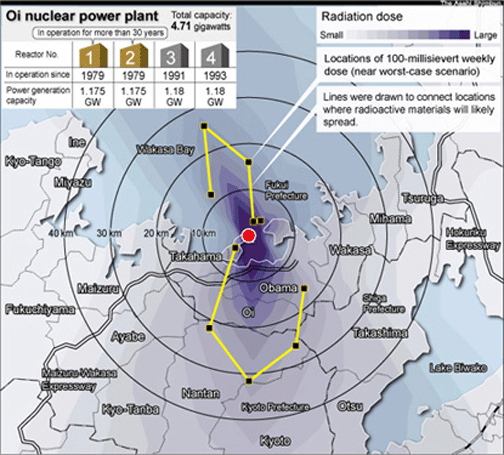
Forecast predicts wider evacuations needed if nuclear disaster repeated Nuclear watchdog may broaden definition of active fault lines October 24, 2012 THE ASAHI SHIMBUN A forecast of the radiation released in another nuclear accident shows that at four plants, a 30-kilometer evacuation zone would be insufficient for public safety, and that more distant residents would need to flee their homes too. Continue reading
Amid political and cost uncertainties, Japan to continue building some nuclear reactors
 uncertainties about the future cost of operating nuclear plants in Japan weaken the economic case for more atomic power. “There will be more costs for safety upgrades, and no one knows what kind of insurance system is going to be put in place. These things will make a big difference to generating costs.”….
Japanese plan to complete reactors raises doubts about nuclear phase-out WP, By Jonathan Soble | Financial Times, October 23 TOKYO — It has been only a month since Japan declared that it would close down its nuclear industry by the end of the 2030s, but already a contentious plan to complete several partially built reactors is sowing doubts about the government’s commitment to the radical policy shift…..
In the weeks since the nuclear phase-out was announced, Yukio Edano, industry minister, has said three approved but unfinished reactors are exempt from a central provision of the phase-out policy, under which no new plants will be built. Continue reading
Japan’s nuclear regulator warns that Fukushima’s situation is still precarious
Fukushima situation stable but still precarious: regulator (Reuters) Fredrik Dahl. 24 Oct, – The situation at Japan’s stricken Fukushima nuclear power plant has been stabilized but is still precarious, more than a year and a half after disaster struck, a senior Japanese regulatory official said on Wednesday.. Continue reading
Radiation hotspots in schools, playgrounds near Fukushima
 AFP: Some school facilities in Fukushima city exceeding radiation limit by 1,000% — Many hot spots around playground equipment are especially disturbing – http://enenews.com/afp-school-facilities-fukushima-city-exceed-radiation-limit-1000-many-hot-spots-around-playground-equipment-especially-disturbing-greenpeaceGreenpeace
Title: Japan’s radiation monitoring unreliable: Greenpeace
Source: AFP
Author: Kyoko Hasegawa
Date: Oct 23, 2012
Government radiation monitoring in areas near Japan’s crippled Fukushima nuclear plant is unreliable, Greenpeace charged on Tuesday, w, with heavily populated areas exposed to 13 times the legal limit.
The environmental group said authorities were wasting time cleaning up evacuated areas and should prioritise decontamination efforts in places where people live, work and play.
Greenpeace found that in some parks and school facilities in Fukushima city, home to 285,000 people, radiation levels were above three microsieverts per hour. Japan’s recommended radiation limit is 0.23 microsieverts per hour. […]
Rianne Teule, Greenpeace’s radiation expert
“We also found that official monitoring posts placed by the government systematically underestimate the radiation levels”
Some machines are shielded from radiation by surrounding metal and concrete structures
“Official monitoring stations are placed in areas the authorities have decontaminated. However, our monitoring shows that just a few steps away the radiation levels rise significantly”
“Decontamination efforts are seriously delayed and many hot spots that were repeatedly identified by Greenpeace are still there”
“It is especially disturbing to see that there are many hot spots around playground equipment, exposing children who are most vulnerable to radiation risks”
No solution to Fukushima’s melted nuclear fuel
Filmed: Oct. 18, 2012
Published: Oct. 21, 2012
 Translation: Fukushima Diary
Hiroaki Koide, Kyoto University Reactor Research Institute: There are a lot of problems and Tepco and Japanese government state they are going to pick the melted fuel up someday, somehow. I personally think it’s impossible.


30-km nuke safety zone may not be enough http://www.japantimes.co.jp/text/nn20121024a3.html Kyodo Radiation doses beyond 30 km from four nuclear plants, including those in Niigata and Fukui prefectures, could reach 100 millisieverts in the first seven days amid a severe meltdown crisis like the one that started in March 2011 at the Fukushima No. 1 complex, according to estimates by the Nuclear Regulation Authority.The NRA is crafting new guidelines on nuclear disaster mitigation measures based on the Fukushima disaster and has proposed a radius of 30 km from a nuclear plant as a rough standard for areas where special preparations against fallout exposure should be made.
The latest simulation results, however, could lead local governments to require preparations in areas beyond the 30-km zone.
The four nuclear power stations are Tokyo Electric Power Co.’s Kashiwazaki-Kariwa plant in Niigata Prefecture and Fukushima No. 2 plant in Fukushima Prefecture, Kansai Electric Power Co.’s Oi plant in Fukui Prefecture, and Chubu Electric Power Co.’s Hamaoka plant in Shizuoka Prefecture.
The NRA assumed two scenarios — one in which the amount of radioactive substances released is as high as in the Fukushima disaster and the other in which all reactors at each plant suffer meltdowns — to identify areas in which exposure could reach 100 millisieverts in the first seven days. The simulation did not take into account the geography around the plants.
For Kashiwazaki-Kariwa, areas located within a 40-km radius of the plant would register 100 millisieverts.
High radiation in Fukushima neighbourhoods
 Japan Newspaper: Radiation levels rising every month since decontamination in Fukushima district — Gov’t won’t help or even respond — “Are they forcing us to tolerate high radiation?” http://enenews.com/mainichi-radiation-levels-rising-every-month-since-decontamination-in-fukushima-district-govt-wont-help-or-even-respond-are-they-forcing-us-to-tolerate-high-radiation Title: One year on, Fukushima still fights uphill battle to decontaminate farming district
Source: Mainichi Japan
Date: Oct. 18, 2012
h/t Fukushima Diary
[…] The residents of the Onami district are frustrated with the government’s inaction, with one of them saying, “Are they forcing us to tolerate high radiation doses?” Continue reading
Japan official fudging of radiation readings
 False hope: radiation monitoring in the Fukushima area (includes video) Greenpeace by Greg McNevin – October 23, 2012 Last week, three Greenpeace radiation-monitoring teams took to the streets of Fukushima City and the heavily contaminated region of Iitate to again record and assess contamination threats.
Like many trips before, we noticed decreased expose rates in a few areas, but many hotspots remain throughout heavily populated Fukushima City. What is more concerning, however, is the official government radiation monitoring stations that have appeared throughout the city.
Earlier this month The Association for Citizens and Scientists Concerned About Internal Radiation Exposures raised concerns that the Japanese government was manipulating radiation readings with these official monitoring stations. Continue reading
Japan Engineer: Tepco won’t spend money needed at Fukushima Daiichi — Asahi: Tepco still giving large ‘donations’ to areas with nuclear facilities (VIDEO) http://enenews.com/japan-engineer-tepco-wont-spend-money-needed-fukushima-daiichi-asahi-tepco-giving-large-donations-areas-nuclear-facilities Continue reading
A HOAX about new Fukushima crisis should not make us think it is now SAFE
 Nuclear Perceptions Fight Reality OpEd News, By William Boardman, 22 Oct 12, FUKUSHIMA FREAKOUT OBSCURES REAL ACCIDENT THAT GOES ON AND ON An early morning flurry of internet reports carried scary – but false – headlines aboutFukushima nuclear power plant’s fuel pools exploding and burning, and releasing massive amounts of radiation on October 22. Many readers expressed skepticism, as the reports seemed to come from a single, unconfirmed source and by later the same afternoon more responsible websites were labeling the story a hoax .
The Fukushima accident in Japan continues nonetheless, at a slower pace for now, even though one of the more dangerous damaged units has cracks in its walls and is sinking into the ground, as affirmed by nuclear engineer Arnie Gunderson in his October 21 podcast .
Unit 4 at Fukushima is perhaps the most threatening part of the damaged plant because the unit’s fuel rods are outside the containment where further mishap could lead to the release massive amounts of radiation directly into the environment.
At the time of the earthquake in March 2011, about 100 miles of Japan’s coastline, including the area around Fukushima, dropped about three feet, increasing the impact of the tsunami that destroyed the nuclear power plant, which continues to deteriorate.
In recent weeks it’s become increasingly clear that Fukushima Unit 4, with its unprotected fuel rods is continuing to sink into the ground, and is sinking asymmetrically, creating the possibility that the building will begin to tilt. The unit sank about 36 inches in March 2011 and has sunk another 30 inches since then, as confirmed by Gunderson.
How Safe Is a Buckled, Sinking Building?…….. http://www.opednews.com/articles/Nuclear-Perceptions-Fight-by-William-Boardman-121022-931.html
In order to keep people happy, nuclear power plants were kept UNSAFE!
 Nuclear Perceptions Fight Reality OpEd News, By William Boardman, 22 Oct 12, FUKUSHIMA FREAKOUT OBSCURES REAL ACCIDENT THAT GOES ON AND ON ”….Perception of Safety Wins Out Over RealityAs has been widely reported, Tepco has known since 2002 that the Fukushima site was unsafe. “I actually think they knew in the eighties,” Gunderson commented. One reason TEPCO didn’t do anything was money, and another was public relations. They didn’t want to create the perception that the site was unsafe, so therefore they kept the site unsafe,” Gunderson said. He explained that they have since acknowledged their behavior and he read from a TEPCO public statement:
“There was a worry that, if the company were to implement a severe accident response plan, it would spur anxiety throughout the country and in the community where the plant was sited, and it would lend momentum to the anti-nuclear movement.”
Similar thinking in the U.S. was revealed by the release of a Nuclear Regulatory Commission (NRC) study that showed that 34 U.S. nuclear power plants at risk of flooding from dam failures upstream. Written about six months ago, but classified “not for public disclosure,” the studywas recently made public by a whistleblower.
“So here’s the NRC, America’s nuclear watchdog, doing exactly what Tokyo Electric did, preventing the public from becoming aware of a safety problem, because they don’t want to frighten the public,” Gunderson said….. http://www.opednews.com/articles/Nuclear-Perceptions-Fight-by-William-Boardman-121022-931.html
“Sleeping dragon” Fukushima reactor No 4 nuclear fuel pool
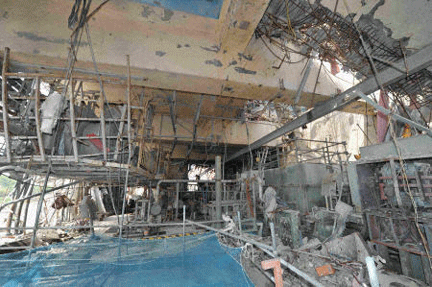 Nuclear Perceptions Fight Reality OpEd News, By William Boardman, 22 Oct 12, FUKUSHIMA FREAKOUT OBSCURES REAL ACCIDENT THAT GOES ON AND ON These buildings are supposed to be seismically and structurally secure and, you know, if the ground sinks under them, that suddenly changes a lot of people’s perception,” Gunderson said, underscoring the assurances of the nuclear industry that reactors are constructed to survive earthquakes intact. The Japanese “seismic calculations were wrong all along,” he added.
Unit 4 was first damaged by the earthquake/tsunami event, and then suffered several explosions during the aftermath. Tokyo Electric (TEPCO) acknowledged that the building was damaged and went in during the spring of 2011 to structurally reinforce the elevated fuel pool, to keep the bottom of the pool from breaking and dumping fuel rods uncontrollably.
Today the Unit 4 building is buckled, and is two inches wider at the bottom than at the top. There is at least one crack in its foundation.
Of the four Fukushima reactors and fuel pools, Unit 4 has the most nuclear fuel in the fuel pool, and no fuel in its reactor within the containment. All the fuel in Unit 4 is outside the relative safety of the containment. And part of that fuel is the entire hot nuclear core that used to be in the reactor. That’s why the fuel pool steams on colder days.
“There is dozens of times more Cesium in the nuclear fuel pool at Unit 4 than was ever released in all the above ground [nuclear bomb] testing that ever occurred, so if that pool were to face structural damage from another earthquake, it would likely devastate Japan,” Gunderson said, “It’s a sleeping dragon.”
He added that until Tepco gets the fuel out of the pool, the world needs to keeps its fingers crossed that there’s not another earthquake, because Tepco is moving too slowly and methodically to make the site safe any time soon…… http://www.opednews.com/articles/2/Nuclear-Perceptions-Fight-by-William-Boardman-121022-931.html
1 This Month





PLEASE OPPOSE HR 8255 AND S.3639 – bills would accelerate satellite deployment, with no environmental review or safeguards – https://ncstd5li.quorum.us/campaign/169331/
To see nuclear-related stories in greater depth and intensity – go to https://nuclearinformation.wordpress.com
-
Archives
- October 2026 (81)
- September 2026 (339)
- August 2026 (330)
- July 2026 (355)
- June 2026 (287)
- May 2026 (306)
- April 2026 (356)
- March 2026 (251)
- February 2026 (267)
- January 2026 (308)
- December 2025 (358)
- November 2025 (359)
-
Categories
- 1
- 1 NUCLEAR ISSUES
- business and costs
- climate change
- culture and arts
- ENERGY
- environment
- health
- history
- indigenous issues
- Legal
- marketing of nuclear
- media
- opposition to nuclear
- PERSONAL STORIES
- politics
- politics international
- Religion and ethics
- safety
- secrets,lies and civil liberties
- spinbuster
- technology
- Uranium
- wastes
- weapons and war
- Women
- 2 WORLD
- ACTION
- AFRICA
- Atrocities
- AUSTRALIA
- Christina's notes
- Christina's themes
- culture and arts
- Events
- Fuk 2022
- Fuk 2023
- Fukushima 2017
- Fukushima 2018
- fukushima 2019
- Fukushima 2020
- Fukushima 2021
- general
- global warming
- Humour (God we need it)
- Nuclear
- RARE EARTHS
- Reference
- resources – print
- Resources -audiovicual
- Weekly Newsletter
- World
- World Nuclear
- YouTube
-
RSS
Entries RSS
Comments RSS

