Japanese government ‘cooking the books’ on Fukushima health effects

 Mainichi: Gov’t “choreographed” event on Fukushima health effects http://enenews.com/mainichi-govt-choreographed-event-fukushima-health-effects/comment-page-1#comment-293237 October 5th, 2012 Title: Fukushima Prefecture prepared proceedings for nuke radiation meeting Source: Mainichi Date: Oct 5, 2012 The Fukushima Prefectural Government drew up proceedings for a health research panel prior to a formal July 2011 meeting on nuclear radiation, deciding in advance what members should say, the Mainichi has learned.
The drafted proceedings included concluding remarks about the results of the research on the health of Fukushima Prefecture residents […]
When contacted by the Mainichi Shimbun about the choreographed proceedings, a prefectural government official in charge said the Fukushima government “may have produced” a chart of proceedings but declined to make further comment. […]
[The chart] ended with the prearranged conclusion that internal exposure to cesium 134 and cesium 137 was less than 1 millisievert in total and extremely low […]
A prefectural government official said the chart may have been prepared for the panel chairman, Shunichi Yamashita, vice president of Fukushima Medical University. […]
See also: Gov’t held secret meetings about human health impacts from Fukushima crisis
More on Yamashita: Head of Fukushima health study: 100 mSv/yr OK for pregnant moms — “Effects of radiation do not come to people that are happy… They come to people that are weak-spirited”
First case of compensation for cancer in Fukushima worker
 Fukushima workers started having cancer
http://fukushima-diary.com/2012/10/fukushima-workers-started-having-cancer/ by Mochizuki October 5th, 2012 In September, Ministry of Health, Labour and Welfare admitted a Fukushima worker applied for workmen’s compensation insurance. It isfor gastric cancer, esophageal cancer or colon cancer.
This is the first case of the application of workmen’s compensation insurance. The occupational disease department of MHLW is concealing the profile and the integral dose of the worker.
Another nuclear worker commented like this below, Continue reading
Politics in Japan, as government muddles over Fukushima crisis
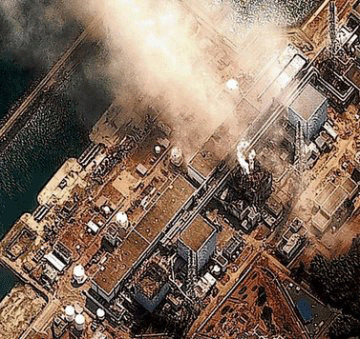 Fukushima Nuclear Crisis Update for October 2nd to October 4th, 2012 Greenpeace International, by Christine McCann – October 5, 2012 Nuclear Regulation Authority Japan’s Nuclear Regulation Authority (NRA) has released new guidelines for nuclear disasters, including expanding the evacuation zone around nuclear reactors from 10 to 30 km. The move will have a significant impact on local communities, which now need to craft complicated evacuation plans. Previously, only 45 municipalities in 15 prefectures were required to have nuclear emergency plans; now 135 municipalities in 21 prefectures are required to submit them by March 2013. Iodine tablets will also be distributed to anyone living within 50 km of a nuclear reactor. Local officials are complaining that the central government has not shared radiation diffusion simulation data, which makes it impossible to determine where to send people if a nuclear accident occurs. Continue reading
 Yamaguchi Prefecture kills project for new nuclear plant
 Yamaguchi rejects Chugoku Electric’s license for new nuclear plant http://ajw.asahi.com/article/behind_news/social_affairs/AJ201210050069 5 Oct 12, THE ASAHI SHIMBUN YAMAGUCHI–Yamaguchi Governor Shigetaro
 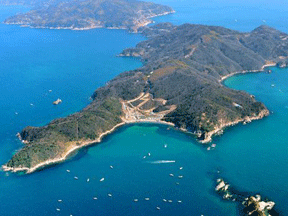 Yamamoto has rejected a license extension to Chugoku Electric Co. to reclaim land for a new nuclear power plant in Kaminoseki, Yamaguchi Prefecture effectively killing the project.
“We cannot grant permission at this moment. The decision has been made
not to grant the license,” Yamamoto told the news media on Oct. 5. The
license is set to expire Oct. 6. Continue reading
Other Nuclear Politics in Japan
Fukushima Nuclear Crisis Update for October 2nd to October 4th, 2012 Greenpeace International, by Christine McCann – October 5, 2012 “….Other Nuclear Politics in Japan Municipal leaders and residents in towns surrounding Electric Power Development Company’s (known in Japan as J-Power) proposed Ohma nuclear power plant are protesting resumption of construction there, citing concerns about their safety in the event of a nuclear disaster. Continue reading
Fukushima residents treated with discrimination, like the hibakusha
the same sort of discrimination is happening to people who were exposed to radiation in Fukushima.
Voices of the “Explosion Covered People” http://www.npr.org/blogs/pictureshow/2012/09/25/161755636/voices-of-the-explosion-covered-people More than 65 years after atom bombs were dropped on Hiroshima and Nagasaki, there are still thousands of people suffering. In addition to experiencing lingering effects from the radiation, many are also considered social outcasts.
The term hibakusha in Japanese means “explosion-covered people” and applies to anyone who came within 2 kilometers (approximately 1.25 miles) of the hypocenter of the bomb — within two weeks of the explosion. Thought to be diseased and contagious, many people hid their experience from friends, family and society at large to avoid being shunned. Continue reading
State of the Fukushima Reactors
Fukushima Nuclear Crisis Update for October 2nd to October 4th, 2012 Greenpeace International, by Christine McCann – October 5, 2012 “…State of the Fukushima Reactors TEPCO has finally installed a new thermometer in the crippled #2 reactor at the Fukushima Daiichi plant. The reactor experienced a meltdown in the days following the Fukushima nuclear disaster; since then, five out of six thermometers in the reactor have broken. If the final thermometer broke, the utility would have no way of knowing if the reactor was overheating and in danger of further meltdown. Although they cannot see inside the reactors, workers believe that the new thermometer is near the bottom of the pressure vessel.
The NRA will declare the Fukushima Daiichi plant a “special nuclear facility” in order to oversee stabilization of the plant, as well as its decommissioning. Currently, the agency has no authority over TEPCO’s plans there. NRA Chair Shunichi Tanaka said this week that the Fukushima plant is still unstable, contradicting earlier government reports that operations there had been stabilized.
This week, TEPCO began removing 764 spent fuel rods from reactor #4 at its Fukushima Daini power plant. The Daini plant is located approximately 11 km from the crippled Fukushima Daiichi plant, where a triple meltdown occurred after power was lost there after last year’s massive earthquake and tsunami. Although a nuclear emergency was also declared at the Daini plant, workers were able to recover cooling systems and avoid meltdowns at the reactors. The utility is moving the rods to a storage pool on upper floors of the building, and eventually plans to follow suit with reactors #1, #2, and #3, a process that will continue through the end of 2014. (Source: NHK) http://www.greenpeace.org/international/en/news/Blogs/nuclear-reaction/fukushima-nuclear-crisis-update-for-october-2/blog/42456/
Human Rights request to Fukushima Prefecture
 Human Rights Now (3 September 2012)【Statement】Request for the Radical Reform of the Health Check System including Thyroid Examination for the Affected People by the Nuclear Power Plant Accident “…..HRN requests to Fukushima prefecture to:
1. Conduct the thyroid examination for children at least once a year for the “early identification” and “early treatment.” Especially when the thyroid nodules or cysts are recognized, establish and implement the system quickly;
2. Expand the thyroid examination to adults, and also conduct the blood and urine examinations;
3. Provide information of the thyroid examination and others (such as blood examination and thyroid sonogram) conducted by the prefecture to first-person or their parents, and provide explanation if requested;
4. Store the result of the thyroid examination over a long period of time for the future follow-up and comparison, and disclose the information of the examination result when requested by the examinees or their parents, without asking the information disclose procedure. Also, take necessary measures so that other municipalities and medical institutes that will provide the health examinations can share the data.
HRN requests to the state to:
1. From the position of protecting the residents’ rights to health around the nuclear power plant accident, as a responsibility of the state, construct the guidelines regarding health checks, examination, and medical treatment promptly. In the course of that, take into account the international perception and the good practice of medical policies, taken by the related countries of the Chernobyl accident;
2. Publish guidelines about the information disclosure of the result of health examinations including the thyroid examination, and instruct the prefecture;
3. As a state, commit to the health checks of the prefecture, and request the drastic reform and improvement of the examination system, based on the above mentioned recommendations towards Fukushima prefecture;
4. Provide a financial support to the municipalities in Fukushima prefecture to enable them to establish the examination systems including the thyroid examination and the internal exposure examination; secure the base hospitals of the health examinations including the thyroid examination in all areas in Japan, and provide a financial support so that the affected people are able to take necessary examinations, such as thyroid and internal exposure examinations, for free at least once a year, regardless of their living place.
HRN requests to Mr. Shunichi Yamashita (the head of the Exploratory Committee on the “Fukushima Health Management Survey,” the vice-president of the Fukushima Medical University, and the president of theRadiation Medical Science Center for the Fukushima health management survey) to:
1. Officially withdraw the announcement (dated 16 January 2012) sent to the members of the Japan Thyroid Association.
These recommendations are all important to protect the right to people’s health (Article 25 of the Constitution, and the International Covenant on Economic, Social, and Cultural Rights), therefore, prompt improvement and implementation are required. http://hrn.or.jp/eng/activity/area/japan/statementrequest-for-the-radical-reform-of-the-health-check-system-including-thyroid-examination-for/
Contamination, Including Human Exposure – Fukushima
Fukushima Nuclear Crisis Update for October 2nd to October 4th, 2012 Greenpeace International, by Christine McCann – October 5, 2012 “…Contamination, Including Human Exposure The JAEC has begun monitoring radiation levels in restricted zones of Fukushima Prefecture via unmanned helicopters. The project, which was requested by the Ministry of Education, Culture, Sports, Science, and Technology (MEXT), marks the first time that radiation has been measured from the air in the no-go zone. The agency will compile a report by the end of the month, including radiation maps of hotspots. Meanwhile, another research team is studying radiation levels in forests and rivers there, in order to determine their effect on human habitats and the ocean. The research will continue for the next 20 years. (Source: NHK)
Researchers from the Nippon Veterinary and Life Science University (NVLU) have begun to study the effects of radiation on Japanese macaques, noting that the similarities between primates and humans may help them determine how radiation could eventually affect people. Shin-ichi Hayama, one of the scientists working on the project, said, “This presents an opportunity to study the impact of low-dose radiation on primates, which are so close to humans, over a more than 20-year period. That could help forecast the impact on humans, as well.”http://www.greenpeace.org/international/en/news/Blogs/nuclear-reaction/fukushima-nuclear-crisis-update-for-october-2/blog/42456/
Evacuation and Repopulation – Fukushima
Fukushima Nuclear Crisis Update for October 2nd to October 4th, 2012 Greenpeace International, by Christine McCann – October 5, 2012 “…Evacuation and Repopulation In spite of efforts by the central government to lift evacuation orders and begin repopulating some areas of Fukushima Prefecture located between 20 and 30 km from the site of the Fukushima nuclear disaster, a new survey conducted by the Asahi Shimbun shows that only 11% of those who evacuated the prefecture have returned. Approximately 58,000 people lived there before the crisis erupted, and 48% evacuated in the months following the nuclear meltdowns. The area includes Minami-Soma, Tamura, Kawauchi, Nahara, and Hirono… http://www.greenpeace.org/international/en/news/Blogs/nuclear-reaction/fukushima-nuclear-crisis-update-for-october-2/blog/42456/
Massive solar power farm for Japan
SMA Solar Inverters To Be Used In Japan’s Biggest Solar Farm http://www.energymatters.com.au/index.php?main_page=news_article&article_id=3409 5 Oct 12 SMA has been selected as the sole supplier of inverters for Japan’s largest solar power plant.
The 70 megawatt solar panel based project operated by Kagoshima Mega Solar Power Corporation will utilise 140 Sunny Central 500CP–JP inverters. SMA will also supply 1,260 Sunny String Monitors for monitoring the massive solar farm. Continue reading
Japan’s intelligence agency pressed for stopping research on radiation spread
Intelligence agency pressured researchers to withhold info on spread of Fukushima radiation http://enenews.com/intelligence-agency-pressured-researchers-to-stop-investigating-spread-of-fukushima-radiation October 3rd, 2012
Title: Government body pressured to withhold info on Fukushima radiation
Source: The Hankyoreh (S. Korea)
Author: Lee Keun-young
Date: Oct. 3, 2012
Government body pressured to withhold info on Fukushima radiation
The National Institute of Environmental Research (NIER) abruptly halted its inquiry last year into the dispersion of radiation from Japan’s Fukushima nuclear power plant disaster after contacting the National Intelligence Service, it was belatedly revealed on Oct. 2.
[…]
lawmaker Chang Ha-na […] said on Oct. 2 that an examination by the Ministry of Environment inspector’s office at the [sic] showed NIER research to predict the spread of radiation from Fukushima, and its effects on South Korea, was halted immediately after a report to the NIS.
[…]
The inspector’s office examination took place in the immediate wake of March reports from the Hankyoreh and other news outlets alleging NIS involvement in the decision to suspend NIER research indicating that trace amounts of radiation were reaching the Korean Peninsula.
[…]
The inspector’s office requested a “stern warning” to [the NIER director] to ensure no similar incidents occurred in the future.
[…]
“This is as good as an admission that there was pressure from the NIS,” [lawmaker Chang] added.
New nuclear reactor now being built North of Tokyo
 Work resumes on Japanese nuclear reactor http://www.abc.net.au/news/2012-10-02/japan-resumes-reactor-work/4290390 By North Asia correspondent Mark Willacy,2 Oct 12, A Japanese power firm has resumed construction of an atomic reactor, despite government plans to phase out nuclear power in the wake of the Fukushima disaster.
The reactor – 650 kilometres north of Tokyo – is being built by the J-Power company which had planned to have it operational in two years’ time. The company says it has now resumed construction of the reactor which was halted work after the Fukushima meltdowns. Continue reading
Fukushima compensation payments 1.24 trillion yen, and rising
TEPCO must compensate nuclear accident victims quickly The Yomiuri Shimbun, 2 Oct 12
The government should further enhance its system to resolve disputes over compensation for damage caused by the crisis at the Fukushima No. 1 nuclear power plant so people suffering from the nuclear accident can be helped appropriately and quickly.
By late September, 940,000 compensation claims had been made against Tokyo Electric Power Co., the operator of the nuclear plant, for damage caused by the crisis. The claimants and TEPCO have reached agreements in 860,000 cases. The total compensation has already reached 1.24 trillion yen and will increase further. This shows the seriousness of the accident, which has forced 160,000 local residents to evacuate.
Under a compensation scheme for the damage caused by the crisis, the government first pays evacuees the money and later requires TEPCO to repay it. Compensation is calculated based on criteria set by the government’s Committee for Dispute Resolution for Compensating Damages from the Nuclear Power Plant Incident.
The criteria require TEPCO to pay compensation for such expenses as evacuation transportation fees and damage to farmers and other people who lost their businesses due to the crisis.
The agreement ratio has been high in initial compensation negotiations, but many crisis victims are still dissatisfied with the amount of reparations…… http://www.yomiuri.co.jp/dy/editorial/T121001002720.htm
Japan’s Indistry Minister calls for a quick phaseout of nuclear energy
 The most serious problem is spent fuel buildup at each plant as well as an additional storage at a fuel reprocessing plant in Aomori prefecture, northern Japan. The country lacks plans about what to do with the highly radioactive waste.
Minister: Japan Must Quickly Phase out Nuke Energy abc news, By MARI YAMAGUCHI Associated Press TOKYO September 29, 2012 Japan’s industry minister said the country must give up nuclear power plants as soon as possible because they pose too much risk in one of the world’s most earthquake-prone countries.
Yukio Edano said last year’s meltdowns after a tsunami hit the Fukushima Dai-ichi plant showed that nuclear power’s cost is too high. He expressed the opinion in his new book of policy views that hit stores Saturday.
Edano, who served top government spokesman during the height of the nuclear crisis last year, said he came to the conclusion after seeing “what was believed to be masterpiece of modern technology succumb to natural disaster so easily.”
“Now I want to eliminate nuclear power plants as soon as possible,” he wrote in the book, “Even if I get a beating, I must say this.”…. Continue reading
1 This Month





PLEASE OPPOSE HR 8255 AND S.3639 – bills would accelerate satellite deployment, with no environmental review or safeguards – https://ncstd5li.quorum.us/campaign/169331/
To see nuclear-related stories in greater depth and intensity – go to https://nuclearinformation.wordpress.com
-
Archives
- October 2026 (81)
- September 2026 (339)
- August 2026 (330)
- July 2026 (355)
- June 2026 (287)
- May 2026 (306)
- April 2026 (356)
- March 2026 (251)
- February 2026 (267)
- January 2026 (308)
- December 2025 (358)
- November 2025 (359)
-
Categories
- 1
- 1 NUCLEAR ISSUES
- business and costs
- climate change
- culture and arts
- ENERGY
- environment
- health
- history
- indigenous issues
- Legal
- marketing of nuclear
- media
- opposition to nuclear
- PERSONAL STORIES
- politics
- politics international
- Religion and ethics
- safety
- secrets,lies and civil liberties
- spinbuster
- technology
- Uranium
- wastes
- weapons and war
- Women
- 2 WORLD
- ACTION
- AFRICA
- Atrocities
- AUSTRALIA
- Christina's notes
- Christina's themes
- culture and arts
- Events
- Fuk 2022
- Fuk 2023
- Fukushima 2017
- Fukushima 2018
- fukushima 2019
- Fukushima 2020
- Fukushima 2021
- general
- global warming
- Humour (God we need it)
- Nuclear
- RARE EARTHS
- Reference
- resources – print
- Resources -audiovicual
- Weekly Newsletter
- World
- World Nuclear
- YouTube
-
RSS
Entries RSS
Comments RSS

