New safety regulations for Japanese nuclear reactors: in force from July
Japanese nuclear regulators present new safety measures THE HINDU, TOKYO, JAN 21: Japan’s nuclear regulators on Monday presented a draft outline of new safety measures to prevent or minimise the consequences of severe accidents like Fukushima nuclear disaster.
Among other features, the Nuclear Regulation Authority said utilities will be required to build a special safety facility housing a secondary control room for reactor operations to guard against accidents from natural disasters or acts of terrorism, such as intentional aircraft crashes.
Japan’s new nuclear safety standards are expected to come into force in July, replacing the current ones that proved insufficient in the wake of the 2011 Fukushima nuclear disaster.
The implementation of new safety standards is a major precondition for Japanese power companies to apply for government permits to put their idled reactors back online…… Continue reading
Corporations circle around for lucrative nuclear waste cleanup
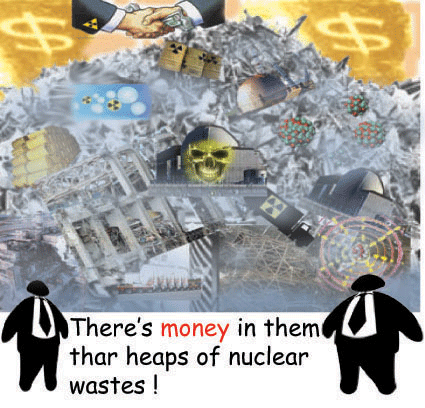 UK firms to bid for Japan’s nuclear clean-up
http://www.independent.co.uk/news/business/news/uk-firms-to-bid-for-japans-nuclear-cleanup-8458524.html
MARK LEFTLY, 20 JANUARY 2013 British engineers Amec, Babcock
International, and Atkins are believed to be circling nuclear
decommissioning work estimated to be worth at least $5bn (£3.2bn) in
Japan as a result of the Fukushima disaster.
The new Japanese government is thought to be preparing decommissioning
contracts that will include Fukushima’s Daiichi plant, which was
overwhelmed by a tsunami in 2011, and other reactors in seismically
endangered areas.
A nuclear source said bids could be invited for the clean-up work
before the end of the year, with British groups in a strong position
due to all the decommissioning work that has been undertaken in the
UK.
US-owned Energy Solutions will also be interested.
“This is a huge opportunity,” claimed the source. “Japan should start
making some real progress on decommissioning now.”
Japanese professors remind public of the story of hibakusha
 The next few years will be crucial in collecting oral
histories from hibakusha. I feel a sense of responsibility as the last
generation that can learn directly from the victims.
INTERVIEW: Scholars call for greater cooperation between Hiroshima,
Nagasaki in anti-nuclear push January 20, 2013 THE ASAHI SHIMBUN
Two scholars who have spent their careers collating first-hand
accounts of atomic victims from Hiroshima and Nagasaki and using those
experiences to push for nuclear disarmament sat down with The Asahi
Shimbun to talk about their research into the 1945 attacks.
Taeko Kiriya, 32, is an assistant professor at the Hiroshima Peace
Institute of Hiroshima City University while Keiko Nakamura, 40, is an
associate professor at the Research Center for Nuclear Weapons
Abolition (RECNA) at Nagasaki University.
Excerpts of the interviews follow:…… Continue reading
Japan’s govt confirms cases of badly done nuclear decontamination work
CROOKED CLEANUP: Government confirms 5 cases of shoddy decontamination
work January 18, 2013 THE ASAHI SHIMBUN
The Environment Ministry on Jan. 18 said that there have been five
cases of shoddy decontamination work around the crippled Fukushima No.
1 nuclear power plant and has punished the general contractors
involved in the cleanup effort.
In the five instances, three general contractors were ordered to take
corrective actions, the ministry said on Jan. 18 in its report on the
investigation into the central government-commissioned work, following
reports of the suspected such dumping of potentially radioactive
debris. Two other contractors were given guidance on following proper
procedures.
The ministry also announced that countermeasures would be taken for
preventing illegal dumping in the future….
http://ajw.asahi.com/article/0311disaster/fukushima/AJ201301180075
Fukushima fish – radiation levels 2500 times the legal limit
 Record high radiation level found in fish http://www.news.com.au/breaking-news/world/record-high-radiation-level-found-in-fish/story-e6frfkui-1226557111874#ixzz2IRxmSfvD January 19, 2013
Tokyo Electric Power Co (TEPCO) said caesium equivalent to 254,000 becquerels per kilogram – or 2540 times more than the government seafood limit – was detected in a “murasoi” fish.
The fish, similar to rockfish, was caught at a port inside the Fukushima plant, a TEPCO spokesman said.
The Fukushima Daiichi nuclear plant was battered by a towering tsunami following a huge earthquake on March 11, 2011, causing reactor meltdowns which spewed radioactive contamination into the atmosphere.
Fishing around Fukushima was halted and the government banned beef, milk, mushrooms and vegetables from being produced in surrounding areas.
Nuclear reactors in operation – drop in numbers, as IAEA reclassifies 47 Japanese reactors as “Long-term Shutdown” (LTS)
IAEA Shifts 47 Japanese Reactors Into “Long-Term Shutdown” Category 16 January 2013 In an unprecedented move, the International Atomic Energy Agency (IAEA) has shifted 47 Japanese nuclear reactors from the category “In Operation” to the category “Long-term Shutdown” (LTS) in its web-based Power Reactor Information System (PRIS). The number of nuclear reactors listed as “In Operation” in the world thus drops from 437 yesterday to 390 today, a level last seen in Chernobyl-year 1986 and a dramatic step of the IAEA’s official statistics in recognizing industrial reality in Japan.
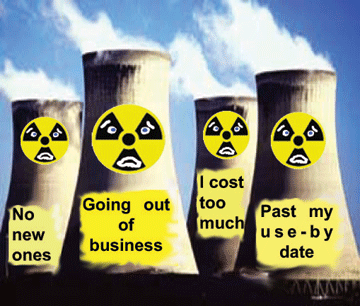
This is without doubt a unique revision of world operational nuclear data. However, numerous questions remain. The definitions of the IAEA’s reactor status categories remain unclear. Units can remain in the LTS category for many years, without any apparent limit. Japan has now 48 units listed as LTS, one of which is the fast breeder reactor Monju that has not been generating electricity since a sodium fire severely damaged the plant in 1995, while three further units at Kashiwazaki-kariwa have not been generating power since an earthquake hit the site in 2007.
Radioactive groundwater leaking into Fukushima reactors
Tepco Official in US: “We are still seeing leakage” — Contaminated groundwater seeping into reactor areas http://enenews.com/tepco-official-leakage-contaminated-groundwater-seeping-reactor-areas
Title: Fukushima recovery aided by SRS cleanup technology
Source: The Augusta Chronicle
Author: Rob Pavey
Date: Jan. 15, 2013

[…] Even after almost two years of nonstop cleanup work, managing the flow of water contaminated with radiation continues to be one of site’s most significant challenges, [Masumi Ishikawa, TEPCO’s general manager for radioactive fuel management] said.
“We are still seeing leakage,” he said. “That is an important challenge we must meet.”
Maintaining the essential flow of cooling water to the melted reactors, he said, has been complicated by the need to remove and treat contaminated groundwater that has seeped into the reactor areas since the March 2011 earthquake and tsunami.
[…] Ishikawa said the plant site will almost certainly play some sort of role in the future.
“Our new prime minister explicitly has said, Japan’s revitalization will not happen without the revitalization of Fukushima Dai-ichi,” he said.
See also: ‘Impermeable wall’ between leaking Fukushima reactors and ocean yet to be built — Tepco still working on silt fence (PHOTO)
World’s largest offshore wind farm for Japan
 Japan to build world’s largest offshore wind farm, New Scientist, 16
January 2013 by Rob Gilhooly, Tokyo It’s goodbye nuclear, hello
renewables as Japan prepares to build the world’s largest offshore
wind farm this July. Continue reading
There’s money in them thar nuclear wastes
Veolia Draws Upon Fukushima to Move Into Nuclear Dismantling, Bloomberg, By Tara Patel – Jan 15, 2013 Veolia Environnement SA (VIE), which treated radioactive water from Japan’s nuclear meltdown at Fukushima, plans to use the experience to move into decontamination and power plant dismantling.
The water utility and the nuclear research group known as CEA plan to earn as much as 400 million euros ($534 million) in revenue within about four years by cleaning radioactive sites and taking apart installations, they said today.
“The market is developing very quickly,” Veolia Chief Executive Officer Antoine Frerot told a press conference today in Paris. About 300 nuclear reactors will have to be halted worldwide within two decades including in France, Germany, Japan and the U.S., he said.
The shift into the atomic market comes after President Francois Hollande pledged to lower France’s dependence on the energy and shut the country’s oldest plant at Fessenheim. It’s also the first new market Veolia has publicly announced it will enter into since Frerot pledged to pull out of some countries and businesses in a bid to boost profit…… http://www.bloomberg.com/news/2013-01-15/veolia-draws-upon-fukushima-to-move-into-nuclear-dismantling-1-.html
Japan’s nuclear regulator to set rules about tsunami heights
Watchdog to define maximum tsunami heights for nuclear plants January
16, 2013.Asahi Shimbun, By RYUTA KOIKE/ Staff Writer
The Nuclear Regulation Authority decided Jan. 15 to set maximum
heights of possible tsunami striking individual nuclear plants and
obligate their operators to take commensurate safety measures. Continue reading
Cesium near Fukushima now 10 times higher than previous highest measurement
 Over 1,000,000 Bq/kg of cesium near Fukushima plant — 10 times higher than highest measurement in prior soil survey
http://enenews.com/1000000-bqkg-cesium-fukushima-plant-10-times-higher-highest-reading-prior-soil-survey
January 12th, 2013
Environment Ministry’s radioactive monitoring in Fukushima with summary translation by Fukushima Diary:
http://www.env.go.jp/jishin/monitoring/result_pw130110-1.pdf
Soil sampled on Oct. 25, 2012 from beside an reservoir in Okuma
Cs-134 : 400,000 becquerels per kilogram (Bq/kg)
Cs-137 : 650,000 Bq/kg
Combined Cs-134, -137: 1,050,000 Bq/kg
Nikkei’s report on the monitoring says the highest t reading was 96,000 Bq/kg of Cs-134 and -137 during last summer’s research, detected in soil from a reservoir in Namie.
Shortage of workers at Fukushima nuclear plant resulted in high radiation exposure
Worker shortages revealed at nuclear plant after disaster
http://www.yomiuri.co.jp/dy/national/T130113003104.htm 14 Jan
A manager’s calls for reinforcements to help contain a series of
crises at Tokyo Electric Power Co.’s Fukushima No. 1 nuclear power
plant were ignored, newly released TEPCO teleconference footage has
revealed.
Although Masao Yoshida, then manager of the plant damaged by the March
11, 2011, earthquake and tsunami, repeatedly asked TEPCO headquarters
in Tokyo to send more workers, the request was not met in a timely
manner. As a result, the plant’s workers suffered extreme fatigue and
heightened radiation exposure, the footage showed. Continue reading
Japan’s new government hand in glove with the old “nuclear village”
the public
remains sceptical about industry promises to mend its ways after
decades of collusion with regulators and pro-nuclear politicians.
But those concerns are unlikely to hold much sway with the LDP, which
helped develop Japan’s “nuclear village” – the web of power utilities,
bureaucrats and MPs who peddled the nuclear dream and shunned rigorous
regulation…..

Japan seeks to reverse commitment to phase out nuclear power, Justin
McCurry in Tokyo guardian.co.uk, Friday 11 January 2013 The Fukushima
Daiich meltdown prompted the previous government to pledge a phaseout
of all 50 reactors in Japan Almost two years after the triple meltdown
at Fukushima Daiichi power plant sent shockwaves around the world,
Japan’s government is attempting to resell the nuclear dream to a
traumatised public. Continue reading
Full radiation decontamination of Fukushima region an impossible task
 Asahi: We are reminded anew of the huge scale of contamination released from Fukushima plant — Impossible to recover pre-disaster environment — Radiation levels not dropping in certain areas http://enenews.com/asahi-reminded-anew-huge-scale-contamination-released-fukushima-plant-impossible-recover-pre-disaster-environment-radiation-levels-dropping-areas
(Subscription Only) Title: EDITORIAL: More data needed to make decontamination work effective
Source: Asahi
Date: January 09, 2013
Decontamination work is in progress in areas affected by the March 2011 accident at the Fukushima No. 1 nuclear power plant, but cases have been uncovered of workers dumping contaminated soil, vegetation and water into nearby rivers or other places without properly collecting them.
[…] One problem is that radiation levels are not dropping in certain areas. Another problem is that additional manpower is required, but hiring more workers isn’t financially viable.
Thinking about those problems, we are reminded anew of the huge scale of contamination caused by the Fukushima nuclear disaster.
It is impossible to recover the pre-disaster environment, and it is unrealistic to think that all affected areas can be decontaminated. […]
Poor conditions, poor morale of Fukushima radiation clean-up workforce
Fukushima ‘decontamination’ workers threatened — We were punished if we tried to resist http://enenews.com/fukushima-decontamination-workers-threatened-we-were-punished-if-we-tried-to-resist
January 9th, 2013
(Subscription Only) Title: CROOKED CLEANUP: Decontamination workers say cutting corners came naturally
Source: THE ASAHI SHIMBUN
Author: Compiled from reports by Tamiyuki Kihara and Toshio Tada
Date: January 09, 2013
[… Workers] cited a lack of training, unreasonable deadlines, threats of isolation, and persistent feelings that their efforts were pointless. […]
Asahi Shimbun reporters and the company have received more than 100 e-mails and phone calls from people involved in the decontamination project in Fukushima Prefecture. […]
50-year-old worker involved in decontaminating Tamura between Nov. 5 and Dec. 28 who was born in Fukushima Prefecture and graduated from Waseda University in Tokyo
“We were pressed to finish the work as quickly as possible”
“If we tried to resist, we would become isolated from other workers, although it did not reach the extent of losing the job”
“With sub-zero temperatures in the mountains, being placed in such circumstances would have led to feelings of loneliness among many people”
“Radiation levels returned even after we completed the work, so there was a sense that what we were doing was worthless”
“There will be no end to the shoddy work even if oversight is strengthened”
1 This Month





PLEASE OPPOSE HR 8255 AND S.3639 – bills would accelerate satellite deployment, with no environmental review or safeguards – https://ncstd5li.quorum.us/campaign/169331/
To see nuclear-related stories in greater depth and intensity – go to https://nuclearinformation.wordpress.com
-
Archives
- October 2026 (74)
- September 2026 (339)
- August 2026 (330)
- July 2026 (355)
- June 2026 (287)
- May 2026 (306)
- April 2026 (356)
- March 2026 (251)
- February 2026 (267)
- January 2026 (308)
- December 2025 (358)
- November 2025 (359)
-
Categories
- 1
- 1 NUCLEAR ISSUES
- business and costs
- climate change
- culture and arts
- ENERGY
- environment
- health
- history
- indigenous issues
- Legal
- marketing of nuclear
- media
- opposition to nuclear
- PERSONAL STORIES
- politics
- politics international
- Religion and ethics
- safety
- secrets,lies and civil liberties
- spinbuster
- technology
- Uranium
- wastes
- weapons and war
- Women
- 2 WORLD
- ACTION
- AFRICA
- Atrocities
- AUSTRALIA
- Christina's notes
- Christina's themes
- culture and arts
- Events
- Fuk 2022
- Fuk 2023
- Fukushima 2017
- Fukushima 2018
- fukushima 2019
- Fukushima 2020
- Fukushima 2021
- general
- global warming
- Humour (God we need it)
- Nuclear
- RARE EARTHS
- Reference
- resources – print
- Resources -audiovicual
- Weekly Newsletter
- World
- World Nuclear
- YouTube
-
RSS
Entries RSS
Comments RSS

