Japan’s nuclear phase-out has already happened:will it really phase-in again?
several fundamental nuclear-policy questions await answers—answers that could have significant consequences for the communities hosting Japan’s nuclear facilities, broader Japanese society and, to some extent, the global nuclear order. Beyond Japan’s two operating reactors, how many more of Japan’s fifty viable reactors will be allowed to restart? Will Japan continue its current effort to close the nuclear fuel cycle? What is the future for the industry’s fuel-cycle facilities in Aomori Prefecture and the nuclear materials currently stored there and at reactor sites around the country?
nuclear energy continues to be deeply unpopular in Japan, with opposition remaining well above 70 percent
the phase-out has already happened. The prescient concern would be a nuclear phase-in,
 Japan’s Nuclear Muddle, The National Interest Ryan Shaffer | January 10, 2013 Japan’s December election put an end to the brief rule of the Democratic Party of Japan (DPJ). It also handed an overwhelming victory and lower house majority to Japan’s traditional political leaders, the Liberal Democratic Party (LDP). However, still lacking a majority in the upper house, the LDP’s ability to push through legislation is dependent on its alliance with New Komeito, a party with significant policy differences on some of the immediate questions facing the LDP.
Between now and the next scheduled elections for Japan’s upper house in July 2013, the LDP’s first priority will be posturing for an upper house majority in the next election, not taking hard stands on controversial policy issues. One such issue concerns the country’s heated debate on nuclear energy. Continue reading
Inadequate radiation checkups for population near Fukushima area
As radiation fears dwindle, so do checkups Doctor wants more residents
to get followup full-body scans, Japan Times, By MIZUHO AOKI, 10 Jan
13, “……..As residents have come to understand more about radiation
and that their internal exposure levels are low, an air of calm has
been noticeable. At the same time, residents’ interest in knowing
their exposure levels has waned.
“I’m surprised to see such a dramatic loss of interest in just about a
year and a half,” said Tsubokura, 30, who works several days a week at
Minamisoma hospital and the rest of the week at the University of
Tokyo. “The biggest issue we have now is finding ways to secure
continuous checkups for internal radiation exposure.” Continue reading
Fukushima cleanup led by company that built the nuclear reactors
 NY Times: Japan’s cleanup denounced — “A disgrace… absolutely irresponsible” — Company that built all six Fukushima reactor buildings is leading ‘decontamination’ http://enenews.com/nytimes-japans-cleanup-denounced-disgrace-absolutely-irresponsible-company-built-all-six-fukushima-reactor-buildings-control-decontamination
January 8th, 2013
Title: Japan’s Cleanup After a Nuclear Accident Is Denounced
Source: NYTimes
Author: HIROKO TABUCHI; Makiko Inoue contributed reporting
Date: January 7, 2013
The decontamination crews at a deserted elementary school here are at the forefront of what Japan says is the most ambitious radiological cleanup the world has seen […]
Recent reports in the local media of cleanup crews dumping contaminated soil and leaves into rivers has focused attention on the sloppiness of the cleanup.
[…] the central and local governments have handed over much of the 1 trillion yen decontamination effort to Japan’s largest construction companies. […]
Kajima also built the reactor buildings for all six reactors at the Fukushima Daiichi plant, leading some critics to question why control of the cleanup effort has been left to companies with deep ties to the nuclear industry. […]
“What’s happening on the ground is a disgrace” -Masafumi Shiga, president of Shiga Toso, a refurbishing company based in Iwaki, Fukushima
“This isn’t decontamination — it’s […] absolutely irresponsible” -Tomoya Yamauchi, an expert in radiation measurement at Kobe University
See also: Gundersen: Truly appalling nuclear event in Japan — A lot of people are very, very concerned (AUDIO)
Fukushima clean-up mess – a disaster on top of the nuclear disaster
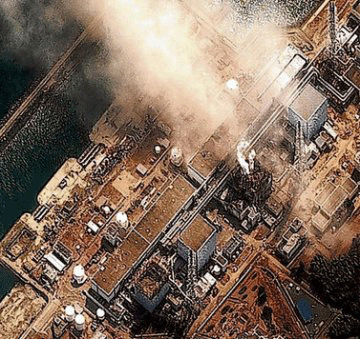 Fukushima Cleanup Workers Have Been Dumping Contaminated Debris Into Rivers http://www.businessinsider.com/fukushima-radiation-cleanup-still-primitive-22-months-after-the-tsunami-2013-1#ixzz2HX4rP6eZ Michael Kelley | Jan. 8, 2013, After a massive earthquake and subsequent tsunami struck Japan on March 11, 2011, officials promised to use cutting-edge technology from across the globe to mount the most ambitious radiological cleanup humanity has ever seen.
But it appears that the $11.5 billion, multi-decade effort has become part of the nuclear disaster. Continue reading
Japan’s government gambling with climate/nuclear disaster risks
Japan’s Pro-Nuclear Cabinet Fight Future Disaster With Reformed
Policies, The International, By Abbie Saunders JANUARY 07,
2013“……..The American Nuclear Society suggests that “one of the
most effective ways to reduce global carbon-dioxide emissions in the
future is by making increasing use of nuclear energy to replace fossil
fuels”. But Kurt Kleiner for Nature Reports maintains a different
stance.
 Kleiner suggests that while the operation of a nuclear power plant
itself has “near-zero carbon emissions”, it is the initial
construction of these plants that damages their eco-friendly
reputation. He points to the sources of nuclear energy as the problem:
“uranium has to be mined, processed and transported, waste has to be
stored, and eventually the plant has to be decommissioned. All these
actions produce carbon emissions.”
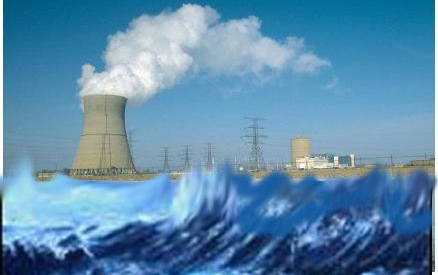 Whilst nuclear energy itself may be considered more eco-friendly than
exhaustible energy sources, renowned Japan correspondent Lucy
Birmingham points to the country’s history of natural disasters as a
potential danger. In November 2012, following the destruction of
Hurricane Sandy, she poignantly remarked that “nuclear power and
superstorms don’t mix”. She suggests that both floods and droughts can
severely damage nuclear reactors, causing them to release potentially
fatal radioactive materials.
It is this reality that prompts the Japanese population to protest.
Since Fukushima, the citizens of Japan have become increasingly
concerned about the dangers of nuclear energy. If the government’s
primary responsibility is the security of its citizens, is Shinzo
Abe’s attempt to bolster the economy and Japan’s carbon footprint one
risk too far for the environment and the welfare of the people
residing in potential risk areas?….”
Japanese government’s nuclear reprocessing plans likely to be colossal waste of money
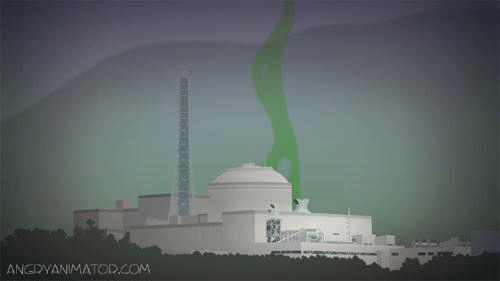 But the continued operation of the Monju reactor is uncertain due to
frequent malfunctions. The Japanese government has admitted that it
may not be put into commercial use until 2050, prompting criticism
that the Rokashomura facility was a colossal waste of money.
 Japan Could Reprocess Nuclear Fuel from Korea
http://www.energytribune.com/69930/japan-could-reprocess-nuclear-fuel-from-korea-2
January 07, 2013 From Chosun Ilbo The Japanese government is
considering reprocessing spent nuclear fuel rods from Korea, Vietnam
and other Asian countries, the Tokyo Shimbun reported Sunday. Japan is
the only country in the world that has no nuclear weapons but the
facilities to reprocess spent nuclear fuel rods capable of producing
weapons-grade plutonium.
An advisory council to the Democratic Party of Japan in a report last
May said reprocessing spent nuclear fuel rods would “strengthen”
Japan’s diplomacy, security and the country’s economy as well as
“contribute to the peaceful use of atomic energy.”
The report suggests using the Rokashomura nuclear reprocessing plant
in Aomori Prefecture, which will become obsolete if Japan scraps all
its own nuclear power plants in the 2030s. Continue reading
Abuses, deceptions, cover-ups in the Fukushima clean-up operations
 Citizen journalism also brought to light that workers as young as 18 were sent to the Fukushima site without adequate training. Some reported that they were told to write resumes with fictitious work experience. The new citizen media site 8bit uploaded a video interview with a worker in September who had applied for a job entitled “backup logistics support,” but was actually dispatched to the stricken plant, and exposed to high doses of radiation. (Global Voices, Sept. 20)
 Back in July, journalists and scientists who undertook to inspect the droids found that the immediate environs of the monitoring posts had been deliberately decontaminated so as to produce low readings. For instance, clean, non-radioactive soil was spread over the ground below the posts so the contamination below would not be registered
 by Bill Weinberg 01/06/2013– Contractors could be illegally dumping radioactive soil, vegetation and water into rivers and open areas near the stricken Fukushima No. 1 nuclear plant, Japan’s Environment Ministry admitted Jan. 4. The ministry said it will summon senior officials from companies contracted by the Fukushima Office for Environmental Restoration to answer questions on how they manage contaminated waste following claims of illegal dumping in the coastal town of Naraha, the evacuated village of Iitate, and the inland in the city of Tamura. Under a law passed in the wake of the Fukushima disaster, illegal dumping of contaminated substances may be punishable by up to five years in prison or a fine of up to ¥10 million. “It is very regrettable if that is true,” Fukushima Gov. Yuhei Sato said of the suspected dumping at his first news conference of 2013. (Kyodo, Jan. 5)
The charges came to light when a young worker for one of the contractors, Dai Nippon Construction, alerted the Environment Ministry after repeated complaints to management were apparently met with such replies as “Yeah, yeah, it’s OK. It can’t be helped.” The young man, who was recruited at a job placement center in Tokyo, even reported that contaminated vegetation was being dumped loose, rather than being collected in bags. (Asahi Shimbun, Jan. 4) Local residents also reported witnessing radioactive mud being dumped directly into Fukushima prefecture’s major river, the Abukuma. (Fukushima Diary, Jan. 5) Continue reading
Daily 400 tons of underground water flows into Fukushima reactor buildings
 NHK: Radiation levels increasing at Fukushima plant — “No solution to tainted water” — Hundreds of tons flowing into reactor buildings every day (VIDEO) http://enenews.com/nhk-radiation-levels-increasing-fukushima-plant-solution-tainted-water-hundreds-tons-flowing-reactor-buildings-every-day-video
January 5th, 2013
Title: No solution to tainted water at Fukushima plant
Source: NHK WORLD English
Date: Jan. 4, 2013
No solution to tainted water at Fukushima plant
[…] Each day about 400 tons of underground water has been flowing into reactor buildings […] The water becomes contaminated with radioactive materials.
[…] the volume of the water is continuing to rise, increasing radiation levels at the plant. […]
The company plans to pump underground water to prevent it from flowing into reactor buildings. It will also install steel walls underground to block contaminated water from leaking into the sea. […]
Watch the video here
Japan can survive without nuclear power, by smart energy saving
 When he returns to
Japan in the spring, Okamura will be able to tell METI what would be
necessary to achieve its energy savings goal of 20 percent in the
years ahead, especially as the effectiveness of voluntary pleas wears
off.
Sacrifice and luck help Japan survive without nuclear power, Stanford
visiting scholar says, Stanford News, Stanford Report, January 4, 2013
In the wake of the Fukushima disaster, nuclear-dependent Japan began
shutting down its other reactors. Toshiya Okamura, a Tokyo Gas
executive and visiting scholar at Stanford University, explains how
the country survived the summer, and expresses deep concerns about
this winter and his country’s energy future. Continue reading
Japan’s energy conservation success, post Fukushima
How Japan Discovered Conservation: Fukushima Forbes, 6 Jan 13, Japan lost a quarter of its electric capacity when it shuttered its nuclear reactors in the wake of the Fukushima disaster. Predicted blackouts have not materialized, though, thanks to a national conservation effort that reduced demand by as much as 15 percent….. “People did everything they could,” said Okamura. “To minimize air conditioning, they raised thermostats in homes, offices and stores to 83 degrees Fahrenheit, as the government asked. They set every appliance and electronic device to the most energy-efficient settings. They kept the lights off as much as possible. Escalators were shut off.” Continue reading
Fukushima govt’s new law to force stores to sell local produce?
New law to force stores to sell produce from Fukushima? http://enenews.com/report-japan-govt-force-stores-sell-fukushima-food Fukushima Minpo’s Jan. 3, 2013 report on their recent interview with Masako Mori, the ‘minister in charge of dealing with declining number of children’ (elected to the Upper House from District in Fukushima Prefecture), translated by EXSKF:
[…]
[Mori said] the government will aim to pass the legislation to promote the sale of Fukushima produce and goods, in order to clearly show [to the public] how the national government stands on the issue of baseless rumor damages. It is considered that Mr. Mori’s agency [Consumer Affairs Agency] and related agencies and ministries will decide on the details [of the legislation]. In summary, the legislation would “designate Fukushima Prefecture as the “special zone”, and enable the national government to order retailers to sell locally-produced goods and to extend preferential treatment to retailers who sell such goods in the storefronts”, Ms. Mori explained.
The Constitution guarantees “freedom of commerce”. It remains to be seen whether the legislation can legally force retailers.
[…]
EXSKF adds, “It’s not very clear […] whether this legislation is intended for retailers only in Fukushima, or any retailers anywhere. (The more I read it, it feels the legislation will be for the retailers everywhere in Japan, but not 100% sure.)”
Illegal dumping of radioactive material in Fukushima
 Contaminated soil might have been illegally dumped in Fukushima
http://mainichi.jp/english/english/newsselect/news/20130104p2g00m0dm068000c.html
TOKYO (Kyodo), 4 Jan 13, — Some Japanese contractors are suspected of having
illegally dumped radioactively contaminated soil, vegetation and water
into rivers or other places close to the tsunami-hit Fukushima Daiichi
nuclear power plant, the Environment Ministry said Friday. Continue reading
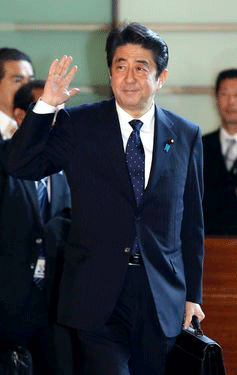
Prime Minister Abe in a hurry to restart nuclear power, fearing that Japan might manage well without it
 A survey conducted by the Tokyo Shimbun newspaper, just before the
elections last month, showed that more than 60 per cent wanted to
phase out nuclear energy completely
If the government allows nuclear plants to remain switched off, it
would be admitting that nuclear power is not critical to economic
recovery
the Abe administration cannot afford to have
the public realise that Japan can get along just fine without nuclear
power
Japan prepares for nuclear U-turn.Ft.com By Michiyo Nakamoto in Tokyo 3 Jan 13,
Japan’s plan for a nuclear-free society, which gathered momentum after
the nuclear meltdown in Fukushima nearly two years ago, looks set to
be shortlived.
Since its electoral landslide in December, the Liberal Democratic
party has wasted no time in setting the stage for a return to Japan’s
former policy of promoting nuclear power as a major source of energy
generation.
Shinzo Abe, who took over as prime minister last month, has given a
clear indication that the government is looking to build new nuclear
power plants, Continue reading
Turkey now testing all food from Japan for radiation
Report: Turkey begins testing all food from Japan for radiation — Imports suspected to be contaminated http://enenews.com/report-turkey-begins-testing-all-food-japan-radiation-imports-suspected-be-contaminated
January 2nd, 2013
Excerpt From: Turkey to test Japanese products for radiation
Source: World Bulletin
Date: December 30 2012
h/t Anonymous tip
Turkey to test Japanese products for radiation
The arrangement will go into effect on January 1, 2013 and will cover all Japanese products sent to Turkey after March 11, 2011. […]
Fukushima Diary summarizes a Japanese-language report on Turkey’s move:
[…] They state imports from Japan are suspected to be radioactively contaminated.
Fukushima government’s efforts to stop study of baby teeth for radiation checks.
 Fukushima gov’t tried to kill proposal to store baby teeth for future
radiation checks
http://mainichi.jp/english/english/newsselect/news/20121219p2a00m0na016000c.html
FUKUSHIMA — The Fukushima Prefectural Government has tried to kill a
proposal by a local assemblyperson to store local children’s milk
teeth to examine their internal radiation exposure stemming from the
Fukushima nuclear disaster, it has been learned. Continue reading
1 This Month





PLEASE OPPOSE HR 8255 AND S.3639 – bills would accelerate satellite deployment, with no environmental review or safeguards – https://ncstd5li.quorum.us/campaign/169331/
To see nuclear-related stories in greater depth and intensity – go to https://nuclearinformation.wordpress.com
-
Archives
- October 2026 (74)
- September 2026 (339)
- August 2026 (330)
- July 2026 (355)
- June 2026 (287)
- May 2026 (306)
- April 2026 (356)
- March 2026 (251)
- February 2026 (267)
- January 2026 (308)
- December 2025 (358)
- November 2025 (359)
-
Categories
- 1
- 1 NUCLEAR ISSUES
- business and costs
- climate change
- culture and arts
- ENERGY
- environment
- health
- history
- indigenous issues
- Legal
- marketing of nuclear
- media
- opposition to nuclear
- PERSONAL STORIES
- politics
- politics international
- Religion and ethics
- safety
- secrets,lies and civil liberties
- spinbuster
- technology
- Uranium
- wastes
- weapons and war
- Women
- 2 WORLD
- ACTION
- AFRICA
- Atrocities
- AUSTRALIA
- Christina's notes
- Christina's themes
- culture and arts
- Events
- Fuk 2022
- Fuk 2023
- Fukushima 2017
- Fukushima 2018
- fukushima 2019
- Fukushima 2020
- Fukushima 2021
- general
- global warming
- Humour (God we need it)
- Nuclear
- RARE EARTHS
- Reference
- resources – print
- Resources -audiovicual
- Weekly Newsletter
- World
- World Nuclear
- YouTube
-
RSS
Entries RSS
Comments RSS

