Plutonium in ocean near Fukushima
 Study: Fukushima plutonium in Pacific Ocean from ‘liquid direct releases’? http://enenews.com/study-plutonium-could-be-pacific-ocean-liquid-direct-releases-fukushima
Title: Should we measure plutonium concentrations in marine sediments near Fukushima?
Source: Journal of Radioanalytical and Nuclear Chemistry
Author: R. Periáñez, Kyung-Suk Suh, Byung-Il Min
Date: February 2013
Excerpt
Much less information is available in the case of plutonium isotopes. Trace amounts of Pu isotopes originating from the accident have been identified in soil samples. While it is known that atmospheric releases of Pu were several orders of magnitude lower than that from Chernobyl accident, no information on Pu isotopes in the liquid direct releases to the sea is available. Pu isotopes have been measured in marine sediments outside a 30 km radius circle around Fukushima. Results do not show any contamination due to the accident. Instead Pu isotopes here detected are attributed to global fallout.
However, the situation inside the 30 km zone remains unknown. It could be possible that Pu isotopes entered this coastal area from the direct release of contaminated water in early April 2011. The objective for this work consists of showing, by means of numerical modelling, that, if Pu contamination originating from the accident would be present in sediments of the close area to Fukushima, contamination would not reach areas far from the plant. Contamination would be restricted to the close area because of the low mobility of Pu. Thus, it would not be detected if samples are not collected there. Consequently, further studies on the determination of Pu isotopes in seawater and sediments within the 30 km zone would be required.
Note the objective: “The objective for this work consists of showing […] that, […] Pu contamination […] would not reach areas far from the plant.”
Criminal gangs in the money again in Japan – now in “nuclear waste disposal”
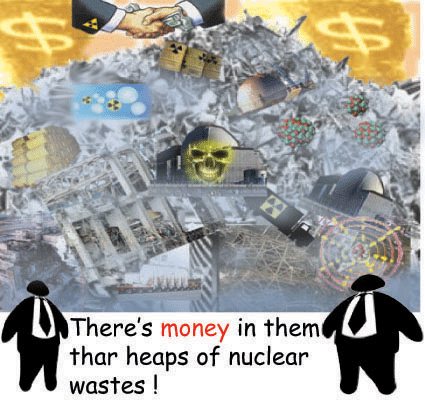 Asahi: Gangsters cashing in on Fukushima disaster — Involved in “disposal of waste” http://enenews.com/asahi-gangsters-cashing-fukushima-disaster-involved-disposal-waste
Title: Gangster illegally hired workers for decontamination projects
Source: AJW by The Asahi Shimbun
Author: KENJI OGATA
Date: January 31, 2013
Criminal organizations are cashing in on the disaster that shook Japan nearly two years ago by sinking their claws into all aspects of recovery operations to skim off handsome profits.
Police have just turned up an instance of a gang member brazenly providing laborers to help clean up contaminated areas in Fukushima Prefecture, and pocketing part of their wages. […]
“The recovery operations involve a lot of money, so they are a godsend for gangs that have trouble making money due to a police crackdown on gang activities,” a gang insider said.
The man said these groups have been involved in the demolition of buildings and the disposal of waste in devastated areas. […]
See also: Police make arrest over cleanup workers at Fukushima Daiichi — Crime syndicate “allegedly participated in containment work for the damaged facilities”
Crisis of Fukushima No 4 reactor a worry for entire world
Japan Experts: Fukushima Unit 4 is the immediate crisis… entire world is concerned — No good solution for speeding up fuel removal http://enenews.com/japan-experts-fukushima-unit-4-immediate-crisis-entire-world-concerned-good-solution-speeding-fuel-removal
Report from Jiji on January 30, 2013 meeting of the Fukushima accident council with summary translation by Fukushima Diary:
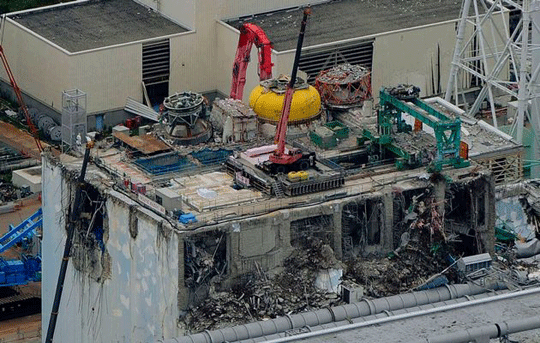
[…] Mr. Kurokawa, the chairman of the governmental accident investigation committee commented the SFP of reactor 4 is the crisis in front of us. The entire world is concerned about that.
Mr. Kitazawa, the chairman of the council stated it takes a while to remove all the spent fuel from the pool. There is no appropriate solution for that.
Systran Translation
[…] The same nuclear plant 4 the anxiety for the used nuclear fuel pool of the machine was shown from the group of members […]
[…] Kurokawa which is National Diet accident pitch chairman is clear Science Council of Japan former chairman “the crisis which is immediately. The inside of the world feels concern” […]
[…] Chairman Hiroshi Kitazawa who serves the chairman of intellectual person meeting, points out that time is required for the fuel removal. “There is no good solution method” […]
See also: TV: Gov’t seeking to empty Fukushima No. 4 fuel pool much sooner than planned — Worries it could become ‘unsafe’ (VIDEO
Fukushima area: radioactivity in 79 tested cattle
 Discovery.com: Radioactive Cattle Found Near Fukushima — “In the event of a nuclear Armageddon, don’t eat the steak” — Newborns, fetuses concentrating contamination http://enenews.com/discovery-radioactive-cattle-found-near-fukushima-in-the-event-of-a-nuclear-armageddon-dont-eat-the-steak-newborns-fetuses-concentrating-contamination
Title: Radioactive Cattle Found Near Fukushima
Source: Discovery News
Author: Tim Wall
Date: Jan 30, 2013
Radioactive Cattle Found Near Fukushima
[…] Now, nearly two years after the disaster, those abandoned cattle were found to be contaminated with radioactive elements. Traces of radioactive cesium, silver and tellurium were found in the 79 cattle analyzed by a scientific team led by Nagoya University engineer Toshio Fukuda and published in the journal PLOS ONE.
Fetuses and calves had radioactive materials concentrations up to 1.5 times higher than the adults. The calves had been born, and the fetuses conceived, after the disaster.
In the event of a nuclear Armageddon, don’t eat the steak. Radioactive elements collected most heavily in the cattle’s skeletal muscle. […]
See also: Gov’t to begin testing fetuses for gene mutations in “Fukushima Genomic Analysis”
Fukushima Genomic Analysis will test three generations for gene mutations
Gov’t to begin testing fetuses for gene mutations in “Fukushima Genomic Analysis” http://enenews.com/govt-to-begin-testing-fetuses-for-gene-mutations-in-fukushima-genomic-analysis
September 9th, 2012
http://www.minpo.jp/news/detail/201209073518 …
Source: http://www.minpo.jp/news/detail/201209073518
Grandparents will also be investigated if possible in order to investigate three generations of gene mutations
Japan’s Nuclear Board sets out safety regulations: nuclear industry working to weaken these
The power industry, which has a more supportive government potentially on its side, has been lobbying heavily against some of the regulations.
During the process, the requirements can be watered down.”
 Japan Nuclear Board Offers New Safety Plans, WSJ, By MARI IWATA , January 31, 2013, TOKYO—Japan’s revamped nuclear-safety regulator issued its first proposed safety guidelines, telling utilities they need to
  plan for “unthinkable incidents,” such as the mammoth earthquake and tsunami that caused the 2011 Fukushima Daiichi disaster.
Under the new rules, power plants will need to have more than a single access to the external grid power and to install enhanced filters to prevent contamination from being released if the reactors need to be vented due to a dangerous buildup of pressure.U.S. regulators, for example, require nuclear plants to have at least two connections to the external power grid. They require filters on some, but not all, venting valves and are weighing whether to adopt rules that would require expensive new filtering systems at 31 U.S. reactors with designs similar to Fukushima Daiichi.
The utilities also will have to plan how to deal with other types of risks previously not considered, such as a terrorist attack or a plane crash, proposing measures such as stronger buildings surrounding the reactor units and having critical backup systems at greater distance.
The new measures, which are subject to public comment, were issued Thursday by the new Nuclear Regulation Authority, set up in the aftermath of the Fukushima accident. The new body was created following criticism that the previous regulator, part of the energy ministry, was too close to the industry. Nuclear-power opponents say the agency’s work so far has shown that the previous cozy relationships, dubbed the “nuclear village,” are still in place.
Some experts said the new regulations sidestep many of the most important questions that will likely determine whether Japan will again have a heavy dependence on nuclear-generated electricity.
One key issue not yet addressed is how to determine whether a plant should be shut down because it sits on an “active” earthquake fault…..Another critical question for the utilities is whether additional equipment must all be installed immediately or over time, a question that could prompt some utilities to close older plants.
Antinuclear activist Takeshi Sakagami, who has been a regular attendee at NRA events and related expert-panel meetings since the agency began in July 2011, says the agency has been largely taken over by bureaucrats who want to restart Japan’s reactors. “Bureaucrats have been drafting the proposed rules and answering questions in the panel meetings,” he said. “It’s already back to the hands of the nuclear village members.”
He pointed out that the authority has held two sessions with power utilities in its discussions about reactor safety regulations, but so far none with residents from around Fukushima nor with antinuclear groups……
The power industry, which has a more supportive government potentially on its side, has been lobbying heavily against some of the regulations. One utility posted a profit and the other, Fukushima operator Tokyo Electric Power Co.,9501.TO +0.94% has yet to report.
Makoto Yagi, president of Kansai Electric Power Co., 9503.TO 0.00% Japan’s second-largest power utility and previously heavily dependent on nuclear power, said on Jan. 25 that the company will need at least ¥285 billion ($3.15 billion) in additional capital investment to equip its 11 reactors with safety measures required by the new guidelines.
The draft rules are still open to public comment. “It’s not as simple as you might think to evaluate the guidelines at this point,” said Hiromitsu Ino, emeritus professor of the Tokyo University and an expert of raw materials used in reactors. “During the process, the requirements can be watered down.”
The utilities have been hit by higher costs of oil- and gas-fired power plants. Of the nation’s nine utilities that own and operate nuclear-power plants, seven have so far reported losses for the nine months to December…… http://online.wsj.com/article/SB10001424127887324156204578275690031511384.html
Freedom of press in Japan has gone down drastically, since Fukushima nuclear disaster
 Jiji: Japan plummets in press freedom list — “Almost zero respect for access to information related to Fukushima… Should sound an alarm” -Group http://enenews.com/jiji-japan-plummets-press-freedom-list-almost-respect-access-information-related-fukushima-sharp-fall-sound-alarm
Title: Japan dives to 53rd in press freedom list
Source: Jiji Press
Date: Jan. 30, 2013
Japan plummeted to 53rd from 22nd last year in the 2013 press freedom ranking released by Reporters Without Borders, a Paris-based nonprofit organization, on Wednesday.
Japan “has been affected by a lack of transparency and almost zero respect for access to information on subjects directly or indirectly related to Fukushima,” the group said in a statement, referring to the crisis at Tokyo Electric Power Co.’s crippled Fukushima No. 1 nuclear power plant. “This sharp fall should sound an alarm,” it added. […]
See also: Professor: Goebbels would smile in his grave to see how nuclear establishment handled disaster (AUDIO)
Safety concerns may shut world’s largest nuclear plant, Kashiwarazaki-Kariwa
The Kashiwarazaki-Kariwa plant may be susceptible the same type of
cataclysmic event which led to Fukushima Daiichi nuclear disaster, as
the plant itself is situated in an active fault zone.
Japan may shutter world’s largest nuclear plant over earthquake
threat, RT.com 26 January, 2013, The world’s largest nuclear power
plant may be forced to shut down under stricter rules proposed by
Japan’s new nuclear watchdog. The measures are intended to safeguard
against future natural disasters following the 2011 tsunami.

The Kashiwazaki-Kariwa nuclear power plant in the heart of Japan is
now facing permanent closure following a move by the country’s Nuclear
Regulation Authority (NRA) to expand the definition of an active fault
– a crack in the earth’s crust. The operators of the plant, Tokyo
Electric Power are the same company which powered the stricken
Fukishima plant. Continue reading
Japan’s only two operating nuclear reactors to be shut for maintenance in 2013
 Japan faces nuclear shutdown for 2nd time since Fukushima — Expert: They’re trying to protect their nation from diseases, death http://enenews.com/reuters-japan-faces-nuclear-shutdown-for-2nd-time-since-fukushima-expert-trying-to-protect-their-nation-from-diseases-and-death-audio

January 24th, 2013
Title: Japan faces nuclear shutdown for second time since Fukushima
Source: Reuters
Author: Aaron Sheldrick
Date: Jan 24, 2013
Japan may face a total nuclear shutdown in the summer for the second time since the March 2011 Fukushima disaster as the country’s two operating reactors close for maintenance and tough new safety checks keep the rest of the fleet offline. […]
The only two of Japan’s 50 nuclear plants operating are both at Kansai Electric Power’s Ohi plant in western Japan, and must be for shut for maintenance [in mid-September 2013] 13 months after resuming commercial operations, according to Japanese law. […]
Title: Japan Contemplates Complete Nuclear Shutdown
Source: Voice of Russia American Edition
Date: Jan 24, 2013
Full broadcast here
Over 5 months, radiation in Fukushima soil nearly doubled
TV: Radiation levels nearly doubled in Fukushima soil sample over 5-month period (VIDEO) http://enenews.com/watch-radiation-levels-doubled-fukushima-soil-sample-5-month-period-video
Title: ReUpload. Full Version Upload was Rejected !!! 音声入りが上がりません
Source: guardianofmiyagi
Date: Jan 24, 2013
Riverside soil samples from same location in Aizu, Fukushima (~100 kilometers west of Fukushima Daiichi)
December 2011: 8,790 becquerels per kilogram of cesium 134 & 137
April 2012: 17,000 becquerels per kilogram of cesium 134 & 137
Watch the video here
Radioactive water to be dumped into Pacific Ocean by TEPCO
 TEPCO plans to dump water stored at Fukushima Daiichi into Pacific http://enformable.com/2013/01/tepco-plans-to-dump-water-stored-at-fukushima-daiichi-into-pacific/ TEPCO has announced that it plans to dump contaminated water into the Pacific Ocean after processing it to reduce radioactive materials to legally permissible levels. By “processing”, TEPCO means once-high radioactive content has been reduced considerably, but not completely.
The plant has already released enormous amounts of highly contaminated water directly into the ocean from a plethora of leaks from the reactor buildings. Outside experts are seriously concerned about the contaminated water that is released, and have warned there may well be lasting impact on the environment.
The utility says the operation is necessary due to concerns that they will run out of capacity to store highly contaminated water which continues to accumulate. After the water has passed through the crippled units, it is processed through the SARRY system to remove cesium, but other systems designed to remove other radioactive materials have been overwhelmed by the complexity and concentration of contamination found at Fukushima Daiichi.
TEPCO estimates show that the volume of contaminated water required to be stored on site will likely triple over the next three years.
Questions have been raised if TEPCO would be able to gain the necessary approval from local municipalities and other parties who have raised concerns about plans to dump the water into the ocean.
In December 2011, the utility was forced to scrap a previous plan to dump water into the sea following fierce protests from fishing groups.
“Descent from Heaven ” Japan’s nuclear top men in lucrative jobs
 2 key industry ministry bureaucrats landed lucrative jobs after
retirement, Asahi Shimbun January 21, 2013 By ATSUSHI KOMORI/ Senior
Staff Writer
Two industry ministry officials who played a central role in Japan’s
nuclear policy at the time of the Fukushima disaster went on to land
senior positions at major financial institutions after they retired
from public life.
The practice of retired bureaucrats ending up in jobs at organizations
or companies that were often once under their jurisdiction is called
“amakudari,” which translates as “descent from heaven,” and has come
under severe criticism due to fears it fosters collusion between
bureaucrats and private companies.
Kazuo Matsunaga, 60, was formerly vice minister of the Ministry of
Economy, Trade and Industry, and Tetsuhiro Hosono, 60, served as
director-general of the Agency for Natural Resources and Energy.
They held these key posts during the reactor meltdowns at the
Fukushima No. 1 nuclear power plant triggered by the March 11, 2011,
Great East Japan Earthquake, which spawned towering tsunami that
devastated coastlines of northeastern Japan.
Their re-employment will likely ignite controversy, because even now,
more than 150,000 people affected by the disaster have not been able
to return to their homes because of high radiation levels and other
reason…. http://ajw.asahi.com/article/0311disaster/fukushima/AJ201301210093
Radioactvity increasing in water at Fukushima Unit No. 2 nuclear reactor
Report: Radioactivity levels rising at Fukushima Unit No. 2 sub-drain since November http://enenews.com/report-radioactivity-levels-rising-at-fukushima-unit-no-2-sub-drain-since-november
January 22nd, 2013
Title: Contaminated water still a serious issue at Fukushima Daiichi
Source: Enformable
Date: Jan 22, 2013
[…] over 220,000 metric tons of contaminated water have been collected and stored on site, still another 75,000 tons remains in the reactor buildings. Every day at least another 40 tons of contaminated water are created […]
The utility has been so far unable to prevent the contaminated water injected into the damaged reactors from flowing out of the buildings into the environment and even escaping directly into the ocean. […]
The levels of radioactivity measured near the Unit 2 Sub-Drain have been on the rise since November […] it is critical to control the seeping of contamination through the local groundwater.
See Tepco’s report here
Fukushima radiation in seafood chain – record level in rockfish
 Record cesium levels measured in Fukushima rockfish, signaling radiation woes in food chain far from over in Japan, Part of: Nuclear meltdown in Japan Less than two months shy of the second anniversary of the devastating triple nuclear meltdown at Japan’s coastal Fukushima Daiichi plant, a fish containing more than 2,500 times Japan’s legal limit for radiation has been caught by the plant’s operator in waters near the wrecked facility. Bellona, Charles Digges, 21/01-201
The ‘murasoi’ fish, similar to a rockfish – indicating an amount of cesium measuring 254,000 Becquerel per kilogram, or 2,540 times Japans limit for radiation in seafood – was caught at a port inside the plant by its owner, Tokyo Electric Power Co. (TEPCO) Friday, according to AFP.
The utility also released a photo of the fish, caught near an unloading point north of the No. 1 through No. 4 reactors. No fishermen operate in the nuclear plant’s port.
Friday’s catch shatters the previous record for wildlife contamination as a result of radioactive contamination, which was was 25,800 Becquerel of cesium per kilogram found in two greenlings caught about 20 kilometers north of the plant in August 2012, the Asashi Shimbun newspaper reported.
Other countries are also increasingly distressed by the amount of irradiated marine life turning up near their coastlines along the Pacific Rim: Over the summer, Russia’s state English language television station RT reported concern over fish caught off its coast near Japan.
In May, a tuna contaminated by low levels of radiation was found near the California coast, Reuters reported……. http://www.bellona.org/articles/articles_2012/fukushima_rockfish
Japan’s nuclear utilities buy the silence of communities
“This structure of dependency makes it impossible for communities to speak out against the plants or nuclear power,”
Japanese nuclear plant operators charge over 90 million dollars per year to pay local authorities http://enformable.com/2013/01/japanese-nuclear-plant-operators-charge-over-90-million-dollars-per-year-to-pay-local-authorities/ A report by NHK has shown that operators of nuclear power plants in Japan charge the public users over 90 million dollars per year, in order to cover payments made to local authorities in the areas which host the nuclear sites. Last year, the central government announced that it did not consider these charges as an expense, and that it would no longer allow utilities to charge users to cover them.
Osaka University Professor Tatsuo Hatta says utilities may be able to find other ways to compensate themselves for the payments, and is calling for further transparency.
Kansai Electric has been charging their users around 40 million dollars per year, TEPCO charges around 22 million, Kyushu charges around 10 million, Chugoku charges about 8 million, and Chubu charges about 4 million. Continue reading
1 This Month





PLEASE OPPOSE HR 8255 AND S.3639 – bills would accelerate satellite deployment, with no environmental review or safeguards – https://ncstd5li.quorum.us/campaign/169331/
To see nuclear-related stories in greater depth and intensity – go to https://nuclearinformation.wordpress.com
-
Archives
- October 2026 (74)
- September 2026 (339)
- August 2026 (330)
- July 2026 (355)
- June 2026 (287)
- May 2026 (306)
- April 2026 (356)
- March 2026 (251)
- February 2026 (267)
- January 2026 (308)
- December 2025 (358)
- November 2025 (359)
-
Categories
- 1
- 1 NUCLEAR ISSUES
- business and costs
- climate change
- culture and arts
- ENERGY
- environment
- health
- history
- indigenous issues
- Legal
- marketing of nuclear
- media
- opposition to nuclear
- PERSONAL STORIES
- politics
- politics international
- Religion and ethics
- safety
- secrets,lies and civil liberties
- spinbuster
- technology
- Uranium
- wastes
- weapons and war
- Women
- 2 WORLD
- ACTION
- AFRICA
- Atrocities
- AUSTRALIA
- Christina's notes
- Christina's themes
- culture and arts
- Events
- Fuk 2022
- Fuk 2023
- Fukushima 2017
- Fukushima 2018
- fukushima 2019
- Fukushima 2020
- Fukushima 2021
- general
- global warming
- Humour (God we need it)
- Nuclear
- RARE EARTHS
- Reference
- resources – print
- Resources -audiovicual
- Weekly Newsletter
- World
- World Nuclear
- YouTube
-
RSS
Entries RSS
Comments RSS

