Tepco digging ground to assess extent of radiation contamination at Fukushima
The utility will dig areas measuring 12 sq. meters in total to a depth of 40 to 50 cm where pools of leaked radioactive water formed, and then measure levels to determine how far the contamination has spread and how much soil needs to be removed.
Some 300 tons of highly radioactive water recently spewed into the Pacific from one of 26 tanks built in an area just 500 meters from the plant’s seawall. The tanks are surrounded by dikes, but some 120 liters of the water leaked outside of them, making it necessary to collect soil to prevent the contamination from spreading……. Groundwater that mixed with the tainted water has already flowed to the ocean, and Tepco said Friday it has launched an operation to pump it out of 28 wells….. http://www.japantimes.co.jp/news/2013/08/23/national/tepco-testing-tainted-earth-at-no-1-plant/#.UhleVNJwonF
Digital change in the advertising world
World of advertising undergoes digital change By Chris Betros EXECUTIVE IMPACT AUG. 19, 2013 Takahiro Uchinaga, CEO of Isobar Japan TOKYO —
The world of advertising has seen many innovations in recent years as the media landscape changes. The changes are being driven by digital communications.
One of the companies at the forefront is the Aegis Media Group, a global communication agency established in 2003 (and bought by Dentsu), that operates in over 30 markets with digital at its heart. One of the group’s subsidiary companies is Isobar, a professional full support digital marketing group working on strategic planning, creative system planning, media planning, analytics, consulting and application service, to support clients with technology all over from the world.
Isobar’s global clients include Kellogg’s, adidas, Reebok, Disney and P&G, while its Japan-based clients include Panasonic, Fujitsu, Casio, H.I.S., Jetstar and Pernod Ricard. Continue reading
Radioactive water crisis out of control at Fukushima
Japan’s leaky nuclear plant, No end in sight The Fukushima nightmare lingers http://www.economist.com/news/asia/21584054-fukushima-nightmare-lingers-no-end-sight Aug 24th 2013 | TOKYO THE agonising efforts to clean up the crippled Fukushima Dai-ichi nuclear power plant hit new obstacles this week. On August 21st the Nuclear Regulation Authority (NRA) said that leaks of radioactive water were a level three, or “serious”, incident on a scale that goes up to seven. Some help from American experts aside, Japan has been dealing with the disaster itself. Now, even Tokyo Electric Power (TEPCO), the plant’s owner, would welcome foreign help.
TEPCO is under intense fire at home. It “has no sense of crisis at all”, grumbled Shunichi Tanaka, chairman of the NRA, as the leaks worsened. Another NRA commissioner questioned whether TEPCO’s data could even be trusted. After months of denial, the firm has only just admitted that contaminated water is leaking into the Pacific. China and South Korea have both expressed concern.
The plant’s melted reactor cores are tainting both the hundreds of tonnes of water pumped into them each day and the groundwater, producing vast quantities of radioactive liquid. After underground pools leaked, TEPCO has hastily built around 1,000 surface storage tanks. Several are leaking from joints sealed with plastic. The most recent leak, of 300 tonnes, prompted the NRA alert. Experts say many more tanks are at risk.
A shortage of cash may have heightened the crisis. TEPCO faces massive bills for replacement fuels and compensating evacuees. It failed to install even the most basic system to monitor water leaks. Its workers stand on tanks and memorise water levels. The NRA this week ordered TEPCO to install water gauges at once. “What’s needed is tanks with stainless-steel seals, but that would take time and money,” says Neil Hyatt, professor of radioactive-waste management at the University of Sheffield.
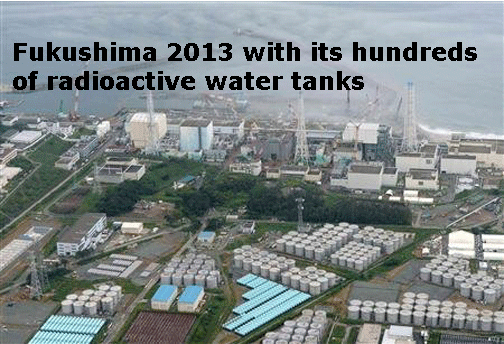
Huge and growing area of tanks storing Fukushima’s radioactive water

 Radioactive Leaks in Japan Prompt Call for Overseas Help, Bloomberg, By Yuji Okada, Jacob Adelman & Peter Langan – Aug 21, 2013
“……..Toxic Sludge. Tepco was storing 330,000 tons of radioactive water as of Aug. 13 in tanks covering an area equal to 37 football fields, according to the company. The utility is clearing forest to make room for more tanks as it adds to the stored water at a rate of 400 tons a day after pumping it out from under the plant’s reactors, which melted down as a result of the March 2011 earthquake and tsunami.
The water is treated to remove some of the cesium particles before it is stored, which has left 480 filters clogged with the radioactive material at the site. Each weigh 15 tons and are warehoused in what the utility calls temporary storage, though it will take hundreds of years for the radiation to decay. Other radioactive contaminants remain in the water even after treatment. That includes strontium, which has been linked to bone cancers.
Besides radiated water, the site north of Tokyo has more than 73,000 cubic meters of contaminated concrete, 58,000 cubic meters of irradiated trees and undergrowth, and 157,710 gallons of toxic sludge, according to the utility.
’Biggest Concern’
Japan’s nuclear watchdog has ratcheted up alarm over the potential for more leaks of highly radioactive water from the hundreds of storage tanks at the Fukushima atomic plant.
The possibility of leaks from other tanks “is the biggest concern,” said Nuclear Regulation Authority Chairman Shunichi Tanaka at a press conference yesterday. “This will need to be handled carefully on the assumption that one incident could bring another.”
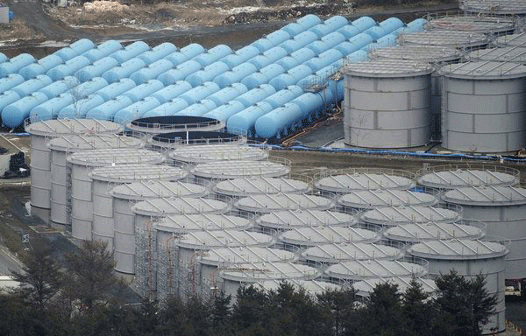
Late last night, Tepco said water leaking from the storage tank probably ran into the ocean, citing high radiation readings in a drainage ditch.
As much as 20 trillion becquerels of cesium and 10 trillion becquerels of strontium leaked into the ocean since May 2011, Tepco spokeswoman Mayumi Yoshida said today. The total amount of cesium and strontium is equivalent to about 100 times the annual limit on radiation from the plant to the ocean under normal conditions, according to calculations based on Tepco data……….
Leaking Tanks
Japan’s government has ordered an investigation into the safety of hundreds of other tanks storing contaminated water in Fukushima, the site of the world’s worst civilian nuclear disaster since the Chernobyl reactor exploded in 1986.
There are 226 tanks of similar bolted design to the leaking unit with the same 1,000-ton capacity at the site, said Tatsuya Shinkawa, director of the nuclear accident response office in the government’s Agency for Natural Resources and Energy, which called for the probe…… http://www.bloomberg.com/news/2013-08-21/tepco-shares-plunge-on-report-of-serious-radiated-water-leak.html
Solar energy shiningin Japan, amidst its nuclear nightmare
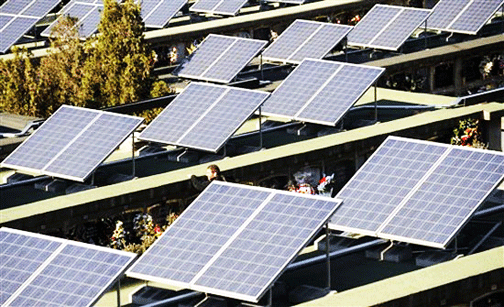 Japan Adds 2+ Gigawatts Of Solar PV by Energy Matters, 22 Aug 13, Japan’s love affair with solar blossoms while a massive radioactive contamination threat still looms large.
Renewable energy facilities that commenced operations during Japan’s 2012 fiscal year (1 April 2012 to March 31 2013) totaled 2.08 gigawatts capacity, equivalent to two nuclear reactors, said the nation’s Economy, Trade and Industry Ministry.
Of the 2.08 gigawatts, 1.98 gigawatts was contributed by residential, commercial and utility scale solar PV.
The Ministry describes Japan’s shift towards a renewable future as “smooth”, with an additional 1.28 gigawatts of renewables added to the nation’s energy infrastructure in April and May this year.
All told, the amount of renewable capacity approved between July 2012 and March this year was 21.09 gigawatts, meaning far more is yet to be built.
While solar is enjoying smooth sailing, the country’s nuclear industry is experiencing anything but; with crisis after crisis occurring at the crippled Fukushima nuclear power station…… http://www.energymatters.com.au/index.php?main_page=news_article&article_id=3905
Japan getting desperate about Fukusima leaks, at last asking for overseas help
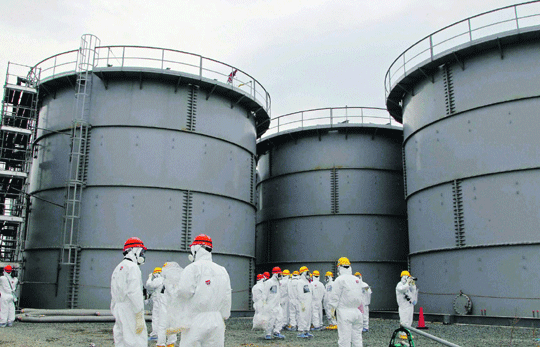 Radioactive Leaks in Japan Prompt Call for Overseas Help, Bloomberg, By Yuji Okada, Jacob Adelman & Peter Langan – Aug 21, 2013 The crippled nuclear plant at Fukushima is losing its two-year battle to contain radioactive water leaks and its owner emphasized for the first time it needs overseas expertise to help contain the disaster.
Tokyo Electric Power Co. (9501) is grappling with the worst spill of contaminated water since the March 2011 earthquake and tsunami caused a meltdown at the Fukushima Dai-Ichi plant. The call for help from Zengo Aizawa, a vice president at the utility, follows a leak of 300 metric tons of irradiated water. Japan’s nuclear regulator labeled the incident “serious” and questioned Tepco’s ability to deal with the crisis. Prime Minister Shinzo Abe made similar comments earlier this month.
“We will revamp contaminated-water management to tackle the issue at the Fukushima Dai-Ichi plant and seek expertise from within and outside of the country,” Aizawa said at a press conference last night in Tokyo. “There is much experience in decommissioning reactors outside of Japan. We need that knowledge and support.”
The International Atomic Energy Agency in Vienna and the U.S. Nuclear Regulatory Commission said they are prepared to help.http://www.bloomberg.com/news/2013-08-21/tepco-shares-plunge-on-report-of-serious-radiated-water-leak.html
Normally rare in children, thyroid cancer in 18 Fukushima children
 Thyroid cancer found in 18 Fukushima children http://www3.nhk.or.jp/nhkworld/english/news/20130821_06.html 20 Aug 13, Medical examinations in Fukushima Prefecture following the nuclear crisis of 2011 have detected 18 children with thyroid cancer.
The finding was reported on Tuesday by a prefectural panel examining the impact of radiation on the health of local residents.
The prefecture is giving medical checkups to all 360,000 children aged 18 or younger at the time of the accident at the Fukushima Daiichi plant in March 2011.
That’s because radioactive substances released in the accident can accumulate in children’s thyroid glands, possibly increasing their risk of developing cancer. Some 210,000 children had been tested by the end of July.
Besides the 18 minors diagnosed with cancer, 25 others are suspected to have the illness.
The incidence rate of thyroid cancer in children is said to be one in hundreds of thousands. In Japan, 46 people under 20 were diagnosed with thyroid cancer in 2006.The panel says it cannot determine if the accident has affected the incidence of cancer among children in Fukushima. But it has decided to set up an expert team to look into the situation.
Panel chief Hokuto Hoshi says they will carefully examine the accumulated data and individual cases so they can give explanations to residents in a responsible manner.
Dangers in removing Fukushima’s spent nuclear fuel rods
 Japanese gamble Armageddon in Last Ditch Fukushima Effort, Whiteout Press, August 20, 2013. Fukushima, Japan Japan gambles the world “……….For the past two years, there have been varying and sporadic reports, some official and some unofficial, describing how the Fukushima nuclear meltdown is anything but under control. In fact, millions of gallons of radioactive wastewater continue to spill out into the Pacific to this day. And while the reactors and their safety mechanisms continue to break down, the world comes closer and closer to global Armageddon.
To stop the complete and total meltdown of Japan’s nuclear reactors, authorities have proposed a dangerous plan. The biggest problem is Fukushima’s Reactor Number 4. The reactor’s cooling pool for spent nuclear rods is located on the top floor of the TEPCO building. And that building was heavily damaged by the 2011 quake. Due to its instability, authorities say they must move the 400 tons of spent fuel rods right away.
Spent fuel rod transfers occur on a fairly regular basis, but always under the most secure and controlled setting due to the potential nuclear catastrophe that would happen if just one spent rod is mishandled. In the case of Fukushima’s Reactor 4, officials will attempt to remove 1,300 spent fuel rods from a structurally unsafe building in a highly contaminated environment.
The problems and dangers
One nuclear fallout expert, Christina Consolo, spoke to RT News to answer the outlet’s questions regarding the situation in Fukushima. She detailed a list of potential problems authorities might encounter when they attempt to move the spent rods. Those potentially catastrophic hurdles include (from RT News):
- The racks inside the pool that contain this fuel were damaged by the explosion in the early days of the accident.
- Zirconium cladding which encased the rods burned when water levels dropped, but to what extent the rods have been damaged is not known, and probably won’t be until removal is attempted.
- Saltwater cooling has caused corrosion of the pool walls, and probably the fuel rods and racks.
- The building is sinking.
- The cranes that normally lift the fuel were destroyed.
- Computer-guided removal will not be possible; everything will have to be done manually.
- TEPCO cannot attempt this process without humans, which will manage this enormous task while being bombarded with radiation during the extraction and casking.
- The process of removing each rod will have to be repeated over 1,300 times without incident.
- Moving damaged nuclear fuel under such complex conditions could result in a criticality if the rods come into close proximity to one another, which would then set off a chain reaction that cannot be stopped.
What is most likely to go wrong?
When asked what the biggest potential dangers are in removing the damaged spent fuel rods, Christina Consolo replied, “The most serious complication would be anything that leads to a nuclear chain reaction. And as outlined above, there are many different ways this could occur. In a fuel pool containing damaged rods and racks, it could potentially start up on its own at anytime. TEPCO has been incredibly lucky that this hasn’t happened so far.”
She also expressed concern for the human workers that will have to submerse themselves into a highly radioactive environment and then perform extremely precise movements. Not only might their senses and thinking be affected, but their protective gear will make the entire operation somewhat clumsy.
“My second biggest concern would be the physical and mental fitness of the workers that will be in such close proximity to exposed fuel during this extraction process,” Consolo told RT News, “They will be the ones guiding this operation and will need to be in the highest state of alertness to have any chance at all of executing this plan manually and successfully. Many of their senses, most importantly eyesight, will be hindered by the apparatus that will need to be worn during their exposure to prevent immediate death from lifting compromised fuel rods out of the pool.” http://www.whiteoutpress.com/articles/q32013/japanese-gamble-armageddon-in-last-ditch-fukushima-effort/
The most absurd of Japan’s pro nuclear ppropaganda
Watch the Japanese propaganda video that promises radiation won’t harm you if you just “laugh” http://www.naturalnews.com/041720_Fukushima_radiation_Japanese_government_propaganda_brainwashing.html#ixzz2cjArWiTe It is a video of Dr. Shunichi Yamashita — now known as “Dr. Brainwasher” — giving a propaganda lecture on March 21, 2011 in Fukushima City.
Watch Dr. Brainwasher utter some of these outrageous lies in the following video:
Unbelievable Comment by Mr. Yamashita
This blogspot website has located and translated several key brainwashing phrases uttered by Dr. Yamashita as part of the Japanese government’s propaganda campaign. The following statements span several online videos featuring “Dr. Brainwasher.” Each of these statements is a total propaganda fabrication. The comments in ALL CAPS are my own: Continue reading
Mark Willacy, in Tokyo, on the farce that is TEPCO’s Fukushima script
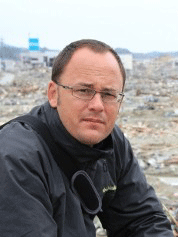 I have learned through my many dealings with TEPCO that this is a company rooted deep in denial. It is a firm that has apparently put public relations before disaster planning.
In the first act we are confronted with outright denial. The Fukushima plant is stable, the reactors are under control. There is no problem. In the second act a problem is exposed in all its radioactive glory – it could be a nuclear water leak, or contaminated groundwater leeching into the Pacific, or a power failure to pools cooling thousands of toxic fuel rods, or mysterious steam oozing from a shattered reactor building (all have happened). In the final act, a line of sober-faced TEPCO officials fills the stage. They choreograph their bows, and the dialogue begins.
“We apologise again for causing anxiety among the public.”
At the start of this crisis, it was keeping water out of the Fukushima plant that was TEPCO’s major failing. Now, it is keeping water in. What next in this endless loop of black farce?
Sorry, sorry, sorry: As the nuclear radiation crisis at Fukushima deepens, at least TEPCO know the script http://www.independent.co.uk/voices/comment/sorry-sorry-sorry-as-the-nuclear-radiation-crisis-at-fukushima-deepens-at-least-tepco-know-the-script-8778017.html MARK WILLACY Wednesday 21 August 2013
This latest leak comes after years of farcical mismanagement It was a stunning contortion of logic, performed with such a straight face that at first I thought Junichi Matsumoto was having me on.
“Yes, taking extra safety measures [at Fukushima] would have been interpreted as TEPCO being worried about a tsunami,” said the senior TEPCO official. “If we had built seawalls in front of the plant…it would’ve made [local residents] worry.” Continue reading
First hand witness tells of government brainwashing on Fukushima radiation
those big US corporations actually asked for their people who were within 80 km (even 100 km) to evacuate. The Fukushima government had possession of the forecast chart of radiation levels in the air, but they didn’t publish them. On the contrary, they held a speaking tour to advocate that there was no need to worry about radiation.
 Natural News exclusive: Fukushima victim exposes Japanese government’s attempted bizarre brainwashing of radiation victims http://www.naturalnews.com/041720_Fukushima_radiation_Japanese_government_propaganda_brainwashing.html#ixzz2cjAxwtYH Wednesday, August 21, 2013 by Mike Adams, the Health Ranger Editor of NaturalNews.com
The following is a first-person account of the attempt by the Japanese government to brainwash victims of Fukushima radiation poisoning into believing radiation would not harm them if they simply “smile.” Natural News is the first U.S. news source to publish this account in English. The name of the original author is Uwamae Masako, who now lives in Taiwan after escaping Fukushima and leaving behind many friends and family members.
As you’ll see below, the Japanese government’s Fukushima Radiation Health Risk Advisor uses a hypnotic, droning speech pattern to try to convince his audience of absolutely bizarre quack science beliefs like “people who drink aren’t affected by radiation” or that “laughter will remove your radiation phobia.”
What follows is a true, firsthand account.
I’m a mother who has two kids. I lived in Koriyama, Fukushima. When the earthquake happened, I heard from the radio that the nuclear plant exploded. “We can’t go back to Koriyama anymore,” was the first thought came to my mind. Sendai, where my husband worked, was not a safe place, either. Although the distance between the nuclear plant and Sendai is about 120 km, the wind direction made it not safe there. Continue reading
Grave new warning about Fukushima’s radioactive water leaks
Japan to issue gravest Fukushima nuclear warning in two years Toronto Sun, KENTARO HAMADA AND JAMES TOPHAM, REUTERS, AUGUST 21, 2013 03 TOKYO – Japan will dramatically raise its warning about the severity of a toxic water leak at the Fukushima nuclear plant, its nuclear watchdog said on Wednesday, its most serious action since the plant was destroyed by an earthquake and tsunami in 2011.
The deepening crisis at the Fukushima plant will be upgraded from a level 1 “anomaly” to a level three “serious incident” on an international scale for radiological releases, a spokesman for Japan’s Nuclear Regulation Authority (NRA) said.
That will mark the first time Japan has issued a warning on the International Nuclear Event Scale (INES) since three reactor meltdowns after the massive quake in March 2011.
Water still leaking from the plant is so contaminated that a person standing close to it for an hour would receive five times the annual recommended limit for nuclear workers in a year…… The leak, which has not been plugged, is so contaminated that a person standing 50 cm (1.6 feet) away would, within an hour, receive a radiation dose five times the average annual global limit for nuclear workers.
After 10 hours, a worker in that proximity to the leak would develop radiation sickness with symptoms including nausea and a drop in white blood cells.
Each one-step INES increase represents a tenfold increase in severity, according to a factsheet on the website of the International Atomic Energy Agency. http://www.torontosun.com/2013/08/21/japan-to-issue-gravest-fukushima-nuclear-warning-in-two-years
Truth the first casualty in uncontrolled catastrophe at Fukushima

Radiation spreading
As detailed by two Whiteout Press articles, one in 2012 and one in 2013, the effects of the Fukushima meltdown are still being felt across the US. …..Americans getting sick
Quietly left out of most news headlines is the fact that 70,000 US military personnel and their families have been invited to join a class action lawsuit against the Fukushima utility company (TEPCO) that owned the power plants and reactors that broke-down after an earthquake struck Japan. The suit seeks $2 billion in damages, most especially for the thousands of US first responders who were stationed in Japan and South Korea at the time. On top of that, hundreds of Alaska Airlines flight attendants have file a complaint citing rampant and mysterious skin lesions and numerous cases of their hair falling out. There have been 280 documented cases of sickened attendants already.
Two of the more eye-opening revelations being disclosed lately include the accusation by environmental activists that independent measurements smuggled out of Fukushima have shown radiation levels ten-times higher than the numbers being released by the US and Japanese governments. Authorities are also hesitant to remind Americans that 100 million tons of radioactive debris continues to wash up on America’s shores. Most heartbreaking were the findings published in March 2013 by the Open Journal of Pediatrics. Test results showed a spike in hypothyroidism in newborns across the western United States……….
For complete details, read the Whiteout Press articles, ‘Fukushima Radiation Poisoning infecting US’ and ‘US Babies suffering Radiation Poisoning from Fukushima’. http://www.whiteoutpress.com/articles/q32013/japanese-gamble-armageddon-in-last-ditch-fukushima-effort/
BBC Radio shuts up Fukushima Diary author
 “The expert” kept on talking. Said, “Fukushima is much much smaller than Chernobyl. You can’t compare.” then I heard the ending music. I was given 0 question to answer.
[Column] The reason why I published only one article today -Invited by BBC and given 0 sec to talk on the radio show http://fukushima-diary.com/2013/08/column-the-reason-why-i- published-only-one-article-today-invited-by-bbc-and-given-0-second-to-talk-on-the-radio-show/ Iori Mochizuki August 21st, 2013 In the quiet morning of 8/21/2013, I was communicating with my readers on Twitter.
Suddenly a lady talked to me if I can be on BBC at 19:30 in JST. After nearly 2 years blank, BBC and some other international media are coming back to cover Fukushima. Since this morning, BBC has been featuring the latest leakage of 300m3 water.
I talked to her on the phone and we arranged the schedule. She was supposed to call me in 2 hours from that time.
She was nice and professional. She asked me what I think about the leakage. I answered this is only the beginning.When she asked me if I trust what government says, I laughed and said obviously no. She asked me why.
I was “Because the government has been saying no meltdown, no meltout was going on. There is no short term health effect etc. Then last year, the chief cabinet secretary of Japan said they didn’t announce Fukushima was having meltdown because he thought everyone was already aware of it.”.
She said, “Sure.”.
It was the radio show “World Have Your Say [URL]“.
We had 30 mins. Japanese commentators found each other on Twitter and we waited for them to call me.
I was supposed to talk on the phone.
I found the program relatively fair in the beginning except for the “coughing” on the background. (Is it normal to catch someone’s coughing on the radio show of BBC ?) and they started leaning to the “safer” side as it went toward the end. Continue reading
Chris Busby explains impact of radioactive water on Fukushima coast
| Nevertheless, the sea-to-land effect is real. And anyone living within 1km of the coast to at least 200km north or south of Fukushima should get out. They should evacuate inland. It is not eating the fish and shellfish that gets you – it’s breathing.
|
1 This Month





PLEASE OPPOSE HR 8255 AND S.3639 – bills would accelerate satellite deployment, with no environmental review or safeguards – https://ncstd5li.quorum.us/campaign/169331/
To see nuclear-related stories in greater depth and intensity – go to https://nuclearinformation.wordpress.com
-
Archives
- October 2026 (67)
- September 2026 (339)
- August 2026 (330)
- July 2026 (355)
- June 2026 (287)
- May 2026 (306)
- April 2026 (356)
- March 2026 (251)
- February 2026 (267)
- January 2026 (308)
- December 2025 (358)
- November 2025 (359)
-
Categories
- 1
- 1 NUCLEAR ISSUES
- business and costs
- climate change
- culture and arts
- ENERGY
- environment
- health
- history
- indigenous issues
- Legal
- marketing of nuclear
- media
- opposition to nuclear
- PERSONAL STORIES
- politics
- politics international
- Religion and ethics
- safety
- secrets,lies and civil liberties
- spinbuster
- technology
- Uranium
- wastes
- weapons and war
- Women
- 2 WORLD
- ACTION
- AFRICA
- Atrocities
- AUSTRALIA
- Christina's notes
- Christina's themes
- culture and arts
- Events
- Fuk 2022
- Fuk 2023
- Fukushima 2017
- Fukushima 2018
- fukushima 2019
- Fukushima 2020
- Fukushima 2021
- general
- global warming
- Humour (God we need it)
- Nuclear
- RARE EARTHS
- Reference
- resources – print
- Resources -audiovicual
- Weekly Newsletter
- World
- World Nuclear
- YouTube
-
RSS
Entries RSS
Comments RSS

