Thyroid cancer in Fukushima children: an inconvenient fact for Japan’s government
 Japan Professor: Outbreak of cancer is now underway in Fukushima children; Clear evidence of an epidemic — All of Japan is still being exposed to nuclear radiation — Gov’t Official: It will be ‘disastrous’ if we have to conclude there’s an actual increase in thyroid cancer from Fukushima http://enenews.com/japan-professor-outbreak-cancer-fukushima-children-clear-evidence-epidemic-underway-all-japan-being-exposed-nuclear-radiation-govt-official-will-be-disastrous-conclude-actual-increase-thyroid-ca?utm_source=feedburner&utm_medium=email&utm_campaign=Feed%3A+ENENews+%28Energy+News%29
Excerpts from a report by Dr. Yuri Hiranuma, a physician specializing neuromusculoskeletal medicine, published by Fukushima Voice version 2e, Aug 3, 2014:
[At the July 16, 2014 Expert Meeting Regarding the Status of Health Management of Residents Following the Tokyo Electric Fukushima Daiichi Nuclear Power Plan Accident, held by the Ministry of the Environment]
- Toshihide Tsuda, a physician and an epidemiologist at Okayama University, has just emphatically stated that in certain Fukushima municipalities there was a clear evidence of a thyroid cancer epidemic […] Calling this an “outbreak, occurring only 3.1 to 3.2 years after the accident” […] “outbreak” of thyroid cancers in Fukushima children cannot be explained by the “screening effect,” when the data is analyzed and compared with the national cancer statistics as well as within Fukushima Prefecture against municipalities with the lowest exposure dose. Critical of the commonly accepted notion that health effects do not occur below 100 mSv, Tsuda presented numerous published studies that proved otherwise. […] “This Expert Meeting has not brought up these studies so I must do it” […] Tsuda also said that the Expert Meeting should consider the fact that all age groups including pregnant women were still being exposed to radiation in Fukushima Prefecture. […] Tsuda said, “We are all being exposed to radiation in Japan” […]
- [Committee] Chairman Shigenobu Nagataki, emeritus professor at Nagasaki University, a former chairman of Radiation Effects Research Foundation, and a mentor to infamousShunichi Yamashita [said] “Committee members, please do not hesitate to ask questions. Given what was just stated, it will be disastrous for this committee to have to conclude that there is an actual increase in thyroid cancer (due to the Fukushima accident).” […] if the Expert Meeting were seriously considerate of the disaster victims […] why would it be disastrous for this Expert Meeting to have a conclusion that cases of thyroid cancers might be increasing? […]
Excerpts from an article by Japanese independent media outlet OurPlanet-TV summarizing the July 16 meeting, translated by Dr. Yuri Hiranuma, Aug. 3, 2014:
- Professor Shinzo Kimura [who conducted] field investigations in Chernobyl, reported that currently there are many cases of thyroid cancer […] more than 250 km away from Chernobyl
- Matsumoto City Mayor Sugenoya, who has provided medical care to children with thyroid cancer in Belarus [said] even in areas contaminated with low-level radiation with an annual radiation level below 1 mSv, residents showed a depressed immune function, hematopoietic disorders, and perinatal abnormalities [and] medical personnel are not allowed to refer to the Chernobyl accident.
- Okayama University Professor Tsuda pointed out that there is no end of the number of researchers who say, “No cancer occurrence is expected from radiation exposure dose under 100 mSv,” after the Fukushima accident. Tsuda candidly said researchers should refrain from making such statements. […] As of the end of March 2014 [Nakadori, the central region of Fukushima that is 40-80 km from the Daiichi plant] had the highest detection rate [of thyroid cancer,] as much as 11 times higher than Aizu [western region of Fukushima, over 80 km from the plant]. […] thyroid cancers from municipalities other than Aizu region showed rates which were 15 to 40 times higher [than data from the National Cancer Center]. He sounded an alarm […] “It’s only been 3.1 to 3.2 years but there are so many cases observed in Fukushima. We need to take immediate countermeasures.” […] “They are still exposed to radiation. We can’t wait until the results come out. […] All of us as well as Fukushima residents are being exposed to radiation.”
- During this session, the audience applauded several times when witnesses spoke.
Ever- increasing radioactive water at Fukushima: they have no idea how to fix this
TV Host: I’m studying Fukushima every day — “They have no idea what they’re going to do… There’s no solution… It’s a nightmare” — Tens of thousands of gallons of radioactive water spill into Pacific Ocean each day — “We really need to shut down all reactors” (VIDEO) http://enenews.com/tv-host-im-studying-fukushima-every-day?utm_source=feedburner&utm_medium=email&utm_campaign=Feed%3A+ENENews+%28Energy+News%29

*NSFW* — Joe Rogan Experience, Aug. 2, 2014 (at 2:21:00 in):
- Abby Martin, host of RT’s ‘Breaking the Set’: I want to ask you, have you seen the VICE special on Fukushima? Oh my good god… Even though I study this sh*t every day I did not realize – until you see it, until you see that VICE special, and you see the tanks — how every day they’re filling this whole reactor up with fresh water, draining the radioactive water multiple times a day, storing it in hundreds of tanks. They’re going to run out of room. All the tanks are leaking. They’re spilling like 30,000 gallons of radioactive water into the Pacific Ocean water every day [According to the Washington Post, “400 (metric) tons of toxic water is flowing daily into the Pacific”, equal to 105,669 gallons]. They have no idea what the f*ck they’re going to do… There’s no solution — and what are they going to f*cking do? … It’s a f*cking nightmare… Look at Chernobyl; they have this giant sarcophagus that’s cracking… Why are we dealing with an energy that we can’t harness properly? … Clearly we don’t what the f*ck we’re doing with it.
- Joe Rogan, host: You know all it does is make steam?
- Martin: Yeah, that’s what’s so crazy, when you see what it really just is.
- Rogan: Ithought that it did something like made electricity with the nuclear — splitting atoms, and it just goes through the wires. No, they’re making steam… Couldn’t they do that in a better way? Seems like a lot of waste to make steam… What are you a**holes doing? You guys are making some sh*t that you can never shut off… They’re all over the place, too. The really bizarre thing is when you drive down the California coast, and you realize that we are on a fault — California moves all the time — then you go on the way to San Diego, there’s a f*cking nuclear power plant that’s right there! … Once those things go bad, they’re bad forever. So you have, as of now there’s only two spots, but those two spots are toast. Chernobyl and Fukushima are f*cking toast. Those areas are f*cked for 100,000 years. Then you have the storage of the nuclear waste from all the other places that are still operational… What the f*ck. This is less than 100 years of splitting atoms… and you already have two spots that are broken. If you could look at the future and you look at potential spots to go wrong… we’re going to f*ck up a huge percentage of the world with this power source… Maybe that solar thing is something you guys want to look at?
Martin: The thing is, it’s not working. I think that we really do need to shut down all the reactors… At the end of the day, is it worth the risk? To have this sh*t out there for a million years — is it worth it, when we do have other sources?
Full interview here
Tepco runnng out of space for radioactive water: it’s to be dumped in Pacific Ocean
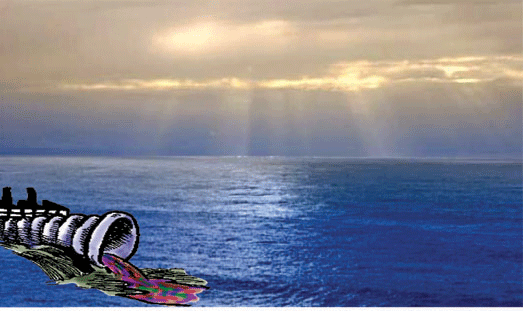 ‘‘Shock’: Water underneath Fukushima reactors to be dumped in ocean — Attempts to deal with problem have ‘failed’ — Officials: It’s better than radioactive substances just “spilling directly into the ocean” like it is now (VIDEO) nenews.com/shock-water-fukushima-reactors-be-dumped-ocean-attempts-deal-problem-failed-officials-better-allowing-contamination-spill-directly-ocean-like-video?utm_source=feedburner&utm_medium=email&utm_campaign=Feed%3A+ENENews+%28Energy+News%29
AFP, Aug. 7, 2014 (emphasis added): Tepco ‘running out of space’ for tainted water — [Tepco] on Thursday unveiled a plan to dump scrubbed water directly into the ocean, sparking concerns over whether it would be properly decontaminated. […] {Tepco] has admitted that it’s running out of space. It is also fighting to contain contaminated groundwater around the plant from seeping into the ocean […] [Tepco] said it now wants to start pumping out the underground water, purify it […] and then release it […] the firm has long faced criticism over delays in disclosing key information […]
NHK, Aug. 6, 2014: Highly radioactive water […] is seeping into the earth and mixing with ground water. Experts estimate around 200 [or 400] tons of contaminated ground water are leaking into the ocean each day. [Tepco wants] to decontaminate ground water collected at wells near reactor buildings before releasing it into the ocean. […] They say their plan is an improvement on the current situation, as contaminated water is spilling directly into the ocean.
Yomiuri Shimbun, Aug 7, 2014: Groundwater to be pumped up from some of the subdrain pits includes high levels of tritium, a radioactive substance thatcannot be removed […] However, TEPCO believes it is possible to […] meet standards if the water is mixed in tanks with water pumped from other subdrain pits.
Kyodo, Aug 7, 2014: Tepco to collect toxic groundwater at Fukushima, dump in ocean after treatment […] it is unclear whether [the plan] will work as smoothly as expected, one of the officials admitted. […] Radioactive substances such as tritium and cesium have been detected [but] TEPCO says it aims to clean the water to a level that would do no harm to the environment, but tritium will remain untreated […]
Asahi Shimbun, Aug 7, 2014: [Tepco] wants to dump decontaminated water […] into the ocean. [TEPCO] is in talks with government ministries to pump contaminated water found around the buildings […] process it […] then release it […] “We would never consider dumping the water into the ocean unless we received the consent of local residents,” a TEPCO official said. […] it would be the first time […] for contaminated water to be dumped into the ocean after it has been purified. […] “The water close to the plant buildings is already contaminated,” the official said. “Fishermen are sure to raise objections” […]
Bloomberg, Aug 4, 2014: [E]stimates […] suggest filtering the isotope strontium out of stored water will take more time [than Tepco’s March 31, 2015 deadline.] Strontium has been linked to leukemia and can enter the food chain […] Delays in the cleanup could extend a South Korean ban on Japanese seafood imports […] Michael Friedlander, a former nuclear engineer [said] “They’re basically accumulating vast quantities of radioactive material that isn’t in control” […] Corrosion has delayed full use of a filtration system known as ALPS […] Tepco said aplan to divert groundwater into the sea […] has so far failed […]
NHK, Aug. 7, 2014: [TEPCO] is running a so-called bypass system […] But groundwater continues to flow into the reactors’ buildings and become contaminated. Part of it is believed to be seeping into the nearby Pacific Ocean. […] In the closed-door meeting, the officials are said to have explained that they plan to collect contaminated groundwater both at wells near reactor buildings and […] a coastal embankment. […] Fisheries association head Hiroyuki Sato told reporters that fishermen were shocked to hear that the measure is needed […]
Fukushima’s nuclear fuel found 15 miles from Tokyo suburbs
Nuclear fuel found 15 miles from Tokyo suburbs — Fukushima uranium in ‘glassy’ spheres transported over 170 km — Structural materials from the nuclear reactors also present (PHOTOS) http://enenews.com/nuclear-fuel-found-15-miles-tokyo-suburbs-fukushima-uranium-glassy-spheres-transported-170-km-structural-materials-nuclear-reactors-present-photos
Fukushima Diary, Aug 9, 2014: NHK admitted pieces of fuel rods and reactor vessels blasted to at least Ibaraki to contain Uranium & Zirconium […] NHK announced that pieces of nuclear fuel […] were blasted to at least 130km away from Fukushima nuclear plant. It was 2μm diameter particle. The ball-looking shape proves it was molten in high temperature and quickly cooled down […] the same material as nuclear fuel and the structure inside the vessels. These were collected from 3/14 ~ 3/15/2011 in Tsukuba city Ibaraki prefecture by the study group of Science Univ. of Tokyo. […]
NHK News (Translation by SysTran), Aug 9, 2014: Scattering of uranium fuel in a nuclear reactor damage […] in the Ibaraki prefecture immediately after the accident of Fukushima Daiichi Nuclear Power Station has occurred, the material of the structure of other nuclear reactor of uranium is detected […] it’s a result that confirms that damage to the reactor massive had progressed […] Research group of Izumi Nakai professors from Tokyo University of Science […] the dust in the atmosphere […] collected at Tsukuba, Ibaraki Prefecture […] 130 km from the nuclear power plant over the next morning from the night of March 14 […] It is a result, in addition to the radioactive cesium, zirconium material of the fuel rods and uranium, and iron of the material of the pressure vessel, material that matches the structure of the nuclear reactor and nuclear fuel has been detected. It is that dust that these shows feature when it is cold suddenly you have to be in the ball-shaped of about 2 micrometers in diameter, and is released after external melted at high temperatures. […]
American Chemical Society Publication, Analytical Chemistry — Detection of uranium and chemical state analysis of individual radioactive microparticles emitted from the Fukushima nuclear accident using multiple synchrotron radiation X-ray analyses, Yoshinari Abe , Yushin Iizawa , Yasuko Terada , Kouji Adachi , Yasuhito Igarashi , and Izumi Nakai (Tokyo University, Japan Synchrotron Radiation Research Institute, Meteorological Research Institute), August 1, 2014 (emphasis added): […] analyses revealed the detailed chemical nature of radioactive aerosol microparticles emitted during the Fukushima Daiichi Nuclear Power Plant (FDNPP) accident, resulting in better understanding of what occurred in the plant during the early stages of the accident. Three spherical microparticles (~2 μm Φ) containing radioactive Cs were found in aerosol samples collected on March 14th and 15th, 2011, in Tsukuba, 172 km southwest of the FDNPP […] 10 heavy elements [were] in all three particles: Fe, Zn, Rb, Zr, Mo, Sn, Sb, Te, Cs, and Ba. In addition, U was found for the first time in two of the [three] particles […]implying that U fuel and its fission products were contained in these particles […] These results strongly suggest that the FDNPP was damaged to emit U fuel and fission productsoutside the containment vessel as aerosol particles. […] individual particles revealed that they were present at high oxidation states, i.e., Fe3+, Zn2+, Mo6+, and Sn4+ in the glass matrix […] These radioactive materials in a glassy state possibly remain in the environment longer than those emitted as water soluble radioactive Cs aerosol particles.
Radiation-polluted steel returned to Japan from South Korea
South Korea to return 20 kg Japanese steel scrap due to radiation contamination Aug 11, 2014 By Meeyoung Cho SEOUL (Reuters) – South Korea plans to return some steel scrap imported from Japan due to radiation contamination, the first returned shipment since Seoul heightened nuclear safety checks in 2012, the country’s nuclear watchdog said in a statement on Monday.
The Nuclear Safety and Security Commission detected caesium 137 at a higher than allowed level in 20 kilogrammes of steel scrap out of a total 20 tonnes imported earlier this month, said a spokeswoman at the agency…….http://af.reuters.com/article/worldNews/idAFKBN0GB0IA20140811
Plutonium contamination at Fukushima becomes ever more alarming
 ‘Increasing alarm’ at Fukushima: Trenches filled with thousands of tons of plutonium contaminated liquid leaking into ocean — ‘Biggest risk’ at plant — ‘Exceptionally difficult’ problem — ‘Constant flow’ in and out of trenches — ‘Racing to stop’ more from coming in (PHOTO) http://enenews.com/japan-officials-increasingly-alarmed-thousands-tons-plutonium-contaminated-liquid-fukushima-trenches-leaking-ocean-biggest-risk-plant-exceptionally-difficult-problem?utm_source=feedburner&utm_medium=email&utm_campaign=Feed%3A+ENENews+%28Energy+News%29
Wall St. Journal, Aug 7, 2014(emphasis added): [Shunichi Tanaka, chairman of the Nuclear Regulation Authority] said [Tepco] needs to get its priorities straight when it comes to work to decommission […] Fukushima Daiichi […] “The biggest risk is the trench water. Until that matter is addressed, it will be difficult to proceed with other decommissioning work,” [Tanaka] said on Wednesday at his weekly news conference. “It appears that they are getting off track,” he told reporters. Tepco has been trying to remove some 11,000 metric tons of water that contains dangerous radioactive materials such as uranium and plutonium from a trench that runs from the Fukushima Daiichi plant’s No.2 reactor building. […] “What if another tsunami hits the plant and the highly contaminated water in the trench is discharged…
NHK, July, 30, 2014: TEPCO initially planned to freeze radioactive wastewater that’s been flowing into underground utility tunnels [trenches] at the plant. It hoped the measure would prevent the wastewater from mixing with groundwater and flowing out to sea. But 3 months into the project, the water hasn’t frozen as planned.
Nuclear Engineering International,August 7, 2014: TEPCO has admitted that it has having problems with freezing contaminated water flowing in trenches […] The water in the trenches is […] coming into contact with nuclear material[…] because the water flows in and out of the trenches because of water pumping operations, it has proved ‘exceptionally difficult’ to freeze, TEPCO said. This was despite increasing the flow of coolant, adding ice and dry ice to the trench water[…]
Kyodo, Aug. 5, 2014: Tepco is racing to stop the buildup of radioactive cooling water in the trenches. […] Tepco inserted refrigeration rods in the trenches to try to freeze the water butabandoned the effort after more than three frustrating months. […] Though [Tepco has now put] 58 tons of ice in the trenches, the utility has “yet to see” whether it will work […] The new method was introduced after an increasingly alarmed Nuclear Regulation Authority urged the company last month to take additional steps as soon as possible […]
World Nuclear News, July 24, 2014: New approaches to removing the contaminated water from trenches […] after attempts to freeze it failed. […] The trenches contain highly-contaminated water that has flowed from the main power plant buildings […] Tepco said that, despite the success of early experiments, “it has proved exceptionally difficult” to freeze the trench water. This, it said, is due to the constant flow of water into and out of the trench […]
The nuclear bombing of Nagasaki
The day the bomb fell on Nagasaki BRIAN MCKENNA The Globe and Mail Aug. 07 2014, The atomic bomb destined for the ancient trading port of Nagasaki was called Fat Man. Sister Regina McKenna, my grandfather’s sister, was close enough to ground zero to feel the death wind on her face. She might have preferred another name: Terror. Or, as the Japanese call it: Slaughter.
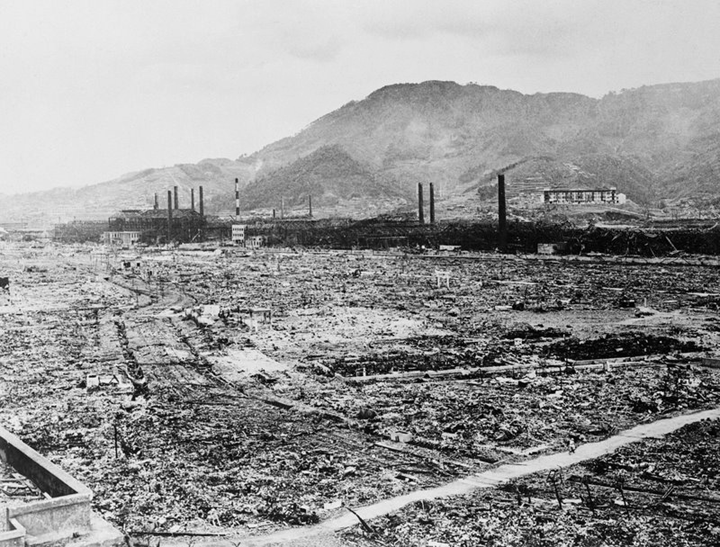
We knew her as Aunt Reggie, a nun with Montreal’s order of the Sacred Heart. She was teaching in Japan when war broke out. She was imprisoned in an internment camp outside Nagasaki.
Boasting some beautiful churches, Nagasaki was home to Japan’s biggest colony of Christians. Thus far, the city had been spared the U.S. Army Air Force campaign of annihilation. Under General Curtis LeMay, armadas of B-29s were systematically bombing Japan “back to the stone age.”………
……….Fat Man was released, flying like an angel of death toward an unsuspecting population. The bomb exploded at 500 metres at precisely 11:02 a.m.
“It seemed as though the sun had burst and I was lost in its midst. I threw myself at once into a clump of young bamboo trees. I was lying on a big bag of grass. My face only felt hot.”
She was spared the worst of the physical blast, shielded by the tall hills encircling Nagasaki. She ran back to the camp. All the windows had imploded. The shattering glass inflicted minor wounds. Downtown Nagasaki was another story.
The city burned for days. Almost all of the churches were destroyed. The survivors wrote of unspeakable suffering, 70,000 dead within 90 days, and everywhere a stench of death and corruption.
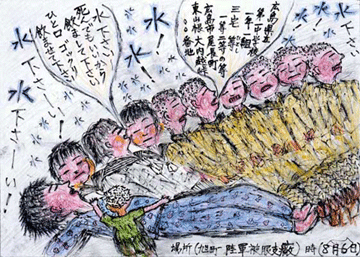 Sister McKenna wrote that the medical system is overwhelmed. “Two-thirds of the population of Nagasaki are dead. The city itself is a mass of ruins. They are still burning the dead. The hospitals having been destroyed, the wounded are not being cared for.”
In 1945, the medical world knew little of radiation poisoning, so her next line resonates. “Some patients apparently recover, then suddenly die from hemorrhages.”
All reporting from Nagasaki was censored.
A Japanese and American film crew rushed to the site. But their footage was suppressed for more than 50 years. When footage finally aired, the impact on public policy (“why two bombs?”) that the nuclear attack should have triggered was diminished by the passage of time.
For Sister McKenna, the imprint of that explosion was like a gigantic X-ray, searing her body and mind for a lifetime. Her fellow teaching sisters said “she was never quite right” after experiencing that cataclysm. And in the end she succumbed to a cancer brought on by radiation poisoning……http://www.theglobeandmail.com/life/facts-and-arguments/the-day-the-bomb-fell-on-nagasaki/article19959476/
Tepco under-reported Fukushima release of plutonium – by 200 times!
 New report estimates 278 trillion Bq of plutonium released from Fukushima reactors — Over 200 times higher than amount reported by Tepco — “Highly radiotoxic when incorporated into human body” as it decays http://enenews.com/new-report-estimates-278-trillion-bq-of-plutonium-released-from-fukushima-reactors-over-200-times-higher-than-amount-reported-by-tepco?utm_source=feedburner&utm_medium=email&utm_campaign=Feed%3A+ENENews+%28Energy+News%29
Evaluation of the Fukushima Accident Source Term through the fast running code RASCAL 4.2(pdf),ENEA Bologna Research Centre, May 23, 2014: This Report presents the results of the application of the fast-running US-NRC direct code RASCAL 4.2 to the estimation of the Fukushima Source Term. […] it is plausible that the ventings that TEPCO announced during the accident as being conducted from the wetwell were, as a matter of fact and because of the degraded conditions of the plants, conducted actually from the drywell. […] wetwell properties imply releases which can be several oder of magnitudes lower than those from the drywell […] it can clearly be seen that the most probable path is the combination of Drywell+Direct option […] the true venting path, i.e. from Drywell instead of from Wetwell, is an extremely important issue. […] in several instances when TEPCO tried to operate venting, in order to release pressure outside the building through the stack, it proved impossible […] there are many indications that probably the radioactive material escaped from the drywell; this may have occurred without TEPCO’s immediate knowledge and because of several factors; for example: structural damages to the pipings connecting drywell to torus room (vent piping bellows), due either to the earthquake, and/or to the too violent pressure and temperature increase in the D/W; leakages through the top head manhole, the top head flange, the piping penetrations, the electrical wiring penetrations, the personal airlocks, the S/C manholes, the machine hatches, etc. […] The value of 1%/h was chosen by ENEA because of the possible highly damaged conditions of the Fukushima NPPs due to the BDB [Beyond Design Basis] earthquake.
> Table 7. Cumulative Source Term (Bq) TEPCO MELCOR
- Pu-241 Total = 1.2E+12 (1,200,000,000,000 Bq)
> Table 7. Cumulative Source Term (Bq) ENEA RASCAL 4.2
- Pu-241 Unit 1 = 6.52E+13 (65,200,000,000,000 Bq)
- Pu-241 Unit 2 = 1.86E+14 (186,000,000,000,000 Bq)
- Pu-241 Unit 3 = 2.67E+13 (26,700,000,000,000 Bq)
- Pu-241 Total = 2.78E+14 (278,000,000,000,000 Bq)
Environmental Science & Technology (American Chemical Society), July 11, 2014: [S]tandard alpha spectrometry techniques […] are not able […] to measure 241Pu.
Boreal Environment Research (pdf), Feb. 28, 2014: The 241Pu isotope was introduced into the environment from […] accidents that released nuclear reactor fuel, such as […] the 2011 Fukushima catastrophe. As compared with other Pu isotopes in the environment that are alpha-emitting and long-lived, 241Pu is a short-lived isotope with a half-life of 14.35 years […] 241Pu decays to the alpha emitter 241Am, that has a much longer half-life (432.2 years) and is highly radiotoxic when it is incorporated into either the human or animal body. […] The 241Pu isotope has been studied less extensively than the α-emitting Pu isotopes for several reasons. Activity concentration of 241Pu cannot be determined from the same alpha spectrum as the Pu isotopes 238, 239, and 240, and extra effort is needed in order to analyze 241Pu concentration of a sample. Actually, 241Pu emits alpha particles, but they have so low probability (0.002%) that 241Pu cannot be measured directly by α-spectrometry […]
Melted nuclear fuel cores leaking radiation directly into groundwater at Fukushima
 Official: “Unfortunately, the fuel itself is exposed” at Fukushima — Scientist: Our tests show contamination isn’t going away… reactors are leaking out into ocean… there’s still a problem — PBS: Plume of water tainted with radiation is reaching to other side of Pacific (VIDEO) http://enenews.com/official-fuel-exposed-fukushima-scientist-tests-show-contamination-going-away-reactors-leaking-ocean-problem-pbs-plume-water-tainted-radiation-reaching-other-side-pacific-video?utm_source=feedburner&utm_medium=email&utm_campaign=Feed%3A+ENENews+%28Energy+News%29
PBS NewsHour’s ‘Return to Fukushima’, Aug 6, 2014: NewsHour science correspondent Miles O’Brien […] has traveled to Fukushima three times and six times entered the exclusion zone, which he described as a “post-apocalyptic landscape of abandoned towns, frozen in time.” We’ve stitched his latest reports together into this documentary-length video. They include his tour of the hazardous Fukushima Daiichi nuclear power plant and a look at the health of marine life off the coast of Japan […] Plus, a never-before-seen exclusive tour of Fukushima Daini, Daiichi’s sister plant, which narrowly escaped the same fate.
- 3:30 in – Miles O’Brien, PBS: 3 of [Fukushima Daiich’s] cores are now melted down, still steaming hot, their steel containment structures breached. Engineers believe some of the nuclear fuel has melted right through the steel containment vessels on to a concrete basement floor, where it is exposed to groundwater. […] Each and every day, about 100,000 gallons of fresh groundwater seeps into the basements of the plant, where it becomes contaminated with a witch’s brew of radionuclide. […] No one disputes the plant is steadily leaking radiation-tainted water into the sea.
- 14:00 in – O’Brien: [Naohiro Masuda, leader of Fukushima Daiichi’s decommissioning company and head of Fukushima Daiini during 3/11] explained where the melted nuclear fuel has gone.
- 14:05 in — Masuda: Unfortunately, the fuel itself is exposed.
- 14:10 in — O’Brien: Melted through?
- 14:15 in — Masuda: Melted through the pressure vessel, and coming down to this room and it goes down to the floor.
- 17:30 in — Crystal Breier, Woods Hole Oceanographic Institution: This is Fukushima water, this is from our cruise this past September. We found there’s still contamination. […] It’s been persistent, it hasn’t gone away. It’s indicating that the reactors are leaking out more cesium — and there is still a problem.
- 18:15 in – O’Brien: The plume of water tainted with radiation from Fukushima is only now reaching the other side of the Pacific. This has prompted an online tsunami of pseudoscience, blog rumors and wild accusations […]
- 32:45 in – O’Brien: Of course local health officials have been following the evacuees in the Fukushima region and they say there have been more than 1,600 deaths attributed to stress. In the end, perhaps the biggest risk associated with nuclear energy might very well be the fear of nuclear energy. Thanks for watching.
- Watch the PBS broadcast here
Delay in plans to restart Sendai nuclear reactors
 Restart of Sendai reactors unlikely before winter Japan Times 5 Aug 14 Kyushu Electric Power Co. said Tuesday it won’t be able until late September or October to submit documents necessary for regulatory safety checks of two of its nuclear reactors.
This means it is unlikely that reactors 1 and 2 at the nuclear power station in Sendai, Kagoshima Prefecture, will be restarted before this winter.
Kyushu Electric initially planned to submit the documents, including specific steps to deal with accidents, in late May.
It is expected to take at least several months after the documents are submitted before all required procedures for restarting the reactors can be completed…….http://www.japantimes.co.jp/news/2014/08/05/national/restart-of-sendai-reactors-unlikely-before-winter/#.U-MNaONdUnk
The problems that hold back Japan’s anti nuclear movement
Japan’s anti-nuclear movement Where’s the protest? http://www.economist.com/blogs/banyan/2014/08/japan-s-anti-nuclear-movement Aug 3rd 2014, by T.B. | SATSUMASENDAI ACROSS the rice-paddy fields from the Sendai (川内) nuclear plant, at the southern tip of Kyushu, the southernmost of Japan’s four main islands, Ryoko Torihara is battling to prevent two reactors being switched back on. She is in her 60s, and runs the local anti-nuclear association from her sitting room. That is a typical profile for the movement in Japan, which first gathered numbers in the 1960s. Her association has lacked the force to halt progress towards a restart at Sendai, she admits. Sendai is set to become the first plant to start operations since the last of Japan’s nuclear fleet was shut down last autumn. The plant’s owner, Kyushu Electric, by contrast, has dispatched a small army of around 80 public-relations staff to blitz local officials.
Another seasoned campaigner is Yoshitaka Mukohara, a book publisher who lost a race for governor of Kagoshima prefecture against the pro-nuclear incumbent in 2012, Yuichiro Ito. He won only half as many votes as Mr Ito. Even in the aftermath of the triple meltdown at the Fukushima Dai-ichi power plant in 2011, it proved impossible to win on an anti-nuclear platform when people wished to hear mainly about the government’s economic plans to better their livelihoods.
One reason for the weakness of the movement in Kagoshima prefecture and beyond, Mr Mukohara says, is that its members are usually part-timers.
In Japan it took 15 months for mass anti-nuclear protests to emerge after the disaster of 2011, while thousands of miles away in Germany and elsewhere people took to the streets far sooner. When Japanese did mobilise, mainly in Tokyo, a large proportion were amateur protesters, including plenty of young mothers and unemployed youth. Their energy, and the size of rallies, diminished afterwards.
Since then the anti-nuclear movement has largely failed to gain political traction. Its nadir came in February this year when not even the backing of Junichiro Koizumi, Japan’s charismatic former prime minister, helped an anti-nuclear candidate win an election for governor of Tokyo. The movement has proven “stunningly ineffective”, says Jeff Kingston of Temple University in Tokyo.
There are some notable exceptions, such as Green Action, a Kyoto-based NGO. It is one of the few anti-nuclear organisations able to employ full-time professional staff. Aileen Mioko Smith, its director, says that the anti-nuclear movement has enjoyed a measure of success over the years. Local groups halted the construction of dozens of planned new reactors, including the Ashihama project in Mie prefecture, which wascancelled in 2000. Yet anti-nuclear groups have not managed effectively to lobby politicians or energy-industry leaders to shape government policy, she says, nor have they roused the general public to take action.
The fault may lie in the movement’s own structure. Eric Johnston, a journalist at the Japan Times, describes its elderly members as being out of touch with the media techniques of modern NGOs. Local groups in the regions are fragmented, parochial and suspicious of outsiders. They do not necessarily welcome the younger members who could bring fresh ideas. Potential recruits feel shut out by traditional groups’ seniority systems. And the movement is divided where it could be united. The organisations that demonstrate each year against nuclear weapons at Hiroshima and Nagasaki remain quiet on nuclear energy.
Anti-nuclear sentiment has made a strong impact in the politics of one prefecture, in addition to Fukushima itself. Last month, Taizo Mikazuki from the Democratic Party of Japan won an election for governor of Shiga prefecture after running a strongly anti-nuclear campaign. The public’s anger over the way in which Shinzo Abe, the prime minister, handled a change in national-security policy was crucial to his victory. But fears about more than a dozen reactors across the prefectural border in Fukui also played an important role. Polls of public opinion show that a consistent majority of Japanese, when asked, would prefer a total phase-out of nuclear power. With more modern and professional methods, the anti-nuclear movement might achieve more than it has.
Proper research urgently needed into medical effects of Japan’s nuclear meltdowns
issue under the rug, predicting any harmful effects of the catastrophe is “unlikely.”
The UN panel made a very broad assumption about the worst nuclear catastrophe in history (or worst since Chernobyl) – and did this BEFORE research is done. However, a local health study raises alarm bells. Fukushima Medical University found 46% of local children have a pre-cancerous nodule or cyst, and 130 have thyroid cancer, vs. 3 expected. Incredibly, the University corrupts science by asserting the meltdown played no role in these high figures.
But Japanese studies must go far beyond childhood thyroid diseases. Japan isn’t the only site to study, as the fallout from the meltdown spread across the northern hemisphere.
In 2011, we estimated 13,983 excess U.S. deaths occurred in the 14 weeks after Fukushima, when fallout levels were highest – roughly the same after Chernobyl in 1986. We used only a sample of deaths available at that time, and cautioned not to conclude that fallout caused all of these deaths.
Final figures became available this week. The 2010-2011 change in deaths in the four months after Fukushima was +2.63%, vs. +1.54% for the rest of the year. This difference translates to 9,158 excess deaths – not an exact match for the 13,983 estimate, but a substantial spike nonetheless.
Again, without concluding that only Fukushima caused these deaths, some interesting patterns emerged. The five Pacific and West Coast states, with the greatest levels of Fukushima fallout in the U.S., had an especially large excess. So did the five neighboring states (Arizona, Idaho, Montana, Nevada, and Utah), which received the next highest levels.
Most of the spring 2011 mortality increase were people over 80. Many of these elderly were in frail health; one possibility is that the added exposure to radioactive poison sped the dying process.
Fukushima radiation is the same as fallout from atom bomb explosions, releasing over 100 chemicals not found in nature. The radioactive chemicals enter the body as a result of precipitation that gets into the food chain. Once in the body, these particles harm or kill cells, leading to disease or death.
Once-skeptical health officials now admit even low doses of radiation are harmful. Studies showed X-rays to pregnant women’s abdomens raised the risk of the child dying of cancer, ending the practice. Bomb fallout from Nevada caused up to 212,000 Americans to develop thyroid cancer. Nuclear weapons workers are at high risk for a large number of cancers.
Rather than the UN Committee making assumptions based on no research, medical research on changes in Japanese disease and death rates are needed – now, in all parts of Japan. Similar studies should be done in nations like Korea, China, eastern Russia, and the U.S. Not knowing Fukushima’s health toll only raises the chance that such a disaster will be repeated in the future.
Joseph Mangano is Executive Director of the Radiation and Public Health Project.
Janette D. Sherman MD is an internist and toxicologist, and editor of Chernobyl: Consequences of the Catastrophe for People and the Environme
Dr Helen Caldicott on the authorities’ concealment of medical effects of Fukushima catastrophe
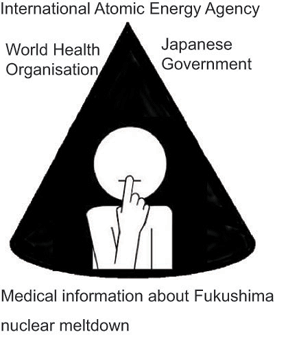
UN, Japan, Concealing Extent of Fukushima Catastrophe MWC News, By Sherwood Ross Friday, 01 August 2014 Japanese and United Nations authorities have placed “a cone of silence” over medical information an endangered Japanese public is entitled to have about the Fukushima nuclear plant meltdown.
“It is obvious that there is collaboration between the World Health Organization(WHO) and the International Atomic Energy Agency(IAEA) and also the Japanese government…to hide, to lie, and to cover-up vital medical information that must be made available to the Japanese population,” says Dr. Helen Caldicott, the medical doctor who has been showered with honors and awards for her long-time opposition to the dangers of nuclear power manufacture and nuclear war.
“Many doctors have been ordered not to inform their patients that their symptoms could be related to radiation, leaving them in a state of despair,” Dr.Caldicott says. (They) “need to know the truth about their situation and that of their children.”
Dr. Caldicott, who has received 21 honorary doctorates for her work, says that to make matters worse, Japan Prime  Minister Shinzo Abe “has passed a secrecy law which will almost certainly intimidate the media from keeping a very close watch over the tenuous (nuclear) plant.”
The government, she says, and Tokyo Electric Power Co.(TEPCO), “have been reluctant to divulge reliable data and information about radioactive releases, the ongoing state of the severely damaged reactors, the continuous outflow of radioactive water into the sea, and the possibility of a serious accident and radiation release in the event of another earthquake greater than 7 on the Richter scale which could well trigger the collapse of the seriously damaged buildings numbers 3 and 4.”
Damaged Building 3 contains over 100 tons of molten radioactive fuel which “would almost certainly release massive quantities of radioactive elements…threatening millions of people with radioactive contamination,” Dr. Caldicott points out.
She goes on to say that if precariously damaged Building 4 should collapse, 400 tons of extremely radioactive fuel will plunge 100 feet to the ground, releasing its cooling water with possible ignition of the fuel. This could release ten times more cesium than was released at Chernobyl or the equivalent of 14,000 Hiroshima-sized bombs.
What’s more, of the 800,000 healthy youngsters called “liquidators” brought in by the Government from around Russia to fight the burning reactor, within 19 years more than 120,000 were dead.
Dr. Caldicott urged the public to “demand that TEPCO and the Japanese government continually inform the public about the events that are and will be occurring at the Fukushima reactors, without cover-ups and denials of the facts.”
Should another major release of radiation occur, she said, the public must be informed immediately and evacuation begun immediately. http://mwcnews.net/focus/politics/44145-fukushima-catastrophe.html#sthash.5cgmPLZn.dpuf
Japan wants to measure individuals’ radiation exposure, not air doses
Ministry seeks to focus on individual radiation exposure The Yomiuri Shimbun 2 Aug 14 The Environment Ministry has compiled a report calling for decontamination work in areas affected by the crisis at Tokyo Electric Power Co.’s Fukushima No. 1 nuclear power plant to be based on measurements of individuals’ radiation exposure doses, instead of air doses. Continue reading
Japan returning to a new age of fascism with Shinzo Abe’s policies?
The most important question is no longer whether each of Abe’s policies is good or bad, but rather whether we are going to condone the prime minister’s basic attitude that negates the common sense of a modern state and will lead to turning Japan into a barbaric nation.
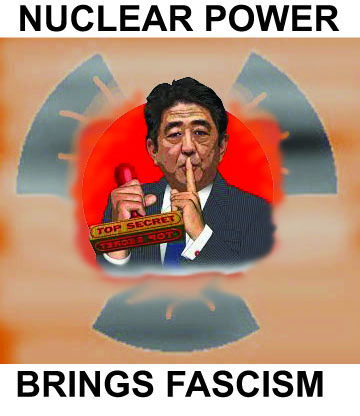
 Abe undermining rule of law, Japan Times, BY JIRO YAMAGUCHI JUL 31, 2014 A recent series of events has demonstrated the deterioration of Japan as a nation. At the root of the problem appears to be a bottomless nihilism on the part of those in power characterized by their thinking that the powers that be can ignore the rules and norms of society and polity.
On July 1, the Abe administration made a Cabinet decision to pave the way for Japan engaging in collective self-defense. This is an act that alters the foundation of Japan’s national security policies developed over the past 60 years, and an outrageous move that way oversteps the power of a single Cabinet.
How vague and sloppy the decision itself is was illustrated by the Budget Committee debates in both chambers of the Diet held two weeks later……..
The new conditions for the use of force overseas set under the LDP-New Komeito agreement will never serve as an effective brake on Japan’s military actions overseas.
Questions and answers in the Diet showed that the text of the Cabinet decision allows different people to interpret it in their own way.
If so, the norms set by the Cabinet over Japan engaging in collective self-defense will be meaningless. In the first place, Abe does not have the idea that government leaders must exercise their power in accordance with rules that are set down in words…….
If the content of norms and rules of a nation can be freely changed by those who interpret them, the nation is no longer under the rule of law; it’s under the rule of man.
Meanwhile, the Nuclear Regulation Authority screened Kyushu Electric Power Co.’s Sendai Nuclear Power Plant in Kagoshima Prefecture in accordance with the NRA’s plant design standards updated in the wake of the 2011 Fukushima nuclear disaster and announced that the Sendai plant has cleared the screening. Thus the NRA has paved the way for restarting the idled plant.
At the same time, NRA Chairman Shunichi Tanaka said NRA cannot determine whether the plant is safe to restart. The NRA chief insists its screening standards are not safety standards.
Yet, the Abe administration, which had repeatedly said it would reactivate nuclear power plants that have cleared “the safety standards,” is expected to push for a quick restart of the Sendai plant. The government says that NRA screening has confirmed the safety of the Sendai plant.
As with the issue of the exercise of the right to collective self-defense, each of the people involved in the nuclear power policy is allowed to interpret the rules in his or her own way.
All these events demonstrate that people in power in this country — in particular Abe — do not recognize that they are bound by rules. They defiantly argue that even if certain things are prohibited under rules, they can do them simply by first changing the interpretation of the rules. Or, if they cannot win a game, they think that it’s because the rules and the referee are wrong. They then think that if the referee is replaced, things will be all right.
The most important question is no longer whether each of Abe’s policies is good or bad, but rather whether we are going to condone the prime minister’s basic attitude that negates the common sense of a modern state and will lead to turning Japan into a barbaric nation.
Jiro Yamaguchi is a professor of political science at Hosei University. http://www.japantimes.co.jp/opinion/2014/07/31/commentary/world-commentary/abe-undermining-rule-law/#.U9xbVuNdUnk
1 This Month





PLEASE OPPOSE HR 8255 AND S.3639 – bills would accelerate satellite deployment, with no environmental review or safeguards – https://ncstd5li.quorum.us/campaign/169331/
To see nuclear-related stories in greater depth and intensity – go to https://nuclearinformation.wordpress.com
-
Archives
- October 2026 (58)
- September 2026 (339)
- August 2026 (330)
- July 2026 (355)
- June 2026 (287)
- May 2026 (306)
- April 2026 (356)
- March 2026 (251)
- February 2026 (267)
- January 2026 (308)
- December 2025 (358)
- November 2025 (359)
-
Categories
- 1
- 1 NUCLEAR ISSUES
- business and costs
- climate change
- culture and arts
- ENERGY
- environment
- health
- history
- indigenous issues
- Legal
- marketing of nuclear
- media
- opposition to nuclear
- PERSONAL STORIES
- politics
- politics international
- Religion and ethics
- safety
- secrets,lies and civil liberties
- spinbuster
- technology
- Uranium
- wastes
- weapons and war
- Women
- 2 WORLD
- ACTION
- AFRICA
- Atrocities
- AUSTRALIA
- Christina's notes
- Christina's themes
- culture and arts
- Events
- Fuk 2022
- Fuk 2023
- Fukushima 2017
- Fukushima 2018
- fukushima 2019
- Fukushima 2020
- Fukushima 2021
- general
- global warming
- Humour (God we need it)
- Nuclear
- RARE EARTHS
- Reference
- resources – print
- Resources -audiovicual
- Weekly Newsletter
- World
- World Nuclear
- YouTube
-
RSS
Entries RSS
Comments RSS

