No plain sailing for japan’s nuclear restart as Fukushima’s waste problems continue
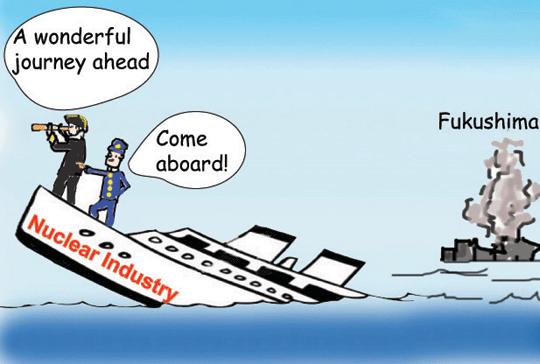 Persistent Nuclear Waste From Fukushima Inhibits Restarts Fukushima’s long-term problems will make public acceptance of a general nuclear restart difficult.http://thediplomat.com/2014/07/persistent-nuclear-waste-from-fukushima-inhibits-restarts/ By Clint Richards July 30, 2014 After months of attempting to negotiate with local residents in Fukushima, the Japanese government has abandoned its attempt to purchase land to store nuclear waste from the stricken Fukushima Daiichi reactors. Storing nuclear waste and preventing groundwater from entering the disaster site continue to be persistent problems for the government, with no clear solution. This inability is a key factor explaining why public sentiment remains so strong against restarting Japan’s nuclear reactors, despite newer and much more robust safety standards from the Nuclear Regulatory Authority (NRA).
Instead of purchasing nearby land, Environment Minister Nobuteru Ishihara and Reconstruction Minister Takumi Nemoto met with Fukushima Governor Yuhei Sato and the mayors of Futaba and Okuma and proposed a 30 year lease for 230 billion yen ($2.25 billion). The Jiji Press reported that local residents had refused to selltheir land because they believed the temporary storage facilities would become permanent if the land was owned by the state. The mayors of the respective towns said they would submit the proposal to their residents, but that it would take time to gain acceptance.
Additionally, on Monday Tokyo Electric Power Co. (TEPCO) finally admitted that an operation underway since May to divert groundwater from entering into reactor buildings was unsuccessful. TEPCO had been attempting to intercept the water before it entered the tainted facilities and divert it into the ocean, but so far “the utility has yet to see tangible results,”according to the Japan Times. There are reportedly 400 tons of water flowing into the contaminated area on average every day, with TEPCO’s operation intended to reduce that amount by as much as 100 tons. Instead, the company hopes to stop groundwater from entering by solidifying the nearby hillside soil with concrete.
The government’s piecemeal approach to the waste problem generated by the Fukushima Daiichi reactors has done little to inspire the confidence of the Japanese population about plans to restart some of its reactors in the coming months. While Kyushu Electric Power Co.’s Sendai nuclear power plant passed the NRA’s new, more stringent safety inspections on July 16, 59 percent of Japanese people oppose the restart, according to an Asahi Shimbun poll conducted July 26 and 27. Even though the Sendai reactors only need to gain local acceptance in order to restart, these poll numbers indicate that a more general restart will continue to be met with resistance. The government has further plans to stem the flow of contaminated groundwater, for instance revamping its “ice wall” beneath the Fukushima Daiichi reactors by adding additional pipes and dumping as much as 10 tons of ice a day. However, until Japanese people feel there is an effective, long-term solution to the nuclear disaster in place, public opposition to nuclear energy will remain.
Japan’s Prime Minister Abe pinning his political future on nuclear power restart
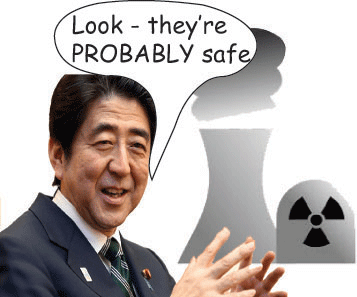 Flicking the switch Restarting nuclear plants is unpopular but crucial for Shinzo Abe The Economist Aug 2nd 2014 | SATSUMASENDAI|”……. The pro-nuclear government of Shinzo Abe, the prime minister, hopes a restart at the Sendai plant can open the way for a dozen or more reactors to resume operations……..The cost of closure to the local economy means that officials who favour nuclear power overwhelmingly outnumber opponents in the local assemblies that will vote in the autumn. Yet on the national stage, Mr Abe may still pay a price. His popularity has recently flagged. Last month his Liberal Democratic Party lost a gubernatorial election in Shiga prefecture, partly due to rising anti-nuclear sentiment. Some three-fifths of people are against the Sendai restart, according to a recent nationwide poll of public opinion.
Back in Kyushu, the possibility of an imminent restart was driven home this week when the prefecture handed out iodine tablets to households near the plant to protect against thyroid cancer in case of an accident. Other plans are incomplete, most notably on basic evacuation routes in case of a nuclear emergency. The plant is likely to restart without an earthquake-proof off-site emergency centre, though these were mandated after the Fukushima disaster. Japan lies in one of the world’s most seismically active areas, but insufficient discussion has been held about the risks posed by a surrounding group of five calderas and by Sakurajima, an active volcano only 50 kilometres (31 miles) away from the Sendai plant.
The central government has to date relied on the NRA and on Kagoshima officials to make the case for the restart. Yet the governor, Yuichiro Ito, now says the authorities in Tokyo must convince the public of the plant’s safety. In 2012, before two reactors at Oi in Fukui prefecture were switched back on for a while, the governor there ensured that the then prime minister, Yoshihiko Noda, reassured the public over the plant’s safety. Mr Abe may have to dip deep into his political capital if reactors across the country are to be fired up. http://www.economist.com/news/asia/21610329-restarting-nuclear-plants-unpopular-crucial-shinzo-abe-flicking-switch
Fukushima monkeys’ abnormal blood could have been caused only by nuclear radiation
 Guardian: Abnormal blood in monkeys linked to Fukushima disaster — Study: ‘Epidemic infectious disease’ could occur — “We cannot find other reasons except radiation” — Concern about strontium-90 & other radioactive materials besides cesium — “Potential direct relevance to humans”http://enenews.com/study-finds-blood-monkeys-70-km-fukushima-plant-epidemic-infectious-disease-could-occur-find-other-reasons-except-radiation-effects-neurological-development-discovered-other-mammals-potent?utm_source=feedburner&utm_medium=email&utm_campaign=Feed%3A+ENENews+%28Energy+News%29
The Guardian, July 24, 2014: Japanese monkeys’ abnormal blood linked to Fukushima disaster – study – Wild monkeys in the Fukushima region of Japan have blood abnormalities linked to the radioactive fall-out from the 2011 nuclear power plant disaster, according to a new scientific study that may help increase the understanding of radiation on human health. […] Professor Shin-ichi Hayama, at the Nippon Veterinary and Life Science University in Tokyo, told the Guardian […] “This first data from non-human primates — the closest taxonomic relatives of humans — should make a notable contribution to future research on the health effects of radiation exposure in humans… The low haematological values in the Fukushima monkeys could have therefore been due to the effect of any radioactive materials… We did not conclude the low-blood cell counts are caused by caesium but so far we cannot find other reasons except radiation.”
Scientific Reports (Nature.com), July 24, 2014: In April 2012 we carried out a 1-year hematological study on a population of wild Japanese monkeys inhabiting the forest area of Fukushima City. This area is located 70 km from the Fukushima Daiichi Nuclear Power Plant […] Total muscle cesium concentration in Fukushima monkeys was in the range of 78-1778 Bq/kg, whereas the level of cesium was below the detection limit in all [monkeys from 400 km away.] Fukushima monkeys had significantly low white and red blood cell counts, hemoglobin, and hematocrit […] These results suggest that the exposure to some form of radioactive material contributed to hematological changes in Fukushima monkeys. […] low hematological values in Fukushima monkeys could have […] been due to the effect of other radioactive materials. […] The hematological changes in the Fukushima monkeys might likely be the result of exposure to some form of radioactive material, but only radiocesium concentration was measured in this study. […] We therefore plan to investigate in a future study the underlying mechanism in detail with the aim of detecting other radioactive materials, such as 90Sr. […]
The Australian, Higher Education Reporter John Ross, July 25, 2014: Reality apes movie for Fukushima monkeys — In the latest Planet of the Apes movie, a virus created in a lab pushes primate evolution into overdrive while morphing into a simian flu that wipes out most of the human race. Scientists monitoring the aftermath of the Fukushima nuclear plant meltdown may be witnessing something similar in real life […] “Low blood cell count … may suggest that the immune system has been compromised, potentially making the entire troop susceptible to, for example, epidemic infectious disease.” The study suggests strongly that the blood changes are the result of nuclear contamination […]
Fox News, July 25, 2014: “The findings are consistent with what our group had found with red blood cells and hemoglobin content for children living around Chernobyl,” said Tim Mousseau, a biologist at U. of South Carolina […] “The fact that they are seeing a signal in monkeys living in Fukushima city means that there’s some potential direct relevance to the human population.”
See also: SNL mocks Fukushima — Shows radioactive monkeys replacing Godzilla (VIDEO)
Radioactive cesium in Minamisoma, Fukushima Prefecture,
Debris cleanup at Fukushima reactor may have contaminated rice crops, Japan Times, KYODO JUL 14, 2014 Debris cleanup work by Tokyo Electric Power Co. at the Fukushima No. 1 nuclear plant may have led to the contamination of rice crops in nearby areas, agriculture ministry officials said Monday.
Radioactive cesium exceeding the government limit of 100 becquerels per kilogram was detected in rice crops from Minamisoma, Fukushima Prefecture, last year, including areas located more than 20 km from the crippled nuclear plant.
Farm ministry officials said they could not deny the possibility that radioactive dust was stirred up when Tepco cleaned up debris at the No. 3 reactor last August and that the dust could have made its way north to Minamisoma……..http://www.japantimes.co.jp/news/2014/07/14/national/debris-cleanup-fukushima-reactor-may-contaminated-rice-crops/#.U9m_C-NdUnk
Japan struggles to plan disposal area for nuclear waste dumps
According to online newspaper, local residents did not agree to the initial plan and refused to sell their lands, even though most of them are located within 20 kilometers (12 miles) of the Fukushima-1 power plant and are still considered unfit for habitation due to their high levels of radioactive contamination.
The Japanese Environment Ministry decided to lease the land for a 30-year period instead.
Environment Minister Nobuteru Ishihara and Reconstruction Minister Takumi Nemoto explained the new proposal in a meeting with Fukushima Governor Yuhei Sato and the mayors of Okuma and Futaba, whose towns were selected as interim storage facilities……… researchers found radioactive cesium fallout in Fukushima plants and animals. http://en.ria.ru/world/20140729/191432845/Japan-Gives-Up-Plan-to-Buy-Fukushima-Lands-for-Nuclear-Waste.html
Japanese residents near Sendai to get iodine tablets, in case of nuclear power accident
 Kagoshima residents near Sendai nuclear plant given iodine tablets http://www.japantimes.co.jp/news/2014/07/27/national/kagoshima-residents-near-sendai-nuclear-plant-given-iodine-tablets/#.U9bY_ONdUnk KYODO JUL 27, 2014 Local authorities in Kagoshima Prefecture on Sunday started handing out iodine tablets to residents living within 5 km of the Sendai nuclear power plant, which may be restarted in the fall.
It is the first time iodine tablets have been distributed under guidelines instituted by the Nuclear Regulation Authority, which was set up in the wake of the 2011 Fukushima nuclear disaster. Iodine tablets help people protect their thyroid glands from radiation.
The move by the Kagoshima prefectural and Satsumasendai municipal governments came after Kyushu Electric Power Co.’s Sendai plant cleared a key safety hurdle for restarting operations earlier this month.
About 2,700 of the roughly 4,700 residents over 3 who live within the 5-km radius were given a supply of tablets after hearing an official briefing, submitting medical interview sheets and receiving the green light from doctors, according to prefectural officials.
Briefings for the remaining residents will resume in September, they said.
A total of 39 residents declined to receive the tablets. Children under 3 will receive the equivalent at shelters in the event of a nuclear accident, the officials said.
Tokyo’s growing nuclear radiation danger
 ‘Tokyo should no longer be inhabited,’ Japanese doctor warns residents regarding radiation http://www.naturalnews.com/046112_radiation_fukushima_tokyo.html 25 July 14 (NaturalNews)In an essay addressed to his colleagues, Japanese doctor Shigeru Mita has explained why he recently moved away from Tokyo to restart his practice in western Japan: He believes that Tokyo is no longer safe to inhabit due to radioactive contamination caused by the March 11, 2011, meltdowns at the Fukushima Daiichi nuclear plant.
The essay, titled “Why did I leave Tokyo?” was published in the newsletter of the Association of Doctors in Kodaira, metropolitan Tokyo.
Soil tests prove contamination
Dr. Mita opens his essay by contextualizing his decision to leave, noting that he had a long history as a doctor in Tokyo.
“I closed the clinic in March 2014, which had served the community of Kodaira for more than 50 years, since my father’s generation, and I have started a new Mita clinic in Okayama-city on April 21,” he wrote.
Dr. Mita notes that, for the past 10 years, he had been working to persuade the municipal government of Tokyo to stock iodine pills to distribute to the population in the case of a nuclear accident. Dr. Mita’s concern had been that an earthquake might trigger a meltdown at the Hamaoka nuclear power plant. All of his requests were rejected, however, under the excuse that there was no reason to expect such an accident.
Prior to 2011, Shinjuku (the region of Tokyo that houses the municipal government) tested at only 0.5-1.5 Bq/kg. Today, levels at nearby Kodaira are at 200-300 Bq/kg.
“Within the 23 districts of Metropolitan Tokyo, contamination in the east part is 1000-4000 Bq/kg and the west part is 300-1000 Bq/kg,” Dr. Mita wrote.
For comparison, Kiev (capital of the Ukraine) has soil tested at 500 Bq/kg (Cs-137 only). Following the Chernobyl accident, West Germany and Italy reported levels of 90-100 Bq/kg, and both experienced measurable health effects on their populations.
Dr. Mita notes that the radiation situation in Tokyo is getting worse, not better, due to urban practices of concentrating solid waste in small areas such as municipal dumps and sewage plants. That is why, he says, radiation levels in Tokyo riverbeds have actually been increasing over the prior two years.
Dr. Mita’s essay also chronicles the many cases he has observed of patients presenting with radiation-induced health problems. He notes that, since 2011, he has observed while blood cell counts declining in children under the age of 10, including in children under one year old. In all of these cases, symptoms typically improve if the children move to western Japan. He has similarly observed persistent respiratory symptoms that improve in patients who move away.
Other patients have shown symptoms including “nosebleed, hair loss, lack of energy, subcutaneous bleeding, visible urinary hemorrhage, skin inflammations, coughs and various other non-specific symptoms.” He also notes high occurrences of rheumatic muscle symptoms similar to those observed following the Chernobyl disaster.
“Ever since 3.11, everybody living in Eastern Japan including Tokyo is a victim, and everybody is involved,” he wrote.
Sources for this article include:
Fukushima nuclear reactor No.5 plagued by radioactive leaks
Japan Newspaper: Leaks plaguing Fukushima No. 5 reactor — Experts: Indicates “deterioration in the system” — Report: Water contains up to 3,000 Bq/liter of Cobalt-60, had been used to cool spent fuel (PHOTOS) http://enenews.com/japan-newspaper-leaks-are-plaguing-fukushima-no-5-reactor-experts-this-indicates-deterioration-in-the-system-report-water-contains-up-to-3000-bqliter-of-cobalt-60-was-used-to-cool-spe?utm_source=feedburner&utm_medium=email&utm_campaign=Feed%3A+ENENews+%28Energy+News%29
Asahi Shimbun, July 20, 2014: Water leaks continue to plague No. 5 reactor at Fukushima plant— A leak of radioactive water was found in the piping of water used to cool the spent fuel pool […] a sign of possible deterioration in the system. [TEPCO] said water from the cooling pond leaked […] TEPCO employee found a pool of water in each of two boxes–75 centimeters by 50 cm–that house a control valve in the cooling water piping system on the fifth floor […] The water had collected to a depth of 9 cm in one box and 18 cm in the other. The water contained 2-3 becquerels of cobalt 60 per cubic centimeter [2,000 to 3,000 Bq/liter], according to the utility. This particular piping section has been unused since July 6, when a similar leak was discovered at another section. Experts say the continuing leaks indicate that valves are deteriorating, and that the utility’s inspections are inadequate. […] the pumping of cooling water was temporarily halted after a leak in a similar piping system [inside the No. 6 reactor building] was detected on July 11.
See also: Cobalt-60 detected in Unit 4 fuel pool during first month of disaster
TEPCO official: “We are aware that our approach proved to be lax as we were unable to detect the problem until the leak occurred. We are reviewing the way checks should be conducted.”
Similar incident at Unit 5 on July 6 — Fukushima Daiichi NPS Prompt Report, Jul 8, 2014: The cooling of the spent fuel pool of Unit 5 […] was stopped due to seawater leak found at a pipe resumed cooling by another system at 15:40 today […] A system that cools the spent fuel pool at Unit 5 has been stopped on July 6 2014, after seawater was found leaking from a pipe […] the cooling of 994 fuel assemblies inside the spent fuel pool will be continued through another system […]
Some points of agreement on Fukushima between global physicians and UNSCEAR
 Fukushima: Bad and Getting Worse – Global Physicians Issue Scathing Critique of UN Report on Fukushima CounterPunch, by JOHN LaFORGE, 20 July 14 “……..Points of agreement: Fukushima is worse than reported and worsening still
Before detailing the multiple inaccuracies in the UNSCEAR report, the doctors list four major points of agreement. First, UNSCEAR improved on the World Health Organization’s health assessment of the disaster’s on-going radioactive contamination. UNSCEAR also professionally “rejects the use of a threshold for radiation effects of 100 mSv [millisieverts], used by the International Atomic Energy Agency in the past.” Like most health physicists, both groups agree that there is no radiation dose so small that it can’t cause negative health effects. There are exposures allowed by governments, but none of them are safe.
Second, the UN and the physicians agree that areas of Japan that were not evacuated were seriously contaminated with iodine-132, iodine-131 and tellurium-132, the worst reported instance being Iwaki City which had 52 times the annual absorbed dose to infants’ thyroid than from natural background radiation. UNSCEAR also admitted that “people all over Japan” were affected by radioactive fallout (not just in Fukushima Prefecture) through contact with airborne or ingested radioactive materials. And while the UNSCEAR acknowledged that “contaminated rice, beef, seafood, milk, milk powder, green tea, vegetables, fruits and tap water were found all over mainland Japan”, it neglected “estimating doses for Tokyo … which also received a significant fallout both on March 15 and 21, 2011.”
Third, UNSCEAR agrees that the nuclear industry’s and the government’s estimates of the total radioactive contamination of the Pacific Ocean are “far too low.” Still, the IPPNW reports shows, UNSCEAR’s use of totally unreliable assumptions results in a grossly understated final estimate. For example, the UN report ignores all radioactive discharges to the ocean after April 30, 2011, even though roughly 300 tons of highly contaminated water has been pouring into the Pacific every day for 3-and-1/2 years, about 346,500 tons in the first 38 months.
Fourth, the Fukushima catastrophe is understood by both groups as an ongoing disaster, not the singular event portrayed by industry and commercial media. UNSCEAR even warns that ongoing radioactive pollution of the Pacific “may warrant further follow-up of exposures in the coming years,” and “further releases could not be excluded in the future,” from forests and fields during rainy and typhoon seasons –when winds spread long-lived radioactive particles – a and from waste management plans that now include incineration.
As the global doctors say, in their unhappy agreement with UNSCAR, “In the long run, this may lead to an increase in internal exposure in the general population through radioactive isotopes from ground water supplies and the food chain.”……” http://www.counterpunch.org/2014/07/18/fukushima-bad-and-getting-worse/
Widespread dispersal of radioactive cesium as Fukushima debris is removed
 Study: Cesium from Fukushima debris removal likely spread 50 km http://ajw.asahi.com/article/0311disaster/fukushima/AJ201407160064 July 16, 2014 By MIKI AOKI/ Staff Writer
Radioactive substances released during rubble-removal work at the Fukushima No. 1 nuclear plant last year likely spread to areas nearly 50 kilometers away, according to a research team at Kyoto University.
The agriculture ministry earlier raised the likelihood that debris-removal operations on Aug. 19, 2013, led to cesium levels exceeding the safety standard detected in rice harvested more than 20 km from the plant.
Akio Koizumi, a health and environment science professor at Kyoto University’s Graduate School of Medicine, and four other scientists discovered that the wind likely carried the cesium more than twice that distance.
The researchers set up air sampling instruments at three points in residential areas of Fukushima Prefecture and have measured radioactive cesium concentrations every week since September 2012 to estimate residents’ exposure to radiation.
From samples collected between Aug. 15 and 22 last year, they found a reading of 1.28 millibecquerels per cubic meter at a location in Soma, 48 km northwest of the plant. That radioactivity level was more than six times higher than usual.
Radioactivity levels were 20 to 30 times higher than normal in Minami-Soma, 27 km north-northwest of the Fukushima plant. And there were almost no changes in cesium concentrations in Kawauchi, 22 km west-southwest of the plant, the researchers said.
Based on the wind’s speed and direction at the time, as well as size of the collected particles, Koizumi and his colleagues concluded that the radioactive cesium came from the Fukushima No. 1 plant as the result of the Aug. 19, 2013, clearance work at the No. 3 reactor.
The team also found that cesium levels at the measuring point in Minami-Soma surged in both May and June 2013. They attributed the increase to debris-clearing operations at the facility.
The research results indicate that future rubble removal at the nuclear plant could disperse radioactive materials over much broader areas surrounding the facility.
In March this year, the scientists presented their findings to the Environment Ministry. It has also been reported that the agriculture ministry instructed Tokyo Electric Power Co., operator of the nuclear plant, to take measures to prevent the release of radioactive substances in the debris-removal work at the site.
TEPCO currently plans to resume debris-removal efforts by the end of July, starting with the dismantling of a cover installed on the No. 1 reactor building, where highly contaminated rubble remains to be removed.
The utility acknowledged that the Aug. 19 operations released a maximum 4 trillion becquerels–more than 10,000 times the usual levels at the site–over four hours, and apologized to residents for “causing trouble.”
However, TEPCO argued that it is unclear whether the increase in cesium readings was related to debris-clearing work.
Criticism of nuclear power in Japan in a month’s public debate before nuclear restart is final
 Regulator greenlights reactor restarts in nuclear-weary Japan Rt July 16, 2014 Japan’s nuclear watchdog has given a preliminary safety approval for restarting two nuclear reactors at the Sendai plant. A month is given for opposition groups to make their case against the move before a final decision is taken.
The reactors at Sendai power plant in Kagoshima Prefecture are two of 19 which Japanese electric utilities seek to restart and have applied for permission from the Nuclear Regulation Authority (NRA)………
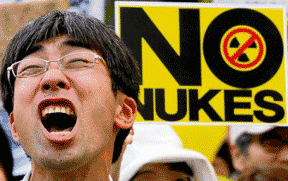
The regulator is bound to see criticism over the one-month public debate period. Even as it was prepared to release the report on Wednesday, a small groups of protesters shouting “Shame on you!” at the public meeting, with one demonstrator accusing the watchdog officials of being puppets of the nuclear industry.
Greenpeace criticized the approval, charging that NRA is “ignoring unresolved safety issues and rising public opposition.”
The Sendai plant has “no effective evacuation plan for the populations in the region, in particular for the elderly, children and those in hospital, no functioning emergency-response center protected against radiation,” the group said in a statement.
The regulator deflected the criticism from the environmental group, saying that evacuation plans are the responsibility of local governments rather than the NRA.
A petition against the planned restart of the Sendai reactors scored 30,000 signatures of residents in Ichikikushikino, a coastal town 5km from the facility. And a local assembly adopted a resolution calling for Sendai to be decommissioned rather than restarted.
In another example of opposition to Abe’s nuclear policies, a candidate backed by his Liberal Democratic Party lost Sunday election to anti-nuclear candidate for the position of Shiga prefecture governor. http://rt.com/news/173224-nuclear-reactor-restart-japan/
USA soil still has radioactive material from Fukushima nuclear disaster
 Fox: Fukushima radioactive material still being found in U.S. soil — Japan Gov’t: The disaster “posed radiation threat to human society”… In 4 days “detectable all across northern hemisphere” — Denmark: Fukushima clearly had widespread consequences, not limited to borders (VIDEOS) http://enenews.com/fox-fukushima-radioactive-material-found-arizona-soil-japan-govt-fukushima-release-posed-radiation-threat-human-society-detectable-all-across-northern-hemisphere-4-days-denmark-fukushima-widespr
Danish Emergency Management Agency’s Carsten Israelson, Nordic Nuclear Safety Research’s 2013 Fukushima seminar (at 4:15 in): The accident in Fukushima… clearly showed that there are consequences that are widespread, and is not limited to borders… Nuclear accidents do happen! Nuclear accidents will likely have widespread consequences – for all of us. >> Watch presentation hereNational Institute of Radiological Sciences (Japan), March 3, 2014: The Fukushima Daiichi Nuclear Power Plant (FDNPP) accident led to the release of large amounts of radionuclides into the environment. […] The released radioactive materials posed radiation threat to human society. Thus, source identification of radioactive contamination and long-term environmental behavior of released radioactive materials are important issues of study after the FDNPP accident.
Japan Atomic Energy Agency & University of Tokyo, Apr. 10, 2014: By March 15, traces from the accident in Fukushima were detectable all across the northern hemisphere. By April 13, the associated radioactivity had spread to the southern hemisphere of the Asia-Pacific region and was clearly detectable at CTBT IMS stations located in Australia, Fiji, Malaysia, and Papua New Guinea.
Fox 10 News — Phoenix, AZ, July 15, 2014: [Aubrey Godwin, director of Arizona Radiation Regulatory Agency] says radioactive material can still be found in Arizona soil from nuclear weapons testing in the 50′s and from Fukushima’s nuclear disaster in 2011. Despite that Godwin says there is no health concern.
Tokyo in danger from Fukushima radiation, says Japanese doctor
 Japan Doctor: “Tokyo should no longer be inhabited” — Everyone here is a victim of Fukushima — People truly suffering — Bleeding under skin, urinary hemorrhaging — Children’s blood tests started changing last year — Time running short… up to physicians to save our citizens and future generations http://enenews.com/japan-doctor-tokyo-longer-be-inhabited-everyone-living-victim-fukushima-disaster-began-notice-childrens-blood-test-results-around-mid-2013-time-running-short-physicians-save-citizens-future-g?utm_source=feedburner&utm_medium=email&utm_campaign=Feed%3A+ENENews+%28Energy+News%29
Dr. Shigeru Mita’s essay published in the newsletter of Association of Doctors in Kodaira (Tokyo), translated by WNSCR, July 16, 2014: Why did I leave Tokyo? To my fellow doctors, I closed the clinic in March 2014, which had served the community of Kodaira for more than 50 years, since my father’s generation, and I have started a new Mita clinic in Okayama-city on April 21. […] It is clear that Eastern Japan and Metropolitan Tokyo have been contaminated with radiation […] contamination in the east part [of Tokyo] is 1000-4000 Bq/kg and the west part is 300-1000 Bq/kg. […] 0.5-1.5 Bq/kg before 2011. […] Tokyo should no longer be inhabited […] Contamination in Tokyo is progressing, and further worsened by urban radiation concentration […] radiation levels on the riverbeds […] in Tokyo have increased drastically in the last 1-2 years. […] Ever since 3.11, everybody living in Eastern Japan including Tokyo is a victim, and everybody is involved. […] The keyword here is “long-term low-level internal irradiation.” This differs greatly from medical irradiation or simple external exposure to radiation. […] People are truly suffering from this utter lack of support. […] If the power to save our citizens and future generations exists somewhere, it [is] in the hands of individual clinical doctors ourselves. […] Residents of Tokyo are unfortunately not in the position to pity the affected regions of Tohoku because they are victims themselves. Time is running short. […]
Dr. Mita on patient symptoms since 2011: White blood cells, especially neutrophils, are decreasing among children […] Patients report nosebleed, hair loss, lack of energy, subcutaneous bleeding, visible urinary hemorrhage, skin inflammations […] we began to notice changes in children’s blood test results around mid-2013 […] Other concerns I have include symptoms reported by general patients, such as persistent asthma and sinusitis […] high occurrences of rheumatic polymyalgia […] Changes are also noticeable in the manifestation of contagious diseases such as influenza, hand-foot-and-mouth disease and shingles. […]
Problem of the Fukushima ice wall against radioactive leaking – it doesn’t work
 Fukushima ‘ice wall’ can’t get cold enough to stop radioactive water flow Dr Leonard Coldwell Jul 09, 2014 A Tokyo Electric Power Co. (TEPCO) project to freeze radioactive water to prevent it from further contaminating surrounding areas and the Pacific Ocean has hit a major snag: the water won’t freeze. ……. Not freezing, and behind schedule
Recently, TEPCO launched two related programs to contain existing contamination and limit the flow of new water into the contaminated area. Both consist of digging trenches for pipes, then filling the pipes with an aqueous solution of calcium chloride cooled to -30°C (-22°F). The goal of the first, smaller project is to freeze 11,000 metric tons of radioactive water that has pooled beneath two of the failed reactors.
This project is widely seen as a pilot project for the much larger, more ambitious plan to use pipes to actually freeze the soil and create a 1.4 km (0.9 mile) “ice wall” to prevent more groundwater from infiltrating down into the underground reactors and becoming radioactive.
But on June 17, TEPCO announced that even the smaller project was having difficulties.
“We have yet to form an ice plug because we can’t get the temperature low enough to freeze the water,” a company spokesperson said.
The company also said that fluctuating water levels were making it difficult for the water to actually freeze.
“We are behind schedule, but have already taken additional measures, including putting in more pipes, so that we can remove contaminated water from the trench starting next month,” the spokesperson said.
Cleanup plagued with gaffes and errors………. http://drleonardcoldwell.com/2014/07/09/fukushima-ice-wall-cant-get-cold-enough-to-stop-radioactive-water-flow/
Tokyo protesters say”NO” to restart of nuclear reactors
Anti-nuclear protesters say “no” to possible reactor restart, Channel News Asia By Japan Bureau Chief Michiyo Ishida 17 July 14 Protesters have gathered in central Tokyo to demonstrate against a decision by Japan’s nuclear watchdog to push ahead with plans to consider restarting a nuclear plant, which it now considers safe. TOKYO: Protesters have gathered in central Tokyo to demonstrate against a decision by Japan’s nuclear watchdog to push ahead with plans to consider restarting a nuclear plant, which it now considers safe.
Shinzo Abe’s government has been pushing to bring reactors back online, after introducing tougher regulations on the industry last year. However, it faces determined opposition from concerned residents.
Protesters in Tokyo surrounded the building where the Nuclear Regulation Authority has its office, calling for the NRA to drop the plan to give the green light for the Sendai nuclear plant in Kyushu to consider the restart of its nuclear reactors.
Kyushu — Japan’s third largest island — has suffered heavily from power shortages. But steps still need to be taken for Sendai to officially restart.
The most difficult hurdle — to gain the approval of residents. Those opposed to the restart question the vulnerability of the plant’s location as it is surrounded by active volcanoes.
One of the protesters said: “We don’t think any of them should be restarted. It’s not about debating what figures indicate their safety.”……..This type of protest however, is not expected to be a one-off event, with 19 nuclear plants having applied to the NRA for a possible restart. http://www.channelnewsasia.com/news/asiapacific/anti-nuclear-protesters/1267526.html
1 This Month





PLEASE OPPOSE HR 8255 AND S.3639 – bills would accelerate satellite deployment, with no environmental review or safeguards – https://ncstd5li.quorum.us/campaign/169331/
To see nuclear-related stories in greater depth and intensity – go to https://nuclearinformation.wordpress.com
-
Archives
- October 2026 (58)
- September 2026 (339)
- August 2026 (330)
- July 2026 (355)
- June 2026 (287)
- May 2026 (306)
- April 2026 (356)
- March 2026 (251)
- February 2026 (267)
- January 2026 (308)
- December 2025 (358)
- November 2025 (359)
-
Categories
- 1
- 1 NUCLEAR ISSUES
- business and costs
- climate change
- culture and arts
- ENERGY
- environment
- health
- history
- indigenous issues
- Legal
- marketing of nuclear
- media
- opposition to nuclear
- PERSONAL STORIES
- politics
- politics international
- Religion and ethics
- safety
- secrets,lies and civil liberties
- spinbuster
- technology
- Uranium
- wastes
- weapons and war
- Women
- 2 WORLD
- ACTION
- AFRICA
- Atrocities
- AUSTRALIA
- Christina's notes
- Christina's themes
- culture and arts
- Events
- Fuk 2022
- Fuk 2023
- Fukushima 2017
- Fukushima 2018
- fukushima 2019
- Fukushima 2020
- Fukushima 2021
- general
- global warming
- Humour (God we need it)
- Nuclear
- RARE EARTHS
- Reference
- resources – print
- Resources -audiovicual
- Weekly Newsletter
- World
- World Nuclear
- YouTube
-
RSS
Entries RSS
Comments RSS

