Japan’s “nuclear restart” fades into the doubtful future
 Don’t bank on nuclear restarts, Japan Times 24 Aug 14 Power companies are moving again to raise their electricity rates to get out of dire financial straits ………..Electricity charges are estimated to have already increased by roughly 20 percent for households and nearly 30 percent for businesses compared with 2010 levels.
Additional hikes could weigh heavily on households and businesses alike, and for that reason many are calling for a quick restart of the idled nuclear reactors — to remove an obstacle to Japan’s economic growth. That, however, does not warrant a return to business as usual for nuclear power in Japan.
While minimizing the inevitable rate hikes by introducing more streamlining and efficiency in their operations, the utility firms should begin an effort to change their cost structure and reduce their reliance on nuclear power by taking a more realistic view of the situation since the Fukushima disaster.
The Abe administration also needs to set down more specific goals in Japan’s energy policy that will incorporate efforts to reduce “as much as possible” the nation’s dependence on nuclear power — as it says in the government’s latest basic energy plan — to set a clear direction for the utility industry……..
When it raised its rates 11 months ago, Hokkaido Electric assumed that its Tomari Nuclear Power Plant would resume operations by June this year.
When Kansai Electric raised its electricity charges in the spring of 2013, it similarly calculated that its Oi and Takahama nuclear plants in Fukui Prefecture would be up and running.
In its reconstruction plans approved by the government last December, Tepco also assumed that it would start reactivating reactors at its Kashiwazaki-Kariwa Nuclear Power Plant in Niigata Prefecture by July this year — adding that it might need to raise its rates again by up to 10 percent if the restart of the plant was delayed.
All of these forecasts by utilities have proven too optimistic. Of the 20 reactors at 13 nuclear power plants under safety review by the Nuclear Regulation Authority since July last year, the two reactors at Kyushu Electric Power Co.’s Sendai plant in Kagoshima Prefecture have effectively cleared the NRA screening, but their actual restart is not likely before the end of this year due to pending procedures…….
The entire process for restarting the nuclear plants, including the necessary approvals from host municipalities and prefectures, is going to be tough and will take a long time. At present, only 20 of the nation’s 48 reactors are under NRA review……
as long as the power companies keep drawing up business plans based on the hope of once again being be able to operate nuclear power plants as they did before 2011, consumers and businesses can bet on the certainty of more hikes in the future. http://www.japantimes.co.jp/opinion/2014/08/24/editorials/dont-bank-nuclear-restarts/#.U_u6scVdUnk
Should Japan take the nuclear power risk again?
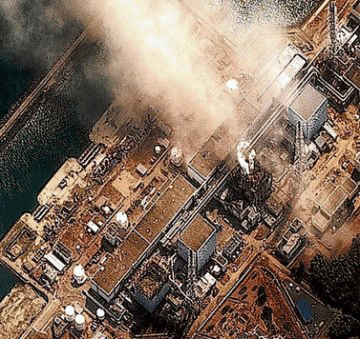 Should Japan restart its nuclear reactors? Cyprus Mail, 22 Aug 14, By Arnie Gundersen Only luck and real courage at 14 nuclear reactors on Japan’s Pacific coast overcame the technical failures of nuclear power and prevented the nation from being destroyed by radiation.
The untold story of March 11, 2011 is how close Japan came to three more spent fuel pool fires at Fukushima Daiichi and four meltdowns at Fukushima Daini.
When the magnitude 9.0 earthquake off the Pacific coast caused a seismic shock wave that reverberated throughout northern Japan, the country’s nuclear plants shut down automatically, as planned, preventing any further nuclear chain reactions.
Therein lies nuclear power’s fatal flaw, because an automatic shutdown does not stop the ongoing heat generated inside each nuclear reactor.
When uranium atoms split (a process called fission), they release tremendous energy, as well as rubble. Even when the chain reaction stops, the highly radioactive rubble emits decay heat that continues for years. Automatic shutdown simply means that no new nuclear fissions will occur……..
When the tsunami struck, the cooling equipment along the shoreline was turned into a scrap yard of twisted metal. Even if they had not been flooded, without operational shoreline pumps, the emergency diesel generators were doomed to fail, making it impossible to cool the nuclear core. In truth, the utter destruction of the shoreline pumps caused the triple meltdown at Fukushima Daiichi.
The tsunami also wrecked cooling pumps at eight other reactors located at Fukushima Daini, Onagawa, and Tokai.
Twenty-four of the 37 emergency diesel generators located at four separate nuclear power sites, which contained a total of 14 nuclear reactors, failed during the tsunami. Of the 24 diesel generators that failed, only nine failures were due to flooding (eight at Fukushima Daiichi and one at Fukushima Daini). The other 15 diesel generators were not flooded, but were disabled when the tsunami wrecked their shoreline cooling pumps.
The situation in Japan was dire when the sun set on March 11, 2011. At Fukushima Daiichi, three reactors were melting down and three spent fuel pools were at risk of catching fire because they could not be cooled. Conditions were also worsening at Fukushima Daini’s four reactors.
It was good fortune and extreme courage that saved Japan and its people from a more tragic catastrophe………
If the earthquake and tsunami had begun at night, only 200 employees would have been working at these plants. With roads and bridges destroyed, none of the necessary staff would have been able to return to work.
Now, more than three years after the Fukushima Daiichi disaster, shoreline cooling pumps throughout the world – including in Japan – remain unprotected from flooding or terrorist attacks.
Japan is prone to earthquakes and tsunamis. Is reopening its nuclear plants worth the risk to its people and their homeland?
The simultaneous technological failure at 14 nuclear reactors due to a single natural phenomenon clearly shows that the nuclear engineers who envisioned and designed nuclear power failed to expect the unexpected.
Unfortunately, the nuclear industry continues to push its message that nuclear power can be made safer. Fukushima, and before it Chernobyl, shows us that nuclear technology will always be able to destroy the fabric of a country in the blink of an eye. http://cyprus-mail.com/2014/08/22/should-japan-restart-its-nuclear-reactors/
Japan thyroid cancer children – crimes against humanity – Tokyo Press Conference
 Tokyo Press Conference: Gov’t is committing crimes against humanity; Fukushima children living in war zone and can’t leave — Childhood cancer developing much faster than Chernobyl; Rate now 14 times higher — Parent: “I’m revealing the reality of what’s going on… it’s only way to get rid of the criminals” (VIDEO) http://enenews.com/tokyo-press-conference-officials-committing-crimes-against-humanity-fukushima-children-living-war-zone-evacuate-childhood-cancer-developing-faster-chernobyl-rate-14-times-higher-parent-im-reveal?utm_source=feedburner&utm_medium=e
Press Conference at The Foreign Correspondents’ Club of Japan, August 18, 2014:
Toshio Yanagihara, attorney representing Fukushima children and their parents
- 5:00 — Thyroid cases after Chernobyl in Belarus — comparing that with the present situation in Fukushima, [here] there’s 14 times [the rate] of children with thyroid cancer.
- 6:00 — Fukushima prefecture’s announced that the massive number of thorough screenings [is the reason why there’s] more numbers of people with cancer — but we found that doubtful. In Fukushima prefecture, the west part of Fukushima compared to those areas that are closer to the nuclear power plant, there are about ¼ or even 1/5 the people who are found with thyroid cancer.
- 7:00 — June 10th of this year, the Fukushima committee in charge of researching thyroid cancer admitted for the first time that the suspicion of malignancy is due to the lymph node metastasis. This is the common thing that was found after the Chernobyl accident.
- 8:00 — In Fukushima right now, we see that the number of the children found with thyroid cancer — and the scale of this catastrophe is ongoing — it is going much faster than it was in the Ukraine after Chernobyl.
- 11:45 — The announcement from the Sendai high court from April 2013 that the Fukushima children’s lives are threatened… this didn’t cause Fukushima or the Japanese government to help provide support.
- 16:15 — We emphasis that the Japanese government is discriminating against the Fukushima children, and in the international [court], we can say this is a crime against humanity. This is Japan’s most important and most criminal human problem that we’re facing right now.
- 17:15 — Fukushima is a war zone, and children have a right to be evacuated to a safer place… In Japan, this present situation is the most harsh child-rearing situation in the world.
- 19:15 — They’re supposed to support and evacuate children from Fukushima during this war zone… It must be argued at the international court that this is a crime against humanity. We would like to take this case to the International Criminal Court, and we’re preparing for that.
Katsumi Hasegawa, parent of two young children who evacuated from Koriyama (60km from Daiichi)
- 22:45 — We currently live in Shizouka prefecture where we evacuated to in August 2011 — my pregnant wife and 5 year-old son… Why did the Japanese government contain us in the no-go zone 20 or 30 km radius, while many foreign countries had told residents within 80 km from Fukushima Daiichi to evacuate?
- 35:00 – I’m a parent of children, and I’m an adult whose living at the time of this accident — this era. I would like to reveal the reality of what is going on. And I would like to do my best, even if I’m starting right now, I would like to do my best. That is my responsibility, and that is the only way to get rid of the criminals — and irresponsibility that we have committed already… Even though raising my voice is hard, I know that there are things that we need to do. Thank you.
- 36:30 — Lucy Birmingham, FCCJ president: Thank you so much. OK… wow.
Propping up Japan’s nuclear industry – with guaranteed electricity prices?
 Japan may guarantee price for nuclear power to prop up industry TOKYO Aug 21 (Reuters) – Japan will consider guaranteeing prices for electricity generated by nuclear plants to help the country’s struggling utilities, which have lost about $35 billion in the three years since the Fukushima disaster saddled them with extra costs.
Japan’s nuclear plants are in shutdown with no schedule for restarts after the meltdown at Fukushima in 2011, leading the country’s utilities to turn to expensive fossil fuel imports.
But even if they can get their reactors running they face higher costs to meet new safety requirements just as the government is pushing through plans to allow more competition in the industry. They also face possible costs for decommissioning older units that are too costly to upgrade.
The move was floated by a trade ministry panel as an example of supporting the nuclear industry financially like Britain’s “Contracts for Difference” scheme, which guarantees nuclear operators fixed rates for power.
The panel, which is in charge of making detailed policies in line with the government’s basic energy plan, did not give a schedule for finalising the scheme.
Propping up nuclear power, promoted for decades by Japan’s ruling Liberal Democratic Party as cheap, safe and reliable, is likely to be at odds with public sentiment which has turned against atomic energy since Fukushima. If the market price of electricity falls below a pre-set level, consumers would pay the gap to the utilities, according to the British example discussed on Thursday at the panel……… http://af.reuters.com/article/commoditiesNews/idAFL4N0QR1G120140821
 |
Click here to Reply or Forward
|
Local leaders want full disclosure of testimony of Fukushima nuclear plant manager
Local leaders seek disclosure of testimony by former nuclear plant chief THE ASAHI SHIMBUN 21 Aug 14 Leaders of local governments near the stricken Fukushima No. 1 nuclear power plant want the testimony given by the plant manager months after the accident to be disclosed.
The Asahi Shimbun ascertained that eight local leaders want full disclosure after seeking the views of the Fukushima governor and heads of 13 cities, towns and villages located within 20 kilometers of the plant and areas outside the 20-km radius where radiation levels were more than 20 millisieverts per year.
Masao Yoshida was plant chief when the March 11, 2011, Great East Japan Earthquake and tsunami set off the nuclear accident.
He gave hours of testimony to the government’s Investigation Committee on the Accident at the Fukushima Nuclear Power Stations, and died in July 2013 from esophageal cancer. Tokyo Electric Power Co., operator of the plant, said Yoshida’s cancer was not related to radiation exposure.
The survey also revealed that five of the leaders said there would be no problem if their own interviews with the government investigation panel were made public.
After the onset of nuclear crisis, the government’s investigation panel interviewed 770 officials and others involved in the disaster.
Although the central government currently plans to publicly disclose part of those records by the end of the year, it will not release the contents of Yoshida’s interview, citing Yoshida’s request not to disclose his testimony……http://ajw.asahi.com/article/0311disaster/fukushima/AJ201408210044
High radiation levels 60 km from Fukushima nuclear plant
 Gov’t: Radiation level 60 km from Fukushima plant is as high as the most contaminated areas in Chernobyl — “Fukushima far exceeded any crisis previously encountered” — “A risk of destruction of the society” — Expert: “It’s unprecedented in scale and duration” (VIDEOS)http://enenews.com/govt-radiation-level-60-km-fukushima-plant-high-contaminated-areas-chernobyl-fukushima-exceeded-crisis-previo
Interview with Dr. Brad Sample, ecotoxicologist and Hazard/Risk Assessment Editor for ‘Environmental Toxicology and Chemistry’(at 8:10 in): “The event [at Fukushima Daiichi] is unprecedented in scale and duration.” >> Full interview here
IRSN News Magazine – Fukushima special report (pdf): “The Fukushima disaster far exceeded any crisis previously encountered”
Fukushima Accident — Contamination of People and the Environment, IRSN (emphasis added):
- 6:45 in — Didier Champion, IRSN: “Japanese authorities… measured… 15 million Bq/m2 for Cs-137 for example. This isquite comparable to that we see in the most contaminated areas around the Chernobyl accident.”
- 7:00 in — Researchers have mapped the contamination of soil… It goes far beyond the evacuation zone, and extends to more than 80 miles away — agricultural and urban areas inhabited by hundreds of thousands of people.
- Watch video here
Jacques Repussard, IRSN Director General (at 5:15 in): “These are such serious accidents covering so many aspects of life in a country… The ability of associations, of local elected officials, to act in an intelligent and in an efficient manner, is a great resource. And also a factor in social cohesion in a disuniting situation, wherethere is a risk of destruction of the society.” >> Watch video here
Fukushima Accident — Response of the Japanese Society, IRSN (at 1:30 in): 60 kilometers from the power plant, farmers organized themselves collectively [and] turned to a researcher in bioscience from Dokkyu Medical University [Dr. Shingo Kimura]… They travel the region to measure contamination on roadsides, in fields, and even within homes… Along this road the dosimeter shows a gamma wave radiation level at more than 50 microsieverts per hour — a tremendous level akin to the highest contamination from Chernobyl. [0.03 microsieverts per hourbefore 3/11] >> Watch video here
Hong Kong still restricting foodstuffs imported from Japan’s irradiated areas
 The government of Hong Kong rejected Japanese request to lift restriction on Japanese imports http://fukushima-diary.com/2014/08/government-hong-kong-rejected-japanese-request-lift-restriction-japanese-imports/ Iori Mochizuki On 8/13/2014, Hayashi, the Minister of Agriculture, Forestry and Fisheries visited Hong Kong to request the government of Hong Kong to lift the restriction on Japanese imports however Ko Wing Man, the chief of the department of food and hygiene rejected the offer.
Since Fukushima accident, the government of Hong Kong stop importing vegetables, fruits, milk, milk based drinks and powdered milk from 5 prefectures to consist of Fukushima, Ibaraki, Tochigi, Gunma and Chiba.
Ko Wing Man commented “Lifting the restriction is difficult at this moment.”.
Japan developing a university-military-industrial nuclear complex
Japan plans fund to develop military technology with universities, Japan Times 17 Aug 14 Ministry plans fund to aid schools engaged in military research The Defense Ministry plans to set up a fund to develop military technology by aiding research projects at universities and other civilian institutions, government sources have revealed.
In a move aimed at keeping down development costs and bolstering civilian-military cooperation, the ministry plans to seek roughly ¥2 billion for the fund in its budget request for fiscal 2015 beginning next April, raising it to ¥6 billion in three years, the sources said Saturday.
The fund, which will be modeled after the U.S. Defense Advanced Research Projects Agency, is part of Prime Minister Shinzo Abe’s drive to expand the nation’s military capabilities……..
A group of university researchers has recently organized a petition opposed to civil-military cooperation, citing the bitter history of academia contributing to the nation’s militarization during World War II……… http://www.japantimes.co.jp/news/2014/08/17/national/japan-plans-fund-develop-military-technology-universities/#.U_KmJsVdUnk
Fukushima and Chernobyl’s plants and animals have suffered from radiation
 No, Fukushima Is Not a Wildlife Haven—and Neither Is Chernobyl http://www.citylab.com/tech/2014/08/no-fukushima-is-no-eden-for-animalsand-neither-is-chernobyl/376046/ A slew of new research reveals the deleterious effects of radiation on Fukushima’s ecology. LAURA BLISS @mslaurabliss Aug 14, 2014
Perhaps you’ve encountered the well-publicized idea that Chernobyl, the world’s worst nuclear disaster of 1986, has become a kind of ‘wildlife haven’ as a result of its abandonment by humans.
So what of Fukushima Daiichi, Japan’s nuclear collapse of 2011—might we expect a happy menagerie there, too? Not so much, according to a slew of new papers out in the Journal of Heredity. And you may want to rethink Chernobyl-as-Eden, too.
The findings of the new studies tell of significant population decline across many different species of animals and plants, as well as a range of expressions of genetic damage and cell mutation.
One paper reports that the pale grass blue butterfly, one of Japan’s most common butterfly species, has suffered from significant size reduction, slowed growth, high mortality and abnormal wing patterns both within the Fukushima exclusion zone and among lab-raised offspring of parents collected at the site. Which is to say, radiation-caused genetic mutations were passed down.
 Researchers also found major declines in populations of birds, butterflies, cicadas, and some small mammals, as well as aberrations and albinism in the feathers of certain birds.
Timothy Mousseau, a prominent biologist and lead author of that population study, has also conducted significant research into radiation’s impacts at Chernobyl. He roundly rejects the claim that the area has become an animal haven, arguing that notion was based on anecdotal evidence rather than scientific data. Mousseau’s own work demonstrates radiation has had similar effects on Chernobyl’s ecology as on Fukushima’s.
Further inquiry into all manner of species living at the Chernobyl site could help scientists better predict Fukushima’s biological trajectory, he says. “There is an urgent need for greater investment in basic scientific research of the wild animals and plants of Fukushima,” Mousseau told the Journal of Heredity.
Japan’s nuclear power restart is just not really happening
After the Fukushima meltdown, Japan’s nuclear restart is stalled, WP By Daniel Aldrich and James Platte August 15 “……Last month, the two reactors at the Kyushu Electric Power Company’s Sendai nuclear power plant were the first to pass new, stricter safety tests, but the actual restart date has been pushed back into the winter of 2015. Residents within 5 km of the plant now have potassium-iodide pills in the event of another accident, and some nine towns within 30 km of the plant have finally designed evacuation plans in case of a meltdown. These changes were a direct result of the Fukushima accident, which also spurred the creation of a new, independent nuclear industry regulator.
The Nuclear Regulation Authority (NRA) replaced a patchwork of bureaucrats who controlled the industry before the disaster — many of whom were simultaneously tasked with promoting the field through incentives and grants to local communities. ……..
Beyond changing the regulatory environment in Japan, the Fukushima meltdowns caused a sea change in public opinion on nuclear power. Before the accidents, some two-thirds of respondents regularly supported increasing the number of nuclear power plants. Now, the same percentage of residents oppose the use of nuclear power in Japan, and a national poll at the end of July found nearly 60 percent of respondents opposed the restart of the Sendai nuclear plant.
Communities that directly host the facilities continue to — with some exceptions — support the restart of these facilities. Their support derives primarily from financial reasons: the central government provides up to $10 million a year to the small, rural, coastal towns that have these projects in their back yards. Research published by one economist showed that even for these communities the actual benefits to individuals vary widely.
But towns more than 5 km from the plant receive few, if any, financial benefits and have been vocal in their opposition to restarts. Further, because of a longstanding gentlemen’s agreement between utilities and local communities, mayors and governors hold unofficial veto power over the process. Without their support, power utilities will be unable to restart their plants…….
all of Japan’s power utilities that operate nuclear power plants are struggling financially, consistently posting large losses since 2011. TEPCO was effectively nationalized to prevent it from failing, and in April, the state-owned Development Bank of Japan announced a total of nearly$1.5 billion in preferred stock investments into Kyushu Electric Power Company and Hokkaido Electric Power Company. Kyushu and Kansai Electric Power Company both recorded losses of over $900 million last year.
The ultimate question is how many reactors will restart and by when……..
While restarting some reactors will help generate revenue for Japan’s struggling power utilities, the cost of decommissioning about half of Japan’s pre-Fukushima reactor fleet will be significant. Despite the nuclear revival ambitions of the LDP and industrial leaders, Japan’s nuclear sector appears to have a long, difficult road ahead of it. http://www.washingtonpost.com/blogs/monkey-cage/wp/2014/08/15/after-the-fukushima-meltdown-japans-nuclear-restart-is-stalled/
Research slowly showing the harmful effects of Chernobyl and Fukushima radiation on the ecosystem
The Crushing Effects Of Radiation From The Fukushima Disaster On The Ecosystem Are Being Slowly Revealed http://www.businessinsider.com.au/the-serious-biological-effects-of-fukushima-radiation-on-plants-insects-and-animals-is-slowly-being-revealed-2014-8 CHRIS PASH A range of scientific studies at Fukushima have begun to reveal the impact on the natural world from the radiation leaks at the power station in Japan caused by an earthquake and tsunami in 2011.
Biological samples were obtained only after extensive delays following the 1986 Chernobyl nuclear power plant meltdown, limiting the information which could be gained about the impact of that disaster.
Scientists, determined not to repeat the shortcomings of the Chernobyl studies, began gathering biological information only a few months after the meltdown of the Daiichi power plant in 2011.
Results of these studies are now beginning to reveal serious biological effects of the Fukushima radiation on non-human organisms ranging from plants to butterflies to birds.
A series of articles summarising these studies has now been published in the Journal of Heredity. These describe widespread impacts, ranging from population declines to genetic damage to responses by the repair mechanisms that help organisms cope with radiation exposure.
“A growing body of empirical results from studies of birds, monkeys, butterflies, and other insects suggests that some species have been significantly impacted by the radioactive releases related to the Fukushima disaster,” says Dr Timothy Mousseau of the University of South Carolina, lead author of one of the studies. Continue reading
Huge amounts of Fukushima radioactive fallout are still bound to organic material
Gov’t Expert: Fukushima hot particles can’t be dissolved, even with hot nitric acid! — Huge amounts of fallout are still bound to organic material… “we have very little knowledge about this” — “Reaction is irreversible”(PHOTO) http://enenews.com/govt-expert-fukushima-radioactive-material-be-dissolved-hot-nitric-acid-huge-amounts-fallout-bound-organic-material-very-little-knowledge-about-reaction-irreversible?utm_
Journal of Radioanalytical and Nuclear Chemistry,Volume 295, Issue 3, 2013 (emphasis added): […] radionuclides were emitted from the FDNPP as airborne ‘hot’ particles […] Subsequent interaction of the ‘hot’ particles with water (e.g. rainfall) dissolved and strongly fixed the radiocesium on rock and soil particles, thus changing the radiocesium into insoluble forms. […] Consequently, ‘hot spots’ were studded on the rock surface rather than being uniformly distributed. […] Leaching experiments demonstrated that radiocesium in rock, soil and river suspended sediment was fairly insoluble, showing that the adsorption [binding of particles to a surface] reaction is irreversible. The micro-scale heterogeneous distribution of radiocesium […] was due to the presence of ‘hot’ particles in aerosols. […] ‘hot’ particles in the aerosols [experienced] irreversible adsorption onto the soil particle complex […]
Agricultural Implications of the Fukushima Nuclear Accident – Radiocesium Absorption by Rice in Paddy Field Ecosystems (pdf), 2013:Unexpectedly, we found that the fallout was relatively insoluble and only a small percentage of the radiocesium could be extracted by a boiling water treatmentfollowed by nitrate leaching. We have very little knowledge about this fallout, including its chemical form and properties, but huge amounts of this relatively insoluble radioactive fallout are still bound to organic matters […]
Presentation by Yasuhito Igarashi of Japan’s Meteorological Research Institute at IAEA’s expert meeting (pdf), February 2014: Mar. 14-15 sample contained insoluble materials not only in water but hot nitric acid! […] They are insoluble; even refractory to conc. nitric acid. […] They would persist for a long time in the environment as well as in living organisms.
Scientific Reports (Nature Publishing Group) — Emission of spherical cesium-bearing particles from an early stage of the Fukushima nuclear accident, Aug. 30, 2013: We analyzed the water solubility of Cs Particle 1 by comparing the particle’s shape before and after exposure to water. The results show that there was no change in shape, suggesting that the particle was insoluble to water at least during atmospheric transportation.
American Chemical Society Publication, Analytical Chemistry — Detection of uranium and chemical state analysis of individual radioactive microparticles emitted from the Fukushima nuclear accident… (Tokyo Univ., Japan’s Meteorological Research Institute), August 1, 2014: We explored the possible sources of the 14 elements (Cr, Mn, Fe, Zn, Rb, Zr, Mo, Ag, Sn, Sb, Te, Cs, Ba, and U) found within the microparticles […] These particle natures suggest that they could have relatively long-term impact on the environment, i.e., the release of soluble radioactive Cs into the environment as these insoluble glassy particles degrade. Similar radioactive particles have been detected in soils, plants, and mushrooms […] it is probable that [these particles are] the same as the microparticles characterized in our study.
A truly ‘hot’ export – Japan’s radioactive cars
Japan’s ‘Hottest’ Export This Year – Radioactive Cars Zero Hedge by Tyler Durden on 08/11/2014 At the start of the year, Russia said ‘nyet’ to 132 Japanese cars imported through Vladivostok due to high radiation levels. Fast forward seven months and as AutoWeek reports, it appears the Japanese are up to their old tricks – desperate to make Abenomics look like it’s working by jamming exports higher – a total of 70 used cars imported from Japan and found to have increased levels of radiation are being stored in Bishkek, Kyrgyzstan. The import of used Japanese cars is big business in Central Asia, especially in Mongolia and the Russian far-east regions, but several batches of cars have been seized by the government during the last three years – despite ‘agreements’ from Japan……..http://www.zerohedge.com/news/2014-08-11/japans-hottest-export-year-radioactive-cars
Tepco dumps AREVA’s ineffective radiation decontamination system
” Tokyo Electric has determined that it will cease use of AREVA’s decontamination system, which uses chemicals to remove radioactive materials from water, as it has not lived up to expectations since it was installed. The utility will file an application with the Nuclear Regulation Authority in order to scrap the system.
The decontamination system was set up in June 2011, three months after the onset of the Fukushima Daiichi nuclear disaster. The design was so complicated that it took 50 welders more than a month to put the system together. In the first three months, the system processed 76,000 tons of contaminated water, but was repeatedly forced to be shut down by a variety of problems.
For the last three years the system has been unused and kept out of operations and in the meantime, TEPCO has introduced a new system to process the ever-accumulating amounts of contaminated water…
View original 236 more words
NO, Prime Minister Abe: Japan can and must choose the path to a nuclear-free world.
EDITORIAL: Japan must pursue a path to a nuclear-free world Asahi Shimbun,August 11, 2014 Prime Minister Shinzo Abe visited Hiroshima and Nagasaki this month, both of which marked the 69th anniversaries of the atomic bombings. In the ceremonies in both cities, he emphasized determination to realize a world without nuclear weapons.
However, it seems that the gap between Abe and the cities that were struck by atomic bombs has increased since last year.
In a meeting with Abe in Hiroshima, 85-year-old hibakusha Yukio Yoshioka said, “(The Cabinet’s approval of the exercise of the right to collective self-defense) will make Japan a country that repeats its (past) mistake and can wage a war.”
Miyako Jodai, 75, who served as the representative of atomic bomb survivors in the ceremony in Nagasaki, said, “I want the government not to forget or deny the sufferings of atomic bomb survivors.”
They apparently demanded that Abe withdraw the Cabinet’s approval of the exercise of the right to collective self-defense.
DIFFERENT FROM DESIRES
There are also other causes of concern.
One is the exports of nuclear power generation infrastructure to emerging countries. Another is negotiations to conclude a nuclear power agreement with India, which has conducted nuclear tests without joining the Nuclear Nonproliferation Treaty (NPT). Both could lead to nuclear proliferation.
The Abe administration also plans to maintain the policy of removing plutonium from spent nuclear fuels and reusing it in nuclear power plants. After the March 2011 nuclear disaster in Fukushima Prefecture, the future of nuclear power generation remains unclear. In addition, Japan already holds stocks of more than 40 tons of plutonium whose use has yet to be decided. Anti-nuclear groups in Japan and abroad suspect that Japan has the intention of arming itself with nuclear weapons.
Why are the moves of the government of A-bombed Japan so different from the desires for anti-nuclear policies?………..
TRUST AND DIALOGUE
In the Hiroshima Peace Declaration, Mayor Kazumi Matsui called for the establishment of “a new security system based on trust and dialogue.”
In the world, the Obama administration is losing its centripetal force, and its relations with Russia have cooled due to the Ukrainian situation. China’s maritime advances have intensified friction with neighboring countries. The road to the “new security system based on trust and dialogue” is steep. But is it just a dream?
The Nagasaki Peace Declaration this year again advocated an idea of establishing “nuclear-weapon-free zones.” In the proposal, Japan and the Korean Peninsula are denuclearized, and nuclear powers promise not to attack the areas with nuclear weapons.
The Japanese government is negative to the idea on the grounds that relations of trust, which serve as a prerequisite, do not exist in the areas partly because North Korea has repeatedly conducted nuclear tests. North Korea counters the view, saying that what is a threat is the U.S. nuclear umbrella.
Relations of trust will be established through dialogue. To realize the nuclear-weapon-free zones, Japan should first show its intentions to set up the zones and leave the U.S. nuclear umbrella. Then, it should urge the United States to accept the zones. After that, showing a joint goal, Japan should strongly urge North Korea to take part in the negotiations.
The improvement of relations with China is also indispensable. A council of experts from five countries in the Asia and Pacific region, including former Australian Foreign Minister Gareth Evans, asked Japan and China to hold a summit meeting in its proposal compiled in Hiroshima.
It is not easy to untangle a thread. Unless there is a dialogue, however, nothing will start. http://ajw.asahi.com/article/views/editorial/AJ201408110020
1 This Month





PLEASE OPPOSE HR 8255 AND S.3639 – bills would accelerate satellite deployment, with no environmental review or safeguards – https://ncstd5li.quorum.us/campaign/169331/
To see nuclear-related stories in greater depth and intensity – go to https://nuclearinformation.wordpress.com
-
Archives
- October 2026 (58)
- September 2026 (339)
- August 2026 (330)
- July 2026 (355)
- June 2026 (287)
- May 2026 (306)
- April 2026 (356)
- March 2026 (251)
- February 2026 (267)
- January 2026 (308)
- December 2025 (358)
- November 2025 (359)
-
Categories
- 1
- 1 NUCLEAR ISSUES
- business and costs
- climate change
- culture and arts
- ENERGY
- environment
- health
- history
- indigenous issues
- Legal
- marketing of nuclear
- media
- opposition to nuclear
- PERSONAL STORIES
- politics
- politics international
- Religion and ethics
- safety
- secrets,lies and civil liberties
- spinbuster
- technology
- Uranium
- wastes
- weapons and war
- Women
- 2 WORLD
- ACTION
- AFRICA
- Atrocities
- AUSTRALIA
- Christina's notes
- Christina's themes
- culture and arts
- Events
- Fuk 2022
- Fuk 2023
- Fukushima 2017
- Fukushima 2018
- fukushima 2019
- Fukushima 2020
- Fukushima 2021
- general
- global warming
- Humour (God we need it)
- Nuclear
- RARE EARTHS
- Reference
- resources – print
- Resources -audiovicual
- Weekly Newsletter
- World
- World Nuclear
- YouTube
-
RSS
Entries RSS
Comments RSS

