Under the new policy, Japan will maximize the use of existing reactors by restarting as many of them as possible and prolonging the operating life of aging ones beyond a 60-year limit. The government also pledged to develop next-generation reactors.In 2011, a powerful earthquake and the ensuing tsunami caused multiple meltdowns at the Fukushima Daiichi plant — a disaster that supercharged anti-nuclear sentiment in Japan and at one point led the government to promise to phase out the energy by around 2030. But since then, the government has recommitted to the technology, including setting a target for nuclear to make up 20-22% of the country’s energy mix by the end of the decade.
Righting shoddy nuclear waste storage site to cost Japan 36 bil. yen (280 million US$)

File photo taken in October 2021 shows the Japan Atomic Energy Agency’s Tokai Reprocessing Plant in Tokai, Ibaraki Prefecture, eastern Japan
Jan 15, 2023
The Japan Atomic Energy Agency estimates that it will cost taxpayers 36.1 billion yen ($280 million) to rectify the shoddy storage of radioactive waste in a storage pool at the Tokai Reprocessing Plant, the nation’s first facility for reprocessing spent nuclear fuel, an official said Sunday.
Around 800 containers of transuranic radioactive waste, or “TRU waste,” were dropped into the pool from 1977 to 1991 using a wire in the now-disused plant in Tokai, a village in Ibaraki Prefecture northeast of Tokyo. They emit high levels of radiation.
The waste includes pieces of metal cladding tubes that contained spent nuclear fuel, generated during the reprocessing process. The containers are ultimately supposed to be buried more than 300 meters below surface.
The agency has estimated that 19.1 billion yen will be needed to build a new storage facility for the containers, and 17 billion yen for a building that will cover the storage pool and the crane equipment to grab containers.
The 794 containers each are about 80 centimeters in diameter, 90 cm tall and weigh about 1 ton, with many lying on their sides or overturned in the pool. Some have had their shape altered by the impact of being dropped.
The containers were found stored in the improper manner in the 1990s. While the agency said the storage is secure from earthquakes and tsunamis, it has nonetheless decided to improve the situation.
The extractions have been delayed by about 10 years from the original plan and are expected to begin in the mid-2030s.
The Tokai Reprocessing Plant was the nation’s first plant that reprocessed spent fuel from nuclear reactors to recover uranium and plutonium. Between 1977 and 2007, about 1,140 tons of fuel were reprocessed. The plant’s dismantlement was decided in 2014 and is expected to take about 70 years at a cost of 1 trillion yen.
Japan, US to team up on next-generation nuclear reactors

Jan. 10, 2023
Japan and the United States have agreed to start work on developing next-generation nuclear reactors as part of joint efforts to strengthen energy security and promote decarbonization.
Japan’s Industry Minister Nishimura Yasutoshi met US Energy Secretary Jennifer Granholm in Washington on Monday.
Nishimura said, “With this agreement, the two countries will explore opportunities for cooperation in the development and construction of next-generation reactors, making the most of existing reactors, and building strong supply chains.”
The two sides said in a joint statement their efforts will include building advanced light water reactors.
They also agreed to try to maximize the use of existing reactors, and establish robust supply chains for uranium fuel and nuclear components.
Japan approved a new policy on nuclear power in December. It includes the development of next-generation reactors to replace decommissioned ones.
Credible nuclear regulation needs independence, transparency
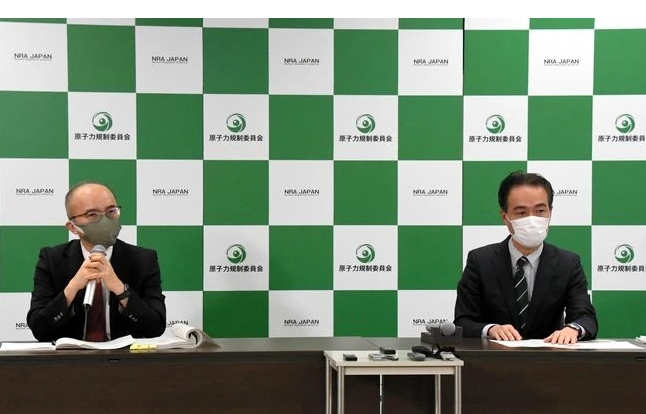
Officials of the Secretariat of the Nuclear Regulation Authority meet reporters in Tokyo on Dec. 27 to explain about closed-door meetings of the secretariat and the Agency for Natural Resources and Energy regarding extending the life span of aging nuclear reactors.
January 6, 2023
Nuclear regulation should place importance on “independent decision-making” and “ensure total disclosure of information,” including facts concerning the decision-making process.
This principle was established in line with the bitter lessons learned from the dreadful calamity that occurred at the Fukushima No. 1 nuclear power plant in 2011. The pledge must not be taken lightly.
Recent revelations have raised serious questions about the nuclear regulator’s commitment to the principle.
The Secretariat of the Nuclear Regulation Authority (NRA) held seven closed-door meetings with the Agency for Natural Resources and Energy, an agency under the Ministry of Economy, Trade and Industry (METI), over Prime Minister Fumio Kishida’s initiative to extend the life span of aging nuclear reactors.
The two organizations also held dozens of telephone conversations over the matter.
After the Fukushima disaster, the jurisdiction of regulating nuclear power generation was transferred from the pro-industry METI to the newly created Nuclear Regulation Authority. The NRA is an external organ of the Environment Ministry.
In early October, the NRA instructed its secretariat to review regulations related to the proposal to extend the legal life of reactors. But the secretariat and the agency had begun holding talks over the matter at the end of July. The secretariat did not report these early meetings to the NRA or keep records of the sessions.
When these facts came to light in December, the secretariat categorically denied discussing, coordinating or adjusting nuclear safety regulations during these talks. It contended there was no problem with the “independence and transparency” of the NRA.
During these meetings, however, the energy agency told the NRA secretariat that revisions to laws including those under the NRA jurisdiction were being considered. The secretariat called for the deletion of certain provisions concerning nuclear safety regulations from the envisioned bill while beginning to consider its own bill.
It is difficult to believe that these meetings were not for advance policy coordination or discussions.
Generally speaking, exchanges of information between government organizations are necessary for smooth administrative functioning. But the NRA was separated from the METI, the leading champion of nuclear power generation, to ensure its independence.
It should not be viewed or treated similarly to other ministries and agencies.
NRA Chairman Shinsuke Yamanaka has argued that there is nothing wrong with staff members of the secretariat discussing related issues since the final decisions are made by the NRA.
But the NRA’s code of conduct, which stresses the importance of independence and transparency, states that the NRA performs its duties “together with” the NRA secretariat. The principle should also be applied to the secretariat.
The NRA’s failure to keep track of what was going on within the secretariat raises questions about its governance.
Especially serious is the secretariat’s disregard for the importance of information disclosure, which is vital for assessing and securing the independence of nuclear regulation.
The secretariat has said meetings and discussions with other ministries and agencies are not subject to the rules concerning record-keeping. But the NRA has told the secretariat to keep records of future meetings with other government departments related to nuclear power generation and make public the records.
But telephone conversations will not be covered by this rule. Is this sufficiently effective?
The top three positions at the NRA secretariat have been held by former METI officials since last summer. The NRA’s responses to the proposal to extend the life span of reactors since October have been criticized as “premature” actions even by some NRA members.
If the NRA fails to forthrightly address the suspicions raised by the latest revelations, the credibility of nuclear regulation will be undermined. The NRA should undertake a serious probe into what transpired and publish the findings.
Fukushima: court upholds acquittals of three Tepco executives over disaster
Three former executives from the company that operates the wrecked
Fukushima Daiichi nuclear plant have had their not-guilty verdicts upheld
by a court in Japan, dealing a blow to campaigners demanding the firm take
legal responsibility for the disaster in March 2011.
The Tokyo high court
on Wednesday cleared Tsunehisa Katsumata, the former chairman of Tokyo
Electric Power (Tepco), along with former vice-presidents Ichiro Takekuro
and Sakae Muto, of professional negligence resulting in death. The court
said the defendants could not have predicted the massive tsunami that
crippled the power plant and triggered the world’s worst nuclear accident
since Chornobyl in 1986.
The three men were indicted in 2016 for allegedly failing to take measures
to defend the plant against tsunamis, resulting in the deaths of 44 people,
including elderly patients at a hospital, who had to be evacuated after the
disaster.
Guardian 18th Jan 2023
China urges Japan to safely dispose of nuclear-contaminated water
China Daily, Xinhua 2023-01-16
BEIJING — China once again urges Japan to take the reasonable concerns of relevant parties seriously and dispose of its nuclear-contaminated water in a science-based, open, transparent and safe manner, Chinese Foreign Ministry spokesperson Wang Wenbin said on Monday.
Wang made the remarks at a daily news briefing here in response to reports that Japan would pipe nuclear-contaminated water from the Fukushima nuclear power station into the ocean during the spring and summer this year.
Wang said that over the past two years, the international community has strongly questioned and opposed the unilateral and erroneous decision of the Japanese government to discharge nuclear-contaminated water into the ocean, and expressed grave concerns over the impact such an action would have on the marine environment and public health.
Wang said the majority of the Japanese public is also opposed to this irresponsible approach. When polled, 55 percent of respondents opposed the disposal of contaminated water into the ocean.
“It is regrettable that the concerns of all parties have yet to be given due attention or be addressed by Japan,” Wang said, adding that Japan has failed to provide scientific and credible explanations concerning the legitimacy of its plan, the accuracy of data on the nuclear-contaminated water, the effectiveness of the treatment system, and the uncertainties about the environmental impact.
The International Atomic Energy Agency (IAEA) has sent three technical task forces to Japan and so far, there has been no conclusive resolution on Japan’s proposal, Wang said, noting that the agency has also issued many requests to Japan, seeking clarifications or making recommendations for improved disposal plans………. more https://www.chinadaily.com.cn/a/202301/16/WS63c551cea31057c47eba9e94.html—
Huge cost for Japanese tax-payers to clean up the botched nuclear waste storage at Tokai reprocessing plant
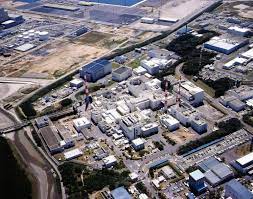
Righting shoddy nuclear waste storage site to cost Japan 36 bil. yen
https://english.kyodonews.net/news/2023/01/a53b75be634e-righting-shoddy-nuclear-waste-storage-site-to-cost-japan-36-bil-yen.html – 16 Jan 23, The Japan Atomic Energy Agency estimates that it will cost taxpayers 36.1 billion yen ($280 million) to rectify the shoddy storage of radioactive waste in a storage pool at the Tokai Reprocessing Plant, the nation’s first facility for reprocessing spent nuclear fuel, an official said Sunday.
Around 800 containers of transuranic radioactive waste, or “TRU waste,” were dropped into the pool from 1977 to 1991 using a wire in the now-disused plant in Tokai, a village in Ibaraki Prefecture northeast of Tokyo. They emit high levels of radiation.
The waste includes pieces of metal cladding tubes that contained spent nuclear fuel, generated during the reprocessing process. The containers are ultimately supposed to be buried more than 300 meters below surface.
The agency has estimated that 19.1 billion yen will be needed to build a new storage facility for the containers, and 17 billion yen for a building that will cover the storage pool and the crane equipment to grab containers.
The 794 containers each are about 80 centimeters in diameter, 90 cm tall and weigh about 1 ton, with many lying on their sides or overturned in the pool. Some have had their shape altered by the impact of being dropped.
The containers were found stored in the improper manner in the 1990s. While the agency said the storage is secure from earthquakes and tsunamis, it has nonetheless decided to improve the situation.
The extractions have been delayed by about 10 years from the original plan and are expected to begin in the mid-2030s.
The Tokai Reprocessing Plant was the nation’s first plant that reprocessed spent fuel from nuclear reactors to recover uranium and plutonium. Between 1977 and 2007, about 1,140 tons of fuel were reprocessed. The plant’s dismantlement was decided in 2014 and is expected to take about 70 years at a cost of 1 trillion yen.
Fukushima nuclear disaster: Japan to release radioactive water into sea this year

By Grace Tsoi BBC News 13 Jan 23,
Japan says it will release more than a million tonnes of water into the sea from the destroyed Fukushima nuclear power plant this year.
After treatment the levels of most radioactive particles meet the national standard, the operator said.
The International Atomic Energy Agency (IAEA) says the proposal is safe, but neighbouring countries have voiced concern.
The 2011 Fukushima disaster was the worst nuclear accident since Chernobyl.
Decommissioning has already started but could take four decades.
“We expect the timing of the release would be sometime during this spring or summer,” said chief cabinet secretary Hirokazu Matsuno on Friday, adding that the government will wait for a “comprehensive report” from IAEA before the release.
Every day, the plant produces 100 cubic metres of contaminated water, which is a mixture of groundwater, seawater and water used to keep the reactors cool. It is then filtered and stored in tanks.
With more than 1.3 million cubic metres on site, space is running out.
The water is filtered for most radioactive isotopes, but the level of tritium is above the national standard, operator Tepco said. Experts say tritium is very difficult to remove from water and is only harmful to humans in large doses.
However, neighbouring countries and local fishermen oppose the proposal, which was approved by the Japanese government in 2021.
The Pacific Islands Forum has criticised Japan for the lack of transparency.
“Pacific peoples are coastal peoples, and the ocean continues to be an integral part of their subsistence living,” Forum Secretary General Henry Puna told news website Stuff.
“Japan is breaking the commitment that their leaders have arrived at when we held our high level summit in 2021.
“It was agreed that we would have access to all independent scientific and verifiable scientific evidence before this discharge takes place. Unfortunately, Japan has not been co-operating.”……. more https://www.bbc.com/news/world-asia-64259043
Fukushima water to be released into ocean in next few months, says Japan
Guardian, Justin McCurry in Tokyo, 13 Jan 23,Authorities to begin release of a million tonnes of water from stricken nuclear plant after treatment to remove most radioactive material
The controversial release of more than a million tonnes of water from the wrecked Fukushima Daiichi nuclear plant will begin in the northern spring or summer, Japan’s government has said – a move that has sparked anger among local fishing communities and countries in the region.
The decision comes more than two years after the government approved the release of the water, which will be treated to remove most radioactive materials but will still contain tritium, a naturally occurring radioactive form of hydrogen that is technically difficult to separate from water.
Japanese officials insist the “treated” water will not pose a threat to human health or the marine environment, but the plans face opposition from fishermen who say it risks destroying their livelihoods, almost 12 years after a magnitude-9.0 earthquake triggered a huge tsunami that killed more than 18,000 people along Japan’s north-east coast…………………………………….
South Korea and China have voiced concern about the discharge, while the Pacific Islands Forum said recently it had “grave concerns” about the proposed release.
Writing in the Guardian, the forum’s secretary general, Henry Puna, said Japan “should hold off on any such release until we are certain about the implications of this proposal on the environment and on human health, especially recognising that the majority of our Pacific peoples are coastal peoples, and that the ocean continues to be an integral part of their subsistence living”.
The South Korean government, which has yet to lift its ban on Fukushima seafood, has said that releasing the water would pose a “grave threat” to marine life. Fishing unions in the area oppose the release, warning it would cause alarm among consumers and derail more than a decade of efforts to reassure the public that Fukushima seafood is safe to eat…………… more https://www.theguardian.com/environment/2023/jan/13/fukushima-water-to-be-released-into-ocean-in-next-few-months-says-japan
Biden Administration Tramples on Japan’s Post-World War II Pacifist Constitution By Pushing Country’s Rearmament
Covert Action magazine, By Sara Flounders, January 9, 2023
Main target is China in dangerously provocative policy that faces no visible domestic opposition in the U.S.
On December 16, Japan’s Prime Minister Fumio Kishida announced a new defense strategy that doubled Japan’s military spending by 2027. Japan further agreed to acquire offensive weapons and reshape its military command structure for its expanded armed forces.
On December 23, the draft budget was approved by Kishida’s cabinet.
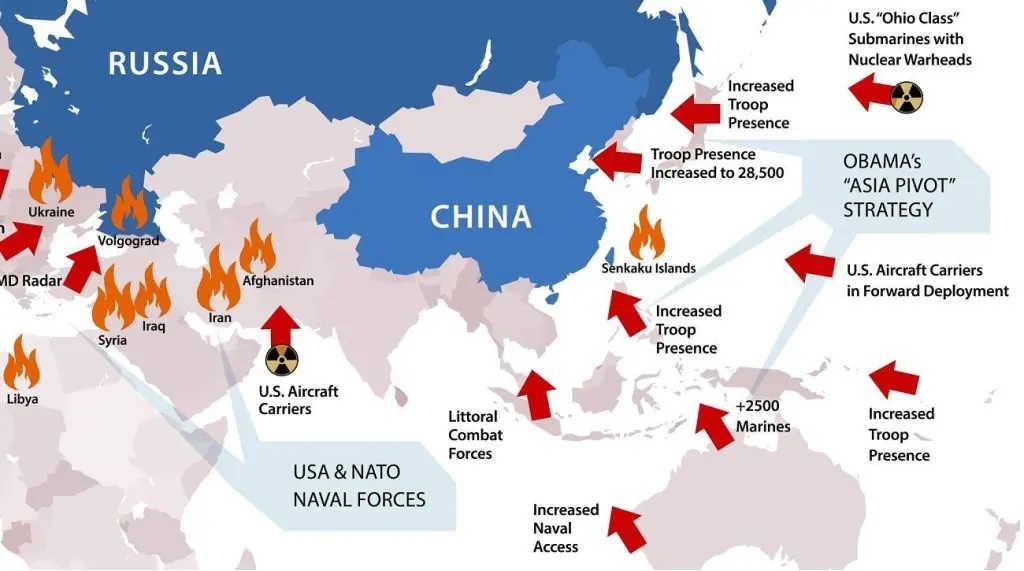
Japan’s dangerous military expansion should set off international alarm bells. This major escalation is taking place based on intense U.S. imperialist pressure. It is the next step in the “Pivot to Asia,” aimed at threatening and surrounding China and attempting to reassert U.S. dominance in the Asia Pacific.
The movements opposing endless U.S. wars must begin to prepare material and draw mass attention to this ominous threat.
The plan to double military spending will add $315 billion to Japan’s defense budget over the next five years and make Japan’s military the world’s third largest, after the U.S. and China. Defense spending will escalate to 2% of gross domestic product, equal to the goal the U.S. sets for its NATO allies. Japan’s economy is the world’s third largest.
The Japanese government plans to buy up to 500 Lockheed Martin Tomahawk missiles and Joint Air-to-Surface Standoff Missiles (JASSM), procure more naval vessels and fighter aircraft, increase cyber-warfare capabilities, manufacture its own hypersonic guided missiles and produce its own advanced fighter jets, along with other weapons. The plan shifts from relying solely on missile defense to also embracing “counter strike” capabilities.
………………………………………………… Although the U.S. occupation force, after defeating Japan’s military in World War II, imposed a “pacifist” constitution on Japan, for decades U.S. strategists have pressured Japan’s government to aggressively rearm, to buy U.S.-made weapons, and to act as a junior partner to U.S. efforts to dominate the Asia-Pacific region.
Article 9 of the imposed Japanese constitution prohibits Japan from maintaining an army, navy and air force. To get around this, the “Japanese Self-Defense Forces” (JSDF) have since 1952 been treated as a legal extension of the police and prison system. The U.S. occupiers considered the JSDF an essential repressive tool defending capitalist property relations against the workers’ movement.
The decision for aggressive military expansion is in open violation of Japan’s supposedly pacifist constitution………………………………………….
The present doubling of the defense budget will be funded by raising taxes. A huge military budget will inevitably mean severe cuts to the country’s limited social spending. ………………….
Targeting China
Japan’s military expansion fits in with Washington’s aggression aimed at China, the DPRK and Russia. U.S. strategists’ goal is to use the U.S. alliance with Japan, South Korea and Australia, just as it uses the U.S.-led NATO alliance in Europe……………………………..
China is Japan’s largest trading partner in both imports and exports. Previous National Strategy Documents said Japan was seeking a “mutually beneficial strategic partnership” with China. Suddenly Japanese strategists started labeling China “the greatest strategic challenge in ensuring the peace and security of Japan.” (U.S. Institute of Peace, December 19)………….,………
A U.S.-Japan alliance is now defined as a “cornerstone” of Japan’s security policy. (Japan Times, December 17)
U.S. Praise of Japan’s Rising Militarism
The U.S. media praised Japan’s new security strategy document as a “bold and historic step.” U.S. National Security Adviser Jake Sullivan praised the defense spending hike, which “will strengthen and modernize the U.S.-Japan alliance.” U.S. Secretary of State Antony Blinken called Japan an “indispensable partner” and cheered that the changed security documents reshape the ability to “protect the rules-based order in the Indo-Pacific region and around the world.” (quotes, whitehouse.gov, December 16)
U.S. corporate power is the immediate beneficiary of this sharp turn in policy, built on military threats and economic sanctions. …………………………………………………… more https://covertactionmagazine.com/2023/01/09/biden-administration-tramples-on-japans-post-world-war-ii-pacifist-constitution-by-pushing-countrys-rearmament/?mc_cid=8da2f4a668&mc_eid=65917fb94b
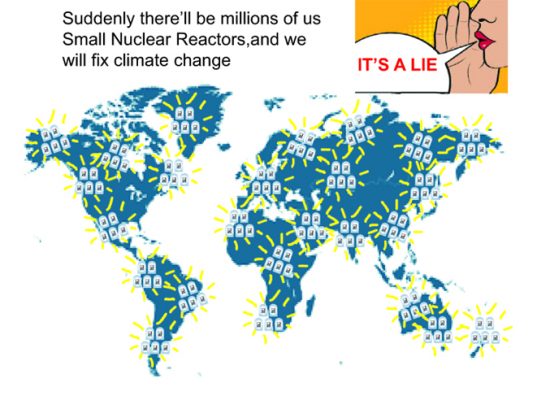
Japan and USA to develop small nuclear reactors”within each country and third countries.”
Japan and the United States agreed Monday to strengthen bilateral
cooperation on developing next-generation nuclear reactors during
ministerial talks on energy.
Japanese industry minister Yasutoshi Nishimura
and U.S. Energy Secretary Jennifer Granholm also agreed during their
meeting that Tokyo and Washington will work more closely on securing
liquefied natural gas and other energy security matters.
According to a
joint statement, Japan and the United States will step up cooperation in
developing and constructing next-generation advanced reactors, including
small modular reactors, “within each country and third countries.” The two
governments already revealed a plan in October to work together on helping
Ghana introduce small nuclear reactor technology.
Kyodo News 10th Jan 2023
The US and Japan have agreed to strengthen cooperation on developing and
constructing next-generation advanced reactors, including small modular
reactors, “within each country and third countries”. Japan’s industry
minister Yasutoshi Nishimura and US energy secretary Jennifer Granholm met
in Washington to discuss the situation surrounding global energy security,
strengthening clean energy cooperation, and the importance of clean energy
transitions, including renewable energies and nuclear energy.
Nucnet 11th Jan 2023
Japan to use Self-Defense Forces to guard nuclear power plants
Government thinks critical infrastructure could be targeted, as seen in Ukraine.
Nikkei Asia 4 Jan 23, TOKYO –– The Japanese government will task the country’s Self-Defense Forces with protecting critical infrastructure, such as nuclear power plants, as it plans to respond immediately if civilian facilities become the target of an attack………….
Attacks on critical civilian infrastructure are banned under the Geneva Conventions, which sets the ground rules for the conduct of war. Russia’s strikes have highlighted the need to develop a response.
In Japan’s National Security Strategy, which was approved by the cabinet in December, the government states that measures to ensure the safety of critical facilities will be taken, not only in the event of an armed attack but in the run-up to a crisis that does not lead to such an attack………… https://asia.nikkei.com/Politics/Japan-to-use-Self-Defense-Forces-to-guard-nuclear-power-plants
Reviving Japan’s nuclear power industry will not be easy
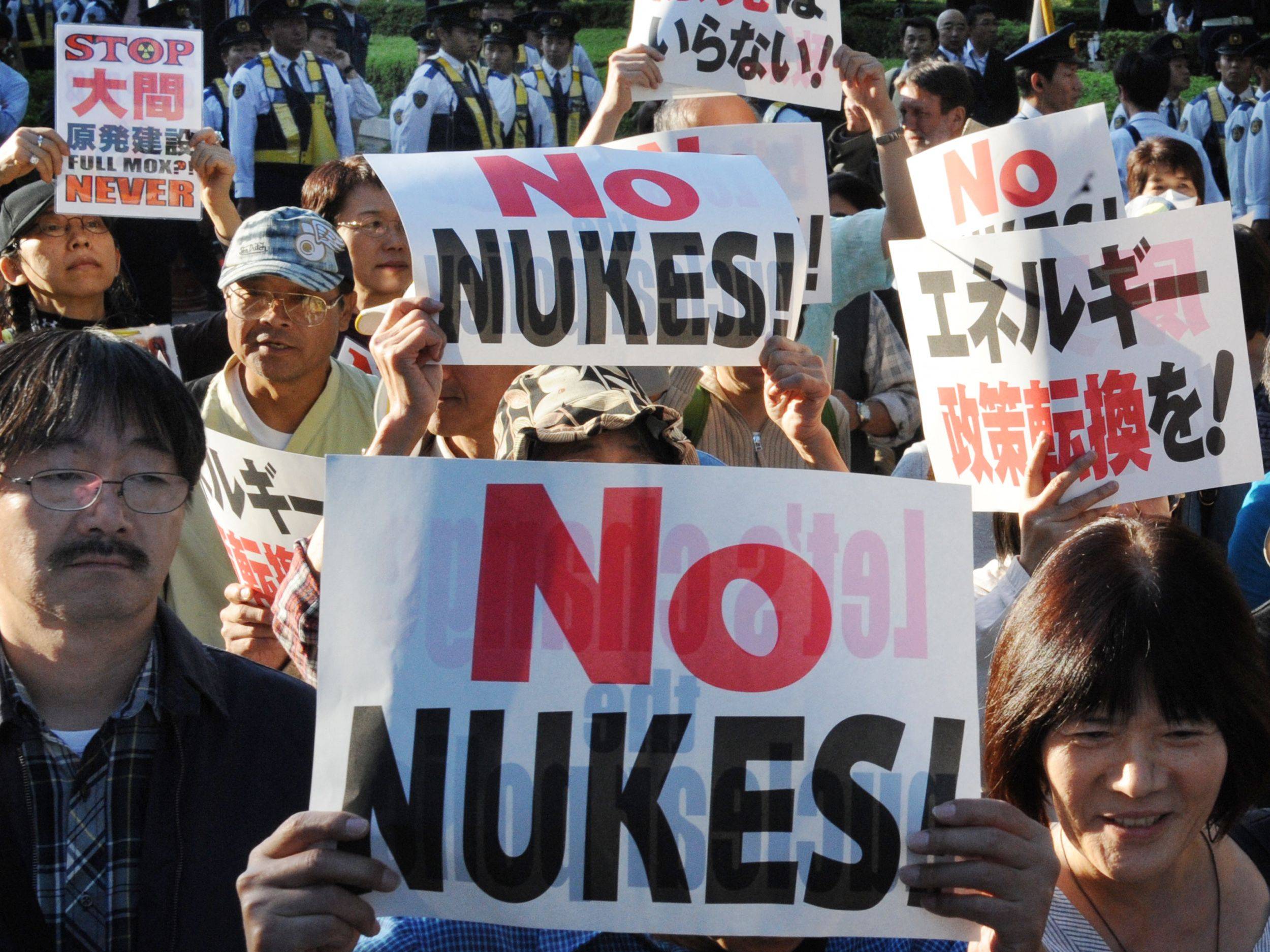
Jan 3, 2023
Japan is facing its most severe energy crisis in decades and wants to speed up the revival of its nuclear energy industry to reduce its dependence on imported fossil fuels.
But restarting more nuclear reactors remains controversial, more than a decade after the 2011 Fukushima disaster.
What does the government want?
All the country’s reactors were shut down for safety checks after the Fukushima meltdown, and there are currently 33 considered operable.
By mid-December, nine were generating electricity, meeting a target set by Prime Minister Fumio Kishida this summer to help counter energy shortages and cover around 10% of Japan’s winter power consumption.
The national nuclear safety watchdog has approved the restart of seven other reactors in principle, but such moves often face fierce opposition from local communities.
In August, Kishida called for these seven reactors to come online by summer 2023 and said Japan should also consider building next-generation nuclear reactors.
He also said authorities would discuss extending the service life of existing reactors beyond the current 60-year limit if safety can be guaranteed.
Before the Fukushima disaster, nearly a third of Japan’s power generation came from nuclear energy, but in the fiscal year to March 2022, the figure stood at around 7%.
The government is aiming for nuclear power to account for between 20% and 22% of electricity production by 2030, part of efforts to reach carbon neutrality by 2050.
What are the obstacles?
The success of these nuclear power ambitions lies with Japan’s independent Nuclear Regulation Authority (NRA), which must give a green light to the plans before they go ahead.
“It will be a challenge” to get existing reactors going again, because some have been “stalled for quite a long time,” said Tom O’Sullivan, a Tokyo-based energy consultant at Mathyos Advisory.
Bringing nuclear plants online could also be complicated by “nervousness about anti-terrorism issues,” he added, pointing to concerns around plants caught in Russia’s war in Ukraine.
“Given what’s happening with the Zaporizhzhia nuclear power plant in Ukraine, I think the NRA is probably more sensitive nowadays to potential terrorist attacks.”
Surveys show that reticence among the Japanese public toward a nuclear power revival has eased since the war in Ukraine triggered a steep rise in energy prices last year.
But opposition from people living near the plants will remain a sticking point, while reports of security breaches at one large plant in recent years have added to public unease, said analyst Hiroe Yamamoto of Moody’s Japan.
How quickly the government’s nuclear power revival hopes can become reality depends on local authorities but also Kishida’s popularity this year, said Nobuo Tanaka, chair of the Innovation for Cool Earth Forum steering committee.
The prime minister is currently “in trouble,” with his approval ratings dragged down last year by scandals, Tanaka said at a recent news conference.
So “just saying we need (more reactors online) because of high energy prices — this kind of argument may not be sustainable,” and the government must also address issues such as waste disposal, he said.
https://www.japantimes.co.jp/news/2023/01/03/national/reviving-nuclear-industry/
Nuclear plant hosts split over Japan’s reversed energy policy
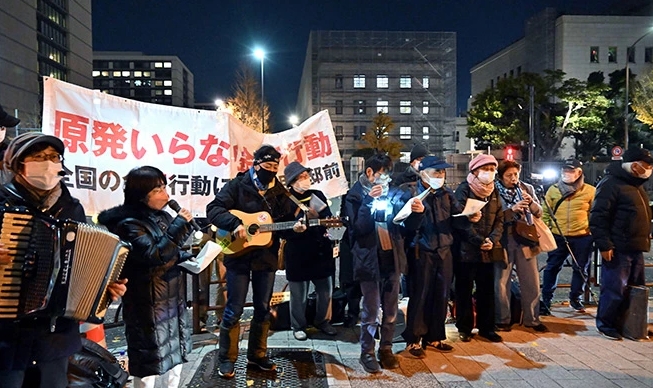
An anti-nuclear rally is held near the prime minister’s office building in Tokyo on Dec. 16.
December 23, 2022
The government’s return to reliance on nuclear energy sparked both anger and joy among municipalities that host nuclear power plants.
The Fumio Kishida administration, in a sweeping reversal of the nation’s nuclear energy policy, says it intends to make “maximum use” of nuclear power to secure a stable energy supply and reduce greenhouse gas emissions.
“We are still struggling to rebuild our community,” said Hisato Iwamoto, a member of the Futaba town assembly. “The central government must have forgotten the Fukushima disaster.”
The town co-hosts the Fukushima No. 1 nuclear plant, which suffered a triple meltdown after the Great East Japan Earthquake and tsunami in March 2011.
Iwamoto’s family was forced to move from one place to another in the prefecture following the disaster.
In fact, all residents of Futaba were told to evacuate their homes.
As a member of the town assembly that had endorsed nuclear power, Iwamoto said he feels responsible.
“It had never occurred to us that an accident could happen at the plant because we constantly asked the central government and Tokyo Electric Power Co. to ensure the plant’s safety,” he said. “I now know there is no such thing as ‘absolutely safe’ no matter how advanced nuclear plants become in the future.”
Since the 2011 triple meltdown, Iwamoto has consistently sounded warnings that a serious accident could occur at any nuclear plant when he attended meetings of assembly members of municipalities hosting nuclear plants across the country.
But their reactions have been lukewarm, according to Iwamoto.
Iwamoto, 65, noted that politicians opposed to nuclear energy would have difficulty winning elections in areas whose economies rely largely on nuclear plants.
His father, Tadao, was a good example.
Tadao was first elected to the Fukushima prefectural assembly in 1971 and began activity opposing nuclear plants. That opposition resulted in three straight election losses since 1975.
Even in the 1979 election, which followed the Three Mile Island nuclear accident in the United States in March that year, he gained the least number of votes among candidates.
After he switched his position and accepted nuclear power, he was elected Futaba mayor. He served five terms at the post.
Evacuees from Futaba were allowed to return to live in their hometown in August.
But Futaba is now a far cry from what it used to be, said Iwamoto, who still lives in evacuation in Iwaki in the prefecture.
“Community ties have never been restored,” he said.
Ritsuko Yanai, a 44-year-old mother who evacuated to Aizuwakamatsu in the prefecture, said she suspects the central government is “trying to wipe the slate clean.”
She is from Okuma, the other co-host of the Fukushima No. 1 nuclear plant.
She fled the disaster with her 1-month-old son. Her parents’ home was dismantled to make space for and interim facility to store debris and waste from decontamination work.
There is no clue on when decommissioning of the plant will be completed. And the release into the sea of tons and tons of treated water stored at the plant is expected to begin in spring.
“The nuclear accident is not over yet,” Yanai said.
But in Mihama, a town hosting the Mihama nuclear plant in Fukui Prefecture, the central government’s decision on nuclear power was mostly welcomed.
The prefecture facing the Sea of Japan hosts 15 reactors, the most in the nation. Seven of them, including two prototype reactors and two reactors at the Mihama plant, are in the process of decommissioning.
“The central government finally took action,” said Jitaro Yamaguchi, a former mayor of the town. “Nothing can serve as an alternative to nuclear energy.”
Yamaguchi, who was Mihama mayor for 20 years until he stepped down in 2019, had lobbied Kansai Electric Power Co., operator of the Mihama nuclear plant, to build more reactors in the town, with a population of about 9,000.
His pro-nuclear power stance remained unchanged even after the Fukushima disaster.
“We need nuclear plants when we think about environmental issues and power supply,” he said. “They have benefitted the local economy.”
The Mihama nuclear plant is called the “heart” of the local economy, sending “blood” to every corner of the town.
More than half of the town’s initial budget of 8.6 billion yen ($65 million) for fiscal 2022 is funded by revenues from nuclear facilities.
Since retiring as mayor, Yamaguchi, 79, has served as head of an organization promoting nuclear power.
He said he is pleased with the government’s new policy to replace retired reactors with new units. Previous governments had refused to commit to such projects following the Fukushima accident.
The town now has better prospects for construction of brand-new reactors–and more money.
“Nuclear power plants are an integral part of the local industry,” he said. “They should be built seamlessly.”
But the town is not without opponents of new reactors as well as advocates for a shift to renewables.
“A nuclear plant is akin to a drug addiction that you cannot break,” said Teruyuki Matsushita, a 74-year-old assemblyman. “Once a huge sum of money from a nuclear project is poured in the town, you are increasingly less likely to give serious thought on how to build the future of the town.”
(This article was compiled from reports by Keitaro Fukuchi, Nobuyuki Takiguchi and Tsunetaka Sato.)
Japanese panel approves return to nuclear power as disaster memories fade

Dec 22, 2022
Prime Minister Fumio Kishida’s advisory panel approved a plan to extend the lifespans of nuclear reactors beyond 60 years and build new units to replace those that are decommissioned, reversing policies put in place after the Fukushima disaster in 2011.
The step reflects a shift in public opinion, as the import-reliant country struggles with the threat of blackouts amid Russia’s war in Ukraine and extreme weather. While massive demonstrations calling for the abolition of atomic power were a regular occurrence in the wake of the meltdowns, recent polls indicate growing support for restarting idled plants.
The government is aiming to present legislation to parliament during the next session to put the basic plan into action, Kishida told a meeting of his “green transformation” panel, which is made up mostly of business executives and academics, on Thursday. The proposal will be opened for public comment and could gain Cabinet approval by February, the Nikkei newspaper reported.
Japan is joining a global shift back to nuclear energy after the prices of natural gas and coal shot to records this year as Russia’s invasion of Ukraine upended markets. The Kishida administration is also turning to nuclear to help curb emissions and hit Japan’s 2050 net-zero target.
A survey by the Yomiuri newspaper in August found 58% in favor of restarting idled reactors, the first time a majority approved of the idea in that poll series since the question was initially posed in 2017. A separate survey by public broadcaster NHK earlier this month found 45% approved of the panel’s plan, while 37% opposed it.
The government still faces some opposition from local residents over nuclear restarts and lawsuits related to safety concerns still keep many reactors offline. Only a third of Japan’s operable reactors have restarted since the 2011 disaster.
After the Fukushima disaster, Japan swore to phase out nuclear power. But not anymore

The Fukushima Daiichi nuclear power plant is seen on March 17. Japan on Thursday adopted a new policy promoting greater use of nuclear energy to ensure a stable power supply amid global fuel shortages and reduce carbon emissions — a major reversal of its phaseout plan since the Fukushima crisis.
December 22, 2022
TOKYO — Japan adopted a plan on Thursday to extend the lifespan of nuclear reactors, replace the old and even build new ones, a major shift in a country scarred by the Fukushima disaster that once planned to phase out atomic power.
In the face of global fuel shortages, rising prices and pressure to reduce carbon emissions, Japan’s leaders have begun to turn back toward nuclear energy, but the announcement was their clearest commitment yet after keeping mum on delicate topics like the possibility of building new reactors.
Still, restart approvals for idled nuclear reactors have come slowly since the Fukushima disaster, which led to stricter safety standards. Utility companies have applied for restarts at 27 reactors in the past decade. Seventeen have passed safety checks and only 10 have resumed operation.
According the paper laying out the new policy, nuclear power serves “an important role as a carbon-free baseload energy source in achieving supply stability and carbon neutrality” and pledged to “sustain use of nuclear power into the future.” Prime Minister Fumio Kishida said he planned to get the Cabinet to approve the policy and submit necessary bills to Parliament.
As part of the new policy, the Economy and Industry Ministry has drafted a plan to allow extensions every 10 years for reactors after 30 years of operation while also permitting utilities to subtract offline periods in calculating reactors’ operational life.
The plan was endorsed on Wednesday by the Nuclear Regulation Authority, Japan’s nuclear watchdog. New safety inspection rules still need to be put into law and approved by Parliament.
The regulation authority’s commissioner, Shinichi Yamanaka, told a news conference the new safety rules requiring operational permits every decade after 30 years will be safer than a current one-time 20-year extension option for 40-year-old reactors. But experts cast some doubt on that.
Some experts question extending the lifespan of older reactors
Takeo Kikkawa, an economics professor at the International University of Japan and an expert on energy, said utility operators under the new policy could keep using old equipment instead of investing in new technology or renewables.
“Naturally, we should aim for newer technology and use it safely. Therefore, extending reactors’ lifespans is an undesirable move,” Kikkawa recently told a talk show.
Most nuclear reactors in Japan are more than 30 years old. Four reactors that have operated for more than 40 years have received permission to operate, and one is currently online.
Under the new policy, Japan will also push for the development and construction of “next-generation innovative reactors” to replace about 20 reactors now set for decommissioning.
Kenichi Oshima, a Ryukoku University professor of environmental economy and energy policy, said some of what the government calls “innovative” reactors are not so different from existing technology and that prospects for nuclear fusion and other next-generation reactors are largely uncertain and not achievable anytime soon.
Thursday’s adoption of the new policy comes less than four months after Kishida launched the “GX (Green Transformation) Implementation Council” of outside experts and ministers to “consider all options” to compile a new policy that addresses global fuel shortages amid Russia’s war on Ukraine and seeks to achieve carbon neutrality by 2050.
Japan’s nuclear energy goals may be out of reach
Nuclear energy accounts for less than 7% of Japan’s energy supply, and achieving the government’s goal of raising that share to 20-22% by 2030 will require about 27 reactors, from the current 10 — a target some say is not achievable. The new policy also does not help address imminent supply shortages because reactors cannot be restarted quickly enough.
While public opinion on nuclear energy has softened since Fukushima, opponents still argue atomic power is not flexible and not even cheaper than renewables when final waste management and necessary safety measures are considered — and that it can cause immeasurable damage in an accident.
Ruiko Muto, a survivor of the Fukushima disaster, called the new policy “extremely disappointing.” She added: “The Fukushima disaster is not over yet and the government seems to have already forgotten what happened.”
The regulation authority came under fire Wednesday after revelations by a civil group that a few of its experts had discussed details with industry ministry officials before the watchdog was officially asked to consider a rule change for aging reactors, despite their compulsory independence.
Prime Minister Kishida also said Thursday that the government will do more to find candidate sites for a final repository for high-level nuclear waste that Japan does not yet have. Preliminary studies have begun in two small towns in Hokkaido, angering some residents.
1 This Month


10 March A LIVE WEBINAR THE REAL EFFECTS OF NUCLEAR POWER
What the Industry Isn’t Telling Us
1:00 PM Mountain, 2 pm Central, 3 pm Eastern. Live on the Keepers of the Water Facebook page


18 March Webinar @ 1 PM EST: An Assessment of SMR Projects: The Case of Canada
register for the zoom:
https://us02web.zoom.us/webinar/register/WN_o8BIIOUvQ2ONJR1nta65DQ#/registration


of the week – STOP SMALL MODULAR REACTORS IN CANADA
To see nuclear-related stories in greater depth and intensity – go to https://nuclearinformation.wordpress.com
-
Archives
- March 2026 (62)
- February 2026 (268)
- January 2026 (308)
- December 2025 (358)
- November 2025 (359)
- October 2025 (376)
- September 2025 (258)
- August 2025 (319)
- July 2025 (230)
- June 2025 (348)
- May 2025 (261)
- April 2025 (305)
-
Categories
- 1
- 1 NUCLEAR ISSUES
- business and costs
- climate change
- culture and arts
- ENERGY
- environment
- health
- history
- indigenous issues
- Legal
- marketing of nuclear
- media
- opposition to nuclear
- PERSONAL STORIES
- politics
- politics international
- Religion and ethics
- safety
- secrets,lies and civil liberties
- spinbuster
- technology
- Uranium
- wastes
- weapons and war
- Women
- 2 WORLD
- ACTION
- AFRICA
- Atrocities
- AUSTRALIA
- Christina's notes
- Christina's themes
- culture and arts
- Events
- Fuk 2022
- Fuk 2023
- Fukushima 2017
- Fukushima 2018
- fukushima 2019
- Fukushima 2020
- Fukushima 2021
- general
- global warming
- Humour (God we need it)
- Nuclear
- RARE EARTHS
- Reference
- resources – print
- Resources -audiovicual
- Weekly Newsletter
- World
- World Nuclear
- YouTube
-
RSS
Entries RSS
Comments RSS
 nuclear-news