Utilities balk at safer storage of spent nuclear fuel to avoid ‘wasted investment’ by Ryuta Koike and Toshio Kawada. January 04, 2015 THE ASAHI SHIMBUN Power companies have resisted government calls to construct safer storage facilities for spent nuclear fuel and are instead waiting for a fuel reprocessing plant to finally start running after nearly two decades of delays.
The utilities say that building dry storage facilities, which hold spent nuclear fuel encased in metal or concrete casks, could prove a waste of money if the Rokkasho reprocessing plant in Aomori Prefecture begins operations and takes all the spent fuel off their hands.
They also cite concerns in communities that host nuclear reactors that dry storage facilities could lead to permanent storage there.
Under Japan’s basic energy plan approved by the Cabinet in April last year, the central government promotes the construction and use of dry storage facilities.
Shunichi Tanaka, chairman of the Nuclear Regulation Authority, has repeatedly referred to the importance of such facilities, which are deemed safer and less expensive to operate than the traditional method of keeping spent nuclear fuel submerged in storage pools at nuclear plant.
Spent fuel pools are usually located next to reactors for swift transport because the fuel rods continue to be highly radioactive and emit heat after use.
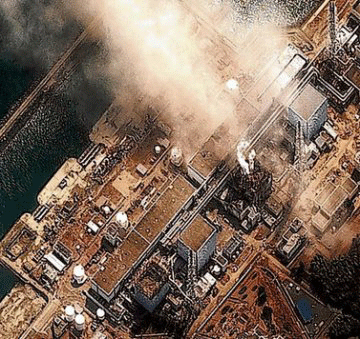
The risk of using storage pools was exposed when all power sources were lost at the Fukushima No. 1 nuclear plant after the Great East Japan Earthquake and tsunami struck on March 11, 2011.
Tokyo Electric Power Co., operator of the plant, not only had to deal with three reactor meltdowns, but it was also forced to take measures to prevent the release of radiation from spent fuel storage pools at the site.
Under the dry storage method, the encased spent fuel is cooled with circulating air at a facility built separate from the reactor building. Dry storage is mainly used for spent fuel whose radioactive decay heat has already dropped to a certain level.
One big advantage that dry storage has over storage pools is that it can continue to cool spent fuel even after a power failure in the event of a nuclear accident or natural disaster.
In fact, spent fuel in a dry storage facility at the Fukushima No. 1 nuclear plant did not suffer any major damage in the 2011 disaster, according to TEPCO.
The only other nuclear power station currently equipped with a dry storage facility within its plant site is Japan Atomic Power Co.’s Tokai No. 2 nuclear power plant in Ibaraki Prefecture.
Chubu Electric Power Co. plans to set up a dry storage facility at its Hamaoka nuclear plant in Shizuoka Prefecture in fiscal 2018. That plan was hatched before the Fukushima nuclear disaster.
But no other utility in Japan has moved in that direction despite the government’s urging………..
The biggest reason the utilities are hesitant to build dry storage facilities is that the government has kept alive the Rokkasho nuclear fuel reprocessing plant project, despite its many problems.
According to the project, the Rokkasho plant will take in the utilities’ spent nuclear fuel and reprocess it for reuse at nuclear reactors around Japan.
The Rokkasho plant was originally scheduled to open in 1997. However, the start of operations has been delayed 21 times because of technical glitches, human error and safety issues.
Japan Nuclear Fuel Ltd., operator of the Rokkasho plant, has postponed the completion date to March 2016.
Still, electric power companies do not want to spend on dry storage facilities now because they believe the plant will start running and alleviate them of their spent fuel problems.
“Even if we build a dry storage facility, it would likely be a wasted investment,” said an official in the nuclear power industry, alluding to the Rokkasho plant.
The utilities say they are also concerned that building dry storage facilities could stoke fears among nearby residents and local officials that hazardous spent fuel would remain in their neighborhoods for a prolonged period……..
Tadahiro Katsuta, associate professor of nuclear energy policy at Meiji University, said the central government should provide incentives to spur utilities to shift to dry storage facilities.
“When the safety of a nuclear plant is at issue, it is obvious that dry storage is more reliable (than pools) since it does not require emergency measures to safeguard the facility in the event of an accident,” Katsuta said. “Financial benefits and setting a limit on the storage period should be considered.” http://ajw.asahi.com/article/0311disaster/fukushima/AJ201501040021
Fukushima desires to host preliminary events for 2020 Tokyo Olympics Global Post, Xinhua News Agency December 16, 2014 TOKYO, Dec. 16 –– Japan’s northeastern Fukushima prefecture on Tuesday expressed desire to host some preliminary events for the 2020 Tokyo Olympics as part of efforts to show its recovery from the 2011 nuclear disaster.
The Foreign Ministry will help local governments tear down overseas barriers on food imports maintained because of worries over radiation, sources said.
Some states still ban some imports of agricultural, forestry and fishery products because of the fear of contamination from Tokyo Electric Power Co.’s Fukushima No. 1 nuclear plant. As a result, the ministry will cooperate with local governments in organizing events overseas to assure regulators and consumers that products are safe.
In 2015, the ministry plans to hold two to three such events, the sources said Sunday.
Unfounded rumors are a matter of life and death for municipalities where agriculture, fisheries or forestry are key industries.
The ministry said 13 countries, including Canada and Vietnam, have lifted import restrictions imposed after the accident on agricultural, forestry and fishery products from affected areas, but nine economies including South Korea, Singapore and Taiwan still have bans.
South Korea bans marine products from prefectures such as Miyagi and Fukushima.
Many countries also implement some kind of import control, such as requiring safety certificates.
When the ministry holds the events abroad, it will give assistance through embassies, aiming to allay concerns among local companies and media organizations.
A senior ministry official said the support for local governments boils down to wanting to disseminate correct information and to sell Japan’s attractions.
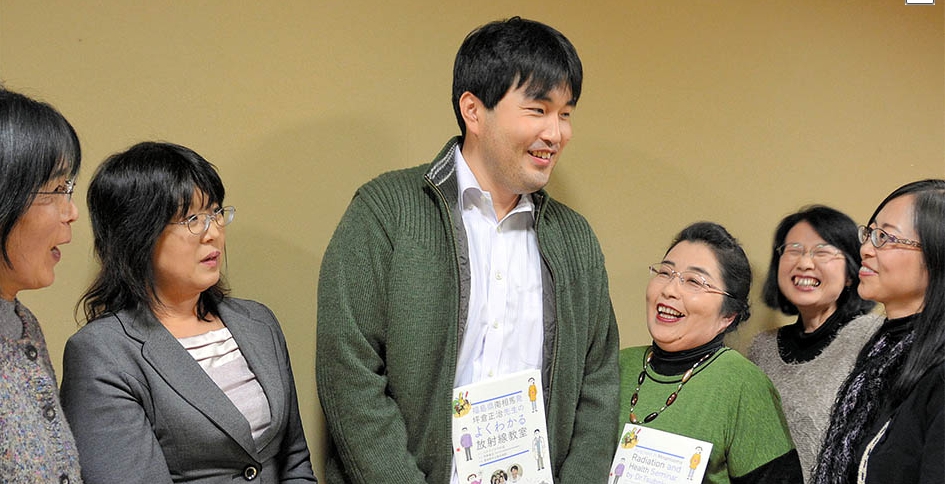
Masaharu Tsubokura, center, and the members of the Veteran Mothers’ Society in Minami-Soma, Fukushima Prefecture
December 29, 2014
MINAMI-SOMA, Fukushima Prefecture–Mothers living near the stricken Fukushima No. 1 nuclear plant have compiled a booklet offering basic knowledge about radiation and explanations addressing safety concerns arising from the disaster.
The booklet, titled “Yoku Wakaru Hoshasen Kyoshitsu” (Radiation and Health Seminar), is available in both Japanese and English and was created by the Veteran Mothers’ Society, which consists of five mothers from the city of Minami-Soma.
The members, some of whom are former high school classmates, decided to create the booklet “for children’s sake.”
The information incorporates lessons learned from doctors at seminars the group organized following the accident at Tokyo Electric Power Co.’s Fukushima No. 1 nuclear plant in March 2011.
Amid the confusion and fears over radiation after the disaster unfolded, the mothers convened their first seminar for children and guardians in December 2011. They invited Masaharu Tsubokura, a doctor of hematology from the University of Tokyo’s Institute of Medical Science who had been providing consultations at the Minami-Soma municipal general hospital.
Other physicians later joined the effort to spread accurate information about radiation, and the mothers have held the sessions once or twice a month.
In the seminars, the children peppered Tsubokura with questions, such as “Can I touch my pets?” and “Is it OK to lick the snow?”
Ikumi Watanabe, the society’s 54-year-old vice chairwoman, recalled that Tsubokura’s explanations “were spoken in an easy-to-understand manner so the information popped straight into our heads. It was nice that we could talk with him on the same level and in person.”
Even now, the nature of the questions has not changed much.
“People have felt pressured not to talk about radiation, and some mothers have finally gotten the information only now, more than three years after the accident,” Tsubokura said. “I hope I can help them make decisions without thinking negatively about themselves or losing their self-confidence.”
In addition to basic knowledge, such as the differences between external and internal radiation exposure and between becquerels and sieverts, the booklet answers questions like: “Can radiation be transmitted from one person to another?” and “Is the tap water OK?”
According to the Veteran Mothers’ Society, 20,000 copies of the Japanese version were distributed to schools, companies and other organizations. The English version has been ordered by international schools, international exchange organizations and other groups.
MINAMI-SOMA, Fukushima Prefecture–The central government lifted on Dec. 28 the last recommended evacuation advisory for several districts in this city, saying radiation levels from the nuclear accident fell below the annual exposure limit.
However, many of the residents of 152 households within these districts voiced their opposition to the lifting.
The central government designated areas that registered high radiation levels outside the zones under mandatory evacuation orders as specific recommended evacuation spots following the triple meltdown at the Fukushima No. 1 nuclear power plant. The residents living within these locales were encouraged to evacuate from their homes.
The districts in Minami-Soma were designated as such because they were at risk of exceeding the annual accumulated dose limit of 20 millisieverts, or 3.8 microsieverts per hour.
The central government in June 2011 issued the advisory for some locales in the cities of Minami-Soma and Date and the village of Kawauchi, all in Fukushima Prefecture, home to 281 households. The advisory for Date and Kawauchi was lifted earlier.
Central government officials explained their latest decision to the residents and local officials, saying that the health risks are not expected because radiation levels in their sites now measure well below the designated limit of 20 millisieverts.
They also presented support measures to encourage the residents to return to their homes.
However, evacuee Katsuji Sato, among the residents of the 152 households, said he would not immediately return home.
The 79-year-old, who lives in temporary housing in Minami-Soma, had lived in a family of six of four generations before the Great East Earthquake and tsunami on March 11, 2011, set off the nuclear disaster.
Sato’s mother died where she evacuated to, and his eldest son, the son’s wife and their elementary school child moved to Miyagi Prefecture.
“My wife and I cannot return to our home even though we want to unless decontamination work is undertaken again,” Sato said.
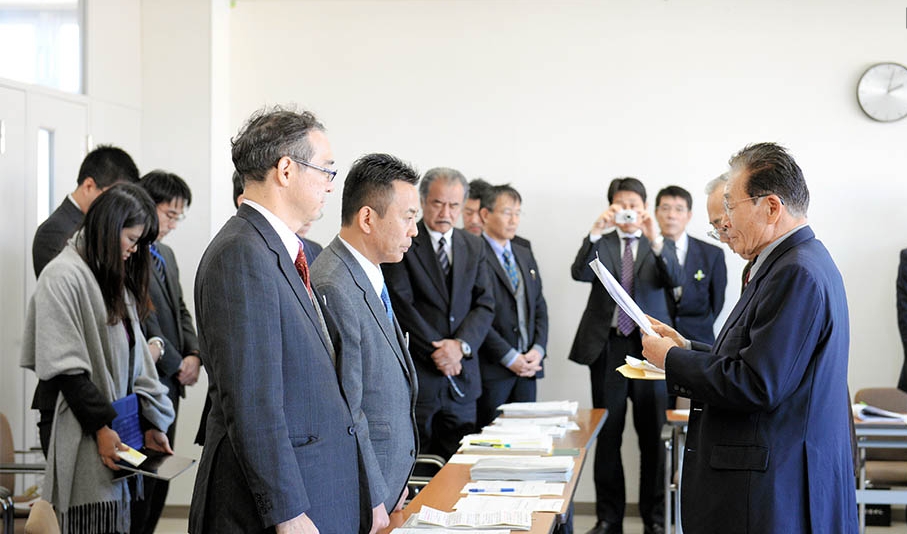
The head of the Takakura district, right, reads aloud a statement in opposition to the lifting of a recommended evacuation advisory to officials of the nuclear emergency local response headquarters
Fukushima rocked by strongest quakes to hit country this month; Epicenter just offshore from reactors; Nuke plant cam shows shaking for over a minute — Top Japan Newspaper: ‘Major quake disasters could strike anywhere in nation’… Great increases in probability; Measures urgently needed (VIDEO) http://enenews.com/fukushima-rocked-strongest-quakes-hit-country-month-footage-nuke-plant-shows-shaking-minute-top-japan-newspaper-major-quake-disasters-could-strike-anywhere-nation-great-increases-perceived-probabil?utm_source=feedburner&utm_medium=email&utm_campaign=Feed%3A+ENENews+%28Energy+News%29
Yomiuri Shimbun, Dec. 24, 2014 (emphasis added): Major earthquake disasters could strike anywhere in the nation — What is the probability of a major earthquake striking each part of the nation? The government’s Headquarters for Earthqake Research Promotion has unveiled its 2014 version of a geographical forecast for massive quakes… A glance at the map shows us that no region in this nation is free from the risk of seismic disaster… The data in question shows that no further delay may be permitted in taking necessary measures… Despite theurgent need for measures to cope with the situation, some municipal governments have not done enough… In producing the latest version, the headquarters expanded the scope of the areas with estimated epicenters while also extending the scales for predicted quakes. This resulted ingreat increases in the perceived probability of a major earthquake striking some areas, including Saitama [north of Tokyo]. The figure for the city marked a 21-point increase to 51 percent.
Prensa Latina, Dec 25, 2014: 5.5 Magnitude Quake Rocks Japan — A 5.5 magnitude quake rocked northeastern Japan yesterday night… The medium-intensity quake [was centered off] Futaba district, Fukushima, with epicenter at a depth of 30 km.
Epoch Times (China), Dec 25, 2014: Earthquake Today in Japan: Strong Quake Off Coast of Fukushima on Christmas… The US Geological Survey said the quake… was measured at 5.5-magnitude… The quake had a depth of 6.2 miles, said the USGS.
The Herald, Dec 21, 2014: Earthquake hits near Fukushima — A 5.9 magnitude earthquake hit Japan’s Honshu island… shaking Fukushima where crippled nuclear power plants are located… A spokesman for Tokyo Electric Power said no irregularities have been found at its Fukushima Daiichi or Daini plants.
Ministry, TEPCO seek to end compensation for Fukushima businesses in Feb. 2016 Mainichi, 29 Dec 14The government and Tokyo Electric Power Co. (TEPCO) have proposed to Fukushima Prefecture’s commerce and industry federation a plan to end nuclear disaster compensation for businesses in February 2016, it has been learned.
The Ministry of Economy, Trade and Industry and TEPCO presented the plan to the Fukushima Federation of Societies of Commerce and Industry on Dec. 25. The ministry and the utility told the federation that they plan to end compensation payments to all businesses, except for those in the agricultural, forestry and fisheries sectors, in February 2016. Ministry and utility officials explained that they would map out future policies after hearing claims from business owners.
The federation’s secretary-general, Hideki Endo, however, criticized the proposal.
“Fukushima business owners face different situations depending on their evacuation statuses and their business categories,” he said. “While we understand the need to draw the line somewhere, we cannot accept the end of compensation payments within a year and a few months from now when the nuclear disaster has still not been brought to a conclusion and there are no prospects that harmful rumors will end in the foreseeable future.”…….http://mainichi.jp/english/english/newsselect/news/20141227p2a00m0na007000c.html
Gary Griggs, Our Ocean Backyard: Tracking Fukushima radiation across the PacificBy Gary Griggs, Our Ocean Backyard 26 Dec 14, Radiation from the meltdown of the three reactors at the Fukushima Daiichi Nuclear Plant in March 2011 quickly entered the offshore ocean.
The radiation was detected in the water immediately. Several species of fish caught offshore in 2011 and 2012 had radioactive cesium levels that exceeded Japan’s seafood consumption levels, but overall concentrations have dropped since the fall of 2011………..
Anything picked up by the Kuroshio Current as it passes by Japan, whether tsunami debris, glass fishing floats, or radioactive contaminants, heads towards North America, but slowly, a little more than 5 miles every day on average.
At this speed, water moving from Japan in a straight path would take about three years or longer to get to the west coast. Shortly after the Fukushima Daiichi meltdown and radiation release, oceanographers projected that it would likely take until 2014 until it reached the West Coast of North America……
the nuclear bomb testing that went on in the Pacific from the 1940s to the 1980s, contributed hundreds of times more radioactivity to the oceans than Fukushima. There is also uranium dissolved naturally in seawater.
So Fukushima is not the largest contributor to radiation in the waters of the Pacific Ocean.
772 interviews were conducted in 2011 and 2012 by a government committee that investigated the disaster.
The testimonies came mainly from government officials and staff from Tokyo Electric Power Company, which operates the crippled Fukushima Daiichi plant.
Some testimonies including those from then prime minister Naoto Kan, and then plant chief Masao Yoshida have already been released.
An additional 127 were made public on Thursday after receiving consent from interviewees.
Among those newly released is one from a worker at Tokyo Electric headquarters. He analyzed conditions inside the reactors in early April 2011 when the effects of the disaster began to unfold.
The official said he thought the upper half of the nuclear fuel rods at the No.1 reactor core must have completely melted. Cooling water was covering only the lower half of the rods.
But the employee added he remembered his company refrained from using the word “meltdown” in news briefings as much as possible. He said he heard TEPCO feared that a misunderstanding could occur as there was no exact definition for the term. Nuclear fuel melted at the No.1, 2 and 3 reactors. But Tokyo Electric admitted the possibility of meltdowns only in May 2011.
New method for contaminated water may be failing http://www3.nhk.or.jp/nhkworld/english/news/20141226_37.htmlTokyo Electric Power Company has indicated that a new method aimed at tackling a large volume of highly radioactive wastewater at the Fukushima Daiichi nuclear power plant has not been entirely successful.
TEPCO gave a progress report on its work to a panel of experts at the Nuclear Regulation Authority on Friday.
The utility last month began pouring cement into underground tunnels filled with the contaminated water from the reactor buildings to stop the water inflow. The water is believed to be leaking into the sea.
TEPCO officials told the panel that workers have completely filled the U-shaped tunnels except for 4 vertical pits that connect the tunnels to the ground surface. They removed 2,500 tons of radioactive water.
But the officials said that when they pumped water up from one of the pits, the water level at another pit changed. That suggests that gaps exist in the concrete-filled tunnels. The officials argued that they can stop the water from flowing into the tunnels once the 4 vertical pits are filled. But panel members and authority commissioners said more thorough inspections are needed.
TEPCO plans to monitor water levels for a month, look for gaps, and study more effective ways to block the water.
The utility initially planned to freeze wastewater at the end of the tunnel to stop inflow from the reactor buildings and remove the water. But the plan did not work.
Fukushima ex-governor slams government for tardy radiation evacuation orders, Japan Times 26 Dec 14 JIJIFormer Fukushima Gov. Yuhei Sato had criticized the central government for failing to issue evacuation orders in a timely manner in March 2011 after the Fukushima No. 1 nuclear plant suffered three reactor core meltdowns and spewed radioactive fallout, according to records disclosed Thursday.
The central government at first did not provide any information about the meltdowns at Tokyo Electric Power Co.’s Fukushima No. 1 nuclear plant, the records quoted Sato as saying.
“Because we received various information from local communities, I decided to issue an evacuation order,” Sato said.
The prefectural government issued an evacuation order on its own to people living within 2 km of the plant soon after the disaster started.
Tokyo Electric Power Company has indicated that a new method aimed at tackling a large volume of highly radioactive wastewater at the Fukushima Daiichi nuclear power plant has not been entirely successful.
TEPCO gave a progress report on its work to a panel of experts at the Nuclear Regulation Authority on Friday.
The utility last month began pouring cement into underground tunnels filled with the contaminated water from the reactor buildings to stop the water inflow. The water is believed to be leaking into the sea.
TEPCO officials told the panel that workers have completely filled the U-shaped tunnels except for 4 vertical pits that connect the tunnels to the ground surface. They removed 2,500 tons of radioactive water.
But the officials said that when they pumped water up from one of the pits, the water level at another pit changed. That suggests that gaps exist in the concrete-filled tunnels.
The officials argued that they can stop the water from flowing into the tunnels once the 4 vertical pits are filled. But panel members and authority commissioners said more thorough inspections are needed.
TEPCO plans to monitor water levels for a month, look for gaps, and study more effective ways to block the water.
Japan Atomic Power set to deploy 100 specialists to help with Fukushima dismantling THE ASAHI SHIMBUN by Daiki Koga and Tsuyoshi Nagano, 25 Dec 14 Japan Atomic Power Co. is working on plans to send a team of more than 100 specialists, backed up by robotic technology, to the beleaguered Fukushima No. 1 nuclear power plant to accelerate decommissioning work there……….
The plant operator finished removing nuclear fuel at the No. 4 reactor on Dec. 20 and is expected to start full-scale dismantling of the more problematic Nos. 1 to 3 reactors soon.
However, due to difficulties in preventing the spread of radioactive substances and removing debris around the reactor, the removal of fuel at the No. 1 reactor is estimated to start two to five years later than originally planned.
Some of the procedures are likely too difficult for TEPCO to undertake on its own, as the utility does not have sufficient experience in decommissioning nuclear reactors.
Workers in protective suits undertook the removal of fuel from the No. 4 reactor in rotation, as radiation levels were relatively low there. However, as radiation levels are much higher at the No. 3 reactor, the removal of fuel from its storage pool has to be conducted using remote-controlled robots……..http://ajw.asahi.com/article/0311disaster/fukushima/AJ201412250035
INTERVIEW/ Yukihiko Kayama: Experts should help Fukushima mothers speak up about radiation fears, Asahi Shimbun December 26, 2014 By YURI OIWA/ Staff Writer FUKUSHIMA--Psychiatrist Yukihiko Kayama said it is becoming more embarrassing, with the passage of time since the Fukushima nuclear disaster of 2011, for mothers in Fukushima Prefecture to casually discuss their fears of radiation.
In a recent interview with The Asahi Shimbun, Kayama attributed the trend to a “division” within the population of Fukushima Prefecture, whereby a divergence in their lifestyles according to their residential areas, available economic resources and other factors has made it difficult for them to relate to each other’s feelings.
He proposed meetings of experts with small audiences of residents, where participants could feel at ease talking about their own experiences, concerns and other problems. That would ease the speakers’ emotions to a certain extent, Kayama said.
Excerpts of the interview follow:……………
“….For one thing, people consciously keep from talking about radiation because many of them have found their own ways of coming to terms with radiation in their lives. But rather, I think it is truer to say that, with the passage of time since the nuclear disaster, it is becoming more embarrassing to talk about radiation at all.
That is partly because you are afraid you could be taken for being eccentric if you don’t react to radiation concerns the way others do. Some are concerned they could be taken for nervous ones who still worry about radiation if they just mentioned the topic of radiation.
Tochigi firm warned for hiring high school student for decontamination work, Mainichi 25 Dec 14 NASU, Tochigi –– A construction company hired a high school student for work to decontaminate houses tainted with radiation from the Fukushima nuclear disaster, the Mainichi Shimbun has learned.
The Nasu Municipal Government revealed on Dec. 25 that a construction firm in the town employed a male high school student from outside the town as a part-timer for decontamination work in possible violation of the Labor Standard Act. The law prohibits engaging those under 18 for work that exposes individuals to harmful radiation. The Ministry of Health, Labor and Welfare has ruled that the legal ban applies to decontamination work.
The municipal government gave a verbal warning to the president of the construction company, while reporting the incident to a local labor standards inspection office in November.
Read the Public Inquiry Report, the Commissioners’ report, Surrendering Australia: The AUKUS Deception is available to download for free at aukuspublicinquiry.com. Or just watch the replay of the National Press Club Luncheon.
19 November – Webinar – The Reality of Reprocessing
Time: 11:00 AM Pacific Time (US & Canada) / 2:00 PM Eastern / 7:00 PM UK / 8:00 PM CET