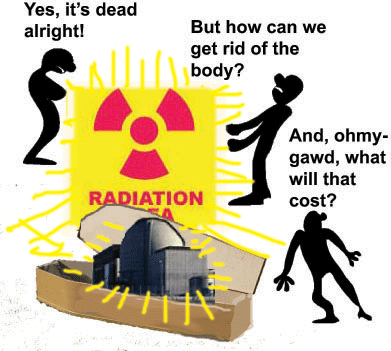
Japanese electric power consumers to share NPP dismantling costs It costs at least $180 million to decommission one reactor TOKYO, January 14. /TASS/. The costs of dismantling of outdated or unsafe nuclear power plants in Japan will be equally shared by the country’s electric power consumers, a working group of the economy, trade and industry ministry said on Wednesday………The government said nuclear power plants will be decommissioned when their authorized 40-year lifespans expire. Some 5 reactors are expected to be dismantled and the plans will be officially announced next month.
The loss due to decommissioning of one reactor is estimated at least at $180 million. Such expenses could deal a serious economic blow to private companies, which own the power reactors, and weaken the country’s economy in general.
Japan’s energy companies have submitted applications for another 19 reactors to resume their operations, but the process has been slowed down by safety checks and paperwork…….http://itar-tass.com/en/world/771074
The Japanese government’s plan to build intermediate storage facilities for radioactive waste from the 2011 nuclear accident is set to move ahead, now that the candidate sites have accepted the plan.
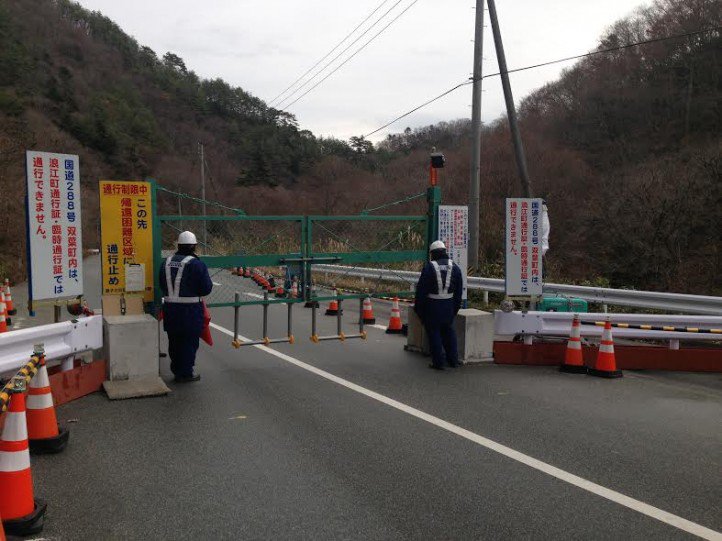
The government wants to build facilities for storing contaminated soil and debris on a 16-square-kilometer site straddling the towns of Futaba and Okuma in Fukushima Prefecture. The 2 towns host the damaged Fukushima Daiichi nuclear plant.
Okuma accepted the plan last month. The mayor of Futaba made the same decision on Tuesday in Iwaki city, where most of the town’s residents have evacuated.
Those in favor of accepting the intermediate storage facilities say they will help speed up decontamination efforts in the region.
But others cite the risk of the intermediate facilities becoming permanent unless the government fulfills its promise to dispose of nuclear waste outside the prefecture.
The government plans to continue purchase negotiations with the site’s landowners. It is also working out safety arrangements with the prefecture and the 2 towns for the transportation of radioactive waste to the facilities.
Futaba Mayor Shiro Izawa said acceptance of the government’s plan is an unavoidable part of accelerating post-disaster rebuilding.
Dr. Steve Elwart, professional engineer and expert for Dept. of Homeland Security, Dec 14, 2014 (emphasis added): With most of the media silent about the cleanup, the public may think the worst is over [at Fukushima Daiichi]… Nothing could be further from the truth… [Radioactive water is] leaking out into the ocean, allowing it to spread… around the world through ocean currents [and this has] prompted grave concerns over the impact on sea life in the area and around the world. [Officials] decided to build an “ice wall” around the reactor site… TEPCO conceded defeat and announced the efforts to construct the plug failed… As if things couldn’t get worse, less than two months ago, TEPCO once again came out with an announcement that it was having problems with the ice wall [and] was going to cease operations on the ice wall and pour cement… TEPCO President Naomi Hirose stated officials “will never give up” on the wall…debate continues over how to stop water from leaking into the ocean… outright failures continue to plague the Fukushima cleanup efforts.
NHK Transcript, Dec 26, 2014: TEPCO is still struggling to deal with contaminated water at the Fukushima Daiichi nuclear power plant.
NHK, Dec 26, 2014: New method for contaminated water may be failing — [TEPCO] has indicated that a new method aimed at tackling a large volume of highly radioactive wastewater at the Fukushima Daiichi nuclear power plant has not been entirely successful. TEPCO gave a progress report on its work to a panel of experts at the Nuclear Regulation Authority on Friday. The utility last month began pouring cement into underground tunnels filled with the contaminated water from the reactor buildings to stop the water inflow. The water is believed to be leaking into the sea… officials said that when they pumped water up from one of the pits, the water level at another pit changed. That suggests that gaps exist in the concrete-filled tunnels.
Dr. Alice Stewart, physician and epidemiologist: All recommendations say one big hit is more dangerous than just a little one… It’s the basis of the control of nuclear waste — if you dilute it enough, it will be safe. Well, we say dilute it and it will add to the dangers.
Jan van de Putte, radiation safety specialist: There’s a philosophy called the dilution philosophy, which means if you dilute something, then it doesn’t give any harm. But with all the knowledge we have today, we must say radiation is inducing health damage regardless of how little the doses of are. If you dilute radiation… all the health effects will only be more widely distributed. This is the only effect of this dilution philosophy.
Dr. Richard Piccioni, biophysicist: Whether you have put it all in one place or have spread it out, the total irradiation of human beings… is the same. In fact if what some researchers like Dr. Stewart are saying is true, it will be even worse.
We estimated a lower limit of 5.2 × 10²¹ slow neutrons m–2 sec–1[m–2 sec–1 = per sq. meter per second] were emitted from the nuclear fuel rods to the sea water injected in the reactors
Priyadarshi et al. (2011) have estimated a release amount of 4 × 10¹¹ slow neutrons m–2. The large difference with our estimation [13,000,000,000 times higher] comes from the intrinsic limit of the box model study by Priyadarshi et al.
Our model directly estimates the amount of material released from the reactor core
The estimated… number of neutron represent a lower limit of the amount of radiation emitted from the nuclear reactors… These values can be used as a proxy to the total amount of radiation emitted since the melt down
[The authors] express their gratitude to… the Japanese Ministry of Environment…Ministry of Education, Culture, Sports, and Technology (MEXT)… [and] the Cabinet Office
Evidence of neutron leakage at the Fukushima nuclear plant… Despite the obvious implication for human health and the surrounding ecology, there are no quantitative estimates of the neutron flux leakage… Heat must be removed by cooling the system to prevent… meltdown, which results in injection of neutrons and other fission products into the atmosphere… [T]ons of seawater were used as a coolant… A consequence is that salts and minerals present in seawater become radioactive by reaction with thermal neutrons… We calculated the total number of neutrons that leaked from the reactor core [and] estimate that a total of 4 × 10¹¹ neutrons per m2 were released before March 20.
Slow Neutrons: “In water-cooled reactors like the ones at Fukushima, the right combination of slow neutrons and enriched fuel leads to a self-sustaining process… [Water] acts as a so-called moderator, slowing down the neutrons and keeping the reaction going.”
Health effects of neutron radiation:
Wikipedia: [Neutron] radiation is considered to be the most severe and dangerous radiation to the whole body when it is exposed to external radiation sources [and] roughly ten times more effective at causing biological damage compared to gamma or beta
Dr. Robert Gale, MD (In 2011 Gale was called to Japan to deal with medical consequences of the Fukushima disaster): All three types of particles… can harm humans. Neutrons are the most dangerous because they are very energetic, can penetrate deeply, and deposit large amounts of energy into tissues.
US Nuclear Regulatory Commission: Neutrons… have an exceptional ability to penetrate other material… neutrons are the only [type of ionizing radiation] that can make objects radioactive… neutrons can travel great distances in air.
Dept. of Health & Human Services: Neutrons… are significantly more potent carcinogens [and] induces… chromosomal aberrations, mutations, and DNA damage… more efficiently
Cs-134/137 and all β nuclides (including Sr-90) density showed the rapid increase in groundwater, according to Tepco.
The sample was taken in the seaside of Reactor 2. Sampling date was 1/12/2015.
Compared to the previous measurement of 1/8/2015, Cs-134/137 density rose up by 57 times, all β nuclides density also rose up by 57 times.
This is the highest reading measured from this boring. Tepco hasn’t identified the reason. This boring is located outside of the underground wall to stop contaminated groundwater flowing to the sea.
TEPCO groundwater plume mapping assumed the contaminated water released from the unit 1 turbine building would eventually reach this area.
TEPCO said within recent weeks that the portions of this trench that were not yet filled in with concrete were seeing contaminated water re-fill the trench as they pumped it out and that both ends of the trench seem to rise and fall with each other.
The concreting of the unit 2 trench that had been full of highly contaminated water since 2011 has caused leaking contaminated water to divert over to this area.
Theoretically, it is natural to assume the high level of contamination is flowing to the sea without anything to stop.
When three of the six nuclear reactors at the Fukushima power plant went into meltdown after the 2011 tsunami hit, radioactive material started spilling into the water and land and became the largest nuclear disaster since Chernobyl.
Families and businesses are still suffering from the effects of this disaster and it has caused an upheaval of environmental issues and a focus on a new green movement in Japan that has consequences in many different facets of East Asian environmental issues: radiation, agriculture, social responsibility and sustainability in business.
One of the areas that has been most affected by the disaster is agriculture and fishery markets. Mari Takenouchi, an independent journalist in Japan, has followed the effects of the disaster, and found the government is doing a lot to hide some of the radiation’s effects.
She speculates strontium 90 and yttrium 90 radiant raise the incidence of leukemia, diabetes, suppressed immune systems, damage of nervous systems and developmental damage to unborn babies. However, the government was slow to include these radiant in its initial reports.
“Since the Japanese government acknowledged the severe danger of strontium 90, they are doing their best to avoid this topic,” Takenouchi said. “Since there is no scientists who do the research on this in Japan, nobody can say the negative impacts for sure, but I think it is already happening.” Radiation Effects More Than General Area
These effects can travel far when the fish are affected by this radiation, Takenouchi said, yet canned pacific fish are still being exported to countries such as Cambodia, Ghana, Senegal, the Congo and Sri Lanka. While no connection to the radiation can definitively be made, Takenouchi said the reports of adverse health effects come from school children out of that country are cause to stop exportation of pacific fish to these developing countries……..http://scrippsiij.blogspot.ie/
New studies by scientists from Fukushima Institute of Public Health and others:Yomiuri Shimbun, Dec. 24, 2014 (emphasis added): Patients with ‘flesh-eating bacteria’ hit record — A record high 263 patients are suffering from streptococcal toxic shock-like syndrome (STSS), a deadly infection… National Institute of Infectious Diseases (NIID) is calling on people to visit a doctor… immediately after a possible STSS symptom is detected, such as a severe sore throat… [A] maximum of 100 patients suffered from the disease annually until 2010… This year, that number reached 263 as of Dec. 14, topping the previous worst record of 242 in 2012… Tokyo ranked first with 41… The infection is mainly caused by Group A Streptococcus… but details remain unclear. It is unknown what triggers the disease… The condition may lead to a state of shock, multiple organ failure and other results in a few days… It is also called “flesh-eating bacteria” [affecting] tissues such as on limbs and the face… NIID official said [to] “seek immediate treatment… should STSS symptoms appear.”
Increased prevalence of group A streptococcus isolates in streptococcal toxic shock syndrome cases in Japan from 2010 to 2012, published 2014: Streptococcal toxic shock syndrome (STSS) is a severe invasive infection characterized by the sudden onset of shock, multi-organ failure, and high mortality… STSS is mainly caused by group A streptococcus (GAS). Although an average of 60–70 cases of GAS-induced STSS are reported annually, 143 cases were recorded in 2011. [We examine] the reason behind this marked increase… mefA-positive emm1 isolates has escalated since 2011.
US Dept. of Defense, 2012: (Photo – “Crew member is checked for radiation [in] Japan… March 2011″); Ch. 5 – Therapy for Bacterial Infections following Ionizing Radiation Injury… [C]oncerns about nuclear disasters have… shifted to emphasize the low-dose acute and low-dose–rate chronic irradiation scenarios of nuclear accidents… nonlethal doses of ionizing radiation enhance susceptibility to exogenous bacterial infections… The predominant bacteria isolated from wounds included… b-hemolytic [and]a-hemolytic Streptococcus… [I]mmune responses are greatly diminished within a few days after irradiation…individuals should be monitored continually for… symptoms of infection [which] aredifficult to treat effectively in those who receive whole-body ionizing radiation.
Al Jazeera: What does Polonium do to a person?… An amount equivalent to the size of a particle of dust is lethal. After being taken into the body… it bombards people’s cells with millions of radioactive alpha particles [and] damages the intestines, causing toxic shock syndrome.
“No, nothing. I have nothing planned for New Year’s. Nothing at all. No one is coming.” A shy, round-faced woman spat these words like darts into the protective mask she wore. Moments earlier she had been laughing happily together with several other former residents of the small town of Tomioka as they reminisced about a friend they all knew. She quickly became raw, however, when asked about the coming holidays.
Tomioka counted 15,839 residents before the March 11, 2011 nightmare of earthquake, tsunami, and nuclear explosion began. All but one person has left — Matsumura Naoto, the now well-known rice farmer who refuses to abandon his family’s fifth-generation farm.
Confusion and despair among the others is common, a state of existence that government officials bewilderingly made even worse on March 25, 2013 when they divided the roughly 25-square-mile seaside spot into three zones: never to return, return for short periods, and in preparation to return. Government-sponsored scientists determined such divisions here and in other areas near the nuclear plant based on so-called acceptable annual dosage rates. Such designations may make surreal sense in scientific terms. In daily life, however, it means streets separated down the middle, one side “safe” while houses around the corner are condemned for tens of thousands of years to come.
All involved understand that the official designations are of critical significance in terms of compensation. If your property was anywhere but “never to return” you won’t be paid for much longer. Less appreciated is how such nuances taken together are playing out among those on the verge of their fourth winter in limbo.
Life in Internal Exile
Many of the former residents of Tomioka are now living 25 miles to the west in the rural town of Miharu, famous for its 1,000-year-old cherry tree. Miharu currently houses about 2,000 people of a total of nearly 140,000 officially classified as “displaced” by the crisis. The term “nuclear refugee” is out. All are lumped together as one. Yet those permanently shut out of their former lives since the Fukushima Daiichi power plant spiraled into meltdown include some who have been in as many as 10 shelters in three-and-a-half years.
On a recent afternoon a small group of Tomioka’s forever “displaced” villagers gathered to talk in a brightly lit common room hidden among twenty or so rows of tightly spaced sand-colored buildings that have been subdivided into small rooms for couples and individuals mainly in their sixties and seventies. A younger man in his fifties stood out. Before the crisis, his business supplied lunches for workers at the nuclear power plant. Vibrant and seemingly able to go anywhere, he is trapped by rules that among other things prevent him from living in Tomioka yet allow him several times a week to visit his beloved dachshund Chocolat, whom he refuses to leave to die.
Many of the displaced still believed in the possibility of return up to a few months ago. The group’s mayor Matsumoto-san no longer sees such a resolution. “If only they had told me then, told me that we wouldn’t be able to go back, I could have taken my family and moved to Aomori (in northern Japan), and we would be together,” he said. He was sharing what many express as the worst of it: families torn apart, children and grandchildren now living scattered throughout Japan and rarely if ever visiting. The shelters offer small, attached units, yet there is little open space, and certainly no land to farm. Freshly painted signs on the streets point to the housing units and appear welcoming, yet those inside say they know they are “in the way” and that “after a while you understand they don’t want you anymore.”
A Lottery Winner
One woman had a surprise for the others. “I’m so sorry I didn’t tell you before,” she began, perhaps taking advantage of the two strangers in the mix to break her news. “I applied to the (housing) lottery, and I’m sorry to tell you that I won. I’m very sorry. In a few weeks I’ll move away to a permanent unit. It isn’t much. I know I had a better chance because I’m on my own. I hope you’ll forgive me.”
Some might reduce these words to cultural essentialisms, yet a powerfully unprocessed atmosphere filled the room. The thin sense of community was yet again torn asunder, and while a few wished her luck — she had been in six different shelters before this — the rest gradually looked as if they would be sick and said nothing. Another woman fought off tears.
The newly published housing policy appears under the awkward slogan in Japanese and English — “Future From Fukushima” — and reveals itself for what it has been from the beginning: make it up as it goes along. Tiny details drive home the point. Even if you’re fortunate enough to win a permanent place and you manage to survive for more than 11 years, you’ll start having to pay rent.
The woman who won did not know this, nor did anyone fill her in if they did. She would escape to a place to call home this winter. Meanwhile, some among the others would become part of a sad statistic, one of the only clear facts to come out since March 2011. More people have died from stress-related causes than from the initial disasters in Fukushima.
Alexis Dudden is a professor of history at the University of Connecticut, a contributor to Foreign Policy In Focus, and the author of Troubled Apologies Among Japan, Korea, and the United States (Columbia University Press, 2008).
The number of workers injured at the Fukushima No. 1 nuclear plant this fiscal year, which ends March 31, far exceeded the 2013 figure by November, Tokyo Electric Power Co. officials said.
The rise mainly reflects an increase in the overall number of workers at the disaster-hit plant, according to the officials.
Thirty-nine workers were injured at the plant between April and November 2014, while one became ill. In fiscal 2013, which ended in March last year, 23 were injured, including one who died.
Last Sept. 22, a worker from a partner company suffered a broken back after being hit by a falling iron pipe while building a storage tank for contaminated water.
During work to build a tank on Nov. 7, three workers were injured by falling steel weighing 390 kg. One was left temporarily unconscious, while another broke both ankles.
The average number of workers per day has continued to increase at the plant. It has exceeded 6,000 since September, nearly double the year-earlier level, due in part to the need to prepare new storage tanks for contaminated water.
Tepco believes the injuries were caused by poor on-site coordination and management by the partner company, according to the officials.
The utility has started holding monthly meetings with contractor firms to analyze the causes of problems and implement countermeasures, they said.
Poll shows local governments split on how to restart nuclear reactors, Japan Times, KYODO JAN 4, 2015 Only about 20 percent of 160 prefectural and municipal governments that host or are located near nuclear plants support how a utility company in Kagoshima Prefecture went about getting the go-ahead for restarting its nuclear reactors, a Kyodo News poll showed Sunday……..
In November, Kyushu Electric Power Co. won consent from the Kagoshima Prefectural Government and the city of Satsumasendai for the restart of two nuclear reactors at its Sendai plant in the prefecture, which means the two reactors will become the first of the country’s 48 offline commercial reactors to resume operation.
In a survey conducted on 21 prefectures and 139 municipalities that are located within a 30-km radius of nuclear reactors, only 35 said the procedure adopted by Kyushu Electric — seeking the consent only of the host prefecture and host municipality — was appropriate.
While 55 municipalities or about 30 percent said the method taken by Kyushu Electric at the Sendai plant was not appropriate, 70 avoided clear-cut answers, including those that said they do not know.
None of the 55 municipalities host nuclear reactors.
2014 Conference on Radioecology and Environmental Radioactivity (final link at bottom of page), K. Buesseler, E. Black, and S. Pike of Woods Hole Oceanographic Institution; T. Kenna of Lamont-Doherty Earth Obseratory; P. Masqué of Autonomous University of Barcelona, Sept 12, 2014 (emphasis added): Plutonium Isotopes In The Ocean Off Japan After Fukushima— The Fukushima Dai-ichi nuclear power plants (NPPs) are known to be an unprecedented accidental source of 137Cs, 134Cs and other volatile radionuclides to the ocean. Much less is known however about the extent of input of refractory radionuclides such as plutonium to the environment. Limited available data from land soils and vegetation, suggest at least some atmospheric delivery of particulate Pu… In 2011, in surface ocean waters, we found ratios 240Pu/239Pu >0.3, which implies a component of Fukushima Pu had been delivered to the ocean… Fukushima derived Pu was not found deeper in the water column.
51:00 — Ken Buesseler, Woods Hole senior scientist: People have a hard time with radiation risk because we can’t taste it, we can’t smell it… we have no control over this accident.
5900 – Question: I’m wondering about the corium and whether anything you’ve detected in the water is coming form the core, the meltdown?
59:30– Buesseler: Great question… What I’m thinking of are things like plutonium uranium, the fuel itself… We’ve actually seen, I’d say a trace amount of plutonium, I’ve seen two talks on that… It doesn’t come out as a gas, it’s in the ocean, probably because of all that cooling water they put on there. Hydrogen makes it very acidic… it dissolves some of the materials and bring that back into the ocean… We haven’t yet taken that into the seafood… [It] may have come out in the hot acidic water, that’s been — still to this day btw – they’re putting on 100s of tons of water a day to cool those reactors and only recovering about half of that water… They have to cool that thing for decades, for years certainly and that takes water and they’ve got leaks everywhere.
Utilities balk at safer storage of spent nuclear fuel to avoid ‘wasted investment’ by Ryuta Koike and Toshio Kawada. January 04, 2015 THE ASAHI SHIMBUN Power companies have resisted government calls to construct safer storage facilities for spent nuclear fuel and are instead waiting for a fuel reprocessing plant to finally start running after nearly two decades of delays.
The utilities say that building dry storage facilities, which hold spent nuclear fuel encased in metal or concrete casks, could prove a waste of money if the Rokkasho reprocessing plant in Aomori Prefecture begins operations and takes all the spent fuel off their hands.
They also cite concerns in communities that host nuclear reactors that dry storage facilities could lead to permanent storage there.
Under Japan’s basic energy plan approved by the Cabinet in April last year, the central government promotes the construction and use of dry storage facilities.
Shunichi Tanaka, chairman of the Nuclear Regulation Authority, has repeatedly referred to the importance of such facilities, which are deemed safer and less expensive to operate than the traditional method of keeping spent nuclear fuel submerged in storage pools at nuclear plant.
Spent fuel pools are usually located next to reactors for swift transport because the fuel rods continue to be highly radioactive and emit heat after use.
The risk of using storage pools was exposed when all power sources were lost at the Fukushima No. 1 nuclear plant after the Great East Japan Earthquake and tsunami struck on March 11, 2011.
Tokyo Electric Power Co., operator of the plant, not only had to deal with three reactor meltdowns, but it was also forced to take measures to prevent the release of radiation from spent fuel storage pools at the site.
Under the dry storage method, the encased spent fuel is cooled with circulating air at a facility built separate from the reactor building. Dry storage is mainly used for spent fuel whose radioactive decay heat has already dropped to a certain level.
One big advantage that dry storage has over storage pools is that it can continue to cool spent fuel even after a power failure in the event of a nuclear accident or natural disaster.
In fact, spent fuel in a dry storage facility at the Fukushima No. 1 nuclear plant did not suffer any major damage in the 2011 disaster, according to TEPCO.
The only other nuclear power station currently equipped with a dry storage facility within its plant site is Japan Atomic Power Co.’s Tokai No. 2 nuclear power plant in Ibaraki Prefecture.
Chubu Electric Power Co. plans to set up a dry storage facility at its Hamaoka nuclear plant in Shizuoka Prefecture in fiscal 2018. That plan was hatched before the Fukushima nuclear disaster.
But no other utility in Japan has moved in that direction despite the government’s urging………..
The biggest reason the utilities are hesitant to build dry storage facilities is that the government has kept alive the Rokkasho nuclear fuel reprocessing plant project, despite its many problems.
According to the project, the Rokkasho plant will take in the utilities’ spent nuclear fuel and reprocess it for reuse at nuclear reactors around Japan.
The Rokkasho plant was originally scheduled to open in 1997. However, the start of operations has been delayed 21 times because of technical glitches, human error and safety issues.
Japan Nuclear Fuel Ltd., operator of the Rokkasho plant, has postponed the completion date to March 2016.
Still, electric power companies do not want to spend on dry storage facilities now because they believe the plant will start running and alleviate them of their spent fuel problems.
“Even if we build a dry storage facility, it would likely be a wasted investment,” said an official in the nuclear power industry, alluding to the Rokkasho plant.
The utilities say they are also concerned that building dry storage facilities could stoke fears among nearby residents and local officials that hazardous spent fuel would remain in their neighborhoods for a prolonged period……..
Tadahiro Katsuta, associate professor of nuclear energy policy at Meiji University, said the central government should provide incentives to spur utilities to shift to dry storage facilities.
“When the safety of a nuclear plant is at issue, it is obvious that dry storage is more reliable (than pools) since it does not require emergency measures to safeguard the facility in the event of an accident,” Katsuta said. “Financial benefits and setting a limit on the storage period should be considered.” http://ajw.asahi.com/article/0311disaster/fukushima/AJ201501040021
Fukushima desires to host preliminary events for 2020 Tokyo Olympics Global Post, Xinhua News Agency December 16, 2014 TOKYO, Dec. 16 –– Japan’s northeastern Fukushima prefecture on Tuesday expressed desire to host some preliminary events for the 2020 Tokyo Olympics as part of efforts to show its recovery from the 2011 nuclear disaster.
The Foreign Ministry will help local governments tear down overseas barriers on food imports maintained because of worries over radiation, sources said.
Some states still ban some imports of agricultural, forestry and fishery products because of the fear of contamination from Tokyo Electric Power Co.’s Fukushima No. 1 nuclear plant. As a result, the ministry will cooperate with local governments in organizing events overseas to assure regulators and consumers that products are safe.
In 2015, the ministry plans to hold two to three such events, the sources said Sunday.
Unfounded rumors are a matter of life and death for municipalities where agriculture, fisheries or forestry are key industries.
The ministry said 13 countries, including Canada and Vietnam, have lifted import restrictions imposed after the accident on agricultural, forestry and fishery products from affected areas, but nine economies including South Korea, Singapore and Taiwan still have bans.
South Korea bans marine products from prefectures such as Miyagi and Fukushima.
Many countries also implement some kind of import control, such as requiring safety certificates.
When the ministry holds the events abroad, it will give assistance through embassies, aiming to allay concerns among local companies and media organizations.
A senior ministry official said the support for local governments boils down to wanting to disseminate correct information and to sell Japan’s attractions.
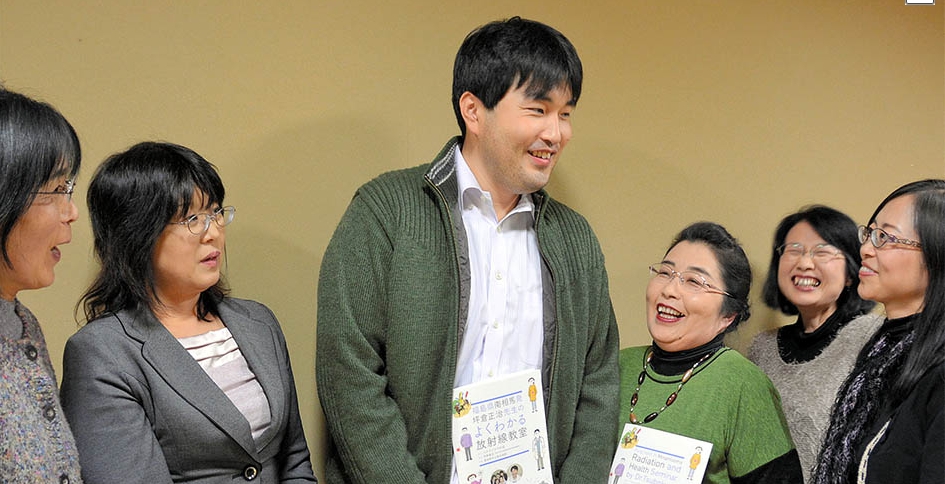
Masaharu Tsubokura, center, and the members of the Veteran Mothers’ Society in Minami-Soma, Fukushima Prefecture
December 29, 2014
MINAMI-SOMA, Fukushima Prefecture–Mothers living near the stricken Fukushima No. 1 nuclear plant have compiled a booklet offering basic knowledge about radiation and explanations addressing safety concerns arising from the disaster.
The booklet, titled “Yoku Wakaru Hoshasen Kyoshitsu” (Radiation and Health Seminar), is available in both Japanese and English and was created by the Veteran Mothers’ Society, which consists of five mothers from the city of Minami-Soma.
The members, some of whom are former high school classmates, decided to create the booklet “for children’s sake.”
The information incorporates lessons learned from doctors at seminars the group organized following the accident at Tokyo Electric Power Co.’s Fukushima No. 1 nuclear plant in March 2011.
Amid the confusion and fears over radiation after the disaster unfolded, the mothers convened their first seminar for children and guardians in December 2011. They invited Masaharu Tsubokura, a doctor of hematology from the University of Tokyo’s Institute of Medical Science who had been providing consultations at the Minami-Soma municipal general hospital.
Other physicians later joined the effort to spread accurate information about radiation, and the mothers have held the sessions once or twice a month.
In the seminars, the children peppered Tsubokura with questions, such as “Can I touch my pets?” and “Is it OK to lick the snow?”
Ikumi Watanabe, the society’s 54-year-old vice chairwoman, recalled that Tsubokura’s explanations “were spoken in an easy-to-understand manner so the information popped straight into our heads. It was nice that we could talk with him on the same level and in person.”
Even now, the nature of the questions has not changed much.
“People have felt pressured not to talk about radiation, and some mothers have finally gotten the information only now, more than three years after the accident,” Tsubokura said. “I hope I can help them make decisions without thinking negatively about themselves or losing their self-confidence.”
In addition to basic knowledge, such as the differences between external and internal radiation exposure and between becquerels and sieverts, the booklet answers questions like: “Can radiation be transmitted from one person to another?” and “Is the tap water OK?”
According to the Veteran Mothers’ Society, 20,000 copies of the Japanese version were distributed to schools, companies and other organizations. The English version has been ordered by international schools, international exchange organizations and other groups.