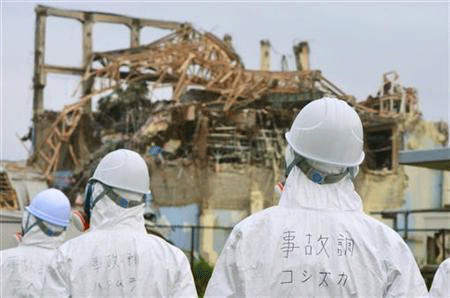
A group of 344 former residents of Minamisoma in Fukushima Prefecture are suing Tokyo Electric Power Co (TEPCO) for more than 6 billion yen in compensation for being forced to leave their homes due to the nuclear crisis at the Fukushima Daiichi power plant.
The group’s lawyers filed the suit with the Tokyo District Court on Friday, NTV reported.
According to the suit, the plaintiffs are seeking damages for mental suffering experienced while living in less than adequate temporary housing after being forced from their homes in the Odaka area of the city in the wake of the nuclear disaster in March 2011.
Along with an individual payment of 10 million yen, the plaintiffs are also demanding monthly compensation of 200,000 yen for the next three years until the evacuation order is lifted for their hometown.
Although some areas in Minamisoma are now open for re-entry, none of the citizens has returned to their homes.
The Japan Atomic Energy Agency says 75 percent of the radioactive substances released from the Fukushima Daiichi Nuclear Power Plant came more than 4 days after the accident.
The government’s investigation has not released what happened during this period. Experts say the reason needs to be determined as to why massive amounts of radioactive materials continued to be released for a prolonged period.
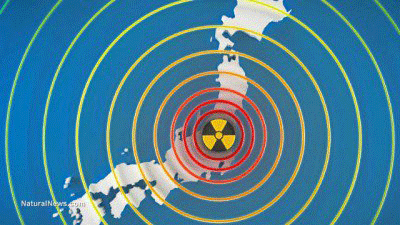
The nuclear accident in Fukushima has been evaluated as the worst, at level 7, on a par with the Chernobyl accident in 1986, due to the large amount of radioactive substances that were released. But the details on how the substances were released remain unknown.
A research group at the Japan Atomic Energy Agency collected new data on radiation detected near the plant over time to analyze how radioactive materials were released into the air.
The research has found that an estimated 470,000 terabecquerels of radioactive substances had been released by the end of March 2011, when the discharge is believed to have mostly subsided.
The research group says 25 percent of the radioactive materials were released during the first 4 days of the accident, as the meltdown and hydrogen explosions were happening, while 75 percent were released over the 2-week period that followed.
The group also analyzed how the radioactive materials spread, using the climate data at the time. They found that contamination in places where former residents are still not allowed to return became serious on March 15th — 4 days after the accident.
They also say radioactive substances released between March 20th and 21st spread to a wider area, including the Kanto region, and are believed to have contaminated drinking water supplies.
The outcome of the analyses indicates that radioactive materials continued to be released after the first 4 days, which is believed to be the critical time during which the situation was deteriorating out of control.
The government’s investigation has focused on the first 4 days, and has not determined the cause of the massive release of radioactive substances following that period.
Masamichi Chino of the research group says the cause needs to be determined to prevent future accidents and to bring the situation under control quickly if another accident happens.
More than 120,000 people are still forced to live in temporary shelters.
Six municipalities remain off limits due to high levels of contamination.
Fukushima Exponentially More Dire than Chernobyl — Deteriorating Plant Threatens Global Radiation? By Guy CrittendenGlobal Research, December 18, 2014 ENEnews 12 December 2014
“…………Instead of a long article about what transpired in 2014 and what may be ahead, I’m going to offer readers three items… that have made a deep impression on me recently; these are “must watch” items for anyone interested in helping our species avoid peril from environmental degradation
The deteriorating status of things at the destroyed nuclear plant at Fukushima, Japan…you have an obligation, really, to be aware of conditions there
[There is a] very real and present threat from the… highly radioactive… destroyed cores of the reactors, as well as things like the storage of contaminated water in hastily-built, rusting containers
This is serious stuff… an actual meltdown of the reactors — real China Syndrome stuff — as had been assumed would never likely happen in a modern reactor
The situation is exponentially more dire than Chernobyl
[Workers must] remove the rods for safe containment without having them contact one another and trigger a fire, the consequences of which would be unimaginable — We’re talking mass extinction around the world, especially in the northern hemisphere
Most people have forgotten the situation and think of it only as a local Japanese problem
It’s only a matter of time before another earthquake or tidal wave triggers such an event
6 tons of contaminated water leak at Japan’s Fukushima nuclear plant Fox News 19 Dec 14As many as six tons of radioactive water has leaked into the ground at Japan’s Fukushima nuclear power plant, the Tokyo Electric Power Company said this week.
Crews were transporting the water to storage tanks when it leaked from pipes at the plant’s reactor building number one Wednesday.
The water had been scrubbed in an advanced liquid processing system, theJapan Times reported, citing TEPCo. It seeped into the ground, officials said, and did not flow into the sea because there was no nearby drainage ditch……….
Wednesday’s leak occurred on the same day a team of experts from South Korea spent three hours at the plant, looking into the safety of Japanese fishery products. The group was informed of measures to keep the nuclear crisis under control, but apparently were not made aware of the leak, the Times reported.
The team inquired about the types of radioactive materials in the water and the results of radiation checks on local seawater, according to Japan’s Fisheries Agency.
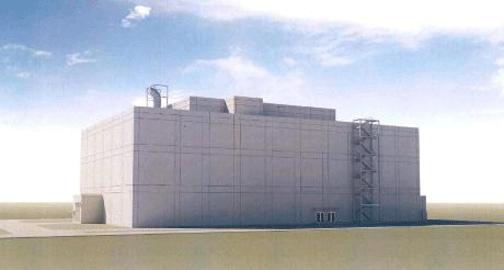
A facility to incinerate radioactive debris and other waste is ready to open in a village near the crippled Fukushima Daiichi nuclear power plant.
The Environment Ministry had been building the temporary incineration facility in the village of Kawauchi since May.
Officials and village delegates marked the completion of the work in a ceremony on Wednesday.
The facility is designed to burn 7 tons of waste per day while removing radioactive cesium.
Ministry officials plan to put the facility into full operation in early January following test runs.
The government lifted an evacuation order for part of Kawauchi last month. But about 1,700 tons of debris and other waste stored in the village remain to be disposed of.
Village Mayor Yuko Endo said some residents are worried about radiation and an unsafe living environment. He said he hopes the incineration facility will help ease their concern.
The Environment Ministry says Kawauchi is the first municipality in Futaba County to have an incineration facility. It says it plans to build similar facilities in other municipalities in the county where Fukushima Daiichi is located.
Japan set for nuclear showdown http://www.power-eng.com/articles/2012/12/japan-set-for-nuclear-showdown.html12/27/2012 Days after Japan’s pro-nuclear Liberal Democratic Party was swept back to power in a landslide, millions of the country’s citizens have signed an online petition demanding the government phase out nuclear power generation. The petition has received 8 million signatures, while hundreds have taken to the streets to demonstrate against nuclear power, the AFP reports. Meanwhile, on Dec. 27, the LDP set to work dismantling the previous government’s plan to rid the country of nuclear power by 2040. The LDP’s victory on December 16 brought the party back to power after a rare three-year hiatus in its status as the majority party.
Toshiba in talks to sell portion of Westinghouse nuclear unit http://www.power-eng.com/articles/2012/12/toshiba-in-talks-to-sell-westinghouse-nuclear-unit.html 12/27/2012Toshiba Corp. (NASDAQ: TOSBF) is currently in talks with three unnamed parties as it seeks to sell up to 16 percent of its stake in the Westinghouse Electric Co. nuclear power unit, the Wall Street Journal reports. The conglomerate is mulling three “very good offers,” Toshiba President Norio Sasaki said, and remains optimistic about its nuclear reactor business despite uncertainty about the future of nuclear power in Japan in the wake of Fukushima. Toshiba paid about $4.2 billion for 77 percent of Westinghouse six years ago and has since sold 10 percent of the company to Kazakhstan’s state-owned NAC Kazatomprom JSC. Toshiba will retain at least 51 percent ownership of the company, said Mr. Sasaki.
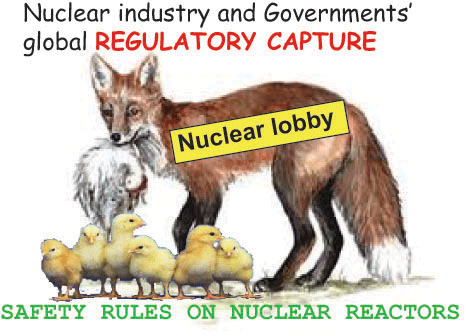
Japan nuclear regulator ignores its duty to protect the people Greenpeace, Justin McKeating – 17 December, 2014 With today’s draft decision to approve the safety measures of two currently closed nuclear reactors, Japan’s Nuclear Regulation Authority (NRA) is ignoring public concerns and the major nuclear risks in the Kansai region. The decision to give backing to two reactors at the Takahama nuclear power plant puts millions of people at risk. Any severe accident at Takahama would be devastating for Kansai’s people and economy – there are no effective emergency plans existing that could protect the people in the region from radiation exposure.
But Kansai Electric Power Co (KEPCO) is keen to restart its reactors and the regulator is doing all it can to help them.
The thing is, KEPCO’s reactors have been offline for years which shows that they are completely unnecessary for Japan’s energy future.
The thirty-year-old Takahama 3 and 4 reactors in Fukui prefecture have been shut down for 34 and 41 months respectively. Seven of KEPCO’s eleven reactors are nearly or over 40 years old with decisions on the horizon on whether they should be closed permanently.
This decision doesn’t mean the Takahama reactors will be restarting immediately, however. The NRA’s draft decision is merely the start of a multi-step process that will reach far into 2015…….
There is both public and political resistance against the restart of the two Takahama reactors. It comes from within the Kansai region as well as the three prefectures neighbouring Fukui.
The governor of Shiga wants the right to have a say over any restart decision. The governor of Kyoto disapproves of a restart. However, a decision on a local level is likely to be delayed as the Abe government is facing regional elections in April 2015, including for the governorship of Fukui.
50 non-governmental organizations in Japan released a declaration to protest the “Convention on Supplementary Compensation for Nuclear Damage” (CSC) which protects nuclear power technology vendors from responsibility for reparations and does not protect the victims of nuclear power accidents.
Declaration
To protest The Japanese Diet’s over-hasty approval of the “Convention on Supplementary Compensation for Nuclear Damage” (CSC) , which heavily protects the nuclear power industry and encourages nuclear exports
On November 19, the “Convention on Supplementary Compensation for Nuclear Damage” (CSC) was ratified by the House of Councilors. We strongly object to today’s vote to approve this treaty, without any discussion of its numerous problems, which was rushed through to accommodate the Abe administration’s schedule for dissolving the Lower House of the Diet.
The treaty promotes the export of nuclear power technology while ignoring the lessons of the Fukushima accident.
Specifically, we raise the following issues:
1) The exemption of nuclear power technology vendors from liability/responsibility for reparations. This will result in increased exports of nuclear power technology.
2) The use of international funds for nuclear accident damage compensation above a fixed amount. This will serve to benefit any nuclear technology vendor who causes an accident.
3) As a result of items 1 and 2, parties involved in the nuclear energy business only profit, without taking any risk – leading to moral hazard and the acceleration of nuclear exports. Continue reading →
Shinzo Abe reelection increases chance of Japan relying more on nuclear power and less on LNG Straght.com by CHARLIE SMITH on DEC 14, 2014 “……….The election results have strengthened Abe’s hand as he pushes to restart more nuclear reactors in the wake of the 2011 earthquake and tsunami that crippled a power plant in Fukushima, spewing radiation across the Pacific Ocean.
The governor of Kagoshima prefecture has already approved firing up two reactors at the Sendai nuclear plant next year, rejecting calls from protesters to keep the facility closed…………….
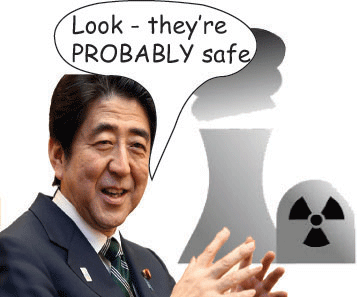
In 2013, Abe told International Olympic Committee delegates that problems at the Fukushima plant were under control.
This was despite the calculations by Georgia Straight contributor Alex Roslin that about 800 people worldwide would develop cancer from Japanese fish eaten at the time of his article in October 2013.
Meanwhile, Japan News recently reported that a South Korean team will visit the Fukushima power plant and conduct tests on Japanese fish products.
South Korea has maintained a ban on importing fish from eight prefectures, including Fukushima.
The South Korean investigation will occur just as Japan’s nuclear watchdog is calling for the release of contaminated water from the Fukushima plant.
According to an article in the Asahi Shimbun newspaper, Nuclear Regulation Authority chairman Shunichi Tanaka said officials will need to gain the consent of local residents.
NRA head signals massive release of tainted water to help decommission Fukushima site
The head of Japan’s nuclear watchdog said contaminated water stored at the crippled Fukushima No. 1 nuclear power plant should be released into the ocean to ensure safe decommissioning of the reactors. Shunichi Tanaka, the chairman of the Nuclear Regulation Authority, made the comment Dec. 12 after visiting the facility to observe progress in dismantling the six reactors. The site was severely damaged in the tsunami generated by the 2011 earthquake.
“I was overwhelmed by the sheer number of tanks (holding water tainted with radioactive substances),” Tanaka told reporters, indicating they pose a danger to decommissioning work. “We have to dispose of the water.”
With regard to expected protests by local fishermen over the discharge, Tanaka said, “We also have to obtain the consent of local residents in carrying out the work, so we can somehow mitigate (the increase in tainted water).”
NRA Chairman Shunichi Tanaka, foreground, inspects storage tanks holding water contaminated with radioactive substances at the Fukushima No. 1 nuclear power plant.
December 13, 2014
The head of Japan’s nuclear watchdog said contaminated water stored at the crippled Fukushima No. 1 nuclear power plant should be released into the ocean to ensure safe decommissioning of the reactors.
Shunichi Tanaka, the chairman of the Nuclear Regulation Authority, made the comment Dec. 12 after visiting the facility to observe progress in dismantling the six reactors. The site was severely damaged in the tsunami generated by the 2011 earthquake.
“I was overwhelmed by the sheer number of tanks (holding water tainted with radioactive substances),” Tanaka told reporters, indicating they pose a danger to decommissioning work. “We have to dispose of the water.”
With regard to expected protests by local fishermen over the discharge, Tanaka said, “We also have to obtain the consent of local residents in carrying out the work, so we can somehow mitigate (the increase in tainted water).”
Tanaka has said previously that to proceed with decommissioning, tainted water stored on the site would need to be released into the sea so long as it had been decontaminated to accepted safety standards.
“While (the idea) may upset people, we must do our utmost to satisfy residents of Fukushima,” Tanaka said, adding that the NRA would provide information to local residents based on continuing studies of radioactive elements in local waters.
The inspection tour was Tanaka’s second since he became NRA chief in September 2012. He last visited in April 2013.
During his visit, Tanaka observed work at a trench on the ocean side of the No. 2 reactor building, where highly contaminated water is being pumped out. He also inspected barriers set up around the storage tanks to prevent leaks of tainted water.
Tanaka praised the completion in November of work to remove all spent nuclear fuel from the No. 4 reactor building, as well as changes to work procedures that he said allows for the completion of the work at the No. 2 reactor trench.
The fraternity of nuclear scientists… create the impression… their extremely risky projects have been carefully thought out in every detail and are inspired by the spirit of greatest responsibility… A large section of the scientific community…believes [their accident simulations are] about as reliable as tomorrow’s weather forecast [and] that by building nuclear power plants in populated areas, the whole world becomes an experimental laboratory with human beings as guinea pigs.
There is always the possibility of a major disaster. The basic difference between nuclear and other industrial accidents lies in the long-range repercussions… one could forget about the havoc wrought, for example, by the explosion of a gas pipeline or the breaching of a dam… But an accident in a nuclear power plant, such as a reactor getting out of control, is capable of doing more than immediate harm. Examples of the deadly long-term effects of a reactor accident are Chernobyl and Fukushima [which] will linger on for ages to haunt the future generations. Among the survivors there will be many cases of permanent sterility, increase of genetic mutation in our progenies, and a shortened life span as a result of cancer and other radiogenic diseases.
[It’s] irresponsible and misleading to suppress the consequences of radiation…[A]ttempts are made… to blind the people by equating nuclear accidents with more familiar hazards… an unlimited risk is falsely portrayed as a limited one and glossed over in a manner that is not only unconscionable, but also unpardonable. Thesedeceptions are further camouflaged by the way in which they are presented to the public… the far-reaching consequences of lethal radiation are overly simplified. In the post-Chernobyl and post-Fukushima era, these… do not hold water.
Wars, plagues, famines and natural disasters were known as the four horsemen of the apocalypse… After Chernobyl and Fukushima, nuclear accidents can be added [as another] horseman of the apocalypse.
Critics describe nuclear reactor as one of the most dangerous technological beasts that mankind has devised and nuclear accident as “A Nuclear War without a War.”
The consequences can assume dimensions that do not take second place to the consequences of earthquake… and in a way actually exceeds them.
R/V Marai — Japan Agency for Marine-Earth Science and Technology (JAMSTEC, administered by gov’t of Japan): The great earthquake [and] tsunami with its height of more than 10 m attacked mainly the Pacific coastline of Tohoku district and approximately thirty thousand people were killed, missing or injured. What is worse is that Fukushima No.1 nuclear power plant was seriously damaged… a gigantic radiation has been leaking to the atmosphere, land and ocean. After this record crisis, the Ministry of Education, Culture, Sports, Science and Technology (MEXT) requested JAMSTEC… monitor [the] level of radiation.
Japanese Nation Forgetting Fukushima Plant Cleanup Workershttp://sputniknews.com/asia/20141210/1015704138.htmlAs snap elections are nearing, the Fukushima Nuclear power plant workers are urging people to understand the harsh circumstances they work under, risking their life by exposing themselves to radiation every single day. MOSCOW, December 10 (Sputnik) – As elections are nearing in Japan, many of the people working toward the decommissioning of the crippled Fukushima No. 1 nuclear plant say they want voters to know about their harsh working conditions, insufficient pay and worries of radiation exposure, reports The Japan Times.
There are around 6,000 people a day working in the decommissioning process at the plant and it is expected to take 30 to 40 years to complete.
“I’m single, so I can somehow manage with the pay if I don’t go out to amuse myself, but I don’t think you can make a living if you have a family,” said a man in his fifties who has worked in the plant for three years. He has been eradicating debris and setting up tanks to store radioactive water, and is now in charge of removing contaminated water from the reactor building basements. He works for a third-tier subcontractor and makes a monthly salary of less than ¥200,000 ($1650 USD).
As The Japan Times reports, due to high radiation exposure, workers must wear heavy protective clothing and a mask that covers the whole face. It is difficult for them to work more than an hour and a half at a time. The workers start at around 5 a.m. because of the time it takes to get to the plant which is about 40 kilometers away, pass entrance checks and change clothing.
According to one worker his most recent monthly radiation dosage was 1.8 millisieverts. The law states that a nuclear worker’s radiation dosage should not exceed 100 millisieverts in five years and 50 millisieverts in a year. Since the reference mark in the plant is 20 millisieverts a year, the man’s dosage is nearing its limit.
“I feel that people are gradually forgetting about the nuclear accident,” he said. “From now, our work will become even harsher because we will have to go inside the reactor buildings, where the radiation level is even higher. I want people to recognize that there are such workplaces,” he told The Japan Times.
Why hasn’t the Japanese government, like the American sailors, filed its own lawsuits against these same companies to determine their legal liability? In other words, why are the Japanese people being forced to pay for the possibly negligent actions of some of the world’s largest corporations?
Dear Minister of Economy, Trade and Industry Yoichi Miyazawa,
As you may be aware, a federal judge in the U.S. recently ruled that a class-action lawsuit filed by about 200 U.S. Navy sailors can proceed against Tokyo Electric Power Co. and other defendants they blame for a variety of ailments caused by radiation exposure following the nuclear reactor meltdowns at Fukushima No. 1.
The sailors allege that Tepco knowingly and negligently gave false and misleading information concerning the true condition of the Fukushima No. 1 nuclear power plant to the public, including the U.S. military. They further allege that Tepco knew the sailors on board the USS Ronald Reagan would be exposed to unsafe levels of radiation because Tepco was aware three nuclear reactors at the site had already melted down.
In this connection, the lawsuit notes that on Dec. 14, 2013, Naoto Kan, Japan’s prime minister at the time of the disaster, told a gathering of journalists regarding the first meltdown: “People think it was March 12 but the first meltdown occurred five hours after the earthquake.”The sailors in question were participating in Operation Tomodachi, providing humanitarian relief in response to the Japanese government’s calls for assistance. In accordance with the U.S.-Japan Security Treaty, these sailors literally risked their lives to aid and protect the people of Japan.
The sailors accuse Tepco of negligence, failure to warn of the dangers, and design defects in the construction and installation of the reactors, among a total of nine claims for damages. To date, the sailors have experienced such illnesses as leukemia, ulcers, brain cancer, brain tumors, testicular cancer, dysfunctional uterine bleeding, thyroid illnesses, stomach ailments and a host of other complaints unusual in such young adults.
One of the major questions to be decided by the lawsuit is who will pay for the military members’ ongoing and possibly lifelong medical treatment. Continue reading →