South Korea agrees to talks over food import ban
Japan’s fisheries minister has expressed hope that South Korea will lift its ban on fishery imports from areas affected by the 2011 nuclear accident at the Fukushima Daiichi power plant.
South Korea has banned all imports of fishery products from 8 Japanese prefectures, including Fukushima, since September 2013.
On Tuesday, Agriculture, Forestry and Fisheries Minister Yoshimasa Hayashi told reporters that South Korea informed Japan last Friday that it will agree to bilateral talks in Geneva, Switzerland, based on a World Trade Organization agreement. Japan requested the meeting last month.
Hayashi said under the WTO rules, negotiations should start within 30 days of a request.
He added that the government will step up efforts to get South Korea to lift the ban, even as a date for the talks is being arranged.
Source: NHK
http://www3.nhk.or.jp/nhkworld/english/news/20150602_20.html
“WE NEED HELP FROM THE WORLD COMMUNITY” Akiko Morimatsu’s speech at the UN Disaster Prevention Convention in Sendai City, Japan, March 15, 2015
 Akiko Morimatsu with her children
“WE NEED HELP FROM THE WORLD COMMUNITY”
Akiko Morimatsu’s speech at the UN Disaster Prevention Convention in Sendai City, Japan, March 15, 2015
translated by Yoko Chase, Ph.D.
Ladies and gentlemen, I would like to express my personal gratitude for the worldwide support given to us on this occasion.
1. East Japan suffered catastrophic damage by the Great East Japan Earthquake and the consequent accident at the Fukushima Daiichi Nuclear Power Plant owned by Tokyo Electric Company on March 11, 2011. Immediately after the disasters occurred, people all over the world sent kind messages as well as necessary commodities for survival, thus helping us both mentally and materially. I thank you all sincerely for the kindness.
2. However, the Japanese government has never been able to put the nuclear power plants under control since the 3 11 accident. The plants have contaminated the ocean, the air, and lands which are, without boundaries, connected throughout the world. The TEPCO’s Fukushima Daiichi nuclear power plant accident has never been put under control and I personally think we must apologize for this fact to the people of the world. The contaminated water has kept leaking and polluting the ocean for four years and no Japanese citizens think Fukushima is under control. It is a shame that we have not apologized to the world for the fact. I, therefore, would like to apologize personally now to all the people in the world on this occasion. I am very sorry that Japan has kept contaminating the beautiful earth.
3. Now in Japan, many people have evacuated the contaminated areas to avoid radiation exposure. The number of registered evacuees in June 2012 reached 347,000 according to the government’s Reconstruction Agency. Moreover, many people have stayed in the contaminated areas due to the lack of the government’s financial support. Most evacuees are families with little children who are vulnerable to radiation. My own case is one of them.
Our two children were a three-year-old infant and a five-month-old baby at the time of the disaster. Since the nuclear accident, my husband who is the father of the children, has stayed in Fukushima but our children and I fled to Osaka. We are dislocated and forced to live in 2 separate locations. Such dislocation to protect children is called, boshi hinan, or “mother and child(ren) evacuees” and there are still many of us.
4. We need to protect ourselves from the radiation contamination which has leaked from TEPCO’s Fukushima Daiichi Nuclear Power Plant. Evacuation is a natural human act to flee from radiation and to enjoy healthy living. I regard the nuclear evacuees like ourselves as people of “Internal Displacement” referred to in the Guiding Principle on Internal Displacement in the 1998 UN Human Right Commission Report.
The second article of the above principle states: “Certain internally displaced persons, such as children, especially unaccompanied minors, expectant mothers, mothers with young children, female heads of household, persons with disabilities and elderly persons, shall be entitled to protection and assistance required by their condition and to treatment which takes into account their special needs.” The Japanese government, however, has not put this principle into action its policies for the internally displaced people due to the nuclear accidents. The Japanese government has not learned lessons of the social protection of victims from Chernobyl nuclear accident.
5 Moreover, the Japanese government has objected and rejected the UN Special Rapporteur Anand Grover’s advice given in 2013.
6. In other words, rights pertaining to human life and health have been continuously violated by the Japanese government since 3.11. Human beings have had the historical experience of the nuclear accident in Chernobyl in the former Soviet Union and have had many witnesses from Chernobyl mothers. The Japanese government, however, has not learned the lessons from “the social protection of victims” in the Chernobyl nuclear accident. By the government ignoring the lessons, many people in Fukushima and other contaminated areas in Japan are still forced to have unnecessary radiation exposure today.
7. I would like to protect life, health, and the future of the children living in Japan. Without evacuating from nuclear contaminated areas or ensured regular recuperation opportunities, we cannot follow the 24th article of the Convention of the Rights of the Child, which Japan has ratified, “the right to enjoy the highest level of health reachable.” We need help from the world community.
8. The Preamble of the Japanese Constitution declares “the right to live free form fear and deprivation and to live in peace” (right to peaceful life).
9 The right to live free from the fear of radiation exposure and to live in peace should be given equally to all people. We cannot make any more “hibakushas” if we have learned the lessons from Hiroshima, Nagasaki and Fukushima.
10. To be free from radiation exposure and to enjoy health is a basic human reaction to protect life. It is a human right directly concerning to human life and health. It is the most important and universal human right. Can you think of anything else which is more precious than human life?
11. We need help from the world community to help all the victims and evacuees of nuclear accident disasters. Please take action and tell the Japanese government to act in compliance with international laws, and respect the guiding principles and recommendations of the United Nations.
Please help us protect the people, especially the children, in Fukushima and East Japan from radiation exposure.
Thank you very much.
Akiko Morimatsu
Thanks & Dream, The Great East Japan Earthquake Disaster Evacuees Association http://sandori2014.blog.fc2.com/
Email: sandori2014@gmail.com
東日本大震災避難者の会 Thanks & Dream (サンドリと呼ばれてます)
避難者が避難者のために主体的に活動し、 お支え下さる方々へ感謝することを忘れず、 避難者の「今」を真摯にお伝えすることによって 社会貢献につながる活動を自発的に行う 避難当事者団体です。 参加メンバー随時募集中(^^) sandori2014@gmail.com
sandori2014.blog.fc2.com
A Letter to Prime Minister Shinzo Abe and Fukushima Governor Masao Uchibori from Akiko Morimatsu, a Fukushima Evacuated Mother
 A Letter to Prime Minister Shinzo Abe and Fukushima Governor Masao Uchibori from Akiko Morimatsu, a mother who voluntarily evacuated from Fukushima so she could raise her two small children in an area free from radioactive contamination.
(Translated by Yoko Chase, Ph.D.)
To: Prime Minister Shinzo Abe Fukushima Governor Masao Uchibori
Dear sirs,
My name is Akiko Morimatsu. I have been living a life of “boshi hinan,” or “mother-child evacuation” with my two children in Osaka ever since we evacuated Fukushima four years ago.
I believe that the right to enjoy a healthy life in a radiation-free area is one of the most important human rights concerning human life and health. The right should be respected equally among all people.
It is only natural for human beings to wish to avoid radiation exposure as much as possible. This wish should be granted equally to all people.
It is also natural for parental psychology to want their children with future to grow up with as little health risk as possible. All parents want their children’s healthy growth. There should be absolutely no shadow of radiation fear nor heath risks.
Would it be reasonable if only some lucky people could flee from radioactive areas because they happened to have relatives or supporters in other areas? Would it be appropriate for a civilized society if only wealthy or lucky people could leave the radiation-contaminated areas?
It seems you announce one appalling new policy after another. Take, for example, the new policy of cutting housing support for Fukushima evacuees, while giving generous support exclusively to Fukushima returnees. Were you aware of the extreme suffering of those parents whose only choice was now to unwillingly return to the contaminated areas even though they strongly hope to stay away for the sake of their little children? Would you call this a truly fair policy? Would you be able to call this right?
I wonder, to begin with, if both the central government and Fukushima government have made policies for the last four years with the proper understanding that many households simply have not been able to evacuate the contaminated areas even when they wanted because there were no appropriate, supportive public policies for them to choose evacuation to continue their life in a safe environment.
If you have not been aware of such people’s struggles, I must question your ability as political leaders to hear the silent voices of the common people living their common lives. I don’t mean to sound impudent, but I cannot help wondering if this failure is as grave as the incompetence of our past political leadership.
Please reflect upon the fact that the “Nuclear Accident Child Victim Support Law” was made in 2014 but has been shopworn. The law has not been activated nor have the victimized children been helped by it at all. What do you think of this fact?
I have never thought harshly of those people who have been obliged to remain in Fukushima or those who have chosen to live with radiation contamination. I deeply care about them and feel strongly empathic with them for their difficult situation as parents raising young children.
However, we evacuees are also the same Fukushima people. Even though we have evacuated to far away places with children, we sincerely wish to be able to return to Fukushima if only Fukushima returns to the uncontaminated state as before 3.11 without any health risks or anxieties of losing health. If only Fukushima could get rid of all the radiation contamination as before 3.11, we would be very happy to return with all of our family members. We have wished this for four years now.
I sent a letter to the former Fukushima Governor, Yuhei Sato and also a copy of my book entitled Evacuating Fukushima with my Children: Mental Locus to Reach the Family Decision to File a Law Suit to plead evacuee support. I, however, wonder if he heard the silent voices of Fukushima evacuees. I also would like to plead to the current Fukushima Governor Masao Uchibori also not to abandon those who chose to evacuate Fukushima; they are Fukushima people after all. Please, respect the basic human rights of the people regarding to their life and health protection. Also, please give generous support and keep practicing concrete, compassionate support policies for evacuees.
I am afraid, more than anything else, of the possible easing the way for infringing numerous human rights in the future if the governmental responses so far after the nuclear accident have become established as common devious methods to do away with problems.
Can there be anything more precious than human life and good health? Japanese people and Fukushima people as well, have, all equally, the right to protect their own lives and enjoy good health.
I implore you, hereby, to give the minimum legally guaranteed protection to the people who have chosen to take the fundamentally human action to protect precious lives and health.
Unfortunately, we have had nuclear accidents. I would like to, therefore, take action which we can hand on for posterity with pride in the future as citizens working together with the Fukushima Prefecture government. The same position and hope can be referred to our national government, as well.
Therefore, please listen not only to those partial groups of people interested merely in economic gain, but also to this sincere mother, a hard-working life supporter, a loving prefectural citizen, and a true Japanese citizen.
Thank you for reading my humble letter written as a Fukushima citizen, wishing the recovery of Fukushima and as a Japanese citizen also wishing for the true reconstruction of the entire East Japan from the earthquake and tsunami disasters.
May 26, 2015
Akiko Morimatsu Author of: ‘Evacuating Fukushima with my Children: Mental Locus to Reach the Family Decision to File a Law Suit’
(translated into English by Yoko Chase, Ph.D.)
Source: http://www.kamogawa.co.jp/kensaku/syoseki/ha/0676.html
Greenpeace releases confidential IAEA Fukushima-Daiichi accident report
The International Atomic Energy Agency report fails to accurately reflect the scale and consequences of the Fukushima disaster.

The International Atomic Energy Agency’s Board of Governors meets on June the 8th to discuss its confidential Fukushima-Daiichi Accident Summary Report. The report describes itself as ‘an assessment of the causes and consequences of the accident at the Fukushima Daiichi nuclear power plant in Japan that began on 11 March 2011.’
Greenpeace has received a copy of the report and we made it public last week. We’ve also conducted an initial analysis of the report and our findings are not good.
Yukiya Amano, the IAEA Director General says the report is ‘an authoritative, factual and balanced assessment, addressing the causes and consequences of the accident, as well as lessons learned.’
Yet our experts find it to be full of inaccuracies, uncertainties, and that it fails to address several highly important issues. We’ve sent our findings to Mr Amano.
Here are some examples.
- The IAEA admits that radiation monitoring was not working properly in the days immediately after the Fukushima disaster began.
- Despite this uncertainty, the report downplays the health risks to the disaster’s many victims.
- This means that the estimates of the levels of radiation the people of Fukushima were exposed to cannot be trusted.
- The IAEA’s analysis of the new safety regulations in Japan are superficial at best, and they offer no evidence in the report that the Japanese nuclear industry is operating to the global highest standards of nuclear safety.
- The reality is that there are major flaws in nuclear regulation in Japan with seismic and other threats to nuclear plants safety ignored or underestimated.
- The report dismisses the environmental impact of the disaster on animal life despite scientific investigations finding measurable effects on the region’s fauna.
- The report fails to acknowledge the uncertainties that still surround the causes of the disaster. Much of the critical systems inside the reactors that melted down have not yet been inspected.
These are just some of our initial findings. There are more to come.
(You can read our full analysis of the report here. The five part IAEA report is here: part one, part two, part three, part four, part five.)
So we see, as we saw in the aftermath of the Chernobyl nuclear disaster, the IAEA trying to create a narrative that minimizes the health and environmental impacts of Fukushima, while emphasising that lessons are being learned, including in making nuclear safety regulation more effective.
In short, the IAEA is moving to protect the nuclear industry instead of the people whose lives have been destroyed by the Fukushima disaster and those who may be affected by future nuclear accidents.
This is not a surprise, a central role of the IAEA is to promote the global expansion of nuclear power. The fact that all commercial nuclear reactors in Japan – 43 in total – remain shutdown is a direct challenge to the IAEA’s mission. That is the context in which the IAEA report must be seen.
After four years, the disaster in Fukushima is still unfolding and will take many decades to address. If the work to clean up the massive damage done is to be carried out effectively and future accidents avoided as much as possible, the IAEA must demonstrate that it can change the way it operates and quickly.
The IAEA at present serves only the interests of the nuclear industry and its drive for profit at the expense of the people who have pay the ultimate price for nuclear power’s failures.
Greenpeace is calling on Mr Amano and the IAEA to suspend their consideration of the report’s findings. An open and transparent process must be established that considers the views of the people of Japan, as well as independent scientists. We stand ready to meet with representatives of the IAEA to discuss our serious concerns.
Source: Greenpeace
Fukushima Daiichi ‘s Port has Record Levels of Radiation

 Record levels of radioactivity in plant’s port http://www3.nhk.or.jp/nhkworld/english/news/nuclear.html May 30, 2015 The operator of the damaged Fukushima Daiichi nuclear plant says it has found record-high levels of radioactive water in the facility’s port. It says the high levels are due to a leak of wastewater. Tokyo Electric Power Company officials said on Friday that contaminated water leaked from a crack in a hose connecting a wastewater tank to a building at the plant.
They later detected about 22,000 becquerels of beta ray-emitting substances per liter of water in a nearby drainage ditch. The ditch is in the upper part of a drainage channel. The utility also found the density of radioactive materials in the channel was around 6,600 becquerels per liter. That’s more than 200 times higher than the figure recorded on Wednesday.
TEPCO officials took samples of seawater from 4 locations in the port, where the leaked water reached via the drainage channel. They detected between 190 and 320 becquerels of radioactive substances per liter. The figure is the highest ever recorded in the port.
Utility officials say the leak stopped after they halted the flow of water, and that it has not affected waters in the Pacific Ocean outside the port. TEPCO workers are trying to collect water from the drainage channel to prevent it from reaching the ocean.
A nation-wide network formed in Japan, to sue government and TEPCO, over the Fukushima nuclear disaster
 Plaintiffs suing over Fukushima nuclear disaster form nationwide network,Asahi Shimbun, May 26, 2015 By MASAKAZU HONDA/ Staff Writer NIHONMATSU, Fukushima Prefecture–Ten groups of plaintiffs in lawsuits and other legal actions over the Fukushima nuclear disaster have joined forces to demand compensation and accountability from the government and Tokyo Electric Power Co.
The groups held a liaison conference, called Hidanren (coalition of nuclear accident victims), to mark its establishment in Nihonmatsu, Fukushima Prefecture, on May 24. The network comprises 20,000 people.
Ruiko Muto, who heads a group pursuing criminal responsibility of TEPCO and government officials, expressed frustration over the developments since the nation’s worst nuclear accident unfolded in March 2011 at TEPCO’s Fukushima No. 1 nuclear power plant.
She called on the groups to work together to press their demands.
“So far, no one has been charged with criminal responsibility,” Muto said. “Few (of the affected) are receiving compensation that they agree with, and few have a clear vision of how to rebuild their lives.”
She also said evacuees are under growing pressure to return to their homes soon amid a government campaign to label their hometowns as safe. The goals set by the conference include: having authorities and TEPCO offer an apology and full compensation to the victims; restore the victims’ livelihoods and lifestyles; provide medical service coverage; and introduce measures to reduce radiation exposure among residents………http://ajw.asahi.com/article/0311disaster/fukushima/AJ201505260003
Voluntary evacuees from Fukushima may lose free housing in 2017
Fukushima may end free housing for voluntary nuclear evacuees in 2017, Japan Times, 27 May 15 JIJI FUKUSHIMA – The Fukushima Prefectural Government may stop providing free accommodations at the end of March 2017 for people who voluntarily left areas in the prefecture not subject to nuclear evacuation advisories, sources said.
Officials hope to encourage people who evacuated on their own to return home, but the proposed end to the assistance will certainty draw objections from them……..
Many voluntary evacuees are people with children as well as former residents of such areas as the town of Hirono, the village of Kawauchi and the city of Minamisoma, all geographically close to the government-designated evacuation zones.
They sought refuge outside their hometowns mainly due to concerns over exposure to radiation from the reactor meltdowns at Tokyo Electric Power Co.’s Fukushima No. 1 plant.
Under the Disaster Relief Act, the prefectural government provides prefabricated temporary housing for nuclear evacuees for free and fully finances their rent for private apartments.
The aid program was originally supposed to run two years, but it was extended by a year twice, with the current version set to expire at the end of next March. For voluntary evacuees, the prefecture hopes to terminate the assistance after another one-year extension, the sources said.
It is looking at continuing the free accommodations for people who fled the designated evacuation areas, the sources said. http://www.japantimes.co.jp/news/2015/05/18/national/fukushima-may-end-free-accommodations-voluntary-nuclear-evacuees-2017/#.VWt9hdKqpHy
Fukushima food coming to a grocery near you?
 How Fukushima Produce Is Making Its Way Into International Stores, Before It’s News,Wednesday, May 27, 2015 It is being reported that tainted food from Fukushima, Ibaraki, Gumma, and Chiba is making its way into local supermarkets in Taiwan due to the irresponsibility of mislabeling. What’s more, these food products were banned in Taiwan since March of 2011.
The first question is: Why are food products from the concerned Japanese prefectures surrounding Fukushima mislabelled?
The second question is: Why is Japan attempting to foist its unsafe and inferior radioactive foods on Taiwan?
Instead of humbly acquiescing to Taiwan’s wishes, Japan takes an aggressive approach even threatening WTO arbitration.
Taiwan’s Food and Drug Administration said the latest enforcement was in line with radiation safety management practices that other countries have put in place on Japanese food imports following the 2011 Fukushima nuclear disaster.
It said it “is necessary to protect the safety of food consumption” for Taiwanese.
But Japan is protesting the move, with the government warning that it may escalate the matter to the World Trade Organization, potentially deepening the conflict between Taipei and Tokyo……..
they are now still dealing with the Fukushima meltdown(s) — a set of intractable nuclear challenges which may have no practical solutions. That means that those prefectures surrounding Fukushima may always have an environment suffering from a proliferation of radionuclides. What exactly are radionuclides?
A radionuclide or radioactive nuclide is a nuclide that is radioactive. Also referred to as a radioisotopeor radioactive isotope, it is an isotope with an unstable nucleus, characterized by excess energy available to be imparted either to a newly created radiation particle within the nucleus or via internal conversion. During this process, the radionuclide is said to undergo radioactive decay, resulting in the emission of gamma ray(s) and/or subatomic particles such as alpha or beta particles.[1] These emissions constitute ionizing radiation. (Source: Wikipedia — Radionuclide)
Radionuclides, and especially the ionizing radiation which they emit, are certainly not something that anyone would want in their back yard, much less in their food. Nevertheless, Japan feels it can maintain the same policies that got them into this calamitous predicament. Hopefully, Taiwan will not relent to demands so unreasonable they strain credulity. After all, Japan needs to learn some critical lessons for their own benefit as well as for their trading partners.http://beforeitsnews.com/health/2015/05/how-fukushima-produce-is-making-its-way-into-international-stores-2575244.html
Two earthquakes shake Japan – one 8.5 magnitude, one 6.4
 Earthquake measuring 8.5 magnitude shakes most of Japan, Guardian 31 May 15 No reports of deaths or major damage after strong quake strikes deep beneath Earth’s surface off the Ogasawara islandsA powerful 8.5 magnitude earthquake struck near remote Japanese islands and shook most of the country on Saturday evening local time, although it occurred well beneath the earth’s surface and did not trigger a tsunami warning. Several people suffered non-life-threatening injuries, and there were no reports of deaths or major damage.
The quake struck off the Ogasawara islands at a depth of 370 miles (590 km), theJapan Meteorological Agency said.
The quake was powerful enough to rattle most of Japan, from the southern islands of Okinawa to Hokkaido in the north. It caused buildings to sway in Tokyo about 620 miles north of the Ogasawara islands and temporarily disrupted some train services in the city. About 400 houses in Saitama prefecture, just north of the capital, were without power, according to the Tokyo Electric Power Company.
On Sunday morning, a second earthquake of magnitude 6.4 struck off Japan’s Izu islands, which are north of the Ogasawara islands, the US Geological Survey said. It struck at a depth of eight miles with its epicenter 390 miles south-east of Tokyo.
The earthquake was not strong enough to generate a tsunami warning or close enough to the islands to cause any significant damage or injuries, said John Bellini, a geophysicist with the USGS in Golden, Colorado. He said it was considered a separate seismic event and not an aftershock to the magnitude 8.5 quake that had struck hours earlier.
Volcano erupting not far from Sendai where nuclear restarts have just been approved
Japan Plans To Restart Reactors Surrounded By Active Volcanoes, Simply Info May 29th, 2015 Japan’s NRA has given the go ahead to restart two reactors at the Sendai nuclear plant. A recent court decision rejected the concerns of the public related to the safety of the plant. The needed local approvals are expected to permit the plant to restart even though public opinion is about two to one against restarts. The first reactor could restart as early as July.
One volcano 64km from the nuclear plant erupted last October. Now one 160km south of the plant is actively erupting. Residents of that island are being evacuated. Even a distant volcano cancause serious problems for a nuclear plant. The ash released in an eruption can take out power lines and cause equipment such as diesel generators to fail. We also found other risks that are unaddressed with the Sendai plant related to any disaster response……..Sendai still lacked an evacuation plan ……..http://www.fukuleaks.org/web/?p=14778
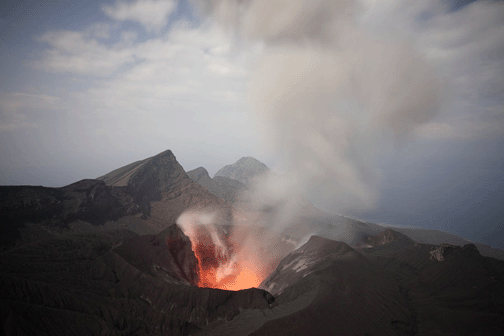
Sendai Nuclear Power Plant to be restarted in July 2015 surrounded by 5 active volcanoes

Sendai reactors surrounded by 5 active volcanoes
Japan’s NRA has given the go ahead to restart two reactors at the Sendai nuclear plant. The needed local approvals are expected to permit the plant to restart even though public opinion is about two to one against restarts. The first reactor could restart as early as July.
Warnings for a minor eruption at one of the five volcanoes near the Sendai nuclear plant were sent out. The volcano 64km from the nuclear plant has seen increased activity, enough so that experts put out a warning. Japan’s government has been pushing to restart the Sendai reactors without a viable plan for dealing with volcano risk.
We also found other risks that are unaddressed with the Sendai plant related to any disaster response.
While the nuclear plant restarts are largely a political move to shore up the profit margins of struggling electrical utilities, other challenges go unaddressed. Meanwhile fuel storage at nuclear plants may be at capacity within two years of reactor restarts.
With experts disputing the safety of restarting the Sendai reactors due to the proximity of so many active volcanoes they may be tempting fate.
Risks at Sendai
The Sendai nuclear power plant located in Kagoshima Japan has been selected as the one Japanese authorities would focus on attempting to approve for restart. Intakes reside at: 5ft above sea level Intake pump buildings 13 feet above sea level Reactor blocks at about 35-40 ft above sea level
Road routes are problematic at the plant. The plant is bordered by a large river to the north, the sea to the west and a large expanse of mountains to the east. Roads route either north along the river or south following the coastline a considerable distance before you reach an area that might be undamaged. The major road that routes towards Sendai crosses the river north of the plant before a road to get to the plant could be reached, requiring another trip across the river. Miyazaki sits further to the east but again requires a north route and river crossing.
All roads to the plant from the north are dependent on a bridge across the river to travel from the north or the east. The roads to the plant from the north as they each require a bridge crossing, circled in red. The road faces the river edge and varies from 5 feet above sea level to 31 feet above sea level.
The south route goes through areas like Tsuchikawa, an area that would likely be subjected to any tsunami that would hit the plant, potentially preventing travel further east to Kagoshima. This would cause a station blackout at the plant just like at Fukushima Daiichi.
The even bigger challenge is that the conditions that would take out offsite power can’t be overcome. That had been the 500th eruption for the year and was just past the half way point of 2013.
The problems a volcano can cause a nuclear power plant is a well known problem. Ash can also cause mechanical damage to anything with moving parts that the ash may get into including pumps and generators.
The isolation of the plant due to the terrain and roads could hinder any response effort.
Non evacuation plans for Sendai
Prime minister Abe said that he approves of the evacuation plans around the Sendai nuclear plant and that he considers them “concrete and reasonable”. There is currently no agency or authority to evaluate evacuation plans in Japan.
The governor of Kagoshima said he was reluctant to develop plans to rescue all the people within 30km. “There are 17 hospitals and welfare facilities within 10 km of the plant. “We could spend long hours creating something unrealistic, but it won’t function” in the event of an actual disaster, Ito told reporters last month.”
The prefecture told the remaining facilities to figure it out for themselves how to evacuate anyone between the 10 to 30km zone.
Critics of the evacuation plans around Sendai pointed out that damage from earthquakes, landslides and tsunami were not given consideration in planning.
2 Sendai reactors cleared by NRA for restart
Japan cleared the way for a resumption of nuclear power, four years after the world’s worst atomic disaster in more than two decades led to the shutdown of all the country’s reactors and fueled public opposition to the industry.
Regulators said Kyushu Electric Power Co.’s two-reactor Sendai nuclear plant had cleared safety hurdles introduced after the triple meltdowns at Tepco’s Fukushima No. 1 plant in 2011.
The Sendai plant, in Kagoshima Prefecture, still needs to go through operational checks before a restart but these are expected to be completed without major hitches.
Volcano explodes off Kyushu 151 km from Sendai, forcing small island to evacuate
A volcano exploded Friday morning on sparsely populated Kuchinoerabu Island, sending smoke and ash soaring into the sky above Kagoshima Prefecture and residents fleeing to the safety of nearby Yakushima Island.
The 9:59 a.m. eruption of 626-meter Mount Shindake, the island’s main peak, produced a plume over 9 km high and a pyroclastic flow that reached the shoreline, the Meteorological Agency said.
There was no warning.
Situated some 100 km off the southern tip of Kyushu, Kuchinoerabu has only about 100 full-time residents. The same mountain had 178 small eruptions in March alone and produced one last week that created a plume 4.3 km high.
Nobuo Geshi of the National Institute of Advanced Industrial Science and Technology claims Friday’s eruption is the same type as the one seen at Sakurajima but much larger.
Geshi, who heads a group of scientists conducting research on massive eruptions, said it is very similar to the one the island experienced in 1966.
He said it can also be regarded as part of the volcanic activity that continued after the eruption last August.
Geshi pointed out that none of the past cases was a one-off eruption, suggesting the activity may continue for a while.
Kuchinoerabu, located in an area south of Kyushu with a large concentration of active volcanoes, has experienced numerous bouts of volcanic activity since Shindake’s colossal eruption in 1841, which scorched nearby villages and killed many residents.
Shindake’s volcanic activities continued in the 1960s, resulting in another massive eruption in November 1966 that hurt three people and caused shock waves and pyroclastic flows that hit Kagoshima and Tanegashima Island, one of the Osumi Islands.
The mountain also experienced a small phreatic eruption in September 1980.
Since the 2000s, a large increase in volcanic quakes and tremors has been reported.
Abe Govt. pushes for nuke restart in Sendai even as volcano pops 151km (94 miles) from there
More than 100 people have been ordered to evacuate after a volcano erupted on the tiny southern Japanese island of Kuchinoerabu on Friday morning.
Spectacular TV footage captured the moment Mount Shindake exploded, sending columns of thick, black smoke high into the air.
Japan’s meteorological agency raised the alert level to five – the highest on its scale – and ordered the island’s 140 residents to evacuate.
The agency said no injuries or damage had been reported following the eruption, which occurred eight months after 57 people died after Mount Ontake in central Japan erupted without warning.
The agency added that pyroclastic flows, dense currents of rock fragments and hot gases from the volcano had reached the island’s north-west shore.
In Tokyo, the prime minister, Shinzo Abe, set up an emergency response team and dispatched a self-defence force to the island. Abe said he had instructed local authorities to do “everything possible” to ensure the islanders’ safety.
Yoshihide Suga, the government’s chief spokesman, said a coastguard vessel had also been sent to help residents evacuate.
A local official said the eruption, which occurred without warning, had forced about 100 people to take shelter at an evacuation centre. “There was a really loud sound of an explosion, and then black smoke rose, darkening the sky,” Nobuaki Hayashi told the national broadcaster NHK. “It smells of sulphur.”
Source: The Guardian
Radioactive water leaks at Fukushima Daiichi: a never ending story
What a surprise! The operator of the destroyed Fukushima Daiichi nuclear plant, Tepco, says workers have found a leak of highly radioactive water at the plant’s site. They say the water flowed into the plant’s port. (Ocean)
We are all dumbfounded by such sudden unexpected horrible news, maybe we should start a worldwide crowdfunding project to provide them with sufficient plenty masking tape!
The operator of the crippled Fukushima Daiichi nuclear plant says workers have found a leak of comparatively highly radioactive water at the plant’s site. It says the water flowed into the plant’s port.
Tokyo Electric Power Company says the contaminated water was leaking from a hose connecting a wastewater tank and a building at the plant.
The hose had a crack about 1 centimeter long. The contaminated water was produced in a process to clean up rainwater tainted by radioactive materials at the plant.
Utility officials said the leaked water flowed into a nearby drainage channel and into the port.
They said they detected about 1,200 becquerels per liter of beta ray-emitting substances from water taken from the channel on Thursday. That figure was 40 times the level the previous day.
They said the figure rose to a maximum of 1,400 becquerels on Friday. The officials believe the leakage continued over the two days.
The company says concerns were raised about the hoses’ durability. It has been replacing them.
Authorities in Fukushima Prefecture have urged the company to conduct an investigation to identify the cause of the leak. They say the company should take thorough measures to prevent a recurrence.
Source: NHK
http://www3.nhk.or.jp/nhkworld/english/news/20150529_41.html
Inadequate cleaning of Fukushima radioactive water
 Fukushima Daiichi Cleans Most Contaminated Water, Not Really, Simply Info May 28th, 2015 TEPCO announced that they have cleaned most of the contaminated water at Fukushima Daiichi. But thedetails show they are no where near close to being done.
Only cesium 137 & 134 along with strontium 90 have been removed from certain tanks of water. 620,000 tons of water have had these two isotopes removed. 10,000 tons of water currently can not be filtered for an undisclosed reason.
440,000 tons of water have now been run through ALPS with 180,000 tons still needing to be processed. Previous admissions showed that ALPS did not remove cobalt 60, iodine 129 and tritium among possible other isotopes……. http://www.fukuleaks.org/web/?p=14776
Japan’s Nuclear Regulation Authority gives approval for restart of Sendai reactors
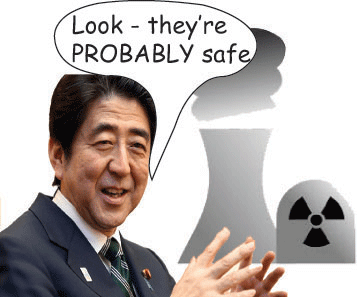 Japan Nuclear Plant Obtains Final Permit Needed To Restart, Huffington Post By MARI YAMAGUCHI 05/27/2015 TOKYO (AP) — A nuclear plant in southern Japan on Wednesday obtained the final permit needed to restart its reactors, paving the way for it to become the first to go back online under new safety standards introduced after the 2011 Fukushima disaster.
All of Japan’s more than 40 reactors are currently offline for repairs or safety inspections. The two units at the Sendai nuclear power plant are among 24 reactors seeking to restart, as Prime Minister Shinzo Abe’s pro-business government tries to put as many back online as possible.
The Nuclear Regulation Authority approved the Sendai plant’s operational safety plans, the last step of a three-part screening process. The plant’s safety program includes emergency response plans in case of fire, floods or other natural disasters, or a serious accident…… While local municipalities have already approved the Sendai plant’s restart, many residents oppose the plan, citing potential danger from active volcanos in the region.
Kyushu Electric hopes to restart one reactor at the Sendai plant in late July after on-site tests and training and the other in late September, though there could be some delays………http://www.huffingtonpost.com/2015/05/27/japan-nuclear-plant-restart_n_7450350.html
1 This Month





PLEASE OPPOSE HR 8255 AND S.3639 – bills would accelerate satellite deployment, with no environmental review or safeguards – https://ncstd5li.quorum.us/campaign/169331/
To see nuclear-related stories in greater depth and intensity – go to https://nuclearinformation.wordpress.com
-
Archives
- October 2026 (49)
- September 2026 (339)
- August 2026 (330)
- July 2026 (355)
- June 2026 (287)
- May 2026 (306)
- April 2026 (356)
- March 2026 (251)
- February 2026 (267)
- January 2026 (308)
- December 2025 (358)
- November 2025 (359)
-
Categories
- 1
- 1 NUCLEAR ISSUES
- business and costs
- climate change
- culture and arts
- ENERGY
- environment
- health
- history
- indigenous issues
- Legal
- marketing of nuclear
- media
- opposition to nuclear
- PERSONAL STORIES
- politics
- politics international
- Religion and ethics
- safety
- secrets,lies and civil liberties
- spinbuster
- technology
- Uranium
- wastes
- weapons and war
- Women
- 2 WORLD
- ACTION
- AFRICA
- Atrocities
- AUSTRALIA
- Christina's notes
- Christina's themes
- culture and arts
- Events
- Fuk 2022
- Fuk 2023
- Fukushima 2017
- Fukushima 2018
- fukushima 2019
- Fukushima 2020
- Fukushima 2021
- general
- global warming
- Humour (God we need it)
- Nuclear
- RARE EARTHS
- Reference
- resources – print
- Resources -audiovicual
- Weekly Newsletter
- World
- World Nuclear
- YouTube
-
RSS
Entries RSS
Comments RSS

