Welcome to Japan, land of cherry blossoms, sushi and sake, and 17,000 metric tons of highly radioactive waste.
That’s what the country has in temporary storage from its nuclear plants. Supporters of atomic power say it’s cleaner than fossil fuels for generating electricity. Detractors say there’s nothing clean about what’s left behind, some of which remains a deadly environmental toxin for thousands of years.
Since atomic power was first harnessed more than 70 years ago, the industry has been trying to solve the problem of safe disposal of the waste. Japan has been thrown into the center of the conundrum by its decision in recent months to retire five reactors after the Fukushima disaster in 2011. It also decided this week to begin the restart process of one reactor despite public opposition.
“It’s part of the price of nuclear energy,” Allison Macfarlane, a former chief of the U.S. Nuclear Regulatory Commission, said in an interview in Tokyo on atomic waste. “Now, especially with the decommissioning of sites, there will be more pressure to do something with this material. Because you have to.”
For more than half a century, nuclear plants in more than 30 countries have been humming away — lighting up Tokyo’s Ginza, putting the twinkle into New York’s Broadway and keeping the elevators running up the Eiffel Tower. Plus powering appliances in countless households, factories and offices around the world.
In the process, the world’s 437 operating reactors now produce about 12,000 tons of high-level waste a year, or the equivalent of 100 double-decker buses, according to the World Nuclear Association.
Fukushima Disaster
Most countries now agree burying atomic waste deep underground is the best option. Other ideas like firing it into space or tossing it inside a volcano came and went.
The U.S., with the most reactors, spent an estimated $15 billion on a site for nuclear refuse in Yucca Mountain, Nevada. Local opposition derailed the plan, meaning about 49,000 tons of spent fuel sits in cooling pools at nuclear plants around the country.
Japan faces another challenge. Four years ago, the country had a nuclear accident unlike anything seen before. An earthquake and tsunami ripped through the engineering defenses at the Fukushima plant north of Tokyo and caused the meltdown of three reactors.
It will need billions of dollars and technology not yet invented to clean up Fukushima. How long that will take is disputed. The operator, Tokyo Electric Power Co., estimates 40 years. Greenpeace says it could take twice that time.
‘Ethical Responsibility’
All Japan’s 43 operational reactors have been offline since September 2013 for safety checks after the disaster. The government has said atomic power is essential to energy supply and reactors that meet safety standards will be allowed to restart.
The first in line belongs to Kyushu Electric Power Co., which today said it has finished refueling one of its units in southern Japan. It plans to restart the plant in August, which means generation of more nuclear waste.
It will be a “failure in our ethical responsibility to future generations,” to restart reactors without a clear plan for waste storage, the Science Council of Japan said in April.
No Thanks
Japan’s Nuclear Waste Management Organization, known as NUMO, has been searching for a permanent storage site for years, initially inviting districts to apply as a host.
In 2007, it got one when the mayor of a town called Toyo submitted interest. Like the residents near Yucca Mountain in the U.S., Toyo’s citizens didn’t like the idea and voted him out of office. His successor canceled the plan.
Now facing the accelerated shutdown of some reactors post-Fukushima, NUMO in May ditched the idea of waiting for a volunteer. Instead, scientists will nominate suitable regions.
“We’d like all citizens to be aware and feel ownership of this situation,” said Takao Kinoshita, a NUMO official. “We should feel grateful for the community that’s doing something for the benefit of the whole country and respect their bravery.”
Deep Underground
NUMO’s plan for a final underground repository was drawn up in 2007 and would cost 3.5 trillion yen ($29 billion).
It would contain about 40,000 canisters, each weighing half a ton and holding waste at temperatures above 200 degrees Celsius (392 Fahrenheit). The contents would give off 1,500 sieverts of radiation an hour, a level that would instantly kill a human being.
The canisters need to cool in interim storage for as long as 50 years before heading 300 meters below ground. Their stainless steel inner layer is wrapped in bentonite clay to make sure water can’t leak inside.
“That’s the biggest risk we see, water leaking through,” said Kinoshita.
Finland and Sweden are the only two countries so far to have selected and reached a public agreement on a final site and storage technology for high-level nuclear waste. Finland’s is expected to open in 2020.
Taking apart a reactor, known as decommissioning, produces a few tons of highly radioactive material, usually the used fuel and coolant. The buildings and equipment account for thousands of tons of so-called low-level waste.
Disposal Confusion
Japan’s government is responsible for dealing with the most radioactive waste. The plant operator handles the rest.
“Even in the low-level category there is the relatively higher-level waste and the nation’s technical solutions are not ready,” Makoto Yagi, the president of Kansai Electric Power Co., said at a June briefing in Tokyo.
Shaun Bernie, senior nuclear specialist with Greenpeace Germany, said this shows Japan’s reactor program and high-level nuclear waste policy is “in a state of crisis.”
Without a clear disposal strategy, costs to take apart the reactors can end up being double original estimate, said Colin Austin, senior vice president at Energy Solutions, which has worked on every decommissioning project in the U.S.
Another wrinkle in Japan for finding a final disposal site is that the country sits on a mesh of colliding tectonic plates that make it one of the most earthquake-prone countries in the world.
Former NRC chief Macfarlane, who is also a seismologist, said that doesn’t make it impossible to bury the waste. A repository hundreds of meters underground is partly protected against quakes in the same way submarines are during high storms, she said.
Leaving nuclear waste on the surface indefinitely means it will get into the environment so Japan has to solve this, she said.
“An adequate place underground is better than waiting for the best possible place.”
Source: Bloomberg Business
July 11, 2015
Posted by dunrenard |
Japan | nuclear waste |
Leave a comment
Sellafield workers are helping clean up the destroyed #Fukushima nuclear plant A group of Sellafield Ltd workers have spent five days at the tsunami-stricken Fukushima plant in Japan, which is in the process of “being decommissioned” after being devastated in 2011.
The trip is part of Sellafield Ltd’s ongoing commitment to support Tepco FDEC (Fukushima Daiichi Decontamination and Decommissioning Engineering Company), the company charged with the task of cleaning up the site.
During the most recent visit, Sellafield Ltd experts toured the facility and surrounding area, seeing first hand a decontamination effort of unprecedented scale, while providing advice and technical expertise on environmental management and radiation protection.
This was a follow-up to a successful trip to west Cumbria last year by their Japanese counterparts, who are already implementing some of the environmental practices used at the Sellafield site.
Members of the leadership team, including the recently appointed Managing Director, Paul Foster, also toured the plant to see the progress being made and provide a more long-term, strategic insight into decommissioning programme.
“My first impression of Fukushima was something I will never forget,” said Mr Foster.
“We’ve probably all seen the news footage of the reactor buildings which were severely damaged by the explosions, but to actually be there and see it first hand was a humbling experience.
“We’re keen to help them as much as we can and the fact that they are so keen to access the skills and expertise that exists in west Cumbria is something of which I am extremely proud.”
Although there is much more work to be done, the progress at Fukushima to date indicates that the benefits of the arrangement are already being realised, with experts from west Cumbria actively contributing to the clean-up.
Mr Foster added: “During the visit we shared our approach to managing large, complex programmes as well as some of our technical and tactical issues. They want to learn from us and, in time, we will learn much from them.”
“Seeing the sheer scale of the task at Fukushima highlights why we must continue to share experience and technical expertise amongst the global nuclear family, and this now resonates with me more strongly than ever.
“This was always the intention of the agreement and the benefits already emerging prove that it is happening in reality, making us both better equipped to deliver our respective missions.”
This mutual commitment between Sellafield Ltd and Tepco FDEC was formalised in a co-operation agreement, signed by the two companies in 2014, which would see them exchange knowledge, experience and skills on an on-going basis to ultimately help “decommission both plants as quickly and safely as possible.”
Source: News and Star
http://www.newsandstar.co.uk/news/1.1222143
July 11, 2015
Posted by dunrenard |
Japan | Fukushima Daiichi |
Leave a comment
Kyushu Electric has completed loading nuclear fuel into a reactor at Sendai Nuclear Station,
The last rod assembly —the 157th — was embedded into the reactor at 12:12 a.m. Friday, ending an operation that engaged some 50 workers around the clock since the loading process started Tuesday at the station in Kagoshima Prefecture, a company official said.
Subject to inspection clearance by the government’s Nuclear Regulation Authority in the coming days, Kyushu Electric is envisaging firing up the reactor around Aug. 10 to start trial power transmission three days later.
The reactor is expected to be geared up to full steam later in the month before starting commercial power transmission in September, a move that would likely bring relief to the company, which has been reeling from losses caused by hefty fossil fuel costs to run conventional power plants with all its six nuclear reactors idled.
The resumption of the reactor — one of the two at the Sendai plant — will mark the restart of nuclear power generation in Japan that has been at a standstill due to safety concerns following the ongoing triple meltdown disaster at the Fukushima plant. None of Japan’s commercial reactors has been online for nearly two years.
If the nuclear authority finds any problem, Kyushu Electric will be required to address it and this may result in the restart being delayed.
The utility is aiming to reload fuel into the second reactor at the Sendai plant in early September and reboot it in mid-October.
Source: Japan Times
http://www.japantimes.co.jp/news/2015/07/10/national/kyushu-electric-finishes-loading-fuel-nuclear-reactor/#.VZ_o5PmFSM9
July 11, 2015
Posted by dunrenard |
Japan | Nuclear Plant Restart, Sendai |
Leave a comment
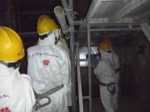 Fukushima Unit 3 Decommissioning Plan Released, Simply Info, July 8th, 2015 [Excellent graphs and photos] TEPCO released significant new information about the plan and progress for dealing with unit 3′s spent fuel pool. The report was buried among other documents related to periodic reporting and didn’t receive any press in Japan.
Radiation levels are a constant problem for this work effort. A significant portion of the planning has gone into ways to lower the radiation doses on the refueling floor even though work such as crane operations will be done remotely from another building. Damage to the building structure is another major challenge. The defueling building and any shielding must be designed to not further damage unstable portions of the building.
The defueling building will span over the existing remains of unit 3. Footings will run down to the ground on one side and to an accessory building on the other. Radiation levels are going to be a problem not just for any workers that might have to do some sort of hands on work but to equipment installed over time. High levels of radiation can damage electronics.
The actual defueling building has already been built. A dry run assembly was done in 2014 at the storage facility at Onahama Port near Fukushima Daiichi. The building now sits disassembled at the port waiting for installation on site………..http://www.fukuleaks.org/web/?p=14857
July 10, 2015
Posted by Christina Macpherson |
Fukushima 2015 |
Leave a comment

 View from Inside Fukushima Prefecture: Vastly Different from Govt. Pronouncements, UK Progressive, by Robert Hunziker, 8 July 15 Because of Japan’s unconscionable open-ended new secrecy law, it is very likely journalism in the nation has turned tail, scared of its own shadow. Nevertheless, glimmers of what has happened, of what is happening, do surface when brave people come forward.
On May 22nd 2015 Hiromichi Ugaya, a photojournalist who is well-informed, insightful, and engaging, was interviewed about what he witnessed in the aftermath of one of the world’s most horrendous disasters……..
Naïveté of Public Continue reading →
July 10, 2015
Posted by Christina Macpherson |
Japan, secrets,lies and civil liberties |
Leave a comment
MOX fuel rods used in Japanese Nuclear Reactor present multiple dangers, DC Bureau By Joseph TrentoMarch 15th, 2011 The mixed oxide fuel rods used in the compromised number three reactor at the Fukushima Daiichi complex contain enough plutonium to threaten public health with the possibility of inhalation of airborne plutonium particles. The compromised fuel rods supplied to the Tokyo Electric Company by the French firm AREVA.
Plutonium is at its most dangerous when it is inhaled and gets into the lungs. The effect on the human body is to vastly increase the chance of developing fatal cancers.

Masashi Goto, a reactor researcher and designer for Toshiba, told the Foreign Correspondents Club in Toyko the mixed oxide (MOX) fuel used in unit 3 of the Fukushima Daiichi nuclear facility uses plutonium, which is “much more toxic than the fuel used in the other reactors.”
Goto said that the MOX also has a lower melting point than the other reactor fuels. The Fukushima facility began using MOX fuel in September 2010, becoming the third plant in Japan to do so, according to MOX supplier AREVA.
Part of the process of making MOX fuel is to grind plutonium into a fine power before it is robotically inserted into fuel rods. Experts agree these tiny plutonium particles once airborne are extremely dangerous to human health. One of the unique characteristics of mixed oxide fuel is that relatively little of the plutonium in the fuel rods is used up in the fuel cycle in a reactor. “When the plutonium in the fuel rods goes into a reactor for commercial power, a very little of it is going to be consumed. I don’t know what percentage, maybe half percentage or something like that, but it’s going to generate an extraordinary amount of contamination throughout the fuel rods…,” says William Lawler, an expert on radioactive waste…….
Mixed oxide fuel is a combination of finely ground up plutonium particles and uranium oxide fabricated into fuel rods at an AREVA subsidiary in La Hague, France. The fuel is made from reprocessing old reactor fuel. Reprocessing was abandoned by the United States in the 1970s because of the dangers of weapons proliferation.
The CIA has reported that Japan’s nuclear power program was not limited to the peaceful production of electrical power. The program had its roots in a secret weapons program that caused the CIA to conclude as far back as 1964 that Japan could assemble within months a nuclear weapon.
Because of the Japanese public’s fear of nuclear weapons, the various subsequent Japanese governments have kept the program secret and have repeatedly denied its existence when news organizations made inquiries. http://www.dcbureau.org/20110315782/natural-resources-news-service/mox-fuel-rods-used-in-japanese-nuclear-reactor-present-multiple-dangers.html#sthash.NydPfWmn.dpuf
July 10, 2015
Posted by Christina Macpherson |
- plutonium, Japan, safety |
2 Comments
Reactor in Japan being loaded with nuke fuel before restart ,Stars and Stripes, By By MARI YAMAGUCHI The Associated Press July 7, 2015 TOKYO — A Japanese utility on Tuesday began loading fuel into a nuclear reactor where operations are scheduled to resume next month in the country’s first restart under safety requirements set following the Fukushima disaster.
Kyushu Electric Power Co. said the first four fuel bundles were loaded into the Sendai plant’s No. 1 reactor as of late Tuesday. A crane slowly lifts each bundle out of a cooling fuel storage pool and places it into the reactor, in a round- the-clock operation. The utility plans to finish loading all 157 fuel bundles Friday ahead of final inspections before restarting the reactor around Aug. 10.
All of Japan’s more than 40 reactors are offline for repairs or safety checks. Sendai No. 1 is one of 25 reactors seeking restarts and under safety inspection, as Prime Minister Shinzo Abe’s government wants to operate as many of them as possible …..
The second reactor in Sendai is scheduled to be restarted in October.

While the trade ministry and local municipalities have approved the restart of the two reactors in southern Japan, many residents oppose the plan, citing potential danger from active volcanos in the region. Opponents of the restarts and nuclear experts are also concerned the evacuation plans in case of a disaster may not work effectively.
July 10, 2015
Posted by Christina Macpherson |
business and costs, Japan |
Leave a comment
 To mind that this article is from Yomiuri, a pro-government newspaper
Two years have passed since new safety standards were introduced requiring utilities to strengthen their measures to prevent serious accidents at nuclear facilities as a result of major earthquakes or tsunami, requirements put in place following the crisis at Tokyo Electric Power Co.’s Fukushima No. 1 nuclear power plant.
Safety inspections are under way at 25 reactors at the nation’s 15 nuclear power plants. However, only five reactors at three nuclear plants, including the Nos. 1 and 2 reactors at Kyushu Electric Power. Co.’s Sendai plant, have been approved as meeting the new standards.
Given the time-consuming process of post-approval checks, all of Japan’s nuclear power plants continue to remain offline.
In September 2014, the Sendai nuclear plant in Kagoshima Prefecture cleared the new safety standards set by the Nuclear Regulation Authority. Kyushu Electric started loading fuel into the Sendai plant’s No. 1 reactor on Tuesday, which is highly likely to be brought online as early as mid-August.
Screenings have been completed for Kansai Electric Power Co.’s Nos. 3 and 4 reactors at its Takahama nuclear power plant in Fukui Prefecture, but a time frame for resuming operations is not yet in sight. The Fukui District Court had issued a provisional disposition order to forbid the restart of the reactors.
Regarding Shikoku Electric Power Co.’s No. 3 reactor at its Ikata nuclear plant in Ehime Prefecture, the NRA will likely issue a screening certificate verifying that the reactor satisfies safety standards.
Safety screenings are progressing more slowly for 10 reactors at eight nuclear power plants, including TEPCO’s Kashiwazaki-Kariwa plant in Niigata Prefecture, which uses boiling water reactors like the ones at the Fukushima No. 1 plant.
Estimates of maximum seismic vibrations, which form the basis for safety measures, have yet to be finalized for these reactors.
KEPCO is aiming to extend the operational period of its aging Nos. 1 and 2 reactors at its Takahama nuclear plant, as well as the No. 3 reactor at its Mihama plant, also in Fukui Prefecture, to more than 40 years. Forty years is the maximum period generally allowed by the state.
The three reactors must pass screenings and other inspections by July next year and November next year in accordance with state regulations, raising the issue of the need to speed up the inspection process.
“The new safety standards have set considerably high standards,” NRA Chairman Shunichi Tanaka said at a press conference on Wednesday, “so I believe utilities are having to take some time to satisfy those requirements.”
Source: Yomiuri
http://the-japan-news.com/news/article/0002276652
July 9, 2015
Posted by dunrenard |
Japan | Nuclear Plant Restart, Sendai |
Leave a comment
 The government has decided to lift evacuation orders for wide areas around the disaster-stricken Fukushima No. 1 nuclear power plant and end blanket compensation payments to people in Fukushima Prefecture who are still suffering from the aftermath of the reactor meltdowns.
More than four years since the nuclear disaster, the uncertain future of the affected local communities and their members is causing further negative effects.
Setting clear dates for lifting evacuation orders will make it easier for evacuees to plan their futures. The move is also meaningful in terms of clarifying the government’s responsibilities to improve the environment for the evacuees’ return home through such measures as decontamination and rebuilding infrastructure related to their daily lives.
But the conditions are not the same for each disaster victim. The move to lift evacuation orders and end compensation payments should not be a simple termination of policy support. It is essential for the government to start fresh support based on careful consideration of the circumstances of individual sufferers.
POSSIBLE BOOST TO RECONSTRUCTION EFFORTS
The government has set clear dates for lifting the evacuation orders for two of the three categories of restricted areas—“areas to which evacuation orders are ready to be lifted” and “areas in which the residents are not permitted to live.” The levels of radiation in these areas are relatively low, and entry into these areas is permitted in the daytime.
The evacuation orders for these areas will be removed by March 2017 at the latest after accelerated decontamination efforts.
The people of Naraha, a town that has been entirely designated as “an area to which the evacuation order is ready to be lifted,” will be allowed to return home on Sept. 5.
The town will be the first among seven municipalities to have an evacuation order for all residents lifted since the meltdowns at the plant in March 2011.
For the residents to be able to start living in the town again, however, it is vital to repair or rebuild damaged houses and secure jobs for the returnees.
Major homebuilders have been reluctant to work in evacuation areas, saying they can’t carry out operations until the evacuation orders are lifted.
Since it was stuck by the disaster, Naraha has persuaded 11 companies to locate their plants in the town. All but one of these companies, however, have been waiting for the removal of the evacuation order to start building the plants.
The scheduled end of the evacuation will bolster efforts to rebuild the community. In a survey of evacuated Naraha residents conducted last autumn, 45.7 percent of the respondents said they would return to their homes in the town either “immediately” or “when necessary conditions are met” after the evacuation order ends. The figure represents an increase of 5.5 percentage points from the previous survey.
But it will be difficult to completely restore the status quo. Many evacuee families have members who are already working at places where they currently live or children who have grown accustomed to their new schools.
NO RETURN TO PRE-DISASTER LIFE
Evacuation orders for parts of Tamura and Kawauchi have already been lifted, but only about half of the residents of these areas have returned.
If the population of an area doesn’t recover sufficiently, it will be difficult to operate such public facilities as medical institutions and schools in the area. This further discourages residents from returning.
Farmers and self-employed people in such areas also face a tough time trying to restart their businesses.
Concerns about radioactive contamination of food grown in disaster areas will remain even though test growing of certain crops has started in some areas. Part of local farmland has been used for provisional storage of soil and plant debris from the decontamination work. Heaps of large bags filled with contaminated materials remain at many sites.
A survey by the Fukushima Federation of Societies of Commerce and Industry of members in evacuation areas found that 56.4 percent of the respondents had restarted their businesses either in or outside the prefecture by June this year.
But most of them are construction or manufacturing businesses, while only a few of the affected retailers and service providers have started doing business again. That’s because their trade areas have disappeared.
After the evacuation order for the Miyakoji district of Tamura was lifted in April last year, a temporary store to sell foodstuffs and daily necessities was opened under the government’s leadership. A convenience store was then opened along a national highway under the initiative of the government. Sales at the store have plunged to a quarter of their peak level partly because of route sales of another convenience store.
In Naraha, a local supermarket is struggling to rebuild. It is concerned about a possible blow to its operations from a new store of retail giant Aeon Co. that is expected to open within a commercial complex built by the neighboring town of Hirono along a national highway.
Amid these circumstances, compensation payments to disaster victims by the government and Tokyo Electric Power Co., the operator of the Fukushima No. 1 plant, will be discontinued.
Compensation for mental health damage (or consolation money of 100,000 yen per month per person) will end after the payments for March 2018. Compensation for damage to businesses paid to small and midsize companies and self-employed people that remain out of business will be terminated after the payments for March 2017.
Critics have been pointing out problems with the way such compensation has been paid to people and businesses damaged by the disaster. They say the compensation programs widen the economic disparity between the recipients and those who don’t receive the money, divide communities and hinder victims’ efforts to regain economic independence.
PAY ATTENTION TO DIFFERENT CONDITIONS OF INDIVIDUALS
But rebuilding shattered lives entails formidable challenges. Consolation money is often used to cover living expenses.
If evacuees can’t find a way to earn a living in their towns, they will be unable to make ends meet when they return to their homes after the evacuation order is lifted.
The government plans to set up a new public-private organization to help self-employed people and farmers restart their businesses in the next two years. The new body will start its work by visiting 8,000 such people for counseling by the end of the year.
But there is still no plan for specific steps to be taken. It will take considerable time just to grasp what kind of situation they are in.
Fuminori Tanba, an associate professor at Fukushima University who has been involved in the development of reconstruction plans for many disaster-hit areas, points out some key factors for successful support to such businesses.
It is crucial to draw up a detailed prescription for each business to sort out the challenges it faces, he says. It is also important to take measures to coordinate the trade areas of similar businesses and retrain those who are seeking to change their businesses.
Tanba also stresses the need to pay attention to problems these people face after restarting their businesses to ensure that they will get on track.
In short, policy support should be provided through the entire process of business reconstruction.
In addition to such support, the government should consider creating a public framework to provide financial aid to cover living expenses for people struggling to rebuild their livelihoods.
These people are suffering from a disaster that happened at a nuclear power plant built under the government’s policy of promoting nuclear power generation. The government should not end financial aid to individual residents of the affected areas.
Four years since the harrowing accident, the conditions of individual residents of areas around the crippled plant remain complicated.
It is necessary for the government to make flexible responses to their needs from their own viewpoints. Now is the critical moment for work to rebuild the lives of people in Fukushima that were destroyed by the disaster.
Source; Asahi Shimbun
http://ajw.asahi.com/article/views/editorial/AJ201507090061
July 9, 2015
Posted by dunrenard |
Japan | Evacuees, Fukushima continuing |
Leave a comment
 The contaminated water crisis at the Fukushima Daiichi nuclear power plant remains very complex. Every day more and more contaminated water is generated and requires storage and processing.
The Russian company Atomproekt has announced that in 2016 it will construct a treatment plant at the Fukushima Daiichi nuclear power plant to demonstrate their ability to process contaminated water and remove tritium.
The tritium processing demonstration facility will have a capacity of only 400 cubic meters per day.

The project was first announced in February 2015, when RosRAO commissioned Atomproekt to design the water treatment plant and test with 48 cubic meters of simulated solution.
RosRAO and Atomproekt are subsidiaries of Rosatom, the Russian state nuclear corporation.
RosRAO is the national manager of spent fuel and radioactive waste in Russia.
Atomproekt is formerly known as VNIPIET (All-Russia Science Research and Design Institute of Power Engineering Technology), and designs nuclear projects, processing plants, and waste facilities.
Source: Enformable
http://enformable.com/2015/07/atomproekt-to-construct-demonstration-tritium-removal-plant-at-fukushima-daiichi/?utm_source=feedburner&utm_medium=email&utm_campaign=Feed%3A+Enformable+%28Enformable%29
July 9, 2015
Posted by dunrenard |
Japan | Fukushima Daiichi |
Leave a comment
SATSUMASENDAI, Kagoshima — Kyushu Electric Power Co. started work to load nuclear fuel into the No. 1 reactor at the Sendai Nuclear Power Plant on July 7, sparking mixed reactions among local residents.
If the reactor restart at the Sendai plant goes ahead as planned, it will be the first such reactivation under stricter safety requirements adopted after the Fukushima No. 1 nuclear plant meltdowns in March 2011.
About 120 people including local residents gathered in front of the main gate of the Sendai nuclear power complex on the morning of July 7. Holding banners which read, “Loading of nuclear fuel is a step toward accidents,” they shouted, “We will never condone reactivation,” and, “Kyushu Electric should abandon nuclear reactors.”
Kiyoaki Kawabata, 59, who heads a local self-governing body in the Kagoshima Prefecture city of Satsumasendai, was angry that Kyushu Electric had moved ahead with fuel loading without holding a briefing session for local residents.
“Even though residents have been seeking an explanation, they ignored us. We cannot forgive them for that,” he said. Hiroshi Sugihara, a 67-year-old part-time lecturer at Kagoshima University, commented, “They should stop work and abandon their (reactor) restart plans.”
Seven people from Minamata, Kagoshima Prefecture, about 45 kilometers from the Sendai nuclear station, joined the rally. Takafumi Nagano, the 60-year-old head of a group calling for sound nuclear evacuation plans, said, “We must not allow for the beginning of a new nuclear era.” In the 1970s, Nagano lived in what was then Sendai city and joined a campaign opposing construction of the Sendai plant.
Hiroyoshi Yamamoto, who heads a pro-nuclear group in Satsumasendai and the Sendai Chamber of Commerce and Industry, said, “Although the local economy remains in bad shape, I hope that, with the fuel loading, the imminent nuclear plant restart will activate the local economy and stabilize business performance.”
Kagoshima Gov. Yuichiro Ito said in a statement, “Because inspections will continue to be carried out before the nuclear plant is put back on line, I would ask Kyushu Electric to continue to place top priority on ensuring safety and take all appropriate measures.”
About 200 people opposed to the Sendai restart gathered in front of Kyushu Electric’s branch office in the Yurakucho district of Tokyo’s Chiyoda Ward on the evening of July 7. The rally was organized by the “Metropolitan Coalition Against Nukes.”
Holding banners, some of which said: “Don’t put in nuclear fuel!” and, “Don’t press the start button,” the demonstrators chanted slogans including “People can’t evacuate!” for about 90 minutes. Protester Yoshimitsu Umezawa, a 62-year-old caregiver from the Tokyo city of Machida, said, “We can’t forgive a reactivation which puts priority on the economy and ignores people’s lives.”
Source: Mainichi
http://mainichi.jp/english/english/newsselect/news/20150708p2a00m0na013000c.html
July 9, 2015
Posted by dunrenard |
Japan | Nuclear Plant Restart, Sendai |
Leave a comment

Funny I was just mentioning about this on our Facebook group Rainbow Warriors in some comments a couple of days ago, that Iodine-131 had been repeatedly found in 2011, 2012, 2013, 2014, and possibly as well in 2015, proving that there is still something constantly fissioning there unstopped since March 2011, and of course this something is not releasing only Iodine-131 into the air but also Cesium-134 and other radionuclides as well….
Significant density of I-131 was detected from dry sludge of Fukushima sewage plant this May. Cs-134 was also detected.
According to Fukushima sewage public corporation, 2 days after rain (26.5 mm) observed on 5/19/2015, Iodine-131 level started jumping up along with Cs-134/137 density.
It kept on being detected until the end of May. The highest reading was 794.4 Bq/Kg (5/23/2015). 113 Bq/Kg of Cesium-134/137 was also measured this day.
It is assumed that the rain carried I-131 from somewhere to the sewage plant, however Fukushima prefectural government has announced no analysis on this.
The data on June is not published yet.
http://www.pref.fukushima.lg.jp/uploaded/attachment/119348.pdf
Source: Fukushima Daiichi
Significant level of I-131 detected from dry sludge of Fukushima sewage plant after rain in May
July 9, 2015
Posted by dunrenard |
Japan | Fukushima Daiichi, radiation |
Leave a comment
Amid preparations to restart nuclear reactors shut down following the 2011 Fukushima meltdown, the Japanese government plans to set a new standard for the permissible upper limit of radiation exposure for those in charge of anti-disaster operations.
The list of those affected by the change in standards includes local government officials, police and fire department officials, as well as bus drivers, who would be charged with securing the steady evacuation of local residents in case of a nuclear accident.
The Japanese government plans to set a new standard for the permissible upper limit of radiation exposure for those in charge of anti-disaster operations.
The list of those affected by the change in standards includes local government officials, police and fire department officials, as well as bus drivers, who would be charged with securing the steady evacuation of local residents in case of a nuclear accident.
Currently, the maximum permissible radiation dose is 1 millisievert per year for ordinary residents, 50 millisieverts per year for decontamination workers, and 100 millisieverts per year for nuclear plant workers; the upper limit for police and fire department officials as well as national public servants and other relevant personnel, previously subject to the same standard as that for ordinary local residents, will be raised to 100 millisieverts per year in emergency situations. During the crisis at the Fukushima No. 1 Nuclear Power Plant, a considerable number of necessary people, such as government staff, were not secured for the local task force near the damaged nuclear power complex, which rendered evacuations and the transport of necessary emergency supplies difficult. The new standard is aimed at preventing similar obstacles in future, The Mainichi reported. “As it is possible that local officials and bus drivers will carry out their duty where radiation levels are relatively high, we need a new standard in order to provide effective evacuation guidance as well,” a Cabinet Office official said. Discussion of the new standard by a working group within the Cabinet Office is scheduled for next month.
Source: Sputnik News
http://m.sputniknews.com/asia/20150708/1024344577.html
July 9, 2015
Posted by dunrenard |
Japan | nuclear, radiation, Radiation Levels |
Leave a comment
by Robert Hunziker
Because of Japan’s unconscionable open-ended new secrecy law, it is very likely journalism in the nation has turned tail, scared of its own shadow. Nevertheless, glimmers of what has happened, of what is happening, do surface when brave people come forward.
On May 22nd 2015 Hiromichi Ugaya, a photojournalist who is well-informed, insightful, and engaging, was interviewed about what he witnessed in the aftermath of one of the world’s most horrendous disasters.
Hiromichi Ugaya was born in Kyoto City, Japan in 1963. He is an accomplished photojournalist with experience in both Japan and the United States, receiving his bachelor’s degree at Kyoto National University and his master’s degree at Columbia University.
Naïveté of Public
Hiromichi first visited Fukushima within two weeks of the disaster, and he has returned nearly 50 times to photograph scenes. His is a personal mission because the tragedy does not receive adequate media coverage. According to him, very few journalists cover the aftermath; television in Japan has lost interest; the public is blasé and dangerously naïve; Japanese publishers do not entertain stories about Fukushima, and the mainstream media in Japan ignores the impact of the aftermath.
Curiously, it’s as if a news blackout has been covertly instituted, and maybe it has. What people do not see, do not hear becomes invisible, out of sight out of mind, similar to the after-affects of radiation exposure, which are not felt, not smelled, not tasted, not physically recognized by people, until it’s too late, until it’s too late, until it’s too late.
Then again, maybe The Act on the Protection of Specially Designated Secrets, Act No. 108 promulgated on December 13, 2013 is quelling public opinion?
According to a leading Japanese newspaper, the law “almost limitlessly widens the range of what can be considered confidential,” and the new secrecy law allows bureaucrats and politicians to “designate state secrets to their liking,” Nobuyuki Sugiura, Managing Editor, Tokyo Head Office, Asahi Shimbun will continue to respond to the public’s right to know, The Asahi Shimbun, December 7, 2013.
Those who leak state secrets face up to 10 years in prison.
And, repeating that standardized rule: Bureaucrats and politicians can “designate state secrets to their liking.” Is this a world’s first? Does this mean that bureaucrats and politicians can determine the fate of anybody and/or everything?
In the face of cowardly authoritarianism, history teaches lessons of harsh reality, for example, Chernobyl is an example of the long-term tragedy associated with nuclear accidents, thirty years later, nearly one million dead (source: Alexey V. Yablokov, Center for Russian Environmental Policy, Moscow, Chernobyl: Consequences of the Catastrophe for People and the Environment, The New York Academy of Sciences, Vol. 1181, December 2009).
Chronicling the first four years of Fukushima, Hiromichi Ugaya composed a photo book about the tragedy as a personal countermeasure to widespread public apathy: Portrait of Fukushima: 2011-2015: Life After Meltdown, which is a treasure trove of over 200 unpublished photos, telling the story from the beginning to the present.
Regions of Fukushima persist ghostlike: “America Tonight journeyed to the affected areas, which are separated into zones of higher and lower radiation risk. In the hardest-hit area, known as the “exclusion zone,” the streets remain virtually empty, eerily silent and frozen in time at the moment residents fled the quaking earth and incoming sea. The garbage and debris that litter the area defy the kempt and pristine neighborhoods for which Japan is famous,” Michael Okwu, Inside Fukushima’s Ghost Towns, Aljazeera America, Jan.6, 2014.
An Insider’s Story- the interview
The government’s initial reaction to the disaster is scandalous. According to Hiromichi, the authorities should have been “more open to the public.” Because of failure to communicate the danger, unnecessary radiation exposure was widespread. Minimal information was provided and evacuations were delayed much too long.
In essence, he believes the authorities were probably concerned about public panic. Regrettably, that concern may serve to haunt and endanger lives for many years. For example: “The most serious leakage of radiation took place March 15th, which was day-five of the nuclear accident, but still, within the radius of 10-20 kilometers, many citizens were still there… They were exposed to the radiation. The number of the people who got exposed to the radiation comes up to like 230,000, which is ten times bigger than Three Mile Island of 1979. So, it’s huge and all the population on Fukushima, two million, have to go for medical checks every year.”
Hiromichi suspects an outbreak of thyroid cancer over the next few years. Already, according to local reports, 107 cases of thyroid cancer have been confirmed. Yet, the gestation period for radiation’s effect is 5-40 years. And, this is only the fourth year.
He believes the Japanese people are not well informed. They only see the limited thyroid cancer cases so far even though those are merely an early harbinger, only foreshadowing the beginning of a long process of widespread complications for years to come. As well, it is doubtful people want to face the brutal truth; avoidance is an easy way out when fear reigns supreme.
Additionally, it is likely that widespread health problems will occur well beyond the limits of Fukushima Prefecture. The radioactive plume traveled notably beyond the immediate area. In March, in the immediate aftermath of the explosions, the plume traveled to Tokyo. “The area between Fukushima and Tokyo has some huge hotspots. In the northern Tokyo metropolitan area, also huge hotspots. Over the eastern region of Japan, the radioactive plume spread across a huge area.”
Hiromichi met with families of Fukushima Prefecture. The accident triggered bizarre behavior amongst families and within communities. The first reaction of family members was to evacuate their children to the next prefectures. But, complications arose, for example, “The problem happened because… first fathers tried to evacuate with their families… in those places where the evacuees reached, the fathers could not find a job. So, the fathers went back to their hometowns to their former jobs although the hometown was contaminated.”
The families of Fukushima squabbled and divided over issues of whether to leave their homes, sometimes leaving behind stubborn family members who refused to leave their lifetime residence. As well, entire communities divided into camps of pro-evacuation versus anti-evacuation, leading to conflict, arguments with old friends labeled as traitors.
Along the way, people experience horrible depression, drinking problems, headaches, vomiting, and loss of appetite, symptoms which are outside of physical normality.
Hiromichi’s story leaves one dangling, wondering what’s to become of the tens of thousands who are homeless to this day, what happens to those who live in fear, to the depressed who now view life as meaningless. And, to those who have already returned to fringe areas.
His is the inside story, the bitter truth behind the recklessness inherent within the complexity of nuclear power generation, toying with enormous untamed power, like wild horses on the plains, originated from e=mc2.
Still, to this day, purportedly, “More people have died from stress-related causes than from the initial disasters in Fukushima,” Alexis Dudden, professor of history, University of Connecticut, The Fourth Winter of Fukushima, Truthout, Jan. 4, 2015.
Beyond that, as time marches on, it is almost certain to bring on a perniciousness of cancer-related complications of unconscionable consequence, look at Chernobyl (1986) where to this day, in the still-contaminated villages and towns of Ukraine and Belarus children are horribly deformed without torsos and babies genetically mutated born without thighs or without fingers and where the “Chernobyl necklace” or thyroid cancer is universally widespread (Source: John Vidal, Nuclear’s Green Cheerleaders Forget Chernobyl at Our Peril, The Guardian, April 1, 2011). It’s 30 years later, and it continues!
The Health Impact
Green Cross International, which is committed to phasing out nuclear energy worldwide, issued a report d/d March 9, 2015: Fukushima Daiichi Power Plant Disaster: How many people were affected? 2015 Report. According to Adam Koniuszewski, Chief Operating Office of Green Cross International: “Our local presence and ongoing activities to help the communities… gives us a first-hand experience of the human and environmental consequences of nuclear disasters.”
Mikhail Gorbachev, former Communist Party General Secretary, formed Green Cross International in 1993. According to the former Soviet Union President and Nobel Peace Prize laureate: “We are facing a global environmental crisis, a conflict between man and nature,” Alexei Yablokov, Heroes of the Environment, Time Magazine, October 17, 2007. Chernobyl happened on his watch.
Estimates of radiation fallout, as obtained by Green Cross Int’l, show that 80% of the released radiation was deposited in the ocean and the other 20% dispersed within a 50 km radius. Over time, the overall risk of cancer will increase, especially for children at risk for entire lifetimes.
“Approximately 32 million people in Japan are affected by the radioactive fallout from the nuclear disaster in Fukushima.”
“The number of deaths from the nuclear disaster attributed to stress, fatigue and hardship of living as evacuees is estimated to be around 1,700 so far.”
So it goes, the long reach of radiation exposure is only starting as the gestation period runs 5-to-40 years. Not only that but the Fukushima Power Plant is still white hot, very hot. Despairingly, the melted core is somewhere inside of or outside of the nuclear containment vessels, nobody knows where, an enormous problem riddled with unforeseen danger for the environment, for humanity, maybe forever.
Why is Japan brazenly restarting nuclear power plants in the face of Fukushima’s continuing calamity, a tragedy that has only just started?
Postscript: According to journalist Kentaro Hamada, Kagoshima, Japan, “Japan Court Approves Restart of Reactors in Boost for Abe’s Nuclear Policy,” Reuters, April 22, 2015.
Source: Counterpunch
Looking Inside Fukushima Prefecture
July 9, 2015
Posted by dunrenard |
Japan | Fukushima continuing |
Leave a comment

Kyushu Electric Power Co. on Tuesday afternoon began loading fuel into the No. 1 reactor at its Sendai power station in preparation for a restart in mid-August, the first under safety standards adopted in response to the Fukushima crisis.
The 890,000-kilowatt unit in the city of Satsumasendai, on the west coast of Kagoshima Prefecture, will also be the first to be brought back on line since 2012.
But local concerns remain about the possibility of damage due to volcanic activity and how people living within 30 km of the two-reactor plant would be evacuated if a disaster hits.
A spokeswoman for Kyushu Electric said the fuel loading is a 24-hour operation and involves inserting into the reactor 157 fuel rod assemblies currently stored in an adjacent fuel pool. The first fuel was loaded early Tuesday afternoon, she said, and the last of the assemblies are expected to be inserted by Friday.
If there are no problems with loading the fuel and starting up the reactor, further safety checks of the electricity grid will be conducted. If given the all-clear, Kyushu Electric will begin selling nuclear-generated electricity by mid-September.
The Sendai No. 1 reactor passed the Nuclear Regulation Authority’s safety standards last September, making it the first reactor since the March 11, 2011, quake and tsunami and three meltdowns at the Fukushima No. 1 plant to be cleared for restart under the new rules.
With the exception of Kansai Electric Power Co.’s Oi No. 3 and No. 4 reactors in Fukui Prefecture, which were online from July 2012 to September 2013, all of Japan’s commercial reactors have been offline since the disaster.
The NRA has also cleared the Sendai No. 2 reactor, which Kyushu Electric hopes to restart by mid-October. Since the stricter requirements for restarts went into effect in July 2013, operators have applied for safety inspections on 25 reactors at 15 plants nationwide.
The loading of the fuel into the Sendai No. 1 reactor came the same day as the government announced revisions to the basic disaster response plan that, it says, will improve communications and coordination between Tokyo and local entities if a natural and nuclear disaster occur at the same time.
But Ryoko Torihara, a resident of Satsumasendai and a long-term anti-nuclear activist, said that the NRA, Kyushu Electric and local officials are rushing to a restart without a thorough analysis of the risk of volcanic damage and with questions remaining about evacuation plans.
“It’s quite strange the NRA did not have any volcanic experts on its committee when it accepted the word of Kyushu Electric that the possibility of a gigantic volcanic eruption, called a caldera eruption, was extremely small,” she said. In addition, evacuation plans for those within 30 km of the plant are vague. There are questions about how to assist the infirm, or even whether there would be enough bus drivers to help get people out, she said.
Source: Japan Times
http://www.japantimes.co.jp/news/2015/07/07/national/fuel-loaded-kagoshima-reactor-first-restart-nears/#.VZxMhfmFSM_
July 7, 2015
Posted by dunrenard |
Japan | Nuclear Plant Restart, Sendai |
Leave a comment