3 ex-TEPCO execs face the law

 to be indicted Mon. over Fukushima nuclear disaster February 26, 2016 (Mainichi Japan) TOKYO (Kyodo) — Three former executives of Tokyo Electric Power Co. will be indicted Monday for allegedly failing to take measures to prevent the tsunami-triggered crisis at the Fukushima Daiichi nuclear complex, a lawyer in charge of the case said Friday.
The three, who will face charges of professional negligence resulting in death and injury, are Tsunehisa Katsumata, 75, chairman of TEPCO at the time, and two former vice presidents — Sakae Muto, 65, and Ichiro Takekuro, 69.
Prosecutors decided not to indict the three in September 2013, but the decision was overturned in July 2015 by an independent committee of citizens that mandated the three be charged on the grounds they were able to foresee the risks of a major tsunami prior to the disaster.
Source close to the matter said the three will be indicted without being taken into custody.
But the trial to look into the criminal responsibility of the then key TEPCO figures is unlikely to start by the end of the year, as preparations to sort out evidence and points of issues apparently require a considerable amount of time, they said…….
The Committee for the Inquest of Prosecution has said the former executives received a report by June 2009 that the plant could be hit by tsunami as high as 15.7 meters and that they “failed to take pre-emptive measures knowing the risk of a major tsunami.”
It also blamed the three for the injuries of 13 people, including Self-Defense Forces members, when hydrogen explosions occurred at the plant and the death of 44 hospital patients who evacuated amid harsh conditions…….http://mainichi.jp/english/articles/20160226/p2a/00m/0na/005000c
TEPCO irresponsible in its assessment of core meltdowns
TEPCO’s statements on assessment of core meltdowns are irresponsible, Japan News, February 27, 2016 The Yomiuri Shimbun Is it possible that Tokyo Electric Power Co. intentionally refused to acknowledge “meltdowns” at crippled reactors of its Fukushima No. 1 nuclear power plant?
It was found that TEPCO had been unaware of assessment guidelines on meltdowns written in in-house regulations when the nuclear accident happened in Fukushima Prefecture. It denied any “meltdown,” which would suggest a serious situation.
“We were not aware at that time that there were such guidelines,” an official of the company said.
This has to be called a lame excuse by TEPCO, the largest electric power company in Japan.
According to the company’s nuclear disaster management manual at the time, a reactor core must be considered in meltdown if 5 percent or more of its nuclear fuel is believed to be damaged.
After the nuclear accident in the prefecture, a device to monitor radiation levels in containment vessels stopped working due to a power outage. After the device was restarted on March 14, 2011, it became possible to estimate how much nuclear fuel had been damaged in the reactors. The firm estimated 30 percent of the nuclear fuel in the No. 3 reactor of the plant had been damaged. If TEPCO had followed the guidelines, the situation apparently would have been a state of “meltdown.”
However, the firm, which called the situation “core damage,” claimed at the time that there was no clear definition of a meltdown. Two months had passed before TEPCO acknowledged at a press conference that the reactors had been in meltdown.
By intentionally avoiding the expression “meltdown,” which could have created more fear, didn’t the firm fail to convey the graveness of the situation to the public?……http://the-japan-news.com/news/article/0002776727
TEPCO now burning thousands of radioactive work clothes
TEPCO begins burning radiation-tainted work clothes at Fukushima plant Asahi Shimbun, February 26, 2016 By HIROMI KUMAI/ Staff Writer OKUMA, Fukushima Prefecture--Tokyo Electric Power Co. has started to incinerate the thousands of boxes of lightly contaminated waste, including clothing used by workers, at the Fukushima No. 1 nuclear power plant to reduce the amount of tainted waste on the site.
TEPCO, the plant operator, fired up a special on-site incinerator on Feb. 25 to burn protective suits, gloves, socks and other work clothes worn by plant workers that became contaminated with low-level radiation.
The operation will reduce the amount of tainted work clothing accumulating at the plant during decommissioning operations since the nuclear disaster unfurled in March 2011. The garments cannot be processed outside the plant due to the radiation.
The clothing being incinerated are items with the lowest levels of contamination that have been stored in tens of thousands of 1 cubic-meter special boxes. The number of containers reached 66,000 at the end of last year…….http://ajw.asahi.com/article/0311disaster/fukushima/AJ201602260071
Crisis mode continues at Fukushima nuclear wreck
5 Years Later, the Fukushima Nuclear Disaster Site Continues to Spill Waste
The cleanup effort could take decades; meanwhile the amount of radioactive material the plant leaks grows, Scientific American By Madhusree Mukerjee on March 1, 2016 “……..
Today the disaster site remains in crisis mode. Former residents will not likely return anytime soon, because levels of radioactivity near their abodes remain high. Even more troublesome, the plant has yet to stop producing dangerous nuclear waste: its operator, the Tokyo Electric Power Company (TEPCO), currently circulates water through the three melted units to keep them cool—generating a relentless supply of radioactive water. To make matters worse, groundwater flowing from a hill behind the crippled plant now mingles with radioactive materials before heading into the sea.
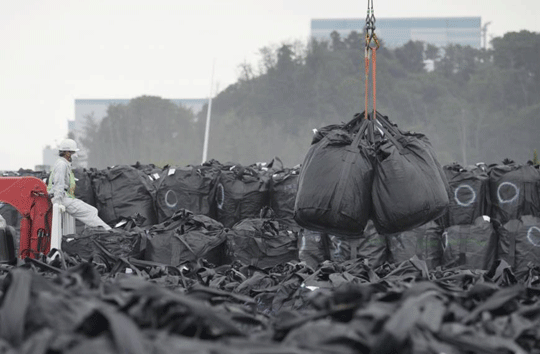
TEPCO collects the contaminated water and stores it all in massive tanks at the rate of up to 400 metric tons a day. Lately the water has been processed to reduce the concentration of radionuclides, but it still retains high concentrations of tritium, a radioactive isotope of hydrogen. Disputes over its final resting place remain unresolved. The same goes for the millions of bags of contaminated topsoil and other solid waste from the disaster, as well as the uranium fuel itself. Health reports, too, are worrisome. Scientists have seen an increase in thyroid cancers among the children who had lived in Fukushima at the time, although it is too early to tell if those cases can be attributed to the accident…….http://www.scientificamerican.com/article/5-years-later-the-fukushima-nuclear-disaster-site-continues-to-spill-waste/
Survey finds “post-disaster” reconstruction slow in Tohoku prefectures
The pace of reconstruction after the powerful earthquake and tsunami that hit parts of northeastern Japan in March 2011, and the subsequent nuclear disaster, differs from community to community, with a delay forecast in Fukushima municipalities affected by radiation from the accident, a Jiji Press survey has revealed.
The survey was conducted in January and February in a total of 42 municipalities along the Pacific coast in Iwate, Miyagi and Fukushima prefectures, and around Tokyo Electric Power Co.’s Fukushima No. 1 nuclear power station, where an unprecedented triple reactor meltdown occurred following the natural disasters.
Of the 42, 12 are in Iwate, and 15 each in Miyagi and Fukushima.
Of the total, 15 municipalities said that post-disaster reconstruction will be completed by the end of fiscal 2020 in March 2021, the final year of the reconstruction period designated by the government.
Three municipalities said reconstruction will finish by the end of fiscal 2016, one by the end of fiscal 2017, six by the end of fiscal 2018 and five by the end of fiscal 2019.
The city of Soma in Fukushima said it is difficult to say exactly when the construction projects will be completed.
Meanwhile, 11 municipalities, including nine in Fukushima, noted that post-disaster reconstruction will end in fiscal 2021 or later.
Many of the nine Fukushima towns and villages cited delays in work to decontaminate areas polluted with radiation and dispose of radiation-tainted soil, and the restoration of agriculture, forestry and fishery industries.
This suggests that industry reconstruction has been tardy, affected by shipment restrictions and misinformation about radiation.
The two other municipalities projecting the completion of reconstruction after fiscal 2020 are Sendai, the prefectural capital of Miyagi, and the Miyagi town of Minamisanriku.
Sendai faces a delay in land procurement for reconstruction projects, including one for elevating roads. The central district of Minamisanriku was devastated by the tsunami.
In Iwate, nearly 50 percent of the planned public housing for people who lost their homes in the quake and tsunami has been completed. The proportion stands at about 50 percent in Miyagi and 40 percent in Fukushima.
Of the 12 Fukushima municipalities where evacuation advisories were issued after the nuclear accident, six, including the towns of Tomioka and Okuma, said that their populations at the end of 2025 are expected to decrease by 20 percent or more from current levels.
Among other municipalities in Fukushima and the two other prefectures, five, including Minamisanriku, project drops of 15-20 percent and eight foresee declines of 10-15 percent.
An official of Minamisanriku said, “The population decrease in our town will likely accelerate, because the number of children is falling and some of the residents who have been evacuated to other areas have found new homes and jobs there and therefore opted not to return to Minamisanriku.”
In Miyagi, Sendai and three nearby municipalities expect increases in their populations, on the back of inflows of evacuees from other areas and the establishment of operational hubs by construction companies.
In Fukushima, population growth is forecast in the town of Shinchi, where a liquefied natural gas storage facility is planned to be constructed.
Many of the surveyed municipalities said that they want the central government to continue securing enough reconstruction budgets and providing personnel support, and to increase flexibility in subsidy programs.
The earthquake and tsunami killed more than 15,800 people and left over 2,500 others unaccounted for.
http://www.japantimes.co.jp/news/2016/02/28/national/social-issues/survey-finds-post-disaster-reconstruction-slow-tohoku-prefectures/#.VtMsmubzN_l
Does Tohoku’s disaster tourism exploit or educate?
Disaster tourism can be an unsettling descent into voyeurism as visitors ghoulishly gawk at, and photograph, those caught up in catastrophe as if they’re at a petting zoo. The concept has prompted widespread condemnation of insensitive tourists and travel companies exploiting disasters as marketing opportunities.
In the years following the Great East Japan Earthquake of 2011, opponents of disaster tourism have claimed that its economic benefits are overstated while the ethical shortcomings are legion. Advocates counter that the economic benefits can be significant, crucial to regional recovery, and that there are important lessons to be learned.
There is no longer much to gawk at along the Tohoku region’s tsunami-ravaged coast, however, save for some shattered buildings preserved to memorialize the tragedy. Bus companies and hotel operators pocket profits, but they also generate jobs and expose outsiders to a region that has always been a neglected backwater.
Recently I witnessed large buses from one local tour company disgorging dozens of sightseers for snapshots of the skeletal disaster management center and the derelict Takano Kaikan hall in Minamisanriku, Miyagi Prefecture. These tourists are spending money in local shops and restaurants in a remote place that has poor transport links and is in the middle of a noisy, messy all-encompassing rebuilding phase. What used to be the center of town is now a vast construction site dominated by giant berms of earth that will raise the town by about five meters.
I met a young man from Osaka who came as a volunteer and then decided to remain in the area. He pointed out that for devastated local businesses, disaster tourism is a welcome lifeline. Elsewhere, a big-screen TV in a hotel lobby features a 3-D video of the tsunami that allows guests to don special glasses and watch the unfolding tragedy. I suppose this could be educational, but the prevailing holiday atmosphere dissuaded me.
Denunciation of disaster tourism in Tohoku is grounded in sympathy for the victims and concerns that devastation is an unseemly attraction, but Australia National University’s Simon Avenell, author of “Transnational Japan in the Global Environmental Movement,” says he is not a purist in this regard.
“From a financial perspective, I’m generally supportive of disaster tourism, certainly because it brings people and some money into the region, but also because it offers local people a chance to express their feelings directly (rather than mediated through the press or TV),” he says. “As time goes by, 3/11 becomes less and less of a news item, so tourism can be at least a small communication pipeline for locals.”
However, Avenell also has qualms about the potential for masking serious unresolved issues, because by promoting a sense of normalization “it could actually hamper fundamental change (and) … its political benefits might be limited or even deleterious in the long run.”
The infamous Kyushu port of Minamata, which put mercury poisoning on the global radar in the 1970s, is now perhaps the most visited sight for school excursions by Kyushu students after Nagasaki’s atomic bomb park and museum. Chris McMorran, a senior lecturer in Japanese studies at the National University of Singapore, takes his students there. He says tourism officials from Tohoku visited Minamata to learn about the city’s educational disaster tourism initiatives and the role of kataribe (storytellers) in them.
“Using an itinerary to create an opening for reflection and communication has long fit the learning objectives of overseas field learning experiences,” he says. There are “packages that continue to attract visitors to Tohoku who want to hear from survivors, witness the destruction and (most intriguingly to me) view (and photograph) disaster monuments. In some areas, there are also new shopping areas targeted at tourists, which feature locally handmade products and restaurants. It seems like these places are actively promoted by locals trying to start businesses in the absence of other major economic activity.”
McMorran posits there are phases in Tohoku’s disaster tourism.
“First, through volunteerism, then volunteer tourism (or ‘voluntourism’), then disaster (recovery/support) tourism. It’s a fascinating evolution that has effectively controlled the potential anarchy of large-scale volunteerism and steered it into consumption (via tourism and the purchase of local goods) as the preferred disaster recovery response from citizens.”
The media has played a significant role in this latter phase. Philip Seaton, a professor of modern Japanese studies at Hokkaido University, has studied the role “contents tourism” has played in Tohoku’s recovery. This is where television shows, films and anime promote an area specifically by featuring it.
Producers chose sites “in disaster zones in the hope that the ‘contents tourism’ induced by popular culture would help in the more general economic revitalization efforts of disaster areas,” Seaton says. Prime examples include NHK dramas “Yae no Sakura,” set in Aizuwakamatsu, Fukushima Prefecture, and “Amachan,” set in Kuji, Iwate Prefecture. It is estimated that the latter generated ¥30 billion in economic benefits for Tohoku as fans of the series flocked to the gorgeous coastal location to sample local delicacies from the show.
It is also clear that a variety of organizations, ranging from religious and education institutions to NPOs and activist groups, are conducting study tours in the region that are explicitly educational. As I wrote two weeks ago, the ruins of Okawa Elementary School in Miyagi Prefecture are now a site for school tours that aim to improve disaster preparation. Universities are also running study tours in the region.
Hiroko Aihara, a journalist with Japan Perspective News, notes that the Japan NGO Center for International Cooperation has issued guidelines for responsible disaster tourism but remains ambivalent over “dark tourism,” which involves places associated with death and suffering. She is concerned about a lingering radiation risk in Fukushima and worries that if tours don’t involve local residents and the evacuees, visitors might get a skewed impression that downplays the nuclear disaster — which could be “converted to political propaganda by the ‘nuclear village,’” she says, referring to pro-nuclear interests. She also cautions that schools and teachers should disclose information about the dangers of radiation exposure near the stricken nuclear plant and suggests bringing individual measurement devices. If properly led, she agrees that educational tours can be beneficial, but she is not in favor of mere casual observation.
Fukushima Prefecture is sponsoring trips to Namie, an abandoned town just 9 kilometers away from Tepco’s three nuclear meltdowns, that convey a powerful message to visitors about the hubris of nuclear safety — underscored by the continuing ban on overnight stays. Nearby Futaba, however, has taken down the iconic pro-nuclear energy welcome sign that spanned the entryway into that ghost town because it had become a favored photo op for tourists. Some disgruntled locals feel it should have been preserved for posterity to help future generations learn the lessons of Fukushima, but abashed town officials claim the aging sign had become a safety hazard. At least that’s their story, and they’re sticking to it.
http://www.japantimes.co.jp/opinion/2016/02/27/commentary/tohokus-disaster-tourism-exploit-educate/#.VtLKBubzN_l
Are Organisms Adapting to Ionizing Radiation at Chernobyl?
Numerous organisms have shown an ability to survive and reproduce under low-dose ionizing radiation arising from natural background radiation or from nuclear accidents. In a literature review, we found a total of 17 supposed cases of adaptation, mostly based on common garden experiments with organisms only deriving from typically two or three sampling locations. We only found one experimental study showing evidence of improved resistance to radiation. Finally, we examined studies for the presence of hormesis (i.e., superior fitness at low levels of radiation compared with controls and high levels of radiation), but found no evidence to support its existence. We conclude that rigorous experiments based on extensive sampling from multiple sites are required.
Radiation research in children teeth in Japan
Prof. Chihiro Ichihara from Aichi Medical University, is an independent man.
He informed the audience about the children teeth project for measuring Strontium 90, with no government support, looking for funding.
Prof. Chihiro Ichihara collects children teeth and lets them measure for Strontium 90. He plans to build an own independent lab for parents.
Similar project was done until the1980s in the U.S. after the bomb tests. It was then supervised by Jay Gould. (STRONTIUM-90 IN BABY TEETH AS A FACTOR IN EARLY CHILDHOOD CANCER http://www.radiation.org/reading/ijhs/ijhs_9_2000.html)
To measure Sr90 is very difficult, because it emits only beta radiation. It causes bone marrow depression, destroys the stem cells and immune system, casuses bone cancer / sarcoma.
His project deserves more attention, because it is VITAL.
STRONTIUM-90 IN BABY TEETH AS A FACTOR IN EARLY CHILDHOOD CANCER
Jay M. Gould, Ernest J. Sternglass, Janette D. Sherman,
Jerry Brown, William McDonnell, Joseph J. Mangano
International Journal of Health Services
Volume 30, Number 3, Pages 515-539, 2000
Copyright Baywood Publishing Co., Inc
http://www.radiation.org/reading/ijhs/ijhs_9_2000.html
Kudos to Prof. Ichihara, wo worked at the research reactor in Kyoto: “He is a physicist specialising in Neutron transport experiments and their calculation as well as in gamma-ray spectrum measurement.
Currently, he teaches as a Visiting Professor at Aichi Medical University. He is a member of the Steering Committee of PDTN. Previously, Prof. Chihiro Ichihara was an Associate Professor at the Research Reactor Institute of Kyoto University.”
Special credits to Jan Hemmer for the pictures and the informations


Hot Spots in the 5th Year Over 20μSv h in Fukushima city Feb. 23, 2016
Here is the video made by Masa in Fukushima and his group. The video is available in English. This is the reality of 5 years after the nuclear accident. The area in the video is going to be “de-contaminated” in this coming spring, 2016.
Despite that there are numerous hot spots in school routes and parks, Masa says that in Fukushima, nobody talks about radiation anymore.
In the 5th year since the Fukushima nuclear accident, we found hotspots on the riverbed in Fukushima city. They exceeded 20μSv/h. We examine the present FUKUSHIMA which is facing the micro-hot-spots phenomena.
As far away as Tokyo, highly radioactive black sand from Fukushima meltdowns is found
New Meltdown Byproduct Found Far From Fukushima Daiichi, Simply Info February 4th, 2016 Another type of material has been found by researchers that is tied to the meltdowns at Fukushima Daiichi. We have reported extensively over the years on the finding of “black stuff” around mainland Japan. This is a highly radioactive black sand like material that had gathered in gutters and roads as far away as Tokyo. Analysis of materials of that type has linked them to the meltdowns inside the reactors at Fukushima Daiichi. This new finding is also linked directly to the reactor meltdowns……..http://www.fukuleaks.org/web/?p=15283
Radioactive leak – but Japanese nuclear reactor still to restart
 Japan nuclear reactor to resume operations despite radioactive leak. UPI.com By Elizabeth Shim TOKYO, Feb. 25 –– A Japanese nuclear power plant reactor that had shown signs of radioactive leaks is to resume operations.
Takahama nuclear power plant’s No. 4 reactor is scheduled to return online Friday, the Asahi Shimbun reported, following the return of two reactors at the Sendai plant in southern Japan, and the resumption of operations at the Takahama plant of reactors No. 1, 2 and 3. The No. 4 reactor was suspended in July 2011 after a regular inspection and is returning online after four years and seven months.
But prior to the announcement, the plant’s parent company Kansai Electric Power had said 36 quarts of contaminated water had been found in a structure next to the No. 4 reactor……….Reactors No. 1 and 2 at Takahama have been operating for more than 40 years. http://www.upi.com/Top_News/World-News/2016/02/25/Japan-nuclear-reactor-to-resume-operations-despite-radioactive-leak/6581456422419/
TEPCO kept secret for 2 months that Fukushima nuclear meltdown occurred
Fukushima nuclear plant operator kept meltdown quiet for 2 months Company says officials were unaware meltdown defined as damage exceeding 5% of a reactor’s fuel CBC News, The Associated Press Feb 25, 2016 The operator of Japan’s damaged Fukushima nuclear plant acknowledged Thursday it failed for two months to announce that meltdowns had occurred in the cores of three of the reactors.
Tokyo Electric Power Co. said its officials were unaware of a company emergency manual that defined a meltdown as damage exceeding five per cent of a reactor’s fuel.
Instead, TEPCO described the condition of the reactors as less serious “core damage” for two months after the plant was hit by a massive earthquake and tsunami in March 2011, despite early damage estimates ranging from 25 to 55 per cent…….
In May 2011, TEPCO finally adopted the term “meltdown” after a computer simulation showed fuel in one reactor had almost entirely melted and fallen to the bottom of the primary containment chamber, and that two other reactor cores had melted significantly…… http://www.cbc.ca/news/world/japan-fukushima-meltdown-report-1.3463649
Radioactive contamination still a very real crisis for Fukushima fishermen
Nuclear water: Fukushima still faces contamination crisis, Phys Org, February 25, 2016 by Harumi Ozawa, Quentin Tyberghien Fish market vendor Satoshi Nakano knows which fish caught in the radiation tainted sea off the Fukushima coast should be kept away from dinner tables.
“It was the single largest release of radioactivity to the marine environment in history,” Greenpeace nuclear expert Shaun Burnie told AFP on the deck of the campaign group’s flagship Rainbow Warrior, which has sailed in to support a three-week marine survey of the area the environmental watchdog is conducting.
Fukushima is facing an “enormous nuclear water crisis,” Burnie warned. He added: “The whole idea that this accident happened five years ago and that Fukushima and Japan have moved on is completely wrong.”
Safe to eat?
Existing contamination means fishermen are banned from operating within a 20-kilometre (12.4-mile) radius from the plant……..http://phys.org/news/2016-02-nuclear-fukushima-contamination-crisis.html
Japan restarts fourth atomic reactor since 2012 moratorium
OSAKA – Kansai Electric Power Co.’s Takahama No. 4 reactor in Fukui Prefecture on Friday became the nation’s fourth to be restarted since 2012 and the first to burn MOX, a mixed-oxide fuel that contains plutonium.
In a statement released Friday afternoon, Kepco President Makoto Yagi said safety would remain the top priority and that the utility would continue to promote safety standards beyond what was legally required.
The startup came nearly a week after a radioactive water leak was discovered at the reactor’s auxiliary building on Feb. 20. Kepco halted restart preparations while it repaired the leak, saying it did not pose a danger to the environment.
The utility said earlier this week the leak was caused by a loose pipe valve and could be repaired without affecting the restart schedule, which called for rebooting the unit by the end of this month.
Under Kepco’s schedule for the restart process, the No. 4 reactor is expected to start generating electricity by Monday afternoon and reach full power a few days later. Once the Nuclear Regulation Authority gives final approval, and assuming there are no last-minute technical problems, the plan is to have it back online and selling electricity from late March, just before the end of fiscal 2015.
The restart of Takahama No. 4 comes about a month after the nuclear power plant’s No. 3 reactor was restarted. Along with two reactors at Kyushu Electric’s Sendai plant, which went back online last August, they comprise the four reactors that have been restarted since beefed-up nuclear safety standards took effect in 2012.
In addition to No. 3 and No. 4, which are at least 30 years old, Kepco also wants to restart Takahama Nos. 1 and 2, both of which are over 40. It hopes to run them for up to two decades. Despite concerns about the increased probability of accidents at the aged plants, their restart moved a step closer to reality on Wednesday, when the NRA said additional safety systems Kepco installed to extend the reactors’ life spans met its standards.
The next step will be soliciting public comment, and then further permission from the NRA is required for what would be the first-ever extensions in Japan of reactors over 40 years old.
Before that happens, Kepco will seek final permission from the mayor of Takahama and the governor of Fukui Prefecture for the restart, which could be a lengthy process. The utility may also find itself forced to deal with public and political concerns in surrounding Kansai prefectures like Shiga and Kyoto, where safety concerns about the aged reactors are strong.
2015 census 1st to confirm national population decline / Fukushima Pref. sees 5.7% fall since 2010

According to preliminary figures of a simplified 2015 census released Friday, Japan’s population dropped to 127.11 million — the first confirmed census decline since the government started conducting such surveys in 1920.
The Internal Affairs and Communications Ministry said the latest census shows that Japan’s population as of Oct. 1, 2015, was 127,110,047. This represents a decline of 947,305, or 0.7 percent, since the last census conducted in 2010. In the 2015 census, men accounted for 61,829,237 of the population, and women 65,280,810.
The population of Fukushima Prefecture, where many residents are still being forced to live away from home due to damage caused to their hometowns by the 2011 Great East Japan Earthquake, decreased by 115,458, a 5.7 percent decline from the last census. The two other prefectures hit hardest by the disaster — Iwate and Miyagi — also saw population declines.

The ministry had estimated that the nation’s population had been declining for four straight years since 2011. The latest results are the first confirmation via a census that the national population has gone down since the government began conducting them.
A ministry official said Japan’s population decline seems to be largely due to the natural factor of deaths outnumbering births. The government conducts a census every five years, and this is the first since the 2011 disaster.
Out of 47 prefectures nationwide, populations declined in 39, including Hokkaido and Aomori. Of the three prefectures hit hardest by the disaster, Miyagi’s population dropped by 13,950, or 0.6 percent; and Iwate’s by 50,333, or 3.8 percent. The decline in Miyagi Prefecture was small, probably due to the inflow of people working on reconstruction projects. The population increased in eight prefectures, including Okinawa, Tokyo and Aichi.
The census found the number of households in the country was a record high 53,403,226, but the average number of people per household was a record low of 2.38.
A large-scale census is conducted every 10 years, and a simplified census is carried out every five years after a large census. The 2015 census was a simplified one.
Disparity seen widening
The vote-value gap between the most and least populated single-seat constituencies of the House of Representatives is estimated to widen to 2.334-to-1, according to trial calculations based on preliminary figures from the latest census released Friday.
This represents an expansion of the disparity from 1.998-to-1 calculated based on the 2010 census.
Selected for comparison were Tokyo Constituency No. 1, which has the largest population per its lower house member, and Miyagi Constituency No. 5, which has the lowest such ratio.
The disparity when compared to the least-populated constituency is estimated to expand to 2-to-1 or more in 37 electoral districts.
The law on the establishment of the Council on the House of Representatives Electoral Districts calls for limiting the gap to less than 2-to-1.
Since 2011, the Supreme Court has ruled that three lower house elections, conducted when a national disparity of more than 2-to-1 existed, were held in a “state of unconstitutionality.”
A research council on the lower house electoral system also demanded that the gap be brought to within 2-to-1. The council is an advisory panel to the lower house speaker.
Up 9, down 15
The allocated number of seats in the lower house will increase by a total of nine across five prefectures, but one seat will be eliminated in each of 15 prefectures, according to an estimate made by The Yomiuri Shimbun based on the latest census results and using the Adams’ method, which is recommended by an advisory panel to the House of Representatives speaker.
Under the current allocation of lower house seats, vote-value disparities between prefectures are 1.885-to-1 or less. But if the increase of nine seats with a reduction of 15 seats is realized, the disparities will drop to 1.668-to-1 and remain lower than the current figure for a while, even if populations in prefectures change in the future.
Though the Democratic Party of Japan, Komeito, the Japan Innovation Party and others intend to accept a report made by the advisory panel recommending the Adams’ method, the Liberal Democratic Party is wary of introducing it. The LDP says vote-value disparities should initially be dealt with by trimming six seats and not adding any.
However, according to an estimate based on the latest census results made with the LDP reform plan to eliminate six seats, one seat each will be eliminated in six prefectures — Aomori, Iwate, Mie, Nara, Kumamoto and Kagoshima. But the largest vote-value disparity between prefectures will remain unchanged at 1.885-to-1. This might require complicated changes to the demarcation of electoral districts, observers said.
Prime Minister Shinzo Abe has already expressed his desire to enact a bill to revise the Public Offices Election Law and other legislation by the end of the current Diet session.
1 This Month




PLEASE OPPOSE HR 8255 AND S.3639 – bills would accelerate satellite deployment, with no environmental review or safeguards – https://ncstd5li.quorum.us/campaign/169331/
To see nuclear-related stories in greater depth and intensity – go to https://nuclearinformation.wordpress.com
-
Archives
- September 2026 (330)
- August 2026 (330)
- July 2026 (355)
- June 2026 (287)
- May 2026 (306)
- April 2026 (356)
- March 2026 (251)
- February 2026 (267)
- January 2026 (308)
- December 2025 (358)
- November 2025 (359)
- October 2025 (375)
-
Categories
- 1
- 1 NUCLEAR ISSUES
- business and costs
- climate change
- culture and arts
- ENERGY
- environment
- health
- history
- indigenous issues
- Legal
- marketing of nuclear
- media
- opposition to nuclear
- PERSONAL STORIES
- politics
- politics international
- Religion and ethics
- safety
- secrets,lies and civil liberties
- spinbuster
- technology
- Uranium
- wastes
- weapons and war
- Women
- 2 WORLD
- ACTION
- AFRICA
- Atrocities
- AUSTRALIA
- Christina's notes
- Christina's themes
- culture and arts
- Events
- Fuk 2022
- Fuk 2023
- Fukushima 2017
- Fukushima 2018
- fukushima 2019
- Fukushima 2020
- Fukushima 2021
- general
- global warming
- Humour (God we need it)
- Nuclear
- RARE EARTHS
- Reference
- resources – print
- Resources -audiovicual
- Weekly Newsletter
- World
- World Nuclear
- YouTube
-
RSS
Entries RSS
Comments RSS

