Despite all the misery, nuclear facility vital part of people’s lives Part 2

A former fisherman who ended up working full-time at the Fukushima No. 1 nuclear power plant harbors mixed feelings about his job choice.
Editor’s note: This is the second installment of a three-part series on conditions that contract workers face at the crippled Fukushima No. 1 nuclear power plant.
* * *
For those living in coastal areas of Fukushima Prefecture, the Fukushima No. 1 nuclear power plant is a bit like the proverbial elephant in the living room, in that it looms large in their lives.
Although the plant unleashed untold havoc five years ago, many people find it unsettling to badmouth the site to which they have owed their economic well-being–even after the disaster.
Tokyo Electric Power Co.’s sprawling nuclear complex provided them with coveted employment that made the difference between making do and doing without in an otherwise depressed local economy.
One local resident, a onetime fisherman, summed up the thoughts of people in the area by saying: “You cannot deny having a sense of gratitude if you have lived in this coastal region. It is not a question of like or dislike.”
Born in a community close to the crash of waves, the man aspired from an early age to become a fisherman.
He loved the sea so much that he even stopped attending high school for several months to work on a boat trawling for Pacific saury.
He eventually quit high school to make his living by fishing full-time.
Local fishermen can be away from home for months at a time, traveling to distant parts of the globe and danger. The longest time the man had been away was 10 months.
He recalled fishing for squid off Argentina shortly after the Falkland War ended in 1982 and witnessing a ship coming under fire and sinking because the vessel had intruded into the country’s territorial waters.
He began a stint at the Fukushima plant in around 1972, about a year after the plant opened. Although he was a full-time fisherman, the man sought to supplement his income when it was off-season for fishing.
As prices for fish continued to stagnate, he eventually quit fishing altogether in 1989 to become a full-time worker at the Fukushima plant.
Ever since, his life revolved around his work at the site–until the disaster triggered by the Great East Japan Earthquake and tsunami on March 11, 2011.
After a break of a couple of months in the aftermath of the triple meltdown, the man returned to the plant to work on ventilation equipment at a reactor building.
He was hired by a construction company based near the crippled facility.
Back in the 1970s, the man recalled that subcontractors were lax about the handling of radioactive materials.
“Workers did not follow the set rules as strictly as today,” he said.
They occasionally disposed of pipes and other radioactive waste generated at reactor buildings manually, although they were expected to use a machine for the task.
His responsibility also involved checking pipes for cracks.
To detect a flaw in piping, it was a standard procedure then, as it is now, to conduct a liquid penetrant test.
Workers paint pipes with a red solution and wipe them after a while.
The penetrant remains inside the damaged parts. Workers then coat the pipes with “developing fluid,” which is a mixture of highly volatile liquid such as thinner and some sort of white powder.
Red stains left in the flawed sections emerge in the process so that workers can identify parts that need to be repaired.
However, they would skip making needed repairs when they feared they would not be able to meet the deadline for the work they had been assigned to do.
“We deliberately did not paint red penetrant to the parts that we knew were damaged,” he recalled.
The man said his crew had no choice.
“The contractor told us to make out a report for all the mistakes we made, but we knew we would be better off not doing so because we would be certainly slapped with a penalty for the errors we would have reported,” he said. “As long as the nature of relations between a contractor and a subcontractor remained that of a higher and lower rung of a pyramid, attempts to cover up oversight were bound to continue.”
When the magnitude-9.0 earthquake struck, the man was in the basement of a reactor building.
An inspection was under way at the time to check whether the replacement of parts he had just finished was done properly.
The man heard metallic clanks from a floor above as if two huge objects had collided with each other.
He was desperate to flee right away, but could not. The stairs were shaking so violently that he was unable to climb them. The man was only able to climb ladders and reach safety after the vibrations had subsided.
Ensuing tsunami swept into the compound, but did not reach the office where he took refuge.
He managed to return home that night.
Later, he learned that the last people to leave the plant were engineers who handled valves.
These were the men who knew exactly which direction water will flow when a particular pipe valve was opened.
“All of us hired by a contractor and subcontractors remained on-site after the other workers had left,” a valve engineer told him.
The man returned to work at the plant around May 2011.
The company initially stated that the men would not have to work at the plant. But one day, the president of the company summoned them to a canteen and apologetically told them they had to.
“It is far from my intention to accept work at the Fukushima No. 1 nuclear plant, but I would be out of a job if we refused,” he said. “I am sorry to have to say this, but I registered you as reserve workers for the plant.”
The president said executives of a contractor had assembled the presidents of subcontractors to ask them to secure manpower for the plant.
One of the presidents demanded an extra allowance for the radiation risks in return.
“The current terms and conditions are unacceptable,” the president said. “We request you provide more hazard pay.”
Then one of the executives of the contractor declared: “We will not partner with a subcontractor that puts money first.”
Some subcontractors went along with the contractor, including the man’s company, while others refused.
When he was a full-time fisherman, the man and his peers were opposed to the plant.
“We believed that warm, discharged water from the plant would cause a change in the ecosystem in waters nearby,” he said.
Still, it was the nuclear power plant that provided him with a job to make a living over nearly four decades.
“Subcontractors have heavily relied on work at the plant as a source of their revenues before and even after the accident,” he said. “Thanks to the contracts with the plant, some companies grew into larger ones and others succeeded in improving their technological skills.”
Braving danger and radiation for chance to earn 11,000 yen a day Part 1

A one-year contract signed by a man from Nagano Prefecture and a subcontractor for the Fukushima No. 1 nuclear power plant. Part of the image was modified for privacy reasons.
Editor’s note: An army of workers, 6,000 or so, battles daily on the front line of the stricken Fukushima No. 1 nuclear power plant to get the site ready for the decades-long process of decommissioning the reactors.
An overwhelming majority of the men are hired by subcontractors and endure low pay, fragile job security and hazardous working conditions. Radiation exposure is a constant risk.
This three-part series is intended to shed light on conditions at the plant and how the people working there feel about their jobs.
***
It is winter and still dark when the man awakes at 3:30 a.m. to start his working day. He begins by putting on five layers of clothing under his protective gear, and dons two pairs of gloves and socks, the insides of which are stuffed with disposable hand warmers.
But even then, the 36-year-old native of Iwaki, Fukushima Prefecture, is cold.
Thirty minutes later, a cutting breeze blows from the ocean as the man climbs into a car ordered by his employer to take him to the J-Village facility, where the workers board buses to transport them to the crippled Fukushima No. 1 nuclear power plant 20 kilometers away. The man’s job is to lay pipes containing contaminated water at the complex. He works for a fourth-tier subcontractor with Tokyo Electric Power Co., operator of the plant.
Five years after the triple meltdown, the plant premises are much tidier than in the immediate aftermath of the disaster. Today, the ground is covered with steel sheets.
However, the steel frames of the reactor buildings still stand exposed because the concrete walls were blown out in hydrogen explosions triggered by the overheating of reactor cores.
Inevitably, jobs near the reactor buildings pose radiation risks.
“The closer you get to the reactor buildings, the higher the radiation readings,” the man said. He is required to carry a dosimeter whenever he is on-site.
Each time the man’s dose climbs by 0.16 millisievert, an alarm sounds. If the alarm goes off three times in a single shift, he must stop what he is doing, no matter what work remains to be done.
With a full-face mask and protective gear, working in summer months can be more grueling–and even life-threatening.
He packs ice cubes under his clothes to keep cool, but they melt within 30 minutes.
One summer day, he saw a middle-aged man lying on the floor of a lounge where the workers congregate during their break.
The man had collapsed after the end of his shift. Although the individual was airlifted to a hospital by helicopter, he apparently died of heatstroke.
When the magnitude-9.0 Great East Japan Earthquake struck, the Iwaki man was working inside the No. 1 reactor building. The power went out and in the darkness he heard a loud crashing noise, as if a piece of equipment had suddenly ground to a halt.
He fled the building as fast as he could.
Fissures dotted the concrete surface of the ground and shards of glass were everywhere.
The man took refuge in a structure in the compound known as the “company building.”
A roll call was taken to check that everybody was safe, and then he and his colleagues were dismissed in the evening.
The Iwaki man did not recall seeing the effects of the tsunami on his way home, which he reached at 8 p.m. By that time, he was running a fever and itched all over his body, probably the result of a stressful and nerve-racking day.
A hydrogen explosion rocked the No. 1 reactor building the following day, March 12.
Several days later, the man and his family evacuated to Nagoya, where he has relatives.
But around May, the president of the company he had worked for called and asked him to consider returning to the plant.
After giving the matter some thought, the Iwaki man accepted. His daughter had just turned 1 year old. He had a family to raise. Leaving his family behind, the man returned to Fukushima for a job that pays 11,000 yen ($97) a day.
ANOTHER MAN’S STORY
A 44-year-old man from Nagano Prefecture landed a short-term position at the plant in 2012 after scouring job ads online.
“I wanted to help contain the spread of radioactive contamination,” said the man, who previously worked in a local car dealership.
Shortly after replying to the ad, he was contacted by a subcontractor.
“We have a job to measure workers’ radiation levels,” the man was told. “It does not entail exposure to high levels of radiation.”
Relieved, the man headed to Iwaki and signed a one-year contract with a company that called itself a fourth-tier subcontractor.
But when he attended a briefing held by a first-tier subcontractor several days later, he learned that the initial job description was far different from what he had just been told.
“As you know, you will be working in an area where radiation levels are high. That’s because the mixers for contaminated water are there,” the official said. “You will be able to stay in the area for five to 10 minutes, no longer.”
The official added that the men would not be involved in replacing the mixers themselves as that is done by veteran workers.
What he and the others were required to do was lay rubber mats on the floor to lower those workers’ radiation exposure to enable them to stay longer.
He was also told that workers have to carry breathing apparatus on their backs.
The Nagano man, upset by what he had just learned about the job, protested to the president of the fourth-tier subcontractor afterward.
“It would be impossible for me to continue with this job as long as for a year if I had such a high level of radiation dose,” he said. “This is not what I signed up for.”
The president tried to appease him.
“Even if you had a reading of 1 millisievert a day, it would halve in a week,” the president said. “If you quit at this stage, the company’s reputation would be jeopardized.”
As it happened, the assignment involving high radiation risks was canceled at the last minute.
Instead, the workers were required to clear the glass shards in the compound.
During a break on the first day of his job, in June 2012, he struck up a conversation with a regular employee of a first-tier subcontractor.
“Would you allow your son to work in a job that gives out several millisieverts of exposure a day?” he asked the middle-aged man.
The employee replied: “It will not be a problem legally, but I would not (send my son to do that kind of work).”
On his way back to his lodgings, the president of the fourth-tier subcontractor called him. He was told to stop by at the office of a third-tier subcontractor.
When he showed up, he was met by someone he didn’t know.
“What you said at the work site gave us problems,” the stranger said. “You do not need to come to work anymore.”
After arguing with the official, the man returned to Nagano Prefecture three days later.
Later, he noticed his bank account had been credited to the tune of 24,000 yen, reflecting what was left over from several days of wages after accommodation costs had been deducted.
The man said he still has no idea at what point the original assignment to measure radiation doses was switched to one that was, without question, dangerous.
http://www.asahi.com/ajw/articles/AJ201604050034.html

Cheated every step of the way: a raw deal from subcontractors Part 3

Two types of monthly paychecks a man in Iwaki, Fukushima Prefecture, received. The payslip issued by a waterworks company in January 2015, right, stated the company paid him 236,828 yen. A cleaning company’s hand-written pay details mention the sum of 204,328 yen. Parts of the images were modified for privacy reasons.
Editor’s note: This is the last installment of a three-part series on conditions that contract workers face at the crippled Fukushima No. 1 nuclear power plant.
* * *
It’s a dirty job, but somebody’s gotta do it.
And that sums up what contract workers are facing, having signed up for jobs to clean up the wrecked Fukushima No. 1 nuclear power plant.
These men are positioned near the bottom of a pyramid of a multilayered hiring system, and get shunted off to dangerous work on the ground–often without due compensation.
One man who quit working at the plant last October was simply fed up with being shortchanged, especially as the work he did was potentially hazardous to his health.
“My pay was doubly skimmed off,” said the 27-year-old, who is from Iwaki in the prefecture.
The man’s case seems to be anything but exceptional because of a hiring system at the plant in which layers of subcontractors often skim off their shares as they assign work to companies below them.
The man signed on with a cleaning company in late 2012 to do decontamination work in Naraha, a stricken town near the plant. There was no written contract for his employment, just a verbal arrangement.
Then in March 2014, the cleaning company referred him to a “better-paying job” at the plant and asked him to sign a contract with a local waterworks company for the assignment.
His written contract with the waterworks company stated that his daily wage would be 15,500 yen ($137).
But the cleaning company, from which the man received his pay for work performed on behalf of the waterworks firm, told him that he would actually get 2,500 yen less than promised. It cited “miscellaneous expenses.”
“Our company cannot continue to operate without funds,” said an official with the cleaning company by way of explaining the discrepancy.
The cleaning company took possession of the man’s bank passbook and seal, and withdrew all the money the waterworks company paid into his bank account.
The cleaning company handed him a monthly salary in cash that was calculated on the basis of 13,000 yen per day.
He was also given two payslips: one stating a salary based on a daily wage of 15,500 yen and the other for 13,000 yen.
After working at the plant for 18 months or so, the man learned that he was being gypped more than he had realized. What the waterworks company actually paid to the cleaning company as his monthly salary was computed on the basis of a daily wage of 20,000 yen.
When he confronted the cleaning company, an official was evasive.
“It was a referral fee,” the official said of the gap. “We will raise your salary.”
Growing distrustful, the man quit the cleaning company in October.
In an interview with The Asahi Shimbun, a female representative at the cleaning company said it had never engaged in fraudulent activities.
“It is true that we kept his bank passbook,” she said. “We did it to withdraw money on his behalf since he could not go to the bank on pay day due to work.”
Plant operator Tokyo Electric Power Co. announced it was doubling hazard pay to 20,000 yen a day in November 2013 to help bolster morale among workers and secure manpower.
The problem is that TEPCO pays the contractors directly, so whether the money actually trickles down to subcontractors–and contract workers they employ–is a separate issue.
In the case of the Iwaki man, his payslip prepared by the waterworks company showed 7,000 yen in hazard pay out of the daily wage of 15,500 yen.
The hand-written slip created by the cleaning company, however, did not have an entry for danger allowance.
Still, the man was involved in work that carried radiation risks, and, in his opinion, with less than adequate protection.
His job at the plant was to install fire hydrants. Radiation readings on the dosimeters that workers were required to carry climbed as his work progressed because the water pipes for hydrants are extended toward the reactor buildings.
Although technicians working near the reactor buildings donned lead vests to shield themselves from radiation, the man had to make do with only protective suits.
On one occasion, his dosimeter started beeping loudly as he approached a reactor building. “Flee!” his boss shouted.
“My work was dangerous,” said the man. “I find it totally unacceptable that my pay was comparable to the money paid for a cleanup assignment.”
Tsuguo Hirota, a lawyer from Fukushima Prefecture who has been involved in lawsuits over back pay of hazard and other allowances for contract workers, said the multitiered hiring system at the plant is at the heart of the problem.
“If the system to repeatedly outsource work to subcontractors were not altered, the practice of skimming off (workers’ salaries) would still be continuing,” he said.
In one case, he said a leading construction company paid a daily wage of 43,000 yen per employee. But all a worker at a third-tier subcontractor ended up with was 11,500 yen.
On the other hand, the skimming of salaries is no longer a widespread practice in the cleanup operation commissioned by the Environment Ministry, although it was the case in the immediate aftermath of the 2011 triple meltdown.
When the ministry places an order with a contractor, its deal includes a clause requiring that designated hazard pay must be paid to workers hired by subcontractors.
But no similar arrangements have been made at the Fukushima No. 1 nuclear power plant.
Other problems inherent in a multilayered hiring system center on ultimate responsibility for ensuring the safety of contract workers at the plant and tracking their accumulative radiation exposure over a long period.
When the Iwaki man worked at the plant, he received instructions from the waterworks company, a third-tier subcontractor, on how to perform his tasks. But a second-tier subcontractor and the cleaning company also told him how to do his job, which could have been unlawful.
According to a TEPCO survey last autumn, 14.2 percent of respondents, or 465 workers, said the company that pays their wages is different from the one that gives direction on how to do the job.
Takeshi Katsura, a staff member of the Fukushima nuclear power plant workers’ consultation center, a private group in Iwaki, urged subcontractors to have a greater sense of responsibility for their workers.
“Even five years after the accident, some are working on a mere verbal arrangement,” he said. “A company that concluded a contract with workers should responsibly oversee their wages, safety, social security programs and other work-related matters.”
Japanese People Shun Fukushima Survivors While Doctors Refuse Them Care
From 2/26/2016

Those who do not fit the norm, for whatever reason no matter how abusive, are outcasts.
In retrospect, societal norms throughout history have sometimes become fatally irresponsible. When it comes to popular movements and health trends, humanity has had its share of shameful events stamped forever into the history books. While working in Vienna General Hospital’s first obstetrical clinic, where doctors’ wards had three times the mortality of midwives’ wards, Hungarian physician Ignaz Semmelweis proposed the novel idea of hand washing in 1847. Despite various publications of results where hand washing reduced mortality from 35% to below 1%, Semmelweis’s observations conflicted with the established scientific and medical opinions of the time and his ideas were rejected. After his discovery, Semmelweis was committed to an insane asylum and promptly beaten to death by guards. As horrific as these visions and events can sometimes be, they continue to be played out in today’s society partially due to public ignorance, corruption, conflicts of interest and imbedded norms.
The world is rapidly approaching the five year anniversary of the worst nuclear disaster in human history. The triple meltdown at the Fukushima daiichi nuclear power plant has seen shameful omissions by global leaders and officials at every level. To compound matters, Japanese survivors are forced to submit to a complicit medical community bordering on anti-human. While the solutions to the widespread nuclear contamination are few, media blackouts, government directives and purposefully omitted medical reporting has made things exponentially worse. Over the last five years, the situation on the ground in Japan had deteriorated to shocking levels as abuse and trauma towards the survivors has become intolerable.
Even before the nuclear disaster in Fukushima, Japan endured another nuclear disaster as a testing ground for the US military’s new nuclear arsenal on the cities of Hiroshima and Nagasaki in 1945. The numbers of Japanese civilians killed were estimated at around 226,000, roughly half of the deaths occurred on the first day. After the initial detonation of the two nuclear bombs, both Japanese cities endured a legacy of radiation damage and human suffering for decades after. Tomiko Matsumoto, a resident of Hiroshima and survivor of the bombing described the abuse and trauma she endured by her society:
“I was shocked because I was discriminated against by Hiroshima people. We lived together in the same place and Hiroshima people know what happened but they discriminated against each other. ..I was shocked.”
“There were so many different kinds of discrimination. People said that girls who survived the bomb shouldn’t get married. Also they refused to hire the survivors, not only because of the scars, but because they were so weak. Survivors did not have 100 percent energy.”
“There was a survivor’s certificate and medical treatment was free. But the other people were jealous. Jealous people, mentally discriminated. So, I didn’t want to show the health book sometimes, so I paid. Some of the people, even though they had the health book, were afraid of discrimination, so they didn’t even apply for the health book. They thought discrimination was worse than paying for health care.”
A similar scene is playing out today in Japan as residents of the Fukushima prefecture, who survived triple nuclear meltdowns, are forced to endure similar conditions over half a century later. Fairewinds Energy Education director and former nuclear executive Arnie Gundersen is currently embarked on a speaking tour of Japan as their population continues to search for the truth about nuclear risks and the reality of life in affected areas of Japan after the 2011 disaster. Many Fukushima prefecture residents are still displaced and living in resettlement communities as their city sits as a radioactive ghost town. Visiting one such resettlement community, Gundersen had this to say:
“Today I went to a resettlement community. There were 22 women who met us, out of 66 families who live in this resettlement community. They stood up and said my name is…and I’m in 6A…my name is…and I’m in 11B and that’s how they define themselves by the little cubicle they live in — it’s very sad.”
Speaking with the unofficial, interim mayor of the resettlement community, she told Gundersen
“After the disaster at Fukushima, her hair fell out, she got a bloody nose and her body was speckled with hives and boils and the doctor told her it was stress…and she believes him. It was absolutely amazing. We explained to her that those area all symptoms of radiation [poisoning] and she should have that looked into. She really felt her doctor had her best interests at heart and she was not going to pursue it.”
Speaking about how Japanese officials handled this resettlement community’s (and others?) health education after the disaster, Gundersen reported:
“They [the 22 women who met with Gunderson] told us that we were the first people in five years to come to them and talk to them about radiation. They had nobody in five years of their exile had ever talked to them about radiation before…Which was another terribly sad moment.”
When asked if the women felt isolated from the rest of Japan they described to Gundersen the following:
“Some of them had changed their license plates so that they’re not in Fukushima anymore — so their license plates show they’re from another location. When they drive back into Fukushima, people realize that they’re natives and deliberately scratch their cars…deliberately scratch their cars because they are traitors. Then we had the opposite hold true that the people that didn’t change their plates and when they left Fukushima and went to other areas, people deliberately scratched their cars because they were from Fukushima.”
Gundersen summed up the information he received by saying, “The pubic’s animosity is directed toward the people of Fukushima Prefecture as if they somehow caused the nuclear disaster.”
When it comes to health decisions, the medical community and political class has polarized the conversation into an “either-or” “us vs. them” mentality. Reckless lawmaking and biased reported has only driven the Japanese public further down this slippery slope. In many countries, the public watched as medical dogma and ideology captured healthcare, which in turn began to direct policy and law. Many societies beyond Japan are now facing difficult choices as the free expression of health preservation and medical choice has fallen into a dangerous grey area. Oscillating between authoritative legal action, medical discrimination and public abuse, society’s norms appear to be rapidly heading down the wrong road. Untold damage and traumas are unfolding as governments hide information and quietly omit vital data further fueling the fire. Alternative media and the work of those in medicine with true integrity and compassion have herculean tasks awaiting them as they work to change a historically dangerous narrative attempting to root.
Autoradiograph: radioactivity after the 3/11 quake
By Masamichi Kagaya (Photographer) and Dr. Satoshi Mori (University of Tokyo)
As a consequence of the Great East Japan Earthquake and ensuing tsunami on March 11, 2011, the cores of the first to third nuclear reactors at the Fukushima Daiichi Nuclear Plant underwent meltdowns as external power for the cooling pumps was lost. As a result, a huge amount of radioactive particles was released into the air. These particles were carried by southeasterly winds to Iitate Village, Fukushima City, and Nakadori, a central region of Fukushima Prefecture, leaving high levels of radioactive contamination in their wake. The particles were further carried along multiple routes creating radioactively contaminated areas in regions from Ibaraki to Tokyo and Kanagawa Prefecture, as well as in Northern Kanto and the Tohoku Region (Northeastern Japan).
Whether we are in Tokyo, Fukushima, or even in front of the damaged nuclear reactor buildings, we are exposed to radiation that we are unaware of. It is too small to see, it cannot be heard and it is odorless. Therefore, despite living in a region contaminated with radioactive particles, to this day, we are not consciously aware of the radiation. NaI (TI) scintillation detectors and germanium semiconductor detectors are used to measure the amount of radioactive contamination in soil, food, and water in units called Becquerels (Bq). Radioactivity is further measured in Sieverts (Sv), which is an index of the effects of radioactive levels in the air, doses of exposure, and so on. Nevertheless, from such values, it is impossible to know how the radioactive particles are distributed or where they are concentrating in our cities, lakes, forests, and in living creatures. These values do not enable us to “see” the radioactivity. Thus, radioactive contamination has to be perceived visibly, something that can be done with the cooperation of Satoshi Mori, Professor emeritus at Tokyo University. Professor Mori is using autoradiography to make radioactive contamination visible.
Today, dozens of radiographic images of plants created by Professor emeritus Mori since 2011 are on display together with radiographic images of everyday items and animals. This collection of radiographic images (autoradiographs) is the first in history to be created for objects exposed to radiation resulting from a nuclear accident. I hope that visitors will come away with a sense of the extent of contamination in all regions subject to the fallout — not just those in and around Fukushima. At the same time, I hope that this exhibition will remind visitors of the large region extending from the Fukushima Daiichi Nuclear Power Plant to Namie Town, Iitate Village and the dense forests of the Abukuma Mountain Area that, to this day, remain restricted areas. The radiation affects animals that continue to live in these areas and be exposed to heavy radiation, as well as the 140,000 people that had to evacuate and who lost personal assets (homes, property, work, interpersonal relationships). These people are in addition to the victims who directly breathed in the radioactive materials, subjecting them to internal exposure — victims that include anyone from the residents near the plant to people in Tokyo and the Kanto Region.
Although what can be done is limited, new progress has made it possible to record the otherwise invisible radioactivity and make it visible. The history of needless nuclear accidents occurring in the United States, the Soviet Union (Russia) and Japan over the last several decades may still potentially be repeated elsewhere in the world, but hopefully future generations will see the cycle be broken. Through exhibitions and other means of disseminating knowledge about radioactivity, future generations may learn to leave behind dependence on nuclear power and be free from the dangers of nuclear accidents and nuclear waste.
http://www.chinapost.com.tw/asia/japan/2016/04/10/463030/Autoradiograph-radioactivity.htm
Tell World Leaders: No Fukushima 2020 Olympics
ON BECQUEREL AWARENESS DAY, SUNDAY, APRIL 10, 2016, FUKUSHIMA FALLOUT AWARENESS NETWORK (FFAN) LAUNCHES ITS PETITION/CAMPAIGN TO URGE WORLD LEADERS TO SAY NO TO HOSTING THE 2020 JAPAN OLYMPICS/PARALYMPICS IN FUKUSHIMA PREFECTURE!
Children are now in training to compete at the 2020 Japan Olympics in close proximity to the most devastating and ongoing nuclear and industrial disaster in world history. Our children are our most beloved and cherished gift; and as such, we know they are the most vulnerable to the generational damaging effects of man-made radiation in air, soil, food and water. On March 11, 2016, on the occasion of fifth anniversary of the Fukushima triple nuclear meltdowns, Japan’s 2020 Olympic Minister, Toshiaki Endo, stated to the Associated Press that preliminary softball, baseball and possibly other games like soccer, would very possibly be moved from the host city of Tokyo to Fukushima Prefecture!
FACTS:
1) The International Commission on Radiological Protection (ICRP) guideline for the public is 1mSV/year compared to Japan’s at 20mSv/year due to the disaster. By hosting the 2020 Olympics, Japan is willing to expose not only their own citizens but also children, their families and coaches worldwide to higher than publicly acceptable levels of radiation per the ICRP.
2) There is no safe dose. The Biological Effects of Ionizing Radiation 7 (BEIR 7) Report unequivocally states that there is no threshold of exposure below which solid cancers are not induced.
3) Even after thirty years, the 30km area around Chernobyl remains an exclusion zone. This fact makes holding the 2020 Olympics in Fukushima even more shocking. There is no possible way to return Japan to normal in 2020 after the triple nuclear meltdowns, as explosions and ongoing ensuing leaks and incineration of radioactive waste are still happening in the wake of Fukushima Daiichi.
FFAN stands in solidarity with the children and families of Japan and is committed to educating the public about the dangers of man-made radiation. In our effort to raise awareness worldwide, FFAN is asking people everywhere to SIGN and SHARE this PETITION to Japanese Ambassador Caroline Kennedy, the State Department, UNICEF and other world leaders HERE: http://chn.ge/22j0Xko
Holding the Olympics and Paralympics in Fukushima, or in fact anywhere in Japan, will not make the problems of radioactive contamination go away. To the contrary, it will only spread cancer and other diseases farther afield worldwide. Let them know the whole world is watching this most dangerous game.
(Please RSVP here and join us on our EVENT PAGE: https://www.facebook.com/events

Japan’s poor nuclear security is a global danger

 Japan Nuclear Plants Are Vulnerable to Terror Attacks, The Daily Beast, JAKE ADELSTEIN MARI YAMAMOTO, 8 Apr 16,
Poor nuclear security is endemic at Japanese power stations. It’s a ludicrous risk, not only for the Japanese, but for the world.
TOKYO — Given the febrile global security atmosphere, recent revelations that those responsible for the Brussels attacks also scoped out Belgium’s nuclear facilities have, understandably, caused great consternation in many countries.
In Japan, however, the issue of nuclear security is treated with a strangely insouciant attitude by the authorities; unarmed guards keep watch outside of nuclear facilities, there is poor surveillance of sites and, incredibly, there are no mandated background checks on workers, allowing members of organized crime gangs access to radioactive material.
There is growing awareness that this is a problem not just for this island country, but for the world.
There is every reason to believe Japan is a target of the so-called Islamic State, which was behind the horrific slaughter in Parisin November and in Brussels in March.
Early last year, amid worldwide outrage about the Charlie Hebdo attacks in France, Prime Minister Shinzo Abe made a speech in the Middle East vowing assistance to states “contending” with ISIS. That led to a de facto declaration of war against Japan by the jihadists and may have contributed to the death of a journalist they held captive.
Yet there is no serious effort to rethink the nuclear security issue. National Police Agency told The Daily Beast, on condition of anonymity, “The game has changed. We are not keeping up. We can’t trust the utility companies to deal with internal threats by themselves—they have neither the willpower nor the capability. We don’t have to worry so much about terrorists breaking down doors and blowing up nuclear power plants—we have to worry about them filling out job applications and just walking in.”
Japan has a large number of nuclear facilities staffed by guards who carry no weapons and who are otherwise poorly equipped to handle a terrorist attack. Past U.S. State Department cables note police officers who are asleep, express shock that Japanese guards are unarmed, and criticize the government for staging unrealistic training exercises while essentially outsourcing nuclear security to the utility companies.
Meanwhile there have been companies with ties to the yakuza crime organizations dispatching workers—in some cases, active yakuza members—to the plants. “Generally speaking, you don’t want sociopathic criminals around nuclear materials. Not a good idea,” deadpanned a Japan Nuclear Regulation Authority official, speaking on background, of course.
The guards do not carry weapons because Japan’s incredibly stringent gun laws make it almost impossible for civilians, including private security guards, to have them. This is good in that it keeps Japan’s annual gun-related deaths down to single digits. It’s bad in that unarmed men are probably unlikely to stop armed terrorists from storming the facilities. Some plants have armed police cars parked outside them at regular intervals, but few plants are fully guarded.
what is most disturbing to Japan’s law enforcement community is that long-debated plans to mandate background checks on nuclear facility workers in conjunction with the police have been effectively scrapped since the accident—even though they may be needed now more than ever.
Japan’s Nuclear Reprocessing Center at Rokkasho, in Aomori Prefecture, which is supposed to restart operations this year, is designed to produce eight tons of plutonium annually—enough to fuel more than 2,600 warheads. The International Atomic Energy Agency is supposed to ensure that plutonium cannot be removed or leak from the Rokkasho plant without detection. But the system it has installed there is only 99 percent accurate, meaning that, theoretically, enough plutonium for over 20 nuclear bombs a year could still be spirited away without a trace………http://www.thedailybeast.com/articles/2016/04/07/when-will-nuclear-terror-hit-japan.html
A future of litigation doesn’t augur well for Japan’s nuclear industry
 Japan’s nuclear restart stymied by courts Reactors switched on and off in campaign of litigation launched by activists Ft.com APRIL 6, 2016 by: Robin Harding in Tokyo
A welter of conflicting legal decisions has left Japan’s nuclear reactors in a state of limbo as national energy strategy clashes with the courts.
The reactors are being turned on and off like light switches as activists file lawsuits, highlighting the tension between safety fears and energy supply, and raising questions about the role of courts in nuclear regulation………The Takahama shutdown was a particular blow to the industry because a court in the district that hosts the reactor had lifted its injunction against the plant. That showed how plaintiffs can try different judges, given the wide areas potentially affected by an accident.
The stop-start court decisions are a huge frustration to government policymakers, who last year set a goal of restoring nuclear power to 20-22 per cent of Japan’s energy mix……..
“We tried leaving everything to the experts and what we got is Fukushima,” he says, arguing that one way or another, Japan’s nuclear experts are tied to the industry.
“The courts don’t consider energy strategy, they just consider whether a reactor should start or stop,” Mr Kawai says. “Thinking too much about energy strategy and government policy is what leads courts to error.”
Kenichi Ido, a former judge who issued an injunction against a nuclear power station in 2006 — well before the Fukushima disaster — said it was not surprising Japan’s courts kept coming to different opinions given the widely different views in society………That leaves Japan’s reactors facing a future of constant litigation — and Mr Kawai is revelling in it. “We’ll aim to get injunctions against any reactor that tries to restart,” he says.
With the Sendai plant operating, he recognises his alliance of lawyers may not stop them all. But, he promises: “There’s no chance of all Japan’s reactors starting up again.” https://next.ft.com/content/1c92b5ac-fbbb-11e5-b3f6-11d5706b613b
Fishermen suing Japanese govt over radiation from 1950s atomic tests
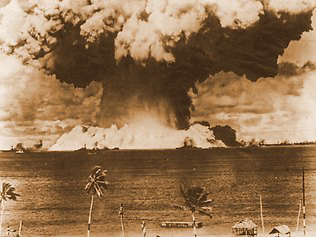 Japanese fishermen to sue over fallout from Bikini Atoll nuclear tests in 1950s Julian Ryall 8 APRIL 2016 http://www.telegraph.co.uk/news/2016/04/08/japanese-fishermen-to-sue-over-fallout-from-bikini-atoll-nuclear/
Agroup of fishermen is to sue the Japanese government for failing to release records detailing their exposure to radiation from US nuclear tests in the Pacific in the 1950s.
Some 20 people, including relatives of fishermen who have since died, are to file their case with the Kochi District Court in May, each demanding Y2 million (£13,088) in compensation.
The men have been particularly angered by the actions of the Ministry of Health, Labour and Welfare, which in September 2014 admitted it had data on the radioactive fallout that around 500 fishing vessels and their crews were exposed to in the Castle Bravo nuclear tests.
The ministry had previously claimed the documents no longer existed, the Asahi newspaper reported.
The first of the Castle Bravo tests, on March 1, 1954, was three times more powerful than scientists had initially predicted, producing a fireball around 4.5 miles across within a second.
The mushroom cloud reached a height of nearly 9 miles in around one minute and eventually climbed to an altitude of 25 miles. The blast was estimated to be 1,000 times more powerful than the atomic bombs that devastated Hiroshima and Nagasaki. As well as producing a larger blast, strong winds took the fallout far greater distances than the scientists had expected.
The Daigo Fukuryu Maru was approximately 800 miles east of Bikini Atoll, one of the Marshall Islands in the central Pacific, and more than 80 miles outside the US government’s 92,000 square mile exclusion zone around the island, when the first bomb was detonated.
Fallout began to coat the tuna fishing boat – and its 23 crew – about two hours later. Unaware of the danger, they scooped the radioactive ash off the deck with their bare hands, while one of the fishermen, Matashichi Oishi, said he licked the dust, reporting that it was gritty but had no taste.
By the time the ship docked in Japan two weeks later, the men were suffering from nausea, headaches, burns, pain in their eyes and bleeding from their gums and were diagnosed with acute radiation poisoning.
In September, 40-year-old Aikichi Kuboyama died as a result of his exposure. In 1955, the US paid Japan $2 million in “consolation money” and concluded the issue at the political level. The Japanese government paid each of the crew of the Lucky Dragon Y2 million (£13,088 at present day exchange rates), but provided nothing to fishermen aboard other ships.
The health ministry in Tokyo maintains that crew members of 10 ships were exposed to radiation, but it insists that their doses “did not reach levels that could damage their health”.
Tests conducted on enamel on the teeth of the fishermen by a professor at Okayama University of Science revealed radiation measuring up to 414 millisieverts, equivalent to people standing about 1 mile from the hypocenter of the atomic bomb that was dropped on Hiroshima in 1945.
Under Japanese law, anyone who was within 2.2 miles of the Hiroshima or Nagasaki atomic bomb detonation points is eligible for medical allowances for a range of illnesses, including cancer.
Lawyer Hiroyuki Kawai continues his lifelong fight to stop the nuclear industry
Lawyer continues 20-year campaign against nuclear power, Japan Today, By YURI KAGEYAMA and MARI YAMAGUCHI
NATIONAL APR. 08, 2016 TOKYO —
Lawyer Hiroyuki Kawai stands out in Japan, a nation dominated by somber dark suits: When not in a courtroom, he often wears colorful shirts and crystal-covered animal pins. He is a Noh dancer, a tenor and, of late, a filmmaker. His motorbike is a Harley.
Some of it is just for fun, but much of the flamboyance is meant to draw attention to his cause: shutting down all nuclear plants in Japan. His more than two-decade-long legal battle is gaining momentum after the multiple meltdowns in Fukushima five years ago led to all plants being idled for safety checks.
In March, Kawai helped set up an organization to support Fukushima residents whose children have developed thyroid cancer since the 2011 disaster — 166 among 380,000 people 18 years and under who were tested, including suspected cases. That’s up to 50 times higher than on average, according to Toshihide Tsuda, a professor at Okayama University.
The Japanese government denies any link, saying the increase reflects more rigorous screening. Thyroid cancer, rare among children at two or three in a million, soared after the 1986 Chernobyl nuclear disaster.
Also last month, Kawai’s team won a court injunction to stop two nuclear reactors in western Japan that had recently restarted. The district court cited concerns about safety, emergency planning and environmental contamination. One of the reactors was shut down shortly after its restart because of glitches. Both had met stricter standards upgraded after the 2011 disaster.
Kawai’s team is pursuing damage compensation for those evacuated from Fukushima, and criminal charges against former executives of Tokyo Electric Power Co., which operates the Fukushima plant. His ultimate goal is to banish nuclear power.
“If another nuclear accident ever happens in Japan, everything will be destroyed — turning upside down our politics, our economy, our education, our culture, our love, our law,” Kawai told The Associated Press, sitting at a desk overflowing with files and papers in his Tokyo office.
Born in 1944 in Manchuria, northeastern China, Kawaii has built a reputation as a champion of humanitarian causes, helping out Japanese abandoned as children in China after World War II, and Filipinos of Japanese descent in the Philippines. His compassion is driven partly by his own experience: A baby brother died of starvation during his family’s perilous journey back to Japan.
After graduating from prestigious Tokyo University, Kawai represented major corporations as a lawyer during the “bubble era” of the 1980s. In the mid-1990s he began taking on lawsuits against nuclear power.
Until 2011, he was fighting a losing battle………
“I think he is fantastic,” said Yurika Ayukawa, a professor of policy at Chiba University of Commerce. She attended at a recent screening where Kawai spoke and surprised the crowd by breaking into a song on Iitate, one of rural Fukushima’s most radiated areas.
Radiation is a sensitive issue in Japan, the only country to suffer atomic bomb attacks, and the Fukushima thyroid cancer patients and their families mostly have kept silent, fearing a social backlash. They face pressure from the hospital treating their children not to speak to media or to question the official view that the illnesses are unrelated to radiation.
Two of the patients’ families appeared recently with Kawai before reporters, although in a video-call with their faces not shown. They said they felt doubtful, afraid and isolated. Kawai believes they are entitled to compensation, though they have not yet filed a lawsuit.
George Fujita, an attorney who specializes in environmental issues, says Kawai is Japan’s top lawyer on nuclear lawsuits.
“It’s unusual for judges to watch a whole movie entered as evidence. It’s because the people are putting pressure on the courts,” he said.
Kawai admits that at times he been tempted to give up.
“I should never walk away. I must fight it out,” he said………..Online site for Kawai’s movie: http://www.nihontogenpatsu.com/english http://www.japantoday.com/category/national/view/lawyer-continues-20-year-campaign-against-nuclear-power
Massive amounts of radiation continue daily to enter Japan’s water and air, and the Pacific Ocean
Nuclear engineer Arnie Gundersen on Fukushima@5, Mar 7, 2016 (emphasis added): Massive amounts of radiation continue to enter Japan’s water and air, and the Pacific Ocean, daily… Due to its triple meltdowns and the unmitigable radioactive releases, Fukushima Daiichi will continue to bleed radiation into the Pacific Ocean for more than a century… There is no road map to follow with directions to stop the ongoing debacle…
Nuclear engineer Arnie Gundersen on KPFA, Mar 30, 2016: [Univ. of California] Berkeley’s nuclear program has been in the forefront of the pro-nuclear propaganda for decades, and since Fukushima has been aggressively downplaying the significance of it. So, whatever comes out of Berkeley, I just attribute to a very pro-nuclear faculty… [Woods Hole Oceanographic Institution is] measuring 1,000 miles offshore [of the US West Coast] and… picking up 10 becquerels per cubic meter [Bq/m3]. At my point, that’s when my alarm bells go off is 10 [Bq/m3]… That plume is still coming, the Pacific is a huge place and to think that a disaster on the opposite side of the world can be detected and begin to contaminate California, I think that the monumental shattering conclusion [is] radiation knows no borders… So this ‘dilution is the solution to pollution’ is what I think Berkeley believes in. What you can be sure of is that somebody’s going to die from the radiation that’s in the Pacific, but you just won’t know who it is – and they’re counting on that. The nuclear establishment is saying, ‘Well, we can smear that out in a broader epidemiological study.’
Nuclear engineer Arnie Gundersen on CCTV, Apr 5, 2016: We’re looking at newspaper coverage from the last couple of weeks and it’s clear that the plant continues to hemorrhage.
Fairewinds Japan Speaking Tour Series No. 1, Feb 12, 2016:
- Nuclear engineer Arnie Gundersen: [T]he Fukushima power plants… continues to bleed into the Pacific every day. But what no one is paying any attention to is that the entire mountain range that runs 100 miles up and down this coast is also contaminated. And as much radiation is pouring out… into the Pacific from the mountain range because it’s so contaminated, as from the Fukushima site… in fact, they’ve got an entire state pouring radiation into the Pacific. So what’s in the Pacific? Off of California, they’re finding radiation at what I would consider significant levels… in a cubic meter of ocean water, they’re finding 10 radioactive decays every second… So a cubic meter of water, if you’re in a dark room, would have 10 flashes of light every second, and that’s going to go on for 300 years. So we have contaminated the biggest source of water on the planet, and there’s no way to stop it.
- Maggie Gundersen, founder of Fairewinds: So are you saying that the contaminated water problem is hopeless? Is there nothing we can do to slow it down?
- Arnie Gundersen: It used to be that scientists believed dilution is the solution to pollution. But I think we’re finding with the biggest body of water on the planet, that you can’t dilute this stuff. And we’re going to begin to see this bio-accumulation, which is all the fish that are in the ocean are going to uptake the cesium and the strontium and become more and more and more radioactive…
Radioactivity at buried tank up in Daiichi plant

The operator of the crippled Fukushima Daiichi nuclear plant says the level of radioactivity near one underground wastewater tank at the plant is more than 100 times earlier readings.
Tokyo Electric Power Company says the tanks were built 3 years ago to store highly radioactive wastewater produced within the crippled plant. But all of the tanks soon went out of use due to repeated leaks of contaminated water.
The utility pumped most of the water out of them, but has been checking radioactivity levels of groundwater near the tanks.
On Wednesday, equipment detected 8,100 becquerels of beta-ray-emitting radioactive substances per liter of water. On Thursday, it went up to 9,300 becquerels.
A week ago, the level was only 87 becquerels.
TEPCO says it doesn’t know why the sharp rise took place. It says some highly radioactive water remains in the tank, but it is isolated with waterproof measures.
TEPCO says it will continue to analyze groundwater samples around the tank, and also compare them with data on the contaminated water left in part of the tank.
http://www3.nhk.or.jp/nhkworld/en/news/20160408_03/
Very pertinent comments and photos from Ray Masalas regarding the said “buried tank”:
I see the Japanese media is once again lying to protect Tepco. These were not tanks. They were in ground pools with sloped sides that were dug on site, lined with thin poly and filled with highly radioactive water. {See pic below} With a lining as thick as 2 garbage bags they leaked into the ground fast. Whether they transfered these tons of radioactive water to steel tanks or not, I’ll leave up to you to believe or not believe. At the same time they were building enclosed concrete ditches running down the west hill to sea. From the flyover footage I’d guess that there were about a dozen of these pits up on the west hill.

Sept 013. One of the “tanks” they spoke of.
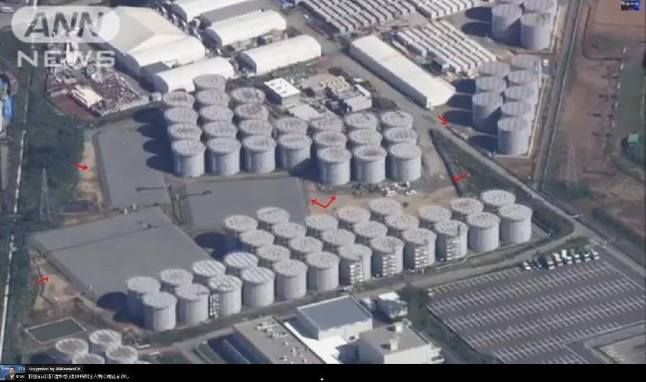
After they said that the transferred the radioactive water to steel tanks these empty pits magically got lids. My guess is that they dumped then refilled.

The enclosed concrete ditches running down to the sea were built at the same time. Dec 013
Children’s book connects stories of Fukushima and Chernobyl

A page from Shoko Nakazawa’s latest work depicts Natsuko about to part
with her pet piglet Momo.
Inspired by a letter sent to her by a young reader, author Shoko Nakazawa revived a past work and penned an entirely new illustrated children’s book on nuclear disasters in Fukushima and Chernobyl.
In 1988, Nakazawa’s “Ashita wa Hareta Sora no Shita de Bokutachi no Chernobyl” (Tomorrow, under a fair sky, our Chernobyl) was released by Choubunsha Publishing Co.
In the letter, a junior high school student in Yokohama who read the book after the triple meltdown at the Fukushima No. 1 nuclear power plant wanted to know how such an incident occurred when humans had surely learned of nuclear horrors from the Chernobyl accident in Ukraine in 1986.
The student asked what adults had done to prevent the Fukushima disaster. Because her 1988 book had long been out of print, Nakazawa, 63, first went about having it republished in summer 2011.
She also wrote a new work, recently published by Iwasaki Publishing Co., titled “Kobuta Monogatari Chernobyl kara Fukushima e” (A tale of piglets, from Chernobyl to Fukushima). The book sells for 1,300 yen, tax exclusive.
The two parts of the book involve little girls living in Chernobyl and Fukushima. Tanya lives in Chernobyl and has a pet piglet named Marumaru. Their peaceful life is turned upside down by the nuclear accident that forces all residents to evacuate.
Marumaru is left behind on the farm and time passes as the piglet waits for Tanya and her family to return. They never do.
The Fukushima portion involves a girl named Natsuko and her pet piglet Momo. They are also separated by the Fukushima nuclear accident.
A temporary lifting of the evacuation order allows Natsuko and her mother to return home. However, the mother does not recognize Momo, who is now filthy because no one was around to take care of the animal. The mother shooes the piglet away in a harsh voice.
The two parts of the book are connected because Natsuko’s mother had come to know Tanya when she visited Japan more than 20 years ago. Tanya even sent a letter to Natsuko’s mother in which she wrote, “Please do not forget us.”
During their short stay at home, the mother comes across that letter again and breaks down crying.
“I forgot everything.”
A key turning point in Nakazawa’s life was moving to Hiroshima from Nagoya before she entered junior high school. Most of her friends had parents who were hibakusha. Nakazawa herself was shocked when she saw the exhibit about the horrors of the atomic bombing at the Hiroshima Peace Memorial Museum.
She is concerned about recent moves to resume operations at nuclear power plants around Japan.
“We are once again trying to forget,” she said. “I hope the book becomes a catalyst to rethink a civilization that exists upon something like ‘nuclear power’ that simply cannot co-exist with humans and nature.”
Reactor ruling ignores lessons, anxiety from Fukushima crisis
A court ruling concerning nuclear reactor operations raises serious doubts about whether the court rightly recognized the gravity of the damage and the harsh realities caused by the 2011 accident at the Fukushima No. 1 nuclear plant.
The Miyazaki branch of the Fukuoka High Court on April 6 rejected an appeal by Kyushu residents seeking an injunction to shut down the No. 1 and No. 2 reactors of the Sendai nuclear plant run by Kyushu Electric Power Co. in Satsuma-Sendai, Kagoshima Prefecture. They are the only two reactors currently operating in Japan.
The ruling in essence said the Nuclear Regulation Authority’s (NRA) new safety standards, established after the disaster at the Fukushima plant, reflect the lessons learned from the triple meltdown and cannot be described as unreasonable. It also dismissed the plaintiffs’ argument that the design of the Sendai plant underestimates the safety risks posed by possible major earthquakes.
This ruling stands in sharp contrast with the Otsu District Court’s decision in March that raised doubts about the NRA’s safety standards and ordered the suspension of operations of two reactors at Kansai Electric Power Co.’s Takahama nuclear plant in Fukui Prefecture.
What happened in Fukushima has created strong anxiety among Japanese about the safety of nuclear power generation. From this point of view, it is obvious which of the two rulings really echoed the public sentiment about nuclear safety.
Symptomatic of the two courts’ different stances toward public concerns are their views about evacuation plans.
The new nuclear safety standards do not address issues related to evacuation plans.
The Otsu District Court raised questions about this fact and contended that the government is obliged to develop new regulatory standards based on a broader perspective that also address evacuation plans.
The Miyazaki branch acknowledged there are legitimate concerns about the existing plan for emergency evacuations.
The plaintiffs argued that the plan would be unable to deal with a situation that requires an immediate and massive evacuation. They also said the number of buses available to transport local residents during nuclear crises would be insufficient.
But the court nevertheless dismissed the plaintiffs’claim that operating the Sendai reactors violates their personal rights. The court pointed out that at least an emergency evacuation plan was in place.
Following the accident in Fukushima, many residents could not smoothly flee for their safety, leading to serious confusion.
The high court’s decision did not give due consideration to this fact.
Volcanoes, including the highly active Sakurajima, are located around the Sendai nuclear plant.
The NRA has established guidelines concerning the risks to nuclear plants posed by volcanic eruptions.
The high court judged the guidelines, based on the assumption that the timing and scale of eruptions can be accurately predicted, to be “irrational.”
Yet the court said the probability of an eruption triggering a catastrophic nuclear accident was so low that the risk can be ignored unless solid grounds for thinking otherwise are shown.
The court acknowledged the NRA’s flawed approach to dealing with the safety risk posed by volcanic eruptions. But it said the widely accepted view in society is that the risk can be ignored because of the low probability of such eruptions actually occurring.
Can this be described as an opinion based on serious reflection on the fact that unforeseen circumstances occurred at the Fukushima plant?
The exact causes of the nuclear disaster are not yet clear, and around 100,000 people are still living as evacuees.
That explains why various opinion polls show a majority of respondents expressing negative views about plans to restart reactors.
The court ruling that endorses the NRA’s new safety standards does not translate into public support of the government’s policy to bring idled reactors back on stream.
The sharply different court rulings on reactor operations should be regarded as a sign that the knotty question of how to secure safety at nuclear plants remains unsolved.
Japan lawyer wants no-nukes after Fukushima
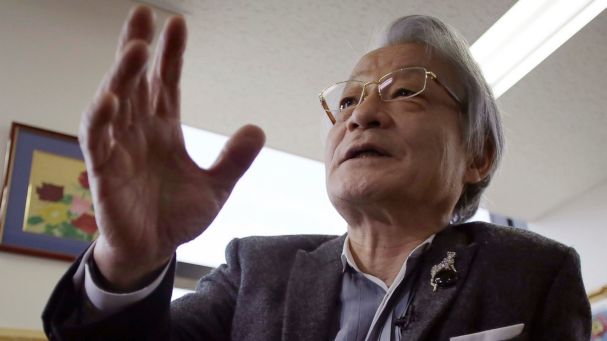
Lawyer Hiroyuki Kawai stands out in Japan, a nation dominated by somber dark suits: When not in a courtroom, he often wears colorful shirts and crystal-covered animal pins. He is a Noh dancer, a tenor and, of late, a filmmaker. His ride is a Harley.
Some of it is just for fun, but much of the flamboyance is meant to draw attention to his cause: shutting down all nuclear plants in Japan. His more than two-decade-long legal battle is gaining momentum after the multiple meltdowns in Fukushima five years ago led to all plants being idled for safety checks.
In March, Kawai helped set up an organization to support Fukushima residents whose children have developed thyroid cancer since the 2011 disaster — 166 among 380,000 people 18 years and under who were tested, including suspected cases. That’s up to 50 times higher than on average, according to Toshihide Tsuda, a professor at Okayama University.
The Japanese government denies any link, saying the increase reflects more rigorous screening. Thyroid cancer, rare among children at two or three in a million, soared after the 1986 Chernobyl nuclear disaster.
Also last month, Kawai’s won a court injunction to stop two nuclear reactors in western Japan that had recently restarted. The district court cited concerns about safety, emergency planning and environmental contamination. One of the reactors was shut down shortly after its restart because of glitches. Both had met stricter standards upgraded after the 2011 disaster.
Kawai’s team is pursuing damage compensation for those evacuated from Fukushima, and criminal charges against former executives of Tokyo Electric Power Co., which operates the Fukushima plant. His ultimate goal is to banish nuclear power.
“If another nuclear accident ever happens in Japan, everything will be destroyed — turning upside down our politics, our economy, our education, our culture, our love, our law,” Kawai told The Associated Press, sitting at a desk overflowing with files and papers in his Tokyo office.
Born in 1944 in Manchuria, northeastern China, Kawaii has built a reputation as a champion of humanitarian causes, helping out Japanese abandoned as children in China after World War II, and Filipinos of Japanese descent in the Philippines. His compassion is driven partly by his own experience: A baby brother died of starvation during his family’s perilous journey back to Japan.
After graduating from prestigious Tokyo University, Kawai represented major corporations as a lawyer during the “bubble era” of the 1980s. In the mid-1990s he began taking on lawsuits against nuclear power.
Until 2011, he was fighting a losing battle.
To win over regular people after the Fukushima accident Kawai started making movies, which are sometimes entered as evidence for his court cases. In “Nuclear Japan,” he points out how precariously quake- and tsunami-prone Japan is, and how densely populated. He interviews scientists, former Fukushima residents, a fire fighter who could not go back to save lives because of radiation.
“Imagine remembering this film in an evacuation center after the next nuclear disaster,” Kawai narrates in the movie.
Since Japan imports almost all its energy, many in government and business view nuclear power as the cheapest option, and the best way to curb pollution and counter global warming.
Kawai’s stance angers many in the powerful business community. Hiroshi Sato, a senior adviser at Kobe Steel, lambasted Kawai’s position as “emotional” and “unscientific.”
“What I’m really worried about is the idea of similar lawsuits being filed one after another. That would lead to uncertainty about a stable electricity supply,” he told reporters recently.
Even those who insist nuclear power is safe — including top government regulator Shunichi Tanaka and Gerry Thomas, a professor at the Imperial College of London who advises Japan — say the choice of whether to keep or abandon nuclear energy should be left to the Japanese people.
Kawai believes policy shifts, like the turn against nuclear in Germany, begin in the courtroom.
“For 50 years, Japan had a campaign that we need nuclear power, and how it is reliable and safe, and 99 percent of Japanese believed this,” he said.
“But we thought we could finally win, and about 300 lawyers came together to start a new fight against nuclear power,” he said with a zeal making him appear younger than his 71 years.
Financially independent thanks to his corporate law days, Kawai invested 35 million yen ($350,000) in his first movie, which turned a profit from screenings and DVD sales. He is now working on his third film.
“I think he is fantastic,” said Yurika Ayukawa, a professor of policy at Chiba University of Commerce. She attended at a recent screening where Kawai spoke and surprised the crowd by breaking into a song on Iitate, one of rural Fukushima’s most radiated areas.
Radiation is a sensitive issue in Japan, the only country to suffer atomic bomb attacks, and the Fukushima thyroid cancer patients and their families mostly have kept silent, fearing a social backlash. They face pressure from the hospital treating their children not to speak to media or to question the official view that the illnesses are unrelated to radiation.
Two of the patients’ families appeared recently with Kawai before reporters, although in a video-call with their faces not shown. They said they felt doubtful, afraid and isolated. Kawai believes they are entitled to compensation, though they have not yet filed a lawsuit.
George Fujita, an attorney who specializes in environmental issues, says Kawai is Japan’s top lawyer on nuclear lawsuits.
“It’s unusual for judges to watch a whole movie entered as evidence. It’s because the people are putting pressure on the courts,” he said.
Kawai admits that at times he been tempted to give up.
“I should never walk away. I must fight it out,” he said.
His business card is three times the usual size to include his artistic activities and his motto: “If you really mean it, you get most anything done. If you really mean it, everything becomes fun. If you really mean it, someone will come and help.”
1 This Month

22 June – Virtual Event –Climate Change: New Data, New Debate

Monday, June 22, 2026 2:30 p.m. – 3:15 p.m. CT
YouTube. Register here
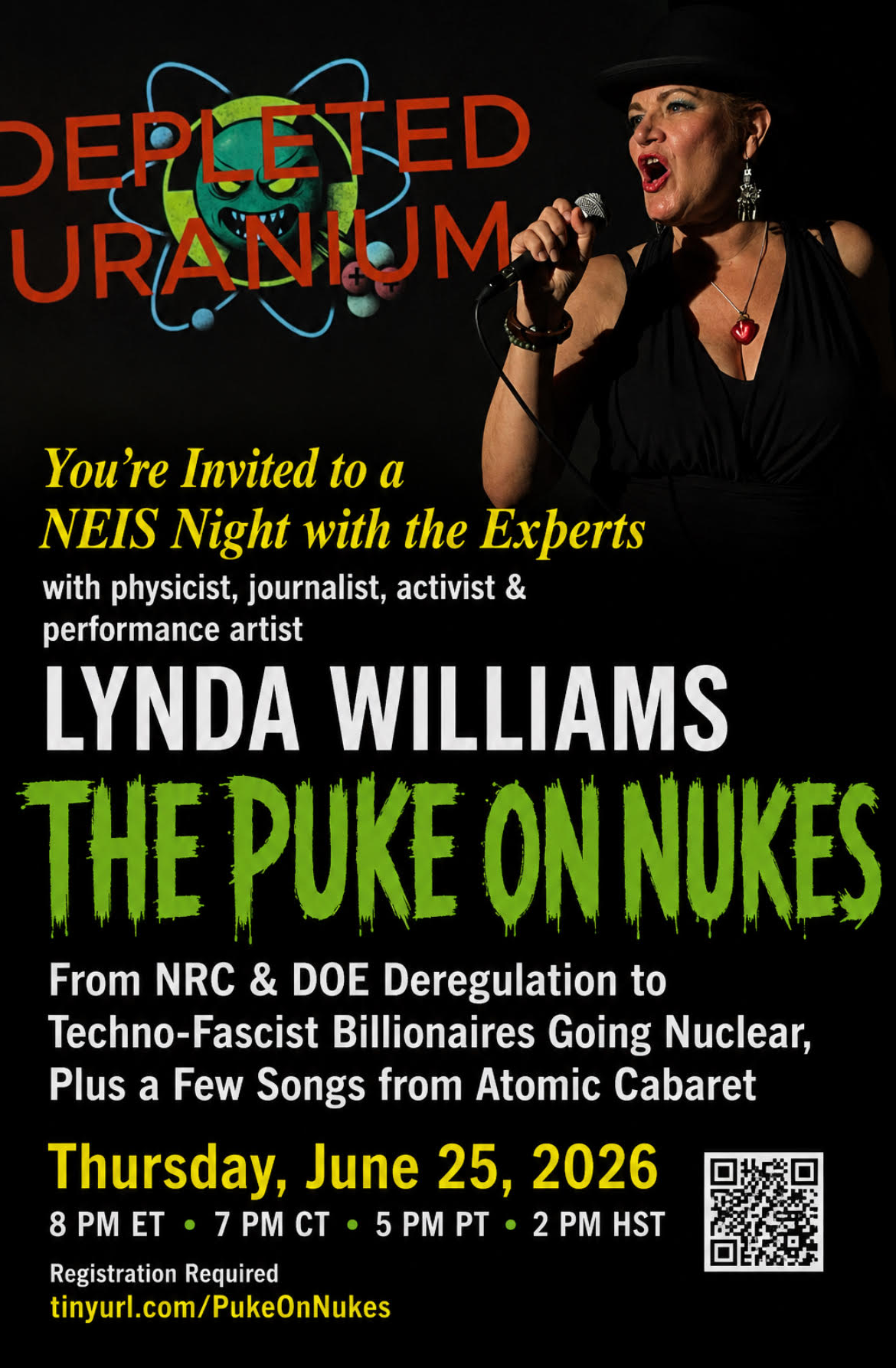
25 June- THE PUKE ON NUKES
Thursday, June 25, 2026
7pm Central Time (8pm ET, 6pm MT, 5pm PT) UTC – 5
From NRC & DOE Deregulation to Techno-Fascist Billionaires Going Nuclear, Plus a Few Songs from Atomic Cabaret REGISTER
26 June – Radiation Trainwreck at the NRC / Join the Protect Better Campaign – https://us02web.zoom.us/meeting/register/4ZlZ5_qLSHGiLSCg8FF6Bg#/registration
1st July – Webinar Waste of Space: The Environmental Harm of Military and Civil Space Activity st July, 7 pm

Report Launch Online: We are seeing an increasing exploitation of space for military and commercial purposes. This must change.

Protect Sazan Island from the Trump family! https://secure.avaaz.org/campaign/en/protect_sazan_island_from_the_trump_family_loc/?bqFCVab&v=174511&cl=22707147157&_checksum=5e9dde668860e8231c33699735e16a1fbf22ab2cb01da50c999fe8732b9775ef&utm_source=email&utm_medium=blast_email&utm_campaign=174511


Cuba Is Not a Failed State – It Is a Besieged State
PETITION: “Global Appeal to Endorse Palestinian Right of Return of Refugees”
To see nuclear-related stories in greater depth and intensity – go to https://nuclearinformation.wordpress.com
-
Archives
- June 2026 (221)
- May 2026 (306)
- April 2026 (356)
- March 2026 (251)
- February 2026 (268)
- January 2026 (308)
- December 2025 (358)
- November 2025 (359)
- October 2025 (376)
- September 2025 (257)
- August 2025 (319)
- July 2025 (230)
-
Categories
- 1
- 1 NUCLEAR ISSUES
- business and costs
- climate change
- culture and arts
- ENERGY
- environment
- health
- history
- indigenous issues
- Legal
- marketing of nuclear
- media
- opposition to nuclear
- PERSONAL STORIES
- politics
- politics international
- Religion and ethics
- safety
- secrets,lies and civil liberties
- spinbuster
- technology
- Uranium
- wastes
- weapons and war
- Women
- 2 WORLD
- ACTION
- AFRICA
- Atrocities
- AUSTRALIA
- Christina's notes
- Christina's themes
- culture and arts
- Events
- Fuk 2022
- Fuk 2023
- Fukushima 2017
- Fukushima 2018
- fukushima 2019
- Fukushima 2020
- Fukushima 2021
- general
- global warming
- Humour (God we need it)
- Nuclear
- RARE EARTHS
- Reference
- resources – print
- Resources -audiovicual
- Weekly Newsletter
- World
- World Nuclear
- YouTube
-
RSS
Entries RSS
Comments RSS
 nuclear-news