French prosecutors launch probe into Tokyo’s 2020 Olympic bid
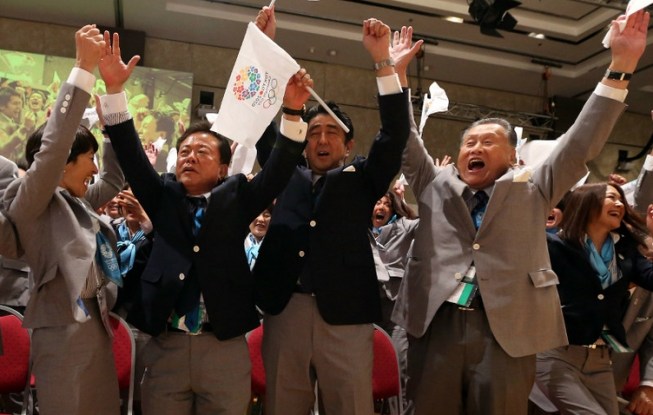
In this Sept. 7, 2013, file photo, Japan’s Prime Minister Shinzo Abe, center, Governor of Tokyo and Chairman of Tokyo 2020, Naoki Inose, second from left, and other members of the Japanese delegation celebrate as International Olympic Committee (IOC) President Jacques Rogge announces that Tokyo will host the 2020 Olympic Games during the 125th IOC session in Buenos Aires, Argentina.
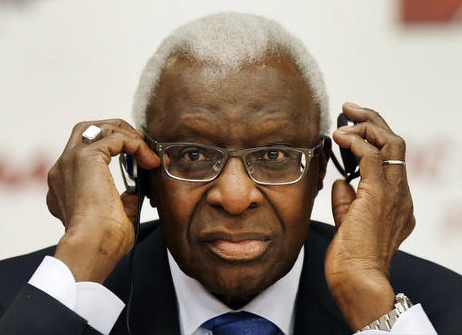
In this Aug. 21, 2015, file photo, then-IAAF president Lamine Diack adjusts his headphones during a joint IOC and IAAF news conference on the site of the World Athletic Championships in Beijing. French prosecutors say $2 million associated with Tokyo’s bid for the 2020 Olympics was apparently paid to an account linked to the son of the disgraced former IAAF president Diack in the months immediately before and after the Japanese capital won the games.
PARIS/TOKYO (Kyodo) — French prosecutors announced Thursday they have launched an investigation into Tokyo’s campaign to host the 2020 Olympics for alleged corruption and money laundering.
A statement from the prosecutors said a total of 2.8 million Singapore dollars ($2.04 million) has been transferred from a Japanese bank to one in Singapore related to Papa Massata Diack, the son of former International Association of Athletics Federations President Lamine Diack, in July and October 2013 under the name of “Tokyo 2020 Olympic Games Bid.”
The prosecutors said they have confirmed there were huge outlays by Diack’s side during the same time in Paris. Tokyo was awarded the Games in September 2013 when Diack was an International Olympic Committee member and was known as an influential power broker in the committee.
“How much influence the former president could have had on other committee members will be the focal point of the investigation,” a French judicial authority member told reporters.
“We carried out our bidding campaign fairly. There’s no issue or things to get worried about,” said Japanese Olympic Committee President Tsunekazu Takeda, who was the chief of the bidding team. “We’ll reply properly if we get asked (by the IOC).”
Olympic minister Toshiaki Endo also said in a TV program he takes pride in Tokyo making a clean bid and denied the allegations.
Japan’s top government spokesman earlier Thursday denied allegations of bribery, saying the government understands the organizing committee conducted the campaign in an appropriate manner.
“We understand the campaign for the 2020 Tokyo Games was conducted in a clean way,” Chief Cabinet Secretary Yoshihide Suga said at a news conference after British newspaper the Guardian reported the Tokyo Olympics organizing committee paid 1.3 million euros ($1.48 million) to the account of Diack’s son.
Suga said he was “not aware of” the report, which also said French authorities were investigating the allegations. “If we receive a request (for investigation) from French judicial authorities, our country will respond appropriately,” he added.
Suga said the Japanese government has no plan to question the Tokyo Organizing Committee of the Olympic and Paralympic Games or conduct its own investigation into the allegations.
The account in question became a vital piece of the puzzle related to what has been alleged as being institutional corruption at athletics’ governing body.
Complicating the scandal further, the report said Japanese marketing and advertising behemoth Dentsu Inc. has previously been linked to the Diack clan through its long-running sponsorship contract with the IAAF, a deal that was extended by Diack just months before his presidency ended. Dentsu has been previously linked to scandals at both the IAAF and world soccer’s governing body FIFA.
The prosecutors launched an investigation into corruption in the IAAF and Diack was arrested in December, accused of accepting bribes to cover up doping offenses.
A report in January from the prosecutors claimed that Diack did not support the bid from Tokyo’s rival Istanbul as Turkey didn’t pay similar sponsorship money to the IAAF.
http://mainichi.jp/english/articles/20160513/p2g/00m/0dm/002000c
Seniors mull share house to keep Fukushima evacuee community intact
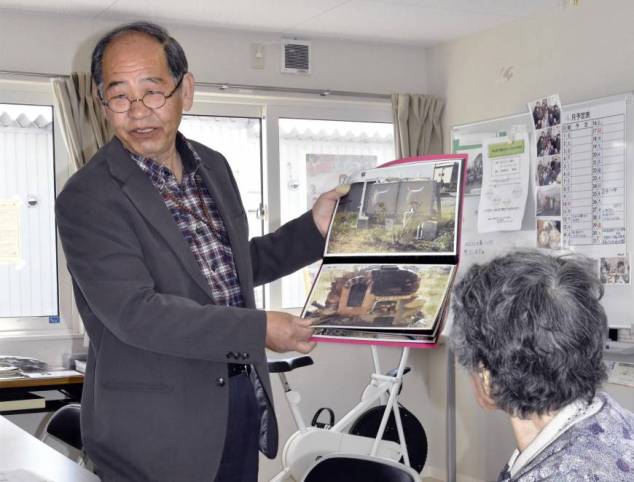
Masaharu Fujishima, who is proposing to build a share house for temporary housing residents, explains his plan to residents in a meeting in April in Minamisoma, Fukushima Prefecture.
FUKUSHIMA – As the government looks to lift the evacuation zone for part of Minamisoma, Fukushima Prefecture, elderly people currently living in temporary dwellings are considering a share house so they can stay together.
If the no-go zone is lifted, residents at temporary housing units are likely to be asked to leave. One option is to return to their hometown of Minamisoma’s Odaka district — a choice few are likely to make. Another option is to move in to city-provided public housing where they would have to start again in unfamiliar surrounds.
In Odaka, residents will be allowed to stay inside the evacuation zone to prepare for their permanent return after the designation is lifted. But of the area’s 11,700 residents, only 1,870 have registered to go back, suggesting few plan to return permanently.
It’s for this reason that Masaharu Fujishima, 70, a resident at Minamisoma’s temporary housing complex, is pitching a plan to create a share house with individual rooms and common space that will allow temporary housing residents who have bonded since the March 2011 Fukushima nuclear disaster to live together.
Fujishima evacuated from Odaka to temporary housing in the city center. Serving as head of the community association until January, he was able to talk with many residents about the troubles they faced as they attempted to rebuild their lives.
Many were worried about leaving a community of friends they bonded with over the past five years for a new one they would need to create from scratch.
“After the nuclear disaster, many people had to move around before they finally settled in the temporary housing,” said Fujishima. “I’m worried that if they leave here, they would have to go through all the trouble again of searching for a new place to live.”
So far, Fujishima has held three meetings for temporary housing residents to explain his proposal. While some feedback has been positive, with residents saying it will prevent them from becoming senile, others have voiced concern about what will happen when one of the dwellers becomes ill or dies.
To put the plan in motion, Fujishima submitted about 16,000 signatures to the Minamisoma Municipal Assembly.
The city is expected to consider the proposal, though a city official in charge of housing construction was not sure if the idea is feasible.
“It is difficult because public houses are not designed for many people to live together like a share house,” the official said.
Collision on the Joban Expressway in Fukushima
On May 4, 2016, a head-on collision between a car and a bus on the Joban Expressway in Fukushima killed a mother and her daughter on the passeger car. *link for Yahoo Japan article
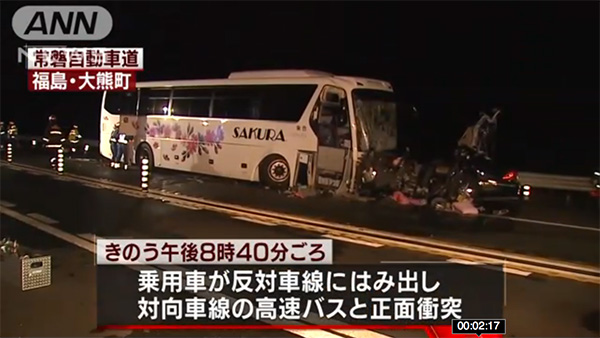
The accident happened in Okuma town which is within “Difficult-to-return” zones, due the nuclear accident at Fukushima Daiichi Nuclear Power Plant.
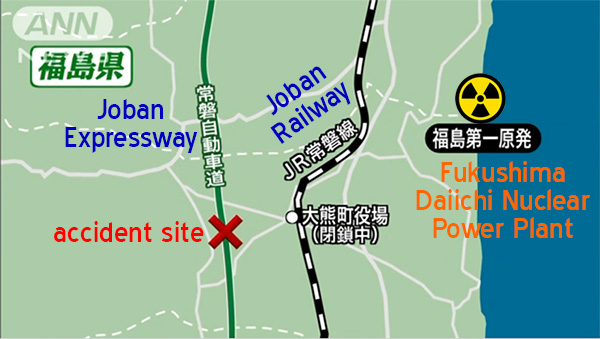
The designated area has been exposed to more than 50 millisieverts per year of radiation from the melted-down power plant. It is considered difficult for local residents to return possibly for the next several decades.
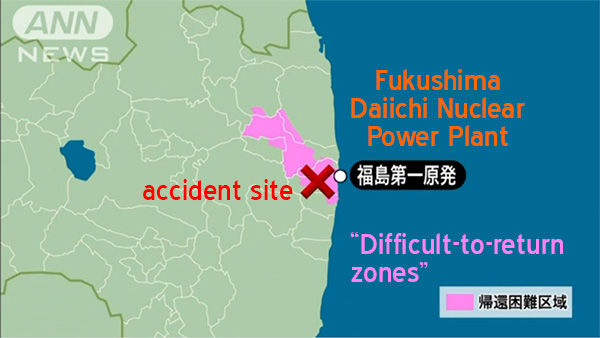
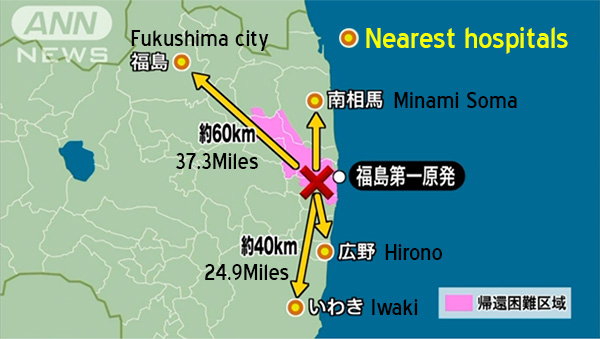
Since the entire area has been evacuated, the injured passengers on the crashed bus had be transported as far as 37Miles.
40 passengers including the bus driver had to wait for the ambulance for two hours on the side of the road. No face masks were provided.
(Cars and buses are allowed around this section of Joban Expressway, but not motorcycles due to the extreme level of radioactive contamination.)
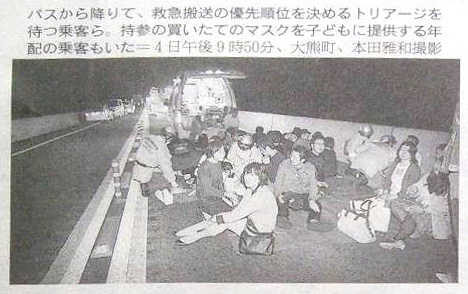
*Photo of the Japanese newspaper article courtesy of Facebook group, “NPO法人チェルノブイリへのかけはし“.

Background radiation level in Okuma town as of March 24, 25 of 2016, measured by Okuma town.
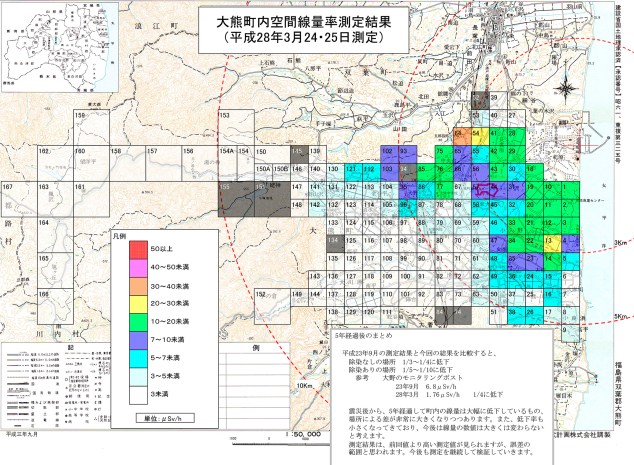

Source: http://www.mp-nuclear-free.com/main-articles/news-snippets_20160507.html
Arnie Gundersen measured 4,000 Bq/kg on a Tokyo street
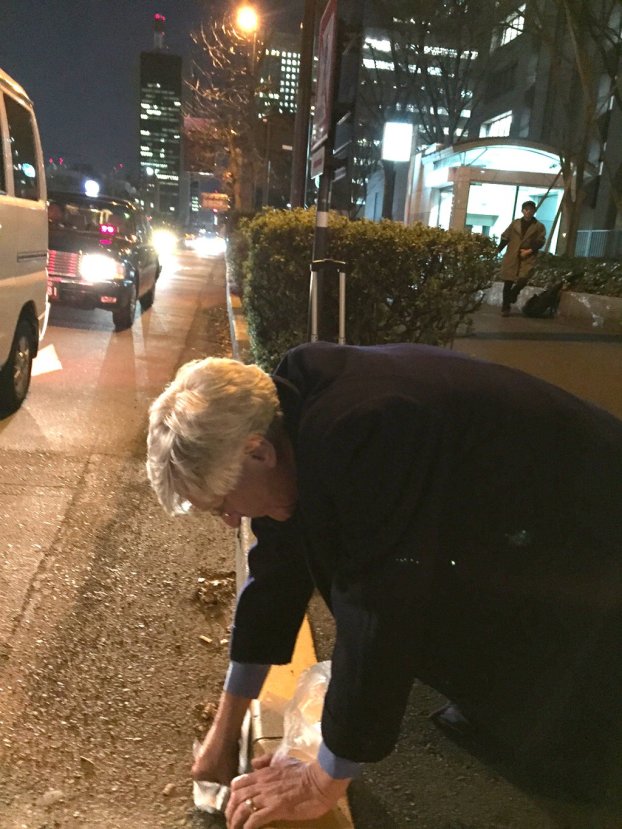
Arnie Gundersen measured 4,000 Bq/kg on a Tokyo street outside METI, Japan nuclear regulator…Olympics anyone?
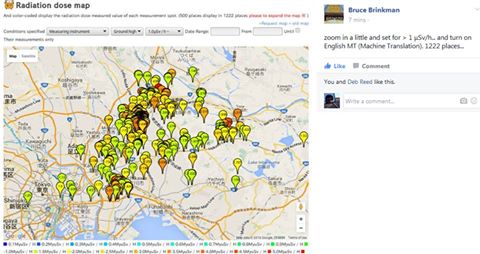
76 measurements that are over 5µS/h in the “Kashiwa hotspot”

Kashiwa city, Chiba prefecture, nearby Tokyo
Some screen caps of the new background radiation tests from Japan. Kashiwa hot spots. Thanks to Bruce Brinkman
Hakatte Geiger users have uploaded 76 measurements that are over 5µS/h in the “Kashiwa hotspot” area. You can see how they are distributed as the plume came over Kasumigaura and into eastern Tokyo. I travel through that on my way to and from work. I have to go through Matsudo and Kashiwa which are buried under the map pins.

Zoom in a little and set for > 1 μSv/h… 1222 places.
Abe’s questionable handling of the Kumamoto quakes
The series of earthquakes that has hit central Kyushu since April 14 pose a variety of problems for us. The Meteorological Agency has explained that this chain of temblors is unprecedented in that the location of the hypocenter has moved. But one has to realize that it was only recently in the long history of the Earth that humans began their observations of seismic activities — and that it should come as no surprise if such a pattern of earthquakes had happened frequently in the past. In short, we humans know very little about the movements of the Earth. In Japan, earthquakes can hit anytime and anywhere.
Serious questions have been raised about the Abe administration’s response to the Kumamoto quakes. The first is why it didn’t try to listen to people who were suffering from the devastation brought by the temblors. The government’s call on evacuees to take shelter indoors following the initial quake that hit on April 14 drew the ire of the Kumamoto governor, who felt that officials in Tokyo didn’t understand the feelings of local residents.
The second question deals with the administration’s policy on the operation of nuclear power plants following the quakes. The government has declared that it won’t shut down the reactors at Kyushu Electric Power Co.’s Sendai plant in Kagoshima Prefecture — currently the sole nuclear plant in operation in this country. After clearing the Nuclear Regulation Authority’s screening of the plant for a restart, Kyushu Electric scrapped its plan to build a new facility with a seismically isolated structure that would serve as a command center in the event of an emergency. One of the assumptions in judging the safety of restarting the Sendai plant was that people would be able to evacuate the area by using bullet trains and the expressway network in case of a nuclear crisis. The Kumamoto quakes knocked those transportation means out of service, raising doubts about the workability of the evacuation scenario. That alone should be reason enough to halt the Sendai plant and rethink the safety measures. We need to consider carefully whether it is wise to have so many nuclear plants in this quake-prone country.
The third question is on the government’s intension to take advantage of the disaster to achieve its political goals — instead of focusing on relief for people in the disaster zone. Right after the temblors hit, Chief Cabinet Secretary Yoshihide Suga said the quakes highlighted the importance of amending the Constitution to give the government emergency powers to respond to such crises. Two U.S. Marine MV-22 Osprey tilt-rotor aircraft were dispatched to transport relief supplies in an apparent attempt at what Canadian author Naomi Klein calls the Shock Doctrine — taking advantage of a disaster to push a political agenda that has nothing to do with disaster response.
It is false to say that the government’s response to a disaster cannot proceed quickly because the Constitution does not grant emergency powers. Existing laws, such as the basic law on disaster response, provides a variety of powers that enables the government to take various actions if it wants to. Requesting the Osprey aircraft had nothing to do with providing relief for the disaster-hit people. I have heard nothing about Self-Defense Forces helicopters having been mobilized to their full capacity to transport relief goods to Kumamoto. I believe that using the Osprey was only a ploy to impress the public that strengthening defense cooperation between Japan and the United States under the Abe administration’s security legislation is helping ordinary citizens.
As memories of the 3/11 disasters fade away, the Abe administration is trying to divert public attention from the damage brought by the Fukushima nuclear disaster and create the impression that everything is back to normal. Its policy of restarting nuclear plants idled in the wake of the Fukushima crisis is part of such attempts. The Kumamoto quakes have exposed the questionable nature of Prime Minister Shinzo Abe’s politics.
When it comes to risks to people’s lives and their safety, natural disasters at home and the weakening of society as manifested by the aging and shrinking of the population pose a much more real threat than changes in the security environment surrounding Japan. The government is about to invest trillions of yen in Tokyo as it prepares to host the Summer Olympics in 2020. What significance does building a posh new national stadium in Tokyo and pursuing large urban redevelopment projects carry when people in other parts of the country suffer from the devastation caused by natural disasters? Can the government secure sufficient financial resources for reconstruction of the disaster-hit areas?
It is difficult to criticize the government when it is engaged in efforts to help people affected by a major disaster. But objections need to be clearly raised against any attempt to take advantage of a disaster to promote an unrelated political agenda. The mass media in particular bear a heavy responsibility to do that.
40-year-old Shikoku reactor to be sixth unit scrapped under stricter safety regimen
MATSUYAMA, EHIME PREF. – Shikoku Electric Power Co. on Tuesday ended operation of a nearly 40-year old nuclear reactor in western Japan, making it the sixth unit to be scrapped under stricter safety regulations introduced after the 2011 Fukushima disaster started.
The utility decided in March to decommission the idled reactor 1 at its Ikata nuclear complex in Ehime Prefecture, as it would be too costly to reboot the aging reactor.
The company estimates more than ¥170 billion ($1.59 billion) would be needed to beef up safety measures for restarting the reactor, which started operation in 1977.
It is expected to take about 30 years to complete the decommissioning of the reactor at a total cost of ¥40 billion, according to Shikoku Electric.
The company is banking on technology cooperation that it agreed on with three other regional utilities last month to cut decommissioning costs.
The tougher safety rules prohibit the operation of nuclear reactors beyond 40 years in principle. But operation for an additional 20 years is possible if operators make safety upgrades and pass the regulator’s screening.
The government is looking to reactivate more reactors to meet a goal of generating at least 20 percent of Japan’s overall electricity with nuclear power generation by 2030.
The shutdown of the Ikata reactor 1 reduced the number of commercial reactors in Japan to 42, of which four have been restarted under the post-Fukushima safety rules. But two of the four were shut down earlier this year following a court decision banning them from resuming operations.
With new reactor construction difficult amid public concern over the safety of nuclear power, the country would need a dozen of the aging reactors to operate beyond the 40-year limit to accomplish the government goal, industry observers say.
Shikoku Electric has said it would not make economic sense to restart the unit 1 given the cost and the fact that it has a relatively small output capacity of 566,000 kw, while the company aims to reboot the larger and newer reactor 3 at the same power plant.
The town of Ikata expects the scrapping of the aging reactor to reduce state subsidies that it receives for hosting the nuclear complex by ¥300 million to ¥400 million to around ¥1 billion.
Overemphasis on economic growth led to Minamata, Fukushima: NPO forum
TOKYO — Marking the 60th anniversary of the official recognition of Minamata disease, speakers hosted by a nonprofit organization say that an overemphasis on economic growth was behind the mercury-poisoning illness as well as the nuclear disaster in Fukushima.
“Japan has put priority on economic development, rather than valuing human life, and such an attitude caused the problems of Minamata and Fukushima as well as grave fatal accidents, such as explosions at coal mines,” said Kunio Yanagida, a freelance journalist.
“The problem is that lawmakers and bureaucrats have tried to avoid their responsibility, rather than determining the truth behind the incidents, and they have failed to make the lessons learned from them universal,” he told an audience of around 1,000 at the event in Tokyo last week.
“Japan is still driven by a wartime policy of increasing its wealth and military power,” he said.
Tatsuya Mori, a film director and writer, referred to a Minamata disease patient who once said, “I was aware that I am Chisso.” The patient meant that while he is a victim of the disaster caused by Chisso Corp, a chemical maker which dumped industrial waste into the sea, he himself had enjoyed the benefits of its products and might have gone along with its actions if he had belonged to the company himself.
Mori said, “In a similar way, we could say, ‘I am Fukushima,’ or ‘I am Tokyo Electric Power Co.,’ as we have depended on the crippled Fukushima Daiichi nuclear plant” operated by the utility.
“We need to realize we have supported the system that caused the issues of Minamata and Fukushima,” he added.
The Tokyo forum was organized by Minamata Forum to mark the 60th anniversary since a public health center in Minamata in the southwestern Japan prefecture of Kumamoto received a report from a local doctor about four people with unexplained neurological disorders—considered later to be when Minamata disease was first recognized.
Before starting the session, the audience observed a moment of silence before 500 portraits of Minamata disease victims put up behind the speakers on the stage.
So far, only around 3,000 among over 33,500 applicants have been officially recognized as Minamata disease patients in Kumamoto and neighboring Kagoshima prefectures as well as Niigata Prefecture, where a similar disease was confirmed in 1965, caused by wastewater from a Showa Denko K.K. plant.
Critics claim that six decades after Minamata disease was first recognized, the issue has still not been resolved with the full number of sufferers yet to be fully acknowledged. Several damages suits are still pending.
Japan and South Korea lean towards getting nuclear weapons
 Japan and South Korea May Soon Go Nuclear http://www.wsj.com/articles/japan-and-south-korea-may-soon-go-nuclear-1462738914 The longtime status quo is crumbling and plutonium stockpiles are rising. HENRY SOKOLSKI May 8, 2016
On Friday North Korean dictator Kim Jong Un praised his country’s recent hydrogen bomb test and satellite launch as “unprecedented” achievements that will “bring the final victory of the revolution.” Such rhetoric is nothing new, but North Korea’s nuclear-weapons program and a growing sense that security arrangements with the U.S. aren’t sufficient has eroded the Japanese taboo against nuclear weapons. On April 1, Prime Minister Shinzo Abe’s cabinet announcedthat Japan’s constitution did not ban his country from having or using nuclear arms.
Meanwhile, South Korea’s ruling-party leaders have urged President Park Geun-hye to stockpile “peaceful” plutonium as a military hedge against its neighbors. A Feb. 19 article in Seoul’s leading conservative daily, the Chosun Ilbo, went so far as to detail how South Korea could use its existing civilian nuclear facilities to build a bomb in 18 months.
Japan and South Korea are party to the Nuclear Nonproliferation Treaty, and Tokyo’s antinuclear-weapons stance dates to 1945 and the nuclear devastation the U.S. wreaked on Hiroshima and Nagasaki. But that won’t necessarily stop either country from joining the nuclear club—or at least positioning themselves to do so quickly—if they feel the U.S. “nuclear umbrella” is folding.
Japan already has stockpiled 11 tons of plutonium, separated from fuel used in its nuclear-power reactors. A bomb requires roughly five kilograms (or 1/200th of a ton). The old shibboleth, popular with the nuclear industry, that such “reactor-grade” plutonium is unsuitable for weapons, is essentially irrelevant for a technologically advanced country. Japan also has built—but not operated—a large reprocessing plant of French design that can separate about eight tons of plutonium a year.
The shutdown of Japan’s power reactors following the 2011 Fukushima disaster means there are no reactors online that can use this plutonium. But Japan says it will proceed with reprocessing anyway, putatively to keep open the distant possibility of fueling a new generation of so-called fast-breeder reactors. Japan’s nuclear cooperation agreement with Washington allows it to do this with U.S.-origin fuel. South Korea’s agreement prohibits this without U.S. approval, something Seoul chafes at. It sees itself the equal of Japan. Should Japan operate Rokkasho, as it plans to do late in 2018, it will be impossible politically to restrain South Korea from following suit.
China, meanwhile, is negotiating with France to build a reprocessing plant similar to Japan’s. One might discount the security significance of this; Beijing already has nuclear weapons. But a large reprocessing plant would allow it to expand its nuclear arsenal far beyond its present size. The Chinese are clearly aware of the military significance of nominally civilian plutonium. Consider their loud and repeated complaints about Japan’s plutonium stocks.
The Asian goal of stockpiling plutonium to launch a new generation of plutonium-fueled fast-breeder reactors is one shared with nuclear enthusiasts in the West. But fast reactors are so much more expensive than conventional uranium-burning reactors that they, and the reprocessing of spent fuel they require, have never made economic sense. In Tokyo, Seoul and Beijing there are government officials and advisers who understand this and the security risks of commercializing plutonium. But their concerns have been trumped by nationalistic demands not to fall behind in plutonium technology.
The obvious fix, which would be economically beneficial for Japan, South Korea and China, is a collective pause in the rush toward civil plutonium. For the U.S. to credibly broker this, Capitol Hill needs to support the Energy Department’s February decision to terminate the construction in South Carolina of a plutonium plant designed to fuel U.S. power reactors that is billions over budget and years behind schedule.
An Asian-U.S. plutonium pause has support within the administration and Congress. Energy Secretary Ernest Monizrecently told the Journal’s Beijing office: “We don’t support large-scale reprocessing.” He said a large commercial Chinese reprocessing plant “certainly isn’t a positive in terms of nonproliferation.”
At a March hearing of the Senate Foreign Relations Committee, Sens.Bob Corker (R., Tenn.) and Ed Markey (D., Mass.), both backed a “time out” on East Asian plutonium recycling. Assistant Secretary of State Thomas Countryman agreed: “I would be very happy to see all countries get out of the plutonium reprocessing business.” In the House a plutonium timeout has been championed by Reps. Brad Sherman (D., Calif.), Jeff Fortenberry (R., Neb.) and Adam Schiff (D., Calif.).
They understand that a collective plutonium timeout would calm East Asia and save our Asian allies, China and the U.S. hundreds of billions of dollars. President Obama, with less than a year in office to make a lasting contribution to nuclear nonproliferation, should feel comfortable backing this proposal.
Mr. Sokolski is the executive director of the Nonproliferation Policy Education Center and the author of “Underestimated: Our Not So Peaceful Nuclear Future” (Strategic Studies Institute, 2016).
The ‘uncanny’ in Fukushima’s nuclear aftermath: anxiety-provoking attachment to home
Yohei Koyama, doctoral researcher in the Department of Languages and Cultures of Japan and Korea, SOAS, University of London, UK.
“I’m afraid to say it, but we love Chernobyl. It’s become the meaning of our lives. The meaning of our suffering” (Alexievich 1997, 215), says Natalya Roslova. She is one of the voices in Svetlana Alexievich’s Voices from Chernobyl. Her monologue continues:
On the way back, the sun is setting, I say, “Look at how beautiful this land is!” The sun is illuminating the forest and the fields, bidding us farewell. “Yes,” one of the Germans who speaks Russian answers, “it’s pretty, but it’s contaminated.” He has a dosimeter in his hand. And then I understand that the sunset is only for me. This is my land. I’m the one who lives here. (Alexievich 1997, 216)
The monologue reveals her strange affection to Chernobyl which awakens what Freud called the uncanny. In short, the Freudian uncanny is what evokes not only fear and dread but also affection – it is the ambivalence of fear and affection (Freud 1919, 123). And this ambivalence is something that Chernobyl shares with Fukushima.
In this piece, I will shed light on the strange affection of the uncanny. Particularly, I would like to present a story of Momoko who I met during my fieldwork in Fukushima in 2014. Although she was an ordinary 30-something woman in Fukushima, extraordinary was that she forfeited marriage with her fiancé to stay in Fukushima after the nuclear accident. Her story reveals not only her strong attachment to her hometown and willingness to stay there but also her fear of radiation and anxiety about health risks. It is a manifestation of the same kind of strange affection which belongs to the realms of the Freudian uncanny.
***
Ever since Momoko was born, she has always lived in her hometown located in the western part of Fukushima. There are always people who never leave their hometowns and continue to live with their family, and Momoko is one of them. On the contrary, her ex-fiancé is not from Fukushima – his family moved to Momoko’s town when he was a child due to work circumstances. He spent some years in Fukushima, but he left for good to go to a university in Tokyo. Despite the distance, she was happy in the relationship with him for a few years before the accident. Sometimes a rural life felt inconvenient to her, but she could go to Tokyo on some weekends and even travel abroad at least once a year. She said she was not always happy about her rural life, but she was not unhappy about it either. It was perhaps a simple pastoral life, but it was about to change on 11 March 2011.
The nuclear accident was a life-threating experience for Momoko, not to mention the preceding severe earthquake and continuous aftershocks. “I thought I could die by radiation! I guess I was oversentimental and naïve at that time,” she said with a laugh. She confessed that she was feeling her own death for the first time in her life after she saw the multiple explosions at Fukushima Daiichi Nuclear Power Plant on television and when everyone started talking about radiation. But after this initial oversentimental phase, she quickly learned radiation protection through study meetings on radiation and its health effects organized by the local government and online research. When I met her in 2014, she showed great familiarity with the terminologies such as different names of radioisotopes, units of radioactivity and radiation dosage, and with the particular situation of radiation contamination in her living environment. This very much resembles how people affected by the Chernobyl accident became heavily informed by bio-scientific knowledge – what Adriana Petryna (2002) described a biomedical subject.
In the meantime, the initial oversentimental phase never ended for her ex-fiancé. He was eager for her to evacuate not only from Fukushima but also from East Japan with his family. Although she knew she would leave her hometown to live with him once she gets married (and she was actually looking forward to the day to come), she could not leave her family and friends who were stuck in the middle of the nuclear crisis. She felt she was a part of them, and more importantly, she felt there was a growing affection for her hometown. Despite knowing the risks she was taking, she wanted to stay for one simple reason – because it was her home. So they were destined for a never-solving dispute about whether or not she should evacuate. She confessed that she had been yelled at and called “foolishly stubborn” by him over the phone. Even though she was trying to understand how much he cared about her, their relationship was falling apart. “After all,” she said, “he didn’t have a ‘home’ like I did. He would have never understood how I felt about my hometown.” A few months after the accident, she was single again.
Momoko expressed her strong affection for her hometown and self-determination to live there which eventually set her apart from her ex-fiancé, but it does not mean that she was not concerned about possible risks. Also, even though she formed her opinions of risk perception and decided to stay on her own terms, such decision making could be an art of balancing the fear with the available knowledge. Moreover, there are displays of real-time spatial radiation dose, everyday monitoring of locally-produced food, examination of human bodies and on-going decontamination works throughout the prefecture. They are all constant reminders of the presence of radiation in everyday life. In such situation, it seemed as if she was in a constant struggle with her fear. She mentioned that her willingness to learn radiation protection could be her fear of radiation just reversed. To use her own word, “I know the spatial dose is a lot lower now and radiation contamination is no longer detected in the food we eat, but it still weighs on my mind. And that’s probably why I keep checking the dose and screening results.”
Thus, Momoko’s affection for her hometown becomes extremely ambivalent which comprises her fear of radiation. In this way, it coincides with the Freudian sense of uncanny. Freud defines the particular state of feeling uncanny as “the frightening that goes back to what was once well known and had long been familiar” (Freud 1919, 123). In other words, the uncanny is something familiar that has long been repressed, and the uncanny effect arises when the repressed returns (Freud 1919, 150). To an extent, Freud’s intention here was to transgress conventional reality by this de-familiarization of the familiar. It is notable that what is de-familiarized overlaps with the excess of reality in Bataille’s sense. But for Freud, such excess could be associated with the attraction of death (1919,148). In fact, Freud (1919, 148) did not forget to mention that the uncanny could be represented by anything associated with death.
It should be noted that for many Japanese people, the word radiation is arguably the signifier of death because of its association with their collective memories of Hiroshima and Nagasaki. Although it was five years ago Momoko closely felt her own, radiation is still present in the everyday life in Fukushima today. In this sense, her life in Fukushima remains as something that brings her own death to her consciousness and her affection for her hometown becomes the uncanny.
…for many Japanese people, the word radiation is arguably the signifier of death because of its association with their collective memories of Hiroshima and Nagasaki.
***
I keep in touch with Momoko by email. In this April, she sent me pictures of cherry blossoms – sakura in Japanese – in full bloom. People eat and drink under fully bloomed sakura throughout Japan every spring, and it is called hanami. It looked like she had it for this year. “I think the sakura in my town is the best after all”, she said.
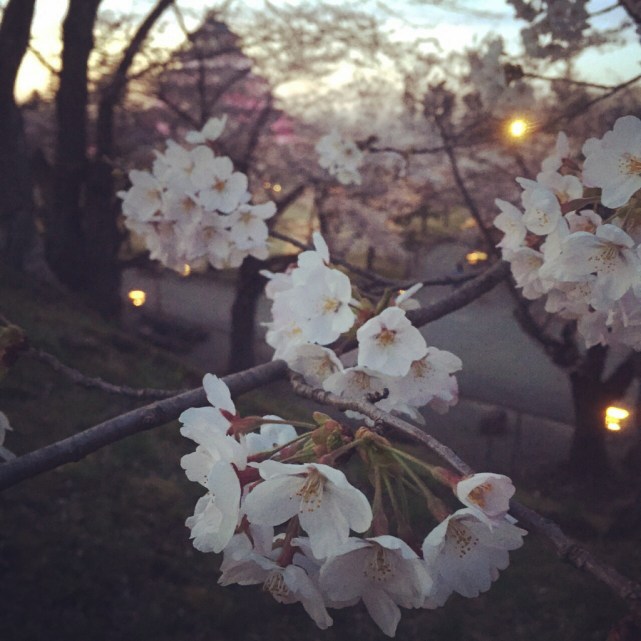
Cherry Blossoms [Sakura] photographed by Mokomo near where she lives in Western Fukushima Prefecture, Japan. ‘I think the sakura in my home town is the best after all’ says Mokomo.
The image of people having hamami in Fukushima could be simply horrific because of radiation contamination. But for her, such image is also a landscape of her home that she loves in spite of the contamination. It is uncanny, but perhaps, it is also a manifestation of her self-determination to live with radiation.
Yohei Koyama is currently undertaking doctoral research in Japan focussing on the aftermath of the Fukushima nuclear accident. His ongoing PhD research, supervised by Dr Griseldis Kirsch, is titled: ‘Life with Radiation: ethnography of the nuclear disaster in Fukushima’.
References:
Alexievich, S. 1997. Voices from Chernobyl. Normal; London: Dalkey Archive Press
Freud, S. 1919. “The uncanny”. In S. Freud. 2003. The uncanny. Translated by D. McLintock. New York: Penguin Books
Petryna. A. 2002. Life exposed: biological citizens after Chernobyl. Princeton, NJ; Oxford, UK: Princeton University Press
Fukushima and the Right NOT to Return: Nuclear Displacement in a System for “Hometown Recovery”
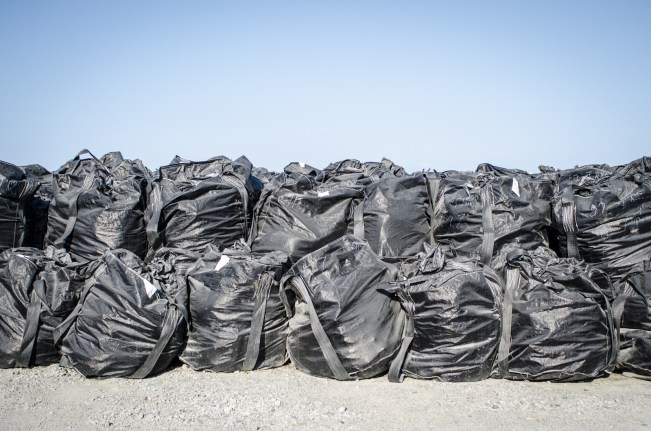
Bags of contaminated material seen near the town of Odaka on the edge of the Fukushima Exclusion Zone.
Dr Liz Maly, Assistant Professor in the International Research institute of Disaster Science (IRIDeS), Tohoku University
On March 11, 2011, the 9.0 magnitude Great East Japan Earthquake (GEJE) unleashed a massive tsunami devastating over 500 square kilometers of Japan’s northeast Tohoku coast. This region has experienced tsunamis every 30-40 years, but the size and impact of the waves of the 3.11 tsunami vastly exceeded any in recent memory or predictions. The tsunami swallowed buildings and places thought to be safe, killing more than 18,000 people and reducing entire communities to rubble. Damage to the Tokyo Electric Power Company (TEPCO) Fukushima Daiichi Nuclear Power Plant on the coastline of Fukushima Prefecture caused the most serious nuclear accident since Chernobyl—a nuclear meltdown which TEPCO and government officials did not publicly admit until almost 5 years later.
Over 1,000,000 house were destroyed or damaged. In the days that followed, 470,000 people evacuated to school gymnasiums or other facilities, as aftershocks and blackouts continued and cleanup efforts began. In the following months, disaster survivors moved into various temporary housing provided by government support. Five years later, 174,000 people are still displaced, living interim housing, including 99,000 from Fukushima.
For those fleeing nuclear radiation, evacuation and displacement is more complicated. In the days after 3.11, the evacuation zone around the NPP was increased to a 20km radius; people within 30km were ordered to stay inside and prepare to evacuate if necessary. However, the radioactive plume was carried further northwest by wind and rain on March 15th. Although information about the direction of the fallout was available from SPEEDI (the System for Prediction of Environment Emergency Dose Information), it was not made public until March 23, too late for people unaware they were in or evacuating directly into the path of the highest amounts of radiation.
People from areas near the NPP struggled with evacuation decisions amidst a lack of information. Some towns ordered evacuation following government directives; others outside designated areas ordered evacuation independently. Still areas were not evacuated until weeks later. Some towns’ residents evacuated collectively; others scattered to various locations inside and outside Fukushima Prefecture. Most moved multiple times. So-called “voluntary evacuees” made their own decisions to evacuate from areas officially deemed “safe.” Elderly people, especially those in nursing/care facilities, suffered severely; more people from Fukushima died as a result of physical and emotional stress related to evacuation and displacement than directly from earthquake or tsunami impact.
More people from Fukushima died as a result of physical and emotional stress related to evacuation and displacement than directly from earthquake or tsunami impact.
Restricted areas were later categorized into three zones based on contamination and possibility of residents’ return. Entry is forbidden to the most severely contaminated, euphemistically named “difficult to return” zone 1. In “residence restricted” zone 2, daytime visits are allowed. In zone 3, optimistically designated “preparing to lift evacuation orders,” daytime entry and business activities are allowed. Contamination levels are based on air samples from point sources; some municipalities include multiple zones, which have been revised several times.
Decontamination, the government’s primary measure for reducing the amount of radioactive material, involves cleaning house roofs, etc., and removing natural materials and a layer of topsoil, which is collected in black plastic bags, continuously piling up in growing storage areas.
While the promise of decontamination is every area can be made safe, there are limits.
For example, there is no way to decontaminate forested mountains; every rainfall carries material to nearby communities, in effect re-contaminating them. Government plans rely on the underlying logic of a one-track plan for the future of contaminated towns: decontamination leads to lifting evacuation orders, then residents will move back. Based on level of contamination and speed of decontamination, the progress on this timeline towards its singular goal is shortened or extended.
Lifted restrictions mean people are allowed to move back, not that they will. In September 2015 restrictions were lifted for Naraha Town; 4 months later, only 6% of former residents moved back. Long term impacts of radiation exposure in Fukushima will not be known for years. But regardless of decontamination efforts and assurances of “safety,” many people will chose not to return, especially parents unwilling to risk children’s health. Conclusions about what areas are actually safe, made on a household or individual basis, also cause rifts within families such as “atomic divorce.” However, some people desperately want to move back, primarily elderly residents less concerned about long term health effects. As Japan is already facing a national demographic crises of an aging, shrinking population, the long-term future of these towns is uncertain at best.
Japanese disaster recovery policies strongly support a one-track ‘hometown recovery’ approach. Local governments have the main responsibility for post-disaster recovery planning (and other disaster management activities). With national funding, Tohoku’s local municipalities have created and are implementing recovery plans. Varying by town, common goals include bringing residents back and helping rebuild homes and lives. Temporary housing, also government-supported, is intended as an interim support until people can go back to new houses in old hometowns; the timeline to move out of temporary housing for those in Fukushima is longer, and their future is unclear. For permanent housing reconstruction, support options include provision of access to lots for private housing reconstruction, and public housing for those unable to rebuild on their own. Fukushima Prefecture is building public housing within the prefecture for residents from contaminated area. However, the main projects supporting residential relocation for rebuilding private houses on individual lots away from coastal areas, happening throughout the tsunami-affected area at a scale never before seen in Japan, limit relocation within single municipalities.
For towns affected by the nuclear accident, the recovery planning process has a vast internal contradiction: recovery plans and policies focus exclusively on rebuilding hometowns, but some towns will not be inhabitable for many years, and in others the majority of residents don’t want to return. Existing recovery policies don’t have a way to deal with relocating partial or entire towns. Several contaminated municipalities have established temporary town halls within other towns. But it is difficult for towns to consider a recovery plan that dissolves the town itself.
How can you put a price on the loss of a house, livelihood, and community?
While displaced, “official” evacuees (those from designated evacuation areas) receive compensation payments from TEPCO (actually the Japanese government, since TEPCO was nationalized). Although these are large sums of money, the real question is not if the amount is enough, but how can you put a price on the loss of a house, livelihood, and community? Compensation payments to nuclear evacuees can’t bring back what was lost.
Japan has well-established disaster recovery policies based on social welfare support for survivors. Yet even with a sizable national disaster recovery budget and governance experience, current policies can not adequately address the actual challenges for recovering the lives of nuclear evacuees and their contaminated hometowns. Beyond the disruptions of lives and communities, the cleanup and full decommissioning of the NPP will take decades, and leave a site that will be contaminated for a very long time.
Even with highly developed disaster preparations, such as the case in Japan, it is impossible to reduce all risk from natural disasters. Yet even if a nuclear accident is caused because of a natural hazard, it is in fact a man-made disaster. Everything possible should be done to prevent another nuclear accident, including decommissioning reactors; in Japan many are located near earthquake faults or coastal areas.
Japan is the only county whose people have been victims of both an atomic bombing and a massive nuclear accident. Beyond horrendous experiences of bomb survivors in Hiroshima and Nagasaki, their children and grandchildren suffered stigma and discrimination (sadly, evacuees from Fukushima have also faced discrimination). The experience of having been attacked by atomic bombs did not stop development and promotion of nuclear power in Japan, strongly supported by government. After the Fukushima Daichi accident, there was a massive swell of popular anti-nuclear opposition, and operation of all 44 active nuclear reactors in Japan was stopped. However, in August 2015, despite residents’ strong opposition, the first nuclear reactor restarted operation at the Sendai Nuclear Power Plant in Japan’s southernmost island, Kyushu.
On April 14, 2016, a large earthquake struck Kumamoto City, in Kyushu, followed by a larger M7.3 quake in the early hours of April 16th; strong aftershocks continuing for a week.
As of April 20, 48 people had been confirmed dead, included several people who died during evacuation, and more than 100,000 people had evacuated from damaged homes or those in danger due to aftershocks. Heavy rains caused landslides, sections of highways were destroyed and operation of bullet trains were suspended, making it difficult to get supplies to evacuees, and any potential evacuation from a nuclear accident impossible. Despite predictions that large quakes will continue, potentially triggering more landslides, and vocal calls from inside and outside Japan, the Japanese Nuclear Authority refuses to stop the reactors, which continue to operate nearby. It seems not enough has changed since 3.11; not only do problems of Fukushima’s nuclear evacuees from remain unsolved, they are in real danger of being recreated.
Dr Liz Maly’s work centers on disaster recovery, housing reconstruction and community-based recovery planning. She has previously researched post-Katrina and post-Sandy housing recovery and land use policy in the USA, as well as the Central Java Earthquake in Indonesia. Dr Maly continues to work on long-term community recovery for groups impacted by the 2011 Great East Japan Earthquake. Her website ‘Recovering Tohoku’ is highly recommended, and you can follow her on twitter here.
Fukushima and the Right NOT to Return: Nuclear Displacement in a System for “Hometown Recovery”
Let Japanese Officials Eat Isotopes To Atone For Fukushima
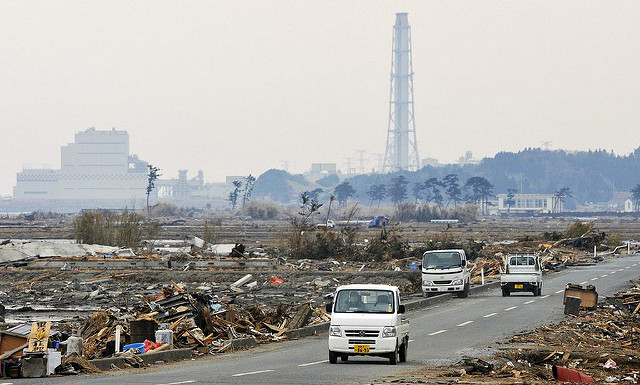
Despite the Fukushima and Chernobyl disasters, nuclear energy continues to thrive. Pictured: Fukushima shortly after the disaster.
How Japanese Officials Can Atone for Fukushima
Let them eat isotopes.
The meltdowns and release of radiation from the Fukushima Daaichi nuclear power plant has been an ongoing crisis for five years. Nuclear engineer Koide Hiroaki has been one of the most trenchant critics of how the Japanese government and power company TEPCO (mis)handled the disaster. In a wide-ranging interview at Counterpunch, he offered a way for officials, who have gone unpunished, to atone.
Right now the people of Fukushima have been abandoned in the areas of the highest levels of radiation. And abandoned people have to find a way to live. Farmers produce agricultural goods, dairy farmers produce dairy products, and ranchers produce meat; these people must do so in order to live. They are not the ones to be blamed at all.
As the Japanese state is absolutely unreliable in this matter, these people have no choice but to go on producing food in that place, all the while suffering further exposure. So I don’t think we can throw out the food they produce there under those conditions. Inevitably someone has to consume that food.
Certainly not the residents of the Fukushima area. Hiroaki has a better idea.
We should serve all of the most heavily contaminated food at say the employee cafeteria at TEPCO or in the cafeteria for Diet members [Japanese parliament] in the Diet building. But that isn’t nearly enough. We must carefully inspect the food, and once we’ve determined what foods have what levels of contamination, once that is fully measured and delineated, then those who have the corresponding levels of responsibility should eat it, should be given it.
He’s serious.
I am aware that this is a controversial proposal, but each one of us, especially those who built post-war Japan, bears responsibility for allowing our society to heavily dependent on nuclear energy without carefully reflecting on the risks and consequences of it. And more importantly, we have the responsibility for protecting children.
Even after Chernobyl and Fukushima, nuclear energy thrives. Especially in Russia and China, where they are planning to build floating nuclear energy plants. Huh? From CNN on April 28:
China is planning to build nuclear reactors that will take to the sea to provide power in remote locations. … These small power plants will be built in Chinese shipyards, mounted on large sea-going barges, towed to a remote place where power is needed and connected to the local power grid, or perhaps oil rig.
China has 20 planned; Russia seven. Never mind how much the costs would cascade if another disaster occurs. In January 2014, at Warscapes magazine, I wrote that it was difficult to understand how the advocates of nuclear power can continue to block out the risk of major accidents, especially when they are fresh in our memory.:
Fukushima has just occurred before the world has gotten over the last one, Chernobyl. What if another accident occurs while we’re still knee-deep in cleaning up and bearing the costs of Fukushima, and maybe even still Chernobyl? Casualties and damage to the environment aside for the moment, how can nations afford this? Come to think of it, how do nuclear-power companies afford it, yet continue to forge ahead?
To answer the last question: state subsidies to build nuclear energy plants. Also, of course, much of the cost of cleaning up after an accident is, as you would expect, offloaded to the state and its citizens. Bailing out the nuclear energy is of a piece with bailing out the banks.
http://fpif.org/japanese-officials-can-atone-fukushima/
Mount Sakura is just 50km from the NPP Sendai
The Sakurajima volcano in Japan erupted again on April 30, 2016.
Japanese media do not talk about it…
Mount Sakura is just 50km from the NPP Sendai (Kagoshima, Japan)!
3 subsequent explosions sent a column of ash 3800, 1800, and 1200 meters over the crater.


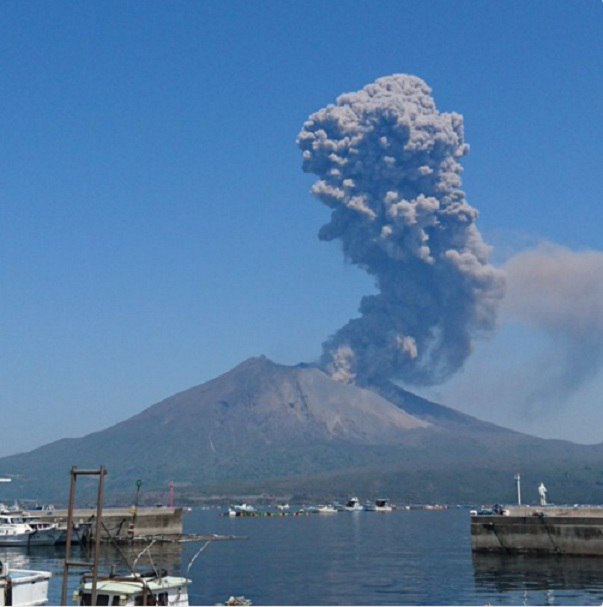
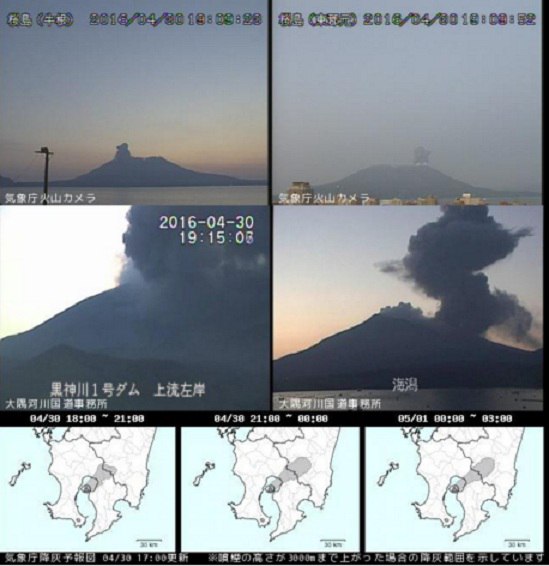
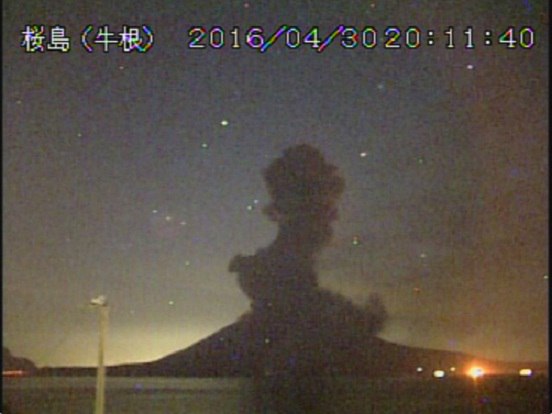
Nowlook at this awesome video:
This new eruptive phase at Sakurajima volcano, Japan, began back on April 29, 2016:
鹿児島県:桜島
4月28日23時16分(爆発的噴火) 火山雷あり。瀬戸空振計:19.3Pa 弾道を描いて飛散する大きな噴石:4合目。今年40回目(気象庁火山観測報:https://t.co/tA1AEDEzT3) pic.twitter.com/KmosoHMCkn— T.HIRANO (@TOHRU_HIRANO) April 28, 2016
Explosions also occurred on April 30, 2016:
鹿児島県:桜島
4月29日17時17分(爆発的噴火) 噴煙:火口上3500m 瀬戸空振計:21.2Pa:弾道を描いて飛散する大きな噴石:6合目。今年41回目 (気象庁火山観測報:https://t.co/UYFKIKSDz4) pic.twitter.com/4SSdN7fpLx— T.HIRANO (@TOHRU_HIRANO) April 29, 2016
Before exploding again on April 30 2016.
鹿児島県:桜島
4月30日09時25分(爆発的噴火) 噴煙:火口上3600m 瀬戸空振計:22.6Pa:弾道を描いて飛散する大きな噴石:5合目。今年42回目 (気象庁:https://t.co/7CnC8fMEfq) pic.twitter.com/3Z6SOlCeG1— T.HIRANO (@TOHRU_HIRANO) April 30, 2016
The volcanic unrest continues… And nobody knows when it is going to stop!
How Can Japan Settle The Issue Of Fukushima Daiichi Tritium? Drink It.

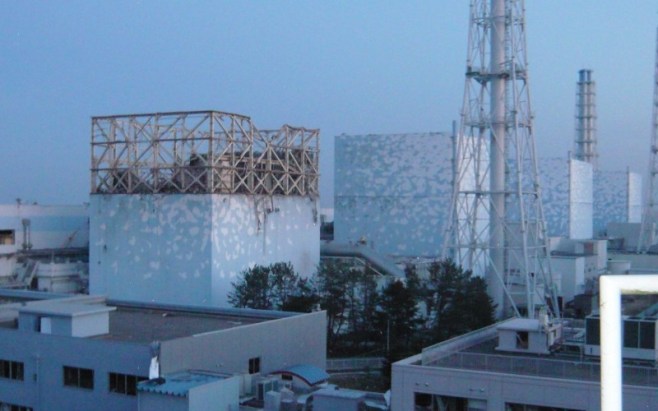
Water tanks crowding the Fukushima Daichi nuclear plant site
Here’s the problem in a nutshell—or rather a thimbleful—facing the Japanese government and Tokyo Electric Power Company (TEPCO), the operator of the crippled Fukushima Daiichi nuclear plant.
There are over 1,100 large steel tanks brimming with filtered water—except for a low contaminant called tritium—clogging both the plant and an expanding area outside the site.
The water is a mix of tons of groundwater flowing into the plant’s basements and tons of contaminated water that have become radiated after draining down there through the three damaged reactors the water was injected into to keep the melted uranium cores cool. This lethal liquid mix is pumped out the basements and decontaminated before it overflows and seeps into the sea; some of it is recycled back as coolant into the reactors while the rest is pumped into the storage tanks.
This process continues hour after hour, day after day, year after year: a cunningly worthy punishment of the gods for the latter-day Sisyphus, TEPCO. Consequently, every week or two a new tank-full of treated water is added to the forest of steel now covering the area like giant alien mushrooms. The total amount of stored water exceeds 800,000 cubic tons and is inexorably heading for one million tons and more without an end in site.
The cost is enormous, and picking up the tab is the Japanese taxpayer—not TEPCO, which is undergoing a ten-year reconstruction since a government bail out saved it from bankruptcy.
So the million-ton-plus dilemma for the government has boiled down to three options: keep on with the endless and expensive tank building and filling; find a way to remove the tritium from the water; or have TEPCO discharge (dump) the water into the ocean.
The latter option is by far the easiest and least expensive method, except that the water is tritiated: that is the water has become radioactive.
Without context, that’s a scary word, until you remember that sunbathing and eating bananas are pleasant radioactive pastimes. The point being that the energy tritium gives off is so low as to be unmeasurable with a dosimeter. And the particles (not rays) tritium expels can be stopped by plastic wrap—as Shunichi Tanaka, head of Japan’s Nuclear Regulatory Authority, told the press recently.
That’s a fact, but it’s not the point, say environmentalist foes of the dumping method. Ingesting tritium is a concern for health they argue. And they have experts to back up such concerns, though they are mostly theoretical. Meanwhile, there are experts on the other side of the debate pooh-poohing such worries and asking to see some solid proof to back up the theory.
Conclusion: Those supportive of nuclear power tend to minimize the health risks of tritium, while those opposing the use of nuclear power tend to exaggerate its risks.
What is not debatable is the negative psychological impact releasing the water into the sea will have on Japan’s nervous neighbors, the suffering people of the northeast, the region’s fishing industry and the Japanese electorate.
Given such concerns and uncertainties, organizations like Greenpeace urge the government to err on the side of caution. The best option, says Greenpeace, is to continue storing the water while exploring all technical options for tritium separation.
On the face of it, that seems reasonable. But then experts opposing this stance, like Lake Barrett, a nuclear industry consultant advising TEPCO, point out that while it may be possible to create a method of separating the tritium, it hasn’t been found yet, despite much effort; and it would likely cost a couple of billion dollars to develop and perfect in any case. It’s no surprise that TEPCO and the government have reached the same conclusion.
“All that money could be better spent on schools, hospitals,” Barrett told me. “And you can’t go on building tanks forever.”
Besides, he adds, “The very low levels of tritium in the stored water are not a meaningful health risk. After verification that the radioactivity levels are within conservative Japanese health risks, I would not hesitate to drink it, bathe in it, or eat fish or shellfish harvested from it.”
Now there’s an idea. If the government is to discharge the tritiated water into the ocean without turning a large portion of the electorate against it, it needs to persuade a majority of citizens that it is safe within reason to do so. This will require a number of carefully thought out steps.
The government will have to clearly explain the pros and cons of its action and the reason for its decision; it must establish a mechanism to compensate the fisherman for the shortfall they will undergo following the release; an international panel of independent, knowledgeable people, including environmentalists of the non-hysterical variety, is required to verify the tritiated water does indeed fall well below internationally accepted standards for release; and the panel members must be granted access to monitor the process at any time they wish.
Then for the coup de grâce, Prime Minister Abe, his cabinet members along with TEPCO executives should visit Fukushima Daiichi, and while standing in front of one the giant tanks each drink a glass of the tritiated water. This won’t sway everyone, of course, but it would give the government the minimum moral authority required to make such a contentious decision.
Radioactive material from Fukushima plant coming back to Japan in the Pacific
Prof. Aoyama from Institute of Environmental Radioactivity of Fukushima University reported that the radioactive material discharged from Fukushima plant circulated in the Pacific to come back to Japan offshore.
He implemented seawater analysis at 71 points from 11. 2015 to 2. 2016. The analysis is partially completed to show radioactive material has spread to the South West offshore of Japan. 2 Bq/m3 of Cs-137 was detected in seawater from South West offshore of Kyushu. 1.83 Bq/m3 was detected even offshore of the west coast of Japan.
0.38 Bq/m3 of Cs-134 was also measured to prove this is from Fukushima accident.
It is assumed that the discharged Cs-134/137 travelled to the east in the Northern Pacific. It was carried to the South and West to come back to Japan by taking 2 ~ 3 years.
He comments it is possible that the density of radioactive material increases from now.
http://www.asyura2.com/16/genpatu45/msg/611.html
Radioactive material from Fukushima plant coming back to Japan in the Pacific
1 This Month




PLEASE OPPOSE HR 8255 AND S.3639 – bills would accelerate satellite deployment, with no environmental review or safeguards – https://ncstd5li.quorum.us/campaign/169331/
To see nuclear-related stories in greater depth and intensity – go to https://nuclearinformation.wordpress.com
-
Archives
- September 2026 (330)
- August 2026 (330)
- July 2026 (355)
- June 2026 (287)
- May 2026 (306)
- April 2026 (356)
- March 2026 (251)
- February 2026 (267)
- January 2026 (308)
- December 2025 (358)
- November 2025 (359)
- October 2025 (375)
-
Categories
- 1
- 1 NUCLEAR ISSUES
- business and costs
- climate change
- culture and arts
- ENERGY
- environment
- health
- history
- indigenous issues
- Legal
- marketing of nuclear
- media
- opposition to nuclear
- PERSONAL STORIES
- politics
- politics international
- Religion and ethics
- safety
- secrets,lies and civil liberties
- spinbuster
- technology
- Uranium
- wastes
- weapons and war
- Women
- 2 WORLD
- ACTION
- AFRICA
- Atrocities
- AUSTRALIA
- Christina's notes
- Christina's themes
- culture and arts
- Events
- Fuk 2022
- Fuk 2023
- Fukushima 2017
- Fukushima 2018
- fukushima 2019
- Fukushima 2020
- Fukushima 2021
- general
- global warming
- Humour (God we need it)
- Nuclear
- RARE EARTHS
- Reference
- resources – print
- Resources -audiovicual
- Weekly Newsletter
- World
- World Nuclear
- YouTube
-
RSS
Entries RSS
Comments RSS

