It’s horrible to think that if the rice is over 99 Bq/kg it cannot be sold in Japan yet it can have up to 600Bq/kg (?) of Cs137/134 and be sold in the EU. One man’s poison is another man’s food …
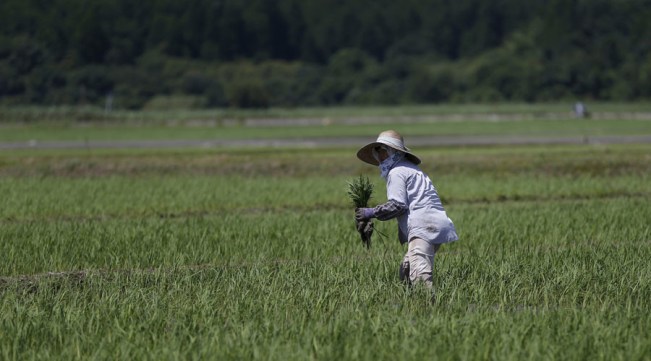
Rice harvested in Japan’s Fukushima region, heavily affected by a nuclear meltdown in 2011, is returning to the EU, starting with Britain next month, the Japan Times reports.
A total of 1.9 tons of Fukushima rice called Ten no Tsubu will be sold in London, making the UK the first EU nation to import the region’s produce after the nuclear disaster. The sale became possible after a long campaign from Fukushima natives in London to fend off rumors about the potential danger of the crops, the media said.
“With the UK as a foothold, we hope to expand the sale of prefecture-produced rice to other EU member countries,” said Nobuo Ohashi from Japanese farmers group Zen-Noh.
Brussels requires rice from Fukushima to undergo a radiation test in Japan or the importer country.
“It’s bright news for Fukushima, which has been struggling with the import restrictions. We will make further efforts so the restrictions will be lifted entirely,” said a spokesperson for a prefectural office.
The disaster at the Fukushima-Daiichi Nuclear Plant was caused by a tsunami that resulted in the meltdown of three nuclear reactors and the release of radioactive material. It was the largest nuclear disaster since the Chernobyl accident in 1986, and the second to receive the highest level classification on the International Nuclear Event Scale.
A March report by the US National Academy of Sciences said that five years following the disaster, most seafood caught off the coast of Japan is now safe to be consumed, adding, “the overall contamination risk for aquatic food items is very low.”
https://www.rt.com/business/347459-fukushima-rice-japan-meltdown/
June 21, 2016
Posted by dunrenard |
Fukushima 2016 | Contaminated Food, EUROPE, Exports, Fukushima continuing, United Kingdom |
Leave a comment
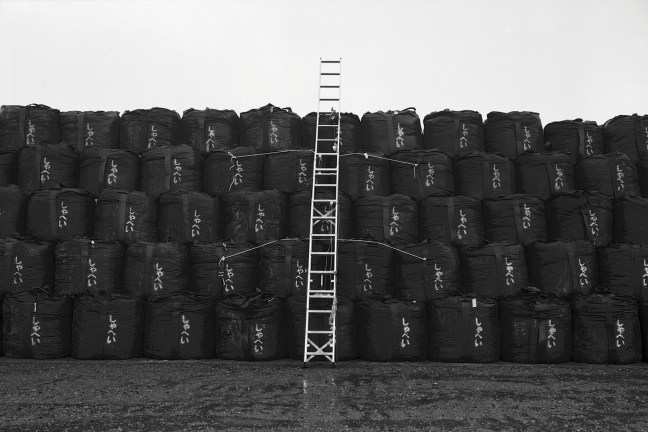
ABOVE: Radioactive waste from the evacuation zone is stored at massive dump sites. In Naraha, thousands of decontamination workers dug up and disposed of a two-inch layer of soil around every building in town.
Hisao Yanai, a one-armed, chain-smoking, retired yakuza boss, stands alone behind the bar at Ippei, the restaurant he owns in the Japanese town of Naraha. There are no customers today. The streets outside the restaurant are deserted. Five years ago, on March 11, 2011, a powerful earthquake and tsunami triggered a triple meltdown at the Fukushima Daiichi nuclear power plant, located ten miles north of Naraha, forcing the evacuation of roughly 160,000 people. Half of them still cannot go home. Last fall, Naraha became the first town in Fukushima’s mandatory evacuation zone to reopen fully, allowing all 7,400 residents to return. Nothing like it had ever been attempted before. Could a town despoiled by radiation be summoned back to life?
When I visit Naraha in the fall of 2015, not long after it reopens, only 150 residents have returned. (The number has since risen to 500.) Most are elderly. The town seems abandoned, like a seaside resort in the off-season. With no functioning banks, schools, or even a post office, Naraha has reverted to the rural backwater that Yanai escaped 50 years ago as a high school dropout. At 15, he ran off to Tokyo and learned to drive a dump truck during the construction boom leading up to the 1964 Olympics. At 16, he lost his left arm to a conveyor belt at a quarry. Eventually, he returned to Naraha and went to work at Fukushima Daiichi, which was flooding the area with high-paying jobs and government subsidies. Naraha, once known in Japan as “the Tibet of Fukushima,” had suddenly been thrust into the nuclear age.
“The nuclear plant changed the history of this town,” Yanai says. “They told us it was 100 percent safe.”
Naraha still has the outward appearance of a sleepy farming community, with tidy neighborhoods separated by rice paddies, fruit orchards, and two rivers tumbling to the sea from the nearby Abukuma Mountains. Since decontamination began about 18 months after the disaster, thousands of workers equipped with little more than garden tools have cut down trees, power-washed streets, and peeled off a two-inch layer of radioactive soil in a 65-foot perimeter around every structure in town. Vast fields and mountainsides have been left largely untouched, save for large burial mounds of black plastic bags filled with low-level radioactive waste that metastasized across the landscape as the work progressed.
There’s no blueprint for remediating a radioactive town and then moving people back into it. After the 1986 nuclear disaster in Chernobyl, the Soviet Union simply abandoned scores of towns. But in a country as densely populated as Japan, abandoning an area the size of Connecticut wasn’t an option. In a concerted push to resettle all but the most severely contaminated areas, the government has spent $31 billion on the cleanup effort, and a staggering $58 billion in compensation payments to evacuees.
The government maintains that it is safe for residents to return to Naraha. Radiation levels in the central part of town average less than 1 millisievert per year—the maximum allowable exposure for ordinary citizens under guidelines set by the International Commission on Radiological Protection. An annual dose of 1 millisievert would increase a resident’s risk for cancer by .005 percent. For a smoker like Yanai, cigarettes pose a far greater threat than radioactive fallout.
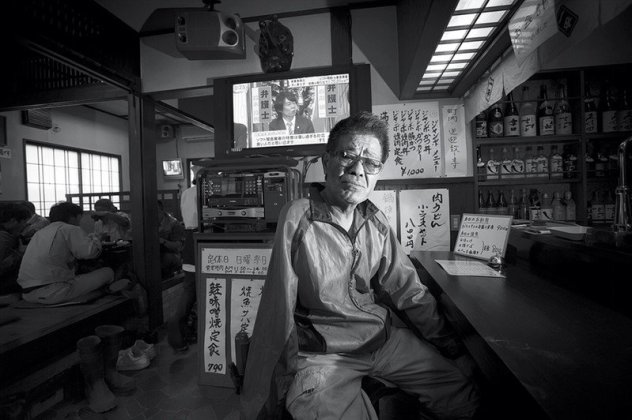
Hisao Yanai, a retired yakuza boss, returned to Naraha without his wife and daughter.
Like many residents, however, Yanai distrusts the government. Surveys indicate that half of all evacuees don’t plan to return home. The cleanup effort is widely viewed as political theater, designed to whitewash Fukushima in time for the 2020 Olympics. Encouraging evacuees to return home now would also put an early stop to some compensation payments, which aren’t set to expire until 2018. The government, in short, has a financial incentive to strong-arm mayors into reopening towns before they’re ready, or even properly decontaminated.
“The central government pressured us to lift the evacuation order,” Yanai says. “Nobody in town wanted it, because nothing is prepared.” His restaurant remains the only place in Naraha where you can get a beer. In the two weeks I spent in town, I saw only two people dining at Ippei. Behind the bar, the hands on the clock are frozen at 2:47, the moment when the earthquake hit. Yanai has vowed not to reset it until life in Naraha returns to normal.
One day, Yanai invites me to his home, to see the results of the government’s decontamination program. His house sits on a hilltop, ringed by a concrete wall. When I arrive, Yanai is sitting at a picnic table, smoking. Thick weeds mark the border of the decontaminated buffer zone around his house. Before it was decontaminated, radiation levels in Yanai’s yard measured 10 microsieverts per hour—nearly 50 times higher than the government’s allowable limit.
“There are still places in town that measure 10 micro-sieverts,” Yanai says. He walks over to the corner of his garage, which houses a dusty Mercedes resting on flat tires, and points to a patch of gravel beneath a downspout. This particular spot, he says, was decontaminated three times, because rain kept washing radioactive particles off the garage roof. Government contractors excavated the hot spot each time, but only after Yanai filed a request through the town office.
“If you don’t ask,” Yanai shrugs, “they won’t do it.”
The government has strict decontamination guidelines, but in the field practices are often improvised. At Yanai’s house, contractors dumped wheelbarrow-loads of contaminated dirt in a corner of his garden.
“Look, I’m a nice guy,” says Yanai, grinning. He crushes a cigarette butt into the gravel with his heel. “I said, ‘Fine, if you want to dump it there, I’m not going to say anything. But if you do the same thing in the neighbor’s yard, they might shoot you.’ ”
Yanai is keen to show me his menagerie. His prized specimen is Boo, a boar named for the sound, in Japanese, that a pig makes. After the Fukushima disaster, wild boars came down from the mountains and roamed the evacuation zone, tearing up gardens and ransacking houses. They can still be seen in Naraha, trotting along the road at night. Boo is the size of a small, snaggle-toothed dog. He snorts and gnaws at Yanai’s shin. “They’re not very friendly to people,” says Yanai, shooing the pig away with his foot. “But I’m determined to make him my pet.”
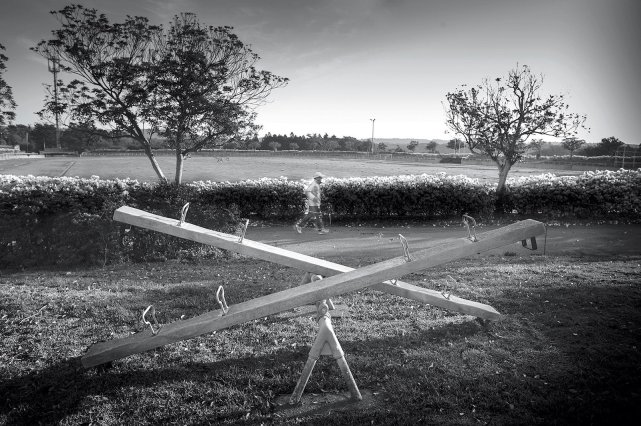
Of the 500 villagers who have returned to Naraha, most are elderly. It is a town without children.
Although Yanai professes to be retired from the Japanese Mafia, his years as a yakuza boss have left him with wealth, influence, and a fearsome reputation. It was rumored that he’d served time in prison for assault. After the nuclear disaster, he used his mojo to force the big construction companies in charge of the cleanup to hire local firms as subcontractors. “In a way,” he says, “the disaster was a good thing.”
Stepping onto the patio in back of his house, Yanai reaches into a galvanized steel tub full of water and pulls out a goldfish as big as a grapefruit. There is a technique to feeding them, he observes. “Do it too quick and they die.”
It’s obvious that Yanai misses being a yakuza boss. He is still bending creatures to his will, only now it’s a quirky hobby. He has a wife and daughter, but they live in Tokyo.
“It must get lonely here,” I venture.
“That’s true,” says Yanai, releasing the goldfish back into the tub. He watches the fish rejoin its companions. “When I get home they’re waiting for me. They don’t complain if they’re hungry, but they’ll die if I don’t take care of them.”
At the ceremony to mark Naraha’s reopening, Mayor Yukiei Matsumoto performed the banal civic rituals required of mayors everywhere. He planted a tree using a gold shovel, celebrated with a group of children, and projected confidence while posing next to a brightly colored illustration of Naraha’s future. “The clock that was stopped,” he declared, “has now begun to tick.”
A few weeks later, I meet Matsumoto at the town hall. Scattered among the office’s sober furnishings are stuffed toys portraying Naraha’s mascot, an anthropomorphic yellow citrus fruit named Yuzutaro. Between sips of green tea, Matsumoto speaks in a soft monotone. To hear him tell it, running a radioactive ghost town for more than three years was marginally more eventful than a meeting of the zoning commission. He attended countless meetings with government officials and oversaw infrastructure repairs. When he speaks of the town, the word “radiation” rarely crosses his lips. Instead, he prefers vague euphemisms like “environment.”
I ask him to describe what evacuees are most concerned about. At first, he says, they were “quite angry” about “the environmental conditions of the town.”
“And now?” I ask.
“Now there are no problems,” he says, “and people have become tranquil.”
Later, as I talk to more residents, it becomes clear that this characterization is a vast overstatement. It’s obvious to even the most casual observer that only old people are returning to Naraha. If young people are afraid to raise children here, I ask Matsumoto, what kind of future is there for Naraha?
“Naturally we want everybody to come back,” he says. “Elderly people are coming back first.” He places his teacup on the table. “But if the children do not come back here, the town cannot exist.”
For a moment, Matsumoto seems surprised by his own candor. Then he hastens to obfuscate it. Leaning forward in his chair, he redefines Naraha’s existential dilemma as a simple misunderstanding. Naraha is completely safe, he asserts. Parents with young children just need a little more convincing to return. One thing his office could do, he suggests, is to “make the environment around the schools better. Also we need to do something to make the parents understand.”
“Understand … what?”
“Regarding the issue of—radiation,” says Matsumoto, searching for a more diplomatic word. “People have their own ideas about what’s safe. But actually, in Naraha, it’s lower than 1 millisievert per year, which is what the government set for exposure to the public. That’s the reality I want people to understand.”
I ask him if he is happy with the government’s decontamination efforts. Matsumoto chuckles. “Let me say I’m not 100 percent satisfied,” he says. For further details, he refers me to Hiroyuki Igari, the town’s director of radiation measurement.
A week later I speak to Igari, a churlish man with a dosimeter badge—a device that measures a person’s cumulative radiation exposure—hanging on a lanyard around his neck. If anything, he insists, the government is actually overstating the amount of radiation that residents are being exposed to. “I live in Naraha,” he says. “I commute to work. Sometimes I stop by the store. Then I go home. That’s my routine.” He yanks on the dosimeter. “After two weeks, it’s obvious from this dosimeter that my exposure won’t exceed 1 millisievert per year.”
While Igari doesn’t put any stock in the notion that the government is pressuring towns like Naraha to reopen prematurely, he acknowledges that the cleanup is imperfect. In his view, the government has done a poor job of educating people about radiation, and its standards for mopping up recurring hot spots like the one in Yanai’s yard are nonexistent. But he believes that radiation isn’t a determining factor in whether people choose to return.
“People who were stressed in the temporary houses, they just want to come home. They don’t care about dose rates,” Igari says. “People who don’t return are used to their new lives. They’re used to living under one roof. But now they’re split up, and they don’t want to leave their families again.”
But dosimeter readings and official reassurances have done nothing to alter a more fundamental reality: In post-Fukushima Japan, nuclear safety is a bankrupt concept. Officials like Mayor Matsumoto who use the word “safe” in an absolute sense echo the corporate propaganda of companies like Tokyo Electric Power Company, the disgraced utility that owns Fukushima Daiichi. As the son of a TEPCO salaryman, Matsumoto has spent his career working the levers of a political machine that is oiled with money from the nuclear industry. Yet in the aftermath of one of the world’s worst nuclear disasters, he still believes himself to be a credible authority on the relative safety of low-dose radiation.
The truth is that there’s no such thing as a “safe” dose of radiation, only gradations of risk. Epidemiological studies show that cancer risk increases in tandem with radiation dose, but we know very little about the risks associated with doses below 100 millisieverts per year. Denying that risk contradicts most people’s inherent understanding of safety as a cost-benefit equation. A patient who agrees to a CAT scan of their head, for example, knows that the diagnostic benefit outweighs any increased risk for brain cancer.
Matsumoto prefers to focus on the benefit side of the equation, which doesn’t require him to invent new euphemisms for “radiation.” He points to the brand new secondary school that will open next year, as well as a $50 million retrofit of J-Village, a national soccer training facility presently serving as a staging ground for 7,000 nuclear workers, which will open in time for the 2020 Tokyo Olympics.
“It’s going to be big news,” says Matsumoto.
There are also plans for a new hotel, office building, and a “compact town” that will house a supermarket, pharmacy, home center, and medical clinic. A robotics research facility is due to open this summer. And thanks to government subsidies, ten companies, including a battery-maker, a pharmaceutical firm, and a steel manufacturer, are thinking of moving to Naraha.
For its investment in Naraha, Tokyo got a showpiece to justify the trillions of yen it’s pouring into Fukushima. Since the disaster, only two of Japan’s 42 operable nuclear reactors have reopened over public protests, and the nuclear industry is desperate for a public relations coup. As we part, Matsumoto repeats the promise he made personally to Prime Minister Shinzo Abe. “I told the prime minister that we’re not going to simply reconstruct the town—we’re going to be a model town of the reconstruction,” Matsumoto says, beaming with conviction. “We’re going to do that, and you’re going to see it.”
Convoys of construction vehicles rumble continuously down Route 6, the coastal highway that runs through Naraha and connects the boomtown of Iwaki to the ghost towns of the restricted zone clustered around the nuclear plant. Built for the 1964 Olympics, Route 6 was instrumental in nudging the region out of rural isolation and onto the planning maps of authorities in charge of Japan’s nascent nuclear energy program. Within a decade, Naraha and its neighbors became charter members of Japan’s “nuclear village,” a network of company towns that received government subsidies in return for hosting nuclear power plants.
Tokuo Hayakawa was a young man in 1967 when TEPCO began building Fukushima Daiichi. He is the chief monk at Naraha’s 600-year-old Hyokoji temple, and an ardent antinuclear activist. I visit Hayakawa on two occasions, and each time he wears a white NO NUCLEAR PLANT button pinned to his lapel.
“Since TEPCO started operating here, nobody believed what they were saying about safety,” Hayakawa says. And yet the utility was able to build not just one, but two nuclear plants in Fukushima prefecture: Daiichi and Daini. (Daini was also damaged by the tsunami, narrowly averting a meltdown.) How could TEPCO accomplish this, I ask, if nobody thought the plants were safe?
“As a foreigner, it’s really difficult for you to understand,” Hayakawa says after a long pause. “There’s an atmosphere that keeps people from raising their voices. If something is dangerous, they can’t say it’s dangerous. If something isn’t right, they can’t say it’s not right.”

Tokuo Hayakawa, chief monk at Naraha’s 600-year-old temple, believes the town can’t be revived: “Naraha isn’t a place to live anymore.”
Social unity is a bedrock feature of Japanese culture, especially in rural areas. The inbred politics of the nuclear village exploited this tendency, fusing the emphasis on communal harmony with corporate interests. Questioning the safety of the nuclear plant was akin to disavowing one’s family, friends, and neighbors. For decades, skeptics bit their tongues, government regulators promoted the absolute safety of nuclear power, and TEPCO executives operated with little or no oversight. This conspiracy of complacency led to dangerous practices, such as locating diesel generators at Fukushima Daiichi in areas that were vulnerable to flooding—a factor that contributed directly to the disaster. Last February, three former TEPCO executives were charged with criminal negligence for their role in the nuclear meltdown.
Hayakawa didn’t want to return to Naraha, but he had no choice. “I cannot abandon the temple,” he says. “There are family tombs here.” Besides, he feels too old to start a new life. He had his hopes set on his grandson taking over for him. But the disaster eliminated that possibility. “I am definitely the last one,” he says. “It’s clear that Naraha isn’t a place to live anymore.”
“The monk was opposed to the nuclear plant from the beginning,” says Toshimitsu Wakizawa, a gregarious 67-year-old newspaper deliveryman who seems to know everybody in Naraha. “And everything he said came true.”
When I approach him, Wakizawa is gathering sticks in his front yard. Japanese people don’t generally engage in conversations with strangers, to say nothing of American journalists who walk up to them unannounced. But Wakizawa chats with me as if we’ve been neighbors for years. He points to houses that are going to be demolished because their owners aren’t coming back.
“I thought 30 percent might return,” he says, “But now I think it’ll be 20 percent, or even less.”
Wakizawa doesn’t blame his neighbors for preferring the conveniences of city life in Iwaki, where 80 percent of Naraha’s evacuees went during the disaster, to the preternatural quiet of their hometown. “It’s even worse here than before the nuclear plants were built 40 years ago,” he says. “When I drive up Route 6, I don’t see any life, not even insects. Around 8 o’clock it’s scary, because nobody’s here.”
Wakizawa is preparing to move back to Naraha in a few days to restart his newspaper delivery business. “People want to read the obituaries,” he says. “That’s why they want the local newspapers—to see who died and what the radiation levels are.”
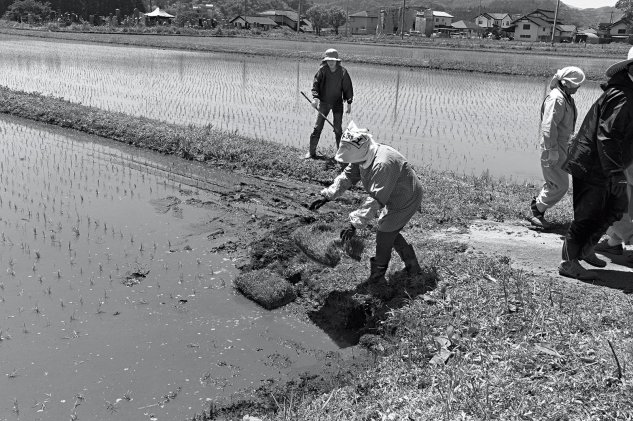
In May, residents planted one of the town’s first rice crops since the disaster. Many believe Naraha’s water is still too contaminated to drink.
Today there are only 50 houses on Wakizawa’s delivery route, down from 250 before the disaster. “The town is disappearing,” he says. He’s troubled by the sense of alienation he feels in Naraha’s desolate neighborhoods. People live alone, outside the traditional support networks of neighbors and extended families. Somebody could die at home and nobody would even know. When I tell him that such deaths aren’t an unusual occurrence in the United States, he looks aghast. “That never happens here! We always talk to our neighbors!” He shakes his head, as if attempting to dislodge the thought of a world where neighbors are strangers and people die alone.
“It’s all mixed up,” he says. “Everything is so confused.”
I leave Wakizawa and drive to the ocean, hoping to find some trace of the houses swept away by the tsunami. Instead I find a vast radioactive waste dump, half-hidden behind flimsy white panels decorated with pictures of birds and trees. I stand with my back to the sea, looking west over the dump toward the dark-shouldered mountains. The river plain is a ragged checkerboard of fallow rice paddies dotted with mounds of black decontamination bags. It is a sobering sight in a country where every inch of arable land is intensively cultivated. The Japanese expression for it is mottainai, a feeling of sorrow for something wasted.
Naraha’s “business district” consists of a single prefab metal shed tucked in a corner of the town hall parking lot. It contains a diner named Takechan, owned and operated by Miyuki Sato and her husband, who commute an hour to and from Iwaki each day. The original Takechan, now overrun with vermin and mold, was a neighborhood fixture in Naraha for 40 years. The reincarnated version has all the charm of a hospital cafeteria, with white laminate walls and glaring fluorescent lights. It is packed with decontamination workers in gray uniforms bent over steaming bowls of ramen.
After the lunch rush one day, I sit down with Miyuki. A television reporter from Sweden had interviewed her earlier in the week. “What do you think about the radiation?” Miyuki intones in mock seriousness. Then she claps her hand over her mouth to stifle a giggle. “So we finished the interview very quickly.”
The Satos haven’t yet found a place in Naraha to relocate. They are eager to leave Iwaki, though, partly because of the long commute, and partly because the evacuee community there isn’t as tranquil as the mayor has suggested. Residents are bitterly divided over his decision to reopen Naraha, Miyuki explains. She is reluctant to say more, except that she has been criticized for cooking with the town’s contaminated tap water. She shows me a certificate from the water authority taped to the wall, guaranteeing that Takechan’s water meets health standards.
“We just wanted to open Takechan, that’s it,” she sighs. “But some people don’t take it that way.”
The director of the local water authority, Haruo Otsuka, shows me a machine that tests the county’s drinking water every hour for cesium-137, the primary isotope in Fukushima’s fallout. The results are always undetectable. I tell Otsuka about evacuees who have criticized the Satos. “Those people are just looking for a reason not to come back,” he scoffs. “At first they said radiation levels in the rice paddies were too high. Then it was the roads. Now they’re blaming the water.”
Tensions among evacuees, however, continue to run high. Hiroko Yuki’s family runs the Shell gas station around the corner from Takechan. Although the Yukis were the first to reopen after the disaster, they have recently bought a house in Iwaki. They aren’t moving back to Naraha.
“We say it’s a house provided by the government,” Yuki says.
“Why is that?”
“People are jealous,” she shrugs. “We work all day, morning to night, and profit margins are slim in this business. We’re not making big money, but people don’t believe it.”
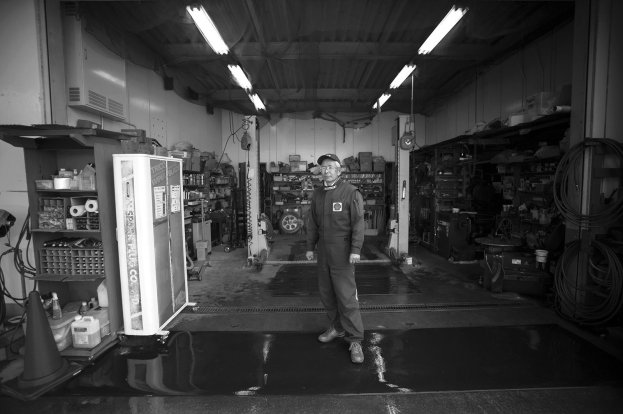
Hiroko Yuki runs the Shell gas station in Naraha. His family has decided not to move back to the village.
Such petty resentments seem unrelated to the serious disagreements among evacuees about resettling Naraha that Miyuki Sato had alluded to. I didn’t understand why anyone would begrudge their neighbors the choice to return—or not. The whole dynamic felt very—Japanese.
“Yes, that’s right, it is very Japanese,” replies Yuki, unfazed. She stands with her hands clasped behind her back, chin tilted in the air, looking a bit like a soldier with her buzzed hair and black Shell uniform. “Japanese people—we always care about how we’re perceived by others. That’s even more true here in the countryside.”
In Japanese society, self-interest is inextricably tied to family, work, and community. But the Fukushima disaster has sliced through those ties like an axe coming down on a bundle of rope. Virtually overnight, tens of thousands of people were set adrift. What looks on the surface like frivolous squabbles are expressions of the profound anxiety many people feel about their place in post-Fukushima Japan. The question of returning home has become a kind of loyalty test that nobody can pass, because home no longer exists.
Nobody understands this better than Kiyoshi Watanabe, president of Naraha’s commerce and industry association and a stolid member of the generation that had a duty, as he puts it, “to keep the house and the family tombs.” Watanabe has returned to Naraha to help “create more opportunities over the next three to five years for younger people to come back and find work.” It won’t be easy. Paradoxically, the disaster has liberated young people from traditional obligations that kept families bound to the same area, even the same house, for generations. Naraha has to reinvent itself to attract new blood.
“In the past, even if the first son lives in some other place, he has to come back to take care of his parents if they ask,” Watanabe explains. “But now he has a good excuse not to: radiation. The parents can’t say anything.”
Glimmers of Naraha’s future can be seen in the recent sale of seven residential lots near the Kido River. A few of the lots, which sold out immediately, went to buyers from Tomioka, a town bordering Naraha that is next to be reopened.
“Naraha won’t take the same form in the future,” Watanabe says. “New people will be moving in, and we have to think about making a new community for them.”
The half-life of cesium-137 is 30.17 years. What’s the half-life of a broken social bond?
“After five years, it’ll be hard to repair,” says Fumiko Yokota. “People just get used to things, good or bad.”
A stout septuagenarian with a mischievous cackle, Yokota lives alone in the hills above Route 6. On my last full day in Naraha, we talk in her kitchen as a warm breeze lifts the sheer curtains over a window offering a distant view of the ocean. Yokota is glad to be back in Naraha. Life in Iwaki “was quite depressing,” she says. But she recognizes that the younger generation has grown accustomed to “living the evacuee life,” and for them there is no looking back.
I ask her what’s so great about life in Iwaki.
“There’s more beautiful people in Iwaki, that’s the biggest difference,” says Yokota, laughing herself into a fit of coughing. “Now maybe this is the twisted idea of an old lady, but I think for some young people the disaster was a stroke of luck.”
Naraha was the kind of place young people forsook for the big city if given the chance, just as Hisao Yanai did 50 years ago. The Fukushima disaster was that chance. Yokota pushes herself up from her chair and goes to the window. Just across Route 6, an elderly couple from Tomioka has built a new house. Yokota met the woman in passing and got a good feeling from her. “I’m thinking we could be friends,” she muses. “It’s not going to happen fast, but gradually this is how we’re going to rebuild Naraha. I can only do what I can do, and that’s not always easy at my age.”
“Bring her a pie,” I joke.
Yokota chuckles. “We’re not like Americans. We’re really shy. I’m not sure they’re looking for friends. But everybody needs to talk to their neighbors.”
Squinting against the sunlight, she clears her throat, her voice a hoarse whisper, and says, “I hope we can be friends.”
https://newrepublic.com/article/133890/ghosts-fukushima
June 21, 2016
Posted by dunrenard |
Fukushima 2016 | Evacuees, Evacuees Return, Fukushima continuing, Villages |
Leave a comment
Very few evacuees want to return to live in contaminated villages, those villages therefore have to offer many incentives to people if they want to repopulate, and not remain just the ghost towns that they became.
KAWAUCHI, Fukushima — The municipal government here, where an evacuation order, issued following the 2011 outbreak of the Fukushima nuclear crisis, was lifted on June 14, is encouraging single-parent families in urban areas to move to the village in a bid to put the brakes on its population decline and aging.
To that end, the Kawauchi Municipal Government plans to provide up to 800,000 yen in subsidies to each single-parent family that moves to the village.
“It’s possible to live more comfortably in the village than in Tokyo and other urban areas,” says an official of the municipal government in charge of the program.
A total of 51 people in 19 households in the Ogi and Kainosaka districts in eastern Kawauchi were affected by the evacuation order that was lifted on June 14. Most of these people have no plans to return home.
Evacuation orders had been lifted in all areas in the village apart from Ogi and Kainosaka by October 2014. Nevertheless, only about 1,800 of some 3,000 residents who had lived in the village before the disaster had returned by April 1 this year.
Approximately 40 percent of those who have returned are elderly people aged 65 or over.
As countermeasures against population decline and aging, the Kawauchi Municipal Government has decided to offer financial incentives to encourage single-parent households outside the village, including those in urban areas, to move in.
Specifically, the municipal government will provide 600,000 yen to each single-parent household that will live in the village to help them buy a car and move into their new home, and 50,000 yen per person (for up to four people) to cover miscellaneous expenses.
The maximum amount of the subsidies is 800,000 yen for a family comprising a parent and three children. The municipal government will introduce full-time jobs at companies operating in the village to those who move there, and provide a subsidy to cover half of the rent of privately owned apartments (up to 20,000 yen).
The municipal government will organize a two-day tour for those who are interested in the program July 29-30, and will begin to accept applicants for the tour as early as this week.
The village will use grants from the national government, which are part of measures to revitalize local economies, to finance the program. Under the program, the municipal government is considering accepting five to 10 new residents a year through fiscal 2017, and about 15 residents per year beyond that.
Moreover, a consultative council encouraging single-parent families to move into the village will be set up with the participation of a local women’s association. Elderly women living in the village will support new residents’ childrearing. Day care services are provided for free in the village.
http://mainichi.jp/english/articles/20160619/p2a/00m/0na/004000c
June 21, 2016
Posted by dunrenard |
Fukushima 2016 | Evacuees, Fukushima continuing, Return Incentives |
Leave a comment
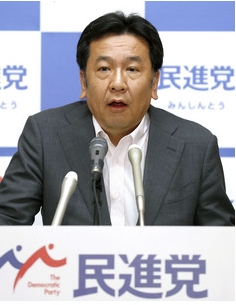
Democratic Party Secretary General Yukio Edano attends a press conference in Tokyo on June 17, 2016. Edano said a report on how Tokyo Electric Power Co. handled the Fukushima nuclear disaster is inappropriate as it notes the then TEPCO chief instructed staff not to use the term “core meltdown” in describing the situation in the early days of the crisis due to pressure from the prime minister’s office. Edano, then chief Cabinet secretary, said, “We may take legal action to challenge it.” (Kyodo)
https://english.kyodonews.jp/photos/2016/06/416899.html
June 20, 2016
Posted by dunrenard |
Fukushima 2016 | Fukushima Daiichi, Japanese Government, Lies & Cover-up, Tepco |
Leave a comment
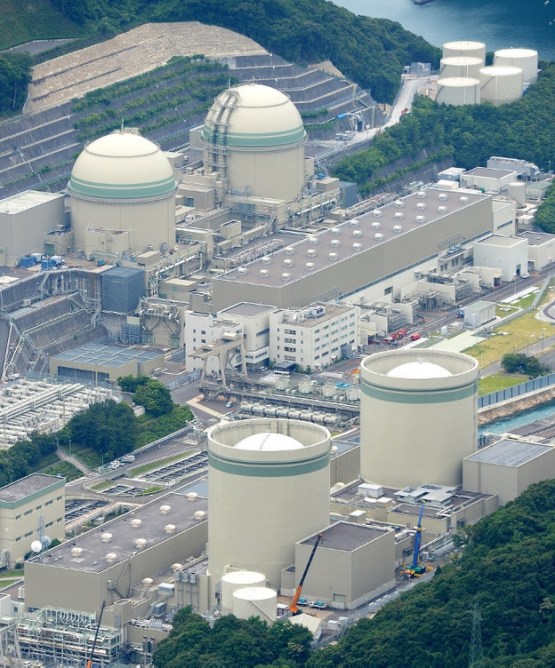
The Takahama Nuclear Power Plant’s No. 1 and 2 reactors (from left in the front row) and No. 3 and 4 reactors (from left in the back row) are pictured in this photo taken from a Mainichi helicopter in Takahama, Fukui Prefecture, on June 15, 2016.
TOKYO (Kyodo) — Japan’s nuclear regulator on Monday approved an additional 20 years of operation for two aging reactors on the Sea of Japan coast that will become the first such reactors to resume operation under new rules introduced after the Fukushima nuclear meltdown.
The Nuclear Regulation Authority granted its approval of Kansai Electric Power Co.’s plan to continue the operation of its No.1 and No.2 reactors at the Takahama nuclear plant in Fukui Prefecture, both of which are over 40 years old.
The rules, tightened after the 2011 nuclear disaster at Tokyo Electric Power Co.’s Fukushima Daiichi plant, set the maximum length of operation for nuclear reactors at 40 years in principle but also stipulate that their operations can be extended for an additional 20 years if the NRA allows.
Since December 2014, Kansai Electric has been checking on degradation of the two reactors in a stricter manner than regular checkups to obtain approval for extending their operations.
After confirming there were no abnormalities, the utility applied in April last year for an NRA screening.
In order for the reactors to resume operation, the company needed to complete three procedures by July 7. The two reactors had already passed a test for compatibility with the new rules and received approval for a construction plan that detailed equipment design. The only remaining test was for measures against the degradation of the reactors.
In the screening, preventing long electric cables from catching fire and covering the containment vessels with concrete were raised as issues to be addressed, and the company submitted a plan to complete such necessary measures by October 2019.
The reactors are therefore expected to resume operations after these steps have been completed.
The No.1 reactor began operating in November 1974, while the No. 2 reactor did so in November the following year. Both reactors have been suspended since regular checkups in 2011.
http://mainichi.jp/english/articles/20160620/p2g/00m/0dm/070000c
June 20, 2016
Posted by dunrenard |
Japan | 20 years, Extension, Nuclear Regulation Authority, Takahama NPP |
Leave a comment
Not only it is criminal to allow Fukushima products, potentially contaminated, to be sold in London, Europe at a Japanese Government sponsored event, and their ignorant buyers to be possibly internally contaminated, knowing that internal radiation exposure is 100 times more harmful than external radiation exposure; such event is then used by the Japanese government in the local Fukushima newspaper (Fukushima Minpo) and in the national newspapers (Japan Times) as propaganda to convince the Fukushima people and the Japanese people that it is quite safe, not harmful to eat the Fukushima products, the proof: Europeans are buying it and eating it!
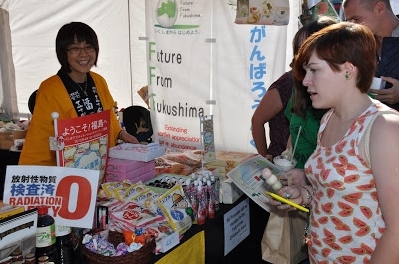
Fukushima nativees sell products made in Fukushima Prefecture at the Japan Matsuri festival in London last Spetember (Fukushima Minpo)
Fukushima-harvested rice will hit the stores in Britain in July, which might make it the first member of the EU to import the grain, following a sustained effort by a group of Fukushima natives in London fighting rumors about the safety of the crop.
It is also the third nation, after Singapore and Malaysia, to import Fukushima rice since the March 2011 earthquake and tsunami caused three reactor meltdowns at the Fukushima No. 1 nuclear plant. Starting next month, 1.9 tons of Fukushima rice called Ten no Tsubu will be sold in London. A Fukushima branch of National Federation of Agricultural Cooperative Associations, a Japanese farmers group better known as Zen-Noh, will export the rice via a British trading company.
“With the U.K. as a foothold, we hope to expand the sale of prefecture-produced rice to other EU member countries,” said Nobuo Ohashi, who heads the Fukushima branch of Zen-Noh.
According to Japan’s Agriculture, Forestry and Fisheries Ministry, the EU has been phasing out its ban on Fukushima food products since the nuclear disaster started. But for Fukushima rice, the EU still obliges importers to submit a radiation test certified by the Japanese government or sample tests by the member nation importing it.
“It’s bright news for Fukushima, which has been struggling with the import restrictions,” said an official at the prefectural office in charge of promoting its products. “We will make further efforts so the restrictions will be lifted entirely.”
There were many hurdles to overcome.
Amid fears that Fukushima products were tainted with radioactive fallout, Yoshiro Mitsuyama, who heads the Fukushima group in London, consulted an official at Zen-Noh’s branch in Germany on how to sell Fukushima products a few years ago.
With the help of Zen-Noh, Mitsuyama’s group started selling Fukushima-made rice, peach and apple juice at the annual Japan Matsuri held at London’s Trafalgar Square three years ago.
The products were popular with London residents. When Visit Japan Ambassador Martin Barrow came to Fukushima last April, he bought some local produce.
“I want to help sell Fukushima fruits like cherries, apples and pears in London as well, not just rice,” said Mitsuyama.
This section, appearing every third Monday, features topics and issues covered by the Fukushima Minpo, the largest newspaper in Fukushima Prefecture. The original article was published on May 25.
http://www.japantimes.co.jp/news/2016/06/19/national/fukushima-rice-set-to-make-first-eu-foray-with-debut-in-britain/
June 20, 2016
Posted by dunrenard |
Fukushima 2016 | Contaminated Food, Contamination, EUROPE, Fukushima continuing, U.K. |
Leave a comment
Was Tokyo Electric Power Co. (now Tokyo Electric Power Company Holdings, Inc.) putting top priority on ensuring the safety of residents around its Fukushima No. 1 nuclear power plant when the accident occurred? The findings of a recent probe have raised doubts even about this.
A third-party panel of lawyers set up by TEPCO released a report on why it took as long as two months after the crisis for the utility to acknowledge that the reactors had melted down.
On March 14, 2011, three days after the accident occurred following the massive earthquake and tsunami, then TEPCO President Masataka Shimizu instructed a then executive vice president during a press conference “not to use” the word “meltdown,” according to the report. The message was delivered via a public relations staffer, citing instructions from the Prime Minister’s Office, the report said.
Subsequently, TEPCO used the description “core damage” in connection with the accident. “The nuclear power plant and the head office shared a recognition that they should refrain from using ‘meltdown,’” the report pointed out.
Then Prime Minister Naoto Kan and then Chief Cabinet Secretary Yukio Edano have completely denied issuing such instructions on their own.
At the time of the accident, many politicians, bureaucrats and others concerned were working at the Prime Minister’s Office. The third-party probe failed to identify who gave the instructions to Shimizu.
This shows the limitations that the third-party panel faced as it probed the accident based only on interviews it conducted with TEPCO officials. Furthermore, Shimizu’s memories of those days were vague.
However, the probe revealed that TEPCO was paying too much attention to the Prime Minister’s Office’s intentions in responding to the accident.
Operator holds responsibility
When a nuclear power plant is hit by a serious accident, residents living around the facility face severe consequences. It is the primary responsibility of the plant operator to respond appropriately.
In such a situation, the highest priority should be placed on the safety of local residents. The operator must accurately provide local governments and residents with precise and necessary information regarding the situation the power plant is facing.
TEPCO chose to use “core damage,” an expression that made the status of the accident unclear, instead of “meltdown,” even though “meltdown” would have clearly shown the severity of the developments the Fukushima plant was dealing with. The operator cannot avoid criticism for having betrayed local residents with this decision. This kind of stance taken by the utility has caused increasing distrust of nuclear power plants.
At the time of the accident, TEPCO had internal manuals that described what constituted a meltdown. The operator must seriously reflect on why it failed to follow these guidelines.
When it came to public relations announcements at the time of the accident, the investigation committees set up by the government and the Diet both pointed out that the Prime Minister’s Office had some involvement.
An official at the then Nuclear and Industrial Safety Agency of the Economy, Trade and Industry Ministry was replaced after referring to a “meltdown” during a press conference. TEPCO was told by the Prime Minister’s Office to brief it in advance of any announcements made at press conferences, according to the latest report.
The Niigata prefectural government, whose administrative area is home to TEPCO’s Kashiwazaki-Kariwa nuclear power plant, has called for uncovering the whole process of how information was manipulated, saying this is a prerequisite for reactivating reactors at Kashiwazaki-Kariwa. The government cannot help but cooperate with the probe.
http://www.the-japan-news.com/news/article/0003026750
June 20, 2016
Posted by dunrenard |
Fukushima 2016 | Fukushima Daiichi, Lies & Cover-up, Responsibility, Tepco |
Leave a comment
A panel investigating Tokyo Electric Power Co.’s response to the triple meltdown during the 2011 Fukushima nuclear disaster revealed an unpardonable breach of trust by the operator of the stricken Fukushima No. 1 nuclear power plant.
But there is still a lot more work to be done by the panel to uncover the full scope of the utility’s apparent meltdown cover-up.
Immediately after the catastrophic accident at the Fukushima nuclear plant, then TEPCO President Masataka Shimizu instructed employees not to use the term “meltdown,” leading to a delay in the official announcement, according to a report compiled by the investigation panel commissioned by the company.
A reactor meltdown, or the melting of nuclear fuel in the core of a reactor, is about as bad as it gets.
The panel’s report suggests that in the middle of this unprecedented nuclear disaster the top official of the plant operator was trying to conceal the severity of what was unfolding from the public, including people living in areas around the plant.
For four long years, TEPCO kept giving false explanations about the delay in the announcement of the reactor meltdowns to Niigata Prefecture, which was demanding the truth of what happened. The company claimed it did not have the criteria for defining and determining a meltdown. The firm also said no in-house instruction was given to employees telling them not to use the term.
In February this year, however, the company said it had “found” an in-house manual that spelled out such criteria and set up the third-party panel of legal experts to get to the truth about the delayed announcement of the meltdowns.
With the revelations made in its report, can the panel claim it has accomplished its mission?
We have to say the answer is “no,” although the disclosure of the former TEPCO president’s instruction concerning the meltdowns is definitely a step forward.
What is particularly baffling is the opinion about the president’s instruction voiced by Yasuhisa Tanaka, the former president of the Sendai High Court who headed the investigation. “We cannot say for certain that there was a deliberate cover-up by the company,” Tanaka said during a news conference.
At the time of the accident, a reactor meltdown was defined by the nuclear disaster special measures law as an emergency situation that must be reported. The conditions of the reactors at the Fukushima plant fulfilled TEPCO’s criteria, which say a meltdown means that 5 percent or more of the core of a reactor has been damaged.
But the utility initially denied that a meltdown was happening, while the president instructed employees not to use the term. If this was not a cover-up, what was it?
Also questionable is the panel’s suggestion that the TEPCO chief was probably acting on requests from the prime minister’s office in giving the instruction. The panel interviewed about 60 former and current TEPCO officials, but no government officials or bureaucrats who were involved in dealing with the crisis.
In explaining the panel’s failure to interview key government officials, Tanaka said, “Our authority to investigate is limited, and it is difficult (to uncover the entire truth) in such a short time.” But the panel didn’t even request interviews with them.
Both Naoto Kan, who was then prime minister, and Yukio Edano, who was chief Cabinet secretary, rejected the allegations that the government told TEPCO not to declare a meltdown.
As for the related requests made by Niigata Prefecture, TEPCO says it will continue its joint efforts with the prefectural government to uncover the facts.
The company has a responsibility to clarify the broad picture of the accident and publish the findings of its probe. But the Diet has its own role to play.
Whether the prime minister’s office actually asked TEPCO not to declare a reactor meltdown is not the only remaining mystery about the exchanges between the government and the company during the crisis. Only some fragments of information about the communications between the two sides have been revealed.
A Diet investigation committee has drawn up a report on its inquiry into the accident. But there are still many questions that the Diet should try to answer by using its right to investigate state affairs.
We need to learn all vital lessons from the devastating nuclear accident so as to avoid making the same mistakes.
That requires unearthing all the related facts first. It is our responsibility to tackle this challenge for future generations.
http://www.asahi.com/ajw/articles/AJ201606180026.html
June 20, 2016
Posted by dunrenard |
Fukushima 2016 | Fukushima Daiichi, Lies & Cover-up, Meltdowns, Tepco |
Leave a comment
What this article from Nikkei (the Japanese Business & investment Newspaper) does not say is if the nuclear industry discloses, informs the public about the true facts, the public trust in the nuclear industry will NEVER be restored, and no nuclear plant will ever be allowed to restart.

TOKYO — For Tepco, there is no escaping the accusation that the utility’s deliberate avoidance of the term “meltdown” after the Fukushima Daiichi nuclear disaster was an attempt to minimize the severity of the situation to the public.
Tokyo Electric Power Co. recognized immediately that a core meltdown had occurred at the ill-fated power plant, and so did Japan’s government. On March 12, 2011 — the day after the crisis began — the term was used at a news conference held by the Nuclear and Industrial Safety Agency, Japan’s nuclear power regulator at that time. The spokesman who uttered the word was replaced the following day.
The report issued Thursday by a third-party committee investigating Tepco’s handling of the disaster underscores once again the inability of the prime minister’s office and the bureaucracy at the time to face the reality of the situation. It also deepens the suspicion that officials sought to control the flow of information to the public.
A fear of causing widespread panic is a poor excuse for covering up the truth. If anyone was panicking, it was arguably Tepco’s president at the time, Masataka Shimizu, as well as other officials at the utility and at the prime minister’s office. The report said Shimizu gave instructions at Tepco to avoid using the term meltdown.
Crews at Fukushima Daiichi, led by plant manager Masao Yoshida, made every effort to contain the crisis on the assumption that they were dealing with a meltdown. Even if Tepco headquarters had used this term instead of “core damage” in informing the public, the utility’s response on the ground probably would have been the same. But residents of the evacuation zone, as well as the Self-Defense Forces and other first responders, may have acted differently.
The investigative committee did not determine who in the government might have prompted Shimizu’s directive against using the word. There has been reluctance to examine the involvement of elected officials and bureaucrats in the disaster response. More probing is needed.
It took more than five years for Shimizu’s instructions to come to light. The latest investigation itself never would have occurred if not for the persistence of the Niigata Prefecture government, which has its own Tepco — whose formal name is now Tokyo Electric Power Co. Holdings — nuclear power plant to worry about.
What happens at the nation’s nuclear reactors ought to be made public without disguise — and not just when serious safety breaches like meltdowns are involved. Efforts on disclosure must begin with everyday information in order to restore the public’s trust in nuclear power.
http://asia.nikkei.com/Politics-Economy/Policy-Politics/Public-deserves-closer-look-into-Fukushima-response
June 20, 2016
Posted by dunrenard |
Fukushima 2016 | Fukushima Daiichi, Nuclear Industry, Nuclear Plant Restart, Truth |
Leave a comment

Residents on Friday hold a banner that reads: “Kepco’s request has been rejected; Court rejects restart of Takahama reactors.” The protesters are seen in front of the Otsu District Court in Shiga Prefecture.
OTSU, SHIGA PREF. – The Otsu District Court on Friday rejected a bid by Kansai Electric Power Co. to lift an injunction against restarting reactors at a nearby plant, dealing yet another setback to attempts by the utility and the central government to return swiftly to nuclear power.
The move means the No. 3 and No. 4 reactors at the Takahama nuclear plant, in Fukui Prefecture, will remain idled.
In a statement, Kepco condemned the court’s action.
In his decision, Judge Yoshihiko Yamamoto said Kepco failed to provide sufficient evidence to back up its claims that the two reactors were safe.
“The very first article of the law that established the Nuclear Regulation Authority says a fundamental point of Japan’s nuclear power administration is clearly establishing the understanding that the maximum effort must be made at all times to prevent an accident involving the use of nuclear power,” said Yamamoto. “But unless the operator shows that there is nothing lacking in regards to safety, it’s presumed some safety points are lacking.”
The decision was welcomed by citizens’ groups fighting the restart of the two reactors, but it was also expected. Yamamoto was the same judge who had granted their initial request back in March that shut down the reactors, also citing a lack of convincing evidence on the part of Kepco that the plants were safe. The reactors were originally restarted at the beginning of the year.
“It was a just decision, very direct. We hope it will provide a spark to other legal efforts in other parts of Japan to stop nuclear power plants from being restarted,” Yoshinori Tsuji said after the ruling. Tsuji was one of the plaintiffs who filed for an injunction in March.
Legal wrangling over the two reactors continues. Kepco has filed a separate legal challenge to the Otsu court’s decision, and said Friday it hoped that when that ruling came, possibly in July or August, it will lead to restarts.
Shiga residents seeking to keep the reactors offline have said Friday’s decision did not mean their court battles were over.
“If the Otsu court rules against Kepco, it could end up in the Osaka High Court, possibly next year,” said Hidenori Sugihara, another one of the plaintiffs who sought the injunction.
The Otsu court case has demonstrated the difficulty of restarting nuclear power plants in a timely manner. Under laws drawn up by the NRA that went into effect in 2012, localities within a 30 kilometer radius of a nuclear power plant are supposed to establish evacuation plans in the event of an emergency.
But the expanded radius has greatly increased the number of local governments and residents who are concerned about a rush by the utilities to restart as many plants as possible.
In the Kansai region, where parts of Kyoto and Shiga prefectures lie within 30 kilometers of Fukui Prefecture’s plants, lawsuits by residents like the one in Otsu have the potential to slow down, if not halt, Kepco’s plans for restarts.
The original injunction was brought by Shiga residents who fear an accident at the plant would have a damaging impact on Lake Biwa, the nation’s largest freshwater lake and the source of water for about 14 million residents in cities such as Kyoto and Osaka.
http://www.japantimes.co.jp/news/2016/06/17/national/crime-legal/kepco-fails-suspend-injunction-takahama-nuclear-plant/#.V2e1E_ZLJ0t.facebook
June 20, 2016
Posted by dunrenard |
Japan | Court Refusal, Nuclear Plant Restart, Takahama NPP |
Leave a comment

 Japan court upholds injunction to halt reactors in blow to nuclear power industry, Reuters, TOKYO | BY OSAMU TSUKIMORI 17 June 16, A Japanese court on Friday upheld an order to keep two reactors at the Takahama nuclear plant closed, operator Kansai Electric Power said, leaving efforts to get a struggling nuclear industry up and running in limbo.
The court decision ,
, upholding a petition from residents living near the plant concerned about safety, keeps the legal battle center stage in a struggle by Prime Minister Shinzo Abe’s government to restore atomic power five years after the Fukushima disaster.
The Otsu District Court on March 9 ordered Kansai Electric, Japan’s second-biggest utility, to shut down the reactors in Fukui prefecture west of Tokyo, in the country’s first injunction to halt an operating nuclear plant.
The nuclear industry has only recently started to get reactors in a nuclear sector, which used to supply about a third of the country’s power, back online amid widespread public opposition after the melt downs at Fukushima in 2011.
Friday’s decision denied the utility’s attempt to temporarily halt the shutdown order……….
Amid mounting public scepticism over nuclear safety, local residents have lodged injunctions against nuclear plants across Japan…….http://www.reuters.com/article/us-japan-nuclear-court-idUSKCN0Z306R
June 17, 2016
Posted by Christina Macpherson |
Japan, Legal |
2 Comments

Yasuhisa Tanaka, center, chairman of an outside investigation team appointed by the operator of Japan’s damaged Fukushima nuclear plant, speaks during a press conference in Tokyo Thursday. Two other lawyers of the team are: Zenzo Sasaki, left, and Toshiki Nagasaki.
A Japanese opposition leader who was a senior official during the 2011 Fukushima nuclear plant crisis denied Friday that he or the prime minister at the time pressured the president of Tokyo Electric Power Co. not to use the term “meltdown.”
Democratic Party Secretary-General Yukio Edano called a special news conference to refute a finding in a new report that then-TEPCO President Masataka Shimizu apparently came under political pressure not to use the word. The report did not find direct evidence of that.
“The fact that I or then-Prime Minister (Naoto) Kan ordered or requested then-President Shimizu to avoid using the term ‘meltdown’ under any circumstance does not exist,” Edano said. He said the timing of the report was suspicious ahead of an Upper House election next month.
The report released Thursday by a team of three lawyers appointed by TEPCO found that an instruction from Shimizu to avoid using the term “meltdown” delayed full public disclosure of the status of the nuclear plant, which suffered three reactor meltdowns after a major earthquake and tsunami hit the northeastern Japanese coast on March 11, 2011.
The utility used the less serious phrase “core damage” for two months after the disaster.
TEPCO reported to authorities three days after the tsunami that the damage, based on a computer simulation, involved 25 to 55 percent of the fuel but did not say it constituted a “meltdown,” the report said. Yet the company’s internal manual defined a meltdown as damage to more than 5 percent of the fuel.
In May 2011, TEPCO finally used “meltdown” after another computer simulation showed fuel in one reactor had almost entirely melted and fallen to the bottom of the primary containment chamber, and that the two other reactor cores had melted significantly.
TEPCO has been accused of softening its language to cover up the seriousness of the disaster, though the investigation found TEPCO’s delayed acknowledgement did not break any law.
In the 70-page report, the lawyers said Shimizu instructed his deputy not to use the word “meltdown” during news conferences immediately after the crisis. TEPCO’s vice president at the time, Sakae Muto, used the phrase “possibility of meltdown” until March 14, 2011.
Video of a news conference that day shows a company official rushing over to Muto when he was about to respond to a question, showing him a memo and hissing into his ear, “The prime minister’s office says never to use this word.”
Yasuhisa Tanaka, the lawyer who headed the investigation, said interviews of 70 former and current TEPCO officials, including Muto and Shimizu, showed that Muto had planned to use the word “meltdown” until he saw the memo, which has not been found.
“Mr. Shimizu’s understanding was the term ‘meltdown’ could not be used without permission from the prime minister’s office,” Tanaka said at a news conference at TEPCO headquarters. “The notion that the word should be avoided was shared company-wide. But we don’t believe it was a cover-up.”
Edano criticized the report as “inadequate and unilateral,” and said the team didn’t talk to him or Kan.
Tanaka said his investigation, which did not interview any government officials, could not track down what exactly happened between Shimizu and the prime minister’s office.
The Nuclear and Industrial Safety Agency, Japan’s nuclear regulatory unit at the time, was also reluctant to use the word. Two spokesmen were replaced between March 12 and 13, 2011, after suggesting meltdowns had occurred.
TEPCO has said the delay in confirming the meltdowns didn’t affect the company’s response to the emergency.
The issue surfaced earlier this year in a separate investigation in which TEPCO acknowledged that a company manual had been overlooked, reversing its earlier position that it had no internal criteria for a meltdown. TEPCO has eliminated the definition of a meltdown from the manual in revisions after the Fukushima disaster.
http://abcnews.go.com/International/wireStory/utility-head-blamed-late-mention-fukushima-meltdown-39902188
June 17, 2016
Posted by dunrenard |
Fukushima 2016 | Fukushima Daiichi, Lies & Cover-up, Meltdowns, Tepco |
Leave a comment
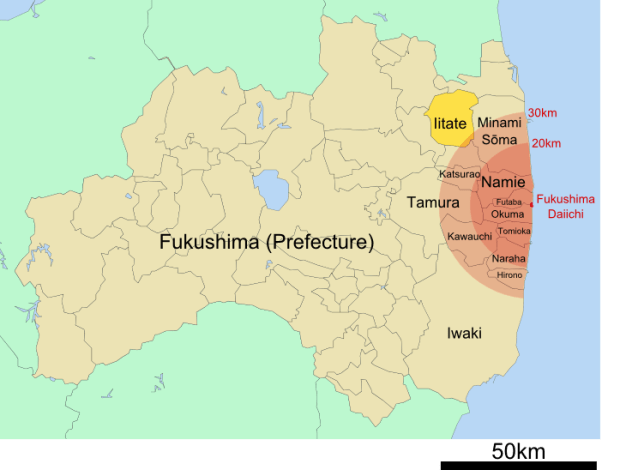
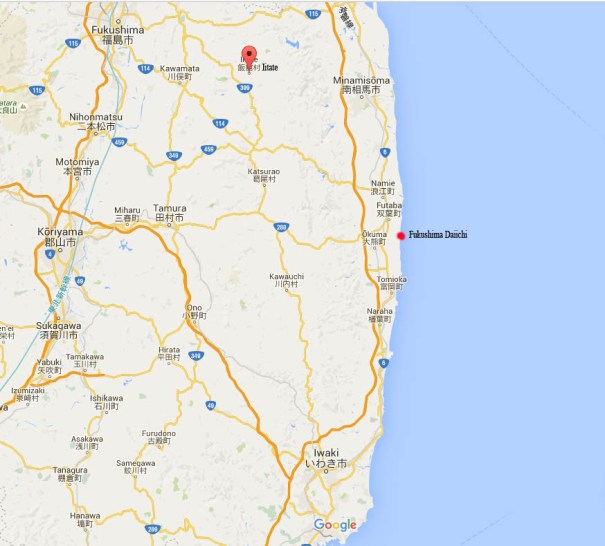
FUKUSHIMA – The central government has said it is considering plans to lift its evacuation order for most of the village of Iitate, Fukushima Prefecture, effective March 31.
The village is nearby the Fukushima No. 1 nuclear power plant, which experienced a meltdown disaster in 2011.
Yosuke Takagi, state minister of economy, trade and industry, conveyed the plan to Mayor Norio Kanno and other officials of the Fukushima Prefecture village at a meeting on Wednesday.
The government plans to make an official decision on the lifting shortly, along with a program to be launched in July to allow residents to stay overnight at their homes as part of preparations for permanent returns.
The evacuation order will be lifted for areas with less radiation from the three reactor meltdowns at the Tokyo Electric Power Co. Holdings Inc. plant, which was damaged in the March 2011 earthquake and tsunami.
As of the end of May, 5,917 residents in 1,770 households, or over 90 percent of the overall population of the village, were registered as citizens of such areas.
The government plans to finish decontamination work on houses by the end of this month and on farmland, roads and other facilities by the end of this year.
Visiting the village’s temporary office in the city of Fukushima on Wednesday, Takagi said the government aims to get the residents to return home by “resolving a series of challenges one by one.”
Kanno said, “We still have a long way to go and have to rebuild our village in a new form.”
The evacuation order will remain in place for highly contaminated areas, where 268 residents in 75 households are registered as local citizens.
http://www.japantimes.co.jp/news/2016/06/17/national/state-lift-evacuation-order-fukushima-village-iitate-march-31/
June 17, 2016
Posted by dunrenard |
Fukushima 2016 | Evacuation, Evacuation Order To Be lifted, Fukushima continuing, Iitate |
Leave a comment

Naomi Hirose, president of Tokyo Electric Power Co., speaks in Tokyo on June 16 after an investigation team released its report on the 2011 Fukushima nuclear disaster.
Former government leaders vehemently rejected suggestions in a report that they were pulling the strings behind a suspected meltdown cover-up when the Fukushima nuclear disaster was unfolding in 2011.
The report, compiled by an investigation panel commissioned by Tokyo Electric Power Co., operator of the crippled nuclear power plant, said Masataka Shimizu, who was TEPCO president at the time of the accident, instructed employees not to use the term “meltdown,” leading to a delay in the official announcement.
But the report also implied that Shimizu was acting on orders from high up in the government.
Yukio Edano, who was chief Cabinet secretary of the Democratic Party of Japan-led government when the Great East Japan Earthquake and tsunami triggered the nuclear crisis on March 11, 2011, described the report as preposterous.
“As far as I know, it is unthinkable for government officials back then to ask TEPCO to do such a thing,” Edano, now the secretary-general of the opposition Democratic Party, told reporters on June 16.
He accused the panel of merely skimming the surface of the matter and sidestepping the truth behind the instructions to avoid using the term “meltdown.”
“It is utterly irresponsible for the panel to say that it did not uncover that (Shimizu) was instructed by who and what,” he said.
The third-party panel of legal experts said in the report released on June 16 that it can be assumed that Shimizu understood that he was requested by the prime minister’s office to seek its approval beforehand if the company were to announce the “meltdown.”
The panel also said it would be difficult to conclude that TEPCO’s delay in declaring the meltdown was a “deliberate cover-up.”
“Since TEPCO released information on radiation levels inside the reactors and other related data at that time, just not using the term meltdown cannot be described as an act of a deliberate cover-up,” the panel said.
TEPCO declared the meltdown at three reactors at the Fukushima No. 1 plant in May 2011, two months after it occurred.
According to the report, Shimizu entered the chief Cabinet secretary’s office, which is located at the prime minister’s office building, by himself on March 13, 2011. The following day, Sakae Muto, vice president of TEPCO, explained the conditions of the reactors at the plant.
During the news conference, Shimizu handed a memo to Muto through a TEPCO public relations official, telling him not to use the word “meltdown” on the instructions of the prime minister’s office, according to the panel.
Naoto Kan, who was prime minister at the time of the disaster, denied giving the instruction to TEPCO.
“I myself have never given directions to TEPCO not to use the expression ‘meltdown,’” Kan, a member of the Democratic Party, said in a statement.
One reason for the lack of clarity in the report is that Shimizu, who was interviewed twice for a total of four hours, said, “I do not remember very well” with regard to who gave what instructions.
Another TEPCO employee interviewed by the panel said Shimizu “was under tremendous pressure and must not have a detailed recollection.”
The panel interviewed about 60 former and current TEPCO officials but no government officials and bureaucrats who were involved in dealing with the crisis.
“Our authority to investigate is limited, and it is difficult (to uncover the entire truth) in such a short time,” said Yasuhisa Tanaka, the lawyer who headed the investigation.
Tanaka and another panel member, Zenzo Sasaki, a former prosecutor at the Tokyo District Public Prosecutors Office, were also in charge of the third-party investigation into the accident conducted in 2013.
That investigation, based on interviews of TEPCO officials, came under fire for “only arbitrarily presenting TEPCO’s argument that is convenient to the company.”
The findings by the latest panel showed TEPCO officials looking into the nuclear disaster were aware of Shimizu’s order not to use “meltdown,” but TEPCO’s in-house investigation team did not include it in its report in 2012, apparently believing it was not significant enough to mention.
“TEPCO’s efforts to share information inside the company were insufficient,” Tanaka said. “It lacked consideration for local governments, which should have been top priority.”
The revelation that Shimizu ordered the avoidance of “meltdown” fueled feelings of distrust toward TEPCO among local governments hosting TEPCO nuclear power plants.
“We are still in this stage of the investigation even five years after the accident,” said Toshitsuna Watanabe, mayor of Okuma, which co-hosts the crippled Fukushima plant.
Hirohiko Izumida, governor of Niigata Prefecture, home to TEPCO’s Kashiwazaki-Kariwa nuclear power plant, called for a further investigation to reveal the whole picture of the Fukushima disaster.
“We need to step up efforts to uncover what has not been sufficiently investigated before,” he said. “TEPCO, as an organization, should make a sincere response without hiding anything.”
The latest panel was established in March at the request of the Niigata prefectural government’s technology committee, which aims to determine why TEPCO waited until May 2011 to announce the triple meltdown.
TEPCO initially said it did not have the criteria for defining and determining a meltdown.
But it announced in February this year that the company “found” an in-house manual that explained whether a meltdown was taking place.
http://www.asahi.com/ajw/articles/AJ201606170063.html
June 17, 2016
Posted by dunrenard |
Fukushima 2016 | Fukushima Daiichi, Lies & Cover-up, Meltdowns, Teoco |
Leave a comment








