Scientists Find New Kind Of Fukushima Fallout
THIS IS ABSOLUTE B.S. , THIS IS DISINFORMATION, SPREADING NONSENSE!
It completely ignores what science and multiple studies have already well established, that internal radiation is 100 times more harmful than external radiation: “He cautions that any internal radiation from particles containing cesium-137 would be much less than the doses people got from external radiation, which would come from cesium-137 and other radioactive elements in the soil or the environment around them.”

A Tokyo Electric Power Co. (TEPCO) employee, wearing a protective suit and a mask, walks in front of the No. 1 reactor building at TEPCO’s Fukushima Daiichi nuclear power plant.
Some of the radioactive material that escaped the Fukushima Daiichi nuclear reactor in 2011 took a form no one was looking for, scientists have discovered. Now they have to figure out what it means for Japan and for future disasters.
Radioactive cesium—specifically, cesium-137—is one of the waste products of nuclear power. It’s also one of the most dangerous substances in a nuclear disaster like Chernobyl or Fukushima.
One reason why is that the type of radiation it emits is particularly damaging to our bodies. Another is that cesium-137 dissolves in water. That means it can spread quickly through the environment and get into the plants, animal and water we consume.
Until now, scientists and disaster experts thought cesium-137 fallout from the Fukushima reactor meltdown was in this soluble form. That guided their cleanup efforts, like removing and washing topsoil, and helped them map where radiation might spread.
It turns out that wasn’t entirely true. Satoshi Utsunomiya, a geochemist at Kyushu University in Japan, announced over the weekend that he had found cesium-137 in a new form: trapped inside tiny glass particles that spewed from the damaged reactors. These particles are not water soluble, meaning we know very little about how they behave in the environment—or in our bodies. He found the particles in air filters placed around Tokyo at the time of the disaster.
According to Utsunomiya, high temperatures inside the malfunctioning reactors at the Fukushima plant melted and broke down the concrete and metal in the buildings. Silica, zinc, iron, oxygen and cesium-137 fused into millimeter-wide glass microparticles, each about the size of a pin’s head. Lifted into the atmosphere by the fires raging at the plant, they then blew about 240 kilometers southeast to Tokyo.
“As much as 89% of all of the cesium [in Tokyo] was in fact in these particles. It’s profound,” says Daniel Kaplan, a geochemist at Savannah River National Laboratory in South Carolina. He attended Utsunomiya’s lecture describing the findings at the ongoing Goldschmidt Conference in Yokohama, Japan.
Kaplan says similar particles were observed near the Chernobyl reactors after the explosion there in 1986. But they were only seen within about 30 kilometers; beyond that, cesium-137 was only observed in rain.
The discovery could change how we model fallout from nuclear disasters. Kaplan explains that it might add a new variable to the models we use to predict where radioactive particles will go and how long they’ll stay there. It might also change how we treat cesium-137 during cleanup and monitoring.
It is probably still too early to say what this means for people living in Tokyo or elsewhere in Japan. Kaplan thinks the amount of radiation they received probably hasn’t changed. Whether they got it from water-soluble cesium-137 or from these particles, the radiation dose was the same—and for Tokyo residents, that number was within the margin of safe exposure.
The bad thing about water-soluble cesium-137 is that it can easily get into our bodies from soil by way of plants and animals. This new discovery alleviates that concern. But it opens up a new possibility we know little about.
“If the particles are in the air—because that’s how they get to Tokyo—then when you are aspirating this air you should find them in some ways on your lungs,” says Bernd Grambow, who studies nuclear waste chemistry as head of the SUBATECH laboratory in France.
Water-soluble cesium-137 that makes it into our lungs passes into the bloodstream and is peed out within a few weeks. But Grambow says we really don’t know what happens to insoluble cesium-137-containing particles if they get in our lungs. Some of them are likely coughed out or removed by our lungs’ other normal processes. As for the rest, Grambow says we don’t know how long they might remain.
He cautions that any internal radiation from particles containing cesium-137 would be much less than the doses people got from external radiation, which would come from cesium-137 and other radioactive elements in the soil or the environment around them. “We don’t know very much, and my point is only that they should be studied,” Grambow says.
Utsunomiya’s next step is finding out how much of the cesium-137 that ended up in soils in Tokyo and elsewhere was in these glass particles. That way, researchers will be able to better understand how cesium made its way out of the reactor and into the environment.
Four new solar power plants in Fukushima
Mitsubishi Materials builds solar plants in Fukushima, Japan Today , By Shinichi Kato, Nikkei BP CleanTech Institute, 29 June 16, TOKYO —Mitsubishi Materials Corp has started operation of solar power plants with a total output of about 8.3MW in Fukushima Prefecture.

The power producer for the mega (large-scale) solar power plants, Yabuki Solar Power Plant, is MM Sun Power, a 50-50 joint venture between Mitsubishi Materials and Mitsubishi UFJ Lease & Finance Co Ltd.
The plants were built by using four unoccupied areas of Yabuki Techno Park, which Mitsubishi Materials Real Estate Corp, a subsidiary of Mitsubishi Materials, runs in Yabuki-machi, Nishishirakawa-gun, Fukushima Prefecture, Japan.
The Yabuki Solar Power Plant consists of four solar power plants built on the four areas. The total site area is 103,624m2, and the total output of solar panels installed at the plants is 8.284MW. The plants transmit a total of 6.544MW of electricity to the power grid…….http://www.japantoday.com/category/business/view/mitsubishi-materials-builds-solar-plants-in-fukushima
How far up the ladder did the #Fukushima cover up really go?
Tokyo – About the only country today where a public apology is still accepted is in Japan, and quite honestly, this writer has always thought life would be so much more simpler if that’s all it took to right a profound wrong.

That is what took place last week when CTV News reported Tokyo Electric Power Co. (TEPCO) President Naomi Hirose acknowledged in public the company had delayed its disclosure of the meltdowns of three reactors at the Fukushima Daiichi nuclear power plant.
Hirose’s apology on the cover-up was to be expected after the news came out that an investigation had found Hirose’s predecessor had instructed staff to avoid using the term, “meltdown” after the disaster in March 2011. “I would say it was a cover-up,” Hirose told a news conference. “It’s extremely regrettable.”
Hirose said he would take a 10 percent pay cut and another executive will take a 30 percent pay cut for one month each to show how sincere the apology really is. I hope all the children with thyroid abnormalities and all those displaced refugees from Fukushima Prefecture are willing to accept a one-month pay reduction by TEPCO executives as compensation for their troubles.
An investigative report submitted by three company-appointed lawyers on June 16, 2016, said TEPCO’s then-President Masataka Shimizu instructed officials to avoid using the specific description “meltdown” under alleged pressure from the Prime Minister’s Office, although the company’s attorneys say they have no direct evidence of this.
So TEPCO officials used the less damaging term “core damage” for two months, leaving the Japanese population and the rest of the world to think the disaster wasn’t that bad. Boy, was the world ever fooled? Of course, former officials at the Prime Minister’s Office have denied there was any pressure exerted on TEPCO, but what else would they be expected to say?
It wasn’t until May 2011 that TEPCO officials used the scary “M” word reports the Associated Press, and that was because computer simulations showed the fuel in one reactor had melted to the point it had fallen into the bottom of the primary containment chamber, and the other two reactor’s cores had melted far worse than previously thought.
It is interesting that every investigation so far had put the blame for the Fukushima disaster squarely on the shoulders of TEPCO. The first independent investigation authorized by the National Diet in its 66-year history was commissioned in 2011. That investigation reported: “It was a profoundly man-made disaster – that could and should have been foreseen and prevented. And its effects could have been mitigated by a more effective human response. “Governments, regulatory authorities and Tokyo Electric Power lacked a sense of responsibility to protect people’s lives and society.”
The big question for me is simple. Did Prime Minister Shinzo Abe put enough pressure on TEPCO officials that the disaster was downplayed to the world? Abe’s government has not been very forthcoming about anything to do with Fukushima over the past five years, as this writer has reported previously in Digital Journal.
And owing to the fact that Mr. Abe has been adamant in saying Japan needs its nuclear power plants, anything he says about Fukushima I would take with a grain of salt. Digital Journal reported that on March 6, this year at a press conference, Abe insisted that safety of nuclear plants was the government’s “top priority.” He also said the government would “not change its policy” in which reactors that meet the new standards can be restarted. So, yes, I think he probably did speak sternly with TEPCO officials in March 2011.
Nuclear watchdog finds 3 nuclear plants guilty of ‘malicious’ safety violations
The Nuclear Regulation Authority (NRA) concluded on June 29 that three nuclear power plants were guilty of “level 2” safety violations by breaching standards on placement of power cables
A “level 2” violation is the second heaviest violation in the NRA’s four-tier list.
The NRA deemed that new safety standards regarding power cable installation had been violated at Tokyo Electric Power Co. (TEPCO)’s Fukushima No. 2 Nuclear Power Plant in Fukushima Prefecture, Tohoku Electric Power Co.’s Onagawa plant in Miyagi Prefecture and Chubu Electric Power Co.’s Hamaoka plant in Shizuoka Prefecture. TEPCO’s Kashiwazaki-Kariwa nuclear station in Niigata Prefecture was earlier found to have committed a level 2 violation.
The NRA is set to carry out additional safety inspections on the three recently named nuclear plants as well as at the Kashiwazaki-Kariwa plant to check whether problems at these plants have been corrected.
Violation of power cable-related safety standards has been found at 19 reactors within 6 nuclear plants, as well as at Japan Nuclear Fuel Ltd.’s spent fuel reprocessing facility in Aomori Prefecture. Subsequent inspections by power companies and the NRA found such violations at a total of 5,344 locations on the premises of those nuclear plants. Of these, violations at the four nuclear stations including the Kashiwazaki-Kariwa plant were deemed particularly malicious as utilities failed to check their power cable placing and continued to violate the safety standards even after regulations for power companies to conduct in-house inspections on power cable installation were introduced in October 2003.
http://mainichi.jp/english/articles/20160630/p2a/00m/0na/010000c
Shikoku Electric looks to fire up MOX-fueled Ehime reactor around Aug. 25
As if Fukushima ‘s catastrophe was not enough, Japan seems to have a death wish when it is now restarting the Shikoku Electric’s Ehime reactor, loaded with Mox-fuel.
This Ehime reactor standing right on the main fault line which caused the 2016 Kumamoto earthquakes in the nearby island of Kyushu, with plenty destruction.

MATSUYAMA, EHIME PREF. – Shikoku Electric Power Co. is considering launching commercial operations of its No. 3 reactor at the Ikata nuclear power plant in Ehime Prefecture around Aug. 25, sources said. The date would be later than the initially planned time frame of mid-August.
The company reviewed the schedule to provide more time for a mandatory pre-use inspection from regulators, the sources said.
Shikoku Electric on Monday finished loading 157 fuel assemblies into reactor No. 3, including 16 units of mixed oxide, or MOX fuel — a blend of uranium and plutonium extracted from spent nuclear fuel.
The company plans to resume operations of the reactor as early as July 26 if the safety checks show no major issues.
Reactor No. 3 was shut down in April 2011 for a routine safety inspection.
Shikoku Electric expects the reactor to improve its earnings by some ¥25 billion annually after it begins commercial operations.
Outgoing Fukushima plant chief says long road still ahead

The crippled Fukushima No. 1 nuclear power plant has seen improvements over the past three years but it will continue to be a difficult project during its decades-long decommissioning, the outgoing chief of the plant said Thursday.
Akira Ono, who headed the plant for three years until Thursday, said improvements include removing spent fuel rods from the damaged reactor building 4 and reducing the amount of groundwater seeping into reactor buildings, which then mixes with highly contaminated water.
“As for the working environment, workers can now have hot meals at a new, large rest station. In March, we were also able to widen the areas where they can work with their regular clothes” as radiation levels have decreased, Ono said.
Under the high radiation atmosphere, workers have to wear protective suits and full-face masks that are uncomfortable and make it hard to communicate with each other.
But the plant still needs to ensure facilities and equipment are operating more smoothly, and also further improve working conditions over the next two to three years in order to handle decommissioning work expected to take 30 to 40 more years, Ono said.
The Fukushima No. 1 plant faced an electric outage this week, which shut down some of the cooling facilities for its underground ice walls.
Ono said that the decommissioning work will also face other challenges, including identifying the exact location of melted fuel rods.
Shunji Uchida, who will be heading the plant from Friday, said he will spearhead efforts to create a strong foundation for the long decommissioning task ahead.
Ono takes on a new role at the Nuclear Damage Compensation and Decommissioning Facilitation Corporation, a body funded by the government and regional utilities to research technologies for decommissioning work.
Japan approves guidelines of reusing soil from Fukushima for public works
TOKYO, June 30 (Xinhua) — Japan’s Ministry of the Environment approved Thursday guidelines of reusing contaminated soil from the Fukushima nuclear disaster for national public works despite public concerns over safety.
According to the guidelines, Japan would allow tainted soil generated from the Fukushima decontamination work with the radioactive cesium level lower than a certain limit varying from 5,000 to 8,000 becquerels per kilogram according to different uses, to be reused in national public works.
The tainted soil, while reused, shall be covered with clean earth, concrete or other materials, so as to make the amount of radiation sustained by residents living nearby less than 0.01 mSv a year after the construction is completed, according to the guidelines.
The reuse is aimed to cut the amount of radioactive soil from Fukushima disaster to be shipped to other prefectures for final disposal, according to the ministry.
The decision was made despite public concerns that contaminated materials would still leach out as roads or other public works in which the tainted soil is used might decay or collapse during earthquakes, floods or other national disasters or fail over time.
Earlier estimates by a working group of the ministry showed that it would take as long as 170 years before the soil’s radiation levels drop to legal safety standards, while public works such as roads are often durable for just 70 years.
Under the Act on the Regulation of Nuclear Source Material, Nuclear Fuel Material and Reactors, the safety standards for reusing materials generated from the Fukushima decontamination work are less than 100 becquerels of radioactive cesium per kilogram.
http://www.shanghaidaily.com/article/article_xinhua.aspx?id=330465
Monju fiasco, Fukushima plans point to a better energy source

Michihito and Yoko Endo in Tomioka, Fukushima Prefecture, in March. The couple and other evacuees plan to build a large-scale solar farm on the rice paddies behind them.
We are perhaps witnessing a turning point in history regarding humankind and energy.
The total capacity of facilities in Japan that sell electricity generated from solar power under the feed-in tariff system exceeded 30 gigawatts by the end of last year, according to figures of the Agency for Natural Resources and Energy.
Most of those facilities began generating power after the Great East Japan Earthquake and tsunami triggered the Fukushima No. 1 nuclear power plant disaster in 2011. Their total capacity is worth 30 nuclear reactors, although actual output depends on the time of day and the weather.
Frankly, I was surprised to learn that solar power has grown so big despite the many barriers, such as regional utilities essentially setting upper limits on the amount of electricity generated with renewable energy sources that they purchase.
And solar power is turning out to be useful.
Through inquiries with nine regional utilities, The Asahi Shimbun learned that electricity generated with solar power accounted for about 10 percent of power supply at peak demand last summer.
In the service area of Kyushu Electric Power Co., the ratio was close to 25 percent.
The shift to renewable energies is more pronounced on the global scale.
For example, global wind power capacity topped 430 gigawatts in 2015, according to the Global Status Report released on June 1 by the Renewable Energy Policy Network for the 21st Century (REN21), an international body.
Global nuclear power capacity is now 386 gigawatts, according to figures of the International Atomic Energy Agency, so wind turbines have outstripped nuclear reactors in terms of output capacity.
Solar power has a total capacity of 227 gigawatts, nearly 60 percent of that of nuclear power.
SOLAR FARM IN EMPTY TOWN
A symposium was held June 4 in Koriyama, Fukushima Prefecture, to commemorate the start of a large-scale solar farm project in the town of Tomioka, also in the prefecture. Tomioka remains entirely evacuated because of the nuclear disaster.
Under their own initiative, residents of the town plan to build a giant solar farm with an output capacity of 30 megawatts. Proceeds from the project will be used to help rebuild communities.
The plan is being led by Yoko Endo, a 66-year-old former music teacher, and her husband, Michihito, a 60-year-old former art teacher. The couple now live in evacuation in the city of Iwaki, also in Fukushima Prefecture.
The couple’s former home is in a government-designated “no-residence” zone, whereas Yoko’s family home nearby stands in a “difficult-to-return” zone.
Michihito’s 2 hectares of rice paddies have also been rendered unusable.
The couple said they thought they would still be able to produce something that would be good for Japan from their terrain, even if they could not return to Tomioka and no longer grow crops there.
They solicited cooperation from their “neighbors” in diaspora across the country for the solar farm project, and they obtained agreements from more than 30 landowners for the use of about 35 hectares of rice paddies.
The total cost of the project is 9.5 billion yen ($91 million), an exceptionally large figure for a project initiated by residents. Citizens’ investments will cover 1.3 billion yen of the expenses.
Proceeds from the project will be used to help elderly residents get to and from medical institutions and stores when they return to Tomioka. The money will also fund projects to help pass on farming technologies to younger generations when farming can resume in the town.
The couple plan to start building the solar farm this autumn and have it operational in March 2018.
“We hope to nurture the project so that people will look back and say that this solar farm project, led by the initiative of residents, was more bright and brilliant than any other project of the kind,” Yoko Endo said.
Other large-scale renewable energy projects are springing up in Fukushima Prefecture.
MONJU REACTOR IN DEADLOCK
“An energy source that relies on nuclear power is not suited to human needs,” Tetsuya Takahashi, a professor of philosophy with the University of Tokyo, said in his keynote lecture during the Koriyama symposium. “Once it runs amok, it hurts human livelihoods to an unrecoverable extent.”
Takahashi was born in Iwaki and spent his childhood in Tomioka. People from that area are now aspiring to create an energy source that is better suited to their needs.
As I listened to the professor talk, my thoughts went to Monju, the prototype fast-breeder reactor.
In 1956, shortly after Japan set out on its nuclear development program, the government said in its initial long-term plan that a fast-breeder reactor “best fits the circumstances of Japan.” At the time, the reactor appeared to represent the best solution.
In the following years, the fast-breeder reactor became the symbol of Japan’s nuclear development.
The government has spent 1 trillion yen on the construction of Monju, which began in earnest in 1985. But its development program was suspended after sodium leaked from the reactor in 1995.
Things got so bad that the Nuclear Regulation Authority recommended to science minister Hiroshi Hase last November that Monju should be brought under a different operating body.
“The first thing to do is to implement reliable maintenance in a state of suspended operation,” a study group set up by the science ministry said May 27 in a report about Monju’s operating body.
Something as basic as that is not being done properly.
A project once thought to symbolize national policy was, after all, not best suited to the people’s needs.
Melted fuel may be at the bottom of No.2 reactor
NHK has learned it is highly likely that a large amount of melted nuclear fuel remains at the bottom of one of the damaged reactors at the Fukushima Daiichi nuclear power plant.
Experts from Tokyo Electric Power Company and other institutions confirmed a large black shadow at the bottom of the No.2 reactor, using a device that uses elementary particles called muons.
The probe to see into the reactor’s interior has been conducted with the High Energy Accelerator Research Organization and others.
The analyses of the image led the experts to believe that most of the melted fuel is likely located at the bottom of the reactor together with other structures in the reactor.
This is the first time that an image of what’s believed to be molten fuel has been captured. Similar shadows are said to have been confirmed also on the walls of the reactor.
The results of the probe have a considerable impact on a process to remove melted fuel, the most difficult part of reactor decommissioning.
TEPCO is conducting further analyses of the reactor.
During the accident in 2011, nuclear fuel melted down in the plant’s 3 reactors. Most of the fuel in the No.1 reactor is believed to have melted through the core. But the locations of the fuel in the No.2 and 3 reactors are not yet known.
Prefecture’s subsidies for residents near Fukushima No. 1 plant to run out next year
FUKUSHIMA – Fukushima Prefecture’s fund to provide subsidies to residents living near Tokyo Electric Power Company Holdings Inc.’s Fukushima No. 1 nuclear power plant is expected to run out during fiscal 2017, sources said Tuesday.
The prefectural government will hold talks with nine municipalities around the plant this autumn to decide whether to abolish the subsidy program during fiscal 2016, which ends next March, or find a new revenue source to continue it, the sources said.
The fund finances benefits provided to some 33,770 households and offices in the nine municipalities.
The balance of the fund is expected to decline to about ¥50 million by the end of fiscal 2016 from ¥280 million a year before.
Benefits to residents near the plant began in fiscal 1981. Initially, they were provided by the central government through the prefecture.
The central government halted the grants to the prefecture at the end of fiscal 2014, after Tepco decided in January 2014 to decommission all of the reactors at the plant following its triple meltdown in March 2011.
But the prefectural government continued the provision using subsidies not given to residents whose whereabouts became unknown after the nuclear disaster started.
Chiba wants radioactive designation lifted from Fukushima-contaminated waste
CHIBA – The Chiba Municipal Government on Tuesday filed for Environment Ministry approval to lift the radioactive designation for waste stored in the city that was contaminated by the Fukushima reactor meltdowns five years ago.
This marked the first application in Japan seeking to lift the radioactive designation for waste tainted by the 2011 meltdowns at Tokyo Electric Power Company Holdings Inc.’s Fukushima No. 1 nuclear power plant.
The move came after the city found that levels of radioactive materials in the designated waste are lower than the national designation standards of over 8,000 becquerels per kilogram.
At present, designated radioactive waste generated by the nuclear disaster is stored in 12 prefectures in eastern Japan, including Tokyo.
The ministry plans to judge whether to lift the designation for waste in Chiba in about one month.
In Chiba, 7.7 tons of designated waste is currently stored at a waste disposal center.
The lifting of the designation will allow the city to dispose of the waste the same way as general waste, but the city plans to continue storing the waste for the time being.
Utilities asked by shareholders to abandon nuclear energy

Protesters including shareholders hold up signs criticizing Tokyo Electric Power Co. executives in front of the Yoyogi First Gymnasium where the utility held its annual shareholders’ meeting on June 28.
Shareholders call on utilities to abandon nuclear energy
Japan’s nine major electric power companies faced renewed calls to end their dependence on nuclear energy at their annual shareholders’ meetings on June 28.
However, as such proposals require approval by a two-thirds majority of shareholders with voting rights for passage, all were expected to be rejected.
A total of 73 motions from shareholders were submitted at the meetings of the nine utilities. Many called on the companies to leave nuclear power generation.
But executives again stressed the need for nuclear plants to turn a profit.
At the shareholders’ meeting held by Kyushu Electric Power Co., President Michiaki Uriu said: “We have been able to secure a profit due to the resumption of operations at nuclear plants and a large decrease in fuel costs. We will work toward an early resumption of operations at the Genkai nuclear plant (in Saga Prefecture).”
Kyushu Electric Power resumed operations last year at two reactors of the Sendai nuclear power plant in Satsuma-Sendai, Kagoshima Prefecture, in southern Kyushu.
Kansai Electric Power Co. also resumed operations at two reactors at the Takahama nuclear plant in Fukui Prefecture in central Japan this year, but the Otsu District Court issued a temporary injunction to halt them.
“We will make every effort to gain the understanding of society, starting with local residents,” President Makoto Yagi said at the Kansai Electric Power shareholders’ meeting on June 28. “Nuclear plants are an important energy source from the standpoint of economics and environmental issues. We will implement a cut in electricity rates as soon as possible through an early resumption of operations.”
At the Tokyo Electric Power Co. Holdings Inc. meeting, President Naomi Hirose said: “We will proceed with measures to allow us to work on the important corporate issue of resuming operations at the Kashiwazaki-Kariwa nuclear plant (in Niigata Prefecture).”
Hirose also apologized for a delay in announcing that meltdowns had occurred at the Fukushima No. 1 nuclear power plant after the Great East Japan Earthquake and tsunami struck in March 2011.
Members of the Nuclear Phase-Out TEPCO Shareholder’s Movement handed out fliers in front of the venue for the TEPCO meeting.
Yui Kimura, 63, a leading member of the group, criticized the revelation about covering up the meltdown at the Fukushima plant.
“TEPCO is trying to resume operations at the Kashiwazaki-Kariwa plant without taking responsibility for the accident,” Kimura said.
Another shareholder, Fusako Iwata, 66, from Gifu Prefecture, said: “At that time, the public believed without question what the central government and TEPCO said. We will not be deceived again.”
http://www.asahi.com/ajw/articles/AJ201606280064.html
Utilities reject shareholders’ call to abandon nuclear power
Japan’s nine major electric power companies shot down renewed proposals calling for them to end their dependence on nuclear energy at their annual shareholders’ meetings on June 28.
The top executives of each utility again stressed the importance of nuclear power and indicated that they plan to resume such operations at their plants as soon as possible.
At the Tokyo Electric Power Co. shareholders’ meeting, President Naomi Hirose apologized for his predecessor’s instruction to employees to avoid using the term “meltdown” during the early phases of the March 2011 disaster at the Fukushima No. 1 nuclear power plant.
“I sincerely apologize for causing concerns,” Hirose said in responding to a question from a shareholder. “I promise that we will never impose silence on our employees under any circumstances.”
TEPCO described the condition of the Fukushima reactors as suffering less serious “core damage” for two months after the Great East Japan Earthquake and tsunami crippled the plant.
Seventy-three motions from shareholders were submitted at the meetings of the nine utilities. Many called on the companies to end nuclear power generation.
However, since proposals require approval by a two-thirds majority of the voting rights of participating shareholders for passage, all were rejected.
Japan’s roads to have radioactive foundations

The country’s environment ministry will use irradiated soil from the Fukushima nuclear disaster to build roads, sea walls, railway lines and other public building projects
It is one of the biggest headaches of the Fukushima nuclear accident: how to dispose of vast volumes of radioactive soil, enough to fill 18 sports stadiums, contaminated by fallout from the disaster? Now the government of Japan has found an original, and controversial, answer — use it to build roads.
The country’s environment ministry is pressing ahead with a plan to use the irradiated soil as the foundations of roads, sea walls, railway lines and other public building projects. They insist that the concrete and asphalt which will cover the soil base will shield motorists and local residents from…
http://www.thetimes.co.uk/_TP_/article/japan-s-roads-to-have-radioactive-foundations-wtkvxdgsc
Did Prime Minister Abe have a role in the Fukushima coverup
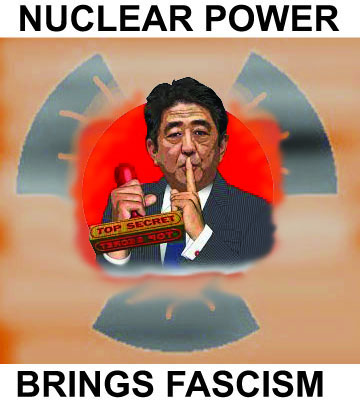 How far up the ladder did the #Fukushima cover up really go? Digital Journal, By Karen Graham Jun 27, 2016 Tokyo – About the only country today where a public apology is still accepted is in Japan, and quite honestly, this writer has always thought life would be so much more simpler if that’s all it took to right a profound wrong.
Hirose’s apology on the cover-up was to be expected after the news came out that an investigation had found Hirose’s predecessor had instructed staff to avoid using the term, “meltdown” after the disaster in March 2011. “I would say it was a cover-up,” Hirose told a news conference. “It’s extremely regrettable.”……..
And owing to the fact that Mr. Abe has been adamant in saying Japan needs its nuclear power plants, anything he says about Fukushima I would take with a grain of salt. Digital Journal reported that on March 6, this year at a press conference, Abe insisted that safety of nuclear plants was the government’s “top priority.” He also said the government would “not change its policy” in which reactors that meet the new standards can be restarted. So, yes, I think he probably did speak sternly with TEPCO officials in March 2011.
Power outage at Fukushima nuclear power plant causes machinery to shut down
The operator of the crippled Fukushima No. 1 nuclear power plant said Tuesday a power outage halted some systems but that no problems were detected in the cooling of the three melted-down reactors.
Machinery affected included cooling equipment for an underground ice wall, which is being set up around four reactor buildings in a bid to restrict the flow of groundwater beneath them.
Tokyo Electric Power Co. said an alarm sounded at 3:40 a.m. Tuesday, and workers found a unit that filters radioactive cesium from contaminated water had shut down.
The Nos. 1 to 3 reactors, which suffered meltdowns in the 2011 crisis, are currently being kept cool by having water poured into them every day.
Tepco said no abnormalities were detected with this equipment or in the surrounding environment.
1 This Month

Read the Public Inquiry Report, the Commissioners’ report, Surrendering Australia: The AUKUS Deception is available to download for free at aukuspublicinquiry.com. Or just watch the replay of the National Press Club Luncheon.


19 November – Webinar – The Reality of Reprocessing
Time: 11:00 AM Pacific Time (US & Canada) / 2:00 PM Eastern / 7:00 PM UK / 8:00 PM CET
Register for the Zoom Event Here



Shut down the radiation-damaged Heysham nuclear reactors now
To see nuclear-related stories in greater depth and intensity – go to https://nuclearinformation.wordpress.com

Say No to NASA’s Reckless Nuclear Reactor on the Moon
Say No to NASA’s Reckless Nuclear Reactor on the Moon
-
Archives
- November 2026 (84)
- October 2026 (302)
- September 2026 (339)
- August 2026 (330)
- July 2026 (355)
- June 2026 (287)
- May 2026 (306)
- April 2026 (356)
- March 2026 (251)
- February 2026 (267)
- January 2026 (308)
- December 2025 (358)
-
Categories
- 1
- 1 NUCLEAR ISSUES
- business and costs
- climate change
- culture and arts
- ENERGY
- environment
- health
- history
- indigenous issues
- Legal
- marketing of nuclear
- media
- opposition to nuclear
- PERSONAL STORIES
- politics
- politics international
- Religion and ethics
- safety
- secrets,lies and civil liberties
- spinbuster
- technology
- Uranium
- wastes
- weapons and war
- Women
- 2 WORLD
- ACTION
- AFRICA
- Atrocities
- AUSTRALIA
- Christina's notes
- Christina's themes
- culture and arts
- Events
- Fuk 2022
- Fuk 2023
- Fukushima 2017
- Fukushima 2018
- fukushima 2019
- Fukushima 2020
- Fukushima 2021
- general
- global warming
- Humour (God we need it)
- Nuclear
- RARE EARTHS
- Reference
- resources – print
- Resources -audiovicual
- Weekly Newsletter
- World
- World Nuclear
- YouTube
-
RSS
Entries RSS
Comments RSS

