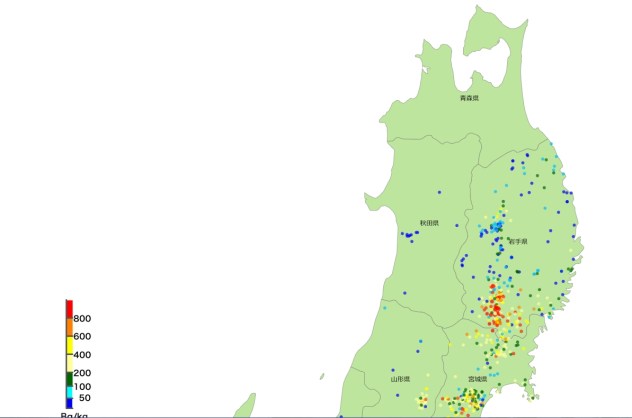
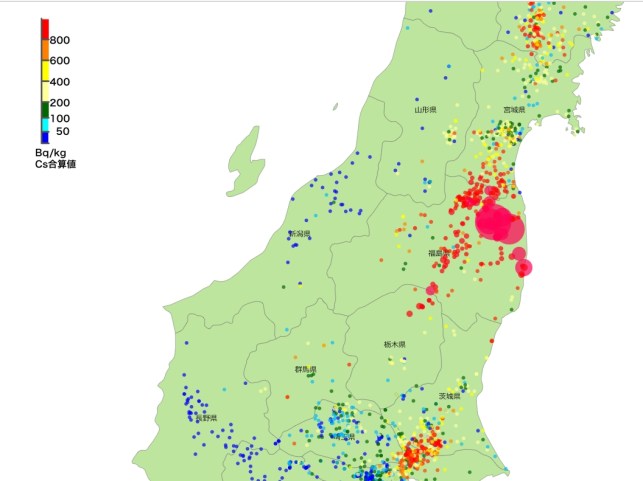
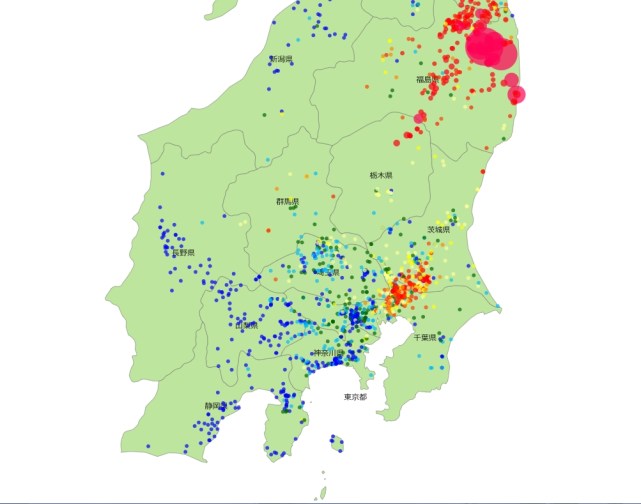
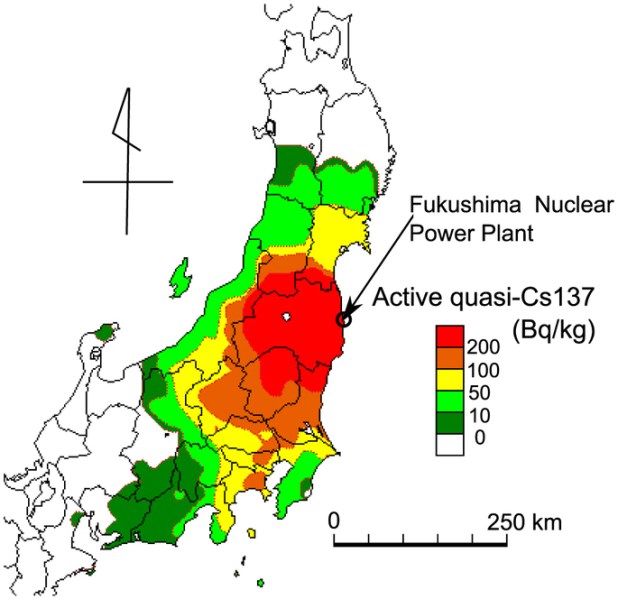
Interactive Map of Cesium in Japan by citizen’s monitoring project.
As you may see the contamination is well spread all along the eastern coast of Japan, the highest contamination found of course in the Fukushima prefecture.
But also numerous hot spots are found in the two prefectures above Fukushima prefecture, the Iwate and Miyagi prefectures, and also near Tokyo in the Ibaraki, Saitama, Kanagawa and Chiba prefectures.
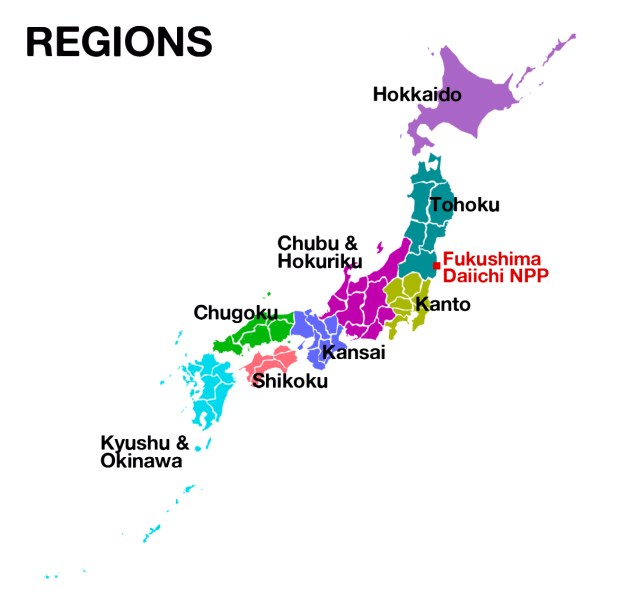
The contamination is concentrated in the two eastern regions of Japan: the Tohoku region in the north-east, and the Kanto region in the east. It is less pronounced once you leave the eastern part of Japan going towards the central regions of nearby Chubu and distant Kansai.
Assessment of residual doses to population after decontamination in Fukushima Prefecture
“….Fukushima Prefecture. Our probabilistic model considers the variabilities in behavioral patterns and Cs-137 surface-activity levels.
Five years after the initial contamination, the 95th percentiles of indoor workers and pensioners in 53 of the 59 municipalities were found to receive annual effective doses of below 1 mSv/y (0.026–0.73 mSv/y).
However, for outdoor workers in 25 municipalities, the annual doses were over 1 mSv/y (1.0–35 mSv/y).
Therefore, the guidance value is effective for indoor workers and pensioners; to determine whether additional countermeasures for outdoor workers should be implemented, a detailed assessment that uses more realistic assumptions is required……”
http://www.sciencedirect.com/science/article/pii/S0265931X16302247
5.0-magnitude quake hits eastern Japan; Tokyo checks nuclear power station
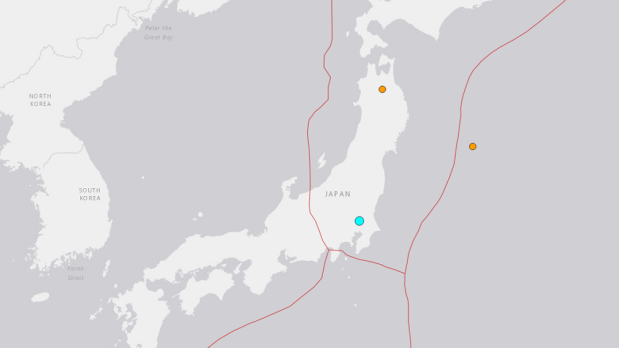
An earthquake with a magnitude of 5.0 struck eastern Japan on Sunday(Jul 17)
TOKYO: An earthquake with a magnitude of 5.0 struck eastern Japan on Sunday(Jul 17), Japan’s Meteorological Agency and the US Geological Survey (USGS) said, rattling buildings in Tokyo.
The USGS put the epicentre of the quake 44km northwest of Tokyo at a depth of about 44km. There were no were immediate reports of damage.
Broadcaster NHK reported that the Tokai No. 2 nuclear power station, which has been shut since 2011, was checked for damage after the quake but none was found.
http://www.channelnewsasia.com/news/asiapacific/tokyo-halts-nuclear-power/2963558.html
Some restricted zones to be lifted near Fukushima nuclear plant
Soft propaganda from the Asahi Shimbun, supporting the Government lifting of the evacuation order in some of the restricted zones, encouraging people to return into the evacuated zones.
Saying “In some of the areas, however, radioactive contaminants have been washed away by rain or blown away by wind. Radiation from those substances has also dissipated naturally.”
Conveniently omitting to mention, that in many decontaminated places, radiation soon returns to pre-decontamination level, thanks to the accumulated radionuclides of the mountain forests (80% of Fukushima prefecture) always ruisseling down with the rain or carried everywhere by the wind, not mentioning also that something in Fukushima Daiichi still fissioning, releasing radionuclides loaded gassings into the environment.
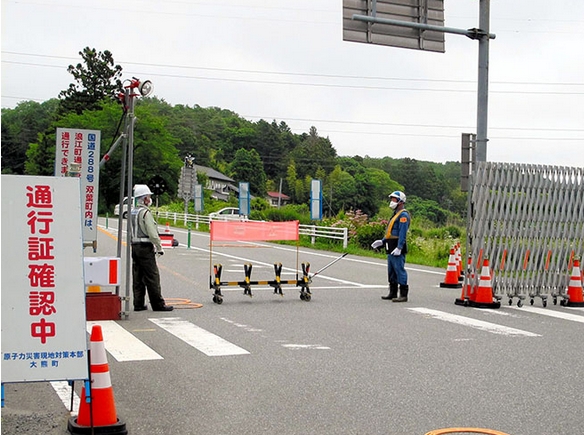
A gate is set up on a national road in Okuma, Fukushima Prefecture, restricting entrance to “difficult-to-return zones.” Permits from the central government are required to enter the areas.
For the first time since the 2011 nuclear disaster in Fukushima Prefecture, the government will lift the designation of some “difficult-to-return zones” around the crippled nuclear plant.
The rescinding is expected to be done gradually from around 2021. By that time, the government plans to undertake intensive decontamination work in central districts of municipalities, where residents will likely return, and districts along main roads.
The “difficult-to-return zones,” which cover a total of 337 square kilometers, are areas where the radiation level exceeded 50 millisieverts per year after the accident at the Fukushima No. 1 nuclear plant. Those areas are off-limits, in principle.
In some of the areas, however, radioactive contaminants have been washed away by rain or blown away by wind. Radiation from those substances has also dissipated naturally.
In front of the Environmental Radioactivity Monitoring Center of Fukushima in the central district of Okuma town, the radiation level is now about 9 millisieverts per year, about one-fifth the level of five years ago.
According to the policies of the government and the ruling parties, if radiation levels are reduced to 20 millisieverts or lower in some areas due to decontamination work, people are allowed to live there.
Of the areas, those where residents or workers for decommissioning of crippled nuclear reactors are expected to live will be subject to intensive decontamination work along with areas on both sides of main roads.
The government and the ruling parties will discuss the lifting of “difficult-to-return zones” with seven municipalities, including Okuma, and will make the official decision in August.
However, even if the designation is lifted, it is uncertain if residents will return to their homes.
According to the annual survey conducted by the Reconstruction Agency on evacuees, only about 10 percent of households evacuating from four municipalities around the nuclear plant are hoping to return home.
Before the nuclear crisis occurred, about 24,000 people of 9,000 households were living in areas that are currently designated as “difficult-to-return zones.”
Japan Reverts to Fascism
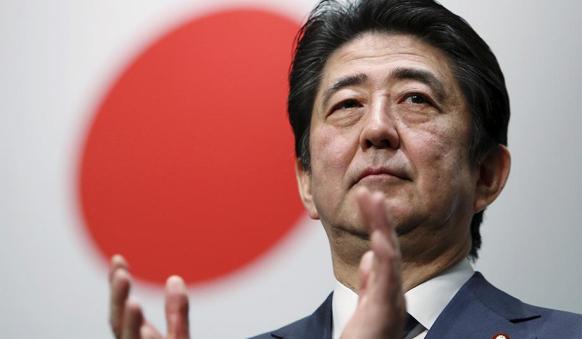
http://www.nationalreview.com/article/437950/japans-new-fascism
State minister rules out sarcophagus option
Japan’s state minister for industry has ruled out the option of sealing off disabled reactors at the Fukushima Daiichi nuclear plant with a Chernobyl-style sarcophagus.
Yosuke Takagi met Fukushima Governor Masao Uchibori in Tokyo on Friday.
Uchibori said he was shocked to hear the word “sarcophagus” and called the option unacceptable.
Two days earlier, a government body charged with decommissioning the plant operated by Tokyo Electric Power Company mentioned the sarcophagus method for the first time.
The body said it remained committed to removing fuel debris from the reactors that suffered meltdowns in the March 2011 accident. But it presented a technical report that left room for entombing the reactors in a massive metal and concrete structure.
Responding to Uchibori, Takagi said the government has no intention of using such an option, and that completing the decommissioning process is the top priority.
Takagi said the government’s policy is to stand by the people of Fukushima, and that his ministry has told the decommissioning body to rewrite its technical report.
http://www3.nhk.or.jp/nhkworld/en/news/20160715_27/
Radioactive Forest
July 9, 2016
The Fukushima nuclear accident in 2011 turned the surrounding towns into a desolate land, making the area into a “radioactive forest”. Without human presence, the land is roamed by wildlife like civets, macaques and wild boars. A project is underway to study the deserted areas by attaching a camera to wild boars to record the conditions of the former farmlands. 5 years after the disaster, we take a close look at how radiation has affected the wildlife, and what it entails for us humans.
Preventing Recriticality in Fuel Debris at Fukushima Daiichi Nuclear Power Station
This video released on July 16, 2016 by Tepco intends to explain the conditions of the fuel retained in the reactors of Units 1-3 at Fukushima Daiichi Nuclear Power Station, and TEPCO’s measures to prevent recriticality- return to a point at which a nuclear reaction becomes self-sustaining- in the fuel debris there.
Kagoshima’s new governor vows to halt Sendai nuclear plant for safety checks
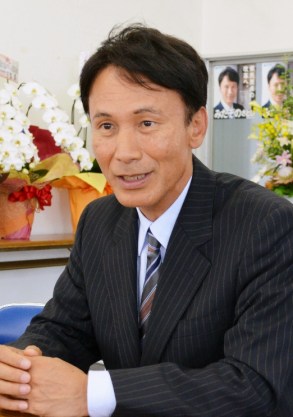
KAGOSHIMA – Incoming Kagoshima Gov. Satoshi Mitazono says he plans to ask Kyushu Electric Power Co. to suspend operation of the Sendai nuclear power plant for safety checks.
In an interview on Wednesday, Mitazono said he will make the request to the utility at a yet to be decided date to examine the effects of powerful earthquakes that hit nearby Kumamoto and Oita prefectures in April.
The former TV commentator was elected Sunday as governor of the only prefecture in Japan with an operating nuclear power plant.
During campaigning, Mitazono pledged to halt its operation.
“I will require Kyushu Electric to temporarily suspend the operation” for a survey of nearby faults and a review of evacuation plans to ensure safety, he said.
“There are many citizens in this prefecture concerned about the nuclear power plant operating after the quakes in Kumamoto,” he said.
Prefectural governors are not authorized to stop the operation of a nuclear reactor, but utilities require local consent to restart them.
Backed by an anti-nuclear camp, Mitazono defeated incumbent Yuichiro Ito, who allowed two reactors at the Sendai complex to be reactivated last year.
Iodine jelly to be handed out to infants living within 30 km of nuclear plants
As a reminder:
A fallout, is the residual radioactive material propelled into the upper atmosphere following a nuclear reaction conducted in an unshielded facility, so called because it “falls out” of the sky after the explosion and the shock wave have passed. It commonly refers to the radioactive dust which can also originate from a damaged nuclear plant. Fallout may take the form of black rain (rain darkened by particulates).
This radioactive dust, consisting of material either directly vaporized by a nuclear blast or charged by exposure, is a highly dangerous kind of radioactive contamination.
Some radiation taints large amounts of land and drinking water causing formal mutations throughout animal and human life.
Iodine tablets only protect the thyroid gland from the Iodine 131, it does not protect anyone from the other occuring fallout radionuclides: 91Sr, 92Sr, 95Zr, 99Mo, 106Ru, 131Sb, 32Te, 134Te, 137Cs, 140Ba, 141La, 144C etc. Iodine 131 has also a very short half-life, 8 days, meaning a full life of 80 to 140 days, whereas most of the other fallout radionuclides have a much longer life span. By example Cesium 134 has a half life of 2 years, a full life of 20 to 30 years, Strontium 90 a half life of 28,8 years, a full life of 288 to 432 years, Cesium 137 a half life of 30 years, a full life of 300 to 450 years.
Another thing, even if the population with the Fukushima catastrophe was only evacuated within a 30km radius, the Fukushima March plume has spread heavily within a 90km radius and less heavily up to a 250km radius.
Iodine jelly to be handed out to infants living within 30 km of nuclear plants
The Cabinet Office said it will soon start distributing iodine jelly to infants living within 30 km of nuclear power plants in a bid to protect their thyroids from possible radiation exposure in the event of a nuclear disaster.
According to the office, about 110,000 infants qualify for the iodine jellies.
There are 21 prefectures where the 30-km radius applies. In addition, infants living within three other prefectures — Kanagawa, Osaka and Okayama — which have nuclear fuel processing facilities are also part of the initiative.
Some local governments have been distributing iodine tablets to all residents for over three years, including in a tablet form for infants that would have to be crushed and mixed with syrup in the event of an accident. But to date this had not been in an iodine jelly form.
The local governments will receive about 300,000 packages, starting as early as this fall, which have a shelf life of three years, the Cabinet Office said.
There are two types of iodine jelly: one for babies under 1 month old and another for those over 1 month and up to 3 years.
Taking the jelly or tablets is supposed to stop the thyroid glands from absorbing iodine contained in radiation in the event of a nuclear disaster, as iodine tends to accumulate in the thyroid.
Japan’s “ludicrous” policy regarding nuclear safety and earthquakes – former nuclear regulator

 Former Japan nuclear regulator lashes out over earthquake standards, Reuters 15 July 16 A former senior official of Japan‘s atomic watchdog has lashed out publicly at the agency’s response to his concerns over the assessment of earthquake risks to nuclear plants, adding to a controversy over safety five years after the Fukushima disaster.
Former deputy chairman of the Nuclear Regulation Authority (NRA), Kunihiko Shimazaki, now a professor emeritus of seismology at the University of Tokyo, in June broke his silence after leaving the regulator in 2014 to voice his concerns that earthquake risks are not being sufficiently addressed.
Shimazaki then met with the NRA on June 16 and the regulator said it would make recalculations of its measurements but Shimazaki said the response falls short.
“I cannot be convinced by their conclusions. I think they are ludicrous,” he told reporters on Friday.
Shimazaki’s technical concerns relate to the Ohi nuclear plant operated by Kansai Electric Power, which is being assessed for a restart. But, he told Reuters after the June meeting with the NRA, “a sense of crisis” over safety prompted him to go public and urge more attention to earthquake risk in general……..
Kyushu Electric Power is the only utility that has been cleared to restart two reactors at its Sendai plant, while other utilities have been blocked so far by legal action from nearby residents. One more reactor may restart later this month.
(Reporting by Osamu Tsukimori; Writing by Aaron Sheldrick; Editing by Christian Schmollinger) http://uk.reuters.com/article/uk-japan-nuclear-regulation-idUKKCN0ZV11C
Study shows bulk of fuel still in crippled Fukushima No. 2 reactor

TOKYO, July 14, Kyodo
A study on the disaster-hit Fukushima Daiichi nuclear power plant has found that most of the melted fuel in the No. 2 reactor is still present in the reactor core area, sources close to the matter said recently.
According to the study that used a cosmic ray imaging system, around 200 tons of fuel and other melted substances is estimated to have accumulated at the bottom of the pressure vessel, the first time the current location of the fuel has been specified.
The finding is important for devising ways to remove the so-called fuel debris, the most challenging task in decommissioning the Nos. 1 to 3 reactors that suffered meltdowns in the nuclear crisis that began in March 2011.
https://english.kyodonews.jp/news/2016/07/421290.html
Deposition of radiocesium on the river flood plains around Fukushima

The environment in the area around Fukushima Daiichi Nuclear Power Plant has been contaminated by widely deposited significant amount of radioactive materials, which were released to the atmosphere caused by the Fukushima Daiichi Nuclear Power Plant accident due to the Great East Japan Earthquake, which occurred on March 11, 2011. The radiocesium released in the accident mainly affects radiation dose in the environment. Decontamination work in the contaminated area except a mountain forests has been conducted to decrease the radiation dose. However, there are concerns that the redistribution of this radiation due to water discharge will occur due to the resulting transport of radiocesium. In particular, the deposition of soil particles containing radiocesium on the flood plains in the downstream areas of Fukushima’s rivers can potentially increase the local radiation dose. Therefore, it is important to understand the influence of the deposition behavior of radiocesium on the radiation dose.
Investigations of rivers have been performed to enhance the understanding of the mechanisms by which radiocesium is deposited on these flood plains. It was found that the spatial distribution of the radiocesium concentration on the flood plain along the river is heterogeneous with a dependence on the depositional condition and that the number of points with high air dose rates is limited. In detail, the radiocesium concentration and air dose rates in flood channels are higher than those at the edges of the river channels. Based on these heterogeneity and hydrological events, the deposition and transport mechanisms of the radiocesium due to water discharge at rivers were also interpreted, and a conceptual model was constructed.
http://www.sciencedirect.com/science/article/pii/S0265931X16301187

Ultraconservative lobby Nippon Kaigi backs constitution revision

TOKYO — An influential political lobby in Japan will do its utmost to capitalize on Prime Minister Shinzo Abe’s election victory and push for the constitution to be revised to allow a more active military, the group’s chairman said Wednesday.
Abe’s gains in the upper house in last weekend’s election mean his party can cobble together the crucial two-thirds majority in both houses to propose a revision and put it to a referendum, if it gets support from lawmakers in other parties open to the changes.
Tadae Takubo, chairman of Nippon Kaigi, or Japan Conference, said the war-renouncing constitution that makes Japan’s defense “defective” needs to be corrected.
It’s time to grow out of Japan’s “silly” postwar goal of becoming an economic power with lightweight military, and seek to restore Japan with more self-respect, traditional family values and principles under the emperor as head of nation, said Takubo, international politics professor at Kyorin University.
“This is a golden opportunity that has never happened before. If I were in the prime minister’s position, I will go all out to accomplish a revision during the current term,” Takubo said. His organization will provide full support to push forward the drive, he said.
For Abe and his ultra-conservative supporters, like Nippon Kaigi, the 1947 constitution is the legacy of Japan’s defeat in World War II and an imposition of the victor’s world order and values. The charter renounces the use of force in international conflicts and limits Japan’s military to self-defense only, although Japan has a well-equipped modern army, navy and air force that work closely with the United States, its top ally.
Abe’s ruling party proposed revisions to the constitution in 2012 that intended to restore traditions similar to prewar-era family values centered on the emperor, and to put national interest before individuals’ basic human rights in some cases. It was never formally submitted to parliament.
Abe did not make the constitution a focus of the election, but said on Monday he takes Sunday’s victory as a public endorsement for a revision, pledging to launch a parliamentary committee to discuss which articles to change and how.
Founded in 1997, Nippon Kaigi has strived to revise the constitution to restore traditional gender roles, increase imperial worshipping and put public interest before individuals. The group is believed to be behind Abe’s comeback in 2012 and has become increasingly influential.
Their grass-roots movement backed by Shinto shrines and other new religious groups has a growing membership that reportedly includes many of Abe’s Cabinet ministers and hundreds of national and local lawmakers.
The organization holds lectures and other events to spread its views and defends Japan’s wartime atrocities while accusing China and South Korea of lying or exaggerating their suffering. It also believes the U.S. postwar occupation brainwashed Japanese with guilt and that education since the war was self-degrading.
‘Stone coffin’ eyed for decommissioning Fukushima plant: report
The government-funded Nuclear Damage Compensation and Decommissioning Facilitation Corp. (NDF) eyes an option of covering the disaster stricken Fukushima No. 1 Nuclear Power Plant with concrete in the future as in the Chernobyl disaster, it has been learned.
In its first planning report drawn up on July 13, the NDF leaves room for adopting the “sarcophagus (stone coffin) method,” in which nuclear fuel debris that melted in the Fukushima crisis will be confined inside reactor buildings using concrete and other materials.
The NDF points out in the report that it will be difficult to manage such a sarcophagus safely over a long period of time, and emphasizes that it is planning to remove fuel debris from the Fukushima nuclear plant for now. However, the report also says, “It is appropriate to flexibly review the plan in accordance with the conditions inside (nuclear reactors and other parts) that will be revealed later.”
The report also states, “It is necessary to fully consider the uncertainties over passing down responsibilities for a long period of time and concerns over easy postponement from one generation to another.”
The sarcophagus method was adopted at the Chernobyl nuclear complex in the former Soviet Union in the wake of the core meltdowns there in 1986.
http://mainichi.jp/english/articles/20160714/p2a/00m/0na/009000c
1 This Month
26 September – International Day for the Total Elimination of Nuclear Weapons





PLEASE OPPOSE HR 8255 AND S.3639 – bills would accelerate satellite deployment, with no environmental review or safeguards – https://ncstd5li.quorum.us/campaign/169331/
To see nuclear-related stories in greater depth and intensity – go to https://nuclearinformation.wordpress.com
-
Archives
- September 2026 (323)
- August 2026 (330)
- July 2026 (355)
- June 2026 (287)
- May 2026 (306)
- April 2026 (356)
- March 2026 (251)
- February 2026 (267)
- January 2026 (308)
- December 2025 (358)
- November 2025 (359)
- October 2025 (375)
-
Categories
- 1
- 1 NUCLEAR ISSUES
- business and costs
- climate change
- culture and arts
- ENERGY
- environment
- health
- history
- indigenous issues
- Legal
- marketing of nuclear
- media
- opposition to nuclear
- PERSONAL STORIES
- politics
- politics international
- Religion and ethics
- safety
- secrets,lies and civil liberties
- spinbuster
- technology
- Uranium
- wastes
- weapons and war
- Women
- 2 WORLD
- ACTION
- AFRICA
- Atrocities
- AUSTRALIA
- Christina's notes
- Christina's themes
- culture and arts
- Events
- Fuk 2022
- Fuk 2023
- Fukushima 2017
- Fukushima 2018
- fukushima 2019
- Fukushima 2020
- Fukushima 2021
- general
- global warming
- Humour (God we need it)
- Nuclear
- RARE EARTHS
- Reference
- resources – print
- Resources -audiovicual
- Weekly Newsletter
- World
- World Nuclear
- YouTube
-
RSS
Entries RSS
Comments RSS

