Tokyo Responsibility to Reveal Truth of Fukushima
We already know what is Tokyo definition of “truth”: five years and half of continuous deception, lies and cover-ups, tidbits of truth released only when forced to do so….
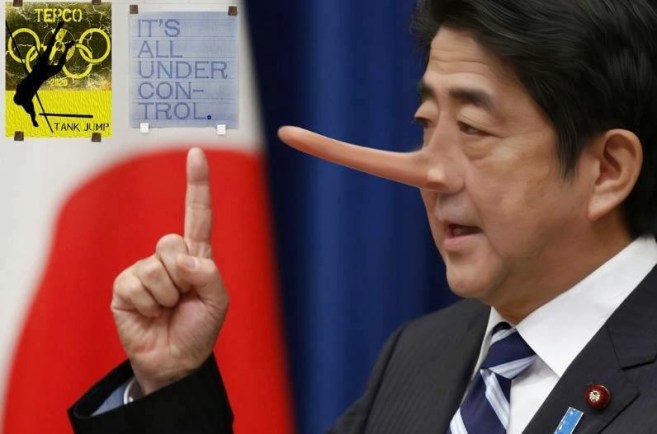
More than five years after the meltdown of the Fukushima Daiichi nuclear power plant in Japan, the legacy of the accident continues, characterized by constant radiation exposure and an ever-lasting sense of fear, not only in this island country but also beyond its territory.
Numerous reports about nuclear radiation and its damage to human bodies have been filed since the Fukushima disaster. An Asahi Shimbun article in 2014 revealed that high levels of accumulated radioactive cesium had been detected in the mud of 468 reservoirs outside of the Fukushima evacuation zone.
But more discouraging news awaits. According to a recent report by The Mainichi, an Environment Ministry survey found that high concentrations of radioactive cesium have been accumulating at the bottom of 10 major dams 50 kilometers away from Fukushima No.1 nuclear power plant, yet officials were quoted as saying that “it is best to contain cesium at those dams.”
It is the inaction that is most depressing. As people’s physical health is exposed to possible risks, the psychological fallout from the accident is worrying as well. As nuclear radiation reports are always published, people affected by the nuclear leak are fearful.
The aftermath of the Fukushima disaster that concerns the lives of millions has failed to prompt the Japanese government to assume responsibility actively on a massive scale.
Earlier this month, former Japanese prime minister Junichiro Koizumi accused current leader Shinzo Abe of lying to the international community that the situation at the nuclear power plant is under control.
Those in a position of Japanese authority should release information about Fukushima-related contamination once and for all. The government should also set up a mechanism which can inform the country and the international community of new findings in a timely manner.
As a neighbor of Japan, China has also felt uneasy with the radiation from the disaster. Years after the meltdown of the Fukushima reactors, Chinese travelers are still asking if it is safe to go to Japan. In terms of food safety, despite a ban by Chinese authorities on food imports and agricultural products from Fukushima and 11 other Japanese regions affected by nuclear contamination since the accident, potentially radiation-tainted seafood from Fukushima smuggled to China poses health threats to the Chinese people.
Since a large number of Chinese travelers are going to Japan, related information is indispensable. Therefore, China should also come up with solutions such as assigning experts to monitor the situation in Japan and offer credible advice to the anxious public. This “nuclear war without a war” will attest to the responsibility of a government to its people.
http://www.globaltimes.cn/content/1008771.shtml#.V-sabiwjxlg.facebook
Tokyo Electric Power : Financial Assistance from the Nuclear Damage Compensation and Decommissioning Facilitation Corporation
On September 23, we received a funding grant of 104.1 billion yen from the Nuclear Damage Compensation and Decommissioning Facilitation Corporation (hereinafter referred to as NDF) based on the revision of the Special Business Plan which was approved on March 31, 2016.
This financial assistance was given in response to the 56th request we made in order to cover the compensation payouts due by the end of October 2016. The amount of the payouts to be paid by that time had been estimated to exceed the sum of the compensation we had received in accordance with the ‘Act on Contract for Indemnification of Nuclear Damage Compensation’ (188.9 billion yen) and the financial assistance that the NDF has provided (6,229.9 billion yen).
With financial assistance from the NDF, we are determined to continue to pay the compensation with courtesy and compassion to all of those who have been afflicted by the nuclear damage.
New Power Firms to Pay Some of the Decommissioning Costs

New power firms may have to pay some costs for nuke reactor decommissioning
The Economy, Trade and Industry Ministry has begun discussions on a plan to have new smaller electric power companies shoulder part of the costs of decommissioning nuclear reactors, officials said.
This is due to fears that nine major power companies that operate nuclear plants and the Japan Atomic Power Co. alone cannot fully foot the costs of decommissioning their reactors in the future.
The government intends to draw a conclusion on the plan by the end of the year, but the move could spark criticism that nuclear plant operators would be given preferential treatment.
The industry ministry convened the first meeting of an advisory panel on electric power system reform on Sept. 27 to discuss challenges to the liberalization of the power market. At the meeting, the ministry proposed that the costs of decommissioning nuclear reactors be added to power grid usage fees that new power supplies pay to major utilities.
If new power companies add the costs of reactor decommissioning to electricity charges, consumers will be required to shoulder such additional costs.
The industry ministry has worked out the plan, which could be viewed as a relief measure for major utilities, because the business environment surrounding these companies has worsened following the liberalization of the power market and criticism of nuclear power in the wake of the outbreak of the Fukushima nuclear crisis.
The costs of decommissioning a nuclear reactor are about 10 times that for a thermal power generator. The operators of nuclear plants use part of their income from electricity charges to save enough money to dismantle their reactors in the future.
However, if the liberalization of the electricity market progresses, a growing number of consumers could switch to new power suppliers and the prices of electric power could further decline because of intensifying competition, making it more difficult for major utilities to secure enough funds to decommission their nuclear reactors.
The suspension of operations at most atomic power stations is also adversely affecting major power companies.
Power companies could secure enough funds to decommission nuclear reactors if they saved money on the assumption that the rate of utilizing such plants stood at 76 percent and that the lifespan of each reactor was 40 years.
However, the suspension of operations at many nuclear plants has been prolonged and power companies are being forced to decommission some reactors earlier than planned, as a result of which they have been unable to secure enough funds.
Under these circumstances, major power companies are insisting that new power companies should shoulder part of the decommissioning costs.
“Customers of new electric power firms previously used power generated by nuclear plants operated by major utilities. We would like these customers to shoulder a fair share of the costs for reactor decommissioning,” an official of one major power company said.
Major power suppliers have asked the executive branch of the government and ruling Liberal Democratic Party (LDP) legislators to consider their requests.
The government has shown consideration to major power companies that are being forced to shoulder the expenses of changes in Japan’s energy policy — such as market liberalization and stepped up safety regulations — following the outbreak of the Fukushima nuclear crisis in 2011.
A working group within an advisory committee to the industry ministry called on the government in March 2015 to consider a system that would take advantage of the pricing system for power transmission and distribution to help power companies cover decommissioning costs.
However, new power suppliers are opposed to the move. “It’d be unreasonable for new electric power companies that don’t have nuclear plants to shoulder the costs of those facilities,” said an executive of a Kansai-based new power supplier.
Ennet Corp. President and CEO Tsutomu Takeda told the panel on Sept. 27, “We can’t convince our customers unless you (the government and major power companies) explain how much it will cost to decommission a reactor.”
An executive of a new power company based in the Tokyo metropolitan area said, “It’d be difficult to gain understanding from our customers who have switched from major power companies following the outbreak of the nuclear disaster.”
In response, the industry ministry will consider setting up a market in which power is traded and encouraging major utilities to supply less expensive power generated by nuclear power and coal-fired thermal power plants to the market. The ministry is aiming to allow new power companies to procure less expensive power from the power transaction market in a bid to persuade them to shoulder part of the costs of decommissioning nuclear reactors.
Under the old power supply system in which major utilities enjoyed regional monopolies, power companies were able to secure funds to build and decommission nuclear plants solely by using electricity charges, allowing them to take advantage of low fuel costs for nuclear plants.
With the liberalization of the power market, however, nuclear power plants have lost their edge.
The government has postponed discussions on whether to go ahead with the construction of new nuclear power plants.
The system proposed lately could give preferential treatment to nuclear plants and encourage power companies to build more atomic power stations.
In-depth debate needs to be held on whether nuclear plants will be consistent with the policy of liberalizing the power market.
http://mainichi.jp/english/articles/20160928/p2a/00m/0na/015000c
Related article from September 8, 2016
Gov’t may shift nuke accident, reactor decommissioning costs onto new power suppliers
The government is moving to bill new electricity suppliers for a portion of nuclear reactor decommissioning costs and compensation payments related to the Fukushima nuclear disaster, it was learned on Sept. 7.
After decades under regional utility monopolies, the electricity supply market was opened to competition in April this year. The government apparently fears that the old monopolies such as Tokyo Electric Power Co. (TEPCO) lose too many customers to new suppliers and they may no longer be able to cover the high costs of decommissioning old reactors or compensate the victims of nuclear accidents, hence the move to shift some of the financial burden onto new market entrants.
However, these costs were originally supposed to be covered by the nine big utilities, and the government’s moves would essentially transfer that burden onto the Japanese people, making a clash more than likely.
Under the current system, large utilities must cover nuclear reactor operating expenses — including eventual decommissioning — from electricity bill income. Also, TEPCO receives monies to cover Fukushima nuclear disaster compensation claims from the government-licensed Nuclear Damage Compensation and Decommissioning Facilitation Corp. (NDF), which is in turn funded by all the large utility companies.
The new system being considered by the government would spread the financial burden of nuclear accident compensation and reactor decommissioning to new electricity suppliers, lightening the load on the big utilities. The government estimates the total cost for reactor decommissioning plus Fukushima nuclear disaster compensation paid before the NDF was established at some 8 trillion yen. The new power suppliers would likely pass on their share of these costs to their customers, resulting in monthly power bills up to about 200 yen higher than at present for an average three-person household.
However, forcing customers of the new electricity firms to pay for the old utilities to decommission their reactors and for TEPCO’s nuclear disaster liabilities runs counter to the goals of liberalizing the electricity market, which was intended to push down prices through competition. It would also in essence be corporate welfare for the big utilities operating nuclear plants.
A sub-committee to debate the new system will be established under the Advisory Committee for Natural Resources and Energy reporting to the minister of economy, trade and industry. The committee will decide on what direction to take by the end of this year, with an eye to submitting a bill to revise the Electricity Business Act to the ordinary Diet session next year.
http://mainichi.jp/english/articles/20160908/p2a/00m/0na/006000c
Debris recovery operation in sea carried out for first time since Fukushima nuclear disaster
The Japan Today article cites it as tsunami debris but it would also include debris from the reactor explosions at the plant. Pieces from these explosions have been found as far inland as Naraha. Why this work had not been done sooner was not mentioned.
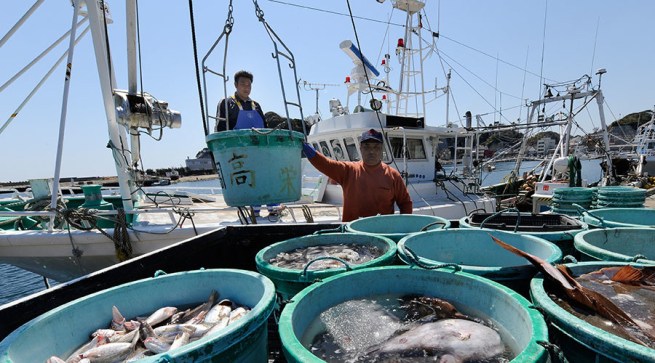
Japan performs tsunami debris cleanup off Fukushima 1st time since nuclear disaster
Local fisheries have begun a debris cleanup near the Fukushima plant for the first time since the tsunami-triggered nuclear disaster. However a plan to start trial fishing next year may face a setback as a nearly-completed ice wall is failing to halt water contamination.
On March 11, 2011, a magnitude-9 earthquake struck northeastern Japan at 2:46pm local time, unleashing a deadly tsunami. Less than an hour after the earthquake, the first of many tsunami waves hit Japan’s coastline. The tsunami waves reached heights of up to 39 meters (128 feet) at Miyako city and reached as far as 10 km (6 miles) ashore in Sendai, destroying everything in its wake. More than 15,000 people died.
At the Fukushima Daiichi Nuclear Power Plant, the tsunami caused a cooling system failure resulting in a nuclear meltdown and the release of radioactive materials. The waves forced the failure of electrical power and backup generators, leading the plant to lose its cooling capabilities. The retreating water sucked a vast amount of rubble into the depths of the Pacific Ocean, contaminating the traditional fishing grounds of the local companies.
Five years after the disaster a cleanup effort to remove the debris has finally been launched by collectives of local fishermen, who aim to start trial fishing expeditions within the area from 5 kilometers (3 miles) to 20 km (12 miles) off the wrecked plant.
On Monday Soma-Futaba Fisheries Cooperative Association send out 32 fishing boats to recover debris from the ocean floor. That fleet is focusing their efforts on the North side of the nuclear power plant.
On Tuesday, the Iwaki City Fisheries Cooperative Association also sent in their fleet to help with the cleanup efforts of the southern side of the contaminated segment.
Once the debris is pulled out and delivered to shore, the unloading of the waste is handled by the industrial waste treatment company. The rubble is then sent to a temporary storage facility where after an inspection for radioactive reading, cleared waste is disposed of in an industrial manner. It is as of yet unclear how the contaminated waste will be treated.
The cleanup work of the seabed endorsed by the Fisheries Agency is scheduled to last at least until February of next year. Fishing on a trial basis can start as early as March.
However such a prospect seem problematic as the recently-completed ice wall around the crippled station has failed to meet expectations, with contaminated groundwater still seeping into the sea.
The $320 million Land-Side Impermeable Wall was built to halt an unrelenting flood of groundwater into the damaged reactor buildings and consequent flow of the contaminated water into the ocean.
But on Tuesday the Japanese government and plant operator Tokyo Electric Power Co. reported that 1.5 km (1 mile) barrier frozen barrier failed to produce the intended results, Nikkei reported.
While gaps still remain in some sections of the ocean-facing side of the wall, TEPCO believes that the inflows that penetrate the contaminated reactor are concentrated at seven unfrozen sections on the inland side.
A similar concern was voiced last month by the operator which claimed that 99 percent of the wall’s is mostly solid and frozen. However, a remaining one percent showed temperatures of the barrier above the freezing point, meaning that the contamination is not fully contained.
TEPCO has been repeatedly facing criticism for the handling of the Fukushima crisis. Despite the ongoing problems encountered following the meltdowns, the company has set 2020 as the goal for ending the plant’s water problem.
The problem of water contamination however is just one of many surrounding the dismantling and decommissioning of the Fukushima plant debris which is estimated to take at least 40 years.
“We will continue to move forward with the decommissioning and contaminated water management in a transparent way, visible to the world, and will also share with the international community the lessons learned from this accident,” Hirotaka Ishihara, state minister of the cabinet office of Japan, told the International Atomic Energy Agency’s 60th General Conference earlier this week.
“We are also making ongoing efforts to ensure the safety of food produced in Japan,” he added. “Recognizing that many countries have already lifted restrictions on food imports from Japan, we encourage the international community to implement import policies based on scientific evidence.”
https://www.rt.com/news/360879-fukushima-fishery-cleanup-debris/#.V-s-7I2uaW0.facebook
Debris recovery operation in sea carried out for first time since Fukushima nuclear disaster
FUKUSHIMA — For the first time since the 2011 nuclear crisis at the Fukushima Daiichi power plant, the removal of debris in seawater located up to 20 km from the plant site has finally started.
The recovery operation, which began Monday, focuses on the removal of rubble in seawater within 5 to 20 km of the wrecked plant, Sankei Shimbun reported.
Five and a half years after the disaster, fishing has yet to be carried out in these waters while tsunami debris on the ocean floor near the Fukushima plant has remained untouched.
With an aim to start trial fishing operations within this targeted cleanup area, the Soma-Futaba Fisheries Cooperative Association employed 32 fishing boats to recover debris such as driftwood and gill nets on Monday.
Following suit, from Tuesday, the Iwaki City Fisheries Cooperative Association started debris removal operations and will continue the cleanup efforts until February of next year.
South Korea and Japan tempted to develop nuclear weapons, in response to North Korea’s nuclear test?
Will North Korea’s Nuclear Test Tempt South Korea and Japan to Go Nuclear?The latest test may strengthen calls South Korea and Japan to develop their own nuclear weapons. The Diplomat, By Pang Zhongying September 27, 2016 North Korea’s latest nuclear test strengthened the sections of public opinion that approve of obtaining nuclear weapons in South Korea and Japan. The test, then, could bring about a chain reaction and accelerate the pace of Japanese and South Korean efforts to possess nuclear weapons. Under these circumstances, China will face not only a threat from the Terminal High Altitude Area Defense (THAAD) system, but also the further deterioration of Northeast Asia’s strategic environment.
In my opinion, the biggest challenge posed to China by this North Korean nuclear test is that South Korea’s domestic support for nuclear weapons may increase. Since Kim Jong-un assumed leadership of North Korea — especially this year — public support for possessing nuclear weapons and turning South Korea into a nuclear state has reached a certain scale. South Korea has been protected by the U.S nuclear umbrella, but now more and more people in South Korea want to build up a domestic nuclear deterrent to balance against North Korea.
On July 1, President Park Geun-hye suddenly decided to deploy the U.S. THAAD system in South Korea. In the following two months, domestic voices advocating for possessing and/or developing nuclear weapons have been constantly coming from South Korea. These voices will get even louder after the latest nuclear test in North Korea. It is said that the tested nuclear warhead was miniaturized, but its blast is estimated to be very large. Readings of the seismic activity in North Korea indicate that the test was very successful. Therefore, South Korea is currently enveloped by the sense of a national security crisis and many now believe that it is not enough to only have United States’ nuclear protection. So North Korea’s nuclear test may further stimulate South Korea to acquire nuclear weapons or develop nuclear weapons, which is also a big challenge for the United States………http://thediplomat.com/2016/09/will-north-koreas-nuclear-test-tempt-south-korea-and-japan-to-go-nuclear/
Fukushima Radioactive Contamination of Tap Water in Eastern Japan
The measures quoted in this article are from the Japan Nuclear Regulatory Agency.
As every measure given by the Japanese government agencies and Tepco during the past 5 and half years, we have the right to question their exactitude and therefore the true numbers could be actually higher than the ones published.
still the fact remains that they do recognize a certain contamination of the tap water in many prefectures of Eastern Japan.
Radioactivity testing of tap water in June 2016
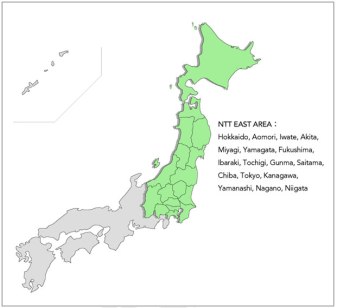
According to the radioactivity test of tap water, the Nuclear Regulatory Agency announced in June 2016 that there is some radioactivity contamination from Fukushima nuclear power plant accident in the tap water of Miyagi Prefecture, Yamagata Prefecture, Fukushima Prefecture, Ibaraki Prefecture, Tochigi Prefecture, Gunma Prefecture, Saitama Prefecture, Chiba Prefecture, Tokyo, Kanagawa Prefecture, Niigata Prefecture, where radioactive cesium has been slightly detected.
(The detection limit value of White Food: 0.5 Bq / kg).
For Tokyo traces of both Cesium 134 and Cesium 137 were detected, proving with certainty that they are from the Fukushima nuclear power plant accident.
As a result, we make sure it is not detected by the detection limit value of 0.0001 Bq / kg. So we have to check the non-detection in strontium inspection that is only carried out in the mineral water industry.
We believe that the one of the products that you sould really worry is the water that you drink every day.
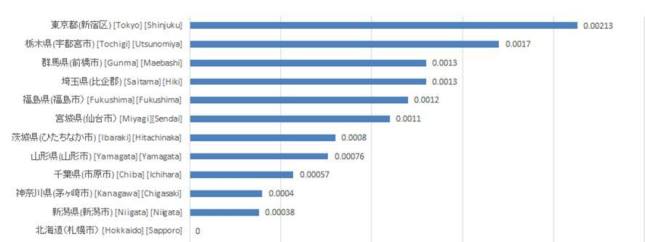
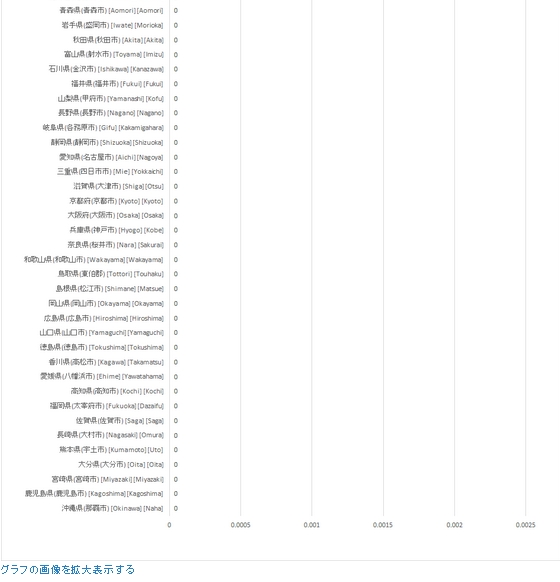
Information Source: Nuclear Regulatory Agency (→ link http://radioactivity.nsr.go.jp/ja/list/194/list-201606.html)
Readings of radioactivity level in drinking water by prefecture (January-March, 2016)
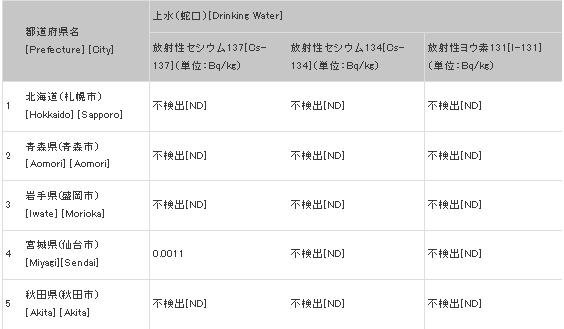
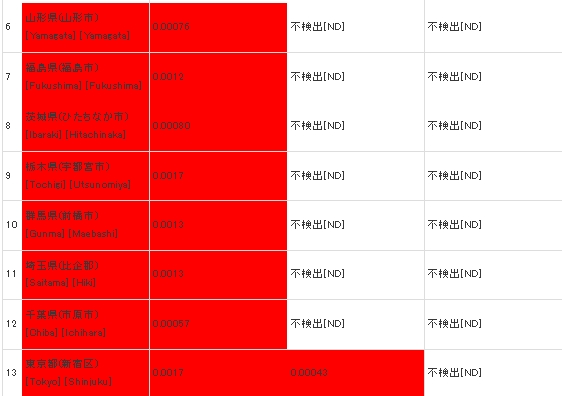
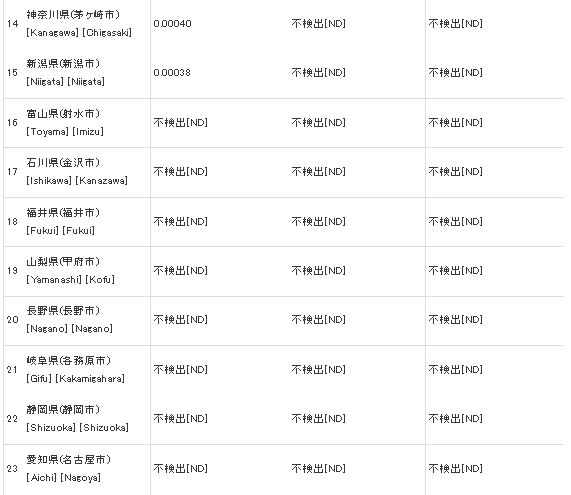
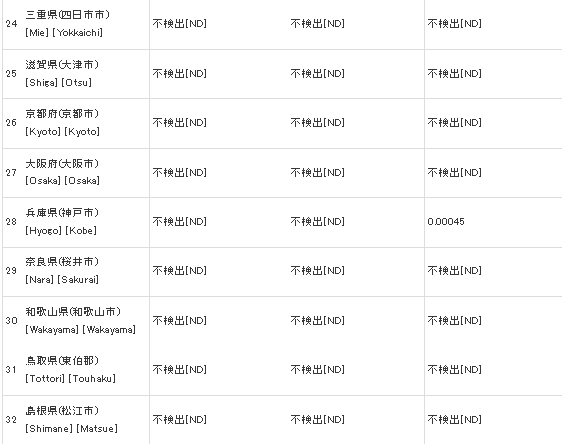
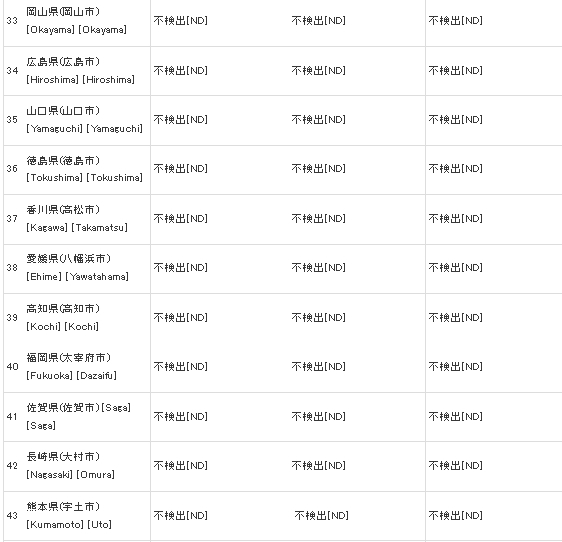
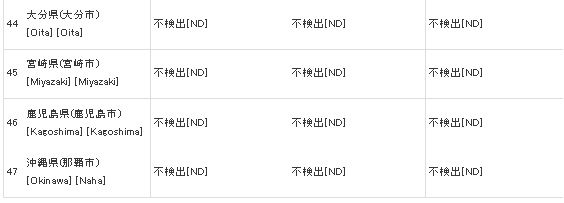
1.本データは、1Bq/LをBq/kgとみなす [1.These figures are estimated as 1Bq/liter = 1Bq/kg]
2.原子力規制委員会が各都道府県等からの報告に基づき作成 [2.The table was made by Nuclear Regulation Authority, based on the reports from prefectures.]
3.検出下限値は、 I-131、Cs-134、Cs-137すべて0.001Bq/kg未満 [3.The detection limits of I-131, Cs-134 and Cs-137 are less than 0.001Bq/kg]
(参考)水道水中の放射性物質に係る指標の見直しについて(厚生労働省)における水道水中の新たな目標値 放射性セシウム(セシウム134及び137の合計) :10Bq/kg [(Ref.)[Document created by Ministry of Health, Labour and Welfare] [Radioactive cesium (The sum of cesium134 and 137) :10Bq/kg]
情報元 : 原子力規制庁(→リンク http://radioactivity.nsr.go.jp/ja/list/194/list-201606.html)
Cesium level is highest in Tokyo tap water
https://news.whitefood.co.jp/news/foodmap/7290/
East Japan Soil Measurement Project of Minna no Data, Dec.2015 to Sept. 2016
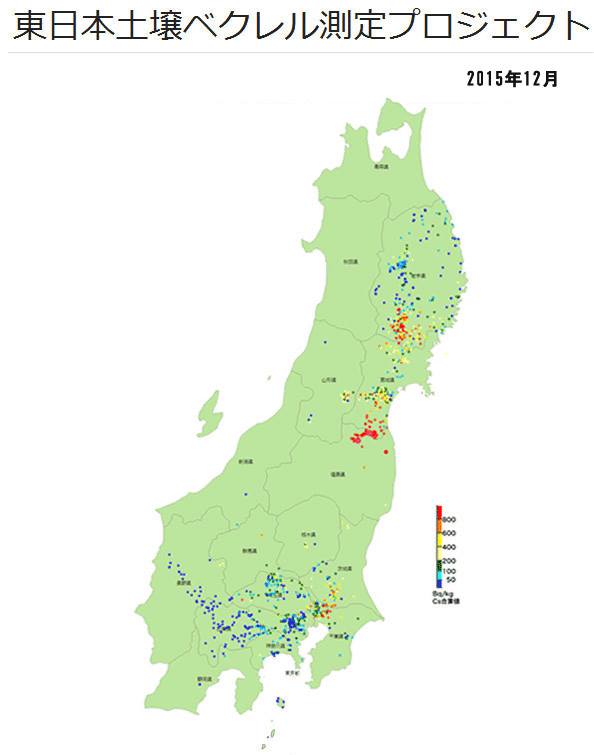

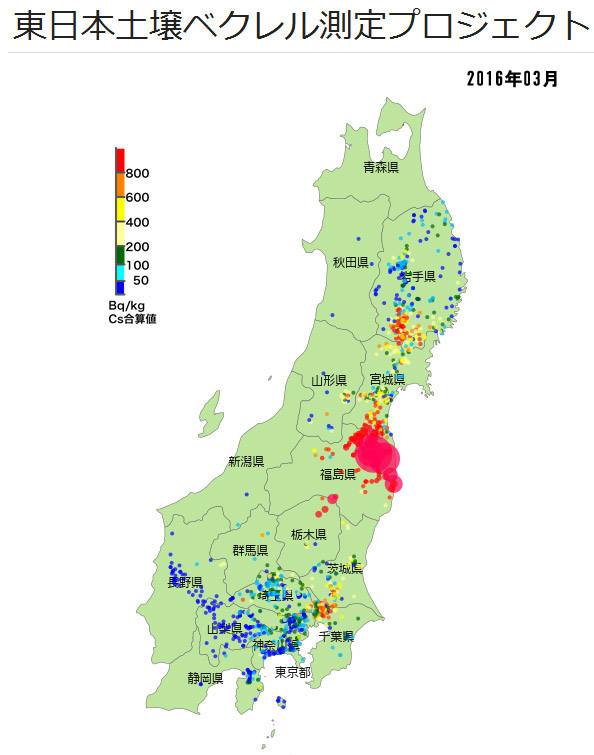


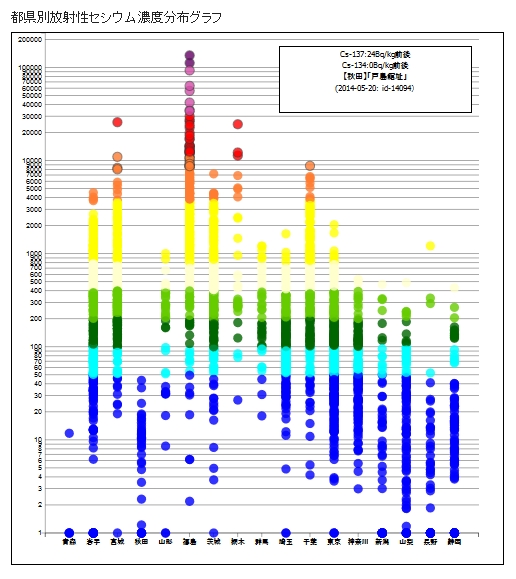
Source: http://www.minnanods.net/soil/pref17_colored/map17.html
East Japan Soil Measurement Project of Minna no Data Site

About This Project
It’s time to cooperate
When we started up MDS (Minna no Data Site, Everyone’s Data Site) we constructed inclusive and shared system on measuring data of food as the first stage, as there were many people who were concerned about food intake.
However, we planned to launch the measuring data of soil as a second stage after intensively equipped the system on food.
In autumn 2014, after one year from opening of MDS, we start up to platform soil measurement data. We, as citizens, try to start to map the status of soil contamination spread over East Japan.
The following is the reason why we stand up to start the East Japan Soil Becquerel Measurement Project. Objectives, outline and methodology of the project is explained.
Outline
In the Project, the method of collection is standardized in order to make comparison of data from multiple measurement laboratories. The Manual for Collection is developed by considering the easiest method of measurement within the limits of keeping accuracy, because many citizens conduct collection and measurement by themselves.
Collected soil is measured by the participating measuring laboratories of MDS. The result becomes open to the public and the report is sent to the collector.
Objectives
Radioactivity contamination by the accident of Tepko Fukushima Nuclear Power Plant is long term lasting.
The soil contamination map of broader areas is needed to understand contamination of neighborhood by measurement and comparison of data.
Though central and local governments conduct soil researches, those researches are insufficient because the value is lower by measuring deep place, or they measure only air dose.
As they decide the spot of measurement by mesh, the data what citizens want to know is lacking.
In our Project, we aim to grasp status of contamination where citizens make living every day. For example, place where children frequently play, where people pick wild grass, or where farmers work is being measured.
The Project aims that people can access necessary information as much as possible by utilizing data and database and by accumulating information which one can find at a glance and can search at ease.
We hope the result would be used as a tool for action for everyone.
Methodology
■ The depth of collection is from 0 to 5 cm, because most of cesium stays within 5 cm from surface of the earth.
Collection of soil should be conducted when it does not rain for several days, in order to avoid weight error caused by water. Less than 10 percent of moisture content is desirable.
■ Spot for collection is set at higher dose spot by measuring rate of air dose (1m、5cm).
The extreme high spot such as micro hot spots and concentrated environment are excluded.
■ Collection is made by a method to compare results of each place.
■ Samples are measured at the participating laboratories of MDS.
・Measurement accuracy of those laboratories is ensured by the MDS original examination.
・The results are accumulated in the common database.
■ The result sof measurement are open to public on MDS. MDS has Japanese and English site.
■ Mapping of data is planned after gathering enough results.
■ Trial calculation of amount of radioactivity by a square meter is planned to be conducted. (Becquerel/ Kg →Becquerel /square meter)
Target areas:17prefectures in east-Japan
Tohoku : Aomori Iwate Akita Miyagi Yamagata Fukushima
Kanto : Ibaragi Tochigi Gunma Saitama Chiba Tokyo Kanagawa
Chubu : Yamanashi Nagano Shizuoka Nigata
* In Iwate, the Soil Project Iwate had implemented measurement at more than 300 spots in 2012 and 2013.
The project activity will be made starting from requested districts. Individuals, groups and any organization such as school and daycare can participate in measurement of proposed spots. Proposing more than 5 spots are desirable.
The measurement spots will be decided after consultation basically in the same municipality.
★ How to support us:
Collection of samples, payment of 2,000yen for measurement of one sample, payment of actual postage for samples.
★ How to feed back :
Sending result of measurement of the spots including spectrum, Reading and downloading data at MDS.
Support our site and project!
To those of you who are viewing this site from overseas, Thank you for visiting ”Minna no Data Site” (Combined Database of Independent Radioactivity Measurement Labs) .
MDS has stacked the data measured by the independent radioactivity measurement laboratories in response to the Fukushima Daiichi nuclear power plant accident, As of September 2014, the number of the food data became nearly 10,000.
For the benefit of those who worry about radioactive contamination of Japan from overseas, we opened the English site. We have started “East Japan soil measurement project” since October 2014 in addition to the food data.
From the fact that government has not done the adequate soil contamination survey for the citizens, this project promotes measuring soils of the places like parks, vacant lots, and educational facilities which are closely related to children’s daily life.
This project is based on the method of “Iwate soil measurement project “(2012- 2013) by citizens of Iwate Prefecture. If the method for collecting the soil is different, the results of monitoring vary greatly.
By using an easy-to-understand manual of the standardized method, you are able to compare, review and analysis the data from different locations. We will publish the measurement results of soil on this site.
We record the status of the radioactive contamination of Japan carefully from the standpoint of citizens, and hope that it will help people who are living with anxiety. For the people overseas, we are preparing the English version of data to show where and how much radioactively contaminated.
To run this project, big budget for measurement cost and update cost of web systems are required. There are 300 locations in each 17 prefectures in Eastern Japan, and each place costs about 4,000 yen.
Although it is planned to reduce costs and to ask for volunteers as much as possible, still the costs such as measurement costs, project management costs and Web systems costs are expected to some extent also.
It is a project of the scale that no one even challenged yet. We rely on your generosity to help funding for this project. We would appreciate your support from abroad. Thank you for your cooperation and support.
The information page of “East Japan soil measurement project” is currently in preparation. It will be published shortly.
◎Donate by the bank transfer
Postal Transfer:
Postal Transfer Account : 10090-85754261
Account Name: Minna no data site Unei Iinkai
Bank Account
Yuucho Bank Branch : Zero Zero Eight (Branch 008):
Interim : 8575426
Account Name: Minna no data site Unei Iinkai
Remittances in either USD or EUR can be made from overseas banks,.
Please note that remittances to Japan cannot be made from certain financial institutions.
For details, please ask your local bank.
http://en.minnanods.net/#mds_indx_srch
http://en.minnanods.net/soil/soil_support.html
High levels of radioactive cesium pooling at dams near Fukushima nuke plant
Once radionuclides enter the eco-system, they move around carried by wind and water. They can’t “go away.” They can’t be “decontaminated.” They can only be moved, the biggest force moving them is nature, not clean up crews.
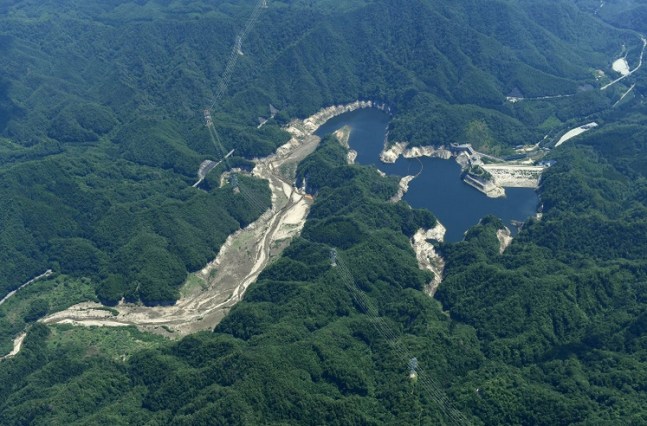
Ogaki Dam in Namie, Fukushima Prefecture, as seen from a Mainichi Shimbun helicopter in July 2016, contains high concentrations of radioactive cesium exceeding the limit set for designated waste.
High levels of radioactive cesium pooling at dams near Fukushima nuke plant
High concentrations of radioactive cesium have been accumulating at the bottom of 10 major dams within a 50-kilometer radius from the disaster-stricken Fukushima No. 1 Nuclear Power Plant, a survey by the Environment Ministry has found.
Radioactive cesium emanating from the 2011 nuclear disaster is pooling at those dams, which are used to hold drinking water and for agricultural use, after the substances flew into there from mountains, forests and rivers. The radiation levels at the bottom of those dams top those set for designated waste at over 8,000 becquerels per kilogram.
While the Environment Ministry plans to monitor the situation without decontaminating the dams on the grounds that radiation levels in dam water is not high enough to affect human health, experts are calling for the ministry to look into measures to counter any future risks.
The ministry began a monitoring survey on those dams and rivers downstream in September 2011 to grasp the moves of radioactive substances flowing into them from mountains and forests that are not subject to decontamination work. The survey samples water at 73 dams in Tokyo, Iwate and seven other prefectures about once every several months.
Among them, there were 10 dams in Fukushima Prefecture where the average concentration of cesium in the surface layer of bottom soil measured between fiscal 2011 and 2015 topped the regulated levels for designated waste. Those dams include Ganbe Dam in the village of Iitate with 64,439 becquerels per kilogram of cesium, Yokokawa Dam in the city of Minamisoma with 27,533 becquerels, and Mano Dam in Iitate with 26,859 becquerels.
Meanwhile, the surface water at those 10 dams contained 1-2 becquerels per liter of cesium, which is below the drinking water criteria at 10 becquerels.
While the total amount of cesium deposited at the bottom of those dams is unknown from the environment ministry’s survey, a separate study conducted at Ogaki Dam in the town of Namie by the Ministry of Agriculture, Forestry and Fisheries’ Tohoku Regional Agricultural Administration Office estimated in December 2013 that there was a combined 8 trillion becquerels of cesium 134 and cesium 137 at the dam. The figure came about after estimating the amount of accumulated cesium every 10-meter-square area based on cesium levels in sedimentary soil sampled at 110 locations at the bottom of the dam, which is for agricultural use.
The National Institute for Environmental Studies in Tsukuba, Ibaraki Prefecture, will shortly begin a full-scale survey on cesium concentrations at several dams.
“At the moment, it is best to contain cesium at those dams. If we dredge it, the substance could curl up and could contaminate rivers downstream,” said an Environment Ministry official.
http://mainichi.jp/english/articles/20160926/p2a/00m/0na/007000c
Anxiety soars as cesium builds up in Fukushima dams
Dams surrounding the stricken Fukushima No. 1 Nuclear Power Plant operated by Tokyo Electric Power Co. (TEPCO) have become de facto storage facilities for high concentrations of radioactive cesium as the element continues to accumulate.
With no effective countermeasures in sight, the government insists that water from the dams is safe, but to local residents, the government’s stance comes across as the shelving of a crucial problem.
“It’s best to leave it as it is,” an official from the Ministry of the Environment says, with the knowledge that in 10 dams in Fukushima Prefecture, there is soil containing concentrations of cesium over the limit set for designated waste — or over 8,000 becquerels per kilogram.
According to monitoring procedures carried out by the ministry, the levels of radioactive cesium detected in the dams’ waters, at 1 to 2 becquerels per liter, are well below the maximum amount permitted in drinking water, which is 10 becquerels per liter. The air radiation doses in the dams’ surrounding areas are at a maximum 2 microsieverts per hour, which the ministry says “does not immediately affect humans, if they avoid going near the dams.” This information is the main basis behind the central government’s wait-and-see stance. For the time being, the cesium appears to have attached itself to soil and is collected at the bottom of the dams, with the water above it blocking radiation from reaching and affecting the surrounding areas.
In a basic policy based on a special law, passed in August 2011, on measures for dealing with radioactive material following the onset of the Fukushima nuclear disaster, the Environment Ministry stipulates the decontamination of areas necessary from “the standpoint of protecting human health.” The ministry argues that as long as high concentrations of cesium at the bottom of multiple dams in Fukushima Prefecture do not pose imminent danger to human health, there are no legal problems in the ministry refraining from taking action.
“If the dams dry up due to water shortages, we just have to keep people from getting close to them,” the aforementioned ministry official says. “If we were to try to decontaminate the dams, how would we secure water sources while the work is in progress? The impact of trying to decontaminate the dams under the current state of affairs would be greater than not doing anything.”
This stance taken by the central government has drawn protests from local residents.
“The Environment Ministry only says that it will monitor the dams’ water and the surrounding areas. They say, ‘We’ll deal with anything that comes up,’ but when asked what they plan to do if the dams break, they have no answers. It’s painful to us that we can only give town residents the answers that the Environment Ministry gives us,” says an official with the revitalization division of the Namie Municipal Government. The central government is set to lift evacuation orders for a part of the Fukushima Prefecture town of Namie in spring of 2017.
According to a Ministry of Agriculture, Forestry and Fisheries survey, Ogaki Dam, an agricultural dam in Namie, was estimated to have sediment totaling approximately 8 trillion becquerels of cesium as of December 2013. The agriculture ministry plans to re-survey the dam’s accumulated cesium amounts and water safety before the water is used for agricultural purposes. Agricultural and fishery products from Fukushima Prefecture are tested to ensure that radioactive substances that they contain are below the maximum permissible amounts stipulated by law before they are shipped for distribution.
Still, one town official worries how revelations of high levels of radioactive material in local dams will affect consumers. “No matter how much they are told that the water is safe, will consumers buy agricultural products from Namie, knowing that there is cesium at the bottom of local dams?”
A 57-year-old vegetable farmer from Namie who has been evacuated to the Fukushima Prefecture city of Iwaki says, “The central government keeps on emphasizing that the dams are safe, but doesn’t seem to be considering any fundamental solutions to the problem. If this state of affairs persists, we won’t be able to return to Namie with peace of mind, nor will it be easy to resume farming.”
http://mainichi.jp/english/articles/20160926/p2a/00m/0na/011000c
Records of Diet’s Fukushima investigation still under wraps
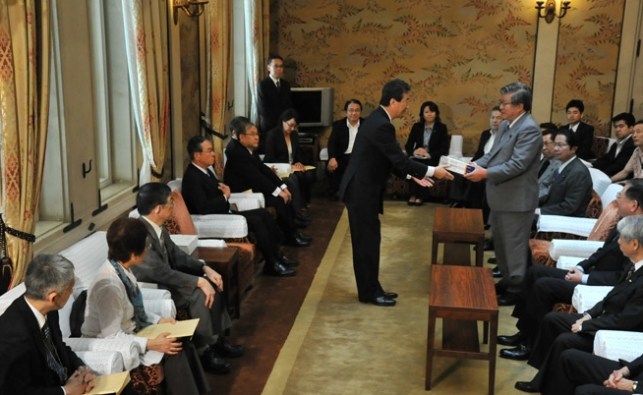
Kiyoshi Kurokawa, chairman of the Fukushima Nuclear Accident Independent Investigation Commission, presents the final report to Lower House Speaker Takahiro Yokomichi, right, in July 2012.
Five years after the accident at the Fukushima No. 1 nuclear power plant, the Diet is still sitting on a trove of raw documents and testimonies of more than 1,100 individuals who were on the front lines during the crisis.
The cache was compiled by the Fukushima Nuclear Accident Independent Investigation Commission, which released a report of its findings that totaled about 600 pages in July 2012.
The documents collected by that commission, including the testimonies of 1,167 individuals, have still not been released to the public more than four years after its disbandment.
Yasunori Sone, a political science professor at Tokyo’s Keio University, said the documents should, in principle, be released to the public because the investigation was conducted by the Diet on behalf of the people.
“The Fukushima Nuclear Accident Independent Investigation Commission was the first established in the Diet with the authority to carry out a thorough investigation,” Sone said. “Disclosure rules should be decided on quickly because it will serve as a precedent for future commissions.”
However, the documents submitted to the commission by the central government as well as Tokyo Electric Power Co., operator of the Fukushima plant, remain in storage at the National Diet Library, along with more than 900 hours of questioning of the 1,167 individuals, many of whom worked to bring the accident under control.
Some of the testimony was given on condition that it would not be released.
For that reason, after the commission disbanded, the rules and administration committees of the two chambers of the Diet were to have established rules for disclosing the commission records.
The commission had left behind a record of its investigation as well as the source of the documents it had accumulated because it felt that it would be helpful when the documents were eventually released.
“It will be possible to learn about the background to the nuclear accident from new reports or books that are written based on the documents,” said Kiyoshi Kurokawa, a professor emeritus at the University of Tokyo, who chaired the commission. “A fundamental point to not repeating mistakes is to learn from one’s past errors.”
Discussions within the rules and administration committees were disrupted when then Prime Minister Yoshihiko Noda dissolved the Lower House in November 2012 and called a snap election.
The December election brought the Liberal Democratic Party and its junior coalition partner, Komeito, back in control of government.
A multiparty group of lawmakers who were seeking to end dependence on nuclear energy asked that the rules and administration committees resume work on establishing disclosure rules. However, a subcommittee held one session that focused on presenting the opinions of members.
“Both the ruling and opposition parties are hesitant about releasing the documents because there is the possibility that they contain contents that are disadvantageous to the LDP, which had pushed nuclear energy, and the then Democratic Party of Japan, which had to deal with the nuclear accident,” said a member of that multiparty group.
The disclosure of the documents is not the only area in which the Diet has been less than aggressive.
In its report, the commission included seven recommendations, including the establishment of a new independent investigation committee, made up mainly of experts from the private sector, to conduct further studies into unanswered questions about the accident.
However, the rules and administration committees have yet to discuss the possibility of establishing such an investigative committee.
The commission also recommended the establishment of special committees in both chambers of the Diet to oversee the nuclear regulatory structure.
In 2013, a Special Committee for Investigation of Nuclear Power Issues was established separately in the two chambers.
However, those special committees have been turned into venues to promote nuclear energy. For example, committee members who were originally from labor unions of the electric power companies or who represented districts where nuclear plants were based criticized the Nuclear Regulation Authority for its strict standards regarding the resumption of operations at nuclear plants.
In a similar manner, the special committees also asked for a review of the rule that limited nuclear plants to a maximum 40-year operating life.
Tomoko Abe, a Democratic Party member who serves as secretary-general of the multiparty group seeking zero nuclear power generation, said, “Although there are some issues regarding the nuclear accident that have become clearer with the passage of time, the arena for looking into those issues has been closed off. It is the responsibility of the legislative branch to set up a structure that will continue to examine the nuclear accident.”
International day for the total elimination of nuclear weapons -September 26
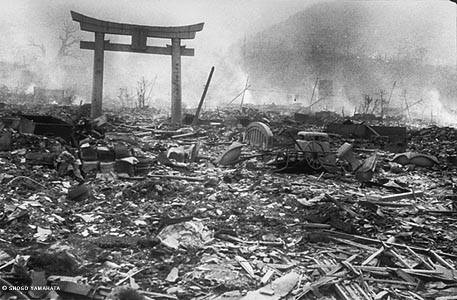 [HERALD INTERVIEW] Nagasaki atom bomb survivor urges denuclearization of world Korea Herald, 24 Sept 16 TOKYO — More than 70 years later, Terumi Tanaka can still relive the havoc wrought on his hometown Nagasaki, which was flattened by a plutonium bomb unleashed from a United States Army Air Forces plane.
At around 11 a.m. on Aug. 9, 1945, Tanaka was at his home some 3.2 kilometers away from the hypocenter of the atomic blast, when he heard a “loud bang” and immediately fell unconscious.
“Everything was instantly blown away in a storm,” the 84-year-old Japanese man told The Korea Herald in Tokyo last week. “I survived because I was lying down on the floor. However, five out of my six relatives died, some instantaneously from the raging inferno, some slowly from putrefying burns.”
Ahead of the international day for the total elimination of nuclear weapons on Sept. 26, designated by the United Nations in 2014, the secretary-general of the Japan Confederation of Atomic and Hydrogen Bomb Sufferers’ Organization, also known as Nihon Hidankyo, warned of the indelible consequences of pursuing nuclear arms and energy.
The bombshell dropped on Nagasaki, dubbed “Fat Man,” killed 74,000 people, roughly half the number that had perished from Hiroshima three days earlier. There are currently over 174,000 survivors — called “hibakusha” in Japanese — of the apocalyptic events in Japan and several thousands more worldwide.
Along with civic organizations such as Japan NGO Network for Nuclear Weapons Abolition and Peace Boat, Nihon Hidankyo has shepherded anti-nuclear calls around the world since it was established in 1956. It has participated in international conferences, street rallies and speaking tours, urging the total abolition of nuclear weapons, state compensation for their injuries, enhancement of government policies and relief measures, and solidarity with nuclear victims around the globe.
“Japan practically became a colony of the US since the war ended,” Tanaka said. “The US government forbade discussion or research of the bombing for seven years after 1945, and the Japanese government followed suit for an additional three years, thereby doing nothing for 10 years.”
As part of the San Francisco Peace Treaty in 1951, Tokyo renounced its right to claim damages from the nuclear bombardments from Washington. The hibakushas were deprived of their health, disadvantaged in employment and discriminated against by society, according to Nihon Hidankyo.
“Life was very tough before 1956, when our government started legislating laws and providing health care to the victims,” Tanaka recalled. “Before that, the sick and dying had to pay for medical expenses out of their own pockets, and many poor people died from malnutrition.”
Tanaka, who lived with a mother and three siblings, had to scrape by working odd jobs and saving pennies for the family as well as schooling. He called it an “unspeakable hardship.”
“We couldn’t eat for days on end. Everyone was poor, and even with little money there was practically nothing we could buy,” he said. “In spite of all our misery, we hoped that things would get better. We survived by shoving whatever was edible into our mouths.”
While Hiroshima has since become a universal symbol of mass destruction, Nagasaki on Japan’s southwestern island of Kyushu has largely been relegated to the larger city’s shadow. Nagasaki was bombed after Hiroshima, though it was less devastating due to the mountains and valleys of the city.
According to analysts, some 50,000 Koreans are thought to have lived in Hiroshima and 20,000 in Nagasaki during the attack, out of which roughly 30,000 and 10,000 are estimated to have died.
Most of Nagasaki’s Korean victims, who came from Hapcheon County in South Gyeongsang Province, were forcibly conscripted for backbreaking labor in wartime factories. The survivors returned home after the war to establish an organization similar to Nihon Hidankyo, with which the Japanese side maintains close contact. …… http://www.koreaherald.com/view.php?ud=20160925000225
Fukushima Children Fund
Some people ask me how they can help the Fukushima victims, and especially the children not evacuated and condemned to live in highly contaminated environment.
You may help with a donation the Fukushima Children’s Fund.
Fukushima Children’s Fund has promoted the movement of collecting donations and of donating food radiation measuring instruments and whole-body radiation detectors (whole-body counters).
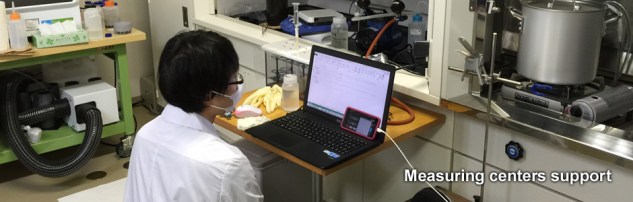
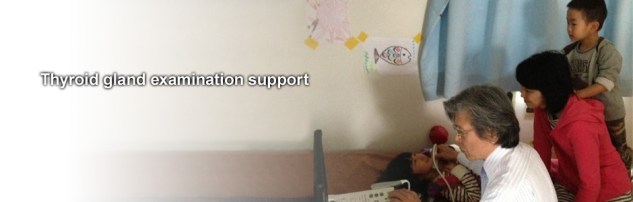
F.C.F. has also undertaken a recuperation project for the children living in radioactive contamination areas. We hope this recuperation in a radiation-free place will help the children to decrease their internal radiation exposure and strengthen their immune system.
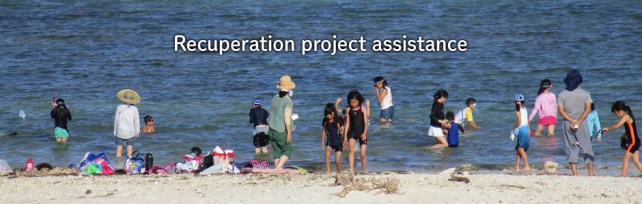
Any amount will be greatly appreciated.
About Fukushima Children’s Fund
F.C.F. was established in June in 2011 about three months after the outset of the Fukushima nuclear incident.
For the Fukushima nuclear incident victims, F.C.F. as a sister group of the Chernobyl Children’s Fund, Japan is now trying to make the most of its twenty years of experience with the Chernobyl nuclear incident victims.
| Chief Secretary | Shin’ichi Kurobe (a pediatrician / a medical adviser of the C.C.F.J.) |
| Organizers | Yukiko Mukai (an organizer of the C.C.F.J.) and others |
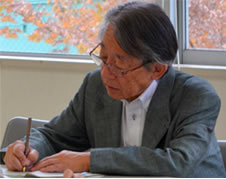
The Profile of Shin’ichi Kurobe
Mr. Kurobe, born in Tokyo in 1941, graduated with a degree in medicine from Keio University. He worked as a pediatrician at Saitama National Hospital, at Fukiage Kyoritsu Clinic, and at Horinouchi Clinic. Since 2012 he has worked as the director of the Suzushiro Clinic.
He started the movement of reducing medical radiation exposure and achieved one of his goals, the abolition of chest x-ray exams at elementary and junior-high schools in Japan. It was because he saw many people who unnecessary exposed to radiation as a result of careless x-ray exams. Hearing about his achievement, C.C.F.J. asked him to be its adviser.
After the March 2011 nuclear incident, he became the head of Fukushima Children’s Fund in order to support the Japanese children.
Recovery Project in Southern Japan, in Kumi-no-sato, Kumejima Island, Okinawa
“Voices from mothers”
We have become healthy both physically and mentally, and I have realized the splendor of Kumi-no-sato. I felt as if I gradually got out of my shell which I had shut myself up in since the Fukushima nuclear incident. Kumi-no-sato is a sacred place of healing. I now realize that we are so lucky to receive loving kindness from everyone.
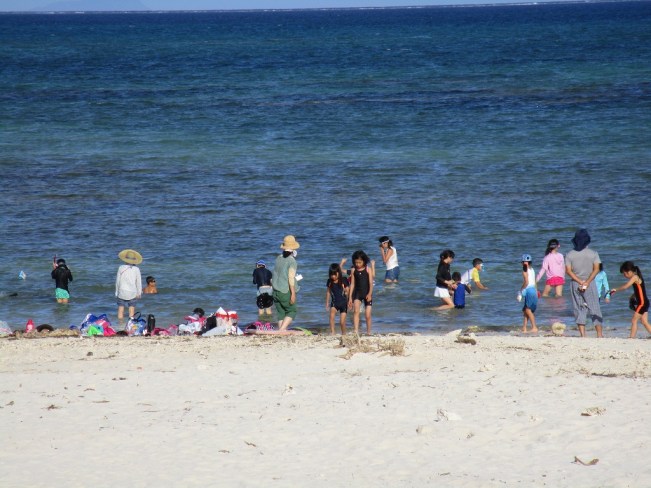
In Fukushima prefecture, people under the age of 18 started receiving medical care for free, the development of hospitals and inpatient facilities is underway after the nuclear power incident. Even more important than that, I am convinced in order to protect the children from diseases, facilities such as Kumi-no-Sato are necessary.
Since the nuclear power incident, I live in constant fear and I feel that I cannot overcome such fear. Last year my children often fell ill as well; my eldest son has recently complained about chest pain. I am concerned about the influence of long-term low-dose exposure on the children’s health. We took part in this activity because I wanted to allow my children to maintain their health, away from contaminated areas.
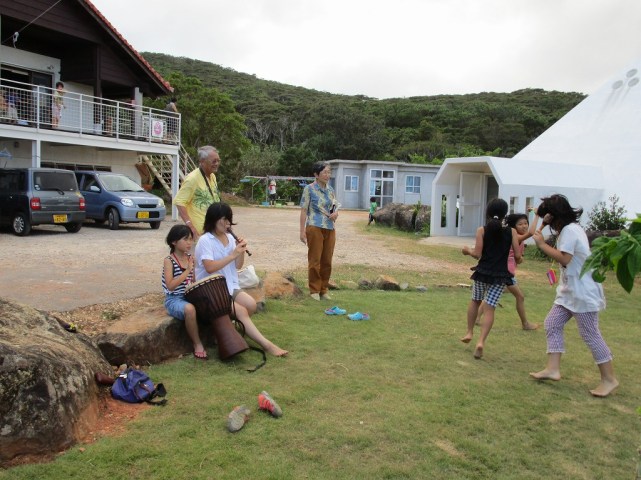
Warm climate, blue sky, the beautiful sea — my heart was uplifted from the moment of our arrival at Kumejima Airport. I was impressed so much by the welcoming faces of volunteer workers. Great people got together for us and we were treated very well.
During our days in Kumi-no-Sato, mothers from the area prepared our meals with love and care, helping us to feel that we were getting better. The children happily played outside, taking walks, picking up stones and leaves, and they ran barefoot in the grass; we mothers were happy to hang laundry outside. I felt more than ever the gratitude of having clean air, earth and water. What bliss to watch the children play with joy! It was a happy time.
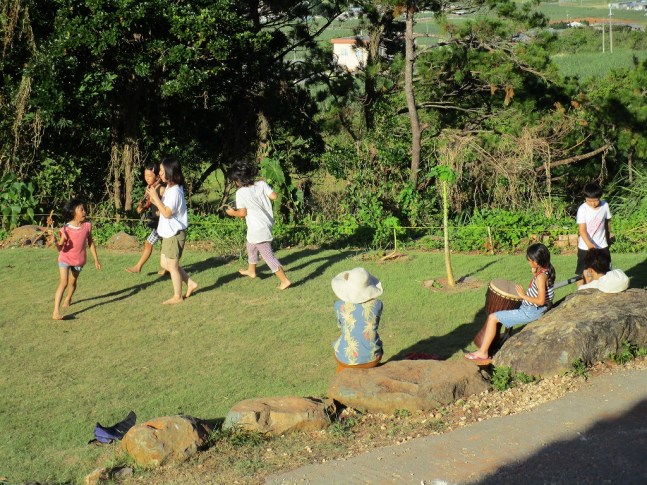
At Kumi-no-sato Mr. Hirokawa, a photo journalist/the founder of this initiative, talked to us about episodes based on his experiences. His story eerily rang exactly true in my mind. I was moved by his strength of dedication, trying to “protect children”. I felt that sharing the truth and accepting the truth is important.
At the thyroid screening during our stay, I was at first told for my own part that my thyroid was perfect. Then my 3-year-old and 6-year-old sons were diagnosed with many cysts.” I unwillingly acknowledged it as true, being painfully aware of the harshness of reality.
One day I was asked by my second son “Am I going to die soon?”
It is not just a matter of thyroid problem; there are various concerns and health hazards.
I want to leave Fukushima if possible, but my husband has no intention of ending his business that he inherited from his grandfather. If it comes to evacuation, it will be only the children and me. I cannot decide to leave because it would tear my family apart. I have often asked myself if it is really safe for us to keep living in Fukushima Pref. though.
Already I feel as if Kumi-no-sato is a second home for us. I would like to thank the people of Kumejima for their generosity and hospitality. We hope a lot of children from Fukushima can visit Kumi-no-Sato and become healthy in those lovely surroundings. We would like to ideally visit once every six months to maintain our health.
We need the continued support of everyone and even more people in the future. I hope you will cooperate with us and support us. I am thinking of starting a fundraising campaign of my own. Without having to sacrifice our children’s bright futures, I want to be creative in the process of doing this. Thank you very much.
Abe Emi (Iwaki City, Fukushima Pref.)
We’d at least like to take our kids to recuperate regularly
I can’t thank you enough for your hospitality. I was able to take my children who have been having health problems such as asthma since last year to recuperate, and I would like to thank those who supported us.

In an environment where we didn’t have to worry about playing, touching, and eating, we never imagined being so happy in our ordinary lives.
It’s been more than a month since we came back from Kumi-no-sato. Now in Fukushima Pref., I go out with a Geiger counter (dosimeter) in my hand and check where the food comes from. I was getting used to it, but then remembered that it’s not normal to live this way.
In Iwaki City where I live, there are the mountains and the sea. We used to go on a picnic in spring, swimming in the sea and the river and catching insects in summer, gathering acorns/chestnuts and harvesting potatoes in fall…, but because of the nuclear incident, we can’t do that anymore. Every spring, we used to look forward to harvesting strawberries and bamboo shoots in our garden. However, nowadays we should limit the time with a portable Geiger counter in hand even when playing in the park.
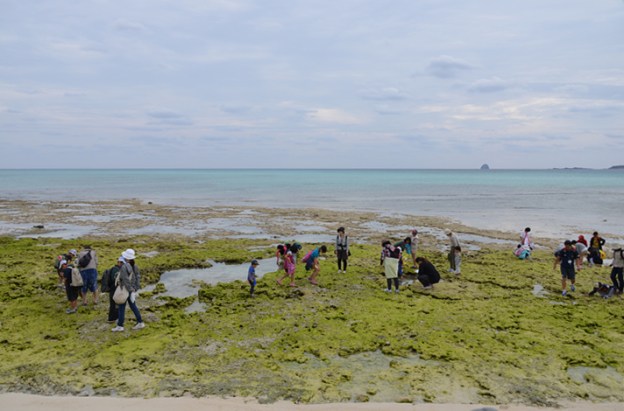
In Kumejima, we spent time outdoors, without checking the clock from morning until evening, swimming in the sea, lying in the grass, and touching all manner of living things. The children were all so happy throughout our stay there, and I felt so satisfied to raise my kids in nature.
I am glad to have met and talked to the volunteer workers of Kumi-no-sato, as well as the mothers from Fukushima, whom I still keep in touch with. In particular, the meeting with Mr. Hirokawa was very important to learn the facts. Hardly ever has the truth been revealed neither on TV nor in the newspapers, and I wasn’t sure how much to believe on the internet. But after talking to Mr. Hirokawa, I felt more at ease with myself.
I often think of seeking refuge somewhere. If we were to evacuate, it would be for 15 years until our kids turn 20. Families who are split and living in two different places may have difficult lives. Then, with my husband, starting a new life in a new place may involve some big risks. Most probably we both would have to work to make ends meet. In an area with no relatives close by, we are not sure if we can both keep working. For many different reasons, there are many families who can’t leave Fukushima. For those reasons, we would at least like to take our kids to recuperate regularly.
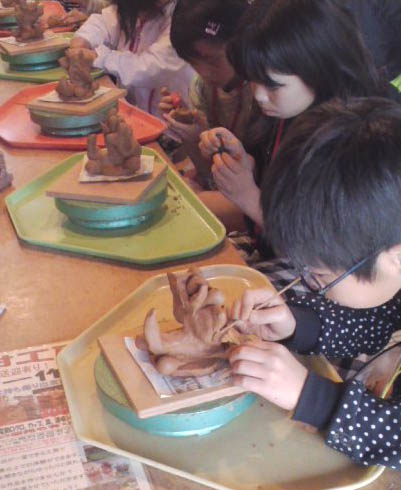
I am worried that the nuclear incident in Fukushima will be forgotten. But I get encouraged from people all over Japan who support and think of Fukushima’s children. I strongly wish more and more people will look at this problem.
K. H. (Iwaki City, Fukushima Pref.)
- 10,000 yen for special members
- 3,000 yen for regular members
- 2,000 yen for student members
- BENEFICIARY’S BANK/ACCOUNTBANK :
- THE BANK OF TOKYO-MITSUBISHI UFJ, LTD
- 3-7, KAGURAZAKA, SHINJYUKU-ku, TOKYO 162-0825, JAPAN
- BENEFICIARY’S BRANCH:
- KAGURAZAKA BRANCH
- SWIFT/BIC:
- BOTKJPJT
- ACCOUNT NAME:
- Fukushima Children’s Fund
- c/o Mukai residence Tate 2-3-4 409 Shiki City Saitama Pref. 353-0006, JAPAN
- ACCOUNT NUMBER:
- 052 - 0064011
- Official name: Fukushima Children’s Fund(Mirai-no Fukushima Kodomo Kikin)
- Purpose: Publicity and fund-raising for Fukushima nuclear victims
- Membership fees: 10,000 yen for special members, 3,000 yen for regular members, 2,000 yen for student members *
- Executives: F.C.F. has a chief secretary and several organizers. An accountant and an auditor are chosen amongst organizers.
- Each member is to promote their activities independently and creatively.
- Our activities are announced through publicity such as printing, emails, internet.
- The general meeting is held once a year to report about our activity and give the annual financial report.
-
- Office:
- c/o Mukai residence Tate 2-3-4-409 Shiki City, Saitama Pref. 353-0006, Japan
- How to make inquiry:
- E-Mail fromcherno0311@ yahoo.co.jp
- History: F.C.F. was established on June 1st, 2011. (the fiscal year starts on June 1st and ends on May 31st.)
How does the Monju fast-breeder nuclear reactor work?

The Japanese government is moving toward decommissioning the Monju prototype fast-breeder nuclear reactor in Tsuruga, Fukui Prefecture. The Mainichi answers common questions readers may have about what kind of reactor Monju is, and the state of international research on other fast-breeder reactors.
Question: The Monju reactor is supposedly a power generating device, but how does it work?
Answer: The reactor uses one of three high-speed neutrons that are released when plutonium-239 undergoes nuclear fission, causing more plutonium-239 to undergo nuclear fission and creating heat. The other two neutrons are collided with uranium-238 — which is not usable by normal nuclear reactors — to create more plutonium-239. The reactor is called a “fast-breeder” because it uses “fast” neutrons to “breed” more nuclear fuel.
Q: What were the original research objectives at Monju?
A: Generally, the development process of fast-breeder reactors is to create an experimental reactor followed by a prototype reactor, a testing reactor and then a practical-use reactor. Monju is at the second of these stages. Its research objectives included improving nuclear safety and reducing nuclear waste.
Q: What are other countries’ fast-breeder reactor programs like?
A: There are few countries that are actively involved in this kind of research. One example is Russia, which has been running its prototype reactor “BN-600” since 1980 and in 2015 it began power production at a testing reactor called “BN-800.” Russia aims to have a practical-use reactor by around 2030. Meanwhile, since 2011, China has been generating power at its testing reactor “CEFR,” and it is also aiming for a practical-use reactor by around 2030. India also planned to start a prototype reactor this year, but its plan has fallen behind schedule.
Q: What about in developed countries?
A: France is planning to begin running a reactor called ASTRID around the year 2030. However, rather than producing nuclear fuel, this reactor is primarily aimed at shortening the radioactive life of nuclear waste products, recovering resources and otherwise dealing with the issue of nuclear waste. France is aiming for commercial operation of the reactor in the 2040s.
On the other hand, the United States, after putting its prototype reactor development plans on indefinite hold in 1977 due to concerns about costs and nuclear proliferation, canceled its fast-breeder reactor plans. In 1991, Germany canceled its construction of a prototype reactor, partially due to financial difficulties. In 1994, the United Kingdom shut down its prototype reactor as well.
Fast-breeder reactors use sodium for cooling, which reacts violently when exposed to water or air, making it difficult to handle, and accidents have occurred. Another point against fast-breeder reactors is that for the time being there is little concern that uranium used for fuel at nuclear plants will run out, reducing the need for creating more nuclear fuel. (Answers by Shuichi Abe, Science & Environment News Department)
http://mainichi.jp/english/articles/20160924/p2a/00m/0na/023000c
Fukushima Possibly Turning into Another “Exotic” Tourist Destination
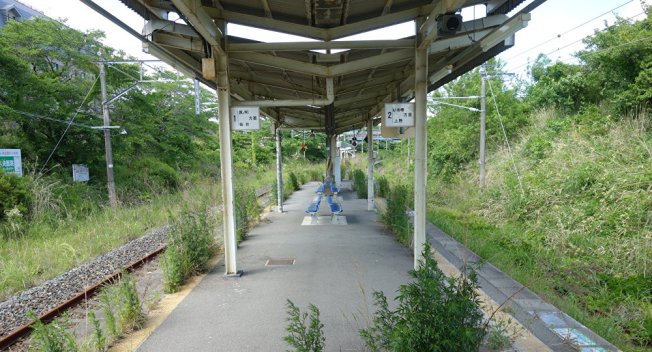
Just like Chernobyl before it, the radioactive exclusion zone surrounding the crippled Fukushima nuclear plant is starting to attract tourists, possibly turning into another of the world’s “exotic” tourist destinations.
Unlike the Chernobyl nuclear disaster which happened over 30 years ago, the Fukushima Daiichi nuclear plant catastrophe is practically a recent event. On March 11, 2011 a tsunami that followed the Tohoku earthquake smashed into the plant, causing several meltdowns and the release of radioactive material resulting in the second nuclear disaster in history to be given the Level 7 event classification of the International Nuclear Event Scale.
Yet even though the scars left by this disaster are still fresh, it seems that there are already people who consider the radioactive zone surrounding the Fukushima nuclear plant a tourist attraction.
The first project aimed at transforming the crippled Fukushima nuclear plant into a tourist attraction was presented to the Japanese authorities in 2012, only a year after the disaster, by philosopher Hiroki Azuma, the author of the Chernobyl Dark Tourism Guide, and his group of fellow enthusiasts.
According to Azuma’s vision, people should’ve been allowed to visit the area and see the process of the Fukushima plant’s decontamination with their own eyes; and by 2036 visitors should be able to approach the plant without the need to wear protective suits
Unfortunately, the prefectural administration torpedoed the idea, arguing that the word ‘tourism’ should never be applied to the catastrophe site.
But even though Azuma’s project was not to be, there are already plenty of companies organizing tours in the disaster area.
Hiroshi Miura, head of one such enterprise called NPO Nomado, told Sputnik that he first started working as a tour guide for people visiting his home city of Minamisoma, located 16 miles north of the Fukushima nuclear plant, back in 2012.
“In October 2012 I established a non-commercial organization Nomada and continued my business by creating a ’20 Kilometers Away From Fukushima-1′ tour. By 2014, just by myself, I had over 5,000 clients. In 2015 other guides and volunteers started working with me, and over 10,000 people participated in our tours,” he said.
Miura also added that the current situation at the nuclear plant is barely discussed by the media, except for the local prefectural outlets, and that the place where he used to live, located only 12 kilometers away from Fukushima Daiichi, remains in the same state as it was right after the tsunami, as no decontamination or recovery operations were conducted there.
Yuta Hirai, another tour guide working in Fukushima, also told Sputnik that there are people from all walks of life interested in visiting the site of the tragedy: scientists, students, former residents, and a considerable number of foreign tourists.
He also believes that tourism could play an important role in helping the Fukushima prefecture to recover from the ordeal of 2011.
“I believe it is important for the prefecture residents to understand that people from without are paying attention to them. They have mixed feelings about the incident, like ‘I want to forget but I don’t want to be forgotten.’ If we learn our lesson from what happened, if we understand that it must not happen again, then it could help the people of Fukushima to believe in themselves. There’s a tendency to pay greater attention to opinions from without rather than to opinions from within. So if more people from other prefectures see the situation with their own eyes, feel it and talk about it, then perhaps the current depressing situation in Fukushima may change for the better,” he said.
Ministries spar as Japan focuses on fast reactor project in France
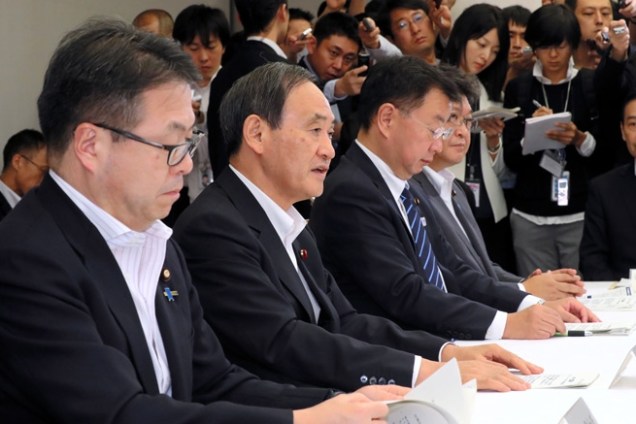
The industry and science ministries were at odds over Japan’s shift toward France for nuclear fuel recycling efforts after Tokyo decided to scrap a “made-in-Japan” pillar of its energy policy.
The industry and science ministries were at odds over Japan’s shift toward France for nuclear fuel recycling efforts after Tokyo decided to scrap a “made-in-Japan” pillar of its energy policy.
Hiroshige Seko, minister of economy, trade and industry, stressed the significance of working with France, a global leader in fast reactor technology, after a Sept. 21 meeting of Cabinet members agreed to terminate the problem-stricken Monju prototype fast-breeder reactor project.
Seko told reporters that his ministry, which is in charge of the nation’ s energy policy, is pinning its hopes on joint research, including France’s ASTRID (Advanced Sodium Technological Reactor for Industrial Demonstration) fast reactor.
“ASTRID is a crucial project for both Japan and France,” Seko said. “Japan has already participated in the project and has obtained various insights.”
The Monju fast-breeder reactor and the ASTRID fast reactor use similar technologies but are different.
Monju was designed to use plutonium as fuel for electricity generation and to produce more plutonium in the process.
ASTRID is centered on generating energy by consuming plutonium.
In addition, ASTRID is at a more advanced development stage than Monju.
There are four stages in the development of a nuclear reactor: experimental, prototype, demonstration and commercial.
ASTRID is in the demonstration stage while Monju is a prototype reactor.
Japan and France are already cooperating in the field of nuclear energy.
Prime Minister Shinzo Abe agreed that Japan would cooperate with France on preparations for a fast reactor project when he met with French President Francois Hollande in June 2013.
The two countries also concluded a tie-up in technological development and cooperation for fast reactors, including ASTRID, in May 2014.
“Prospects are brighter than Monju, and France is a reliable partner,” said an industry ministry official.
But the science ministry, which has clashed with the industry ministry over the fate of Monju, is skeptical.
It says the France-led project does not necessarily promise success, citing Super-Phenix, France’s demonstrator fast-breeder reactor that was forced to shut down after a series of accidents, including a sodium leak, like Monju.
The science ministry has oversight in the first two stages of reactor development, while the industry ministry takes over for the two more advanced stages.
ASTRID is expected to go into operation in the 2030s, but the science ministry said that schedule could face delays.
Sources familiar with the project also say ASTRID will likely cost more than initially expected.
“Japan could end up serving as a cash cow,” a senior science ministry official said.
However, the industry ministry is not budging on its stance.
“What matters is that Japan keeps alive its research on a fast reactor,” a high-ranking ministry official said. “Japan should not dwell on a home-grown project.”
1 This Month
26 September – International Day for the Total Elimination of Nuclear Weapons





PLEASE OPPOSE HR 8255 AND S.3639 – bills would accelerate satellite deployment, with no environmental review or safeguards – https://ncstd5li.quorum.us/campaign/169331/
To see nuclear-related stories in greater depth and intensity – go to https://nuclearinformation.wordpress.com
-
Archives
- September 2026 (313)
- August 2026 (330)
- July 2026 (355)
- June 2026 (287)
- May 2026 (306)
- April 2026 (356)
- March 2026 (251)
- February 2026 (267)
- January 2026 (308)
- December 2025 (358)
- November 2025 (359)
- October 2025 (375)
-
Categories
- 1
- 1 NUCLEAR ISSUES
- business and costs
- climate change
- culture and arts
- ENERGY
- environment
- health
- history
- indigenous issues
- Legal
- marketing of nuclear
- media
- opposition to nuclear
- PERSONAL STORIES
- politics
- politics international
- Religion and ethics
- safety
- secrets,lies and civil liberties
- spinbuster
- technology
- Uranium
- wastes
- weapons and war
- Women
- 2 WORLD
- ACTION
- AFRICA
- Atrocities
- AUSTRALIA
- Christina's notes
- Christina's themes
- culture and arts
- Events
- Fuk 2022
- Fuk 2023
- Fukushima 2017
- Fukushima 2018
- fukushima 2019
- Fukushima 2020
- Fukushima 2021
- general
- global warming
- Humour (God we need it)
- Nuclear
- RARE EARTHS
- Reference
- resources – print
- Resources -audiovicual
- Weekly Newsletter
- World
- World Nuclear
- YouTube
-
RSS
Entries RSS
Comments RSS

