Utilities may get caps on liability in time of serious nuke accidents
In the event of a serious nuclear accident, the government is considering capping the liability of electric power companies and placing the burden beyond that on the public in the form of taxes or higher electricity rates.
The Cabinet Office plans to submit the plan to an experts’ panel along with the current program, which does not contain such caps, sources said.
The experts’ panel will start to discuss both from Oct. 3 and issue the results of its discussions within this fiscal year, which ends in March 2017. After that, the science ministry will consider revising the related laws, they added.
In the accident at the Fukushima No. 1 nuclear power plant in March 2011, the compensation paid by the operator, Tokyo Electric Power Co., has reached 6 trillion yen (about $60 billion).
The amount is much higher than the 120 billion yen in total that can be currently covered by a private insurance program and governmental expenditures.
Because of that liability, electric power companies are asking the government to place a cap on the compensation they must pay at the time of serious nuclear accidents.
According to the sources, the setting of an upper limit would require utilities to shoulder a considerably higher amount of compensation.
In the event that the actual compensation exceeds that amount, the utility would also have to pay the portion beyond the limit if the nuclear accident is completely attributable to their actions.
If the nuclear accident is mainly caused by natural disasters, however, the portion beyond the upper limit would be chiefly covered by governmental compensation and only a part of that portion would fall on the utilities, depending on the extent of their culpability.
The government’s compensation would be eventually shouldered by taxpayers.
The push to set a cap is apparently being led by the belief of electric power companies that now is a good time to ask the public to share part of the burden with the prevailing mood in the current administration to restart nuclear reactors.
However, some experts say that if an upper limit is adopted, electric power companies will become less concerned about safety.
“There is a possibility that those companies will place less importance on investing in safety measures,” said Tadashi Otsuka, professor of law at Waseda University, an expert on environmental laws and compensation systems.
Tokyo Electric Power : Gov’t planning to stay involved in TEPCO’s management longer
The government is considering staying involved in Tokyo Electric Power Co.’s business management longer than currently planned, given larger-than-expected costs for scrapping the Fukushima Daiichi nuclear power plant, sources close to the matter said Saturday.
A delay in the process for reactivating its Kashiwazaki-Kariwa nuclear power plant in Niigata Prefecture, a main pillar of the utility’s reconstruction plan, is another factor prompting the government to think it would be too soon to end state control next April as initially planned, they said.
The government is leading business operations of the utility facing huge compensation payments and other problems from the 2011 Fukushima nuclear disaster as it has acquired 50.1 percent of the firm’s voting rights through the state-backed Nuclear Damage Compensation and Decommissioning Facilitation Corp.
Some bureaucrats of the Ministry of Economy, Trade and Industry are dispatched to the utility, known as TEPCO.
TEPCO said in a business plan in 2014 it would turn itself from the “temporarily publicly managed” company to a self-managed one starting next April.
The industry ministry will hold the first panel meeting Wednesday to discuss additional government support for the utility.
TEPCO faces swelling costs for decommissioning the Fukushima Daiichi plant and compensating those affected beyond the previously estimated 11 trillion yen ($108 billion). Two reactors at the Kashiwazaki-Kariwa plant are under prolonged safety examinations by nuclear regulators.
TEPCO’s new business plan including the revised schedule for ending state control is expected to be compiled next January.
Fukushima rice at Matsuri (Japanese cultural) festival in Trafalgar Square, London
Rice was among a number of products from Fukushima being promoted at the festival today, in order to help the recovery of the region. Young women were making their way through the throng holding up huge peaches and apples from Fukushima.
Members of Kick Nuclear London, Japanese Against Nuclear and friends handed out a few hundred copies of the following leaflet to visitors at the festival this afternoon :
Kick Nuclear has created a web page for those who want to find out more: https://kicknuclear.com/fukushima-rice/


Japan signals end for $10 billion nuclear prototype
“Tokyo believes it would be difficult to gain public support to spend several hundreds of billion yen to upgrade the Monju facility, which has been plagued by accidents, missteps and falsification of documents.”
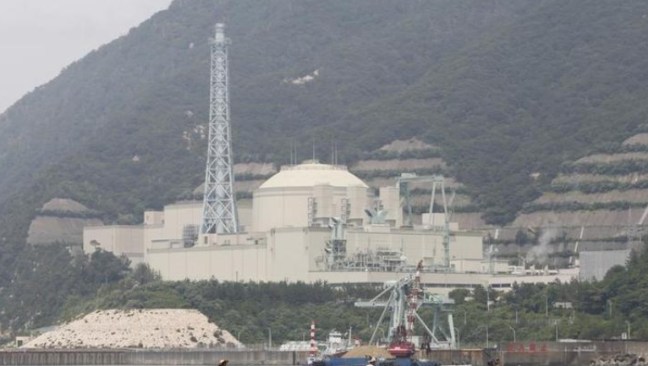
Japan signalled on Wednesday it would scrap a costly prototype nuclear reactor that has operated for less than a year in more than two decades at a cost of 1 trillion yen (£7.6 billion).
Tokyo believes it would be difficult to gain public support to spend several hundreds of billion yen to upgrade the Monju facility, which has been plagued by accidents, missteps and falsification of documents.
There is also a strong anti-nuclear sentiment in Japan in reaction to the 2011 Fukushima atomic disaster and calls to decommission Monju have been growing in the ruling Liberal Democratic Party, with scant results from using around 20 billion yen of pubic money a year for maintenance alone.
Monju was designed to burn plutonium from spent fuel at conventional reactors to create more fuel than it consumes. The process is appealing to a country whose limited resources force it to rely on imports for virtually all its oil and gas needs.
Science Minister Hirokazu Matsuno, Trade Minister Hiroshige Seko and others had decided to shift policy away from developing Monju, a fast-breeder nuclear reactor in the west of the country, the government said.
They had also agreed to keep the nuclear fuel cycle intact and would set up a committee to decide a policy for future fast reactor development by the end of the year.
A formal decision to decommission Monju is likely to be made by the end of the year, government officials said.
The decision would have no impact on Japan’s nuclear recycling policy as Tokyo would continue to co-develop a fast-breeder demonstration reactor that has been proposed in France, while research will continue at another experimental fast-breeder reactor, Joyo, which was a predecessor of Monju.
“The move will not have an impact on nuclear fuel balance or nuclear fuel cycle technology development or Japan’s international cooperation,” Tomoko Murakami, nuclear energy manager at the Institute of Energy Economics, Japan, said.
Before the Fukushima disaster, Japan had planned to build a commercial fast-breeder before 2050, but that may be delayed given the difficulties at Monju, the International Energy Agency said on Wednesday.
http://uk.reuters.com/article/uk-japan-nuclear-idUKKCN11R0LD
Japan busting to market nuclear reactors to India, and busting the Nuclear Non-Proliferation Treaty
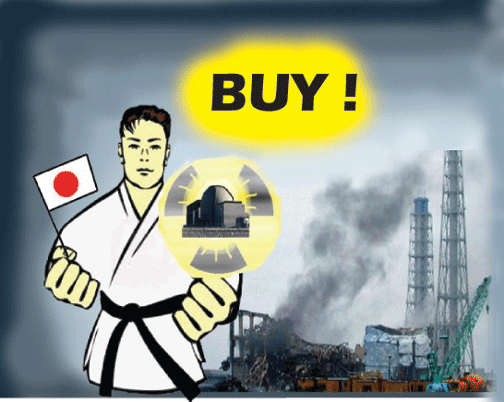 Abe, Modi look to ink civil nuclear pact at November meeting, Japan Times, KYODO, 30 Sept 16 A meeting between Prime Minister Shinzo Abe and his Indian counterpart Narendra Modi is set to be held in Tokyo in mid-November, with a civil nuclear cooperation pact likely to be signed, a source said Friday.
The pact would pave the way for Japan to export nuclear power plant technology to the fast-growing Asian economy. It would be Japan’s first signing of a civil nuclear cooperation pact with a country which has not joined the Nuclear Non-Proliferation Treaty…….
Earlier, other diplomatic sources said that under a provision in the pact, Japan will permit Indian power producers to reprocess spent fuel at designated facilities on the condition the country accepts comprehensive inspections by the International Atomic Energy Agency…….
Following the signing of the treaty, the Japanese government will seek swift approval from the Diet in a bid to promote Japanese companies’ participation in construction of such power plants in India……http://www.japantimes.co.jp/news/2016/09/30/national/japan-india-look-ink-civil-nuclear-pact-november-meeting/#.V-7jmIh97Gg
Japan to formally decide to decommission Monju nuclear reprocessing reactor by end of year
JAPAN SIGNALS END FOR $10BN NUCLEAR PROTOTYPE, Eyewitness News, 30 Sept 16 Tokyo believes it would be difficult to gain public support to spend several hundreds of billion yen. Reuters |
TOKYO – Japan signalled on Wednesday it would scrap a costly prototype nuclear reactor that has operated for less than a year in more than two decades at a cost of 1 trillion yen (£7.6 billion).
Tokyo believes it would be difficult to gain public support to spend several hundreds of billion yen to upgrade the Monju facility, which has been plagued by accidents, missteps and falsification of documents.
There is also a strong anti-nuclear sentiment in Japan in reaction to the 2011 Fukushima atomic disaster and calls to decommission Monju have been growing in the ruling Liberal Democratic Party, with scant results from using around 20 billion yen of public money a year for maintenance alone.
Monju was designed to burn plutonium from spent fuel at conventional reactors to create more fuel than it consumes…….A formal decision to decommission Monju is likely to be made by the end of the year, government officials said. http://ewn.co.za/2016/09/30/Japan-signals-end-for-10-billion-nuclear-prototype
Fukushima plant building exposed as TEPCO opens old wounds
The cover on reactor 1 was installed around the building of the devastated the reactor 1 in October 2011 and Tepco plans to dismantle it by December. It remains 17 panels of 20 tonnes to move. Inside, the spent fuel pool with 392 fuel assemblies in it, which Tepco intends to empty starting 2020 …
Now this uncovered “reactor” freely spits its radioactive lungs again in the open air. Yes that’s right. Tepco had mounted this cover to avoid polluting the air. Today we go back to square one.
The three reactors 1, 2 and 3 have lost their seal and radionuclides roam freely. There is simply no way to seal leaks. Even when the pool will be emptied, the problem will still be the same.
The levels of radioactivity escaping from the three reactors are unknown until Tepco wants to give us some figures, still without any true independent body to verify.
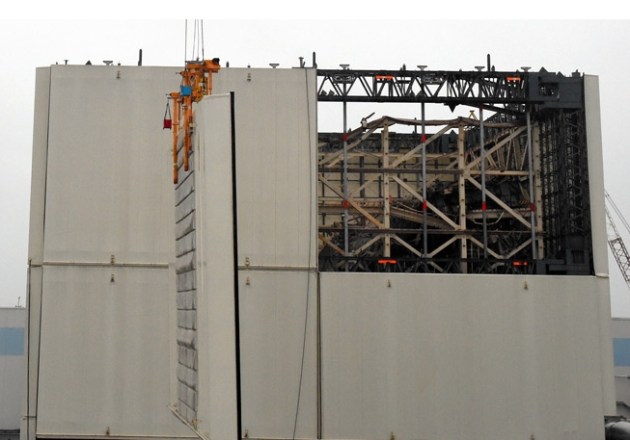
The devastated outer layer of Fukushima No. 1 nuclear power plant’s No. 1 reactor building has been exposed for the first time in almost five years in the painstaking reactor decommissioning process.
Plant operator Tokyo Electric Power Co. began removing on Sept. 13 the exterior walls of the cover installed around the structure to prevent the dispersal of radioactive materials on Sept. 13.
Shortly past 6 a.m., a large crane began removing a massive piece of the cover installed around the reactor building. The panel dismantled that day measured 23 by 17 meters and weighed 20 tons.
The cover was installed in October 2011 as a temporary measure after a nuclear meltdown occurred following the Great East Japan Earthquake and tsunami in March that year. The meltdown caused a hydrogen explosion, blowing the walls off the building.
Once the cover is dismantled, the operator can assess the state of the building’s interiors and remove the debris fallen onto the spent fuel pool inside.
“Steady progress is necessary in reconstruction, but we hope they will carry on the procedure with safety as the No. 1 priority,” said a Fukushima prefectural government official.
TEPCO said that it plans to remove the remaining 17 panels of the covering by the end of the year. The portion covering the roof has already been removed.
Once the cover is removed, the utility will begin drawing up plans to remove the 392 fuel assemblies from the spent fuel pool and melted nuclear fuel from inside the building.
The plant operator said that it plans to be extra careful during the procedure. It will shroud the building in tarpaulins once the cover is removed as a precautionary measure against dust and other materials containing radioactive materials from being carried aloft by the wind.
The utility and central government’s joint schedule for the decommissioning process of the reactor states that the removal of the fuel rods from the pool will start in fiscal 2020.
http://www.asahi.com/ajw/articles/AJ201609130070.html
Japan reactor makers consider merging fuel units to counter rivals
As Mr. Ikuo Hatsukade says : « I wish that these three companies could cooperate to produce renewable energies without nuclear energy. »

A nuclear fuel assembly, center, sits in a spent fuel pool.
TOKYO — Japan’s Hitachi, Toshiba and Mitsubishi Heavy Industries aim to merge their nuclear fuel units to gain an edge on cost in an effort to better compete with Chinese and South Korean rivals.
Amid bleak prospects for getting current domestic reactors up and running, let alone building new ones, the next challenge will be to consolidate their nuclear reactor businesses.
Of the more than 40 reactors in Japan, Kyushu Electric Power‘s Sendai Nuclear Power unit Nos. 1 and 2 in Kagoshima Prefecture and Shikoku Electric Power‘s Ikata Nuclear Power Station unit No. 3 in Ehime Prefecture are the only reactors in operation. Bringing the country’s reactors back online is proceeding very slowly due to strict safety standards set by the Nuclear Regulation Authority.
With the liberalization of Japan’s retail energy market in April, electric power companies are finding it difficult to invest in nuclear power plants, as it is difficult to make forecasts for power generation costs including future decommissioning. The government plans to generate 20-22% of the county’s overall power mix from nuclear power plants by 2030, but many market watchers remain skeptical.
To improve competitiveness, major reactor makers appear to have begun discussing the possibility of integrating their nuclear fuel businesses. One executive of a reactor maker said they cannot hire new nuclear engineers and develop advanced technologies if no measures are taken. “All Japanese reactor makers need to join hands to protect the country’s nuclear technology,” he said.
With the merger of nuclear fuel businesses in sight, the next challenge will be to restore each company’s reactor unit, which have barely remained profitable with only maintenance operations being done. Reactors are classified into two types: pressurized water reactors and boiling water reactors. Some market experts are saying that reactor makers should consolidate operations regardless of reactor type.
Some countries, including Germany, are trying to break away from nuclear power generation, while a number of countries are planning to build new ones. In the U.K., a consortium of Hitachi and General Electric are planning to build nuclear power plants, while Toshiba has plans to construct them on its own. Toshiba’s U.S. nuclear power unit Westinghouse Electric is looking to boost orders in China and India. Mitsubishi Heavy is also looking to expand overseas with new reactors jointly developed with Areva group of France.
That said, Chinese, South Korean and Russian rivals are also actively expanding overseas. To hold a technological lead, Japanese makers must curb costs and build a system to develop technologies.
Fukushima: Living a Disaster
Five years after the nuclear accident in Fukushima, an end to the disaster is not in sight. This short documentary tells the story of the people from Fukushima, forced to leave their homes without knowing if they could ever return, and explores the work that Greenpeace has been doing in the region since 2011. Sign the petition to end the nuclear nightmare and switch on renewables! http://grnpc.org/IgNDC
TEPCO to begin removing tainted water at Fukushima plant
Tokyo Electric Power Co. intends to begin pumping up highly contaminated water accumulating in the basements of buildings at its wrecked Fukushima No. 1 nuclear power plant by the end of March.
TEPCO disclosed its strategy Sept. 28 at a review meeting with the Nuclear Regulation Authority, the government’s nuclear watchdog.
In response, the NRA urged the utility to provide a detailed road map for the project.
Removing the huge volume of radioactive water in the reactor, turbine and other buildings has posed an urgent challenge for TEPCO.
The NRA pressed it to take action as soon as possible, pointing out that the contaminated water in the buildings’ basements is a likely reason flowing groundwater also gets polluted.
The NRA is also concerned that the contaminated water in the basements might leak into the sea if the nuclear complex is struck by another powerful tsunami.
TEPCO estimates that 68,000 tons of tainted water exists below the reactor and turbine buildings, as well as other structures.
Particularly worrisome is the estimated 2,000 tons of highly radioactive water in the condensers of the No. 1 through No. 3 turbine buildings, which accounts for 80 percent of the radioactive materials in all of the tainted water.
The contaminated water was transferred to the condensers in the immediate aftermath of the March 2011 triple meltdown.
TEPCO plans to finish transferring the water in the condensers by the first half of the next fiscal year and all of the contaminated water in the basements by 2020.
Heavy rains stall assessment of frozen wall at Fukushima plant
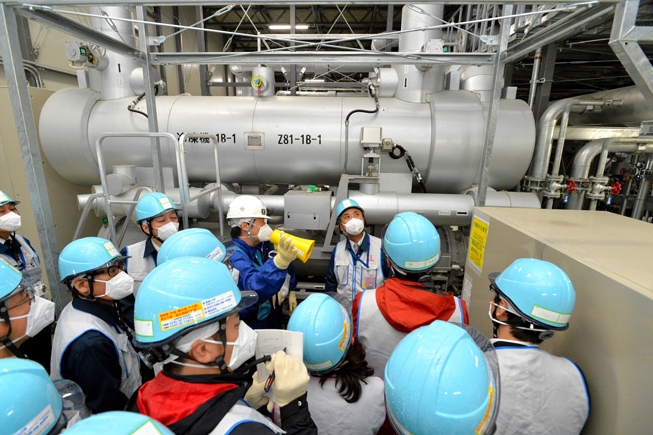
The equipment that cools coolant for the ice wall at the Fukushima No. 1 nuclear power plant
Tokyo Electric Power Co. reported a delay in the underground ice wall project at its Fukushima No. 1 nuclear power plant, citing the stalled assessment of the structure due to heavy rains from a recent typhoon.
The utility reported the delay at a review meeting with the Nuclear Regulation Authority, the government’s nuclear watchdog, on Sept. 28. TEPCO initially planned to assess the effectiveness of the ice wall by the end of this month.
According to TEPCO, the volume of groundwater pumped up in areas on the sea side of the facility was supposed to have dropped by now if the ice wall functioned properly.
But the company acknowledged this had not happened.
TEPCO had sought NRA approval to freeze a section of the ice wall facing the mountainside to enhance the effect of blocking groundwater, but it did not get the go-ahead.
“It does not make sense that the company sought approval to freeze the area facing the mountainside, just because the ice wall on the sea side did not go well,” said Toyoshi Fuketa, a commissioner of the NRA, told the meeting.
The groundwater level in the sea side portion outside the ice wall reached the surface on and off between Sept. 20 and Sept. 23 when the plant was struck by torrential rain as a result of Typhoon No. 16.
TEPCO said rainwater flowed into the sea, rather than seeping into the ground, because of the higher groundwater level.
Radioactive cesium in samples taken from the sea nearby measured a record high 95 becquerels per 1 liter.
According to the company, 0.8 percent of 5,800 or so observation spots set up on the sea side section of the ice wall showed that the soil has not been entirely frozen.
TEPCO officials believe that groundwater penetrated gaps in the ice wall before pushing up the groundwater level in the area downstream near the sea.
The frozen soil wall was built around the No. 1 through No. 4 reactor buildings. The government poured 35 billion yen ($350 million) into the project.
The objective was to block groundwater from mixing with contaminated water in the basements of the reactor and other buildings.
TEPCO started freezing soil in late March, but not all of the soil turned into ice, allowing a huge volume of groundwater to accumulate.
http://www.asahi.com/ajw/articles/AJ201609290073.html
TEPCO Delays Replacing Tainted Water Tanks
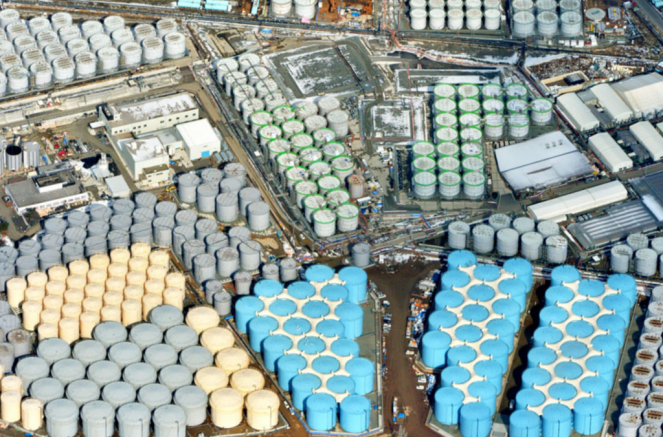
Tokyo, Sept. 28 (Jiji Press)–Tokyo Electric Power Company Holdings Inc. <9501> has effectively given up replacing tainted water storage tanks at its Fukushima No. 1 nuclear power station with safer ones at an early date, it was learned Wednesday.
It is believed to be the first time that the power firm has abandoned a deadline in its decommissioning work timetable, revised in June last year.
TEPCO now expects to finish the work in June 2018 at the earliest, according to documents submitted to a panel of the Nuclear Regulation Authority.
TEPCO initially planned to finish replacing the storage tanks with welded low-leakage ones early in the current business year through March 2017.
TEPCO remains unable to stop increases in the amount of radioactive water. The amount of contaminated water stored in the current tanks with a higher risk of leakage stood above 110,000 tons as of Thursday.
Meet the nuclear cattle of Fukushima
(CNN)Some families have at least one relative who’s either odd or eccentric. Others boast family members of a more unusual kind.
That’s what one filmmaker discovered in 2011 when he heard of a group of former farmers in Fukushima‘s nuclear exclusion zone, fighting to keep their radiation-affected cows alive, though they brought them no profit.
“The farmers think of these cows as family. They know that these cows can’t be sold, but they don’t want to kill them just because they’re not worth anything,” Tamotsu Matsubara, who made a film called ‘Nuclear Cattle’ (Hibaku Ushi) on their plight, told CNN.
It costs around 2,000 dollars to maintain each cow for a year. The farmers featured in Matsubara’s film are among those who refused to obey the Japanese government’s initial requests to euthanize cows in the exclusion zone.
“[These farmers] really want them to serve a greater purpose for humans and for science,” explained Matsubara.
Nuclear Cattle
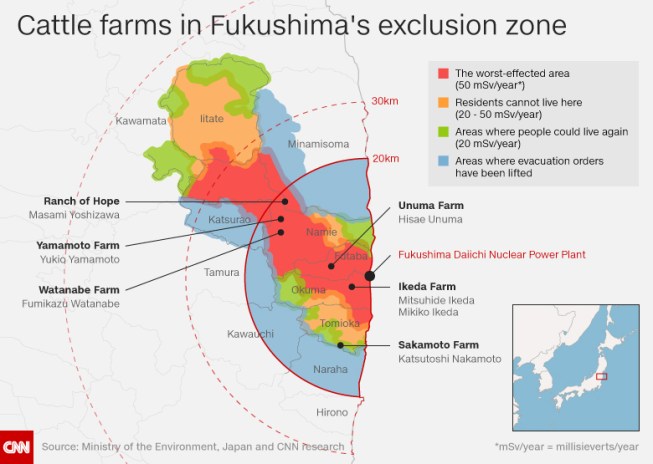
On March 11 2011, a 15-meter tsunami triggered by a 8.9-magnitude earthquake, disabled the Fukushima Daiichi nuclear power plant in Fukushima, causing a nuclear accident.
Residents within a 20 km radius of the facility were forced to evacuate their homes and leave behind their livelihoods and possessions.
Before leaving, some farmers released their cows so they could roam free and survive in the nuclear fallout-affected area. 1,400, however, died from starvation, while the government euthanized 1,500 more.
Since 2011, Matsubara has documented both the relationship six farmers have with their surviving herds as well as an ongoing study examining the effects radiation has on large mammals.
A greater scientific purpose
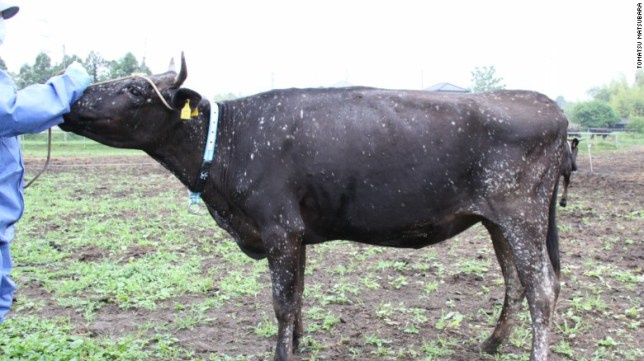
A cow from within Fukushima’s 20 km exclusion zone with an abnormal white spot outbreak.
The farmers — who return two or three times a week to their former farms — initially kept their cows alive just out of love. But since 2013, Keiji Okada, an animal science expert at Iwate University, has been carrying out tests on them.
Okada established the Society for Animal Refugee & Environment post-Nuclear Disaster, a non-profit with researchers from Kitazato, Tohoku and Tokyo university. The researchers are funded through their universities, and say their project is the first to look into the effects of radiation on large animals.
“Large mammals are different to bugs and small birds, the genes affected by radiation exposure can repair more easily that it’s hard to see the effects of radiation,” Okada, told CNN.
“We really need to know what levels of radiation have a dangerous effect on large mammals and what levels don’t,” he added.
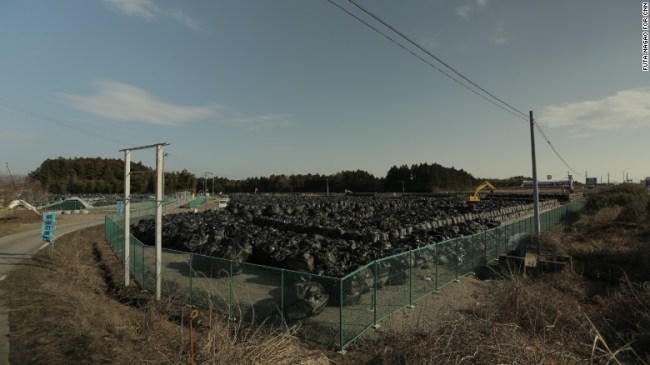
A mountain of black bags filled with contaminated soil sits piled on a roadside in Tomioka, Fukushima. A massive national project to remove topsoil and vegetation contaminated by the Fukushima nuclear disaster will produce at least 22 million square meters of radioactive waste.
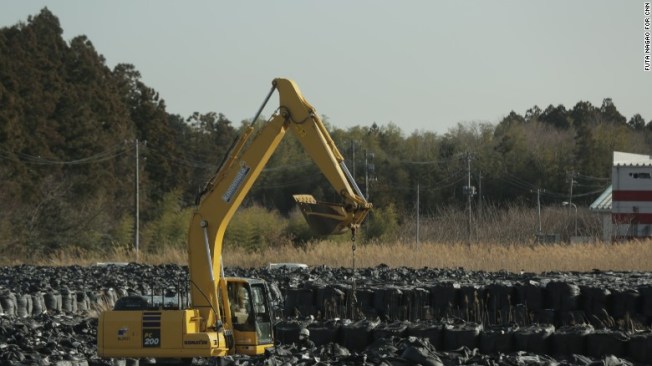
Colossal quantities of contaminated material have been collected from the Fukushima site and surrounding area. What will be done to dispose them still remains to be seen.
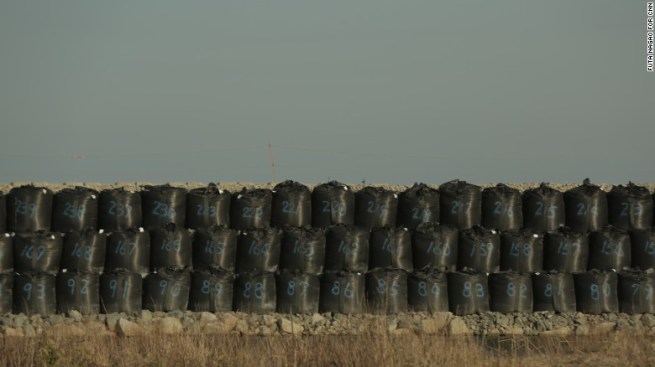
One of hundreds of temporary storage sites for contaminated material.

A giant, 780-meter sea wall under construction near the Fukushima Daiichi nuclear plant is designed to prevent contaminated water on the site from seeping into the ocean
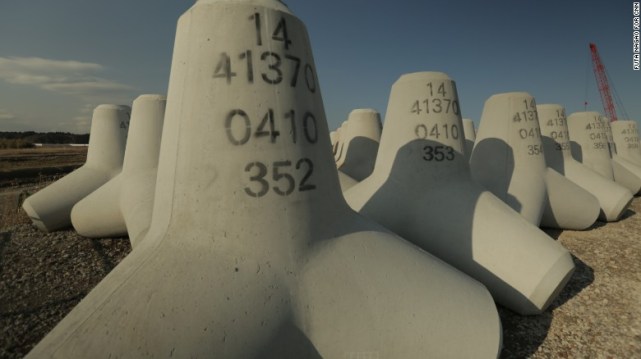
Tetrapods piled up at Udedo port in Namie, Fukushima, waiting to be used for a 7 meter high, 3 kilometer long breakwater along the coast line.
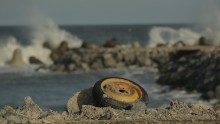
Prior to the wall’s construction, radioactive water and materials readily seeped into the ocean, threatening local fishing stocks and causing potentially irreversible damage to the sea floor.
So far, the cows living within the exclusion zone haven’t shown signs of leukemia or cancer — two diseases usually associated with high levels of radiation exposure. Some, however, have white spots on their hides. Their human minders suspect that these are the side-effects of radiation exposure.
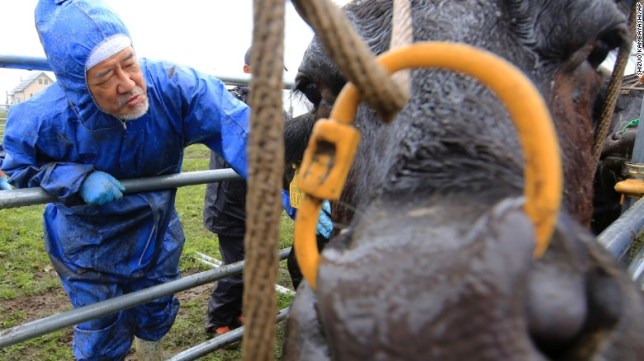
Keiji Okada, associate professor of veterinary medicine and agriculture at Iwate University, examines a cow at Ikeda Ranch in Okuma town, 5 kilometers (3 miles) west of Japan’s crippled Fukushima Dai-ichi nuclear power plant.
As Japan continues to confront its nuclear past, present and future, Okada said his group’s study would keep the country prepared in the event of another disaster.
“We need to know what levels of radiation are safe and dangerous for large mammals, and have that data ready so that the euthanization of livestock can be kept to the minimum,” added Okada.
The ‘cows of hope’
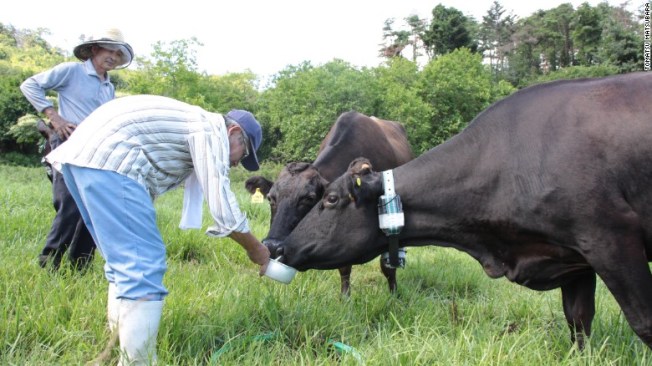
Elderly farmers feeds their radiation-affected cows in the exclusion zone.
Since 2011, the Japanese government has taken measures to decontaminate radiation-affected zones within Fukushima by stripping surface soil from contaminated zones and by cleansing asphalt roads and playgrounds.
Evacuation notices have also lifted on some towns in Fukushima. Taichi Goto, a spokesperson from the Ministry of the Environment’s Office for Decontamination told CNN that Namie, a town currently in the exclusion zone, was scheduled to be decontaminated by March 2017. Yet critics point that the state’s measures still aren’t enough.
Matsubara acknowledged the government’s decontamination work but asserted that it was impossible for them to clear the mountainous areas west of the exclusion zone.
While some farmers have slowly started to rebuild their lives by starting new businesses in decontaminated areas in Fukushima, the campaign to keep alive irradiated cows within the exclusion zone continues.
“These cows are the witnesses of the nuclear accident,” Masami Yoshikawa, who lives in Namie town in the heart of the exclusion zone, states in Nuclear Cattle.
“They’re the cows of hope.”
http://edition.cnn.com/2016/09/27/asia/japan-fukushima-nuclear-cows/index.html
Fukushima ice wall failing to deliver on promise

This Feb. 9 photo shows the crippled No. 3 unit of the Fukushima Daiichi nuclear power plant
TOKYO — Six months since the work began, the “ice wall” has failed to produce its intended results as groundwater continues to flow in and out of damaged facilities at the Fukushima Daiichi nuclear power plant.
An encircling wall of frozen soil, created by pumping a subzero coolant through underground pipes, is getting closer to completion, the Japanese government and plant operator Tokyo Electric Power Co. Holdings reported Tuesday at a meeting of experts convened by the Ministry of Economy, Trade and Industry.
The ocean-facing side of the wall is nearly finished, though gaps remain on the inland side, officials reported. Some of the expert panelists questioned the basis for determining such progress.
Groundwater runs down from the highland and seeps into the damaged reactor buildings, where it becomes tainted with radioactive material before flowing out into the ocean. The frozen wall has been built to stop this flow. But the problem was exacerbated by heavy rains starting around mid-August, as northern Japan was swept by multiple typhoons. This resulted in massive amounts of groundwater rushing into plant buildings, making it difficult to assess the wall’s effectiveness.
The operator, Tepco, thinks the inflows are concentrated at seven unfrozen sections on the inland side. Kunio Watanabe, an associate professor of environmental science at Mie University, blames the utility for having “fallen behind in its responses to address problems” at the Fukushima plant.
“If dealing with the contaminated water takes too long,” warns Masashi Kamon, professor emeritus at Kyoto University, “the entire decommissioning process may be set back.”
More than five and a half years have gone by since the March 2011 earthquake and tsunami that crippled Fukushima Daiichi.
The government and Tepco hope to complete the wall soon. But some outside experts at a meeting held by Japan’s nuclear regulator last month declared the effort a failure.
http://asia.nikkei.com/Japan-Update/Fukushima-ice-wall-failing-to-deliver-on-promise/
1 This Month
26 September – International Day for the Total Elimination of Nuclear Weapons





PLEASE OPPOSE HR 8255 AND S.3639 – bills would accelerate satellite deployment, with no environmental review or safeguards – https://ncstd5li.quorum.us/campaign/169331/
To see nuclear-related stories in greater depth and intensity – go to https://nuclearinformation.wordpress.com
-
Archives
- September 2026 (313)
- August 2026 (330)
- July 2026 (355)
- June 2026 (287)
- May 2026 (306)
- April 2026 (356)
- March 2026 (251)
- February 2026 (267)
- January 2026 (308)
- December 2025 (358)
- November 2025 (359)
- October 2025 (375)
-
Categories
- 1
- 1 NUCLEAR ISSUES
- business and costs
- climate change
- culture and arts
- ENERGY
- environment
- health
- history
- indigenous issues
- Legal
- marketing of nuclear
- media
- opposition to nuclear
- PERSONAL STORIES
- politics
- politics international
- Religion and ethics
- safety
- secrets,lies and civil liberties
- spinbuster
- technology
- Uranium
- wastes
- weapons and war
- Women
- 2 WORLD
- ACTION
- AFRICA
- Atrocities
- AUSTRALIA
- Christina's notes
- Christina's themes
- culture and arts
- Events
- Fuk 2022
- Fuk 2023
- Fukushima 2017
- Fukushima 2018
- fukushima 2019
- Fukushima 2020
- Fukushima 2021
- general
- global warming
- Humour (God we need it)
- Nuclear
- RARE EARTHS
- Reference
- resources – print
- Resources -audiovicual
- Weekly Newsletter
- World
- World Nuclear
- YouTube
-
RSS
Entries RSS
Comments RSS

