Niigata governor dashes TEPCO’s hopes for reactor restarts in 2019
 Tokyo Electric Power Co. President Naomi Hirose, left, hands a report to Niigata Governor Ryuichi Yoneyama at the prefectural government office in Niigata on April 19.
NIIGATA–Niigata Governor Ryuichi Yoneyama said a longer period may be needed to verify safety at the Kashiwazaki-Kariwa nuclear power plant, destroying Tokyo Electric Power Co.’s schedule to restart reactors there.
Yoneyama announced the possible extension of the safety-confirmation period, which he had earlier put at three or four years, at a news conference on April 19 after his meeting with TEPCO President Naomi Hirose here.
The governor said it will take time to confirm that the nuclear plant can withstand major earthquakes, especially a building that is expected to serve as the headquarters in the event of a severe accident at the site.
Only after safety is confirmed can discussions begin on restarting the nuclear plant in the prefecture, Yoneyama said.
Under TEPCO’s reconstruction plan currently being worked out, operations at the Kashiwazaki-Kariwa nuclear plant, one of the largest in the world, will resume in April 2019 at the earliest.
However, TEPCO needs the prefectural government’s consent to restart reactors, and Yoneyama’s words show that the utility’s plan will be impossible to achieve.
TEPCO in 2014 became aware that the headquarters building at the plant was insufficient in terms of earthquake resistance. But the company failed to disclose the shortcomings and maintained its policy of using the building as a disaster headquarters.
The deficiencies of the building came to light in February this year.
Hirose visited the Niigata prefectural government office on April 19 to explain to Yoneyama the issue of the insufficient anti-quake capabilities at the plant’s building.
He acknowledged problems in the mindset of his employees.
“They had a tendency to put priority on the benefits of their own company,” Hirose told the governor.
As for the time needed to confirm safety at the nuclear plant, Yoneyama told Hirose, “The period could become longer depending on the circumstances.”
The prefectural government plans to set up a committee in June at the earliest to verify safety at the Kashiwazaki-Kariwa plant.
“I don’t think nuclear power plants are indispensable for the economies of Japan and Niigata Prefecture,” Yoneyama said at the news conference after his meeting with Hirose.
The reactor restarts, however, may be crucial for TEPCO’s finances.
The company needs to secure 500 billion yen (about $4.6 billion) every year for 30 years to decommission the reactors at its crippled Fukushima No. 1 nuclear power plant and pay compensation to those who evacuated after the disaster unfolded in March 2011.
Resumed operations of two reactors at the Kashiwazaki-Kariwa nuclear plant could provide 100 billion yen a year for TEPCO.
Japan to scrap 5 more nuclear reactors
String of facilities approaching maximum life span
 Workers take apart a pump at Chubu Electric Power’s Hamaoka nuclear plant.
TOKYO — Five nuclear reactors in Japan were approved for decommissioning on Wednesday, pushing utilities and other companies to join hands to tackle both the great business opportunities and daunting technical problems involved with the process.
Two reactors at Kansai Electric Power‘s Mihama plant, as well as one each at Japan Atomic Power’s Tsuruga plant, Chugoku Electric Power‘s Shimane plant and Kyushu Electric Power‘s Genkai facility received the green light from Japan’s Nuclear Regulation Authority. The safety updates needed to keep them running beyond their mandated 40-year life span were deemed too costly.
Japan had 54 nuclear reactors before the 2011 meltdown at the Fukushima Daiichi nuclear plant. A total of 15, including the six at Fukushima Daiichi, are now set to be taken out of service. Another one or two will be brushing up against the 40-year limit every year, unless one-time, 20-year extensions are sought and granted.
Companies now face a pressing need to acquire expertise on dismantling reactors and disposing of radioactive materials. No commercial nuclear reactor has ever been decommissioned in Japan before, and utilities are looking for partners with the necessary capabilities.
Kansai Electric is seeking help from France’s Areva and Japan’s Mitsubishi Heavy Industries in decommissioning the Nos. 1 and 2 reactors at Mihama, particularly in decontaminating pipes and equipment. Japan Atomic Power and U.S.-based EnergySolutions signed an agreement last spring to cooperate on the former’s Tsuruga plant.
Japanese utilities are also beginning to work with each other. Kansai Electric entered a partnership last year with Kyushu Electric, Chugoku Electric and Shikoku Electric Power. The four plan to cut decommissioning costs by jointly procuring materials and sharing technology and staffers.
Other players are also angling for a piece of the pie. Two years ago, Mitsubishi Heavy set up a department specializing in dismantling nuclear reactors. The company was a key player in building the Mihama and Genkai reactors, and wants a lead role in taking them apart. Japanese general contractor Shimizu also signed a technical cooperation agreement with U.K.-based Cavendish Nuclear.
Utilities have increased their rates in order to raise the necessary funds to decommission the five newly approved reactors. They have already come up with about 160 billion yen ($1.47 billion) of the estimated 180 billion yen total. But the process will likely take two or three decades, and costs could easily grow.
The utilities may also face significant challenges to disposing of the roughly 27,000 tons of contaminated waste the five reactors are expected to generate. For example, Japan Atomic Power wants to bury less radioactive materials at the site of the Tokai nuclear plant, one of the earlier plants approved for decommissioning, but faces strong local opposition.
Relevant legislation has not been finalized either. Highly contaminated materials are supposed to be buried more than 70 meters below ground. But the Nuclear Regulation Authority has only just begun debating exactly how they should be buried.
http://asia.nikkei.com/Politics-Economy/Policy-Politics/Japan-to-scrap-5-more-nuclear-reactors
5 Reactors Decommissioning Approved

Decommissioning plans for 5 reactors approved
Japan’s nuclear regulator has approved plans submitted by operators of 4 power plants to decommission 5 aging nuclear reactors. The reactors are to be scrapped in a process lasting up to nearly 30 years.
The Nuclear Regulation Authority approved the plans at a meeting on Wednesday.
Under a government policy introduced after the 2011 nuclear accident at the Fukushima Daiichi plant, reactor lifespan was limited to 40 years in principle.
In 2015, utility companies decided to dismantle the 5 reactors. The 5 include 2 reactors at the Mihama plant and one at the Tsuruga plant, both in Fukui Prefecture, one at the Shimane plant in Shimane Prefecture and one at the Genkai plant in Saga Prefecture.
The plans call for first decontaminating pipes and dismantling facilities that are free of radioactive contamination.
The operators assume that the reactors and their buildings will be taken down and removed by fiscal 2045 at the latest.
At issue is where to put control rods, reactor parts and other radioactive waste. No site for a final disposal facility has been designated.
The regulator is checking another decommissioning plan for a reactor at the Ikata plant in Ehime Prefecture. The facility’s operator decided last year to dismantle it.
https://www3.nhk.or.jp/nhkworld/en/news/20170419_18/
Nuclear authority approves decommissioning plans for 5 aging reactors
TOKYO (Kyodo) — Japan’s nuclear authority approved decommissioning plans for five aging reactors at four power plants on Wednesday, the first such approvals since a government regulation was implemented after the 2011 Fukushima disaster to stop the operation of reactors beyond 40 years.
The five reactors are the Nos. 1 and 2 units at Kansai Electric Power Co.’s Mihama plant in Fukui Prefecture, the No. 1 unit at Japan Atomic Power Co.’s Tsuruga plant in Fukui Prefecture, the No. 1 unit at Chugoku Electric Power Co.’s Shimane plant in Shimane Prefecture and the No. 1 unit at Kyushu Electric Power Co.’s Genkai plant in Saga Prefecture.
While the utilities indicated it will take about 30 years to complete the decommissioning of each reactor, the disposal sites for the radioactive waste from the facilities have yet to be determined.
The decommissioning work will involve removing spent fuel from pools, dismantling reactors and demolishing surrounding facilities.
The regulation brought in following the 2011 disaster at Tokyo Electric Power Co.’s Fukushima Daiichi plant prohibits nuclear reactors from operating for over 40 years in principle, but the Nuclear Regulation Authority can approve the operation of a unit for up to 20 more years if the operator makes safety upgrades and the unit passes screening.
It was decided in March 2015 to scrap the five reactors, mainly due to profitability, as huge amounts of additional investment would be needed to meet the new safety requirements to keep the reactors operating beyond 40 years.
Meanwhile, the authority has given approval for the extended operation of the No. 3 unit at Kansai Electric’s Mihama plant as well as the Nos. 1 and 2 units at its Takahama plant in Fukui Prefecture, which are also around 40 years old.
The authority is currently examining Shikoku Electric Power Co.’s decommissioning plan for the No. 1 unit at the Ikata plant in Ehime Prefecture, after the utility decided in March 2016 to scrap the reactor.
In Wednesday’s meeting, the authority also decided that Japan Nuclear Fuel Ltd.’s uranium enrichment facility in the village of Rokkasho, Aomori Prefecture, satisfies regulatory requirements, virtually giving a green light for its operation. The decision will become official after consultation with the industry minister.
It will become the second fuel plant to clear new regulatory requirements after Global Nuclear Fuel-Japan Co.’s plant in Kanagawa Prefecture.
http://mainichi.jp/english/articles/20170419/p2g/00m/0dm/079000c
Saga Assembly OKs Restart of 2 Genkai N-Plant Reactors, 2,000 Active Faults Beneath the Japanese Archipelago

Saga Assembly OKs Restart of 2 Genkai N-Plant Reactors
Saga, April 13 (Jiji Press)–The Saga prefectural assembly on Thursday voted to accept the restart of the No. 3 and No. 4 reactors at Kyushu Electric Power Co.’s Genkai nuclear power station in the southwestern Japan prefecture.
Following the decision by majority vote, Saga Governor Yoshinori Yamaguchi said he will make his final judgment as early as this month on whether his prefecture should approve the restart.
The mayor and the town assembly of Genkai, the host municipality of the power plant, have already given the green light. Local government procedures needed for reactivating the reactors will finish if the governor approves.
The resolution to accept the Genkai reactor restart was introduced mainly by members of the Liberal Democratic Party, which holds a majority in the assembly.
Two other assembly groups, including members of the Japanese Communist Party, submitted a resolution to call on Yamaguchi not to jump to a hasty decision.
http://jen.jiji.com/jc/eng?g=eco&k=2017041300725
One year after Kyushu quake, and 2,000 active faults beneath us
Novelist Michiko Ishimure, 90, was in Kumamoto when a megaquake jolted the southwestern region exactly one year ago.
“It felt as if my legs had been ripped off from the knees and I was being dragged over a grassy field. The excruciating pain was something I’d never experienced before,” she wrote for the Seibu edition of The Asahi Shimbun for the Kyushu region.
Ishimure blacked out while trying to make an escape after grabbing some food and a ream of writing paper.
Her injury was minor. But when the “main shock” of the 2016 Kumamoto Earthquake struck more than 24 hours after the initial jolt, she was taken to a hospital.
Upon discharge, she returned to the nursing home for the elderly where she was a resident. But her sense of alienation deepened.
“I’d never felt I really belonged there, to begin with,” she explained. “I think this feeling intensified–along with a sense of emptiness–after being shunted around because of the quakes.”
April 14 marks the first anniversary of the massive Kumamoto Earthquake. Many citizens are still unable to return to their prequake lives and are experiencing inconveniences of all sorts. More than 40,000 people are still living in emergency shelters and temporary housing.
A poem by Jun Tsukamoto depicts the plight of survivors fearing aftershocks and sleeping in their cars: “Unable to sleep and wide awake/ Night after night/ Parked cars cover the ground.”
Last summer, “Gendai Tanka” (Contemporary “tanka” poetry) magazine featured verse about the Kumamoto disaster. The pieces reveal the hardships of evacuees, as does this one by Rika Hamana: “My father starts shuffling his feet along a street at night/ The lavatory he is headed to is far away in the driving rain.”
The Kumamoto Earthquake claimed 50 lives. Another 170 died later and their deaths were ruled to have been quake related.
Even after the jolts subsided, survivors were still fighting in the midst of a long battle. How difficult it is to continue providing them the care they need to ensure they don’t feel alone and helpless.
About 2,000 active faults run beneath the Japanese archipelago. I try to imagine what it will be like to have my life completely disrupted and changed, even tomorrow. And I think about what I should do to ensure my own survival.
http://www.asahi.com/ajw/articles/AJ201704140015.html
Apple might save Toshiba, and so help build New Nuclear Plants
Apple Has Some Of the World’s Deepest Pockets
As of the end of December 2016, Apple reported a cash balance of $241 billion with 94% of it – $230 billion – overseas. It has continued to add to that growing pile of cash overseas mainly because it has not paid U.S. corporate taxes on the related earnings. Repatriating it under current provisions in the tax code would require a large payment to the federal government…..
Overseas Investments Logically Escape U.S. Taxman
Like any well-managed company, Apple is not counting on the government making any changes to current law. It’s logical to believe that the company might be seriously investigating the possibility of direct investments or acquisitions in companies that are headquartered outside the U. S…….
Direct overseas investments would deploy the cash pile into a use that might be more lucrative than collecting the tiny amounts of interest currently paid to all savers, including large, successful corporations.
Apple has a long standing working relationship with Toshiba and most likely has a number of fans within Toshiba. In 2005, during the exciting stages of the iPod era, Apple made a long term purchase commitment – which came with a substantial cash advance – that enabled Toshiba and other flash memory suppliers to make the investments that have led to a technological revolution and a reliably profitable business segment.
Both Apple and Toshiba have profited from the relationship over the years. In 2011, Apple stopped buying flash memory from Samsung, indicating that its components no longer met the company’s evolving requirements as it improved its products. That decision shifted more sales volume to Toshiba…….
How Would This Investment Help Electricity Customers In Georgia And South Carolina?
Several years ago Toshiba, as Westinghouse’s large, profitable and then stable parent company, provided substantial guarantees in the case of cost overruns for both the Vogtle and Summer projects. Each of those projects, one in Georgia and one in South Carolina involves the construction of two of Westinghouse’s flagship AP1000 nuclear power plants. According to recent document filings, the total amount of Toshiba’s guarantees is about $4 billion.
Toshiba would like to complete the projects and successfully demonstrate the value of the AP1000 technology. Even though the company has indicated that it no longer wants to be in the nuclear plant construction business, it is still very interested in being a part of the nuclear power plant engineering, manufacturing, fuel supply, and services business. That business line will have a much greater potential for future profits after the first units begin operating.
Both Southern Company’s Georgia Power unit and SCANA, as the lead utilities in each consortium building the power plants, are in an evaluation phase to determine if the plants can and should be finished…..
neither of the state utility regulators will allow project completion if the costs seem prohibitive and if the burden of the cost overruns places an excessive burden on their electricity customers.
Though the cost overrun guarantee from Toshiba will apparently survive the Westinghouse bankruptcy, it may end up near the end of the creditor line if Toshiba itself must seek bankruptcy protection…..
Irresponsible of Court rulings to permit restart of restart of Japan’s NPPs
Court rulings permitting restart of NPPs are irresponsible http://www.japan-press.co.jp/modules/news/index.php?id=10497 April 5, 2017 Akahata editorial
‘Safety myth’ may again run rampant
If deeming that as long as the NRA gives a green light to resuming operations of nuclear reactors, courts do not need to judge whether or not such operations are appropriate, they would no longer be judicial apparatuses independent from the government. The Abe Shinzo Cabinet in principle reactivates NPPs which meet the NRA regulatory standards. It is tantamount to reinforcing the “safety myth” about the NRA screening itself.
Both of the court rulings state that people have the right to seek to protect their lives and livelihoods from NPP-related risks as the Constitution guarantees “personal rights”. The two judgements point out that the investigation into the cause of the 2011 Fukushima nuclear meltdown is totally insufficient. Concerning the NRA quakeproofing and tsunami-proofing criteria that the state used in approving the restart of NPPs, the court decisions criticized the criteria as “too lax”, which is of grave significance. The Fukui and Otsu district courts refused to blindly follow the government’s pro-nuclear policy and made independent decisions, clearly highlighting the collapse of the “safety myth”.
However, the recent decisions by the Osaka High Court and the Hiroshima District Court were completely unlike the previous two courts’ decisions. Regarding the nuclear safety standards that the NRA employed in allowing the reactivation of the reactors, the rulings by the two courts acknowledged the safety standards as “not unreasonable”, claiming that they reflect lessons learned from past accidents as well as the latest scientific and technical knowledge”. The Hiroshima ruling not just followed the state policy but abandoned the principle of judicial independence. It asserted that inconsistencies among court judgements will lead to confusion and that the Hiroshima court made the decision in line with the April 2016 decision by the Fukuoka High Court Miyazaki Branch which allowed the operation of Nos 1 and 2 reactors at the Kyushu Electric Power Company Sendai NPP (Kagoshima Pref.). If the judiciary keeps taking such a stance, it will be unable to protect people’s lives and their human rights.
Safeguard people’s rights
In the first place, the Constitution guarantees people’s right to go to court. It is a matter of course that judges should make their own decisions without being influenced by the state.
Tepco’s latest plan for Kawashiwazaki-Kariwa plant envisions restart in 2019

Tokyo Electric is now aiming to restart the Kawashiwazaki-Kariwa nuclear plant in Niigata Prefecture in April 2019, sources say.
The company plans to include the goal in its financial outlook under a reconstruction program, the sources said Friday.
Restarting the giant plant is considered important to Tokyo Electric Power Company Holdings Inc.’s ability to recover from the triple meltdown at the Fukushima No. 1 nuclear plant in March 2011.
But the prospects for rebooting the plant are dim because it is opposed by Niigata Gov. Ryuichi Yoneyama.
The reconstruction plan is also expected to include Tepco’s commitment to pursuing integration with other companies in some areas.
Tepco is expected to draw up the new plan and file for government approval as early as this month.
Six years after Fukushima – women and children still suffer most
The Japanese government is trying to get back to normality after the Fukushima nuclear disaster, but the crisis is far from over for women and children, says Greenpeace. Thousands of mothers have sued the authorities.

Six years ago, the triple disaster – earthquake, tsunami and meltdown at the Fukushima Daiichi power plant – took the lives of almost 20,000 people and displaced more than 160,000 people from their homes. More than 80,000 people are still living in temporary accommodation.
The disaster had an enormous impact on all members of the affected communities, but to this day it is women and children who “have borne the brunt of human rights violations resulting from it,” according to a report by Greenpeace.
While some injustices faced by women and children were caused by policy failures in the immediate aftermath of the disaster, other women’s and children’s rights violations are a direct result of the current government’s plans to resettle residents to “heavily contaminated ares in Fukushima,” says Greenpeace.
In an effort to get back to normality as quickly as possible, the Japanese government is set to lift evacuation orders at the end of March and allow evacuated residents to return to areas close to the Fukushima power plant.
 Employees clean an elementary school in Fukushima. It’s scheduled to re-open in April.
Greenpeace warned, however, that radiation levels are still dangerously high and called on the government not to “pressure” residents to return to their contaminated homes, under threat of losing financial support. A year after an area is declared safe, the government will stop paying compensation to evacuees.
In March, Japan will also cut housing support for people who decided to move out although they were not under a government evacuation order.
“Cutting off housing support for self-evacuees threatens more than 10,000 households, potentially forcing many people back to contaminated areas against their will,” says Kendra Ulrich, Global Energy Campaigner with Greenpeace Japan. Ending compensation payments “even though radiation levels far exceed the long-term targets in many areas […] amounts to economic coercion and is a deliberate violation of the law and survivors’ human rights.”
“Atomic divorce”
The resettlement plans create a dilemma for those who refuse to go back to their former homes but are dependent on financial support, especially single mums. After the disaster, a lot of women separated from or even divorced their husbands, who chose to stay in contaminated regions because of their work, and evacuated with their children.
There are no official numbers on how many families split as a result of the disaster. But the phenomenon is common enough to have a name, “genpatsu rikon” – literally meaning “atomic divorce”.
 These mothers evacuated with their children from Fukushima prefecture.
Mothers are now faced with the choice between losing housing support or moving back to unsafe areas. In order to speed up the return of evacuees, the government decontaminated corridors and islands instead of entire areas, effectivley creating “an invisible, open-air prison for citizens to return to,” says Greenpeace.
Decontaminated zones often consist of 20 meter strips along roads, around houses and agricultural fields. This poses a health threat as the returnees would be surrounded by contamination.
Mothers are worried about their health and the development of their children. Noriko Kubota, a professor of clinical psychology at Iwaki Meisei University, believes that living in “safe zones” could have a long-lasting negative impact on kids.
“If children need to stay inside and cannot run around outside freely, that would impact their psychological development, more specifically their skills of interacting with each other and controlling their emotions among others,” Kubota told DW.
Mothers sue government
Women are, however, not only silent victims in this disaster. Thousands of mothers have together filed lawsuits against the Japanese government to fight for the continuation of housing support and fair compensation. They also demand accountability for the disaster from the government and Tokyo Electric Power Co. (TEPCO), the company running the Fukushima Daiichi plant.
 Ms Horie is sueing the government for fair compensation.
“I never imagined becoming a plaintiff myself. I’m going to court now for my children and for the next generation,” Ms Horie told Greenpeace. She moved with her children from Fukushima to Kyoto, where she filed a class action suit together with other mums. “Back then, they said on TV that the accident wouldn’t affect our health immediately, but it might affect my kids in the future. That’s why I decided to evacuate.”
Women who left contaminated areas have been “labeled as neurotic or irrational,” says Greenpeace. Their concerns were dismissed both by their partners and the government. The lawsuit is not only about financial compensation but also for moral satisfaction.
“I want to stand in court, knowing that I am right to evacuate my child,” says Ms Sonoda, who moved with her child from Fukushima to England. “We are right.”
http://www.dw.com/en/six-years-after-fukushima-women-and-children-still-suffer-most/a-37871135
Toshiba warns that it might not survive its nuclear financial crisis
 Toshiba warns over its survival as it forecasts £7bn losses Crisis creates concern about future of UK’s Moorside nuclear plant, in which subsidiary Westinghouse is a key player, Guardian, Angela Monaghan, 12 Apr 17, Toshiba, one of the biggest names in consumer electronics, has warned it is facing annual losses of more than £7bn and the future of the company is in doubt as a result of financial turmoil at its nuclear power plant construction business.
The Japanese company finally released third quarter results, after twice delaying publication while auditors attempted to quantify the scale of the problems at Toshiba’s US nuclear engineering subsidiary Westinghouse, which filed for bankruptcy last month.
Toshiba took the unusual decision to publish them on Tuesday without the approval of auditor PricewaterhouseCoopers Aarata. The company said PwC Aarata had been too uncertain about the financial impact of Westinghouse’s takeover of nuclear construction company CB&I Stone and Webster in 2015.
Westinghouse’s plight stems from a $6.1bn (£4.9bn) writedown because costs have overrun on the two plants CB&I is building in Georgia and South Carolina, the first new US nuclear power stations for decades.
The unaudited results showed Toshiba’s total losses widened by 53bn yen to 532bn yen (£3.9bn) in the nine months ending December 2016, adding that losses for the full year ending March could amount to more than 1tn yen (£7.3bn). It would be one of the biggest losses in Japanese corporate history.
Failure to file audited results fuelled speculation that the company could be forced out of the Tokyo Stock Exchange. Toshiba’s president, Satoshi Tsunakawa, called the auditor’s decision not to approve the figures “truly regrettable” and said he hoped the company would not be delisted.
The company’s escalating crisis also heightened fears about the future of Toshiba’s planned Moorside nuclear plant in Cumbria. Earlier this month it was forced to take full control of the venture behind the project, Nugen, after its previous partner, the French utility Engie, exercised the right to sell its 40% stakeunder an option triggered by Westinghouse’s bankruptcy filing.
Unite, Britain’s largest trade union, said it was fearful about what the latest developments at Toshiba would mean for the Moorside plant, and repeated its call on Greg Clark, the business and energy secretary, to intervene to safeguard the future of the project…….. https://www.theguardian.com/business/2017/apr/11/toshiba-losses-uk-moorside-nuclear-plant-westinghouse
Japan’s nuclear technology faces extinction
Evaporating demand and few new projects spell trouble for technical know-how

A semicylindrical structure has been built to cover a reactor containment vessel at J-Power’s Oma nuclear power plant in Aomori Prefecture, where construction work has been suspended since the 2011 Fukushima nuclear disaster.
TOKYO — Japan’s nuclear power industry is at the most critical juncture in its history. Demand for new reactors has dried up at home following the Fukushima nuclear disaster and dismal prospects for export are dual menaces threatening the fate of the country’s nuclear technology.
No domestic construction on a new reactor has begun for the past eight years. The catastrophic accident at the Fukushima Daiichi nuclear power plant in 2011 blew a hole in the industry’s plans. The picture for exports of Japanese nuclear power technology looks just as gloomy.
Japanese reactor manufacturers and suppliers of key components are now facing the possible loss of their technological viability.
Shutdown
Warning signs for the nation’s nuclear power industry are visible in many parts of the country, including Oma, a fishing town in Aomori Prefecture on the northernmost tip of the main island of Honshu.
In that coastal town, Electric Power Development, a wholesale electric utility known as J-Power, has been building a new nuclear power plant.
At the construction site stands a huge semicylindrical-shaped structure bearing the Hitachi logo. It is actually a cover to protect what is inside: a reactor containment vessel, the core equipment of a nuclear plant, from the salty sea winds.
The humidity inside the structure is kept at 50% to prevent pipes and other parts of the vessel from rusting, according to an official in charge of the construction.
J-Power started construction of its first nuclear power plant in Oma in 2008. By the time the devastating earthquakes and tsunami in 2011 triggered reactor meltdowns at the Fukushima plant, 38% of the Oma project had been completed.
But the disaster brought construction to a halt as new, stricter safety standards have been introduced, forcing the company to make necessary adjustments to the plan and design of the plant. The plant was originally envisioned to start operation in 2014, but there is no prospect for quick resumption of full-scale construction.
http://asia.nikkei.com/Tech-Science/Tech/Japan-s-nuclear-technology-faces-extinction
Revised law enables surprise inspection of nuclear plants
The Diet passed on Friday a sweeping reform of nuclear inspections to allow regulators to conduct unannounced inspections of nuclear plants and give them unlimited access to needed data.
The enactment of the revised nuclear reactor regulation law comes after the International Atomic Energy Agency suggested Japan, which has been holding periodic inspections using checklists, needs a more flexible system.
The new inspection system, based on the U.S. system, will be implemented from fiscal 2020 after the Nuclear Regulation Authority sets specific rules.
Anti-Conspiracy Bill to Suppress Anti-Government Demonstrations
 Rally participants protest the so-called “anti-conspiracy bill” at Hibiya Open-Air Concert Hall in Tokyo’s Chiyoda Ward on the evening of April 6, 2017.
Protesters say ‘anti-conspiracy’ bill aims to suppress anti-government demonstrations
Thousands of people gathered in Tokyo to protest the so-called “anti-conspiracy bill” hours after the government submitted the bill to the House of Representatives on April 6.
The group Kyobozai NO! Jikko Iinkai (Committee saying no to the anti-conspiracy bill) and multiple other civic organizations held a rally at Hibiya Open-Air Concert Hall, after which participants marched through the streets of Japan’s capital calling for the bill to be scrapped. According to event organizers, some 3,700 people took part.
“Suppression of protests against the government is the essence of this bill,” Yuichi Kaido, an attorney who has long been active in the movement against anti-conspiracy legislation, told the crowd. “Let us fight to kill this bill.”
Opposition lawmakers who participated in the event remarked, “The bill will turn the public into latent criminals,” “The bill is the modern-day version of the prewar Public Security Preservation Law” and “The prime minister said he would provide a careful explanation, but forcibly submitted the legislation.”
After the rally, participants marched in front of the Diet as they called out, “We don’t need anti-conspiracy legislation!” and “The bill has nothing to do with anti-terrorism,” while holding banners reading, “Simply having a discussion may become a crime!”
http://mainichi.jp/english/articles/20170407/p2a/00m/0na/002000c
 An estimated 3,700 demonstrators rally against a bill that penalizes conspiracies to commit crimes in Tokyo’s Chiyoda Ward on April 6, saying it could lead to the extensive monitoring of citizens and the suppression of freedom of expression
Local councils, citizens raise red flag against new crime legislation
Almost 4,000 protesters marched in Tokyo on April 6 to voice their concern that a proposed law to enable punishment for planning crimes is one step toward an Orwellian society of surveillance.
“The purpose of the bill is to silence citizens opposing the government when these people haven’t actually posed any threat,” said protester Yuichi Kaito, a lawyer who serves as the deputy chief of the task force dealing with the anti-conspiracy legislation at the Japan Federation of Bar Associations.
A 44-year-old public servant from Kawasaki who attended the rally in Hibiya Park in central Tokyo chipped in with, “People who are involved in labor union activities are just ordinary people. If they were cracked down on, they would not be able to enjoy a normal life.”
The protesters marched to the Diet building to coincide with the bill being introduced for a debate at a Lower House plenary session in which the four major opposition parties have pledged to fight it.
A similar bill has been killed three times since it was first submitted to the Diet in 2003. It was criticized that it could be used to target ordinary citizens’ groups and labor unions as the law could be arbitrarily applied by the police and the government.
The government argues the legislation is required to fight terrorism by joining the U.N. Convention against Transnational Organized Crime.
It insists the new legislation is urgently needed as the capital prepares to host the 2020 Tokyo Olympics and Paralympics.
But many citizens fear the legislation could lead to the suppression of freedom of thought.
The country has already experienced suppression in the years leading up to World War II. In 1925, the public security preservation law was enacted with the initial purpose of reining in communism. But its application was expanded to encompass attacks on critics, journalists and activists.
The prefectural assemblies of Mie and Miyazaki, as well as 34 other local assemblies across Japan, had issued statements as of April 6 opposing the legislation or calling for a cautious Diet debate, according to the Lower House.
Nagano Prefecture appears to be particularly opposed to the bill. Thirteen municipal assemblies in the prefecture, prodded by alarmed citizens, have made it clear they oppose the legislation, the largest of any prefecture in Japan.
The backdrop to this is what is known as the Feb. 4 incident of 1933, in which about 600 people in the prefecture–many of them teachers–were arrested on suspicion of violating the public security preservation law. Those arrested were suspected of harboring communist sympathies.
Local residents in Nagano Prefecture see many parallels between the current bill and the pre-war legislation.
“In my appeal, I ask, ‘Is it all right to repeat history?” said Yukio Nunome, head of the secretariat of a federation of civic groups advocating the protection of the pacifist Japanese Constitution.
In Fukushima Prefecture, four local assemblies adopted a statement opposing the bill.
“Since the Fukushima nuclear disaster, we have always protested against the central government,” said Kiyoshi Ishikawa, a Japanese Communist Party (JCP) member of the Kawamata town assembly. “It is only expected that opposition to the anti-conspiracy bill is spreading due to concerns that it could breach freedom of thought.”
In Tokyo, the Kunitachi municipal assembly condemned the legislation as potentially leading to a society where individuals are under constant surveillance and turned into informants for the authorities.
Miyako Owari, a JCP assemblywoman who drafted the protest statement, expressed concern that grass-roots activities could be targeted, such as weekly gatherings held in the city.
“The bill concerns each of us since if it is written into law, we may lose the atmosphere in which we can freely voice our opinions and express ourselves,” she said.
The government aims to pass the bill in the Lower House by early May so that officials can underscore Japan’s efforts to fight terrorism at the Group of Seven summit in Sicily, Italy, later the same month.
Toshiba asks for banks’ support

Executives at ailing conglomerate Toshiba have asked banks for additional support. Three main lenders say they are considering providing new lines of credit.
Toshiba executives met with representatives of about 80 financial institutions on Tuesday. They are believed to have discussed the temporary swell in the company’s losses following the bankruptcy of its US nuclear subsidiary Westinghouse.
The firm plans to spin off its mainstay flash memory chip operation. But it will be some time before it sees any gains from selling a majority stake in the new entity.
Toshiba said it needs to secure more than 6.3 billion dollars in fiscal 2017.
Sumitomo Mitsui Banking Corporation and 2 other main creditor banks proposed additional support on the condition that Toshiba offers shares in the spin-off company as collateral.
The electronics maker has postponed the release of its earnings report twice because it needed to investigate accounting practices at Westinghouse.
It is trying to release the report by Tuesday of next week.
Nuclear disaster of a different kind

JAPANESE corporate giant Toshiba has announced that its Westinghouse nuclear power unit has filed for Chapter 11 bankruptcy in the US, largely due to massive cost overruns for four reactor projects the company is building in South Carolina and Georgia. The financial loss to Toshiba is estimated to be about 1 trillion yen (about $9 billion) for the fiscal year that ended yesterday (March 31), which would be one of, if not the biggest, annual loss in Japanese corporate history.
Officials at both W estinghouse and parent company Toshiba are optimistic that the collapse is not total; the financial problems are rooted in Westinghouse’s construction division, while its nuclear fuel and plant operations/maintenance segments remain relatively profitable. On the other hand, the bankruptcy filing is glaring evidence that these same people have been very wrong before; every other objective indicator suggests that Westinghouse’s fall may be a fatal blow to what nuclear advocates were hoping would be a bit of a renaissance for nuclear power worldwide.
The Westinghouse Electric Company LLC is a remnant of the fabled US corporate giant Westinghouse, which was founded in 1886. Through the mid-1990s the original company was gradually broken up and sold off; the brand is still well known worldwide – mainly in household appliances and certain kinds of industrial equipment – but is owned and produced by a variety of unrelated parent companies. The nuclear power business has historically been one of Westinghouse’s strengths, and reached its zenith during the 1970s; a majority of the several dozen operating nuclear reactors in the US were built by Westinghouse, and it built reactors in several other countries. The mothballed Bataan Nuclear Power Plant (BNPP) here in the Philippines is a Westinghouse product.
The company has over the years become embroiled in controversy at times – the BNPP being one example – but on the whole remained fairly sound, and was considered a good investment when it was purchased in 1999 by British Nuclear Fuels Limited (BNFL). BNFL in turn sold Westinghouse to Toshiba in 2006 for $5.4 billion, just at a time when the prevailing view was that nuclear power was about to undergo a resurgence; China, the US and the UK were all then planning to invest heavily in new nuclear power facilities.
Toshiba thought they had a gold mine on their hands. Westinghouse had a new, marketable reactor design – the AP1000 – which had become the first Generation III+ design to receive final design approval from the US Nuclear Regulatory Commission (NRC) in 2004. The Japanese parent company sold 10 percent of its stake to the Kazakh national uranium company (Kazatomprom) in 2007 to secure a fuel source and strengthen its supply line, and in the same year won a bid from the China National Nuclear Corporation for construction of four AP1000 reactors and transfer of the AP1000 technology. In 2008, Westinghouse won a contract from Georgia Power Company to build two AP1000 reactors in that state and a second contract to build two more in South Carolina; two years later, the US government announced it would provide $8.3 billion in loan guarantees to complete the Georgia plant.
The Fukushima nuclear disaster in March 2011 and the boom in natural gas production in the US had a chilling effect on the plans for new nuclear plants in the US. Even without Fukushima raising safety concerns, nuclear plants suddenly became unreasonably expensive compared with gas-fired plants, which put a bit of pressure on Westinghouse. What really sank the company, however, was the enormous cost and schedule overruns at its Georgia and South Carolina projects. Both were expected to cost about $14 billion each, and be operational by the end of last year; so far, they have cost $19 billion and $22 billion, respectively, and are two years or more behind schedule.
To make matters worse, the financial trouble at Westinghouse has raised old, but still not completely answered, questions from regulators – in the US, the UK, and China – about the safety of the AP1000 reactors. Up to now, most of those concerns have been deflected, but what is likely to happen now, even if Westinghouse can continue to satisfactorily convince governments and potential operators of the system’s safety, is that uncertainty over whether the company – or more likely, whoever buys the ailing unit from Toshiba – can be relied on to keep up standards is going to make big customers look elsewhere. And once they do, they are likely to prefer the more economical and less contentious path countries like the US are taking, turning to gas generation or expanding renewables.
http://www.manilatimes.net/nuclear-disaster-different-kind/320327/
Toshiba’s nuclear mess: shareholders hurl abuse at Toshiba managers
 ‘You’re trash’: Investors hurl abuse at Toshiba managers after nuclear debacle, SMH, Pavel Alpeyev and Takako Taniguchi, 31 Mar 17, Toshiba shareholders have lashed out at management and lamented the downfall of the Japanese icon before approving the sale of its memory chips division to cover the billion-dollar costs resulting from its disastrous foray into nuclear energy.
Incensed investors took turns to hurl abuse at executives during a Thursday meeting convened to take a vote on the intended disposal of its prized semiconductor business. Toshiba is looking to sell a majority stake in the unit to mend a balance sheet ravaged by billions of dollars in writedowns related to cost overruns at its nuclear subsidiary Westinghouse Electric.
Westinghouse, which Toshiba bought for $US5.4 billion in 2006, filed for bankruptcy protection on Wednesday. The Japanese company said it may now book a loss of as much as 1.01 trillion yen ($11.8 billion) in the year ending March, a record for a Japanese manufacturer.
“Toshiba is now a laughing-stock to the whole world,” one shareholder said during a question-and-answer section, raising his voice. “I think all of you are incompetent as managers. Do you even know what’s happening?”
Another shareholder addressed the executives as “trash.”……. http://www.smh.com.au/business/world-business/youre-trash-investors-hurl-abuse-at-toshiba-managers-after-nuclear-debacle-20170330-gvah2j.html
1 This Month

Protect Sazan Island from the Trump family! https://secure.avaaz.org/campaign/en/protect_sazan_island_from_the_trump_family_loc/?bqFCVab&v=174511&cl=22707147157&_checksum=5e9dde668860e8231c33699735e16a1fbf22ab2cb01da50c999fe8732b9775ef&utm_source=email&utm_medium=blast_email&utm_campaign=174511
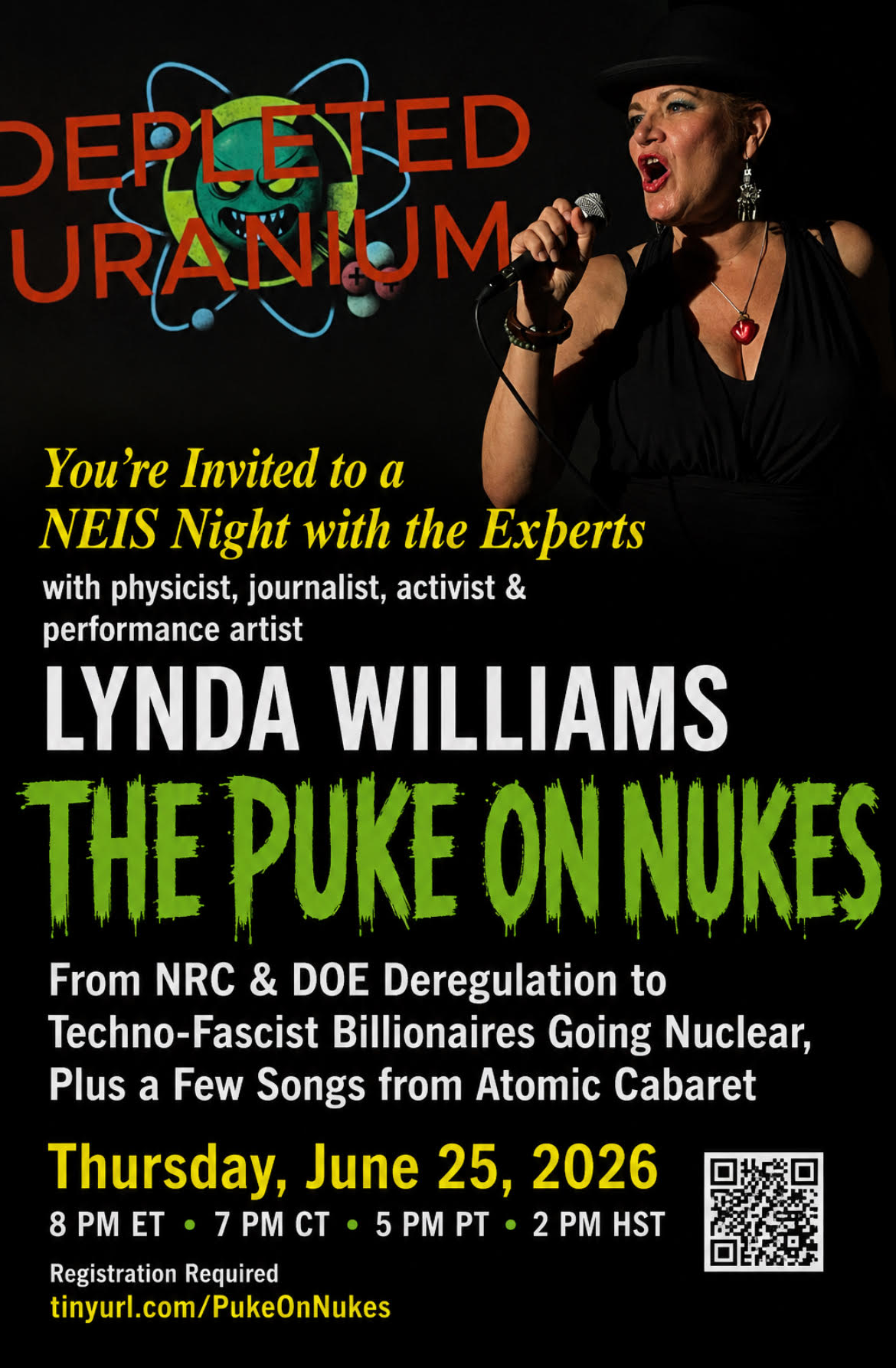
25 June- THE PUKE ON NUKES
Thursday, June 25, 2026
7pm Central Time (8pm ET, 6pm MT, 5pm PT) UTC – 5
From NRC & DOE Deregulation to Techno-Fascist Billionaires Going Nuclear, Plus a Few Songs from Atomic Cabaret REGISTER
26 June – Radiation Trainwreck at the NRC / Join the Protect Better Campaign – https://us02web.zoom.us/meeting/register/4ZlZ5_qLSHGiLSCg8FF6Bg#/registration


Cuba Is Not a Failed State – It Is a Besieged State
PETITION: “Global Appeal to Endorse Palestinian Right of Return of Refugees”
To see nuclear-related stories in greater depth and intensity – go to https://nuclearinformation.wordpress.com
-
Archives
- June 2026 (130)
- May 2026 (306)
- April 2026 (356)
- March 2026 (251)
- February 2026 (268)
- January 2026 (308)
- December 2025 (358)
- November 2025 (359)
- October 2025 (376)
- September 2025 (257)
- August 2025 (319)
- July 2025 (230)
-
Categories
- 1
- 1 NUCLEAR ISSUES
- business and costs
- climate change
- culture and arts
- ENERGY
- environment
- health
- history
- indigenous issues
- Legal
- marketing of nuclear
- media
- opposition to nuclear
- PERSONAL STORIES
- politics
- politics international
- Religion and ethics
- safety
- secrets,lies and civil liberties
- spinbuster
- technology
- Uranium
- wastes
- weapons and war
- Women
- 2 WORLD
- ACTION
- AFRICA
- Atrocities
- AUSTRALIA
- Christina's notes
- Christina's themes
- culture and arts
- Events
- Fuk 2022
- Fuk 2023
- Fukushima 2017
- Fukushima 2018
- fukushima 2019
- Fukushima 2020
- Fukushima 2021
- general
- global warming
- Humour (God we need it)
- Nuclear
- RARE EARTHS
- Reference
- resources – print
- Resources -audiovicual
- Weekly Newsletter
- World
- World Nuclear
- YouTube
-
RSS
Entries RSS
Comments RSS
 nuclear-news