 Solidified nuclear waste mixed with glass is placed in canisters at a reprocessing plant in Rokkasho, Aomori Prefecture, in 2012
The government has set the criteria for a map meant to identify potential final disposal sites for high-level radioactive nuclear waste, paving the way for its release as early as this summer.
The process of finding a host for nuclear waste could face challenges amid public concerns over safety.
Based on the map, the government will approach select municipalities to allow research to be conducted for suitable sites to store waste from nuclear power generation.
For permanent disposal, high-level nuclear waste needs to be stored at a final depository more than 300 meters underground for up to about 100,000 years until radiation levels fall and there is no longer potential harm to humans and the environment.
The government plans to create a permanent underground repository somewhere in stable bedrock so the canisters can be stored for tens of thousands of years.
The map is likely to classify which areas are geologically suitable for such a structure to be built deep enough underground. This would rule out areas near active faults and volcanoes as well as oil and coal fields.
Based on waste transport criteria, the map is likely to show that zones within 20 km of the coastline are favorable to host final disposal sites.
The government hopes other municipalities — not just the ones located near nuclear power plants — may also become interested in hosting the disposal facilities. It also wants to show that a variety of places nationwide are suitable for nuclear waste management.
The map was originally planned for a 2016 release but the publication date was later postponed, as some local governments were wary that disposal sites would be imposed on them.
About 18,000 tons of spent fuel currently exist in Japan. Including spent fuel that has already been reprocessed, the country’s total jumps to about 25,000 canisters of vitrified high-level waste, all of which needs to be managed.
The process to find local governments willing to host final storage started in 2002, but little progress was made due mainly to opposition from local residents.
In May 2015, the central government introduced a plan announcing that final depository site selection would be based on scientific grounds, rather than waiting for municipalities to volunteer.
Before presenting the map, the government will hold symposiums between mid-May and June at nine cities to explain the map criteria to the public. The cities include Tokyo, Nagoya and Fukuoka.
Radioactive waste is classified into two categories: The high-level type is generated from reprocessing spent fuel by separating the plutonium and uranium for recycling, while the low level type refers to all other waste.
High-level waste is a byproduct of fission in the reactor core, which is very hot and dangerous. It is mixed with glass and solidified before being placed in robust heat-resistant stainless steel canisters that are 130 cm high, 40 cm in diameter and weigh 500 kg each.
A full canister emits about 1,500 sieverts per hour — an extremely lethal biological level — and has a surface temperature in excess of 200 degrees.
Its radioactivity starts at 20,000 trillion becquerels. It will take about 1,000 years to fall to one-thousandth of that level, and tens of thousands of years to weaken to the same intensity as natural uranium ore, the Natural Resources and Energy Agency says.
Worldwide, only Finland and Sweden have been able to successfully decide on a final depository site for nuclear waste, while many other countries with nuclear plants face difficulties in doing so.
The United States decided in 2009 to call off a plan to build a site to dispose spent fuel in Nevada’s Yucca Mountain due to local opposition, but President Donald Trump earmarked funds to revive the plan in the budget proposal for fiscal 2018 unveiled in March.
In Japan, the selection process is also a touchy issue and has triggered conflicts in the communities around which prospective depository sites have been considered.
In one example, Minamiosumi Mayor Toshihiko Morita in Kagoshima Prefecture filed a criminal complaint against a 65-year-old resident for libel, claiming that his allegations that the rural town office had been actively inviting such a facility was not only groundless but also defamation.
The resident handed out flyers to about 500 households in the town in January which said Morita went to Tokai, Ibaraki Prefecture, and Horonobe in Hokkaido at the invitation of the private sector involved in the construction of nuclear waste disposal facilities. Both municipalities host nuclear-related facilities.
Morita flatly denied the allegations, telling Kyodo News in writing that he has heard “rumors” that there have been moves aimed at hosting a nuclear waste disposal facility but “I myself haven’t gone anywhere and been treated to anything.”
“I would reject any request from the central government” to host one, Morita said. The town approved an ordinance to reject a plan to host a nuclear waste disposal facility the year after the 2011 nuclear crisis at the Fukushima No. 1 plant.
A supporter of the mayor, however, did visit nuclear-related facilities in locations including Rokkasho, Aomori Prefecture, several years ago, according to the supporter’s admission, and a Tokyo company covered the expenses of the trip.
http://www.japantimes.co.jp/news/2017/05/02/national/government-release-map-potential-final-nuclear-disposal-sites-summer/
May 3, 2017
Posted by dunrenard |
Japan | Disposal Sites, nuclear waste, Storage |
Leave a comment
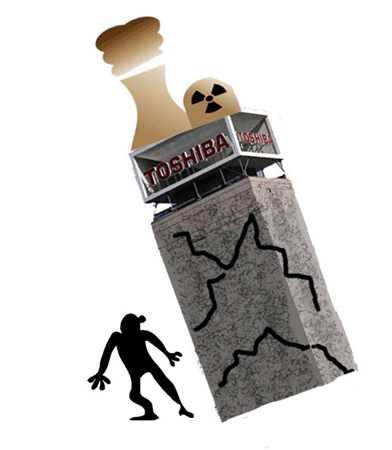 http://breakingenergy.com/2017/05/02/toshiba-to-split-into-four-subsidiaries/ By MICHAEL VINCIon May 02, 2017 Early this year, Toshiba made the strategic decision to divest from its Westinghouse nuclear power generator in America. Now, the Chinese company has decided that splitting into subsidiaries is the only way to protect its other businesses. The four subsidiaries will be (1) infrastructure (including water treatment and railways); (2) energy (including thermal and nuclear power); (3) electronics (including data storage); (4) information and communications.
With the exception of the new energy subsidiary, the rest of the spin-offs would come into being in July 2017. Energy is set to be in effect in October.
The significant of the bankruptcy of Westinghouse is still unclear – many are concerned that the shutdown will have an effect on the nuclear power sector. As the four new subsidiaries demonstrate, the ramifications of this bankruptcy are clearly having their way with Toshiba.
On the eve of the imminent bankruptcy, Moody’s Investors Service
changed their outlook on all five utility companies involved in the project. Each was given a negative outlook.
The measures taken by Moody’s apply to the Vogtle entities. That is, Georgia Power, Oglethorpe Power and the Municipal Electric Authority of Georgia. Also included are the entities of the Summer project. Specifically, SCANA Corp. and the South Carolina Electric and Gas Subsidiary, as well as to the South Caroline Public Service Authority.
Moody’s justifies the new outlook as being reflective of the increased credit and regulatory risk that will be a result of the bankruptcy. The depleted financial condition of Toshiba contributes to this risk. In February, the company took a $6.3 billion write-down associated with Westinghouse’s overrun costs at the two nuclear projects in America.
Now, the bankruptcy has left Toshiba with what can amount to billions of dollars in potential losses. This presents serious struggles for the nearly 150 year old conglomerate. After the bankruptcy was announced, Toshiba shares in Tokyo stumbled nearly 4%. Moreover, losses from last year left the company with $2.1 billion of negative shareholder equity, which threatens its position on the Tokyo Stock Exchange.
More immediate concerns for the company include the expiration of construction licenses, which are needed to sell equipment to the power industry. Unfortunately, the licenses have to be renewed every five years, but require that the company meet certain equity and capital targets. Toshiba’s weakened state jeopardizes the renewal process.
Some of Toshiba’s other revenue streams offer products such as turbines for gas, hydro, and geothermal plants. These power sector products are important to the company, and so the decision to create the subsidiaries is largely to protect those businesses from the potential fall out regarding the Westinghouse bankruptcy. Otherwise, the bankruptcy might end up being a roadblock to engaging in the power sector further.
With regards to the nuclear industry, the bankruptcy has the potential to threaten the completion of two current reactor projects in progress in the Southeast. Further, there is practically zero change that any new nuclear facility in the U.S. will be built in the foreseeable future.
Simply put, nuclear facilities are no longer cost effective. They were intended as an alternative to dirty fossil fuels and expensive green energy, but neither of those are as problematic as they used to be. It seems as if the industry has no prospects left.
May 3, 2017
Posted by Christina Macpherson |
business and costs, Japan |
Leave a comment
 Hidden Radiation Secrets of the World Health Organization, CounterPunch by ROBERT HUNZIKER, MAY 2, 2017
“………WHO issued two reports on Fukushima:
1) Evaluation of exposure
2) Likely health effects
Alex Rosen of Int’l Physicians for the Prevention of Nuclear War critiqued the two WHO Fukushima reports, found to be extremely problematic, and once again, similar to Chernobyl, shoddy work that sweeps way too much dirt under the carpet.
Here’s the problem: WHO’s estimates of Fukushima radioactive exposure are at least 50% less than any other estimates, including estimates provided by TEPCO (Tokyo Electric Power Company, the plant operator) itself. But, WHO is supposed to be the guardian of public health concerns, not TEPCO.
Also, two critical population studies are ignored in the WHO reports, i.e., all of the residents within the 20 km exclusion zone are eliminated, even though their radiation exposure would be very high, actually highest. The second group ignored is workers on site… ahem!
Additionally, WHO cavalierly approved the Japanese government’s drastic change in annual maximum radiation exposure allowed for the general population up to 20 mSv per year.http://www.counterpunch.org/2017/05/02/hidden-radiation-secrets-of-the-world-health-organization/
May 3, 2017
Posted by Christina Macpherson |
Fukushima continuing, secrets,lies and civil liberties |
Leave a comment
Government to release map of potential final nuclear disposal sites this summer, Japan Times, 3 May 17 KYODO, STAFF REPORT, The government has set the criteria for a map meant to identify potential final disposal sites for high-level radioactive nuclear waste, paving the way for its release as early as this summer.
The process of finding a host for nuclear waste could face challenges amid public concerns over safety.
Based on the map, the government will approach select municipalities to allow research to be conducted for suitable sites to store waste from nuclear power generation.
For permanent disposal, high-level nuclear waste needs to be stored at a final depository more than 300 meters underground for up to about 100,000 years until radiation levels fall and there is no longer potential harm to humans and the environment.
The government plans to create a permanent underground repository somewhere in stable bedrock so the canisters can be stored for tens of thousands of years.
The map is likely to classify which areas are geologically suitable for such a structure to be built deep enough underground. This would rule out areas near active faults and volcanoes as well as oil and coal fields.
Based on waste transport criteria, the map is likely to show that zones within 20 km of the coastline are favorable to host final disposal sites.
The government hopes other municipalities — not just the ones located near nuclear power plants — may also become interested in hosting the disposal facilities. It also wants to show that a variety of places nationwide are suitable for nuclear waste management.
The map was originally planned for a 2016 release but the publication date was later postponed, as some local governments were wary that disposal sites would be imposed on them.
About 18,000 tons of spent fuel currently exist in Japan. Including spent fuel that has already been reprocessed, the country’s total jumps to about 25,000 canisters of vitrified high-level waste, all of which needs to be managed.
The process to find local governments willing to host final storage started in 2002, but little progress was made due mainly to opposition from local residents.
In May 2015, the central government introduced a plan announcing that final depository site selection would be based on scientific grounds, rather than waiting for municipalities to volunteer.
Before presenting the map, the government will hold symposiums between mid-May and June at nine cities to explain the map criteria to the public. The cities include Tokyo, Nagoya and Fukuoka…….http://www.japantimes.co.jp/news/2017/05/02/national/government-release-map-potential-final-nuclear-disposal-sites-summer/#.WQlFDEWGPGg
May 3, 2017
Posted by Christina Macpherson |
Japan, wastes |
Leave a comment

Spent nuclear fuel is stored in a pool at the La Hague reprocessing facility in northwestern France in October. It is one of the most dangerous sites in the world, with its 10,000 tons of spent fuel. We were afraid of the Fukushima Daiichi fuel pool 4 but it was nothing: The whole fuel of the Hague corresponds to radiotoxicity 360 times greater than Chernobyl.
About 610 tons of spent nuclear fuel stored at seven of the 17 reactors in Japan that are set to be decommissioned have no fixed transfer destination, it was learned Sunday, threatening to hold up the decommissioning process.
If it remains undecided where to transfer the spent nuclear fuel, work to dismantle reactor buildings and other structures may not be carried out as planned.
The tally excludes the six reactors at Tokyo Electric Power Co. Holdings Inc.’s Fukushima No. 1 plant, which was heavily damaged by the March 2011 earthquake and tsunami.
The seven reactors are the Japan Atomic Energy Agency’s Fugen advanced converter reactor, the agency’s Monju prototype fast-breeder reactor, Japan Atomic Power Co.’s reactor 1 at its Tsuruga plant, reactors 1 and 2 of Kansai Electric Power Co.’s Mihama plant, reactor 1 of Chugoku Electric Power Co.’s Shimane plant and reactor 1 of Kyushu Electric Power Co.’s Genkai plant, according to the companies and the agency.
The Fugen reactor has 70 tons of spent mixed-oxide, or MOX, fuel, a blend of uranium and plutonium recycled from spent nuclear fuel.
The agency has abandoned its plans to move the MOX fuel out of the reactor site in the current fiscal year to March 2018. It has considered consigning the reprocessing of the fuel overseas but a contract has not been signed yet.
The agency’s schedule to finish the decommissioning work by fiscal 2033 has remained unchanged, but an official admitted that the timetable will be affected if a decision on where to transfer the spent fuel is not made.
As for the trouble-prone Monju reactor, the agency has yet to submit a decommissioning program to authorities. How to deal with 22 tons of spent MOX fuel at the reactor is a major issue.
The Mihama No. 1 reactor has 75.7 tons of spent conventional nuclear fuel and 1.3 tons of spent MOX fuel, while the No. 2 reactor has 202 tons of spent nuclear fuel. Kansai Electric plans to take them out of Fukui Prefecture, which hosts the power plant, by fiscal 2035, but the transfer location has not yet been selected.
At the Tsuruga plant’s reactor 1, Japan Atomic Power plans to transfer 31.1 tons of the reactor’s 50-ton spent nuclear fuel to the fuel pool of reactor 2, with the rest to be transported by fiscal 2026 to a Japan Nuclear Fuel reprocessing plant under construction in the village of Rokkasho in Aomori Prefecture.
After being postponed more than 20 times, the completion of the reprocessing plant is currently slated for the first half of fiscal 2018 and the blueprint is undergoing screenings by the Nuclear Regulation Authority, a nuclear watchdog.
As nuclear fuel cannot be brought into the reprocessing plant until it starts operations after receiving all necessary regulatory approval, it is uncertain whether the Tsuruga reactor fuel can be transferred as planned.
Chugoku Electric aims to transfer 122.7 tons of spent nuclear fuel at its Shimane plant’s reactor 1 to the Rokkasho reprocessing plant by fiscal 2029.
Kyushu Electric hopes to take 97.2 tons of spent nuclear fuel at the Genkai reactor 1 out of its fuel pool by fiscal 2029, but the destination has not been fixed.
At three other nuclear plants with reactors set to be decommissioned, spent nuclear fuel is mostly planned to be moved out of the current pools to other pools within the same plant.
In the case of Tepco’s disaster-stricken Fukushima No. 1 plant, the site of the 2011 triple meltdown accident, where the 2,130 tons of spent nuclear fuel will be transferred to has yet to be decided.
Still, the decommissioning work for the six reactors there will not be affected in any significant way for the time being, as more urgent tasks, such as a survey of melted fuel, have been given higher priority, officials said.
http://www.japantimes.co.jp/news/2017/04/30/national/transfer-sites-610-tons-spent-nuclear-fuel-undecided-decommissioning-plans-may-affected/#.WQa0fZxJfbI.facebook
May 1, 2017
Posted by dunrenard |
Japan | Processing, Spent Nuclear Fuel, Storage |
Leave a comment

The Japan Atomic Energy Agency’ Joyo experimental fast reactor in Ibaraki Prefecture
The nation’s nuclear watchdog has slammed the operator of the Joyo experimental fast reactor in Ibaraki Prefecture for its approach to safety concerns in seeking an early restart.
Shunichi Tanaka, chairman of the Nuclear Regulation Authority, on April 26 labeled the Japan Atomic Energy Agency’s proposal to bring the reactor back online as “absolutely unacceptable.”
The NRA on April 25 suspended its screening of Joyo’s restart plan based on stricter safety standards introduced after the 2011 Fukushima nuclear disaster.
“Has the JAEA seriously reflected on the accident at the Fukushima No. 1 nuclear power plant?” Tanaka asked at a news conference on April 26. “It said that explaining the restart (to municipalities) would take too much trouble. Its attitude toward the communities is wrong.”
The JAEA has applied to the NRA to restart the reactor with a plan to operate it with a thermal output of 100,000 kilowatts, rather than its full capacity of 140,000 kilowatts.
On April 25, JAEA officials explained that it would be able to restart the reactor faster by limiting the thermal output because that approach would save it time and effort in providing the necessary explanations to municipal authorities.
If the reactor operates with an output of 100,000 kilowatts, only local governments within a 5-kilometer radius of the reactor are required to produce evacuation plans.
However, when operating with an output of 140,000 kilowatts, local entities within a 30-km radius of the reactor are required to come up with evacuation plans.
Using a motorcycle analogy, Tanaka said the JAEA’s plan is tantamount to saying that the operator needs a “license for a 50cc bike as long as it drives a 750cc motorcycle at a speed of 30 kph or under.”
http://www.asahi.com/ajw/articles/AJ201704270036.html
May 1, 2017
Posted by dunrenard |
Japan | Fast Reactor, Joyo |
Leave a comment
 Fukushima authorities ask troops to help deal with forest fires near crippled nuclear power plant https://www.rt.com/news/386662-fukushima-forest-fires-soldiers/#.WQaIanZz1L8.facebook
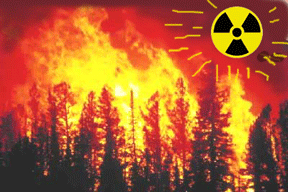
Fukushima prefecture has asked the Japanese Self-Defense Forces for help in handling forest fires that have swept areas near the crippled Fukushima power plant, local media report. Strong winds are hindering the firefighting efforts, however.
The forest fires broke out near the town of Namie, some seven kilometers from the disabled Fukushima Daiichi Nuclear Power Plant, on Saturday evening, Japanese NHK broadcaster reported.
Namie was evacuated following the 2011 tsunami and subsequent nuclear disaster in Fukushima.
The prefecture has deployed several helicopters to extinguish the fires, which are believed to have been caused by lightning. According to police, at least 10 hectares of forest have burned in the area.
There have been no reports of injuries or damage to buildings so far, Japanese media say.
With strong winds stoking the flames, the Fukushima Prefecture has requested help from the Self-Defense Forces, Japan’s de-facto army, on Sunday.
Earlier in April, residents of Namie, as well as those from the village of Iitate and the town of Kawamata’s Yamakiya neighborhood, totaling 22,100 people in all, were told they could return home – with the exception of those with houses in so-called no-go zones, where radiation levels are still too high, according to Japanese media.
So far, the homecoming has not been as successful as the government had hoped, as few residents have been eager to go back.
Results of a Fukushima Prefectural Government survey released on April 24 show that some 78.2 percent of the evacuated households have no intention of returning to their previous residences and plan to remain in the area they evacuated to.
May 1, 2017
Posted by Christina Macpherson |
Fukushima continuing |
Leave a comment

Fukushima native replaces disaster minister after quake gaffe
Japan’s disaster reconstruction minister Masahiro Imamura resigned Wednesday, a day after saying it was “a good thing” the March 2011 earthquake and tsunami struck northeastern Japan rather than the Tokyo area.
Prime Minister Shinzo Abe picked Masayoshi Yoshino, a House of Representatives member from Fukushima Prefecture and the chairman of a special lower house committee on disaster reconstruction, to replace Imamura.
“I severely troubled and hurt people in (northeastern Japan),” Imamura told reporters at Abe’s office after submitting his resignation, which the prime minister accepted immediately.
“I apologize from my heart for my lack of virtue,” he added, while rejecting calls to also resign as a lawmaker.
Abe also apologized, both to the residents of areas recovering from disasters and the Japanese public as a whole, after accepting Imamura’s resignation.
Imamura made the “good thing” comment at a function in Tokyo for a faction of the ruling Liberal Democratic Party, which Abe was also attending, on Tuesday evening. He immediately retracted the remark and apologized, but the damage was done.
The lawmaker made the remark after citing a figure of 25 trillion yen ($225 billion) for the damage to social capital and other infrastructure from the March 2011 disaster.
“It’s a good thing it was over there in the northeast. If it had been close to the greater Tokyo area, there would have been vast, enormous damage,” he said.
The disaster left 15,893 people dead and 2,553 still listed as missing, the National Police Agency said in its latest tally.
Imamura, 70, prompted calls for his resignation earlier this month when he suggested people displaced by the Fukushima nuclear disaster triggered by the quake should fend for themselves.
A native of Saga Prefecture in Japan’s southwest, Imamura was given his post in a Cabinet reshuffle in August last year.
His 68-year-old replacement Yoshino, a fellow LDP lawmaker and former senior vice environment minister, hails from Iwaki, a city in Fukushima on the Pacific coast that bore the brunt of the 2011 disaster at the Fukushima Daiichi nuclear complex.

“My own home was damaged by the tsunami, and my campaign office was completely destroyed, so I think I understand better than anyone else the feelings of those affected by the disaster,” Yoshino said at his first press conference as a Cabinet minister later Wednesday.
The choice of a Fukushima local apparently reflects the administration’s desire to avoid further criticism that the reconstruction minister is unable to relate to people affected by the disaster.
Imamura’s resignation prompted the main opposition Democratic Party and three smaller opposition parties to also seek his resignation as a lawmaker.
The opposition demanded holding Diet committee sessions to pursue Abe’s responsibility in the matter.
The LDP and Democratic Party agreed Wednesday to hold such a session in the lower house on May 8. They are expected to arrange a House of Councillors committee session on May 9 or near that date.
The opposition parties had essentially threatened not to turn up for Diet deliberations until such a date was fixed.
Imamura’s resignation follows a series of blunders by Cabinet ministers and has dealt another blow to the government at a time when it is already facing issues that risk splitting public opinion.
The Diet is deliberating a bill to criminalize conspiracy to commit serious crimes, ostensibly to combat terrorism, which opponents say could result in the suppression of civil liberties.
Public sensitivity also surrounds a special bill in the works to enable the abdication of Emperor Akihito.
The string of embarrassments prompted Natsuo Yamaguchi, leader of the LDP’s junior coalition partner Komeito, to warn last week the administration is “strikingly lacking in a sense of alertness.”
Yamaguchi spoke after LDP lawmaker Toshinao Nakagawa resigned as parliamentary vice minister of economy, trade and industry amid media reports of extramarital affairs.
The week before that, regional revitalization minister Kozo Yamamoto, another LDP lawmaker, called curators of cultural properties a “cancer” that needs to be “eradicated,” before being forced to apologize and retract the remark.
“(The administration) must take seriously the suggestions that we are becoming slack,” Abe acknowledged Wednesday in his apology over Imamura’s resignation, vowing to “win back the public’s trust.”
https://english.kyodonews.net/news/2017/04/43790ecd62a8-update5-fukushima-native-replaces-disaster-minister-after-quake-gaffe.html

Disaster minister quits after quake gaffe, Fukushima rep takes over
Japan’s disaster reconstruction minister Masahiro Imamura resigned Wednesday, a day after saying it was “a good thing” the March 2011 earthquake and tsunami struck northeastern Japan rather than the Tokyo area.
Prime Minister Shinzo Abe picked Masayoshi Yoshino, a House of Representatives member from Fukushima Prefecture and a former senior vice environment minister, to replace Imamura.
Imamura tendered his resignation to Prime Minister Shinzo Abe on Wednesday morning and the prime minister accepted it immediately.
“I severely troubled and hurt people in (northeastern Japan),” Imamura told reporters at the prime minister’s office after submitting his resignation.

“I apologize from my heart for my lack of virtue,” he added, while rejecting calls to also resign as a lawmaker.
Abe also apologized, both to the residents of areas recovering from disasters and to the Japanese public at large, after accepting Imamura’s resignation.
Imamura made the “good thing” comment at a function in Tokyo for a faction of the ruling Liberal Democratic Party, which Abe was also attending, on Tuesday evening. He immediately retracted the remark and apologized, but the damage was done.
Imamura had prompted calls for his resignation earlier this month when he suggested people displaced by the Fukushima nuclear disaster triggered by the quake should fend for themselves.
The leader of the main opposition Democratic Party on Wednesday said Imamura’s resignation is not enough on its own.
“This brings into question Prime Minister Shinzo Abe’s responsibility for having appointed (Imamura),” Renho said at a party meeting.
Abe acknowledged that this responsibility lies with him in his apology. “(The administration) must take seriously the suggestions that we are becoming slack,” Abe said, vowing to “bring back the public’s trust.”
Imamura, a native of Saga Prefecture in Japan’s southwest, was given his post in a Cabinet reshuffle in August last year.
His replacement Yoshino hails from Iwaki, a city in Fukushima on the Pacific coast that bore the brunt of damage in the 2011 disaster at the Fukushima Daiichi nuclear complex.
“I have been making reconstruction my life, so I’m happy to be given a challenging post,” Yoshino told reporters at the LDP’s head office in Tokyo on Wednesday morning.
Imamura’s resignation has prompted the suspension of House of Representatives proceedings scheduled for Wednesday morning and most of the House of Councillors proceedings scheduled for Wednesday.
https://english.kyodonews.net/news/2017/04/e8335852ad1d-update2-disaster-minister-quits-after-quake-gaffe-fukushima-rep-takes-over.html
April 26, 2017
Posted by dunrenard |
Japan | Demission, Fukushima, Reconstruction Minister |
Leave a comment

The Takahama Nuclear Power Plant’s No. 3 reactor, left, and No. 4 reactor are pictured in this file photo taken from a Mainichi Shimbun helicopter in Takahama, Fukui Prefecture, on June 15, 2016.
FUKUI, Japan (Kyodo) — Kansai Electric Power Co. said Tuesday it will seek to restart its two idled reactors in Fukui Prefecture, central Japan, in mid-May and early June, respectively.
Shigeki Iwane, the utility’s president, presented the plan to reboot the two units at the Takahama plant on the Sea of Japan coast when meeting with Fukui Gov. Issei Nishikawa.
“It is correct that (Kansai Electric Power) will take procedures to start operations,” Nishikawa told reporters after the meeting.
Kansai Electric Power will start to load nuclear fuel at the No. 4 unit later this month, eyeing the start of electricity generation in late May while aiming to reactivate the No. 3 reactor in early June after fueling the facility in mid-May, according to the schedule released by the Osaka-based company.
Although Prime Minister Shinzo Abe’s government has been promoting the restart of nuclear reactors across Japan, most of the reactors remain offline amid safety concerns among residents following the Fukushima Daiichi nuclear accident.
The two reactors in Takahama were brought back online in early 2016 after meeting the safety requirements introduced after the 2011 nuclear disaster.
While the No. 4 unit was shut down immediately after its restart in February last year due to a technical problem, the No. 3 reactor was forced to go offline the following month in the wake of an Otsu District Court order that resulted from a lawsuit filed by residents in neighboring Shiga Prefecture.
In March this year, the Osaka High Court struck down the lower court’s decision, making it possible for the two reactors to resume operation.
Among the four units at the Takahama plant, Japan’s nuclear regulators approved June last year the utility’s plan to extend the operation of the Nos. 1 and 2 reactors beyond the government-mandated 40-year service period.
https://mainichi.jp/english/articles/20170426/p2g/00m/0dm/001000c
April 26, 2017
Posted by dunrenard |
Japan | Restarts, Takahama NPP |
Leave a comment
 Report: Japanese seeking out nuclear shelters, air purifiers over North Korean threat https://www.aol.com/article/news/2017/04/24/japanese-seeking-nuclear-shelters-air-purifiers-north-korea-threat/22053701 As North Korea ratchets up international tensions with missile tests and aggressive rhetoric, some residents of a neighboring country are reportedly taking actions to protect themselves in advance.
Reuters is reporting that “sales of nuclear shelters and radiation-blocking air purifiers have surged in Japan in recent weeks…”
One company, Oribe Seiki Seisakusho, appears to be doing particularly well, receiving eight orders for nuclear shelters in April and selling all 50 of its $5,000-a-piece, poison gas filtering air purifiers.
According to Newsweek, the buying activity may have been prompted, at least in part, by Prime Minister Shinzo Abe’s recent warning to other Japanese government officials that “there is a possibility that North Korea already has a capability to put sarin on warheads to strike the ground.”
Meanwhile, the Japan Times reported last month that Oga, a Japanese city in Akita Prefecture, conducted the country’s first evacuation drill “on the premise of a ballistic missile falling into Japanese waters off Akita, [and] was aimed at promptly relaying information while facilitating the swift and safe evacuation of residents.” The media outlet further notes that the drill included participation by an elementary school, among others.
In addition to these protective measures, Japan has been working with the U.S. and its neighbor South Korea to detect and possibly intercept approaching missiles.
April 26, 2017
Posted by Christina Macpherson |
Japan, safety, weapons and war |
Leave a comment
 Japanese citizens have 10 minutes to prepare for a North Korean nuclear attack, Missile ‘will not take long to reach Japan,’ says government, The Independent, Harriet Agerholm @HarrietAgerholm 25 Apr 17, Japanese citizens will have just 10 minutes to prepare a North Korean ballistic missile attack, authorities in the country have warned.
In the event of an attack, a document posted on the country’s civil protection site advises people to find the strongest concrete building possible or go underground.
Then they should then take cover under tables and stay away from windows, it says. A ballistic missile would likely take around 10 minutes to travel 1,600 km (1,000 miles) from its launch pad in North Korea to Okinawa, it adds, citing a launch in February last year which took that length of time to fly over the Japanese island.
The warning comes as tensions ratcheted up between North Korea, its Asian neighbours and the US. The secretive communist state test-fired four ballistic missiles last month, three of which landed in Japan’s exclusive economic zone in the Sea of Japan, just off the coast of the country.
It has subsequently emerged that the country’s civil defence website had 5.7 million visitors in the first 23 days of April — more than 14 times the usual monthly traffic.
Japan’s early-warning system, which issues missile strike alerts to the population via loudspeaker and telephone has come under increased scrutiny amid the rising tensions.
In 1998, North Korea demonstrated that its missiles were capable of reaching Japan when it fired a missile to launch a satellite across Japanese territory that landed in its economic zone on the Pacific Ocean side.
Japan’s government has been briefing local authorities on what they should do if a missile lands in their area and urging them to hold evacuation drills. Sales of nuclear shelters and radiation-blocking air purifiers have also surged in recent weeks. ……..http://www.independent.co.uk/news/world/asia/japan-north-korea-nuclear-attack-10-minutes-prepare-missile-tests-warheads-kim-jong-un-a7700971.html
April 26, 2017
Posted by Christina Macpherson |
Japan, weapons and war |
Leave a comment
The three-tier disposal scheme for the waste generated by the Tokai Reprocessing Plant is based on radiation level.
Waste with the highest radiation level, which will fill some 30,000 drums, will be buried more than 300 meters underground.
Mid-level waste, which will fill about 24,000 containers, is expected to be buried several dozens of meters underground.
Low-level waste, involving another 81,000 drums, will be buried close to the surface, the JAEA said. In the meantime, the plant’s tainted equipment and facilities will need to be decontaminated and scrapped before being filled with cement and mortar and put in drums for transport to a final disposal site.
The big problem is, there has been little progress in deciding where to bury the drums because they can’t find anyone willing to accept them.
 Closure of Tokai Reprocessing Plant to cost an estimated ¥800 billion: JAEA source http://www.japantimes.co.jp/news/2017/04/23/national/closure-tokai-reprocessing-plant-cost-estimated-%C2%A5800-billion-jaea-source/#.WP_gPUWGPGg The Japan Atomic Energy Agency has revealed that the scrapping of the Tokai Reprocessing Plant, the nation’s first facility for reusing spent nuclear fuel, will cost an estimated ¥800 billion, an official said.
The state-backed JAEA did not reveal the cost to taxpayers in 2014, when it made the decision to shut down the plant in the village of Tokai, Ibaraki Prefecture, over a 70-year period.
The facility started operation in 1977 as part of Japan’s desire to establish a nuclear fuel cycle, in which all spent fuel is reprocessed to extract its plutonium and uranium to make more fuel. The policy is designed to ensure resource-dependent Japan uses its nuclear fuel as efficiently as possible.
The JAEA decided to scrap the sprawling plant after it became too costly to run under the more stringent safety rules introduced following the 2011 Fukushima nuclear crisis. The facility comprises around 30 buildings and has large areas rife with contamination caused by its task of disassembling spent nuclear fuel.
According to the official, the startling decommissioning estimate is based on an estimate the agency made in 2003. The JAEA is finalizing the assessment and on course to submit it for approval by the Nuclear Regulation Authority as early as June.
The three-tier disposal scheme for the waste generated by the Tokai Reprocessing Plant is based on radiation level.
Waste with the highest radiation level, which will fill some 30,000 drums, will be buried more than 300 meters underground.
Mid-level waste, which will fill about 24,000 containers, is expected to be buried several dozens of meters underground.
Low-level waste, involving another 81,000 drums, will be buried close to the surface, the JAEA said. In the meantime, the plant’s tainted equipment and facilities will need to be decontaminated and scrapped before being filled with cement and mortar and put in drums for transport to a final disposal site.
The big problem is, there has been little progress in deciding where to bury the drums because they can’t find anyone willing to accept them.
Despite the Fukushima nuclear disaster, the government is trying to resume nuclear power generation and continue its pursuit of a nuclear fuel cycle.
This policy, however, has experienced setbacks from the recent decision to decommission the Monju fast-breeder reactor, an experimental facility in Fukui Prefecture that was considered key to the nuclear fuel cycle plan.
And the completion of a new fuel reprocessing plant in the village of Rokkasho, Aomori Prefecture, has also been largely behind schedule for years.
In the meantime, public concerns about the safety of atomic power remain strong at a time when the government is aiming to make it account for 20 to 22 percent of Japan’s electricity supply by 2030.
The new estimate for decommissioning the Tokai Reprocessing Plant includes ¥330 billion for storing waste underground, ¥166 billion for decontaminating and dismantling the facility, and ¥87 billion for transportation costs.
The JAEA facility is not to be confused with the private uranium-processing facility in Tokai where a fatal criticality accident occurred in 1999.
April 26, 2017
Posted by Christina Macpherson |
Japan, reprocessing, wastes |
Leave a comment

Mothers who fled to the Itoshima, Fukuoka Prefecture, to escape radiation spewed by the March 2011 core meltdowns in Fukushima Prefecture say they are concerned about the safety of the Genkai nuclear plant in neighboring Saga Prefecture.
SAGA – A group of mothers who evacuated from the Kanto region to Fukuoka Prefecture after the 2011 Fukushima nuclear crisis is ramping up protests against efforts to restart the Genkai nuclear plant in neighboring Saga.
After meeting with Minister of Economy, Trade and Industry Hiroshige Seko on Saturday, Saga Gov. Yoshinori Yamaguchi is expected to approve the restart of two reactors in the town of Genkai as early as Monday.
Earlier this month, four of the moms gathered for a meeting in Itoshima in Fukuoka and discussed plans to send the city a document and an inquiry conveying their opposition.
As they racked their brains to deliver effective expressions, the meeting lasted for around six hours until their children returned home from school.
Three of the moms moved to Itoshima after becoming worried their children would be adversely affected by exposure to the fallout spewed by the triple core meltdown at the Fukushima No. 1 plant in Fukushima Prefecture in March 2011. The plant is run by Tokyo Electric Power Company Holdings Inc.
“I wanted to go far away for the sake of my unborn child,” said 39-year-old Fumiyo Endo, the leader of the group.
But the place she relocated to was within 30 km of the Genkai plant run by Kyushu Electric Power Co.
In March, she attended a meeting of residents to get explanations about the restart but was concerned whether safety would be ensured by sheltering indoors as instructed should an accident occur.
She also felt angry after hearing a utility official say that restarting the plant is necessary “for a stable supply of power.” She said it sounded as if the utility did not care about human lives.
But she did not decide to leave Itoshima because she wanted to keep living there, to stay close to the sea and mountains.
Another member of the group said it was important to keep resisting.
“It is significant to protest against nuclear plants near the plant sites,” said photographer Nonoko Kameyama, 40.
Kameyama, a mother of three, has published a photo book of mothers hoping to bring about a society without nuclear power plants.
A day after attending the residents’ meeting, Endo and other members called the Saga Prefectural Government to urge it to reject the restart.
When asked by a prefectural official during the call what the name of their group was, they came up with an impromptu title: “Mothers Who Want to Save Children’s Lives.” Dozens of people have recently joined in response to its Facebook post.
The group has submitted petitions to Saga Gov. Yamaguchi and Itoshima Mayor Yuji Tsukigata.
“Resuming operations only makes residents feel unsettled and we cannot see a bright future,” said Endo. “We want our leaders to understand such feelings.”
Yamaguchi is expected to approve the Genkai restart as early as Monday, after meeting with METI chief Seko on Saturday.
“The central government has shown a strong determination to work on nuclear energy policy in a responsible manner,” Yamaguchi said Saturday, adding he wants to convey his decision “as early as possible.”
The government is pushing for reactor restarts despite the triple core meltdown at Fukushima No. 1, saying nuclear energy is Japan’s key energy source.
In January, reactor Nos. 3 and 4 at the Genkai plant passed the tougher safety requirements introduced in the wake of the Fukushima crisis. On Feb. 24, a majority of the Genkai Municipal Assembly voted in favor of restarting the plant.
http://www.japantimes.co.jp/news/2017/04/23/national/moms-fled-fukushima-fallout-raise-pressure-genkai-plant-restart-saga/
April 25, 2017
Posted by dunrenard |
Japan | Fukushima Evacuees, Genkai NPP, Restart, Saga |
Leave a comment

A girl holds her petition to ask the education ministry to protect children from radioactive contamination at Fukushima prefecture during a rally at the Education Ministry in Tokyo on May 23, 2011. Some 400 civic group members, including 60 parents and children from Fukushima, demanded to review the radiation limit of 3.8 microsieverts per an hour as the education ministry has set a radiation limit to allow children in Fukushima. AFP PHOTO / Yoshikazu TSUNO
Incredible contamination in Namie, Fukushima where people are being forced to live! European News Weekly, April 22, 2017 by arclight2011part2 Mirrored, Source for article – https://fukushima311voices.wordpress.com/2017/04/22/incredible-contamination-in-namie-fukushima/
The evacuation orders of the most populated areas of Namie, Fukushima were lifted on March 31st this year.
“Fukuichi area environmental radiation monitoring project” has published airborne radiation measurements map and soil surface density map. The results are simply incredible. This is far much worse than in Radiation Control Zone. Any area becomes designated as such when the total effective dose due to external radiation and that due to radioactive substances in the air is likely to exceed 1.3mSv per quarter – over a period of three months, or when the surface density is over 40,000Bq/m2. In the Radiation Control Zone, it is prohibited to drink, eat or stay overnight. Even adults are not allowed to stay more than 10 hours. To leave the zone, one has to go through a strict screening.
Namie’s radio contamination is far over these figures! And people are told to go back to these areas……..https://europeannewsweekly.wordpress.com/2017/04/22/incredible-contamination-in-namie-fukushima-where-people-are-being-forced-to-live/
April 24, 2017
Posted by Christina Macpherson |
Fukushima continuing |
Leave a comment

The call might have been made to decommission five over-the-hill nuclear reactors, but the problem remains of where to dispose of their total 26,820 tons of radioactive waste.
The plant operators have yet to find disposal sites, and few local governments are expected to volunteer to store the waste on their properties.
The decommissioning plans for the five reactors that first went into service more than 40 years ago was green-lighted by the Nuclear Regulation Authority on April 19.
It is the first NRA approval for decommissioning since the 2011 Fukushima nuclear disaster triggered by the Great East Japan earthquake and tsunami.
That disaster led to a new regulation putting a 40-year cap, in principle, on the operating life span of reactors.
The reactors to be decommissioned are the No. 1 reactor at Japan Atomic Power Co.’s Tsuruga plant in Fukui Prefecture; the No. 1 reactor at Kyushu Electric Power Co.’s Genkai plant in Saga Prefecture; the No. 1 and No. 2 reactors at Kansai Electric Power Co.’s Mihama plant in Fukui Prefecture; and the No. 1 reactor at Chugoku Electric Power Co.’s Shimane plant in Shimane Prefecture.
The decommissioning will be completed between fiscal 2039 and fiscal 2045 at a total cost of 178.9 billion yen ($1.64 billion), according to the utilities.
In the process, the projects are expected to produce 26,820 tons of radioactive waste–reactors and pipes included.
An additional 40,300 tons of waste, such as scrap construction material, will be handled as nonradioactive waste due to radiation doses deemed lower than the government safety limit.
Securing disposal sites for radioactive waste has proved a big headache for utilities.
About 110 tons of relatively high-level in potency radioactive waste, including control rods, are projected to pile up from the decommissioning of the No. 1 reactor at the Mihama plant.
Such waste needs to be buried underground deeper than 70 meters from the surface and managed for 100,000 years, according to the NRA’s guidelines.
In addition, the decommissioning of the same reactor will generate 2,230 tons of less toxic waste as well, including pipes and steam generators.
Under the current setup, utilities must secure disposal sites on their own.
Kansai Electric, the operator of the Mihama plant, has pledged to find a disposal site “by the time the decommissioning is completed.”
But Fukui Prefecture, which hosts that plant and others, is demanding the waste from the Mihama facility be disposed of outside its borders.
The project to dismantle the reactor and other facilities has been postponed at Japan Atomic Power’s Tokai plant in Ibaraki Prefecture because the company could not find a disposal site for the relatively high-level waste.
The decommissioning of the reactor had been under way there since before the Fukushima disaster.
The expected difficulty of securing disposal sites could jeopardize the decommissioning timetable, experts say.
Even finding a disposal site for waste that will be handled as nonradioactive has made little headway.
What is more daunting is the hunt for a place to store high-level radioactive waste that will be generated during the reprocessing of spent fuel, they said.
http://www.asahi.com/ajw/articles/AJ201704200039.html
April 20, 2017
Posted by dunrenard |
Japan | decommissioning, Radioactive waste, reactors |
Leave a comment






 nuclear-news