 Bomb found at Fukushima nuclear plant — Officials concerned device could explode — “Military unit is headed to the site” — “Police have cordoned off the surrounding area” http://enenews.com/breaking-bomb-found-at-fukushima-nuclear-plant-military-unit-is-headed-to-the-site-police-have-cordoned-off-the-surrounding-area
August 10th, 2017
By ENENews Mainichi, Aug 10, 2017 (emphasis added): Suspected bomb found on premises of Fukushima power plant: TEPCO — What appears to be an undetonated bomb has been discovered on the premises of the Fukushima No. 1 Nuclear Power Plant, Tokyo Electric Power Co. (TEPCO) announced on Aug. 10. The device was discovered buried in the ground at a parking lot currently undergoing maintenance in the western corner of the premises… Police have cordoned off the surrounding area
Kyodo, Aug 10, 2017: Unexploded ordnance found at Fukushima No. 1 nuclear power plant
NHK, Aug 10, 2017: Unexploded bomb found near Fukushima plant — Police are checking what appears to be an unexploded bomb found near the crippled Fukushima Daiichi nuclear power plant… Police were sending the pictures of the object to the Self-Defense Forces to determine whether it could explode…
BBC, Aug 10, 2017: Fukushima disaster: ‘WW2 bomb’ found at Japan nuclear site — A suspected unexploded bomb has been found at the site of the Fukushima nuclear plant… Tepco said construction work was immediately suspended after the object was found and a temporary exclusion zone put in place while bomb disposal experts were deployed…
AP, Aug 10, 2017: Officials say the rusty object is about 85 centimeters (33 inches) long and 15 centimeters (6 inches) wide. A military unit is headed to the site…
AFP, Aug 10, 2017: Japan’s Jiji Press reported that under such circumstances police call in bomb disposal experts from Japan’s military.
August 12, 2017
Posted by Christina Macpherson |
Fukushima continuing, incidents, Japan |
Leave a comment
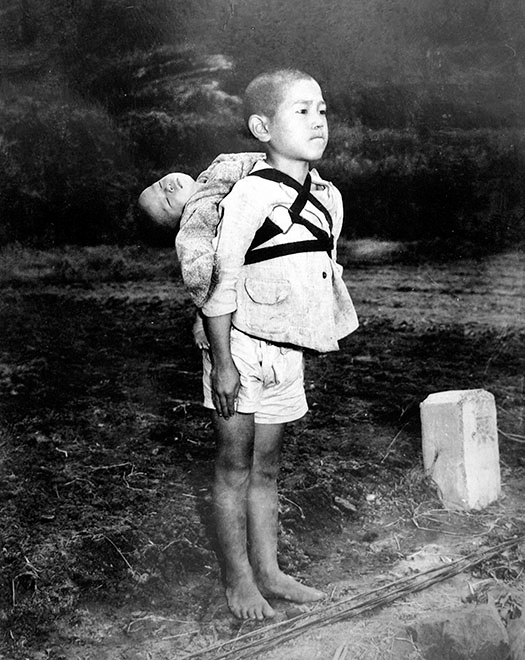
 If you’re against war, get this book: The photos will haunt you http://www.asahi.com/ajw/articles/AJ201708100035.html By SONOKO MIYAZAKI/ Staff Writer August 10, 2017 A boy standing at rigid attention with the dead body of his infant brother strapped to his back at a crematorium in Nagasaki is one of searing images of the city’s destruction after the U.S. atomic bombing in 1945.
In a book published Aug. 9, Kimiko Sakai, the widow of Joe O’Donnell, the photographer who snapped the image, tells the story of her husband’s life work through photographs he shot in Japan in the immediate aftermath of the war.
Aug. 9 marked the 72nd anniversary of the bombing as well as the 10th anniversary of O’Donnell’s death at the age of 85.
The 192-page book, titled “Kamisama no Finder: Moto-Beijugun Cameraman no Isan” (God’s finder: the legacy of a former war photographer), was published by the Tokyo-based Word of Life Press Ministries.
After Japan’s surrender, O’Donnell, who was attached to the U.S. Marine Corps, traveled to Hiroshima, Nagasaki and other Japanese cities to document the wartime devastation. He stayed in Japan from September 1945 to March 1946.
He took 300 or so photographs for his private use.
He believed it was wrong to drop the atomic bombs after witnessing the sufferings of the victims.
But O’Donnell didn’t exhibit these pictures for decades because of prevailing U.S. sentiment that the atomic bombings of Hiroshima and Nagasaki hastened the end of World War and saved many American lives.
O’Donnell later decided to exhibit the photographs in the hope they would help advance the anti-war movement.
The catalyst for this was when he gazed on a sculpture evoking Jesus on the cross and engulfed by flames at a church in Kentucky in 1989. The life-size work, titled “Once,” was created for the repose of the tens of thousands of people killed in that atomic bombings, with photos of victims pasted all over the body. O’Donnell was stunned.
After that, O’Donnell until his death held exhibitions of his photos in the United States and Japan to convey the horrors of nuclear war.
The image of the boy at the crematorium stayed with him. O’Donnell recalled that the boy stared motionless as bodies were being burned and he awaited his turn. He also noticed that the boy’s lips were caked with blood because he was biting them so hard, although no blood spilled.
Sakai agreed to a proposal to publish the book after she was contacted by the publisher two years or so ago. Sakai, who lives in Tennessee, said she accepted out of respect for her husband’s commitment to the anti-war cause.
“My husband photographed his subjects as fellow human beings, not as an occupier,” she said in a recent interview with The Asahi Shimbun.
Asked if she had a message for those working to rid the world of nuclear arsenals, she said, “Just ‘not to forget,’ which is important.”
August 11, 2017
Posted by Christina Macpherson |
history, Japan, Reference, resources - print, weapons and war |
Leave a comment
August 10, 2017 (Mainichi Japan) MITO, Japan (Kyodo) — Ibaraki Gov. Masaru Hashimoto said Thursday he will not consent to restarting the sole reactor at the Tokai No. 2 nuclear power plant in Tokaimura, which went offline in March 2011 just as a nuclear disaster unfolded in neighboring Fukushima Prefecture.
Hashimoto’s pledge, coming on the day his campaigning for a seventh term as governor officially got under way, goes further than his previous stance on the issue, in which he had set conditions for a restart.
“I will not approve a restart,” Hashimoto said at an event marking the start of his official campaign for the Aug. 27 gubernatorial election. “I will steer in the direction of not accepting nuclear power,” he told his supporters….. https://mainichi.jp/english/articles/20170810/p2g/00m/0dm/075000c
August 11, 2017
Posted by Christina Macpherson |
Japan, politics |
Leave a comment
 Delayed Toshiba earnings report reveals $8.8b in losses By Tech Wire Asia | 10th August 2017 | @techwireasia AFTER several delays, Toshiba Corp. has finally released an audited earnings report, which revealed the company’s losses are valued at JPY965.7 billion (US$8.8 billion) for the 2016-2017 financial year ending March this year, reported Bloomberg.
Though a startling number, it should be noted those losses are comparable to the initial estimates by independent analysts who predicted Toshiba would lose an average of JPY977.4 billion (US$8.9 billion). Toshiba’s own outlook was far more bleak, with their own financial officials reporting they expected to lose JPY1.01 trillion (US$9.2 billion)…..
suspicions about the company’s opaque finances have resulted in slipping stock prices, a situation exacerbated by the bankruptcy of its Westinghouse nuclear business…..
The company is facing a possible delisting from the Tokyo Stock Exchange as a result of the manipulation of its account books. The matter is under investigation and if Toshiba fails to clean up its act and pull itself out of the red by next March, expulsion is almost a given…….http://techwireasia.com/2017/08/toshiba-earnings-report-huge-losses/#mMpeeOZFUAVImZpQ.97
August 11, 2017
Posted by Christina Macpherson |
business and costs, Japan |
Leave a comment

 Fukushima city is going to host Olympic baseball and softball games in 2020.
What is the level of radio-contamination there? This is the question on everybody’s mind, spectators and players from all over the world. Is it really safe?
Baseball and softball games will take place in Azuma Sports Park in Fukushima city.


Fukushima prefecture provides the information below on the radiation measurements of the Park.

Measurements of the airborne radiation dose in the baseball stadium: No 13-16
Those of the softball stadium: No 4
The lines above and below indicate the value of the radiation dose at 1cm and 5cm above the ground.
We notice that, as usual, Fukushima prefecture gives only measurements in terms of radiation dose. Based on this information, one might think that it would be relatively safe to play there or to attend the games. However, monitoring only the radiation dose is not enough for radioprotection. The radiation dose is an indication of external irradiation exposure. In this case, the measures of radioprotection will be to stay away from the radioactive objects or not to stay in their vicinity for a long time. But the radiation dose does not provide information to avoid the risk of internal irradiation. For this latter, it is necessary to monitor surface contamination density or concentration, in this case, of soil (in terms of Becquerels/m2 or Bq/kg), as well as the concentration of radioactive substances in the air (Bq/m3). The radioprotection measures against internal irradiation would be wearing protective gear and masks to avoid the radioactive substances from adhering to the skin and/or entering the body.
Here is some information provided by Yoichi OZAWA of « Fukuichi Area Environmental Radiation Monitoring Project », the group of which we have published several soil contamination maps in this blog. OZAWA took measurements on July 27 at the request of the ARD German TV channel team which was visiting Fukushima.

Contamination concentration and density of 5cm surface soil around the Azuma Baseball Stadium
Point A : The entrance of the « Torimu no Mori» where children play.
Radiation dose at 1m above the ground : 0.12 μSv/h
Radiation dose on the ground : 0.19µSv/h
Surface concentration : 605 Bq/kg
Surface density : 47,300 Bq/m2
Point B : In front of the Multi-purpose Fields.
Radiation dose at 1m above the ground : 0.10 μSv/h
Radiation dose on the ground : 0.22µSv/h
Surface concentration : 410 Bq/kg
Surface density : 31,200 Bq/m2
To interpret these figures, let us remind you that in Japan, according to the Ordinance on Prevention of Ionizing Radiation Hazards, places where the effective dose is likely to surpass 1.3mSv in 3 months (approximately 0.6µSv/h of airborne radioactivity) or the contamination density to exceed 40,000Bq/m2 are designated as a « Radiation Control Zone » and public entry must be severely restricted. People under 18 years old are not allowed to enter, and even adults, including nuclear workers, cannot stay more than 10 hours. It is prohibited to eat, drink or stay overnight. To leave the zone, one has go through a strict screening to check for radioactive substances leaving the zone, a measure to protect the individual person as well as the environment.
We do not have the measures of surface density of the baseball nor softball stadiums, but in answering the question of the above German TV team, the information was given as to the decontamination work and radiation dose. There had been decontamination work, and the airborne radiation dose was about 0.04µSv/h in the baseball stadium.
Even when decontamination work has been carried out in the stadium, the mountains and woods behind the park have not been decontaminated, and wind and rain bring the radioactive substances towards the park. Besides, as we can see above, other places in the park are highly contaminated when we look at the surface contamination. They represent high risks of internal irradiation. Moreover, according to recent research, radioactive particles disseminated by the Fukushima Daiichi nuclear accident are mostly insoluble in water. This characteristic makes the health hazard much worse than in the case of the usual water soluble Cesium (see English transcription of NHK documentary on Insoluble Radioactive Particles in this blog). We believe that this Park should not be open to the public, especially to children.
The small type of insoluble radioactive particles – also called Cesium balls -, are dispersed in the Tokyo metropolitan area. People who visit this area should be careful and should take adequate radioprotection measures especially when it is windy and the radioactive particles can be re-disseminated.
All in all, we believe that there is far too much risk for the players and spectators to participate in the Olympic games in Fukushima. Fukushima should not host the Olympic games. Furthermore, we are against holding the Olympic games in Tokyo.
___
Read also :
Forest fire in the exclusion zone in Fukushima: Why monitoring the radiation dose is not enough for radioprotection
See the publication of August 4 2017 in the FB of Oz Yo
https://fukushima311voices.wordpress.com/2017/08/07/olympic-games-in-fukushima-is-it-safe/
August 7, 2017
Posted by dunrenard |
Fukushima 2017, Fukushima continuing | Contamination, Fukushima Olympics, radiation, Tokyo Olympics |
2 Comments
 Hiroshima anniversary highlights contrasting nuclear views, TODAY, AUGUST 7, 2017, TOKYO — Japan yesterday marked 72 years since the nuclear bombing of Hiroshima, with the nation’s traditional contradictions over atomic weapons again coming into focus.
The anniversary came after Japan sided last month with nuclear powers Britain, France and the United States to dismiss a United Nations treaty banning atomic weapons, which was rejected by critics for ignoring the reality of security threats such as North Korea. Japan is the only country to have suffered atomic attacks, in 1945.
Prime Minister Shinzo Abe, speaking at the annual ceremony at Hiroshima Peace Memorial Park near Ground Zero, said Japan hoped to push for a world without nuclear weapons in a way that all countries can agree upon……..
This hell is not a thing of the past,” said Hiroshima Mayor Kazumi Matsui in his peace declaration at yesterday’s ceremony.
“As long as nuclear weapons exist and policymakers threaten their use, their horror could leap into our present at any moment. You could find yourself suffering their cruelty.
“Today, a single bomb can cause even greater damage than the bombs dropped 72 years ago.
“Humankind must never commit such an act,’’ he added, urging nuclear states, as well as Japan, to join the UN nuclear weapons ban treaty adopted in July.
Japanese officials have criticised the treaty as deepening a divide between countries with and without nuclear arms.None of the nine countries that possess nuclear weapons took part in the negotiations or voted on the treaty. Japanese officials routinely argue that they abhor nuclear weapons, but the nation’s defence is firmly set under the US nuclear umbrella.
In his message to Hiroshima, UN Secretary-General Antonio Guterres said the presence of some 15,000 nuclear weapons, along with “dangerous rhetoric regarding their use”, has exacerbated the threat they pose……
Many in Japan feel the attacks on Hiroshima and Nagasaki amounted to war crimes and atrocities because they targeted civilians, and also because of the unprecedented destructive nature of the weapons…….http://www.todayonline.com/world/asia/hiroshima-anniversary-highlights-contrasting-nuclear-views
August 7, 2017
Posted by Christina Macpherson |
Japan, weapons and war |
1 Comment
NHK 3rd Aug 2017, The operator of the Fukushima Daiichi nuclear power plant says the
groundwater level briefly plummeted near a building that houses one of the
crippled reactors.
Tokyo Electric Power Company, or TEPCO, says the fall
was observed in a monitoring well about 11 meters southwest of the No.4
reactor building on Wednesday. The utility says the groundwater level
temporarily sank roughly 1 meter below the level of contaminated water
inside the reactor building. The firm says the groundwater rose above the
usual level 23 minutes later.
A sharp fall in the groundwater level just
outside reactor buildings could cause contaminated water to leak from
inside the buildings. https://www3.nhk.or.jp/nhkworld/en/news/20170804_06/
August 7, 2017
Posted by Christina Macpherson |
Fukushima continuing |
Leave a comment
“I want you to feel the presence of not only the future generations, who will benefit from your negotiations to ban nuclear weapons, but to feel a cloud of witnesses from Hiroshima and Nagasaki.”
“We have no doubt that this treaty can – and will – change the world.” – Setsuko Thurlow, a Hiroshima atomic bomb victim
The elimination of nuclear weapons has been the cause that Greenpeace campaigned so passionately and heavily for since 1971.
Even with the passing of the UN’s Nuclear Weapons Ban Treaty, Japan still remains an outlier, betraying the hopes of atomic bomb survivors from Hiroshima and Nagasaki.
It started with just 12 of them. With a bold mission, this group of activists set sail to Amchitka island off Alaska to protest the detonation of an underground US nuclear test. It was September 1971, and though the mission was initially unsuccessful, it was the beginning of what became Greenpeace, and just one of the many issues – the elimination of nuclear weapons – that the environmental organisation would campaign endlessly against.
Fast forward to 2017, and what was once a hard-fought battle and one of Greenpeace’s legacy issues, has now become a successful defeat. On 7 July, the United Nations adopted the “Nuclear Weapons Treaty” with an overwhelming majority – an epoch-making agreement that prohibits not only the development, experiment, manufacture, possession, and use of nuclear weapons, but also the “threat to use”. Nuclear and chemical weapons, and anti-personnel landmines and cluster bombs were also banned. The Treaty will be open for signature by states on September 20th.
To our disappointment, however, Japan did not join the 122 countries, or two-thirds of the United Nations member countries, that stood up to stop nuclear weapons. The peculiar absence of Japan, whose preamble explicitly recognizes “unacceptable suffering of and harm caused to the victims of the use of nuclear weapons (Hibakusha) as well as those affected by the testing of nuclear weapons” begs explanation.
The Government of Japan expressed a concern that the Treaty that was negotiated only among non-nuclear weapon states could create “a more decisive divide” between the states with and without nuclear weapons. From a standpoint of realpolitik of the Cold War era, Japan is under an American nuclear umbrella, and as such, would violate a Treaty prohibiting the “threat to use” if it were to be a signatory. Therefore Japan sides with the nuclear weapons states (the US, Russia, China, France, UK, India, Pakistan, Israel, North Korea) and the North Atlantic Treaty Organization (NATO) countries that rely on the US nuclear umbrella.
The adoption of this historic Treaty by an overwhelming majority of the UN membership, nonetheless, represents a hard-won victory for people such as the Hibakusha (Japanese word for the surviving victims of the 1945 atomic bombings of Hiroshima and Nagasaki), victims of American nuclear tests and their descendents, and grassroots activists who worked tirelessly against the European nuclear deployment and uranium mining in Australia. The Treaty is a long lasting legacy of their testimonies, protests and actions of the past decades, and keeps a hope alive for realization of the nuclear free world.
Setsuko Thurlow, a Hiroshima atomic bomb victim who now lives in Canada, told delegates of the Treaty negotiations:
“I want you to feel the presence of not only the future generations, who will benefit from your negotiations to ban nuclear weapons, but to feel a cloud of witnesses from Hiroshima and Nagasaki.”
“We have no doubt that this treaty can – and will – change the world.”
On the 72nd anniversary of the Hiroshima and Nagasaki bombings, we stand in solidarity with the survivors and those across the world who have campaigned against nuclear weaponry and call for Japan to join the Treaty. The elimination of nuclear weapons has been the cause that Greenpeace campaigned so passionately and heavily for since 1971. As the only country in the world hit by a nuclear attack, Japan’s commitment to the Treaty would not only be a long-fought win for the country’s tainted history, but also an important step towards a future world that is ultimately safe and nuclear free.
Yuko Yoneda is the Executive Director at Greenpeace Japan.
August 5, 2017
Posted by Christina Macpherson |
Japan, opposition to nuclear |
2 Comments
Reuters 31st July 2017, Japan’s Mitsubishi Heavy Industries (MHI) will buy a 19.5 percent stake in nuclear reactor builder Areva New NP as part of the sale of the Areva unit to utility EDF, MHI said in a statement.
MHI confirmed it is also scheduled to acquire a 5 percent stake in nuclear fuel group New Areva Holding, formerly referred to as “NewCo”, by the end of this year. http://af.reuters.com/article/commoditiesNews/idAFL5N1KM4MU
August 4, 2017
Posted by Christina Macpherson |
business and costs, Japan |
Leave a comment
 In Cumbria 2nd Aug 2017, Toshiba, the owner of the company with plans for a £10bn Cumbrian nuclear new build, has been demoted to the second tier of the Tokyo Stock Exchange.
The Japanese giant- which has taken full control of NuGen, which is behind proposals for a power station at Moorside, near Sellafield – has also seen its share price drop following the move. It will no longer feature in the Nikkei 225 index of Japan’s top public companies also faces the prospect of being delisted from the stock exchange altogether.
This switch has happened because Toshiba’s liabilities exceeded its assets by several billion yen
following a write-off for its American nuclear division Westinghouse Electric, due to provide three AP1000 reactors for Moorside. http://www.in-cumbria.com/Cumbria-nuclear-backer-Toshiba-sees-stock-exchange-demotion-82f05225-a586-4022-adf6-90d8e015c62b-ds
August 4, 2017
Posted by Christina Macpherson |
business and costs, Japan, UK |
Leave a comment
 Extent of A-bomb dust inhalation in 1945 underestimated: researchers https://mainichi.jp/english/articles/20170731/p2a/00m/0na/004000cJuly 31, 2017 (Mainichi Japan)HIROSHIMA — The prevalence of acute symptoms among teenage soldiers exposed to dust particles as they helped out with relief operations in the aftermath of the 1945 U.S. atomic bombing of Hiroshima has been found to be at least 10 times higher than those who were unexposed, it has been learned.
The findings came to light following a questionnaire conducted in February last year by a team of researchers including Megu Otaki, a professor emeritus of statistics at Hiroshima University, covering 142 former army cadets aged between 15 and 19 at the time of the atomic bombing.
The army cadets were gathered together outside Hiroshima on the day the bomb was dropped — Aug. 6, 1945 — before venturing into the city to assist with relief operations between noon and around 5 p.m. In the 2016 questionnaire, the former cadets were asked questions about operation content and locations, inhalation of dust particles, as well as their subsequent health conditions — eliciting responses from 64 of them in total.
In its decision on the effects of internal exposure from inhaling dust particles tainted with radioactive materials, the Japan-U.S. research organization Radiation Effects Research Foundation said that, “The amount in this case is low enough to be ignored.” This decision has been used by the Japanese government in recognizing A-bomb survivors as suffering from A-bomb related diseases.
However, Otaki states that, “It is very likely that the acute symptoms and the disorders that A-bomb victims later developed were mainly caused by internal exposure to radiation (from dust particles). The impact (of the dust particles) has been underestimated.”
The survey found that the frequency of acute symptoms such as hair loss and diarrhea was 11.7 times higher in the group (21 people) exposed to dust particles while operating within a 2-kilometer radius of the bomb’s hypocenter than those who weren’t exposed at locations 2 kilometers or more away (22 people, including some unknown). Similarly, the frequency of acute symptoms was also found to be 5.5 times higher among those who were exposed to dust particles more than 2 kilometers away from ground zero (9 people) than those who weren’t exposed. In addition, there were more cases of people developing cancer and leukemia among the groups exposed to the dust particles.
Commenting on these results, Otaki says, “Although the sample size is small, the conditions of the subjects such as age, health conditions, and the length of relief operation time are almost the same, meaning the data is very reliable.”
In addition, upon re-examining data released by the foundation in 2001 — which showed the relationship between estimated radiation dose and the frequency of chromosomal abnormalities in 3,042 atomic bomb victims — it has become clear that the radiation dose received by victims who were indoors is possibly 30 percent higher than initially thought. Based on this, the team of researchers has concluded that, “It is very likely that people developed chromosomal abnormalities after being exposed to radiation by inhaling dust particles upon going back into damaged buildings.”
With regard to residual radiation and internal exposure to radiation, the foundation has previously concluded that compared to the initial levels of radiation emitted at the time of the explosion, the residual radiation values are lower, making residual radiation “less of a threat to people’s health.” Based on this conclusion, the foundation devised a formula for calculating the estimated exposed dosage deriving only from the initial radiation, which the government has used to recognize “A-bomb related diseases.”
However, there has been a string of judicial rulings determining that the extent of internal exposure has been underestimated, based on examinations of symptoms and experiences of plaintiffs involved in “A-bomb related disease” certification lawsuits.
With this kind of reality in mind, Otaki says, “There are concerns that atomic bomb victims who should have been supported have actually been abandoned. We must reconsider the calculation method.”
August 2, 2017
Posted by Christina Macpherson |
Japan, radiation, Reference |
Leave a comment
,Japan Times, 1 Aug 17 KYODO KYODO AUG 1, 2017 HIROSHIMA/NAGASAKI – The mayors of Hiroshima and Nagasaki will call on the government to help realize a treaty banning nuclear weapons at upcoming anniversaries marking the 1945 U.S. atomic bombings in their cities.
This year’s declarations follow the adoption in New York last month by 122 U.N. members of the Treaty on the Prohibition of Nuclear Weapons. As a country under the U.S. nuclear umbrella, Japan did not participate, nor did any of the nuclear weapon states.
Hiroshima Mayor Kazumi Matsui announced an outline of his declaration at a news conference on Tuesday, to be read out at a commemoration ceremony on the anniversary of the bombing on Aug. 6.
According to the outline, he will stress that the “hell” Hiroshima saw 72 years ago is not a thing of the past, saying, “As long as nuclear weapons exist and policymakers threaten their use, their horror could leap into our present at any moment.”…..
Nagasaki Mayor Tomihisa Taue is to read his declaration at the city’s ceremony three days later on Aug. 9. In Nagasaki, an estimated 74,000 people died from the bombing by the end of 1945.
“Action by civil society will be crucial in making the nuclear prohibition treaty an international norm,” Taue said at a news conference on Monday announcing the outline of his declaration. “I would like to call for coordination.”
Taue said he will call on the government to change its mind and join the treaty, while Matsui will urge the government to “manifest the pacifism in our Constitution” by “doing everything in its power to bridge the gap between the nuclear weapon and non-nuclear weapon states.”…..
Both the Hiroshima and Nagasaki declarations were drafted after meetings in recent months with hibakusha and experts. http://www.japantimes.co.jp/news/2017/08/01/national/hiroshima-nagasaki-mayors-urge-government-act-nuke-ban-treaty/#.WYD_7xWGPGg
August 2, 2017
Posted by Christina Macpherson |
Japan, politics, politics international, weapons and war |
Leave a comment
August 01, 2017 Jiji Press FUKUI — Kansai Electric Power Co. said Monday it has concluded a contract to procure mixed oxide, or MOX, nuclear fuel for the Nos. 3 and 4 reactors at its Takahama nuclear power station in the central prefecture of Fukui.
The company signed the contract with Nuclear Fuel Industries Ltd. MOX fuel is a blend of uranium and plutonium extracted from spent nuclear fuel.
Kansai Electric became the first power supplier in Japan to conclude a deal to receive supply of MOX fuel since the March 2011 triple meltdown at Tokyo Electric Power Company Holdings Inc.’s Fukushima No. 1 nuclear plant.
Nuclear Fuel Industries will take charge of the design of MOX fuel and other processes. The production will be commissioned to a group plant of French nuclear giant Areva SA. Under the deal, 32 sets of MOX fuel will be produced —16 sets each for the two reactors.
Kansai Electric concluded similar procurement deals in March and November 2008. In both cases, it was a few years before MOX fuel produced abroad arrived at the Takahama nuclear plant after the deals were concluded.
The Takahama Nos. 3 and 4 reactors, which went back online earlier this year, produce electricity using MOX fuel, a method called “plu-thermal” power generation.
“We will continue with plu-thermal while giving top priority to safety,” Kansai Electric said
August 2, 2017
Posted by Christina Macpherson |
Japan, technology |
Leave a comment
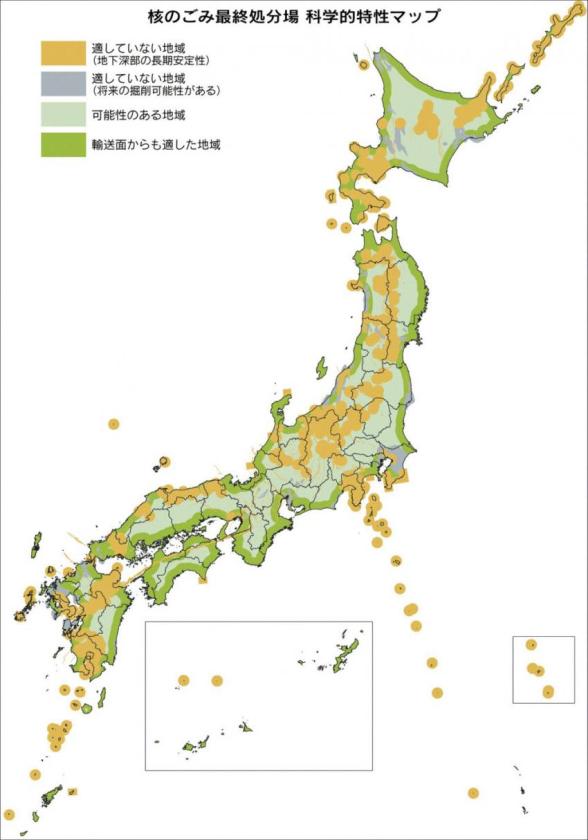
The Japanese government unveiled Friday a map indicating potential deep-underground disposal sites for high-level radioactive nuclear waste, identifying some 70% of the country’s land as suitable.
Based on the map, the government is expected to ask multiple municipalities to accept researchers looking into whether those areas can host sites to dispose of waste left by nuclear power generation. But the process promises to be both difficult and complicated amid public concerns over nuclear safety following the 2011 Fukushima nuclear disaster.
The nationwide map showed that up to 900 municipalities, or half of the country total, encompass coastal areas deemed “favorable.” Areas near active faults, volcanoes and potential drilling sites such as around oil fields are considered unsuitable.
For permanent disposal, high-level radioactive waste, produced as a result of the process of extracting uranium and plutonium from spent fuel, must be stored more than 300 meters underground so that it cannot impact human lives or the environment.
The government will store the waste in vitrified canisters for up to some 100,000 years until the waste’s radioactivity decreases.
As of March, some 18,000 tons of spent fuel existed in Japan with the figure set to increase as more nuclear plants resume operation. When spent fuel that has already been reprocessed is included, Japan will have to deal with about 25,000 such canisters.
The map, illustrated in four different colors based on levels of the suitability of geological conditions, was posted on the website of the Ministry of Economy, Trade and Industry.
Energy minister Hiroshige Seko said Friday that the unveiling of the colored map is an “extremely important step toward the realization of the final disposal but also the first step of a long road.”
Taking the map as an opportunity, “we hope to have communications (with municipalities) nationwide and earn the understanding of the public,” he said.
“It scientifically and objectively shows nationwide conditions, but it is not something with which we will seek municipalities’ decisions on whether to accept a disposal site,” Seko said.
Areas near active faults, volcanoes and oil fields which are potential drilling sites are deemed unsuitable because of “presumed unfavorable characteristics” and colored in orange and silver.
Areas other than those are classified as possessing “relatively high potential” and colored in light green.
Among the potential areas, zones within 20 kilometers of a coastline, around 30 percent of total land, are deemed especially favorable in terms of waste transportation and colored in green.
The map has also colored as suitable a part of Fukushima Prefecture, where reconstruction efforts are underway from the 2011 massive earthquake and tsunami that led to the Fukushima nuclear plant disaster.
But Seko said the government has no plans at this stage to burden the prefecture additionally with the issue of disposal of high-level radioactive waste.
The minister also indicated that Aomori Prefecture in northeastern Japan, home to a facility to reprocess nuclear fuel, is exempt as the prefectural government and state have agreed not to construct a nuclear waste disposal facility there.
Japan, like many other countries with nuclear plants, is struggling to find a permanent geological disposal repository, while Finland and Sweden are the only countries worldwide to have decided on final disposal sites.
A process to find local governments willing to host a final repository site started in 2002 in Japan, but little progress was made due mainly to opposition from local residents.
In 2015, the government decided to choose candidate sites suitable on scientific grounds for building a permanent storage facility, rather than waiting for municipalities to offer to host such a site.
The government aims to construct a site that can house more than 40,000 canisters, with estimated costs amounting to 3.7 trillion yen ($33 billion).
https://japantoday.com/category/national/update1-gov%27t-says-70-of-land-suitable-for-nuclear-waste-disposal#.WXxbhcFJL1A.twitter
July 31, 2017
Posted by dunrenard |
Japan | Disposal Sites, METI, nuclear waste |
Leave a comment
Footage from reactor 3 may force rewrite of Fukushima road map, officials say, http://www.japantimes.co.jp/news/2017/07/30/national/footage-reactor-3-may-force-rewrite-fukushima-road-map-officials-say/ KYODO The first images of melted fuel from the crippled Fukushima No. 1 power plant indicate that it did not burn through the pressure vessel of reactor 3, but exited through the holes used to insert the control rods, officials say.
While the landmark robot footage from the primary containment vessel of unit 3 is helping Tokyo Electric grasp the reality of the damaged fuel assemblies, it may also force it to rewrite the road map for decommissioning the meltdown-hit plant.
Tokyo Electric Power Company Holdings Inc., better known as Tepco, sent an underwater robot into reactor 3 earlier this month to confirm its hypothesis that the core — the fuel assemblies in the pressure vessel — broke apart and fell to the bottom, letting molten fuel burn through and drip into the primary containment vessel.
According to Tepco spokesman Takahiro Kimo to, however, the images taken beneath the PCV indicate the pressure vessel probably withstood the heat of the molten fuel. He said the fuel apparently seeped through the holes for the control rods.
“We do not presume that the vessel, which is 14 cm thick, melted and collapsed together with the fuel, but that part of the fuel instead made its way down through holes,” Kimoto said. The control rods are used to moderate the chain reaction and are inserted vertically into the core.
Tepco said it estimates reactor 3 has about 364 tons of fuel debris, and that similar amounts will be found in reactors 1 and 2. Removing the fuel from the reactors is the largest challenge in defueling the aged plant — a process that could take up to 40 years to complete.

The camera on the underwater robot also captured images of rubble around the fuel debris, which could slow the removal process. The rubble includes devices for supporting the control rods at the bottom of the PCV and scaffolding for maintenance workers beneath the pressure vessel.
Minister of Economy, Trade and Industry Hiroshige Seko said the government and Tepco will try to draft a plan for removing the melted fuel in September, with an eye to hammering out the specifics in the first half of fiscal 2018 and starting the work in 2021.
But the findings from reactor 3 may force them to alter the state’s road map for decommissioning Fukushima No. 1, officials said.
An entity providing technical support for the project has urged that efforts be made to remove the melted fuel from the submerged lower part of the PCV by keeping air in the upper part, according to a source familiar with the plan.
Although filling the PCV completely with water would largely reduce the radiation risk to the robot probes, the Nuclear Damage Compensation and Decommissioning Facilitation Corp. is reluctant to do so because it is damaged and the toxic water will just leak out, the source said.
At the other two reactors, Tepco thinks most of the fuel in reactor 1 fell to the bottom of the primary containment vessel, and that some of the fuel in reactor 2 remained in the pressure vessel. The company made the estimates based on cosmic ray imaging analysis and by sending robots and endoscopes into the PCVs of the two reactors.
July 31, 2017
Posted by Christina Macpherson |
Fukushima continuing |
Leave a comment