Link above is to a PDF, 47 page, readable report. Very well done. stock out
Nuclear issue again takes center stage in Niigata election

The three independent candidates for Niigata governor are, from left: Chikako Ikeda, Hideyo Hanazumi and Satoshi Annaka.
May 25, 2018
NIIGATA–The election for a new governor of Niigata Prefecture was triggered by a sex scandal, but the key issue facing voters is where the candidates stand on restarting the Kashiwazaki-Kariwa nuclear power plant, one of the world’s biggest nuclear facilities.
Campaigning officially kicked off May 24.
The outcome of the June 10 vote could have a bearing on the Abe administration’s moves to bring more nuclear plants back online.
Although the candidates are running as independents, two are supported by political parties.
In early speeches, they all outlined their position on the nuclear plant operated by Tokyo Electric Power Co., but residents are calling on them to be less cautious and state where they truly stand.
“Many people are still suffering (because of the Fukushima nuclear disaster), and there are still many people living as evacuees,” said a female resident, 66. “Some kids have even been bullied. So I really want the candidates to state clearly that Niigata doesn’t need a nuclear plant anymore.”
On the other hand, a 70-year-old female resident argued that local people “cannot flatly oppose the restart of the nuclear plant because of the impact it will have on economy.”
For this reason, she said, “I cannot easily say I am against it.”
The election is expected to come down to a battle between Hideyo Hanazumi, 60, a former vice commandant of the Japan Coast Guard, and Chikako Ikeda, 57, a former member of the prefectural assembly.
Hanazumi is supported by the ruling coalition of the Liberal Democratic Party and Komeito, while Ikeda is backed by five opposition parties.
The other candidate is Satoshi Annaka, 40, a former member of the Gosen municipal assembly.
The election was triggered by the April resignation of Ryuichi Yoneyama after he admitted to paying women for sexual favors.
Yoneyama, 50, had taken a cautious stance on restarting the Kashiwazaki-Kariwa complex.
Hanazumi declared that he would take over an investigation started by Yoneyama to understand the fundamental cause of the triple meltdown at the Fukushima No. 1 nuclear plant in 2011, and reach his decision on the issue when the investigation ends in several years.
Ikeda stressed the significance of reviewing the Fukushima nuclear disaster, stating that continuing with the investigation is “the most basic of basics.”
She said the matter must be pursued rigorously.
Ikeda added that she would make a final decision on the restart issue after careful discussions with residents and other parties.
“I will seek a zero-nuclear Niigata Prefecture,” she said.
New research reveals significant Fukushima radioactive particle release
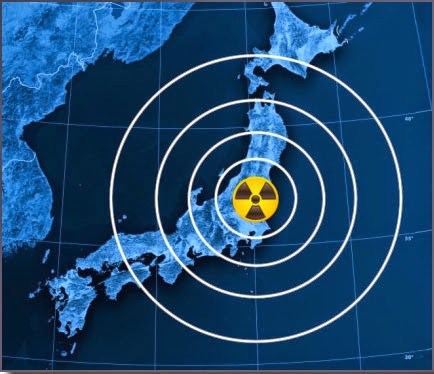 Fukushima radioactive particle release was significant says new research https://www.eurekalert.org/pub_releases/2018-05/uom-frp052418.php UNIVERSITY OF MANCHESTER
Scientists say there was a significant release of radioactive particles during the Fukushima-Daiichi nuclear accident.
The researchers identified the contamination using a new method and say if the particles are inhaled they could pose long-term health risks to humans.
The new method allows scientists to quickly count the number of caesium-rich micro-particles in Fukushima soils and quantify the amount of radioactivity associated with these particles.
The research, which was carried out by scientists from Kyushu University, Japan, and The University of Manchester, UK, was published in Environmental Science and Technology.
In the immediate aftermath of the Fukushima Daiichi nuclear accident, it was thought that only volatile, gaseous radionuclides, such as caesium and iodine, were released from the damaged reactors. However, in recent years it has become apparent that small radioactive particles, termed caesium-rich micro-particles, were also released.
Scientists have shown that these particles are mainly made of glass, and that they contain significant amounts of radioactive caesium, as well as smaller amounts of other radioisotopes, such as uranium and technetium.
The abundance of these micro-particles in Japanese soils and sediments, and their environmental impact is poorly understood. But the particles are very small and do not dissolve easily, meaning they could pose long-term health risks to humans if inhaled.
Therefore, scientists need to understand how many of the micro-particles are present in Fukushima soils and how much of the soil radioactivity can be attributed to the particles. Until recently, these measurements have proven challenging.
The new method makes use of a technique that is readily available in most Radiochemistry Laboratories called Autoradiography. In the method, an imaging plate is placed over contaminated soil samples covered with a plastic wrap, and the radioactive decay from the soil is recorded as an image on the plate. The image from plate is then read onto a computer.
The scientists say radioactive decay from the caesium-rich micro particles can be differentiated from other forms of caesium contamination in the soil.
The scientists tested the new method on rice paddy soil samples retrieved from different locations within the Fukushima prefecture. The samples were taken close to (4 km) and far away (40 km) from the damaged nuclear reactors. The new method found caesium-rich micro-particles in all of the samples and showed that the amount of caesium associated with the micro-particles in the soil was much larger than expected.
Dr Satoshi Utsunomiya, Associate Professor at Kyushu University, Japan, and the lead author of the study says “when we first started to find caesium-rich micro-particles in Fukushima soil samples, we thought they would turn out to be relatively rare. Now, using this method, we find there are lots of caesium-rich microparticles in exclusion zone soils and also in the soils collected from outside of the exclusion zone”.
Dr Gareth Law, Senior Lecturer in Analytical Radiochemistry at the University of Manchester and an author on the paper, adds: “Our research indicates that significant amounts of caesium were released from the Fukushima Daiichi reactors in particle form.
“This particle form of caesium behaves differently to the other, more soluble forms of caesium in the environment. We now need to push forward and better understand if caesium micro-particles are abundant throughout not only the exclusion zone, but also elsewhere in the Fukushima prefecture; then we can start to gauge their impact”.
The new method can be easily used by other research teams investigating the environmental impact of the Fukushima Daiichi accident.
Dr Utsunomiya adds: “we hope that our method will allow scientists to quickly measure the abundance of caesium-rich micro-particles at other locations and estimate the amount of caesium radioactivity associated with the particles. This information can then inform cost effective, safe management and clean-up of soils contaminated by the nuclear accident”.
Air duct corrosion and holes found at seven nuclear plants
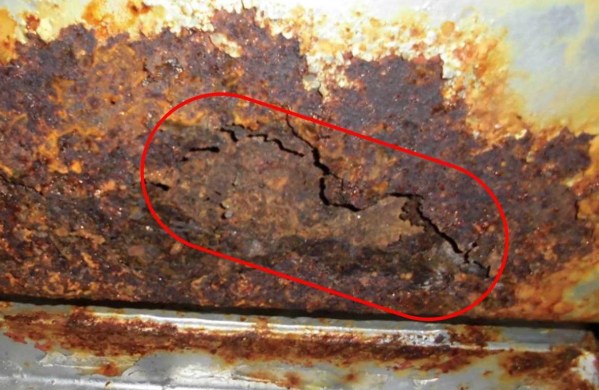
Corrosion is seen in a ventilation duct at the No. 3 unit of the Kashiwazaki-Kariwa nuclear power plant in Niigata Prefecture. | NUCLEAR REGULATION AUTHORITY
Corrosion and holes have been found in ventilation ducts at 12 reactors at seven nuclear plants across the country, the Nuclear Regulation Authority said Wednesday, raising concerns that workers could be exposed to radiation in the event of an accident.
The governmental nuclear watchdog released the results of a nationwide survey it had ordered following a revelation in December 2016 that corrosion had left multiple holes in the air ducts of the No. 2 reactor at Chugoku Electric Power Co.’s Shimane plant in western Japan. That reactor was not included in the survey.
Serious corrosion was found at the No. 3 unit of the Kashiwazaki-Kariwa plant in Niigata Prefecture operated by Tokyo Electric Power Company Holdings Inc. and may have abnormally affected ventilation of the central control room, the watchdog said.
Although the No. 7 unit at the same plant has passed a test to resume operation, the NRA said it will inspect the impact of any corrosion found at the reactor. No abnormality associated with corrosion has been found at the remaining 10 units, it said.
Corrosion or holes were found in steel or galvanized steel ducts at Tohoku Electric Power Co.’s Onagawa nuclear plant, Japan Atomic Power Co.’s Tokai No. 2 nuclear plant, Tepco’s Fukushima No. 1 nuclear plant and Kashiwazaki-Kariwa nuclear plant, Chubu Electric Power Co.’s Hamaoka plant, Hokuriku Electric Power Co.’s Shiga nuclear plant and Chugoku Electric’s Shimane plant.
If an accident occurs, radioactive materials could flow into a plant’s central control room through such holes, putting workers in danger of radiation exposure.
At the No. 3 reactor at the Kashiwazaki-Kariwa plant, a crack as large as 13 centimeters in length and 5 cm in width was found. A total of nine holes and cracks have been discovered at the Nos. 3 and 7 units at the plant.
All the reactors with corrosion were boiling-water reactors, the same type used at the Fukushima No. 1 plant, which spewed a massive amount of radioactive material into the atmosphere following the March 2011 earthquake and tsunami.
No problems have been detected at pressurized-water nuclear reactors, as filtering and other measures take place near air inlets.
The holes at the No. 2 unit at the Shimane plant were discovered when insulation materials covering the ducts were removed for inspection.
The holes, the largest of which measured about 100 centimeters wide and about 30 centimeters long, are believed to have been caused by dew condensation and rainwater that seeped inside the building, as well as salt deposits on the ducts, given that the corrosion extended about 50 meters from the air inlet and spread from the inner surface of the ducts.
Chugoku Electric has decided to increase the number of inspection points at sections near fresh-air inlets and bolster anti-corrosion measures, including the installation of a dehumidifier.
Hitachi’s build of Wylfa nuclear power station delayed – may never happen
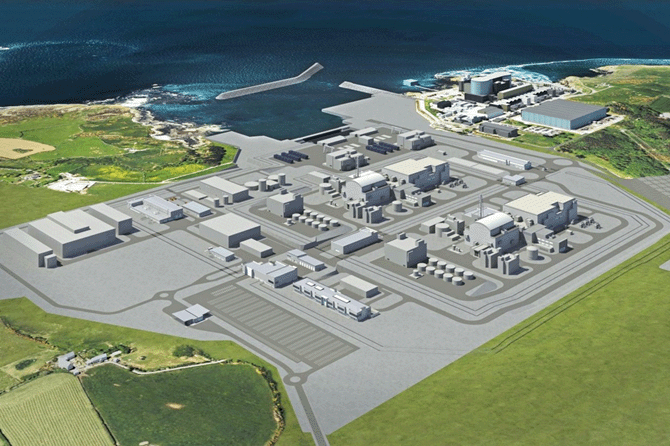
Asahi Shimbun 20th May 2018 [Machine Translation] Hitachi announced plans to delay the goal of starting
nuclear power plans planned in the UK for about two years to 2027. The collection of funds necessary for the project is difficult, and reconsideration of sharing has started between companies that undertake design and construction.
The continuation of the project itself is increasingly uncertain.
In the plan, two nuclear reactors will be built on Anglesey island in the UK. The goal of starting operation has been
announced as “early 20’s”.However, according to officials, the Hitachi side recently proposed a new goal “April 27” to companies and others involved in the plan. It is planned to decide whether to start construction in 2019,
but it seems to be assuming a case where this time is delayed.
https://www.asahi.com/articles/ASL5M4HZ3L5MULFA001.html
Japanese government’s inflexibility in keeping its nuclear power goals, despite the global transition to renewables

 Gov’t energy plan inflexibility on nuclear, renewables reveals lack of vision (Mainichi Japan) The government has unveiled its revised basic energy plan, though its core elements concerning the ratio of Japan’s electricity needs to be supplied by nuclear power and renewables by fiscal 2030 has not changed from the plan adopted three years ago.
In that three years, conditions surrounding energy production have changed drastically both inside and outside Japan, so it is very difficult to understand why the government has chosen to simply maintain course.
The energy plan calls for 20-22 percent of Japan’s energy mix to be made up of nuclear power in 2030, with renewables accounting for 22-24 percent — just as the 2015 version did. However, while Japan has been marking time, other advanced nations have been moving fast to expand solar and other renewable power generation. The reason is simple: measures to combat global warming simply cannot wait.
…….Renewable energy already makes up about 15 percent of Japan’s electricity production. The big utilities have also been expanding their renewable generation base as electricity market liberalization has spurred competition. Keeping the 2030 renewables target as-is could discourage this trend.
We must also question the continuing role projected for nuclear power. Around 30 reactors would be required to fill 20-22 percent of Japan’s energy needs as laid out in the plan, but only eight are now back in operation following the shutdowns after the triple-meltdown at the Fukushima No. 1 nuclear plant.
Serious questions are being raised over the economic viability of nuclear plants, as is shown by the fact that Kansai Electric Power Co. decided last year to decommission two of its larger reactors. Even experts are shaking their heads in doubt at the energy plan’s targets for nuclear power generation……..https://mainichi.jp/english/articles/20180519/p2a/00m/0na/016000c
Japan’s nuclear regulator reviewing Rokkasho nuclear fuel reprocessing plant
 Review of nuclear fuel reprocessing plant resumes https://www3.nhk.or.jp/nhkworld/en/news/20180517_32/ Japan’s nuclear regulator has resumed its review of an under-construction nuclear fuel reprocessing plant, following a suspension of 8 months because of a maintenance problem discovered last summer.
The Nuclear Regulation Authority on Thursday resumed its review of the plant in Rokkasho Village in Aomori Prefecture. The resumption came after the plant’s operator, Japan Nuclear Fuel Limited, gave notice that it has worked out a plan to introduce new safety measures.
Last August, rainwater was found to have flowed into a building for emergency power generators at the plant. The rainwater leak was blamed on a failure by the company to conduct mandatory inspections of the area over a period of several years.
During Thursday’s review session, Japan Nuclear Fuel explained how it will improve its maintenance programs at the plant.
In response, officials from the Regulation Authority said the company should conduct a more rigorous assessment of its past maintenance work.
In future review sessions, the regulator is planning to ask about the company’s contingency plans for emergencies such as the fallout of volcanic ash from a nearby volcano, or a plane crash.
The company is aiming to complete the construction of the plant in 3 years.
Despite costs, safety concerns, waste problem – Japan sets ambitious nuclear energy targets
Business Insider 16th May 2018 , Japan’s government has proposed an energy plan that sets ambitious targets
for nuclear energy use in the coming decade despite challenges after the
2011 Fukushima disaster. The draft, presented Wednesday to a
government-commissioned panel of experts, says that by fiscal 2030 nuclear
energy should account for 20-22 percent of Japan’s total power generation.
The Cabinet is expected to approve the plan within weeks.
The targets appear difficult to achieve given that electric utilities are opting to
scrap aging reactors rather than pay higher costs to meet post-Fukushima
safety standards. Uncertainty over what to do with massive radioactive
waste in the crowded island nation is another big concern.
http://uk.businessinsider.com/ap-japan-draft-plan-sets-ambitious-targets-for-nuclear-energy-2018-5
¥1.13 trillion of taxpayers’ money later, Japan’s Monju nuclear reprocessing reactor a spectacular failure
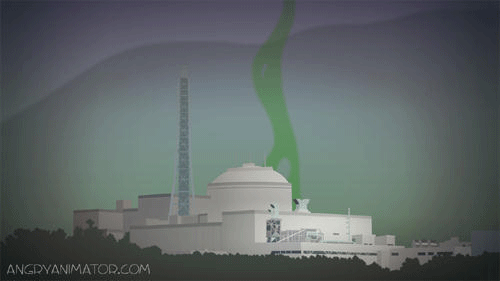
Monju reactor project failed to pay off after swallowing ¥1.13 trillion of taxpayers’ money: auditors https://www.japantimes.co.jp/news/2018/05/11/national/monju-reactor-project-failed-pay-off-swallowing-%C2%A51-13-trillion-taxpayers-money-auditors/#.WvZw_u-FPGg
The Monju fast-breeder reactor experiment yielded few sufficient results despite an investment of at least ¥1.13 trillion ($10.3 billion) worth of taxpayers money since 1994, state auditors confirmed on Friday.
The trouble-plagued prototype, which only ran for 250 days, was designed to play a key role in Japan’s quest to set up a nuclear fuel recycling program, but the project only achieved 16 percent of the intended results, the Board of Audit said.
The government finally decided to scrap Monju in December 2016 at an estimated additional cost of ¥375 billion. But the audit board noted that the 30-year decommissioning plan could cost even more.
The reactor, which started operations in 1994, was designed to produce more plutonium than it consumes while generating electricity, experienced several problems over its more than two-decade run, including a sodium coolant leak and attempted cover-up, and equipment inspection failures.
“Flawed maintenance led to the decommissioning,” the auditors concluded in their report.
But the report also spotlights the absence of a systematic evaluation system for the project. During the entire experiment, the auditors expressed their opinions on Monju’s research and development costs only once — in 2011.
Monju was only up and running for 250 days in total after repeatedly failing to complete test items, according to the report.
As for the decommissioning costs, the report said they might expand because the current estimate does not include personnel costs and taxes. It also noted that the cost of removing the radioactive sodium coolant could change.
No. 4 reactor at Oi nuclear plant restarted after nearly five years offline

Oi nuclear power plant’s No. 4 reactor (far left) in Fukui Prefecture is seen on Wednesday before being restarted by Kansai Electric Power Co.
May 10, 2018
OI, FUKUI PREF. – Kansai Electric Power Co.’s No. 4 reactor at its Oi nuclear plant in Fukui Prefecture inched closer toward running at full capacity Thursday, four years and eight months after operations were suspended.
The reactor has reached criticality, its nuclear fission chain reaction having reached a self-sustaining state, and is set to begin power generation and transmission Friday. It is projected to reach full capacity early next week.
The reactor, which was halted in September 2013 for regular checkups, is the eighth to have been reactivated under the country’s new safety standards for nuclear plants. The new standards were introduced in the wake of the March 2011 triple meltdown at Tokyo Electric Power Company Holdings Inc.’s tsunami-stricken Fukushima No. 1 nuclear plant.
Kansai Electric plans to put the No. 4 reactor into commercial mode in early June and cut its electricity prices this summer.
Commercial operations of the No. 3 and No. 4 reactors at the Oi plant are projected to help reduce the firm’s fuel costs by about ¥120 billion a year. The No. 3 unit was brought back online in March this year and entered commercial mode in April.
The utility lowered its electricity rates for households by 3.15 percent on average in August 2017, after it resumed commercial operations of the No. 3 and No. 4 reactors at its Takahama plant in Fukui Prefecture.
As each of the two Oi reactors has a capacity of 1.18 million kilowatts — larger than the 870,000 kilowatt capacity of each of the Takahama reactors — the forthcoming rate cut may be more significant than the previous one and could bring the company’s electricity prices down to levels from before the Fukushima nuclear accident, industry observers said.
Kansai Electric owns 11 reactors — four each at the Oi and Takahama plants, and three at the Mihama plant, also in Fukui Prefecture.
Besides the four currently in operation, the Mihama No. 1 and No. 2 units and the Oi No. 1 and No. 2 units are set to be decommissioned. The Mihama No. 3 unit and the Takahama No. 1 and No. 2 units are undergoing work to allow them to continue to operate after reaching 40 years of service.
With the Oi and Takahama plants located as little as 13.5 kilometers from each other, the plant operator has been urged to draw up measures that should be taken in case accidents occur at the same time at the two facilities.
This summer the government plans to carry out a comprehensive anti-disaster drill assuming simultaneous accidents.
Contaminated water leak found at Ehime Pref. nuke plant

In this file photo, the No. 3 reactor, center left, of Shikoku Electric Power Co. Ikata Nuclear Power Station is seen from a Mainichi Shimbun helicopter on March 28, 2017.
IKATA, Ehime — Water containing radioactive materials has leaked from a purification system inside of a stalled nuclear reactor here, Shikoku Electric Power Co. and the Ehime Prefectural Government announced on May 9.
The leak occurred in the auxiliary building of the No. 3 reactor at the Ikata Nuclear Power Station in the town of Ikata, Ehime Prefecture. According to the prefectural government and Shikoku Electric, the coolant water was found to be leaking from the pressure gauge stop valve for the purification system at around 2:10 a.m. on May 9.
The radiation level of the materials in the roughly 130 milliliters of escaped water measured 20 becquerels, far below the standard for filing a report to the central government. The utility and Ehime Prefecture said there is no reported leakage outside of the facility, nor was there any danger posed to employees or the surrounding environment. Regardless, the reason for the leak will be investigated thoroughly.
The No. 3 Reactor at the facility was restarted in August 2016. However, while the rector was undergoing a scheduled inspection in December 2017, a temporary injunction was handed down by the Hiroshima High Court that halted operation at the site.
(Japanese original by Aoi Hanazawa, Matsuyama Bureau)
Ohi No.4 reactor restarted
Japan’s 8th reactor is back online. Kansai Electric Power Company on Wednesday restarted a reactor at the Ohi plant in Fukui Prefecture, central Japan.
At the plant, workers pulled out the control rods that suppress atomic fission of the No.4 reactor.
The facility is expected to reach criticality early Thursday, begin power generation and transmission on Friday and go into commercial operation in early June.
The reactor had complied with new government regulations put in place following the 2011 Fukushima Daiichi nuclear accident.
Two months earlier, the utility reactivated the No.3 reactor at the plant. Two more reactors are running at its Takahama plant about 13 kilometers west of Ohi.
Although they all passed the government’s new regulations, attention is now focused on the threat of multiple accidents at these plants in the event of an earthquake and tsunami.
This summer, the government plans to hold its first drill based on a scenario that accidents have occurred simultaneously at the Ohi and Takahama plants.
In 2014, the Fukui District Court ruled against putting the No.3 and No.4 reactors at Ohi back online. It said estimated tremors of possible quakes at the plant are too optimistic. The ruling was appealed to a higher court, which has yet to decide the issue.
Anti-terror emergency response centre for Sendai nuclear power plant
https://mainichi.jp/english/articles/20180508/p2a/00m/0na/007000c
(Mainichi Japan) TOKYO –– Construction plans for an anti-terror and emergency response center for the No. 1 reactor at the Kyushu Electric Power Co.’s Sendai nuclear plant were accepted by the Nuclear Regulation Authority (NRA) on May 7.
Formal approval for the emergency center at the plant in Satsumasendai, Kagoshima Prefecture, is expected soon. Nuclear plant operators are required to build emergency response facilities within a certain timeframe under new safety standards that took effect in 2013. The plans for the Sendai plant are the first to be approved by the NRA.
The NRA reviewed a number of Kyushu Electric construction plans for the response center, including for maintenance equipment, and accepted some of them. Details have not been made available for safety reasons, but the center will be built some distance from the Sendai plant’s reactor buildings. With potential terror attacks in mind, the center will be equipped with water pumps, generators and an emergency control room allowing staff to continue to cool the reactors remotely.
The NRA requires that the emergency response centers be strong enough to withstand being struck by an aircraft, or be located a significant distance from a plant’s reactors, and that they have emergency control rooms.
At first, the NRA had demanded that the response centers be established by July this year. However, with many plants unable to meet the deadline, in November 2015 the agency switched to requiring the centers be set up “within five years of the approval of detailed upgrade plans for the reactors themselves.”
So far, the NRA has green-lit the restarts of seven reactors at five plants, which are now all on the deadline clock to open emergency response centers. The Sendai plant’s No. 1 unit is one of those reactors, and Kyushu Electric has until March 2020 to complete the response center there. If it does not meet the deadline, it will be compelled to shut off the No. 1 reactor until the response center is finished. The deadline for the plant’s No. 2 reactor is in May the same year.
The cost of building the response centers has swelled over time, with those for the Sendai plant’s two reactors set to reach roughly 220 billion yen — five times the initial estimate. Kansai Electric Power Co. is also expected to shell out some 222.7 billion yen for response centers for the four reactors at its Takahama nuclear plant in Fukui Prefecture.
(Japanese original by Riki Iwama, Science & Environment News Department)
1 This Month
26 September – International Day for the Total Elimination of Nuclear Weapons





PLEASE OPPOSE HR 8255 AND S.3639 – bills would accelerate satellite deployment, with no environmental review or safeguards – https://ncstd5li.quorum.us/campaign/169331/
To see nuclear-related stories in greater depth and intensity – go to https://nuclearinformation.wordpress.com
-
Archives
- September 2026 (281)
- August 2026 (330)
- July 2026 (355)
- June 2026 (287)
- May 2026 (306)
- April 2026 (356)
- March 2026 (251)
- February 2026 (267)
- January 2026 (308)
- December 2025 (358)
- November 2025 (359)
- October 2025 (375)
-
Categories
- 1
- 1 NUCLEAR ISSUES
- business and costs
- climate change
- culture and arts
- ENERGY
- environment
- health
- history
- indigenous issues
- Legal
- marketing of nuclear
- media
- opposition to nuclear
- PERSONAL STORIES
- politics
- politics international
- Religion and ethics
- safety
- secrets,lies and civil liberties
- spinbuster
- technology
- Uranium
- wastes
- weapons and war
- Women
- 2 WORLD
- ACTION
- AFRICA
- Atrocities
- AUSTRALIA
- Christina's notes
- Christina's themes
- culture and arts
- Events
- Fuk 2022
- Fuk 2023
- Fukushima 2017
- Fukushima 2018
- fukushima 2019
- Fukushima 2020
- Fukushima 2021
- general
- global warming
- Humour (God we need it)
- Nuclear
- RARE EARTHS
- Reference
- resources – print
- Resources -audiovicual
- Weekly Newsletter
- World
- World Nuclear
- YouTube
-
RSS
Entries RSS
Comments RSS

