The findings come just two weeks ahead of a critical decision at the United Nations Human Rights Council (UNHRC) review on Japan’s human rights record and commitments to evacuees from the nuclear disaster.
“In all of the areas we surveyed, including where people are permitted to live, the radiation levels are such that if it was in a nuclear facility it would require strict controls. Yet this is public land. Citizens, including children and pregnant women returning to their contaminated homes, are at risk of receiving radiation doses equivalent to one chest X-ray every week. This is unacceptable and a clear violation of their human rights, ” said Jan Vande Putte, radiation specialist with Greenpeace Belgium and leader of the survey project.
Greenpeace Japan conducted the investigations in September and October last year, measuring tens of thousands of data points around homes, forests, roads and farmland in the open areas of Namie and Iitate, as well as inside the closed Namie exclusion zone. The government plans to open up small areas of the exclusion zone, including Obori and Tsushima, for human habitation in 2023. The survey shows the decontamination program to be ineffective, combined with a region that is 70-80% mountainous forest which cannot be decontaminated.
Key finding from the Greenpeace Japan survey:
Even after decontamination, in four of six houses in Iitate, the average radiation levels were three times higher than the government long term target. Some areas showed an increase from the previous year, which could have come from recontamination.
At a house in Tsushima in the Namie exclusion zone, despite it being used as a test bed for decontamination in 2011-12, a dose of 7 mSv per year is estimated, while the international limit for public exposure in a non-accidental situation is 1 mSv/y. This reveals the ineffectiveness of decontamination work.
At a school in Namie town, where the evacuation order was lifted, decontamination had failed to significantly reduce radiation risks, with levels in a nearby forest with an average dose rate of more than 10 mSv per year. Children are particularly at risk from radiation exposure.
In one zone in Obori, the maximum radiation measured at 1m would give the equivalent of 101 mSv per year or one hundred times the recommended maximum annual limit, assuming a person would stay there for a full year These high levels are a clear threat, in the first instance, to thousands of decontamination workers who will spend many hours in that area.
This contamination presents a long term risk, and means that the government’s long-term radiation target (1mSv/year which is equivalent to 0.23μSv/hour) are unlikely to be reached before at least the middle of the century in many areas that are currently open and into next century for the exclusion zone of Namie. In an admission of failure, the government has recently initiated a review of its radiation target levels with the aim of raising it even higher.
The Government’s policy to effectively force people to return by ending housing and other financial support is not working, with population return rates of 2.5% and 7% in Namie and Iitate respectively as of December 2017.
In November last year, the UNHRC’s Universal Periodic Review (UPR) on Japan issued four recommendations on Fukushima issues. Member governments (Austria, Portugal, Mexico and Germany) called for Japan to respect the human rights of Fukushima evacuees and adopt strong measures to reduce the radiation risks to citizens, in particular women and children and to fully support self evacuees. Germany called on Japan to return to maximum permissible radiation of 1 mSv per year, while the current government policy in Japan is to permit up to 20 mSv per year. If this recommendation was applied, the Japanese government’s lifting of evacuation orders would have be halted.
“Our radiation survey results provides evidence that there is a significant risk to health and safety for any returning evacuee. The Japanese government must stop forcing people to go back home and protect their rights,” said Kazue Suzuki, Energy Campaigner at Greenpeace Japan. “It is essential that the government fully accept and immediately apply the recommendations at the United Nations.”
FoE Japan 2nd May 2018, Urgent Joint Statement: Hitachi’s nuclear export transfers risks to both Japanese and British people while companies get profits. Hitachi’s
Chairman Nakanishi is reportedly going to visit British Prime Minister
Teresa May on 3rd May to ask the U.K. government to take a direct stake in
Wylfa Newydd nuclear power project in Anglesey, Wales.
Hitachi’s struggle just shows the risks of the nuclear power project is simply huge. While
putting huge risks and cost onto both Japanese and British people, it is
unacceptable that companies and banks take profit. Friends of the Earth
Japan jointly with People Against Wylfa B released an urgent statement.
The report says Hitachi is going to ask not only for direct investment but also
an assurance for a power purchase agreement. Hitachi’s struggle just
shows the risks of the nuclear power project is simply huge. In February,
Mr. Nakanishi already expressed the view that the project would not happen
without government commitment and stated “Both UK and Japanese
governments understand that the project would not go on without the
commitment by the governments”.
To reduce the risk of the project, the project is said to be insured by Nippon Export and Investment Insurance
(NEXI), 100 percent Japanese government owned export credit agency. In
addition to huge construction cost, nuclear projects are associated with
various risks such as accidents, increased cost for tougher regulations,
opposition from local people, radioactive waste management and so on.
Risks are too huge to manage. Thus, it is clear that companies should decide to
retreat from the project. While transferring risks of the project to
people, it is unacceptable that the companies and banks take profits.
The Spokesperson from People Against Wylfa B, Dylan Morgan says; “Don’t pour
good money in to the bottomless black hole of nuclear power. This is an old
fashioned, dirty, dangerous and extortionately expensive technology. The
Fukushima triple explosions and meltdowns has and will continue to cost the
people of Japan greatly. There is no end in sight for this continuing
tragedy, which means that no new nuclear reactors are going to be built in
Japan. It is unacceptable that Japan wish to export this deadly technology
to another state in order to keep Japan in the nuclear club.”
The atomic bombing of Hiroshima at the end of World War II, alongside the bombing of Nagasaki days later, one of the deadliest military actions undertaken in human history. A new study has been able to use human tissue samples to understand precisely how much radiation victims absorbed in their bones. It’s nearly twice the lethal amount.
A weapon drastically different than any other ever used in war, the atomic bomb in Hiroshima instantly killed over 100,000 people and left thousands more dealing with radiation fallout. By the end of 1945, it is estimated that 160,000 people had been killed directly from the bombing. Several historians have argued that while the bombs effectively ended World War II, their unprecedented destructive capabilities started the next global conflict, the Cold War, at the exact same time.
Attempting to measure the damage done to Hiroshima by the atomic bomb overwhelmed science for decades. There were simply no computers or radiation-measuring devices capable of understanding the damage. Personal stories, like those of the survivors describe in John Hershey’s Hiroshimaand art works of survivors, took hold as the dominant narratives.
But that didn’t mean scientists weren’t trying. When the Atomic Bomb Casualty Commission (ABCC) formed in 1947, the agency quickly realized it would need long term study to understand what had happened. Japanese scientists like E. T. Arakawa and Takenobu Higashimura were releasing studies about the effects of the bombings by the early 1960s.
In 1973, Brazilian physicist Sérgio Mascarenhas was trying to date archaeological items in his home country based on radiation absorption. Radiation occurs naturally in sand through elements like thorium, and techniques like radiocarbon dating use similar principles.
However, Mascarenhas realized that this method might have applications beyond archaeological items. He flew to Hiroshima and, with help from the Institute of Nuclear Medicine in Hiroshima, was able to obtain a jawbone from a bombing victim’s body. While he gained some understanding of what the victim’s body had endured, technical issues stood in his way. He was unable to separate background radiation levels from the bomb blast radiation.
Flash forward four decades later and Angela Kinoshita of Universidade do Sagrado Coração in São Paulo State has reexamined the jawbone using modern technology. Kinoshita’s team was able to determine that the jawbone absorbed 9.46 grays of radiation. A mere 5 grays can be fatal. That number lines up with measurements taken of bricks and other inorganic objects measured at the time. The work is published in PLOS ONE.
Beyond gaining a better understanding of what happened to the victims of Hiroshima, who ranged from prisoners of war to soldiers to civilians, the study offers insight into what might happen if a nuclear weapon was ever used again.
“Imagine someone in New York planting an ordinary bomb with a small amount of radioactive material stuck to the explosive. Techniques like this can help identify who has been exposed to radioactive fallout and needs treatment,” says study co-author Oswaldo Baffa of the University of São Paulo in a press statement. Source: Discover
Counterpunch 27th April 2018 The radiation dispersed into the environment by the three reactor meltdowns at Fukushima-Daiichi in Japan has exceeded that of the April 26, 1986
Chernobyl catastrophe, so we may stop calling it the “second worst”
nuclear power disaster in history. Total atmospheric releases from
Fukushima are estimated to be between 5.6 and 8.1 times that of Chernobyl,
according to the 2013 World Nuclear Industry Status Report. Professor Komei
Hosokawa, who wrote the report’s Fukushima section, told London’s
Channel 4 News then, “Almost every day new things happen, and there is no
sign that they will control the situation in the next few months or
years.” https://www.counterpunch.org/2018/04/27/move-over-chernobyl-fukushima-is-now-officially-the-worst-nuclear-power-disaster-in-history/
But in the face of fierce protests from safety-minded residents, the ministry is struggling to advance the plan.
“Don’t scatter contaminated soil on roads,” one resident yelled during a Thursday briefing by Environment Ministry officials in Nihonmatsu.
The officials repeatedly tried to soothe them with safety assurances, but to no avail.
“Ensuring safety is different from having the public feeling at ease,” said Bunsaku Takamiya, a 62-year-old farmer who lives near a road targeted for the plan. He claims the project will produce groundless rumors that nearby farm produce is unsafe.
Seven years after the March 2011 core meltdowns at the Fukushima No. 1 nuclear plant, Takamiya has finally been able to ship his produce in Fukushima without worry. Then the ministry’s soil plan surfaced.
A woman in the neighborhood agrees.
“The nature and air here are assets for the residents. I don’t want them to take it away from us,” she said.
Under the plan, tainted soil will be buried under a 200-meter stretch of road in the city. The soil, packed in black plastic bags, has been sitting in temporary storage.
The plan is to take about 500 cu. meters of the soil, bury it under the road at a depth of 50 cm or more, cover it with clean soil to block radiation, and pave over it with asphalt. The ministry intends to take measurements for the project in May.
Fukushima is estimated to have collected about 22 million cu. meters of tainted soil at most. The ministry plans to put it in temporary storage before transporting it to a final disposal site outside the prefecture.
The idea is to reduce the amount. The ministry thus intends to use soil with cesium emitting a maximum of 8,000 becquerels per kg in public works projects nationwide.
The average radiation level for soil used for road construction is estimated at about 1,000 becquerels per kg, the ministry says.
The ministry has already conducted experiments to raise ground levels in Minamisoma with the tainted soil, saying “a certain level” of safety was confirmed.
Similar plans are on the horizon regarding landfill to be used for gardening in the village of Iitate. But it is first time it will be used in a place where evacuations weren’t issued after the March 2011 meltdowns. Given the protests, an official linked to the ministry said, “It’s difficult to proceed as is.”
FUKUSHIMA’S OTHER BIG PROBLEM: A MILLION TONS OF RADIOACTIVE WATER , Wired, VINCE BEISER, 04.27.18
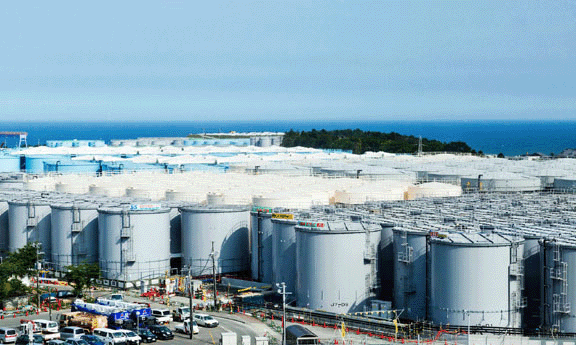
THE TSUNAMI-DRIVEN SEAWATER that engulfed Japan’s Fukushima Daiichi nuclear plant has long since receded. But plant officials are still struggling to cope with another dangerous flood: the enormous amounts of radioactive water the crippled facility generates each day. More than 1 million tons of radiation-laced water is already being kept on-site in an ever-expanding forest of hundreds of hulking steel tanks—and so far, there’s no plan to deal with them.
The earthquake and tsunami that hammered Fukushima on March 11, 2011 triggered meltdowns in three of its six reactors. That left messes of intensely radioactive fuel somewhere loose in the reactor buildings—though no one knows exactly where. What is known, however, is that every day, as much as much as 150 tons of groundwater percolates into the reactors through cracks in their foundations, becoming contaminated with radioactive isotopes in the process.
To keep that water from leaking into the ground or the Pacific, Tepco, the giant utility that owns the plant, pumps it out and runs it through a massive filtering system housed in a building the size of a small aircraft hangar. Inside are arrays of seven-foot tall stainless steel tubes, filled with sand grain-like particles that perform a process called ion exchange. The particles grab on to ions of cesium, strontium, and other dangerous isotopes in the water, making room for them by spitting out sodium. The highly toxic sludge created as a byproduct is stored elsewhere on the site in thousands of sealed canisters.
This technology has improved since the catastrophe. The first filtering systems, installed just weeks after the disaster by California-based Kurion Inc. (which has since been bought by Veolia, a French resource management company), only caught cesium, a strong gamma radiation emitter that makes it the most dangerous of the isotopes in the water. The tubes in those arrays were filled with highly modified grains of naturally occurring volcanic minerals called zeolites. By 2013, the company developed entirely artificial particles—a form of titano silicate—that also grab strontium.
The filters, however, don’t catch tritium, a radioactive isotope of hydrogen. That’s a much trickier task. Cesium and strontium atoms go into solution with the water, like sugar in tea; but tritium can bond with oxygen just like regular hydrogen, rendering the water molecules themselves radioactive. “It’s one thing to separate cesium from water, but how do you separate water from water?” asks John Raymont, Kurion’s founder and now president of Veolia’s nuclear solutions group. The company claims to have developed a system that can do the job, but Tepco has so far balked at the multi-billion dollar cost.
So for now, the tritiated water is pumped into a steadily growing collection of tanks. There are already hundreds of them, and Tepco has to start building a new one every four days.
Tepco has at least reduced the water’s inflow. As much as 400 tons per day was gushing in just a couple of years ago. In an effort to keep the groundwater from getting in, Tepco has built a network of pumps, and in 2016 installed an underground “ice wall”—a $300 million subterranean fence of 30-yard-long rods through which tons of sub-zero brine is pumped, freezing the surrounding earth. All of which helps, but hasn’t solved the problem……… https://www.wired.com/story/fukushimas-other-big-problem-a-million-tons-of-radioactive-water/
Japanese trading house Itochu is pulling out of a nuclear power plant project in Turkey due to a surge in safety-related costs, casting uncertainty over the plant’s future as well as the Japanese government’s infrastructure export ambitions, as reported by Nikkei on April 24.
The project was agreed on by the Japanese and Turkish governments in 2013. A consortium including Itochu and Mitsubishi Heavy Industries had been conducting a feasibility study until March for the construction of a 4,500-megawatt plant in the city of Sinop in Turkey’s Black Sea region.
But costs related to safety measures surged after the Fukushima Daiichi nuclear disaster in 2011, and the estimated costs for the project ballooned to more than five trillion yen ($46.2 billion) from two trillion yen in 2013, according to the report.
Itochu, which was jointly conducting the feasibility study with its consortium partners, is expected to avoid involvement in the project. Mitsubishi Heavy and other investors in the consortium have already extended the feasibility study until this summer.
Initially, 30 percent of the project’s cost was planned to be covered by the consortium and 70 percent by loans from the Japan Bank for International Cooperation and other lenders.
The consortium was expected to be 51 percent owned by Mitsubishi Heavy, Itochu and French electric utility Engie, and 49 percent by others entities, including the Turkish Electricity Generation Corporation.
The departure of deep-pocketed Itochu will make the project more risky for Mitsubishi Heavy, which is requesting the Turkish government to change the ownership structure of the consortium.
Another reactor at Genkai nuclear plant to be restarted late May https://mainichi.jp/english/articles/20180422/p2g/00m/0dm/029000c, (Mainichi Japan) FUKUOKA (Kyodo) — The operator of the Genkai nuclear power plant in southwestern Japan aims to restart another reactor at the complex in late May, according to a plan recently submitted to the government.
The rebooting of the No. 4 unit at the plant in Saga Prefecture after a six-year hiatus will complete Kyushu Electric Power Co.’s plan to bring four of its reactors online after the country’s regulator implemented stricter screening following the Fukushima nuclear disaster in 2011.
According to the plan submitted to the Nuclear Regulation Authority, the company will restart the reactor on May 24 if preparations go smoothly, with commercial operation slated for late June.
Kyushu Electric restarted the No. 3 reactor at the Genkai plant in March. At the company’s Sendai complex in Kagoshima Prefecture, two reactors came back online in 2015.
Some local residents have been opposed to the Genkai plant’s operation, questioning the validity of safety standards and citing the risk of volcanic eruptions in the region. The Saga District Court rejected in March a request for an injunction to suspend the plant’s restart.
Three reactors went into meltdown after the 2011 Japanese tsunami in the worst accident since Chernobyl, leaving an apocalyptic vision of ghost towns and overgrown wildernesses and scared residents refuse to return
JAPAN is lying to the world about nuclear-ravaged Fukushima’s recovery while forcing terrified evacuees to return to their radioactive homes, it is claimed.
More than seven years after the nuclear catastrophe rocked the world, many of the 154,000 people who fled their homes have not returned and towns remain deserted.
Thousands of irradiated wild boars and monkeys roam around while poorly paid and protected decontamination workers scrub homes, schools and shops down ready for people to come home.
Chilling footage of taken inside the evacuated areas of Fukushima City and Köryama lay bare the disaster that unfolded after an earthquake, measuring 9.01 on the Moment Magnitude scale, struck off the coast of Japan on March 11, 2011.
But it was the following 50ft tsunami that damaged reactors at the Fukushima nuclear power plant.
This led to the evacuation of thousands of people from a 12-mile exclusion zone, with roads guarded by roadblocks and officials in protective gear.
Now there is a big campaign is under way to make people return but residents, campaigners and experts believe it not safe.
They accuse the Japanese authorities of wanting to allay public fears over the nuclear power by downplaying the dire consequences of the leak.
Propaganda videos showing the remarkable recovery of Fukushima have been spread by the government on its social media accounts.
“Since the Great East Japan Earthquake in 2011, #Fukushima has been working towards a bright future.
Strict safety standards and monitoring means that #food from the prefecture is enjoyed all over #Japan.” See Fukushima’s amazing recover in this video:http://bit.ly/2CqP0HC
But senior nuclear specialist Shaun Burnie, from Greenpeace Japan, said the nuclear nightmare continues.
He said: “They are not telling the whole truth either to the 127 million people of Japan or to the rest of the world – about the radiation risks in the most contaminated areas of Fukushima.
“The nuclear crisis is not over – we are only in year seven of an accident that will continue to threaten public health, and the environment, for decades and well into the next century.
“Attempts by the government and the nuclear industry communicate that it is safe and it’s over are a deliberate deception.”
Most of Japan’s power plants shut in the wake of the Fukushima nuclear disaster.
But in 2015 the Prime Minister announced plans to restart reactors because the economy needed cheap energy and using fossil fuels risked huge carbon emission fines.
Now five of them are back on – and it’s aimed to to have at least 12 in use by 2025.
The nuclear crisis is not over – we are only in year seven of an accident that will continue to threaten public health, and the environment, for decades and well into the next century(Senior nuclear specialist Shaun Burnie)
Mr Burnie said: “If they can create the illusion of the region that that has recovered from the nuclear accident they think it will reduce public opposition.”
But meanwhile the crisis continues at the Fukushima plant.
He said: “The massive Ice Wall built at the nuclear plant to stop contamination of groundwater is a symbol of this failure and deception – this is no Game of Thrones fantasy but the reality of a nuclear disaster that knows no end.”
Today he says “there were areas of Fukushima where radiation levels could give a person’s maximum annual recommended dose within a week.”
He said: “This is of particular concern with regards to poorly paid decontamination workers, thousands of whom have been involved in attempts to decontaminate radiation around people’s homes, along roads and in narrow strips of forest.”
Mr Burnie said the government claims decontamination has been completed in 100 percent of affected areas after a £8bn clean up operation.
But he added: “What they don’t explain is that 70-80 percent of areas such as Namie and Iitate – two of the most contaminated districts – are forested mountain which it is impossible to decontaminate.
“In areas opened in March 2017 for people to return – radiation levels will pose a risk until the middle of the century.
“These areas are still to high in radiation for people to return safely – and is one reason so few people are returning.”
Meanwhile heavy-handed tactics are being used with some fearful residents reporting that they have been warned they won’t receive lifeline compensation cash if they don’t comply.
Dr Keith Baverstock, a radiation health expert who was at the World Health Organization at the time disaster, told Sun Online: “For the past two years the Japanese government has encouraged the evacuees to return to their homes, but relatively few people have taken up this offer, even though there is a threat – it may even now be a fact – that their compensation will cease.”
The resignation of a Japanese governor blocking the restart of the world’s biggest nuclear power plant in his prefecture may not create an opening for the nation’s pro-nuclear forces.
Niigata Governor Ryuichi Yoneyama, who campaigned on opposition to restarting Tokyo Electric Power Co. Holding Inc.’s Kashiwazaki-Kariwa reactors, said Wednesday he would resign over allegations he paid women for sex. Shares of the utility, known as Tepco, are heading for their biggest weekly gain in more than a year.
The governor was one of a few high-profile opponents to the technology, which the public has viewed with skepticism since the 2011 Fukushima disaster, and the biggest roadblock for Tepco’s effort to run the reactors, two of which have been given the all-clear by regulators. Although the country imposed stronger safety regulations since 2011, only five of its 39 operable reactors are online.
Yoneyama was not a leader, but certainly an important figure in a position to influence the fate of reactors,” said Jeff Kingston, the director of Asian studies at Temple University’s Japan campus. “Not many of those, so he will be missed.”
Yoneyama repeatedly said he wouldn’t support a restart until a panel of experts appointed by the prefecture investigate the Fukushima disaster and study evacuation plans in case of an emergency at the Niigata plant. He said in January that the process would take at least three years.
When is the next election?
Likely around the beginning of June, according to an official in the prefecture’s election commission. The assembly president will officially inform the commission of Yoneyama’s resignation in the coming days, which will then trigger a gubernatorial election within 50 days.
Would the next governor also oppose restarts?
Probably. The last two governors were against restarting the reactors and 64 percent of voters in the last election opposed the move, according an exit poll conducted by the Asahi newspaper.
“It is likely that the next governor will continue an anti-restart policy,” Daniel Aldrich, a professor at Northeastern University, said in an email. “Anti-nuclear sentiment is still high across the country.”
Prime Minister Shinzo Abe’s Liberal Democratic Party supports the restarts, while most of the opposition parties don’t. Both sides will likely field candidates.
High-ranking officials from the Constitutional Democratic Party, the nation’s largest opposition party and against nuclear restarts, and the Democratic Party told Sankei newspaper Wednesday that opposition parties should band together behind one candidate.
Tamio Mori, who was backed by the LDP in the 2016 Niigata election, could be a potential contender for Abe. Mori is the former mayor of Nagaoka City, and was seen as the more pro-nuclear candidate in the 2016 election, where he captured 46 percent of the vote. He didn’t respond to an emailed request for comment.
What about the review panel?
This timeline for its work might speed up if the new governor is pro-restart, according to Miho Kurosaki, an analyst at Bloomberg New Energy Finance.
“I don’t think the panel review will be removed fully,” said Kurosaki, highlighting lingering safety concerns in the community over a 2007 earthquake that temporarily shut the facility.
Does Tepco even need local approval?
While the local governor’s approval is traditionally sought by utilities before they resume a reactor, it’s not required by law. Kyushu Electric Power Co. continued operating reactors at its Sendai facility despite opposition from a newly elected anti-nuclear governor in 2016.
“The ‘gentlemen’s agreement’ that has provided some unwritten capacity to nuclear host community decision makers is in fact quite weak,” Aldrich said. “Even if another anti-nuclear governor is elected within Niigata, I believe that the economic and political pressure on utilities will push them to restart reactors.”
Niigata Gov. Ryuichi Yoneyama bows during a press conference at the Niigata Prefectural Government office on April 18, 2018.
Governor quits over sex scandal, affects nuclear reactor restart
April 18, 2018
NIIGATA (Kyodo) — Niigata Gov. Ryuichi Yoneyama said Wednesday he will resign after admitting to a sex scandal in a move affecting the approval process for the restart of Tokyo Electric Power Company Holdings Inc.’s nuclear reactors in the central Japan prefecture.
“I sincerely offer apologies for betraying the trust of many people,” Yoneyama told a press conference, admitting that his relationship with a woman, as described in a weekly magazine due out Thursday, may “look to some as prostitution.”
Shukan Bunshun magazine alleged in an online teaser article Wednesday that the 50-year-old governor has been paying money to have sex with a 22-year-old college student. At a news conference Wednesday, the governor said he gave a woman he met online “presents and money so she would like me more.”
Since being elected governor in 2016, Yoneyama has refrained from approving the restart of the No. 6 and 7 reactors at the Kashiwazaki-Kariwa nuclear complex.
The governor has said he cannot make the decision until the prefectural government completes its own assessment of what caused the Fukushima Daiichi nuclear disaster in 2011.
All seven Kashiwazaki-Kariwa units are boiling water reactors, the same as those at the Fukushima Daiichi nuclear plant where three of six reactors melted down in the days after a massive earthquake and tsunami in March 2011. Last December, two reactors at the Kashiwazaki-Kariwa complex cleared safety reviews under the stricter, post-Fukushima regulations.
On Tuesday, Yoneyama said he would consider whether to quit over a forthcoming magazine article about a “woman issue.” Calls for his resignation were growing in the Niigata prefectural assembly.
The gubernatorial election to pick Yoneyama’s successor is expected to be held in early June. Yoneyama will resign with two and a half years of his term remaining.
The seven-reactor Kashiwazaki-Kariwa complex is one of the world’s largest nuclear power plants with a combined output capacity of 8.2 million kilowatts.
Facing huge compensation payments and other costs stemming from the Fukushima disaster, Tepco is keen to resume operation of its reactors to improve its financial performance.
The Japanese government of Prime Minister Shinzo Abe also supports restarting nuclear reactors that have cleared post-Fukushima safety reviews.
Yoneyama won the Niigata governorship in October 2016 with the support of the Japanese Communist Party and the Social Democratic Party, which are both opposed to nuclear power. He defeated contenders including a candidate backed by Abe’s Liberal Democratic Party and its junior coalition partner Komeito.
Governor of Japan’s Niigata resigns to avoid ‘turmoil’ over magazine article
April 18, 2018
TOKYO (Reuters) – The governor of Japan’s Niigata prefecture, home to the world’s largest nuclear power plant, resigned on Wednesday, saying he hoped to avoid political turmoil over an impending magazine article about his relations with women.
News that the governor, Ryuichi Yoneyama, intended to resign sent shares of Tokyo Electric Power Company Holdings Inc (Tepco) surging as investors bet his departure could make it easier for the utility to restart its Kashiwazaki-Kariwa nuclear power plant, which is in Niigata prefecture.
Japan has had few reported “#MeToo” cases about sexual harassment involving public figures but Yoneyama’s resignation came on the same day Japan’s top finance bureaucrat resigned on after a magazine said he had sexually harassed several female reporters. The official denied the allegation.
Yoneyama, like his predecessor, is opposed to a restart of the Kashiwazaki-Kariwa plant and has been a block to attempts to get the station going by the utility, which also owns the wrecked Fukushima Daiichi nuclear station.
The No. 4 reactor at Kansai Electric Power Co.’s Oi nuclear plant in Fukui Prefecture is due to be restarted in mid-May.
Kansai Electric Power Co. has started work to load nuclear fuel into reactor 4 at its Oi nuclear plant in Fukui Prefecture.
The operation, which started Sunday, to place 193 uranium fuel assemblies in the reactor is to be completed by Wednesday. Kansai Electric aims to restart the reactor sometime in mid-May.
According to the company, the fuel-loading work started at 10 a.m. using a crane and containers. The operation will continue around the clock.
Reactors 3 and 4 at the Oi plant cleared Nuclear Regulation Authority screenings last year under strict new standards introduced after the March 2011 crisis at the Fukushima No. 1 nuclear plant.
Preparations have been underway to bring the Oi facility’s reactor 3, which was reactivated March 14, into commercial operations mode. Unless any problems are detected in an NRA inspection, the reactor will start commercial operations as early as Tuesday.
A series of earthquakes, including a M6.1 intense one, hit Shimane, the prefecture holds 3 reactors in Shimane Nuclear Power Plant.
Dear friends (especially non-Japanese folks) can you imagine the life like that shivers always run through your body when you experience, or even just hear an earthquake? Because you know every single jolt possibly cause meltdown in some of 53 reactors scattered around all over your country??
But simple facts: the pro-nuke masses, politicians and enterprises are all majorities here, and remaining reactors are ready to restart in few years.
And FYI, 30% of the major earthquakes in the world happen in the Japanese Archipelago.
Lately a remarkable number of tourists (approx. 3 times larger than 2010) are visiting Japan, and the government and the JP media welcome this phenomena as ‘inbound prosperity.’ And the Olympics is coming in 2020.
Everyone is welcome to come to Japan, but I kindly (and sarcastically) recommend you to prepare yourself with a gas mask, and some potassium Iodide tablets if you dare to visit this shaking islands.
April 9, 2018
M6.1 quake hits western Japan’s Shimane, 5 injured
A collapsed torii gate of Karita Shrine is blocking a street in Oda, Shimane Prefecture, on April 9, 2018.
TOKYO (Kyodo) — A magnitude 6.1 earthquake hit the western Japanese prefecture of Shimane early Monday, injuring five people, while also causing a partial blackout and disrupting water supply in the hardest-hit city of Oda.
The quake occurred at 1:32 a.m. at a depth of 12 kilometers, according to the Japan Meteorological Agency. It registered upper 5 on the Japanese seismic intensity scale of 7.
Four people were injured in Oda including a 17-year-old boy who fell from his bed at home, local officials said. A woman in her 70s in the adjacent city of Izumo injured her leg, also after falling from her bed.
Some 100 households lost tap water and 50 households electricity in Oda. A Self-Defense Forces unit has been dispatched to assist in water supply to the area based on a request by the prefectural government.
Damage to some buildings and cracks in roads were also confirmed. In Oda, an entrance gate at a Shinto shrine was destroyed and homes were damaged, forcing more than 100 people to evacuate at one point.
No abnormalities were found at the Shimane nuclear power plant, its operator Chugoku Electric Power Co. said.
Isamu Yamashita, an 81-year-old man who evacuated to an elementary school in Oda, said, “When the quake hit, I couldn’t stand on my own and had to hold on to a column. I still cannot return home because I am scared of possible aftershocks.”
A hospital in the city was forced to stop most of its outpatient services after a pipe in a water storage tank was damaged. The hospital received emergency water supply from the city to serve its inpatients.
West Japan Railway Co. halted some express trains in the region but road traffic was unaffected, according to the Japan Road Traffic Information Center.
In Shimane, a magnitude 5.1 quake struck in 1963 just two hours before a magnitude 5.0 quake hit some 10 to 20 km from the epicenter of the latest quake.
Earthquake cracks streets, leaves 5 injured in Japan
This photo released by the Shimane Nichinichi Shimbun via Jiji Press on April 9, 2018 shows the tarmac along a street damaged by a earthquake in the city of Ohda, Shimane prefecture.
TOKYO — A strong earthquake hit western Japan early Monday, cracking streets, cutting water and power to a number of homes and injuring five people. The Meteorological Agency said the magnitude 6.1 quake struck 7 miles underground near Ohda city, about 480 miles west of Tokyo.
Five people sustained injuries, but most of them were minor and not life-threatening, the Fire and Disaster Management Agency said.
The quake also rattled nearby Izumo, home to one of Japan’s most important Shinto shrines. No damage was reported at the shrine.
The Fire and Disaster Management Agency said roads were cracked in some locations, while more than 1,000 households lost water supplies and dozens of homes were without electricity.
Local officials said dozens of trains in the region were delayed or suspended.
Hokkaido METI bureau requested changes to nuclear energy part of high school lecture https://mainichi.jp/english/articles/20180407/p2a/00m/0na/017000c (Mainichi Japan) SAPPORO –– High-ranking officials from the local bureau of the Ministry of Economy, Trade and Industry (METI) requested that an assistant professor change an October 2017 lecture to high school students pointing out the dangers of nuclear power, it has been learned.
“We will review our operations so as not to cause misunderstandings,” stated industry minister Hiroshige Seko regarding the request by the Hokkaido Bureau of Economy, Trade and Industry.
The lecture at Hokkaido Niseko High School in the prefectural town of Niseko was on energy issues. The school had been chosen by the Agency for Natural Resources and Energy, an industry ministry-affiliated body, as a model for energy education last academic year, and the lecture by Hokkaido University assistant professor Sadamu Yamagata was supported by a government grant.
According to multiple sources close to the matter, Yamagata sent his lecture materials to the school beforehand to be printed, and the school handed the documents over to METI’s Hokkaido bureau at the latter’s request. Two high-ranking officials from the bureau then visited Yamagata and requested that he make changes to a section of the materials explaining the dangers and costs of nuclear power, illustrated with a photo of the aftermath of a hydrogen explosion at the Fukushima No. 1 Nuclear Power Plant. The officials told Yamagata that this was “only one perspective” and that called it “impression manipulation.”
Yamagata added the statement, “natural energy is not necessarily 100 percent safe” along with a photo of a collapsed windmill, but did not comply with the request to change the section about nuclear energy.
“I found it uncomfortable that (the request for changes) was focused on nuclear power,” Yamagata told the Mainichi Shimbun. Hokkaido Niseko High School principal Noboru Baba said, “The lecture content was good. I don’t know if there was intrusion (by the ministry) into education.” However, residents who were aware of what had happened view the flow of events as meddling by the government in education, and the Niseko Municipal Government has held three meetings to explain the situation to locals.
Industry minister Seko told a post-Cabinet meeting news conference on April 6, “It’s common sense that the government takes responsibility for the content of an agency-commissioned program, but with the focus (by the bureau officials) only on nuclear energy, misunderstandings can arise easily.”
The incident comes on the heels of criticism of the Ministry of Education, Culture, Sports, Science and Technology for pressuring the Nagoya Municipal Board of Education by requesting a report about a lecture given by former vice minister of education Kihei Maekawa.
But how should the Hokkaido case be understood? The class taught by Maekawa was set up by the school and the Nagoya education board, completely independently of the central government. On the other hand, the Hokkaido case was funded by a central government grant, and Japan’s stance has so far been that funding gives related government bodies a say in how the monies are used.
The Hokkaido bureau’s Natural Resources, Energy and Environment Department denied intervening, telling the Mainichi, “The purpose was to show both the merits and demerits of all types of energy sources, and if the lecture had hypothetically been extremely critical of natural energy resources, the same request for alternations would have been made. If only the shortcomings of nuclear energy are presented while ignoring the benefits, that is a problem.”
However, experts are critical. Hokkaido University emeritus professor Yoichi Anezaki said, “The case of the education ministry requesting a report of Maekawa’s class was also problematic, but in this case with the industry ministry, which plays a key role in nuclear power policies, requesting that a section pointing out the issues with nuclear energy be changed, it’s an intrusion into education by authority and is much worse. It’s tantamount to censorship.”
“The belief that just because the government provided the grant, it means that it can have its say on the content of education doesn’t make sense,” said Kyoto University of Art and Design professor and former education ministry bureaucrat Ken Terawaki. “If we allow for this, then it means that it’s fine for the Ministry of Foreign Affairs to promote the Trans-Pacific Partnership and the Ministry of Defense the necessity of military affairs in the classroom. Intrusion into education is a serious matter.”
(Japanese original by Ryuko Tadokoro, Hokkaido News Department)
Another powerful eruption observed at Mount Shinmoe , Japan Times, 5 Apr 18FUKUOKA – Another powerful eruption was observed at Mount Shinmoe in southwestern Japan early Thursday, with ash sent spiralling into a plume around 5,000 meters high, the Meteorological Agency said.
The eruption at the 1,421-meter volcano that straddles Miyazaki and Kagoshima prefectures was the largest since March 25, according to the agency.