Japan’s nuclear regulator is unsure about Tepco’s nearly completed ice wall around Fukushima No. 1 nuclear power plant
 Frozen soil wall nearly complete; NRA still doubts effect , http://the-japan-news.com/news/article/0004052403, November 07, 2017 The Yomiuri Shimbun, A construction project to create frozen soil walls that encircle the ground beneath Tokyo Electric Power Company Holdings Inc.’s disaster-hit Fukushima No. 1 nuclear power plant is nearly finished.
Although TEPCO insists that the inflow of groundwater beneath the reactor buildings has been reduced, some members of the Nuclear Regulation Authority are skeptical about the project’s effectiveness. With ¥34.5 billion of public funds being spent on this project, the centerpeice of countermeasures for contaminated water, its cost-effectiveness is being carefully watched.
The project entails building a 1.5-kilometer-long frozen soil wall encircling the Nos. 1 to 4 reactors, with 1,568 pipes buried to a depth of about 30 meters below ground and coolant running through the pipes at minus 30 C to chill the soil.
The process is expected to prevent groundwater from flowing into the contaminated, highly radioactive underground water at such sites as the reactor buildings, and to avoid an increase of contaminated water.
The project began in March last year, and operations to freeze the final section, about seven meters wide, on the mountain side began in August this year.
The temperature of the underground soil has remained below zero, except for a part close the surface that is affected by outdoor air, meaning the project to create the 30-meter-deep walls is almost complete.
According to TEPCO’s assessment, before the project started, about 400 tons of groundwater was flowing into the ground underneath the reactor buildings and other sites daily. TEPCO had initially calculated that the daily inflow of groundwater could decrease to dozens of tons once the walls were installed. However, between April and September the inflow per day was between 120 tons and 140 tons, and in October it was around 100 tons. That the amount of inflow has decreased in stages as the soil freezing progressed seems to prove that the project has been effective to a certain extent. However, it is unclear if the inflow will decrease further in the future.
In parallel with the frozen soil wall project, TEPCO dug about 40 subdrain wells to pump up groundwater before it flows into the reactor buildings. It also reinforced measures to prevent rainwater from soaking into the ground by paving 1.33 million square meters of surface.
In the NRA view, those measures must also contribute greatly to reducing the inflow, casting doubt on the frozen soil walls project by saying the effect of them alone may be limited. The agency has become distrustful of TEPCO and urged the company to verify the effects.
Hiroshi Miyano, visiting professor at Hosei University specializing in system safety, said: “There is sure to be a part that doesn’t freeze completely, and it’s impossible to reduce the inflow to zero. TEPCO must continue applying this measure in tandem with draining the nearby wells for a while.”Speech
Huge new nuclear waste storage facility in Fukushima Prefecture
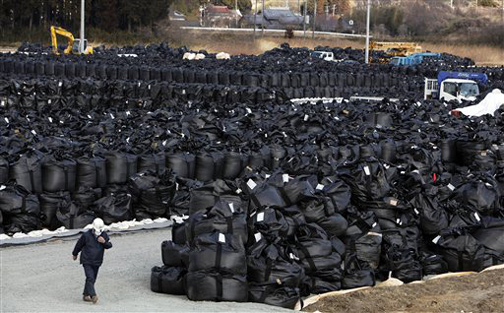 Sprawling radioactive waste storage facility opens for business in Fukushima https://www.japantimes.co.jp/news/2017/10/28/national/sprawling-radioactive-waste-storage-facility-opens-business-fukushima/#.WfZG54-CzGi, KYODO
While the facility near the crippled Fukushima No. 1 nuclear complex is designed to store soil and other tainted waste collected during decontamination work for up to 30 years, it remains only half complete six years after the triple core meltdown struck in March 2011.
The government has been able to buy only 40 percent of the land so far but eventually plans to secure 1,600 hectares for the facility, which is expected to generate ¥1.6 trillion ($14.1 billion) in construction and related costs.
The storage facility is urgently needed to consolidate the 13 million cu. meters of radioactive waste scattered around the prefecture. The prolonged disposal work, among other concerns, is said to be keeping residents away from their hometowns even when the evacuation orders are lifted.
Also on Saturday, the government began full operation of a facility where waste intended for incineration, such as trees and plants, is separated from the rest.
Contaminated soil is sorted into different categories depending on cesium level before storage.
Robots are central to Fukushima’s highly dangerous nuclear radioactivity clean-up
BBC 18th Oct 2017, Robots have become central to the cleaning-up operation at Japan’s
Fukushima nuclear power plant, six years after the tsunami that triggered
the nuclear meltdown. It is estimated that around 600 tonnes of toxic fuel
may have leaked out of the reactor during the incident. The Tokyo Electric
Power Company is using a variety of robots to explore areas too dangerous
for people to go near. BBC Click was given rare access to the site to see
how the decontamination work was progressing.
http://www.bbc.co.uk/news/av/technology-41584738/fukushima-disaster-the-robots-going-where-no-human-can
A Further Delay in the Cleanup At Japan’s Fukushima Nuclear Plant
The Cleanup At Japan’s Fukushima Nuclear Plant Has Been Delayed Yet Again https://www.gizmodo.com.au/2017/09/the-cleanup-at-japans-fukushima-nuclear-plant-has-been-delayed-yet-again/ George Dvorsky, With the backing of Japan’s government, Tokyo Electric Power Company Holdings (TEPCO) has decided to revise its plan to remove highly radioactive spent fuel from the damaged Fukushima nuclear power plant. It’s the fourth re-think made by the utility since the plant suffered a meltdown following the 2011 earthquake and tsunami — and yet another delay to a plan that’s expected to take anywhere from 30 to 40 years.
Peak contamination levels from Fukushima off North America now known
http://www.enn.com/ecosystems/article/52701 From: University of Victoria
September 29, 2017, For the first time since 2011, peak contamination levels in Pacific Canadian waters from Japan’s Fukushima Daiichi nuclear disaster are known, says a University of Victoria scientist who has been monitoring levels since the meltdown of three reactors at the plant.
Releases of radioactive elements from the Fukushima Daiichi Nuclear Power Plant accident in 2011 were the largest unplanned discharges of radioactivity into the ocean. The disaster, triggered by a 15-metre tsunami caused by a magnitude-9 earthquake, created widespread concern over the potential impact on marine life and human health.
“Contamination from Fukushima never reached a level where it was a significant threat to either marine or human life in our neighborhood of the North Pacific,” says UVic chemical oceanographer Jay Cullen.
Continue reading at University of Victoria.
Ice wall at crippled Fukushima Daiichi nuclear power plant damaged by typhoon rain
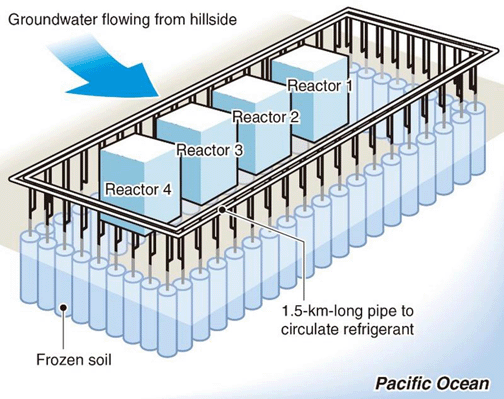
Tokyo Electric Power Company (TEPCO) has announced that the “ice wall” (formally known as the “Land-Side Impermeable Wall”) under construction at the crippled Fukushima Daiichi nuclear power plant in Japan has been
critically affected by rainfall from recent typhoons that have melted parts of the ice structure, allowing new pathways for highly contaminated waterto leak from the basements of the reactor buildings.
http://enformable.com/2016/09/ice-wall-fukushima-daiichi-damaged-recent-typhoons-japan/
Water plan to remove Fukushima fuel is ‘not viable’
Group: Water plan to remove Fukushima fuel ‘not viable’ http://www.asahi.com/ajw/articles/AJ201708310042.html, By KOHEI TOMIDA/ Staff Writer, August 31, 2017 The Asahi Shimbun A decommissioning organization on Aug. 31 formally recommended bypassing a safety measure to remove melted nuclear fuel from crippled reactors at the Fukushima No. 1 nuclear plant.
The Nuclear Damage Compensation and Decommissioning Facilitation Corp. (NDF) urged the central government and Tokyo Electric Power Co. to use the “airborne method” in which the melted fuel is removed even when the water level in the reactor containment vessel is kept low.
Proposals have been made to fill the containment vessels with water to restrain the spewing of radioactive materials during the fuel removal process.
But the NDF said that method is currently not viable because of the difficulties in patching up the holes in the containment vessels.
The government and TEPCO are expected to decide on a fuel removal method in September and confirm the specific steps next fiscal year.
The removal of equipment and other structural objects in and around the reactors must be completed before work can start on taking out melted fuel that remains in the pressure vessels.
The nuclear fuel that has seeped through the pressure vessels and landed at the bottom of the containment vessels will be the first to be removed.
Work will also have to be done to develop a robot arm that can remove fuel from the side of the containment vessel. Under the current schedule, removal of the melted fuel will start at one of the three, No. 1 to No. 3, reactors of the Fukushima No. 1 plant in 2021.
However, officials still do not know the exact location of the melted fuel in the reactors.
Hajimu Yamana, NDF president, pointed out there would likely be a need to combine various methods instead of pushing through with one specific procedure to meet the scheduled deadline.
Another $5bn US suit against TEPCO over Fukushima nuclear disaster
 Tepco faces another $5bn US suit over Fukushima nuclear disaster, Business Live, 24 AUGUST 2017 – 14:54 TOKYO —Tokyo Electric Power Company Holdings (Tepco) said on Thursday it faces another US lawsuit over the 2011 Fukushima nuclear disaster, with the latest one demanding at least $5bn in compensation.
A total of 157 US residents who were supporting Fukushima victims at the time filed the class action suit in a California district court earlier this month against the utility and a US company…….
The plaintiffs, who joined aid efforts along with US troops shortly after the disaster, claim they were exposed to radiation because of the improper design, construction and maintenance of the plant.
They were seeking $5bn to cover the cost of medical tests and treatment needed to recover from the disaster, Tepco said in a statement.
They are also demanding compensation for physical, mental and economic damage but no further details such as a sum of money or the identities of the claimants were available.
It was the second multi-plaintiff suit filed against the utility in a US court following one by more than 200 individuals in 2013.
In Japan, more than 10,000 people who fled their homes over radiation fears have filed various group lawsuits against the government and the firm. https://www.businesslive.co.za/bd/companies/2017-08-24-tepco-faces-another-5bn-us-suit-over-fukushima-nuclear-disaster/
Fukushima aftermath: General Electric and Tokyo Electric Power Co sued by Navy families for wrongful death

 Navy Families Sue Fukushima Operators for Wrongful Death, Courthouse News, SAN DIEGO (CN)— Families of five Navy service members who died after responding to the Fukushima nuclear meltdown have sued Tokyo Electric Power Co., blaming the deaths on radiation illnesses contracted from the March 2011 disaster.
The families wish to join a lawsuit from 152 other members or survivors of members of the 7th Fleet who performed humanitarian response from March 11, 2011 until March 14, when the USS Ronald Reagan aircraft carrier was moved away from Fukushima due to detection of nuclear radiation in the air and on helicopters returning to the ship.
The new plaintiffs want to join in the third amended complaint Cooper, et al. v. TEPCO, et al., originally filed in the same court in 2012. They say it is only recently that they discovered the extent of the injuries, real and/or expected, due to exposure to radiation from the Fukushima Nuclear Power Plant.
The federal lawsuit was filed Friday and made available Monday in U.S. District Court in the Southern District of California. They sued General Electric in addition to Tokyo Electric Power Co., or TEPCO.
SAN DIEGO (CN) — Families of five Navy service members who died after responding to the Fukushima nuclear meltdown have sued Tokyo Electric Power Co., blaming the deaths on radiation illnesses contracted from the March 2011 disaster.
The families wish to join a lawsuit from 152 other members or survivors of members of the 7th Fleet who performed humanitarian response from March 11, 2011 until March 14, when the USS Ronald Reagan aircraft carrier was moved away from Fukushima due to detection of nuclear radiation in the air and on helicopters returning to the ship.
The new plaintiffs want to join in the third amended complaint Cooper, et al. v. TEPCO, et al., originally filed in the same court in 2012. They say it is only recently that they discovered the extent of the injuries, real and/or expected, due to exposure to radiation from the Fukushima Nuclear Power Plant.
The federal lawsuit was filed Friday and made available Monday in U.S. District Court in the Southern District of California. They sued General Electric in addition to Tokyo Electric Power Co., or TEPCO.
The Navy servicemen and -women want a $5 billion survivor fund for medical expenses.
They say General Electric designed defective the GE Boiling Water Reactors at Fukushima, which was run by TEPCO, Japan’s largest electric utility. The 7th Fleet’s Operation Tomodachi provided humanitarian relief after the tsunami and ensuing nuclear disaster. The sailors say they will need medical monitoring for life, payment of medical bills, and health monitoring for their children, including for possible radiation-induced birth defects.
“These harms include, but are not limited to, the following: illnesses such as leukemia, ulcers, gall bladder removals, brain cancer, brain tumors, testicular cancer, dysfunctional uterine bleeding, thyroid illnesses, stomach ailments, birth defects, death, and a host of other complaints unusual in such young adults and victims,” the complaint states…….
The families say the prime minister of Japan has effectively admitted the negligence of TEPCO. “This negligence was underscored on December 12, 2013, by admission of the former Prime Minister of Japan, Naoto Kan, who was in office when the Fukushima disaster took place. It was at that time that he admitted, for the first time: ‘People think it was March 12th (2011) but the first meltdown occurred 5 hours after the earthquake.’
“Unaware of either the meltdown or any potentially harmful radioactive release, the U.S. Sailor First Responders arrived off the coast of Fukushima during the afternoon of March 12, 2011 in order to carry out their mission of providing humanitarian aid to the victims of the earthquake and tsunami disaster. At no time did this mission include, nor expand into a response to a meltdown or a nuclear emergency at the FNPP. Rather, plaintiffs were carrying out their mission to provide humanitarian aid to the people of Japan by coming to their aid by delivering clean water, blankets, food, and other aspects of providing other humanitarian relief to the inhabitants of Fukushima Prefecture.”
The plaintiffs claim that though the nuclear meltdown was induced by a natural disaster, the Fukushima Nuclear Accident Independent Investigation Commission found in July 2012 that the meltdown was manmade because GE and TEPCO did not take adequate precautions for earthquakes and tsunamis.
They claim TEPCO ignored warnings of risk of damage by a tsunami, dismissed the need for better protection against seawater flooding, and failed to inspect, maintain and repair critical pieces of equipment……https://www.courthousenews.com/navy-families-sue-fukushima-operators-wrongful-death/
TEPCO now freezing the last section of Fukushima nuclear site’s underground wall
Daily Mail 22nd Aug 2017, The Fukushima nuclear plant’s operator Tuesday started freezing the last
section of a $320 million ice wall designed to cut down on vast amounts of
contaminated water at the site of the worst atomic accident in a
generation.
Tokyo Electric Power (TEPCO) began pumping coolant into the
remaining seven metres (23 feet) of its 1.5-kilometre underground wall
which encircles four reactors along Japan’s northeast coast. Underground
pipes circulate the coolant and freeze soil around the buildings. The
30-metre deep wall is designed to block underground water from nearby
mountains from flowing into the shattered complex and then seeping into the
Pacific.
It is reportedly expected to take more than two months until the
wall is completely frozen. The huge utility has been building the barrier
since March 2016 with the government picking up its 34.5 billion yen ($320
million) price tag. Even now, with the ice wall almost complete, about 140
tonnes of underground water flows into the plant daily, forcing the company
to pump it out and store it in on-site tanks.
“When the ice wall is completed, we estimate that the amount of underground water flowing into
the complex will be less than 100 tonnes,” a company spokesman said. But
some experts have cast doubt on the ice wall’s effectiveness in containing
the problem. http://www.dailymail.co.uk/wires/afp/article-4811494/Fukushima-reactor-ice-wall-nearly-finished.html
Unexploded bomb found at Fukushima No. 1 nuclear power plant

 Bomb found at Fukushima nuclear plant — Officials concerned device could explode — “Military unit is headed to the site” — “Police have cordoned off the surrounding area” http://enenews.com/breaking-bomb-found-at-fukushima-nuclear-plant-military-unit-is-headed-to-the-site-police-have-cordoned-off-the-surrounding-area
August 10th, 2017
By ENENews Mainichi, Aug 10, 2017 (emphasis added): Suspected bomb found on premises of Fukushima power plant: TEPCO — What appears to be an undetonated bomb has been discovered on the premises of the Fukushima No. 1 Nuclear Power Plant, Tokyo Electric Power Co. (TEPCO) announced on Aug. 10. The device was discovered buried in the ground at a parking lot currently undergoing maintenance in the western corner of the premises… Police have cordoned off the surrounding area
Kyodo, Aug 10, 2017: Unexploded ordnance found at Fukushima No. 1 nuclear power plant
NHK, Aug 10, 2017: Unexploded bomb found near Fukushima plant — Police are checking what appears to be an unexploded bomb found near the crippled Fukushima Daiichi nuclear power plant… Police were sending the pictures of the object to the Self-Defense Forces to determine whether it could explode…
BBC, Aug 10, 2017: Fukushima disaster: ‘WW2 bomb’ found at Japan nuclear site — A suspected unexploded bomb has been found at the site of the Fukushima nuclear plant… Tepco said construction work was immediately suspended after the object was found and a temporary exclusion zone put in place while bomb disposal experts were deployed…
AP, Aug 10, 2017: Officials say the rusty object is about 85 centimeters (33 inches) long and 15 centimeters (6 inches) wide. A military unit is headed to the site…
AFP, Aug 10, 2017: Japan’s Jiji Press reported that under such circumstances police call in bomb disposal experts from Japan’s military.
Olympic games in Fukushima: Is it safe?

 Fukushima city is going to host Olympic baseball and softball games in 2020.
What is the level of radio-contamination there? This is the question on everybody’s mind, spectators and players from all over the world. Is it really safe?
Baseball and softball games will take place in Azuma Sports Park in Fukushima city.


Fukushima prefecture provides the information below on the radiation measurements of the Park.

Measurements of the airborne radiation dose in the baseball stadium: No 13-16
Those of the softball stadium: No 4
The lines above and below indicate the value of the radiation dose at 1cm and 5cm above the ground.
We notice that, as usual, Fukushima prefecture gives only measurements in terms of radiation dose. Based on this information, one might think that it would be relatively safe to play there or to attend the games. However, monitoring only the radiation dose is not enough for radioprotection. The radiation dose is an indication of external irradiation exposure. In this case, the measures of radioprotection will be to stay away from the radioactive objects or not to stay in their vicinity for a long time. But the radiation dose does not provide information to avoid the risk of internal irradiation. For this latter, it is necessary to monitor surface contamination density or concentration, in this case, of soil (in terms of Becquerels/m2 or Bq/kg), as well as the concentration of radioactive substances in the air (Bq/m3). The radioprotection measures against internal irradiation would be wearing protective gear and masks to avoid the radioactive substances from adhering to the skin and/or entering the body.
Here is some information provided by Yoichi OZAWA of « Fukuichi Area Environmental Radiation Monitoring Project », the group of which we have published several soil contamination maps in this blog. OZAWA took measurements on July 27 at the request of the ARD German TV channel team which was visiting Fukushima.

Contamination concentration and density of 5cm surface soil around the Azuma Baseball Stadium
Point A : The entrance of the « Torimu no Mori» where children play.
Radiation dose at 1m above the ground : 0.12 μSv/h
Radiation dose on the ground : 0.19µSv/h
Surface concentration : 605 Bq/kg
Surface density : 47,300 Bq/m2
Point B : In front of the Multi-purpose Fields.
Radiation dose at 1m above the ground : 0.10 μSv/h
Radiation dose on the ground : 0.22µSv/h
Surface concentration : 410 Bq/kg
Surface density : 31,200 Bq/m2
To interpret these figures, let us remind you that in Japan, according to the Ordinance on Prevention of Ionizing Radiation Hazards, places where the effective dose is likely to surpass 1.3mSv in 3 months (approximately 0.6µSv/h of airborne radioactivity) or the contamination density to exceed 40,000Bq/m2 are designated as a « Radiation Control Zone » and public entry must be severely restricted. People under 18 years old are not allowed to enter, and even adults, including nuclear workers, cannot stay more than 10 hours. It is prohibited to eat, drink or stay overnight. To leave the zone, one has go through a strict screening to check for radioactive substances leaving the zone, a measure to protect the individual person as well as the environment.
We do not have the measures of surface density of the baseball nor softball stadiums, but in answering the question of the above German TV team, the information was given as to the decontamination work and radiation dose. There had been decontamination work, and the airborne radiation dose was about 0.04µSv/h in the baseball stadium.
Even when decontamination work has been carried out in the stadium, the mountains and woods behind the park have not been decontaminated, and wind and rain bring the radioactive substances towards the park. Besides, as we can see above, other places in the park are highly contaminated when we look at the surface contamination. They represent high risks of internal irradiation. Moreover, according to recent research, radioactive particles disseminated by the Fukushima Daiichi nuclear accident are mostly insoluble in water. This characteristic makes the health hazard much worse than in the case of the usual water soluble Cesium (see English transcription of NHK documentary on Insoluble Radioactive Particles in this blog). We believe that this Park should not be open to the public, especially to children.
The small type of insoluble radioactive particles – also called Cesium balls -, are dispersed in the Tokyo metropolitan area. People who visit this area should be careful and should take adequate radioprotection measures especially when it is windy and the radioactive particles can be re-disseminated.
All in all, we believe that there is far too much risk for the players and spectators to participate in the Olympic games in Fukushima. Fukushima should not host the Olympic games. Furthermore, we are against holding the Olympic games in Tokyo.
___
Read also :
See the publication of August 4 2017 in the FB of Oz Yo
https://fukushima311voices.wordpress.com/2017/08/07/olympic-games-in-fukushima-is-it-safe/
Brief fall in groundwater near Fukushima’s crippled nuclear reactors
NHK 3rd Aug 2017, The operator of the Fukushima Daiichi nuclear power plant says the
groundwater level briefly plummeted near a building that houses one of the
crippled reactors.
Tokyo Electric Power Company, or TEPCO, says the fall
was observed in a monitoring well about 11 meters southwest of the No.4
reactor building on Wednesday. The utility says the groundwater level
temporarily sank roughly 1 meter below the level of contaminated water
inside the reactor building. The firm says the groundwater rose above the
usual level 23 minutes later.
A sharp fall in the groundwater level just
outside reactor buildings could cause contaminated water to leak from
inside the buildings. https://www3.nhk.or.jp/nhkworld/en/news/20170804_06/
Change of plan needed for Fukushima reactors cleanup, following underwater images
Footage from reactor 3 may force rewrite of Fukushima road map, officials say, http://www.japantimes.co.jp/news/2017/07/30/national/footage-reactor-3-may-force-rewrite-fukushima-road-map-officials-say/ KYODO The first images of melted fuel from the crippled Fukushima No. 1 power plant indicate that it did not burn through the pressure vessel of reactor 3, but exited through the holes used to insert the control rods, officials say.
While the landmark robot footage from the primary containment vessel of unit 3 is helping Tokyo Electric grasp the reality of the damaged fuel assemblies, it may also force it to rewrite the road map for decommissioning the meltdown-hit plant.
Tokyo Electric Power Company Holdings Inc., better known as Tepco, sent an underwater robot into reactor 3 earlier this month to confirm its hypothesis that the core — the fuel assemblies in the pressure vessel — broke apart and fell to the bottom, letting molten fuel burn through and drip into the primary containment vessel.
According to Tepco spokesman Takahiro Kimo to, however, the images taken beneath the PCV indicate the pressure vessel probably withstood the heat of the molten fuel. He said the fuel apparently seeped through the holes for the control rods.
“We do not presume that the vessel, which is 14 cm thick, melted and collapsed together with the fuel, but that part of the fuel instead made its way down through holes,” Kimoto said. The control rods are used to moderate the chain reaction and are inserted vertically into the core.
Tepco said it estimates reactor 3 has about 364 tons of fuel debris, and that similar amounts will be found in reactors 1 and 2. Removing the fuel from the reactors is the largest challenge in defueling the aged plant — a process that could take up to 40 years to complete.

The camera on the underwater robot also captured images of rubble around the fuel debris, which could slow the removal process. The rubble includes devices for supporting the control rods at the bottom of the PCV and scaffolding for maintenance workers beneath the pressure vessel.
Minister of Economy, Trade and Industry Hiroshige Seko said the government and Tepco will try to draft a plan for removing the melted fuel in September, with an eye to hammering out the specifics in the first half of fiscal 2018 and starting the work in 2021.
But the findings from reactor 3 may force them to alter the state’s road map for decommissioning Fukushima No. 1, officials said.
An entity providing technical support for the project has urged that efforts be made to remove the melted fuel from the submerged lower part of the PCV by keeping air in the upper part, according to a source familiar with the plan.
Although filling the PCV completely with water would largely reduce the radiation risk to the robot probes, the Nuclear Damage Compensation and Decommissioning Facilitation Corp. is reluctant to do so because it is damaged and the toxic water will just leak out, the source said.
At the other two reactors, Tepco thinks most of the fuel in reactor 1 fell to the bottom of the primary containment vessel, and that some of the fuel in reactor 2 remained in the pressure vessel. The company made the estimates based on cosmic ray imaging analysis and by sending robots and endoscopes into the PCVs of the two reactors.
The enormity of decommissioning of the Fukushima Reactor No.1 shown by images of melted nuclear fuel
 Melted nuke fuel images show struggle facing Fukushima plant http://www.asahi.com/ajw/articles/AJ201707230012.html, By KOHEI TOMIDA/ Staff Writer, July 23, 2017 Images captured on July 22 of solidified nuclear fuel debris at the bottom of a containment vessel of the crippled Fukushima No. 1 nuclear power plant show the enormity of decommissioning of the facility.
Plant operator Tokyo Electric Power Co. said it will closely study the images from the No. 3 reactor’s containment vessel to determine the spread and amount of nuclear fuel debris.
After analysis, TEPCO will decide on a policy to retrieve the fuel debris. The government and TEPCO plan to start the retrieval process in one of the three crippled reactors at the plant from 2021. It will be a formidable task, given that a method of recovering debris that is stuck to the floor has yet to be considered.
The recent images were taken by a submersible robot, which was sent into the containment vessel on July 19, 21 and 22.The No. 3 reactor’s containment vessel is filled with water to a depth of 6.4 meters. On the final day, the remote-controlled robot was dispatched to the deepest part of the containment vessel.
The images showed that pieces that fell from the structure and deposited material accumulated to a height of about 1 meters at the bottom of the containment vessel.
In particular, what is believed to be nuclear fuel debris is scattered in the form of rocks in the area directly beneath the pressure vessel.
The latest investigation has confirmed TEPCO’s assumption made through analyses that most of the reactor’s nuclear fuel melted through the pressure vessel and accumulated at the bottom of the containment vessel. It also discovered that the nuclear fuel debris has spread throughout the containment vessel. The images marked the first confirmation through a robot probe of a large amount of nuclear debris in any of the embattled No. 1 through No. 3 reactors.
1 This Month
29 Jan. Thursday 7-8 p.m. Webinar – World’s Largest Nuclear Station in Port Hope, ON?
To see nuclear-related stories in greater depth and intensity – go to https://nuclearinformation.wordpress.com/



31st January – Challenging the War Machine – a DECLASSIFIED UK SUMMIT


Website of the Week
Now until to February 10, 2026 Radioactive waste storage in France: the debate is finally open! How to participate?
-
Archives
- January 2026 (288)
- December 2025 (358)
- November 2025 (359)
- October 2025 (376)
- September 2025 (258)
- August 2025 (319)
- July 2025 (230)
- June 2025 (348)
- May 2025 (261)
- April 2025 (305)
- March 2025 (319)
- February 2025 (234)
-
Categories
- 1
- 1 NUCLEAR ISSUES
- business and costs
- climate change
- culture and arts
- ENERGY
- environment
- health
- history
- indigenous issues
- Legal
- marketing of nuclear
- media
- opposition to nuclear
- PERSONAL STORIES
- politics
- politics international
- Religion and ethics
- safety
- secrets,lies and civil liberties
- spinbuster
- technology
- Uranium
- wastes
- weapons and war
- Women
- 2 WORLD
- ACTION
- AFRICA
- Atrocities
- AUSTRALIA
- Christina's notes
- Christina's themes
- culture and arts
- Events
- Fuk 2022
- Fuk 2023
- Fukushima 2017
- Fukushima 2018
- fukushima 2019
- Fukushima 2020
- Fukushima 2021
- general
- global warming
- Humour (God we need it)
- Nuclear
- RARE EARTHS
- Reference
- resources – print
- Resources -audiovicual
- Weekly Newsletter
- World
- World Nuclear
- YouTube
-
RSS
Entries RSS
Comments RSS
 nuclear-news