Scientists say there was a significant release of radioactive particles during the Fukushima-Daiichi nuclear accident.
The researchers identified the contamination using a new method and say if the particles are inhaled they could pose long-term health risks to humans.
The new method allows scientists to quickly count the number of caesium-rich micro-particles in Fukushima soils and quantify the amount of radioactivity associated with these particles.
The research, which was carried out by scientists from Kyushu University, Japan, and The University of Manchester, UK, was published in Environmental Science and Technology.
In the immediate aftermath of the Fukushima Daiichi nuclear accident, it was thought that only volatile, gaseous radionuclides, such as caesium and iodine, were released from the damaged reactors. However, in recent years it has become apparent that small radioactive particles, termed caesium-rich micro-particles, were also released.
Scientists have shown that these particles are mainly made of glass, and that they contain significant amounts of radioactive caesium, as well as smaller amounts of other radioisotopes, such as uranium and technetium.
The abundance of these micro-particles in Japanese soils and sediments, and their environmental impact is poorly understood. But the particles are very small and do not dissolve easily, meaning they could pose long-term health risks to humans if inhaled.
Therefore, scientists need to understand how many of the micro-particles are present in Fukushima soils and how much of the soil radioactivity can be attributed to the particles. Until recently, these measurements have proven challenging.
The new method makes use of a technique that is readily available in most Radiochemistry Laboratories called Autoradiography. In the method, an imaging plate is placed over contaminated soil samples covered with a plastic wrap, and the radioactive decay from the soil is recorded as an image on the plate. The image from plate is then read onto a computer.
The scientists say radioactive decay from the caesium-rich micro particles can be differentiated from other forms of caesium contamination in the soil.
The scientists tested the new method on rice paddy soil samples retrieved from different locations within the Fukushima prefecture. The samples were taken close to (4 km) and far away (40 km) from the damaged nuclear reactors. The new method found caesium-rich micro-particles in all of the samples and showed that the amount of caesium associated with the micro-particles in the soil was much larger than expected.
Dr Satoshi Utsunomiya, Associate Professor at Kyushu University, Japan, and the lead author of the study says “when we first started to find caesium-rich micro-particles in Fukushima soil samples, we thought they would turn out to be relatively rare. Now, using this method, we find there are lots of caesium-rich microparticles in exclusion zone soils and also in the soils collected from outside of the exclusion zone”.
Dr Gareth Law, Senior Lecturer in Analytical Radiochemistry at the University of Manchester and an author on the paper, adds: “Our research indicates that significant amounts of caesium were released from the Fukushima Daiichi reactors in particle form.
“This particle form of caesium behaves differently to the other, more soluble forms of caesium in the environment. We now need to push forward and better understand if caesium micro-particles are abundant throughout not only the exclusion zone, but also elsewhere in the Fukushima prefecture; then we can start to gauge their impact”.
The new method can be easily used by other research teams investigating the environmental impact of the Fukushima Daiichi accident.
Dr Utsunomiya adds: “we hope that our method will allow scientists to quickly measure the abundance of caesium-rich micro-particles at other locations and estimate the amount of caesium radioactivity associated with the particles. This information can then inform cost effective, safe management and clean-up of soils contaminated by the nuclear accident”.
The findings come just two weeks ahead of a critical decision at the United Nations Human Rights Council (UNHRC) review on Japan’s human rights record and commitments to evacuees from the nuclear disaster.
“In all of the areas we surveyed, including where people are permitted to live, the radiation levels are such that if it was in a nuclear facility it would require strict controls. Yet this is public land. Citizens, including children and pregnant women returning to their contaminated homes, are at risk of receiving radiation doses equivalent to one chest X-ray every week. This is unacceptable and a clear violation of their human rights, ” said Jan Vande Putte, radiation specialist with Greenpeace Belgium and leader of the survey project.
Greenpeace Japan conducted the investigations in September and October last year, measuring tens of thousands of data points around homes, forests, roads and farmland in the open areas of Namie and Iitate, as well as inside the closed Namie exclusion zone. The government plans to open up small areas of the exclusion zone, including Obori and Tsushima, for human habitation in 2023. The survey shows the decontamination program to be ineffective, combined with a region that is 70-80% mountainous forest which cannot be decontaminated.
Key finding from the Greenpeace Japan survey:
Even after decontamination, in four of six houses in Iitate, the average radiation levels were three times higher than the government long term target. Some areas showed an increase from the previous year, which could have come from recontamination.
At a house in Tsushima in the Namie exclusion zone, despite it being used as a test bed for decontamination in 2011-12, a dose of 7 mSv per year is estimated, while the international limit for public exposure in a non-accidental situation is 1 mSv/y. This reveals the ineffectiveness of decontamination work.
At a school in Namie town, where the evacuation order was lifted, decontamination had failed to significantly reduce radiation risks, with levels in a nearby forest with an average dose rate of more than 10 mSv per year. Children are particularly at risk from radiation exposure.
In one zone in Obori, the maximum radiation measured at 1m would give the equivalent of 101 mSv per year or one hundred times the recommended maximum annual limit, assuming a person would stay there for a full year These high levels are a clear threat, in the first instance, to thousands of decontamination workers who will spend many hours in that area.
This contamination presents a long term risk, and means that the government’s long-term radiation target (1mSv/year which is equivalent to 0.23μSv/hour) are unlikely to be reached before at least the middle of the century in many areas that are currently open and into next century for the exclusion zone of Namie. In an admission of failure, the government has recently initiated a review of its radiation target levels with the aim of raising it even higher.
The Government’s policy to effectively force people to return by ending housing and other financial support is not working, with population return rates of 2.5% and 7% in Namie and Iitate respectively as of December 2017.
In November last year, the UNHRC’s Universal Periodic Review (UPR) on Japan issued four recommendations on Fukushima issues. Member governments (Austria, Portugal, Mexico and Germany) called for Japan to respect the human rights of Fukushima evacuees and adopt strong measures to reduce the radiation risks to citizens, in particular women and children and to fully support self evacuees. Germany called on Japan to return to maximum permissible radiation of 1 mSv per year, while the current government policy in Japan is to permit up to 20 mSv per year. If this recommendation was applied, the Japanese government’s lifting of evacuation orders would have be halted.
“Our radiation survey results provides evidence that there is a significant risk to health and safety for any returning evacuee. The Japanese government must stop forcing people to go back home and protect their rights,” said Kazue Suzuki, Energy Campaigner at Greenpeace Japan. “It is essential that the government fully accept and immediately apply the recommendations at the United Nations.”
Counterpunch 27th April 2018 The radiation dispersed into the environment by the three reactor meltdowns at Fukushima-Daiichi in Japan has exceeded that of the April 26, 1986
Chernobyl catastrophe, so we may stop calling it the “second worst”
nuclear power disaster in history. Total atmospheric releases from
Fukushima are estimated to be between 5.6 and 8.1 times that of Chernobyl,
according to the 2013 World Nuclear Industry Status Report. Professor Komei
Hosokawa, who wrote the report’s Fukushima section, told London’s
Channel 4 News then, “Almost every day new things happen, and there is no
sign that they will control the situation in the next few months or
years.” https://www.counterpunch.org/2018/04/27/move-over-chernobyl-fukushima-is-now-officially-the-worst-nuclear-power-disaster-in-history/
But in the face of fierce protests from safety-minded residents, the ministry is struggling to advance the plan.
“Don’t scatter contaminated soil on roads,” one resident yelled during a Thursday briefing by Environment Ministry officials in Nihonmatsu.
The officials repeatedly tried to soothe them with safety assurances, but to no avail.
“Ensuring safety is different from having the public feeling at ease,” said Bunsaku Takamiya, a 62-year-old farmer who lives near a road targeted for the plan. He claims the project will produce groundless rumors that nearby farm produce is unsafe.
Seven years after the March 2011 core meltdowns at the Fukushima No. 1 nuclear plant, Takamiya has finally been able to ship his produce in Fukushima without worry. Then the ministry’s soil plan surfaced.
A woman in the neighborhood agrees.
“The nature and air here are assets for the residents. I don’t want them to take it away from us,” she said.
Under the plan, tainted soil will be buried under a 200-meter stretch of road in the city. The soil, packed in black plastic bags, has been sitting in temporary storage.
The plan is to take about 500 cu. meters of the soil, bury it under the road at a depth of 50 cm or more, cover it with clean soil to block radiation, and pave over it with asphalt. The ministry intends to take measurements for the project in May.
Fukushima is estimated to have collected about 22 million cu. meters of tainted soil at most. The ministry plans to put it in temporary storage before transporting it to a final disposal site outside the prefecture.
The idea is to reduce the amount. The ministry thus intends to use soil with cesium emitting a maximum of 8,000 becquerels per kg in public works projects nationwide.
The average radiation level for soil used for road construction is estimated at about 1,000 becquerels per kg, the ministry says.
The ministry has already conducted experiments to raise ground levels in Minamisoma with the tainted soil, saying “a certain level” of safety was confirmed.
Similar plans are on the horizon regarding landfill to be used for gardening in the village of Iitate. But it is first time it will be used in a place where evacuations weren’t issued after the March 2011 meltdowns. Given the protests, an official linked to the ministry said, “It’s difficult to proceed as is.”
FUKUSHIMA’S OTHER BIG PROBLEM: A MILLION TONS OF RADIOACTIVE WATER , Wired, VINCE BEISER, 04.27.18
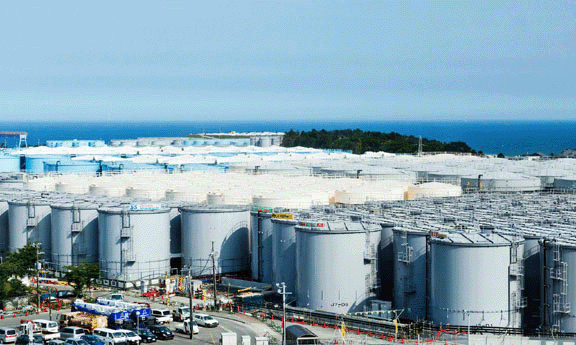
THE TSUNAMI-DRIVEN SEAWATER that engulfed Japan’s Fukushima Daiichi nuclear plant has long since receded. But plant officials are still struggling to cope with another dangerous flood: the enormous amounts of radioactive water the crippled facility generates each day. More than 1 million tons of radiation-laced water is already being kept on-site in an ever-expanding forest of hundreds of hulking steel tanks—and so far, there’s no plan to deal with them.
The earthquake and tsunami that hammered Fukushima on March 11, 2011 triggered meltdowns in three of its six reactors. That left messes of intensely radioactive fuel somewhere loose in the reactor buildings—though no one knows exactly where. What is known, however, is that every day, as much as much as 150 tons of groundwater percolates into the reactors through cracks in their foundations, becoming contaminated with radioactive isotopes in the process.
To keep that water from leaking into the ground or the Pacific, Tepco, the giant utility that owns the plant, pumps it out and runs it through a massive filtering system housed in a building the size of a small aircraft hangar. Inside are arrays of seven-foot tall stainless steel tubes, filled with sand grain-like particles that perform a process called ion exchange. The particles grab on to ions of cesium, strontium, and other dangerous isotopes in the water, making room for them by spitting out sodium. The highly toxic sludge created as a byproduct is stored elsewhere on the site in thousands of sealed canisters.
This technology has improved since the catastrophe. The first filtering systems, installed just weeks after the disaster by California-based Kurion Inc. (which has since been bought by Veolia, a French resource management company), only caught cesium, a strong gamma radiation emitter that makes it the most dangerous of the isotopes in the water. The tubes in those arrays were filled with highly modified grains of naturally occurring volcanic minerals called zeolites. By 2013, the company developed entirely artificial particles—a form of titano silicate—that also grab strontium.
The filters, however, don’t catch tritium, a radioactive isotope of hydrogen. That’s a much trickier task. Cesium and strontium atoms go into solution with the water, like sugar in tea; but tritium can bond with oxygen just like regular hydrogen, rendering the water molecules themselves radioactive. “It’s one thing to separate cesium from water, but how do you separate water from water?” asks John Raymont, Kurion’s founder and now president of Veolia’s nuclear solutions group. The company claims to have developed a system that can do the job, but Tepco has so far balked at the multi-billion dollar cost.
So for now, the tritiated water is pumped into a steadily growing collection of tanks. There are already hundreds of them, and Tepco has to start building a new one every four days.
Tepco has at least reduced the water’s inflow. As much as 400 tons per day was gushing in just a couple of years ago. In an effort to keep the groundwater from getting in, Tepco has built a network of pumps, and in 2016 installed an underground “ice wall”—a $300 million subterranean fence of 30-yard-long rods through which tons of sub-zero brine is pumped, freezing the surrounding earth. All of which helps, but hasn’t solved the problem……… https://www.wired.com/story/fukushimas-other-big-problem-a-million-tons-of-radioactive-water/
Three reactors went into meltdown after the 2011 Japanese tsunami in the worst accident since Chernobyl, leaving an apocalyptic vision of ghost towns and overgrown wildernesses and scared residents refuse to return
JAPAN is lying to the world about nuclear-ravaged Fukushima’s recovery while forcing terrified evacuees to return to their radioactive homes, it is claimed.
More than seven years after the nuclear catastrophe rocked the world, many of the 154,000 people who fled their homes have not returned and towns remain deserted.
Thousands of irradiated wild boars and monkeys roam around while poorly paid and protected decontamination workers scrub homes, schools and shops down ready for people to come home.
Chilling footage of taken inside the evacuated areas of Fukushima City and Köryama lay bare the disaster that unfolded after an earthquake, measuring 9.01 on the Moment Magnitude scale, struck off the coast of Japan on March 11, 2011.
But it was the following 50ft tsunami that damaged reactors at the Fukushima nuclear power plant.
This led to the evacuation of thousands of people from a 12-mile exclusion zone, with roads guarded by roadblocks and officials in protective gear.
Now there is a big campaign is under way to make people return but residents, campaigners and experts believe it not safe.
They accuse the Japanese authorities of wanting to allay public fears over the nuclear power by downplaying the dire consequences of the leak.
Propaganda videos showing the remarkable recovery of Fukushima have been spread by the government on its social media accounts.
“Since the Great East Japan Earthquake in 2011, #Fukushima has been working towards a bright future.
Strict safety standards and monitoring means that #food from the prefecture is enjoyed all over #Japan.” See Fukushima’s amazing recover in this video:http://bit.ly/2CqP0HC
But senior nuclear specialist Shaun Burnie, from Greenpeace Japan, said the nuclear nightmare continues.
He said: “They are not telling the whole truth either to the 127 million people of Japan or to the rest of the world – about the radiation risks in the most contaminated areas of Fukushima.
“The nuclear crisis is not over – we are only in year seven of an accident that will continue to threaten public health, and the environment, for decades and well into the next century.
“Attempts by the government and the nuclear industry communicate that it is safe and it’s over are a deliberate deception.”
Most of Japan’s power plants shut in the wake of the Fukushima nuclear disaster.
But in 2015 the Prime Minister announced plans to restart reactors because the economy needed cheap energy and using fossil fuels risked huge carbon emission fines.
Now five of them are back on – and it’s aimed to to have at least 12 in use by 2025.
The nuclear crisis is not over – we are only in year seven of an accident that will continue to threaten public health, and the environment, for decades and well into the next century(Senior nuclear specialist Shaun Burnie)
Mr Burnie said: “If they can create the illusion of the region that that has recovered from the nuclear accident they think it will reduce public opposition.”
But meanwhile the crisis continues at the Fukushima plant.
He said: “The massive Ice Wall built at the nuclear plant to stop contamination of groundwater is a symbol of this failure and deception – this is no Game of Thrones fantasy but the reality of a nuclear disaster that knows no end.”
Today he says “there were areas of Fukushima where radiation levels could give a person’s maximum annual recommended dose within a week.”
He said: “This is of particular concern with regards to poorly paid decontamination workers, thousands of whom have been involved in attempts to decontaminate radiation around people’s homes, along roads and in narrow strips of forest.”
Mr Burnie said the government claims decontamination has been completed in 100 percent of affected areas after a £8bn clean up operation.
But he added: “What they don’t explain is that 70-80 percent of areas such as Namie and Iitate – two of the most contaminated districts – are forested mountain which it is impossible to decontaminate.
“In areas opened in March 2017 for people to return – radiation levels will pose a risk until the middle of the century.
“These areas are still to high in radiation for people to return safely – and is one reason so few people are returning.”
Meanwhile heavy-handed tactics are being used with some fearful residents reporting that they have been warned they won’t receive lifeline compensation cash if they don’t comply.
Dr Keith Baverstock, a radiation health expert who was at the World Health Organization at the time disaster, told Sun Online: “For the past two years the Japanese government has encouraged the evacuees to return to their homes, but relatively few people have taken up this offer, even though there is a threat – it may even now be a fact – that their compensation will cease.”
Oil Price 30th March 2018,The decommissioning of the Fukushima nuclear power plant will cost an
annual US$2 billion (220 billion yen) until 2021, an unnamed source told
the Japan Times. Half of the money will be used to tackle the radioactive
water buildup at the site of the plant and for removing radioactive fuel
from the fuel pools. A small amount of funds will be used to research ways
of retreating melted fuel from the reactors that got damaged during the
2011 tsunami disaster.
The US$6 billion for the three years is only part of
the total estimated cost for taking Fukushima out of operation. The total
decommissioning tally came in at US$75 billion (8 trillion yen), as
estimated by the specially set up Nuclear Damage Compensation and
Decommissioning Facilitation Corp (NDF).
That’s four times more than the initial estimate of the costs around the NPP’s decommissioning. Now theoperator of Fukushima, Tepco, and the NDF are due to submit their financial plan for the facility to the government for approval by the energy industry
minister. In addition to the US$6 billion allocated for the cleanup, Tepco
will spend another US$1.88 billion (200 billion yen) on preparing to start
extracting the melted fuel from the three damaged reactors. This seems to
be the biggest challenge for the cleanup efforts because of the still high
radiation levels as well as technical difficulties. https://oilprice.com/Latest-Energy-News/World-News/Total-Tally-For-Fukushima-Decommission-Is-75-Billion.html
World Nuclear News 22nd March 2018,Unmanned aerial system technology is being developed to fly into the containment vessels of the damaged reactors at the Fukushima Daiichi nuclear power plant in Japan to assess their condition.
Tokyo Electric Power Company contracted the Southwest Research Institute (SwRI) of the USA
to carry out the work. The greatest challenge in decommissioning the plant will be removing the fuel debris from the three reactors that suffered meltdowns in the March 2011 accident.
However, radiation levels in those reactor buildings remain too high for workers to enter. Therefore remotely
operated equipment, such as robots, is needed to carry out investigations and tasks within those areas. A number of ground- and underwater-based robotic systems have already been sent inside the containment vessels of
units 1, 2 and 3.
Vancouver Sun 12th March 2018,A radioactive metal from the Fukushima nuclear plant disaster in Japan has
been discovered in the Fraser Valley, causing researchers to raise the
alarm about the long-term impact of radiation on B.C.’s west coast.
Examination of a soil sample from Kilby Provincial Park, near Agassiz, has
for the first time in this province found Cesium 134, further evidence of
Fukushima radioactivity being transported to Canada by air and water. http://www.vancouversun.com/news/Toxic+waters+Nuclear+radiation+found+pose+health+concerns/9606269/story.html
Hero rescues pets from Fukushima nuclear wasteland
The 3/11 kitten that wasn’t The “forbidden life” of those caring for abandoned animals in Fukushima, Beyond Nuclear , By Linda Pentz Gunter, 20 March 18 “………. countless animals were indeed abandoned in Japan due to the natural disasters and the forced exile of those living too close to the stricken nuclear plant. Some international rescue groups did go in to try to help, but early on found conditions and access restrictions challenging if not prohibitive.
However, there were also individuals and groups in Japan who were not willing to sit back and watch animals starve. In addition to the rescue operations, a spay-neuter organization began work to prevent the inevitable proliferation of pets who, if they had survived at all, had now become strays. Shelters were eventually built with funds donated by supporters.
But there were some, chronicled in several remarkable films, who either never left, or who quickly returned to Fukushima Prefecture, with one sole purpose in mind: to look after the animals. Their charges soon multiplied and for some, it has become a full-time vocation.
In a 2013 ITN short news segment, we are introduced to 58-year old Keigo Sakamoto, who had already established an animal sanctuary in Nahara, just over 12 miles from the Fukushima plant. He was one who refused the order to evacuate, then found himself completely trapped within the zone, cut off from supplies. He survives on the generosity of individuals and stores outside the zone where he regularly collects discarded food and other supplies essential to keeping his animals — and himself — alive.
Then there are farmers who returned to save their livestock. One such, 53-year old Naoto Matsumura, is featured in the 18-minute Vice documentary, Alone in the Zone. He lives in what was then the ghost town of Tomioka — whose station reopening story we featured last week. But Matsumura could not accept the idea that dogs, cows, goats, ducks and even ostriches should be cast off without a care.
At first he evacuated with his family, fearing all the reactors were going to blow. But when his family faced rejection by relatives who said they were “contaminated”, and the hassle of evacuation shelters became unendurable, he returned home alone. And stayed. “I couldn’t leave the animals behind,” he said. “I am opposed to killing off the animals in the zone.”
Feeding them, and refusing to sign the “death warrant” requirement from the government, will, he hopes, spare them from slaughter. “So many of their fellow cattle died in pain,” he said, recalling the tragedy of cows left in barnes to starve. “To me, animals and people are equal.” ……https://beyondnuclearinternational.org/2018/03/16/the-3-11-kitten-that-wasnt/
NGO Safecast co-founder Pieter Franken explains to schoolgirls how to assemble a Geiger counter kit in their classroom in Koriyama City, Fukushima Prefecture.
Tracking Fukushima’s radiation , https://www.shine.cn/feature/lifestyle/1803181780/Source: AFP Editor: Fu RongBeneath the elegant curves of the roof on the Seirinji Buddhist temple in Japan’s Fukushima region hangs an unlikely adornment: a Geiger counter collecting real-time radiation readings.
The machine is sending data to Safecast, an NGO born after the March 2011 Fukushima nuclear disaster that says it has now built the world’s largest radiation dataset, thanks to the efforts of citizen scientists like Seirinji’s priest Sadamaru Okano.
Like many, Okano lost faith in the government after the nuclear meltdown seven years ago.
“The government didn’t tell us the truth, they didn’t tell us the true measures,” he said.
Okano was in a better position than most to doubt the government line, having developed an amateur interest in nuclear technology 20 years earlier after the Chernobyl disaster. To the bemusement of friends and family, he started measuring local radiation levels in 2007.
“The readings were so high, 50 times higher than natural radiation,” he said of the post-disaster data. “I was amazed. The news told us there was nothing, the administration was telling us there was nothing to worry about.”
That dearth of trustworthy information was the genesis of Safecast, said co-founder Pieter Franken, who was in Tokyo with his family when disaster hit. Franken and friends had the idea of gathering data by attaching Geiger counters to cars and driving around.
“Like how Google does Street View, we could do something for radiation in the same way,” he said. “The only problem was that the system to do that didn’t exist and the only way to solve that problem was to go and build it ourselves. So that’s what we did.”
Within a week, the group had a prototype and got readings that suggested the 20-kilometer exclusion zone declared around the Fukushima plant had no basis in the data, Franken said.
“Evacuees were sent from areas with lower radiation to areas with higher radiation” in some cases, he said.
The zone was eventually redrawn, but for many local residents it was too late to restore trust in the government.
Okano evacuated his mother, wife and son while he stayed with his flock.
A year later, based on his own readings and after decontamination efforts, he brought them back. He learned about Safecast’s efforts and in 2013 installed one of their static counters on his temple.
“I told them: ‘We are measuring the radiation on a daily basis… so if you access the (Safecast) website you can choose (if you think) it’s safe or not’.”
Norio Watanabe has been a Safecast volunteer since 2011. In the days after the disaster evacuees flocked to Koriyama, which was outside the evacuation zone. He assumed his town was safe.
He sent his children away, but stayed behind to look after his mother, a decision he believes may have contributed to his 2015 diagnosis of thyroid cancer.
“As a scientist, I think the chance that it was caused by the Fukushima accident might be 50-50, but in my heart, I think it was likely the cause,” he said.
His thyroid was removed and is now healthy, but Watanabe worries about his students, who he fears “will carry risk with them for the rest of their lives.”
“If there are no people like me who continue to monitor the levels, it will be forgotten.”
Safecast now has around 3,000 devices worldwide and data from 90 countries. Its counters come as a kit that volunteers can buy through third parties and assemble at home.
Despite one newspaper’s effort, Japan can’t make its radioactive waste “disappear.”From information provided by Kurumi Sugita, Jon Goman, and Fukushima 311 Voices.
After the disastrous events of the March 2011 Fukushima-Daiichi nuclear meltdown in Japan, France-based Kurumi Sugita, a retired Japanese social anthropologist, and her American partner, Jon Goman, started a website for the French citizens group, Nos Voisins Lontains, 311(Our Far Away Neighbors 311.) At first published only in French, it is now also published in English and Japanese at Fukushima 311 Voices.
In a particularly revelatory article last October, the pair highlighted the extent to which efforts to “normalize” the devastating consequences of the nuclear disaster are pervasive in Japan.
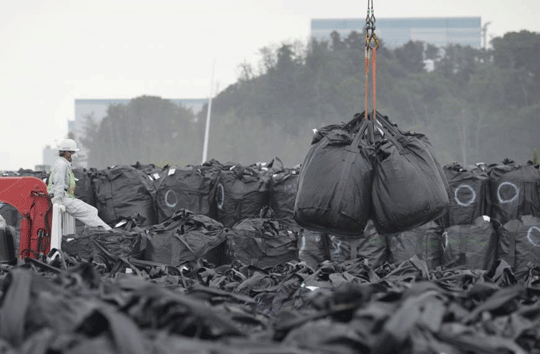
They detailed how the Mainichi Shimbun ran a story about the reopening of a stretch of railway line that had been closed since the Fukushima accident. The photo that accompanied the piece showed a train in the background. But the foreground of the picture was dominated by row after row of black trash bags filled with radioactive waste. (Shown in headline photo at the top of the article.)
Apparently, the radioactive trash bags photo at the train station caused some public (or possibly corporate) protest. The photo abruptly vanished from the Japanese online version of the paper (but not the English language one), to be replaced by a picture showing cheerfully smiling train personnel and passengers on the station platform.
Rows of such radioactive waste-filled bags now litter that region of Japan, sometimes stretching as far as the eye can see. Watch RT’s extraordinary drone footage of waste bags.
They are a reminder of the impossibility of effective “cleanup” after a radioactive accident. In a desperate attempt to restore confidence among exiled residents, top soil and other debris was scooped up intro trash bags in the name of “cleanup”. However, all this achieves, if the bags are ever “disposed of,” is to move the radiation somewhere else.
The story is one small example — but nevertheless a poignant one — of the extent to which the Japanese public are being subjugated, silenced and even threatened into an acceptance of the widespread radioactive contamination of their country.
Here is the original October 30, 2017 blog post from Fukushima 311 Voices, published in English and Japanese.
Newspaper changes an “annoying” photo
When we are outside of Fukushima, or of Japan, it is difficult for us to realize to what extent it has become difficult to speak of radio-contamination and the risk of exposure.
To illustrate this, we are reporting on the case of a photo replacement in the Mainichi Shimbun. This took place only in the Japanese edition. The original photo seems to have remained in the English edition.
At left is the original picture (used also in the Japanese 1st version) with the caption : “A train leaves Tomioka Station in Tomioka, Fukushima Prefecture, after services on the JR Joban Line were resumed between Tomioka and Tatsuta on Oct. 21, 2017. (Mainichi)”.
As you can see, the picture clearly tries to attract the attention of the readers to the black bags containing contaminated waste. In fact, the Japanese caption mentions also: “In the foreground, a temporary storage site of bags containing decontamination waste”. You can see other pictures here by the same photographer.
Here is the link to the togetter (in Japanese) through which you can see in what kind of language these people protesting against the first picture express themselves. They are pointing out crudely “the malicious intention” of the Mainichi Shimbun to devalue the event and the reconstruction of Fukushima.
First samples of Fukushima plant nuclear fuel debris to be collected in FY 2019 https://mainichi.jp/english/articles/20180316/p2a/00m/0na/018000c (Mainichi Japan) The government and Tokyo Electric Power Co. (TEPCO) are set to extract a small sample of melted nuclear fuel from the bottom of the No. 2 reactor’s containment vessel at the disaster-stricken Fukushima No. 1 nuclear plant as early as fiscal 2019.
The operation will be a test before starting full-scale collection of the fuel, targeted for 2021 or earlier. If development of technologies for debris retrieval shows promise, the operation may be moved up to the end of fiscal 2018. The government and TEPCO hope to ascertain the properties of the melted fuel and use the information for developing collection devices and debris containers.
This will be the first attempt to sample nuclear fuel debris from a reactor. Other materials, including those floating in contaminated water and substances stuck to robot probes, have been extracted from the plant’s reactors before. The No. 1, 2 and 3 reactors at the Fukushima No. 1 plant melted down in the March 2011 nuclear disaster.
The road map for collecting the melted fuel, last revised in September 2017, states that TEPCO would choose a first reactor to tackle by the end of fiscal 2019 and decide on a collection method. The utility would then start the retrieval process in 2021. As deciding on this process requires finalizing ways to contain, transfer and store the debris, the government and utility concluded that they would need to grasp the fuel’s current condition by extracting samples beforehand.
In January this year, a camera and dosimeter were sent into the containment vessel of the No. 2 reactor through an existing passage to find pebble- and clay-like masses at its bottom believed to be melted fuel. A source close to the government says the plan is to remotely guide a robot arm equipped with a camera and dosimeter into the containment vessel through the same passage, and extract a small amount of the suspected fuel debris.
The January probe of the containment vessel revealed radiation around the pebble-like masses measured 8 sieverts per hour — a level potentially lethal to humans after just one hour of exposure. Due to the ultrahigh radiation, the sampled material will be placed in a special radiation-shielded container before being removed from the reactor. After that, the sample will be brought to a Japan Atomic Energy Agency facility in Ibaraki Prefecture for analysis.
A government source told the Mainichi Shimbun that sampling the suspected fuel debris is different from the debris collection specified in the road map, and stressed that extracting samples should be beneficial to determine a method for retrieving the fuel.
Fukushima today is the focus of the nuclear lobby’s most egregious lies. It’s hard to know where to start in examining them.
Let’s start with ionising radiation. This year’s March 11 report, by Shin-ichi Hayama, on the macaque monkeys of Fukushima reveals that they have radioactive cesium in their muscles, and significantly low white and red blood cell counts. They have reduced growth rate and smaller head sizes. These “snow monkeys” are close relatives to humans. Hayama’s 10 year study of the macaque provides a unique examination of the effects of chronic low level radiation affecting generations of monkeys.
New nuclear power for Japan, and nuclear technology as a profitable export? A visitor from another planet might well marvel at these fantasies – noting Fukushima’s radioactive shattered reactors, and ever growing masses of radioactive water – with Japan’s vulnerability to earthquakes.
The social costs continue – the rise in childhood and adolescent thyroid cancer, the worried evacuees, the stigma to Fukushim survivors. The financial costs of it all are unimaginable – and will be exacerbated by many legal cases won against the nuclear industry.
So – how does the global nuclear industry, backed by banks and governments respond?
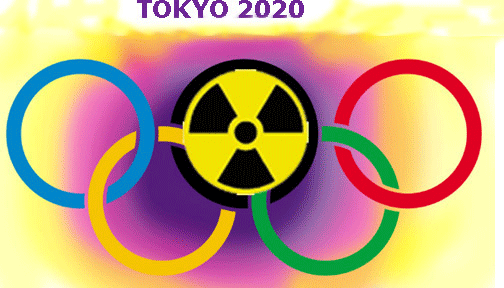
Why – by deciding to hold the 2020 Olympic Games in Tokyo, and pretending that everything is safe, clean green under control in North Eastern Japan!
LET THE OLYMPIC SPIN BEGIN – the survival of the nuclear industry depends on it!!
Seven years after the Fukushima, Japan nuclear disaster began, forcing evacuations of at least 160,000 people, research has uncovered significant health impacts affecting monkeys living in the area and exposed to the radiological contamination of their habitat.
Shin-ichi Hayama, a wild animal veterinarian, has been studying the Japanese macaque (Macaca fuscata), or snow monkey, since before the Fukushima nuclear disaster. Now, his research has shown that monkeys in Fukushima have significantly low white and red blood cell counts as well as a reduced growth rate for body weight and smaller head sizes.
Hayama, who began his macaque research in 2008, had access to monkeys culled by Fukushima City as a crop protection measure. He continued his work after the Fukushima nuclear explosions. As a result, he is uniquely positioned to discover how low, chronic radiation exposure can affect generations of monkeys.
The macaque is an old world monkey native to Japan, living in the coldest climates of all of the non-human primates. Like humans, macaques enjoy a good soak in the mountain hot springs in the region. It is even said that they have developed a “hot tub culture” and enjoy time at the pools to get warm during winter.
However, snow monkeys and humans share more than a love of hot springs. Human DNA differs from rhesus monkeys, a relative of the snow monkey, by just 7%. While that 7% can mean the difference between building vast cities to living unsheltered and outdoors, for basic processes like reproduction, these differences begin to fade. Consequently, what is happening to the macaques in Fukushima should send a warning about the implications for human health as well, and especially for evacuees now returning to a region that has been far from “cleaned up” to any satisfactory level.
Hayama’s research group has published two studies, each comparing data before and after the nuclear catastrophe began, and also between exposed and unexposed monkey populations. In a 2014 study, researchers compared monkeys from two regions of Japan, one group of monkeys from the Shimokita region, 400 Km north of Fukushima, and a second group of monkeys from contaminated land in Fukushima.
The monkeys in Fukushima had significantly low white and red blood cell counts. Other blood components were also reduced. The more a radioactive isotope called cesium was present in their muscles, the lower the white blood cell count, suggesting that the exposure to radioactive material contributed to the damaging blood changes. These blood levels have not recovered, even through 2017, meaning that this has become a chronic health issue.
Changes in blood are also found in people inhabiting contaminated areas around Chernobyl. Having a diminished number of white blood cells, which fight disease, can lead to a compromised immune system in monkeys as well as people, making both species unable to fight off all manner of disease.
Hayama followed up his 2014 study with another in 2017 examining the differences in monkey fetus growth before and after the disaster. The researchers measured fetuses collected between 2008 and 2016 from Fukushima City, approximately 70 km from the ruined reactors. Comparing the relative growth of 31 fetuses conceived prior to the disaster and 31 fetuses conceived after the disaster revealed that body weight growth rate and head size were significantly lower in fetuses conceived after the disaster. Yet, there was no significant difference in maternal nutrition, meaning that radiation could be responsible.
Smaller head size indicates that the fetal brain was developmentally retarded although researchers could not identify which part was affected. The mothers’ muscles still contained radioactive cesium as in the 2014 study, although the levels had decreased. These mothers had conceived after the initial disaster began, meaning that their fetuses’ health reflects a continuing exposure from environmental contamination. This study mirrors human studies around Chernobyl that show similar impacts as well as research from atomic bomb survivors. Studies of birds in Chernobyl contaminated areas show that they have smaller brains.
Although Hayama has approached radiation experts to aid with his research, he claims they have rejected it, saying they don’t have resources or time, preferring to focus on humans. But humans can remove themselves from contaminated areas, and many have chosen to stay away despite government policies encouraging return. Tragically, monkeys don’t know to leave, and relocating them is not under discussion, making study of radiation’s impact on their health vital to inform radiation research on humans, the environment, and any resettlement plans the government of Japan may have.
Hayama presented his work most recently as part of the University of Chicago’scommemoration of the 75th Anniversary of the first man-made controlled nuclear chain reaction. His work follows a long, important, and growing line of research demonstrating that radiation can not only damage in the obvious ways we have been told, but in subtle, yet destructive ways that were unexpected before. The implications for humans, other animals, and the environment, are stark. Cindy Folkers is the radiation and health specialist at Beyond Nuclear.