Eight years later, Fukushima nuclear wreck still resulting in mounting tons of radioactive water, with no solution
Eight years after triple nuclear meltdown, Fukushima No. 1’s water woes show no signs of ebbing, Japan Times, BY RYUSEI TAKAHASHI, STAFF WRITER, 8 Mar 19,
This is the first in a series examining how the northeast and the nation are progressing with efforts to deal with the March 2011 earthquake, tsunami and nuclear crisis.
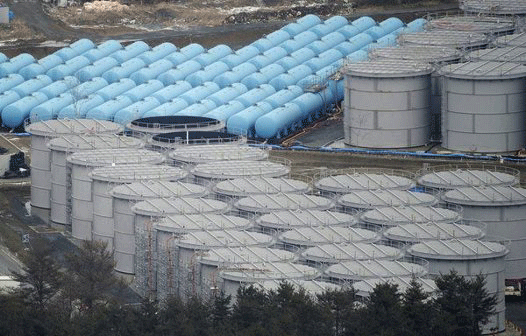
OKUMA, FUKUSHIMA PREF. – Nearly a thousand storage tanks are scattered across the Fukushima No. 1 nuclear power plant, holding a staggering 1.1 million tons of treated water used to keep its melted reactor cores cool while they rust in the sun.
Plant manager Tokyo Electric Power Company Holdings Inc., or Tepco, plans to build more of the gigantic tanks to hold another 0.27 million tons, which is roughly the equivalent of 108 Olympic-size swimming pools. The new tanks are expected reach full capacity in four or five years
Each tank takes seven to 10 days to fill and holds between 1,000 to 1,200 tons of liquid, Tepco officials told reporters during a tour in February organized by the Japan National Press Club. It’s been eight years since Fukushima No. 1 suffered three core meltdowns triggered by tsunami following the Great East Japan Earthquake, but the situation with the tanks may be a sign Tepco has yet to get the facility under control.
“Space isn’t a big issue at this point in time, but five or 10 years from now, after we’ve started removing the melted fuel debris, we’re going to need facilities to store and preserve it,” Akira Ono, president of Fukushima No. 1 Decontamination and Decommissioning Engineering Co., a Tepco unit overseeing the decommissioning process, said at a news conference in January.
The water issue is eating up both space and resources, but a solution is unlikely to emerge anytime soon.
The International Atomic Energy Agency published a report in November that said the physical constraints of the site “leave little room for additional tanks” beyond what Tepco has allocated.
The IAEA report went on to say it believes storing tainted water in “above ground tanks . . . can only be a temporary measure while a more sustainable solution is needed” and a “decision on the disposition path should be taken urgently.”
Beyond 2020, Tepco has not allocated any additional space for holding treated water on the site and has no plans to do so at this time. The utility said the tanks will likely become a headache if they remain at the plant.
“At that point, we may need to rethink how we’re using the space,” Ono said.
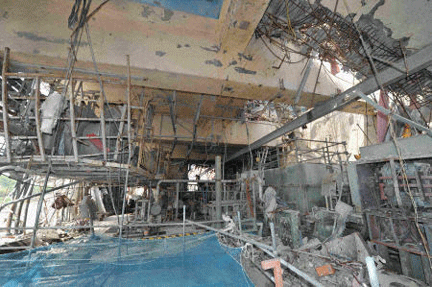
Eight years ago when the monstrous tsunami hit, the entire plant lost power and reactors 1, 2 and 3 lost coolant, causing their cores to overheat. The fuel rods consequently melted, dripping molten fuel that burned through their pressure vessels and pooled in their primary containment vessels. Reactors 1, 3 and 4 then suffered hydrogen explosions.
Tepco must inject water into the reactors indefinitely to keep the melted cores cool, but water tainted by contact with the fuel and associated debris has been leaking from the damaged containment vessels and into the basements of the reactor buildings, where tons of fresh groundwater flows in daily through holes in their damaged walls.
The contaminated water is pumped out and passed through a filtration device called the Advanced Liquid Processing System — which is supposed to remove every radionuclide except for tritium — and stored in the tanks.
Tepco has taken steps to limit the amount of groundwater seeping into the reactor buildings, including wells to intercept and divert it and an underground ice wall around the buildings to block any inflow.
According to Tepco, however, about 83 tons of water are seeping into the reactor buildings each day. Although this is an improvement from some 300 tons in previous years, Tepco must keep making more tanks.
At the moment, Tepco is waiting for a government panel’s advice on what to do with the tritium-tainted water. The panel is considering five disposal methods: ground injection, sea discharge after diluting the tritium concentration, discharging it as steam, discharging it as hydrogen, and solidification followed by underground burial……
there are concerns about the impact an ocean discharge may have on fisheries still trying to recover from the nuclear crisis.
Fishing in the area has resumed on a trial basis and workers still perform radiation checks before shipping their hauls to fish markets. The waters off Fukushima Prefecture are at the confluence of two ocean currents — the Oyashio from the north and Kuroshio from the south — which make for the good fishing grounds that have been a vital part of the agrarian prefecture’s economy.
Eight years after the meltdowns, however, residents are still struggling to convince the world that fish from the area are safe to eat. Many believe public perception alone will cripple Fukushima’s fishing industry anew if the tainted water is expelled into the ocean — even if the tritium has been reduced to below international standards.
Trust issues continue to plague Tepco after it claimed ALPS was filtering every radionuclide from the cooling water except tritium. Last August it came to light that the allegedly treated water still contained other dangerous contaminants, including iodine, cesium and strontium. Some of the concentrations were above current safety limits.
This has further angered Fukushima residents and made it harder to get their approval for dumping the water held by the tanks into the sea.
During a public hearing hosted by METI in August, participants urged the government and Tepco to consider finding an off-site location to store the water instead of discharging it into the ocean.
“Without a national debate and without the understanding of Japanese citizens or the countries importing our products, as a fisherman of Fukushima Prefecture, I strongly oppose the plan to discharge the treated water into the ocean,” Tetsu Nozaki, chairman of the Fukushima Prefectural Federation of Fisheries Cooperative Association, told the hearing.
“To release the ALPS-treated water into the ocean, at this time, would deal a disastrous blow to the fishermen of Fukushima and rob them of their hard work and motivation,” he said…….
Meanwhile, the crippled plant faces other serious challenges — including how to extract the molten fuel…….
Miyano said Tepco and the government — with the help of scientists, nuclear physicists and engineers from around the world — are inventing new technologies as they devise a way to remove the debris……. https://www.japantimes.co.jp/news/2019/03/07/national/eight-years-triple-meltdown-fukushima-no-1s-water-woes-slow-recede/#.XIMmYMkzbGh
The indigenous fight for the truth on Fukushima’ s radioactive impact on the world
The future of all life: Indigenous sovereignty and the Fukushima nuclear disaster, Bay View, National Black Newspaper, by Harun Minhaj, March 4, 2019 In 2011, an unprecedented series of die-offs began to strike dead hundreds of millions of sea creatures in the northern Pacific Ocean. As one sailor who frequently travels the Pacific remarked in October of 2013:
The stigma continues, however much the propaganda spouts about the Fukushima nuclear ‘recovery’
The Fukushima nuclear disaster’s legacy: An inescapable stigma, Commentary: Pockets of innovation, like a drone testing field, have some hoping the region sheds its notoriety. But it’s not that simple. CNet
There’ was just one jarring thing: the utter silence throughout the facility.
It was our first night in the Fukushima region, and my photographer, James Martin, and my interpreter had arrived a little after 10 p.m. Initially, we weren’t sure if this was the right location – we seemingly had the only vehicle in the parking lot, and a quick search of those conference rooms found no staff.
It wasn’t until we located the reception desk, tucked out of sight from the main lobby, that we found another human. The employee noted that only 15 guests were staying in the 200-room hotel.
Welcome to Fukushima.
That first night proved to be one of the more memorable moments in a trip that included a visit inside one of the most radioactive hotspots in the world, a look at a massive underground ice wall and a virtual reality experience that took me to places no human could survive. It stood out because it illustrated the long way this area has to go before any semblance of normalcy can return…….
Eight years on, there’s been little progress with the actual cleanup. While three of the six reactors have been safely decommissioned, the remaining three have proven to be such a challenge that Tokyo Electric Power Company, or Tepco, just last month finally succeeded in sending a robot down to the Unit 2 reactor to pick up some of debris in the highly radioactive core. ………
there are reminders of the disaster everywhere. Drive on the nearby Joban Expressway and you’ll periodically run into signs with a readout of the radiation level. The daily weather report on the local evening news contains an update on the radiation in the area.
I periodically drove past fields containing hundreds of bags of radiated dirt.
University of California covers up the truth on Fukushima radiation
The future of all life: Indigenous sovereignty and the Fukushima nuclear disaster, Bay View, National Black Newspaper, by Harun Minhaj, March 4, 2019 “………..As the Caretakers of Mother Earth have warned, the nuclear establishment has been working tirelessly to cover up and downplay the consequences of this nuclear disaster. The University of California has long played an essential role in this establishment, as it designed the core physical package of every single nuclear warhead in the U.S. arsenal. And now, formerly secret documents show that UC played an indispensable role in the federal response to – and cover-up of – the Fukushima nuclear disaster.
The estimates secretly forecasted by the LLNL’s model predicted very high doses to children in California from radioactive iodine, which is known to cause serious thyroid illnesses. Subsequent measurements found that this model’s predictions of radiation exposure in California were far more accurate than lower estimates and actually underestimated the radiation found 30 km off the coast of Japan.
Yet the UC never issued a single health warning to anyone living on the West Coast prior to their exposure to this deadly radiation. Instead, at the very time that the UC’s LLNL was modeling “estimates of possible plume arrival times and dose for U.S. locations,” UC Berkeley scientists were at the forefront of corporate media coverage on outlets such as ABC7 proclaiming brazen falsehoods such as “there is no plume.”
The LLNL’s model was continually being refined and updated “based on meteorological analyses and available field data” to ensure its predictions were maximally accurate, yet UC Berkeley scientists were simultaneously telling the public that “you cannot predict how the weather is going to carry radiation particles over the West Coast, if anything at all.”
Even worse was the initial UC Berkeley claim that the radiation reaching California was “not harmful at all” and posed “no risk to California,” despite the LLNL’s forecast of very high doses to children in California from radioactive iodine.
Meanwhile, the head of UC Berkeley’s Nuclear Engineering Department secretly admitted that “it is possible that we will find that some people have received doses … that could exceed the levels that current Protective Action Guidelines are designed to prevent.” The Protective Action Guidelines (PAGs) are legal limits on radiation exposure set by the EPA designed to minimize the risk of harm, and this professor subsequently suggested that, should they be exceeded, “this could provide a basis for immediate action to change PAGs.”
When UC Berkeley began testing for radioactive iodine from the Fukushima fallout in California, it found levels in rainwater up to 181 times the EPA’s safe drinking water standards. And although rainwater and tap water should not be conflated, radioactive isotopes climb their way up the food chain in increasing concentrations in numerous ways, such as the soil of produce farms and the pastures of milk-giving cattle.
The UC cover-up of West Coast fallout
Far from being incidentally related to the case, the University of California’s Lawrence Livermore National Lab (LLNL) was in fact the federal contractor given the responsibility of projecting the damage or “dose” from Fukushima Daiichi’s fallout to Japan, the Pacific Ocean and U.S.-occupied Turtle Island.
And, indeed, radioactive materials from Fukushima were detected across California’s food web, while UC Berkeley’s own measurements showed that food items such as milk were regularly exceeding the EPA’s PAGs in both 2011 and 2012 until they stopped taking these measurements.
The response to these findings was once again denial and distortion. The EPA soon increased its PAG “safe limit” by more than 400 times, to such a high level that all of these findings would retroactively cease to be considered health risks.
In the meantime, UC Berkeley engineers once again asserted there was no cause to worry and falsely minimized these readings by conflating external radiation as received from plane travel with the more dangerous internal radiation received through ingesting radioactive particles, which remain in the body emitting radiation for much longer and have the ability to concentrate in specific vulnerable organs such as the thyroid.
But the initial epidemiological evidence is in, and it already shows a variety of illnesses and deaths across the West Coast significantly correlated with the arrival and presence of Fukushima fallout, such as over 100 additional fetal deaths and birth abnormalities in the state of Washington in 2011 and increased rates of congenital hyperthyroidism in California infants born shortly after the meltdowns – around 1,500 additional borderline and severe cases.
The EPA soon increased its PAG “safe limit” by more than 400 times, to such a high level that all of these findings would retroactively cease to be considered health risks.
The University of California totally failed to make public the initial LLNL projections of “very high doses” to California infants and provide adequate health warnings – such as avoiding contaminated milk or taking natural iodine supplements – despite having this legal responsibility both as a federal contractor and as the operator of California’s Poison Control System, which administers such warnings on behalf of the California Emergency Medical Services Authority for the entire state.
The UC cover-up of Pacific fallout and seafood contamination
As serious as the consequences of the fallout on California were, the radiation California and the West Coast received was only a small fraction (<2 percent) of the total, of which the majority (~80 percent) fell into the Pacific.
From the very beginning, UC scientists were involved in studying the Pacific die-offs. Indeed, it was UC scientists who declared when studying the 2011 marine invertebrate mass die-offs that “[N]o previously documented mortality event has been so severe over such a large region …” Yet these UC scientists who had been studying this epidemic from the very beginning have failed to ever monitor the sick and dead animals for radiation, despite one of the lead scientists admitting that Fukushima could not be ruled out as a cause.
When their major study was published in 2018, it included no consideration of Fukushima or radiation whatsoever. Apparently, it was a moot point – the UC’s website on the die-offs had already been claiming for years there was “no evidence” of Fukushima radiation having an impact, even though they had never looked for any despite having already admitted it couldn’t be ruled out.
To make matters worse, one of the principal UC authors of this study falsely claimed that Fukushima radiation could not have precipitated the die-off, because “many more creatures would be affected.” By this time, the unprecedented and concurrent die-offs of fish, marine mammals and sea birds had already been reported.
In denying the impact of Fukushima on the Pacific, these scientists are hardly alone. Overand over again, UC professors – frequently in leadership positions and with government ties – have minimized the impact by relying on the widely debunked fallacy of “dilution.”
Yet dilution has been known to be a false solution to radiation for over 50 years now. In 1955, a once-secret memo from the U.S. Atomic Energy Commission (AEC) – then headquartered in Berkeley – noted that the “dissipation of radioactive fallout in ocean waters is not a gradual spreading out of the activity from the region with the highest concentration to uncontaminated regions, but that in all probability the process results in scattered pockets and streams of higher radioactive materials in the Pacific.”
This is due to a variety of reasons, including the flow of currents and the role played by sediment and debris in transporting radiation. Furthermore, studies have shown that the bioconcentration of radioactive particles up the food chain increasingly amplifies its prevalence in smaller and larger marine organisms by factors ranging from 3 to 300.
While this memo may have previously been secret, the “no threshold” model of radiation has been well-established for almost as long, and is the accepted foundation of radiation protection for the Environmental Protection Agency, National Academy of Sciences, and many other institutions.
In the 1960s, UC Berkeley Nuclear Scientist John Gofman established the Biomedical Research Division of the UC’s LLNL, when he was employed by the AEC to discredit findings which showed that “low level” radiation from nuclear weapons tests was exposing infants in surrounding areas to dangerous amounts of radiation.
Instead, Gofman’s research confirmed these dangers, and at the end of the decade he gave a report showing that there is no threshold beneath which radiation exposure is “safe”: lower levels correspond to a lower – but very real – risk of disease. Consequently, dilution does nothing more than spread the impact of radiation amongst a larger population vulnerable to disease, with each individual facing a lower risk but the overall aggregate impact remaining the same.
The AEC disliked these findings and forced Gofman out of the LLNL, illustrating the reprisals nuclear scientists often face for challenging the pro-nuclear establishment.
Numerous projections of the spread of Fukushima radiation in the Pacific Ocean have predicted that, far from becoming increasingly diluted, once the radiation leaves the immediate vicinity of the Fukushima shoreline it would actually become increasingly concentrated as it approaches the West Coast due to the dynamics of ocean currents, with eventual peak concentrations reaching levels up to 10 times higher than off the coast of the rest of Japan.
There is no threshold beneath which radiation exposure is “safe”: lower levels correspond to a lower – but very real – risk of disease.
What measurements are available not only confirm these projections, showing increasing concentrations traveling east across the Pacific Ocean roughly correlating to these models, they also show that the vast quantities of radioactive particles the Nordic PSA Group predicted would kill at least 50-100 million fish were indeed present throughout large areas of the Pacific Ocean.
In other words, a vast array of scientific knowledge, regulatory precedent, expert models, and empirical data directly contradicts the denials of the UC nuclear establishment that Fukushima’s radiation is of no concern in the Pacific due to “dilution.”
Once again, these denials have serious consequences not just in terms of the ecocidal impact of Fukushima Daiichi’s radiation on Pacific sea life. Based on the thoroughly disproven dilution fallacy, several prominent UC scientists have also denied that there are any health impacts from Fukushima radiation in the Pacific, including the risks entailed in eating contaminated seafood.
The Nordic Probabilistic Safety Assessment Group, however, founded by the nuclear utilities of Finland and Sweden and therefore not at all “anti-nuclear,” concluded in its 2011 report that even if seafood radiation levels from Fukushima stay below legal limits, more than 1 million people would die from just one of the elements of concern, cesium-137. They wrote:
“The fish, seafood, whale meat and seaweed consumed may have concentrations below legal limits, but the radioactive content will be increased from normal levels. As noted in Section 3.6.3, the ingestion dose could be substantial even if the legal limits for the foodstuff are preserved. This cycle will last for many generations, because of the food chain of fish and other marine fauna, and the radioactivity will be recycled and in fact the meat content will increase rather than decreasing by decay. Even if only one one-hundredth of the radioactivity (more than 1e15 Bq of CS137) were to enter this recirculation pattern, the collective whole body ingestion dose over many generations would exceed 1e7 Sv, sufficient to kill more than 1,000,000 people.”
As predictions of mass die-offs and increasingly concentrated radiation crossing the Pacific to the West Coast have already come true, ignoring the scientific evidence about the dangers this radiation poses to us too promises to have deadly consequences. With over 1 hundred million sea creatures having already perished as predicted by the nuclear utility-founded Nordic PSA Group, this institution’s estimate that more than 1 million people could also die if human consumption of Pacific seafood continues unabated is supported by a solid track record based on the scientific method, unlike the UC’s ongoing denials and distortions of even the most basic facts of the Fukushima disaster………….https://sfbayview.com/2019/03/the-future-of-all-life-indigenous-sovereignty-and-the-fukushima-nuclear-disaster/
Schools refitted in Fukushima, but enrolment remains dismal
THE ASAHI SHIMBUN, March 1, 2019 Local governments in Fukushima Prefecture have spent billions of yen to create ideal education environments, including new or renovated school buildings, high-tech classes, free lunches and uniforms, and long-distance buses.
But these schools may be forced to close down. There just aren’t enough children in areas near the Fukushima No. 1 nuclear power plant to sustain their operations.
The enrollment figures have dispirited local government officials, who agree that schools and their students are the key to recovery from the 2011 Great East Japan Earthquake, tsunami and nuclear accident…….http://www.asahi.com/ajw/articles/AJ201903010026.html
“Ice wall” – the effort to contain Fukushima’s radiation
How Fukushima’s underground ice wall keeps nuclear radiation at bay
Think Game of Thrones, but this one is underground and defends against a far more realistic threat. CNet,
BY ROGER CHENG MARCH 8, 2019
The intricate network of small metal pipes, capped off by six-foot-high metal scaffolding, shouldn’t stand out amid the numerous pieces of industrial equipment littered throughout the Fukushima Daiichi Nuclear Power Plant. After all, it’s a power plant.
I take a closer look, and notice spheres of ice perched upon the smaller pipes, which line the center of the structure. The facility sits at the water’s edge, and there’s a brisk breeze blowing through.
e intricate network of small metal pipes, capped off by six-foot-high metal scaffolding, shouldn’t stand out amid the numerous pieces of industrial equipment littered throughout the Fukushima Daiichi Nuclear Power Plant. After all, it’s a power plant.
I take a closer look, and notice spheres of ice perched upon the smaller pipes, which line the center of the structure. The facility sits at the water’s edge, and there’s a brisk breeze blowing through
………. The structure, which cost roughly $300 million, paid for by public funds, serves as critical protection, defending the Fukushima area from one of the most radioactive hotspots in the world. While Tokyo Electric Power Co., also known as Tepco, struggles to find a way to remove radioactive material from the facility – a process the government estimates could take more than four decades — the more immediate concern is what to do with the contaminated water leaking out from the facility……….
Ice cold
While the term “ice wall” has a colorful ring to it, engineers use the more academic-sounding term Artificial Ground Freezing.
…… calcium chloride solution is pumped down through a smaller inner pipe, and circulated back up a large outer pipe.
The coolant brings down the temperature of each pipe to -30 degrees Celsius, or -22 degrees Fahrenheit, and the pipes are spaced about three feet apart. The cold emanating from each one hardens the soil around it.
The point of the ice wall is to keep the groundwater that runs down from the mountains to the west from entering Fukushima Daiichi and mixing with the toxic water leaking out of the Unit 1, 2 and 3 reactors. That is, keep the clean water on the outside of the wall, while the contaminated water stays inside.
Tepco and manufacturing partners, such as Toshiba and Mitsubishi, are working on robots to identify and determine how to clear out the radioactive materials in each of the reactors’ primary containment vessels, essentially the heart of each facility.
Until then, they need a way to slow or stop the flow of water into the facility.
……. With the wall in place, Tepco says it has been able to reduce the level of contaminated water generated from Daiichi. But a Reuters report in March 2018 found that the wall still let a fair amount of clean water in, adding to the volume of toxic water the company needs to deal with. Tepco, however, says it’s been effective in reducing the volume.
“We know this is not the end of our effort,” says a company spokesman. “We will be continuously working hard to reduce the amount of generation of contaminated water.”
The leaky bucket
Imagine a leaky bucket that constantly needs to be filled with water. At the same time, the water from the leak needs to be collected and stored. And there’s no end in sight to this cycle.
That essentially is the problem that Tepco faces at Daiichi. The fuel rods stored in the three radioactive units constantly have to be cooled with fresh water, but leaks mean the company needs to be vigilant about keeping the tainted liquid from getting out of the facility’s grounds.
Since the accident nearly eight years ago, Tepco has collected 1.1 million tons of contaminated water in 900 tanks stored on the grounds at Daiichi. The company estimates it has enough space in the 37.7-million-square-foot facility to house an additional 270,000 tons of water, which means it would run out sometime in 2020.
“We’re conscious of the fact that we can’t keep storing more and more water,” Kenji Abe, a spokesman for Tepco’s decommissioning and decontamination unit, says through an interpreter.
……. So far, treatment technology from partner companies like Kurion and Sarry have enabled Tepco to remove 62 of the 63 radioactive elements from the water, but one, tritium, remains.
It’s this one element, which is bonded to the water at an atomic level, that means Tepco needs to keep collecting and storing the water.
…….. organizations such as Greenpeace have called for Tepco to keep storing the water, noting that much of the early batches of treated water far exceed safety limits for radioactive elements.
Given the sensitivities around Fukushima, Tepco must continue to store the water. A spokesman said the company isn’t planning to disperse the water. But it is one option being considered by the Japanese government, which ultimately makes the decision.
“Resolving the issue of the contaminated water is something we haven’t yet reached a final solution on,” Yagi says.
…….. The scientist explains that Japan has set a legal radioactivity limit of 60,000 becquerel per liter of tritium. But the treated water is still at 1.7 million Bq per liter, or roughly 30 times what’s deemed safe.
So, for now, Tepco must continue collecting the water. And the ice wall continues to stand, invisible to onlookers, as one of the most important lines of defense. https://www.cnet.com/news/how-fukushimas-underground-ice-wall-keeps-nuclear-radiation-at-bay/
8 Years On: Tainted Soil Use Plan Draws Backlash from Fukushima Residents
https://www.nippon.com/en/news/yjj2019030601012/8-years-on-tainted-soil-use-plan-draws-backlash-from-fukushima-residents.html Mar 8, 2019 Minamisoma, Fukushima Pref., March 8 (Jiji Press)–A plan to use soil from decontamination work in areas tainted with radioactive substances from the March 2011 nuclear disaster in Fukushima Prefecture is facing a strong backlash from local residents.
Under an envisaged feasibility study program, the Environment Ministry aims to use the soil for public works projects and examine its safety.
The ministry apparently hopes to reduce the amount of tainted soil to be transferred to a planned final disposal facility.
But Fukushima residents continue to have strong safety concerns about radiation eight years after the triple meltdown accident at Tokyo Electric Power Company Holdings Inc.’s <9501> Fukushima No. 1 nuclear power plant, damaged in the March 2011 earthquake and tsunami
UK, Japan scientists study radioactive Fukushima particles
This sounds like a good idea. But – can we really be confident about science done by Atomic Energy Agencies , whose brief is to further develop atomic energy?
OXFORD, England (Reuters) 8 Mar 19, – Eight years after the Fukushima nuclear meltdown in Japan, radioactive particles collected from the site are undergoing new forensic investigation in Britain in an effort to understand the exact sequence of events…….
The Japan Atomic Energy Agency (JAEA) is currently collaborating with British researchers to learn more about the state of the radioactive particles created by the meltdown.
Dr Yukihiko Satou from the JAEA oversaw the transportation of particles collected from within the restricted zone, very close to the disaster site, to Britain.
“The particles were fundamentally extracted from those attached to soil, dust and debris,” Satou told Reuters.
Encased in protective tape, the samples were brought to the Diamond Light Source, Britain’s national synchrotron, or cyclic particle accelerator, near Oxford.
Here electrons are accelerated to near light speeds until they emit light 10 billion times brighter than the sun, then directed into laboratories in ‘beamlines’ which allow scientists to study minute specimens in extreme detail.
…… Understanding the current state of these particles and how they behave in the environment could ultimately determine if and when the area could be declared safe for people to return…… Writing by Matthew Stock,; Editing by Gareth Jones https://www.reuters.com/article/us-japan-disaster-radiation/uk-japan-scientists-study-radioactive-fukushima-particles-idUSKCN1QP1GF
Nightmarishly high radiation levels -robots the only chance to deal with Fukushima reactors’ molten fuel
For Fukushima’s nuclear disaster, robots may be the only hope, The 2011 meltdown in Japan is still too hot for humans to handle. Send in the machines. CNet BY ROGER CHENG, MARCH 4, 2019 ………. I’m inside the cavernous top of the Unit 3 reactor in the Fukushima Daiichi Nuclear Power Plant. Yes, that Fukushima Daiichi, site of the world’s worst nuclear disaster.
Unit 3 was one of three reactors crippled on March 11, 2011, after a 9.0 earthquake struck 80 miles off the coast of Japan. (Units 4, 5 and 6 at Daiichi weren’t operating at the time.) The temblor shook so violently it shifted the Earth’s axis by nearly 4 inches and moved the coast of Japan by 8 feet. Eleven reactors at four nuclear power plants throughout the region were operating at the time. All shut down automatically. All reported no significant damage.
An hour later, the tsunami reached shore.
Two 50-foot-high waves barreled straight at Fukushima Daiichi, washing over coastal seawalls and disabling the diesel generators powering the plant’s seawater cooling systems. Temperatures inside the reactors skyrocketed to as high as 5,000 degrees Fahrenheit.
Fuel rods became molten puddles of uranium that chewed through the floors below, leaving a radioactive cocktail of fuel rods, concrete, steel and melted debris. Molten fuel ultimately sank into the three reactors’ primary containment vessels, designed to catch and secure contaminated material.
Next Monday marks the eighth anniversary of the earthquake. Since then, Japanese energy giant Tokyo Electric Power Company, or Tepco, has cleared enough of the rubble on the top floor of the Unit 3 building to allow for my 10-minute visit.
I gaze up at the massive barrel vault ceiling, trying to get a handle on the sheer scale of everything. Radiation levels are too high for me to linger. My quickening pace and breath are betrayed by rapid flapping noises coming from the purple filters on both sides of my respirator mask.
At the far end of the room, there’s an enormous orange platform known as a fuel-handling machine. It has four giant metal legs that taper down, giving the structure a sort of animalistic look. Thin steel cables suspend a chrome robot in the center of the frame. The robot, largely obscured by a pink plastic wrapper, is equipped with so-called manipulators that can cut rubble and grab fuel rods. The robot will eventually pull radioactive wreckage out of a 39-foot-deep pool in the center of the room.
It’s just one of the many robots Tepco is using to clean up the power plant. It’s why I came to Japan this past November — to see how robots are working in one of the most extreme situations imaginable.
The Japanese government estimates it will cost $75.7 billion and take 40 years to fully decommission and tear down the facility. The Japan Atomic Energy Agency even built a research center nearby to mock up conditions inside the power plant, allowing experts from around the country to try out new robot designs for clearing away the wreckage.
The hope is that the research facility — along with a drone-testing field an hour away — can clean up Daiichi and revitalize Fukushima Prefecture, once known for everything from seafood to sake. The effort will take so long that Tepco and government organizations are grooming the next generation of robotics experts to finish the job. …….
Two years ago, Tepco erected a dome over the Unit 3 reactor and fuel pool so that engineers could bring in heavy equipment and now, us.
Roughly 60 feet below me, radiation is being emitted at 1 sievert per hour. A single dose at that level is enough to cause radiation sickness such as nausea, vomiting and hemorrhaging. One dose of 5 sieverts an hour would kill about half of those exposed to it within a month, while exposure to 10 sieverts in an hour would be fatal within weeks.
Unit 3 is the least contaminated of the three destroyed reactors.
Radiation in Unit 1 has been measured at 4.1 to 9.7 sieverts per hour. And two years ago, a reading taken at the deepest level of Unit 2 was an “unimaginable” 530 sieverts, according to The Guardian. Readings elsewhere in Unit 2 are typically closer to 70 sieverts an hour, still making it the hottest of Daiichi’s hotspots.
The reactors’ hostile environments brought most of the early robots to their figurative knees: High gamma radiation levels scrambled the electrons within the semiconductors serving as the robots’ brains — ruling out machines that are too sophisticated. Autonomous robots would either shut down or get snared by misshapen obstacles in unexpected places.
The robots also had to be nimble enough to avoid disturbing the volatile melted fuel rods, essentially playing the world’s deadliest game of “Operation.” At least initially, they weren’t. “Fukushima was a humbling moment,” says Rian Whitton, an analyst at ABI Research. “It showed the limits of robot technologies.”………….. https://www.cnet.com/news/for-fukushimas-nuclear-disaster-robots-may-be-the-only-hope/
Fukushima wild boar leather baby shoes?

Robot claw grasped bits of molten nuclear Fuel in Fukushima reactor
Claw Game Japan Sends Robot Into the Nuclear Hell of the Fukushima Reactor https://futurism.com/japanese-spacecraft-hayabusa2-bullet-asteroid It’s like a Roomba — for nuclear waste. Dan Robitzski, February 20th 2019
Nuclear Probe
The Tokyo Electric Power Company (TEPCO) just sent a robot into one of the reactors of the Fukushima nuclear power plant, which was destroyed by a tsunami back in 2011.
The robot made contact with the melted fuel, picking it up and putting it back down to determine whether it was solid enough to cart away during a future mission, according to Ars Technica.
The Claw
Fukushima won’t be fully decommissioned for another 30 to 40 years. But this robotic mission is the first step toward determining how other robots will go about cleaning it up.
In this case, the robot was able to pick up small chunks of the radioactive fuel at five of the six test sites, all of which were located inside one of the power plant’s three damaged reactors. TEPCO published a video of the process taken by the robot’s built-in camera, in which you can see a robotic claw position itself around and pick up small pieces of fuel.
Catch And Release
None of the radioactive fuel left the reactor along with the robot when the mission was over. But that wasn’t the plan. Rather, this mission marks the first time that a robot has been able to physically examine Fukushima’s fuel.
The team hopes to start retrieving some of the deadly fuel in 2021, now that they know it can be physically lifted. READ MORE: Japanese utility makes first contact with melted Fukushima fuel [Ars Technica]
Long haul to clean up radioactive debris in Fukushima’s shattered nuclear reactors – remote probe in use
IAEA urges Japan to slow the Fukushima wastes clean-up – delay release to Pacific till after Olympic Games
IAEA urges Japan to take ample time in Fukushima cleanup https://phys.org/news/2019-01-iaea-urges-japan-ample-fukushima.html January 31, 2019 by Mari Yamaguchi The International Atomic Energy Agency urged Japan on Thursday to spend ample time in developing a decommissioning plan for the tsunami-damaged Fukushima nuclear power plant and to be honest with the public about remaining uncertainties.
The cores of the three reactors melted after a massive 2011 earthquake and tsunami. Utility and government officials plan to start removing the melted fuel in 2021, but still know little about its condition and have not finalized waste management plans.
“The IAEA review team advises that before the commencement of the fuel debris retrieval activities, there should be a clear implementation plan defined to safely manage the retrieved material,” the report said. “TEPCO should ensure that appropriate containers and storage capacity are available before starting the fuel debris retrieval.”
The report also urged the government and TEPCO to carefully consider ways to express “the inherent uncertainties involved” in the project and develop “a credible plan” for the long term. It advised TEPCO to consider adopting contingency plans to “accommodate any schedule delays.”
Dale Klein, a former U.S. Nuclear Regulatory Commission chairman who heads a TEPCO reform committee, said in a recent interview that the decommissioning should not be rushed, even if the government and TEPCO have set a schedule and people want to see it move faster.
“It’s much better to do it right than do it fast,” he said, adding that it’s also good not to rush from a health and safety perspective. “Clearly, the longer you wait, the less the radiation is.”
He said he would be “astounded” if the current schedule ends up unchanged.
In order to make room in the plant compound to safely store the melted fuel and for other needed facilities, about 1 million tons of radioactive waste water currently stored in hundreds of tanks will have to be removed. The IAEA team, headed by Xerri Christoph, an expert on radioactive waste, urged the government and TEPCO to urgently decide how to dispose of it.
Nuclear experts, including officials at the IAEA and Japanese Nuclear Regulation Authority, have said a controlled release of the water into the Pacific Ocean is the only realistic option. A release, however, is unlikely until after the Tokyo 2020 Olympic Games in order to avoid concerns among visitors from overseas.
A new type of robot to probe inside damaged Fukushima nuclear reactor
Toshiba unveils robot to probe melted Fukushima nuclear fuel, WP, By Mari Yamaguchi | AP, January 28 YOKOHAMA, Japan — Toshiba Corp. unveiled a remote-controlled robot with tongs on Monday that it hopes will be able to probe the inside of one of the three damaged reactors at Japan’s tsunami-hit Fukushima nuclear plant and grip chunks of highly radioactive melted fuel.
The device is designed to slide down an extendable 11-meter (36-foot) long pipe and touch melted fuel inside the Unit 2 reactor’s primary containment vessel. The reactor was built by Toshiba and GE.
An earlier probe carrying a camera captured images of pieces of melted fuel in the reactor last year, and robotic probes in the two other reactors have detected traces of damaged fuel, but the exact location, contents and other details remain largely unknown.
Toshiba’s energy systems unit said experiments with the new probe planned in February are key to determining the proper equipment and technologies needed to remove the fuel debris, the most challenging part of the decommissioning process expected to take decades.
…….. The probe will mainly examine the fuel debris’ physical condition rather than its radioactive components or other details which require actual sampling and safe storage……. https://www.washingtonpost.com/world/asia_pacific/toshiba-unveils-robot-to-probe-melted-fukushima-nuclear-fuel/2019/01/28/4214f596-2314-11e9-b5b4-1d18dfb7b084_story.html?utm_term=.3bfe336cb31c
-
Archives
- April 2026 (194)
- March 2026 (251)
- February 2026 (268)
- January 2026 (308)
- December 2025 (358)
- November 2025 (359)
- October 2025 (376)
- September 2025 (257)
- August 2025 (319)
- July 2025 (230)
- June 2025 (348)
- May 2025 (261)
-
Categories
- 1
- 1 NUCLEAR ISSUES
- business and costs
- climate change
- culture and arts
- ENERGY
- environment
- health
- history
- indigenous issues
- Legal
- marketing of nuclear
- media
- opposition to nuclear
- PERSONAL STORIES
- politics
- politics international
- Religion and ethics
- safety
- secrets,lies and civil liberties
- spinbuster
- technology
- Uranium
- wastes
- weapons and war
- Women
- 2 WORLD
- ACTION
- AFRICA
- Atrocities
- AUSTRALIA
- Christina's notes
- Christina's themes
- culture and arts
- Events
- Fuk 2022
- Fuk 2023
- Fukushima 2017
- Fukushima 2018
- fukushima 2019
- Fukushima 2020
- Fukushima 2021
- general
- global warming
- Humour (God we need it)
- Nuclear
- RARE EARTHS
- Reference
- resources – print
- Resources -audiovicual
- Weekly Newsletter
- World
- World Nuclear
- YouTube
-
RSS
Entries RSS
Comments RSS