nuclear-news

The News That Matters about the Nuclear Industry Fukushima Chernobyl Mayak Three Mile Island Atomic Testing Radiation Isotope

  • Home
  • 1 This Month
  • ACTION !
  • Disclaimer
  • Links
  • PAGES on NUCLEAR ISSUES

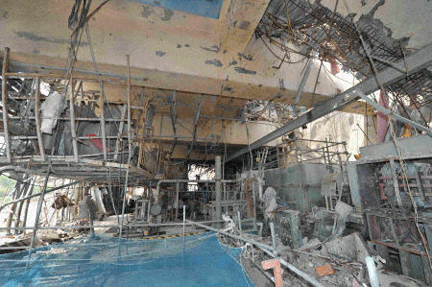
Japan’s massive task to clean up nuclear fuel pools of Fukushima stricken reactors

Japan begins massive nuclear pool clean-up after Fukushima disaster,  https://www.abc.net.au/news/2019-04-15/japan-taking-nuclear-fuel-rods-from-fukushima-reactor/11009422  The operator of the tsunami-wrecked Fukushima nuclear plant has begun removing fuel from a cooling pool at one of three reactors that melted down in the 2011 disaster, a milestone in the decades-long process to decommission the plant.

Key points:

  • Workers need to remove 566 nuclear fuel rods from a cooling pool at the reactor site
  • The whole process occurs underwater to prevent radiation leaks
  • New robots will need to be developed to remove debris from the reactors

The process involves taking out spent nuclear fuel rods by using remote-controlled cranes to lift hundreds of radioactive cylinders from a highly contaminated reactor site.

Tokyo Electric Power Co (TEPCO) said on Monday that workers started removing the first of 566 used and unused fuel units stored in the pool at Unit 3.

The fuel units in the pools located high up in reactor buildings are intact despite the disaster, but the pools are not enclosed, so removing the units to safer ground is crucial to avoid disaster in case of another major quake.

“The work is expected to be completed in March 2021, but safety is our first priority,” spokesman Joji Hara said.

TEPCO says the removal at Unit 3 would take two years, followed by the two other reactors, where about 1,000 fuel units remain in the storage pools.

If the rods are exposed to air or if they break, radioactive gases could be released into the atmosphere.

The 2011 disaster forced 160,000 people to evacuate areas near the Fukushima plant, and many of them have never returned to the most contaminated areas.

Obstacles to removing melted fuel

Removing fuel units from the cooling pools comes ahead of the real challenge of removing melted fuel from inside the reactors, but details of how that might be done are still largely unknown.

Experts say the melted fuel in the three reactors amounts to more than 800 tons.

Removing the fuel in the cooling pools was delayed more than four years by mishaps, high radiation and radioactive debris from an explosion that occurred at the time of the reactor meltdown.

Workers are remotely operating a crane to raise the fuel from a storage rack in the pool and place it into a protective cask.

The whole process occurs underwater to prevent radiation leaks.

Each cask will be filled with seven fuel units, then lifted from the pool and lowered to a truck that will transport the cask to a safer cooling pool elsewhere at the plant.

The work is directed remotely from a control room about 500 metres away because of still-high radiation levels inside the reactor building that houses the pool.

Robotic removal

In 2014, TEPCO safely removed all 1,535 fuel units from the storage pool at a fourth reactor that was idle and had no fuel inside its core when the March 11, 2011, earthquake and tsunami occurred.

Robotic probes have photographed and detected traces of damaged nuclear fuel in the three reactors that had meltdowns, but the exact location and other details of the melted fuel are largely unknown.

In February, a remote-controlled robot with tongs removed pebbles of nuclear debris from the Unit 2 reactor but was unable to remove larger chunks, indicating a robot would need to be developed that can break the chunks into smaller pieces.

TEPCO and government officials plan to determine methods for removing the melted fuel from each of the three damaged reactors later this year so they can begin the process in 2021.

April 18, 2019 Posted by Christina Macpherson | Fukushima continuing | Leave a comment

Okuma residents reluctant to return : much of the area still highly radioactive

Fukushima Japan nuclear fallout: Okuma residents encouraged home  https://www.dw.com/en/fukushima-japan-nuclear-fallout-okuma-residents-encouraged-home/a-48272491 12 Apr19

Eight years after a triple meltdown at the Fukushima nuclear power plant, part of nearby Okuma has been declared safe for residents to return. But there has been no rush to go home as radiation levels remain high. The evacuation order for parts of Okuma was lifted by the Japanese government on Wednesday.

But just 367 of the town’s pre-2011 population of 10,341 have registered to go home, according to local media reports in Japan.

Okuma sits alongside the Fukushima Daiichi Nuclear Power Station and 40% of the town has been declared safe for a permanent return. But a survey last year found only 12.5% of former residents wanted to do so.

Prime Minister Shinzo Abe is to attend a ceremony in Okuma on Sunday to mark the occasion. But the government has been accused of promoting the return of residents to showcase safety ahead of the Tokyo Olympics next summer.

“This is a major milestone for the town,” Mayor Toshitsuna Watanabe said in a written statement. “But this is not the goal, but a start toward the lifting of the evacuation order for the entire town.”

Lingering radiation

There are plans to open a new town hall in May to encourage more people to go back to their town which was devastated by the earthquake, tsunami and triple meltdown at the plant in March 2011. But the town center near the main train station remains closed due to high radiation levels which exceed the annual exposure limit. There will be no functioning hospital for another two years.

Much of Okuma still records high radiation levels and is off-limits. All of nearby Futaba remains closed, with the former 40,000 residents unable to return home. In a report from an investigation published last month, environmental campaign group Greenpeace said “radiation levels remain too high for the safe return of thousands of Japanese citizen evacuees.”

Reluctance to return

The government lifted the evacuation order for much of neighboring Tomioka two years ago. But only 10% of Tomioka’s population has so far returned. Some 339 square kilometers (131 square miles) of the area around the plant are designated unsafe.

Fears of exposure to radiation remain high among former residents, especially those with children. In its report, Greenpeace accused the government of failure: “In the case of workers and children, who are in the frontline of hazards resulting from the Fukushima Daiichi nuclear disaster, the Japanese government continues to ignore international radioprotection recommendations.”

Part of the Okuma is being used to store millions of cubic meters of toxic soil collected during the decontanimation operation. Authorities say it will be removed by 2045 but no alternative storage site has yet been found.

In all, 160,000 people were evacuated out of the area when three of Fukushima’s six reactors went into meltdown, leading to radiation leaks.

April 13, 2019 Posted by Christina Macpherson | Fukushima continuing | Leave a comment

Impossible at present to remove all fuel debris from stricken Fukushima nuclear reactors

Unclear debris map casts shadow over decommissioning of Fukushima plant   https://mainichi.jp/english/articles/20190409/p2a/00m/0na/021000c   April 9, 2019 (Mainichi Japan) TOKYO — The government and Tokyo Electric Power Co. (TEPCO) are set to launch full-scale probes of the inside of the No. 1 through No. 3 reactors at the disaster-stricken Fukushima Daiichi Nuclear Power Station this fiscal year, in an attempt to determine which reactor to work on first to remove fuel debris — a critical step for decommissioning the facility.

However, the interior of the No. 2 reactor, which is most likely to be the first to go through the debris removal process, has turned out to be different from what had originally been expected, underscoring the difficulties entailing the removal work. Since many companies are involved in the process, how to pass down the know-how acquired over the course of the more than 30 year-decommissioning process also poses a challenge.

“At present, it is difficult to clearly say we are going to remove all fuel debris,” said Akira Ono, who leads the decommissioning project, at a regular press conference by TEPCO on March 28, while noting that the utility will not back down from its ultimate goal of full debris removal.

If TEPCO fails to take out all debris from the nuclear plant, the very premise for dismantling the facility and returning the plot to its original state will be undermined. Such a scenario would adversely affect the disaster recovery plans envisaged by the national government and the Fukushima Prefectural Government. While awareness about the difficulty of debris removal has been shared among concerned parties, the actual dismal situation had not been recognized until TEPCO conducted the first debris survey at the No. 2 reactor on Feb. 13.

In that survey, a remotely controlled special device that was injected into the No. 2 reactor’s containment vessel succeeded in lifting portions of sediment accumulated at the bottom, which were believed to be fuel debris. Officials involved were relieved because they “had been worried the material would not move at all,” according to Ono.

The radiation level of the material, measured at a distance of some 30 centimeters, was 7.6 sieverts per hour, far less than anticipated. If the sediment contained a good portion of nuclear fuel, the radiation doses ought to have been several hundred sieverts per hour, even eight years after the 2011 nuclear meltdowns.

This finding suggested that the sediment that TEPCO came in contact with in the survey was not the main nuclear fuel debris it was looking for. Many speculate that the surface of the sediment may mainly consist of metals including cladding tubes that used to cover nuclear fuels.

The question now is whether fuel debris exists beneath the surface of the sediment or if nuclear fuel still remains within the reactor pressure vessel, or even somewhere else. There are currently no prospects for TEPCO to ascertain an accurate distributions of debris.

The material that was lifted in the survey mostly comprised pebble-like sediment, weighing less than 1 kilogram in total. Meanwhile, fuel debris generated in the core meltdowns is estimated to total 237 metric tons at the No. 2 reactor alone and a combined 880 tons at the No. 1 through No. 3 reactors.

At the No. 2 reactor, TEPCO will conduct a more detailed survey on debris possibly in the latter half of this fiscal year and attempt to collect small amounts of samples. At the No. 1 reactor, several apparatus including a robot submarine will be used to launch a full-scale survey inside the reactor to try to collect debris this fiscal year. As for the No. 3 reactor, the power company is apparently planning to prioritize removal of spent fuel, as related devices have gone through a series of glitches.

Unlike the other reactors, the No. 2 reactor did not suffer a hydrogen explosion in the 2011 disaster. Therefore, the No. 2 reactor remains the primary candidate for the first full-scale debris removal work, which is hoped to start in 2021.

With regard to the No. 1 and No. 3 reactors, the utility has yet to be able to reach materials appearing to be debris. The decommissioning of the nuclear plant is scheduled to be completed in 2051, a full 40 years after the triple meltdowns, but a concrete path toward that goal is not yet in sight.

“We have no choice but to remove whichever debris we can,” said a senior official with the Ministry of Economy, Trade and Industry.

Naoyuki Takaki, professor of nuclear engineering at Tokyo City University, commented, “There could ultimately be a decision to stop debris removal after pulling out as much debris as possible. In that case, we would have no option but to consider building a sarcophagus like the one at the Chernobyl nuclear plant.”

(Japanese original by Toshiyuki Suzuki, Science & Environment News Department)

April 11, 2019 Posted by Christina Macpherson | Fukushima continuing | Leave a comment

Japanese government partially lifts evacuation order in one Fukushima nuclear plant hometown

Gov’t lifts evacuation order in parts of Fukushima nuclear plant hometown  https://japantoday.com/category/national/japan-lifts-evacuation-in-parts-of-fukushima-plant-hometown  By Mari Yamaguchi 10 Apr 19, TOKYO

The Japanese government partially lifted an evacuation order in one of the two hometowns of the tsunami-wrecked Fukushima nuclear plant on Wednesday for the first time since the 2011 disaster.

Decontamination efforts have lowered radiation levels significantly in the area about 7 kilometers southwest of the plant where three reactors had meltdowns due to the damage caused by the March 2011 earthquake and tsunami.

The action allows people to return to about 40 percent of Okuma. The other hometown, Futaba, remains off-limits, as are several other towns nearby.

Many former residents are reluctant to return as the complicated process to safely decommission the plant continues. Opponents of lifting the evacuation orders in long-abandoned communities say the government is promoting residents’ return to showcase safety ahead of the Tokyo Olympics next summer.

The government has pushed for an aggressive decontamination program by removing topsoil, chopping trees and washing down houses and roads in contaminated areas, though experts say the effort only caused the contamination to move from one place to another, creating massive amounts of radioactive waste and the need for its long-term storage.

The meltdowns at three of Fukushima Dai-ichi’s six reactors caused massive radiation leaks that contaminated the plant’s surroundings, forcing at its peak some 160,000 people to evacuate their homes for areas elsewhere in Fukushima or outside the prefecture.

Evacuation orders in most of the initial no-go zones have been lifted, but restrictions are still in place in several towns closest to the plant and to its northwest, which were contaminated by radioactive plumes from the plant soon after its meltdowns. More than 40,000 people were still unable to return home as of March, including Okuma’s population of 10,000.

Town officials say the lifting of the evacuation order in the two districts would encourage the area’s recovery.

“We are finally standing on a starting line of reconstruction,” Okuma mayor Toshitsuna Watanabe told reporters.

A new town hall is opening in the Ogawara district in May and 50 new houses and a convenience store is underway. But the town center near a main train station remains closed due to radiation levels still exceeding the annual exposure limit and a hospital won’t be available for two more years, requiring returnees to drive or take a bus to a neighboring town in case of medical needs.

Anti-nuclear sentiment and concerns about radiation exposures remain high in Japan since the disaster, leaving many people skeptical about the safety declaration by the government and utility operators, as risks of developing cancer and other illnesses from low-dose, long-term radiation exposures are still unknown. Critics also say that the annual exposure limit of 20 millisievert, the same as nuclear workers and up from 1 millisievert before the Fukushima meltdowns, is too high.

Many people are reluctant to return home because of lingering concerns about radiation, and they have adapted to new jobs and homes after more than eight years away.

Only 367 people, or less than 4 percent of Okuma’s population, registered as residents in the two districts where the order was lifted. A survey last year found only 12.5 percent of former residents wanted to return to their hometown. The government hopes to allow some of Futaba’s 5,980 residents to return next year.

Okuma is also home to a temporary storage facility for the radioactive waste that came out of the decontamination efforts across Fukushima. A much delayed facility is still underway.

Fukushima plant’s operator, Tokyo Electric Power Co., and government officials plan to start removing the melted fuel in 2021 from one of the three melted reactors, but still know little about its condition inside and have not finalized waste management plans.

April 11, 2019 Posted by Christina Macpherson | Fukushima continuing | Leave a comment

Nuclear challenge: How Japan has boosted food exports from disaster hit Fukushima – exclusive government interview

08-Apr-2019 By Tingmin Koe, Japanese authorities have been engaging both tourists and foreign governments in a double-pronged strategy to promote food products produced in areas that were hardest hit by the nuclear disaster in 2011, according to a senior government official.

HTTPS://WWW.FOODNAVIGATOR-ASIA.COM/ARTICLE/2019/04/08/NUCLEAR-CHALLENGE-HOW-JAPAN-HAS-BOOSTED-FOOD-EXPORTS-FROM-DISASTER-HIT-FUKUSHIMA-EXCLUSIVE-GOVERNMENT-INTERVIEW 

April 9, 2019 Posted by Christina Macpherson | Fukushima continuing | Leave a comment

Few evacuees are likely to return next week to parts of Okuma, host of Fukushima nuclear plant

Evacuees can return next week to parts of Okuma, host of Fukushima nuclear plant, but few likely to. Japan Times, 5 Apr 19, KYODO The government formalized on Friday its decision to partially lift from next Wednesday a mandatory evacuation order for residents of a town that jointly hosts the crippled Fukushima No. 1 nuclear power plant.

The town of Okuma — which saw all of its roughly 10,000 residents evacuate after one of the world’s worst nuclear disasters, triggered by a deadly earthquake and tsunami — will allow former residents to return for the first time in eight years, the government decided. The decision was said to be based on the lower radiation levels achieved through decontamination work.

Futaba, the other town that hosts the plant, remains a no-go zone.

Despite the decision, a very small number of residents are expected to return to Okuma. As of late March, only 367 people from 138 households, or around 3.5 percent of the original population of 10,341, were registered as residents of areas where the order will be lifted. …..

There will be no restrictions in place over approximately 38 percent of the town’s total area, but the rest will remain off-limits due to higher radiation levels……https://www.japantimes.co.jp/news/2019/04/05/national/evacuees-can-return-next-week-parts-okuma-host-fukushima-nuclear-plant-likely/#.XKfUetIzbGg

April 6, 2019 Posted by Christina Macpherson | Fukushima continuing | Leave a comment

Cost of the Fukushima nuclear disaster estimated at up to 81 trillion yen

An aerial view shows workers wearing protective suits and masks working atop contaminated water storage tanks at Tokyo Electric Power Co. (TEPCO)’s tsunami-crippled Fukushima Daiichi nuclear power plant in Fukushima, in this photo taken by Kyodo August 20, 2013. Japan’s nuclear watchdog said on Wednesday it is concerned that more storage tanks at the wrecked Fukushima nuclear plant will spring leaks, following the discovery that highly contaminated water is leaking from one of the hastily built containers. Picture taken August 20, 2013. Mandatory Credit. REUTERS/Kyodo (JAPAN – Tags: DISASTER ENVIRONMENT POLITICS ENERGY)
ATTENTION EDITORS – THIS IMAGE WAS PROVIDED BY A THIRD PARTY. FOR EDITORIAL USE ONLY. NOT FOR SALE FOR MARKETING OR ADVERTISING CAMPAIGNS. THIS PICTURE IS DISTRIBUTED EXACTLY AS RECEIVED BY REUTERS, AS A SERVICE TO CLIENTS. MANDATORY CREDIT. JAPAN OUT. NO COMMERCIAL OR EDITORIAL SALES IN JAPAN. YES

Think tank puts cost to address nuke disaster up to 81 trillion yen  http://www.asahi.com/ajw/articles/AJ201903100044.html By ATSUSHI KOMORI/ Staff Writer, March 10, 2019  In a startling disparity, a private think tank puts the cost of addressing the 2011 Fukushima nuclear disaster between 35 trillion yen and 81 trillion yen ($315 billion and $728 billion), compared with the government estimate of 22 trillion yen.

The calculation, by the Tokyo-based Japan Center for Economic Research, showed that the total could soar to at least 60 percent more and up to 3.7 times more than the 2016 estimate by the Ministry of Economy, Trade and Industry.

In releasing the latest estimates on March 7, the center said it is time for serious debate over the role nuclear energy should play in the nation’s mid- and long-term energy policy.

Of the highest price tag of 81 trillion yen, 51 trillion yen would go toward decommissioning the crippled Fukushima No. 1 nuclear power plant and treating and disposing of radioactive water. The ministry put the cost for these tasks at 8 trillion yen.

The center calculated the compensation to victims at 10 trillion yen, while the comparable estimate by the ministry was 8 trillion yen.

Although the center’s estimate for the decontamination operation was 20 trillion yen, the ministry’s projection was 6 trillion yen.

The biggest disparity in the estimates between the think tank and the ministry is that the former put the treatment and disposal of contaminated water at 40 trillion yen and included the cost for disposing of polluted soil produced during cleanup operations in the overall costs.

If contaminated water is released in the sea after it is diluted with water, the overall costs could be 41 trillion yen, including 11 trillion yen estimated for decommissioning and disposal for tainted water.

The least expensive way of coping with the accident–35 trillion yen–would be to encase the plant in a concrete sarcophagus, rather than undertaking the formidable challenge of retrieving melted nuclear fuel from the reactors, and releasing contaminated water into the sea. In this case, it would cost 4.3 trillion yen to close down the plant and dispose of the radioactive water.

But this scenario drew fire from residents in the affected municipalities as they view covering nuclear fuel debris with a massive structure would be tantamount to asking them to give up hope of eventually returning to their hometowns.

The center’s latest projections followed its estimates two years ago, in which the number varied from 50 trillion yen to 70 trillion yen.

It updated its projections based on the findings about treatment and disposal of radioactive water and progress in cleanup operations over the past years.

March 23, 2019 Posted by Christina Macpherson | Fukushima continuing | 1 Comment

Fukushima radioactive water – a million tons, and still coming

Fukushima water headache: 1 million tons and counting http://www.asahi.com/ajw/articles/AJ201903190042.html THE ASAHI SHIMBUN,March 19, 2019The crippled Fukushima No. 1 nuclear plant reached an undesired milestone on March 18: Storage tanks at the site now contain more than 1 million tons of radiation-contaminated water.The announcement by the plant’s operator, Tokyo Electric Power Co., came as the utility and the central government continue to weigh water-disposal methods while hearing the concerns of fishermen who fear for their livelihoods.

Toyoshi Fuketa, chairman of the Nuclear Regulation Authority, has repeatedly said a decision must be made soon on how to deal with the contaminated water.

“We are entering a period in which further delays in deciding what measure to implement will no longer be tolerable,” Fuketa recently said.

Groundwater becomes contaminated when it flows into the buildings of the three reactors that suffered meltdowns in 2011 following the Great East Japan Earthquake and tsunami. Water that is used to cool the nuclear fuel debris is processed to remove radioactive substances, but the system cannot get rid of tritium.

These problems have forced TEPCO to store the contaminated water in hundreds of tanks installed at the Fukushima plant.

If more storage tanks are constructed, the overall capacity of 1.37 million tons at the site will likely be reached by the end of 2020.

Fukushima fishermen are already on alert for the one option they have already criticized–diluting the water and dumping it into the Pacific Ocean.

The economy ministry in 2016 said that measure could be implemented in the shortest time frame and at a low cost.

Fuketa has also said this is the most realistic option, but he noted that it would require years of preparation.

ome experts said the go-ahead for the dilution measure should have been given at the end of 2018 to start the process before the storage tanks reach capacity.

Economy ministry officials tried to explain various measures being considered at a public hearing in Fukushima in August 2018, including releasing the diluted water into the ocean.

“It will have a devastating effect on fishing in Fukushima,” said Tetsu Nozaki, who heads the Fukushima prefectural federation of fisheries cooperative associations.

Fukushima fishermen have slowly resumed operations since all forms of fishing were prohibited after high levels of radiation were found in fish caught off the Fukushima coast.

Fish auctions restarted at Fukushima ports in spring 2017, but the volume of fish brought in is still only about 20 percent of levels before the 2011 nuclear accident.

The last thing Fukushima fishermen want is an increase of negative publicity about their catches if the diluted water is dumped into the Pacific.

The government has spent about 34.5 billion yen ($309 million) to build a frozen underground earth wall around the three reactor buildings to divert the groundwater to the ocean. The “ice wall” has cut down the flow of groundwater, which at one time reached about 500 tons a day.

But still, groundwater continues to flow into the three reactor buildings at a rate of about 100 tons daily.

(This article was compiled from reports by Chikako Kawahara, Hiroshi Ishizuka, Toshio Kawada and Kazumasa Sugimura.)

March 21, 2019 Posted by Christina Macpherson | Fukushima continuing | Leave a comment

Fukushima Prefecture to lose 15 high schools, due to population decline

As population declines, Fukushima Prefecture to lose 15 of its 96 high schools, Japan Times , FUKUSHIMA MINPO, MAR 15, 2019

The Fukushima Prefectural Board of Education will reduce its number of prefecture-run high schools by 15 by the end of fiscal 2023 as the region continues to struggle with a dwindling number of students due to a declining birthrate.

The mergers will be implemented over the span of three years from fiscal 2021 and will reduce the number of high schools in the prefecture from 96 to 81.

Twenty-five schools will be merged and reorganized into 13 under the plan, which will integrate schools located in close proximity of one another. Each school will retain four to six classes per grade.

With the merger, the prefecture’s 88 day schools and seven night schools will be reduced to 74 and six, respectively, by the end of March 2024, according to the education board’s reform plan revealed Feb. 8. Fukushima’s only correspondence school will remain open……… https://www.japantimes.co.jp/news/2019/03/15/national/population-declines-fukushima-prefecture-lose-15-96-high-schools/#.XIwdDSIzbGg

March 16, 2019 Posted by Christina Macpherson | Fukushima continuing, social effects | Leave a comment

Nobody wants to host Fukushima’s millions of cubic metres of radioactive soil

Fukushima grapples with toxic soil that no one wants   https://www.theguardian.com/world/2019/mar/11/fukushima-toxic-soil-disaster-radioactive Eight years after the disaster, not a single location will take the millions of cubic metres of radioactive soil that remain, Justin McCurry in Okuma 12 Mar 2019 
Workers at a soil separation facility for decontamination work in Okuma. Photograph: Issei Kato/Reuters

Not even the icy wind blowing in from the coast seems to bother the men in protective masks, helmets and gloves, playing their part in the world’s biggest nuclear cleanup.

Away from the public gaze, they remove the latest of the more than 1,000 black sacks filled with radioactive soil and unload their contents into giant sieves. A covered conveyor belt carries the soil to the lip of a huge pit where it is flattened in preparation for the next load. And there it will remain, untouched, for almost three decades.

It is repetitive, painstaking work but there is no quick way of addressing arguably the most controversial physical legacy of the triple meltdown that occurred eight years ago at the nearby Fukushima Daiichi nuclear power plant.

In the years after the disaster, about 70,000 workers removed topsoil, tree branches, grass and other contaminated material from areas near homes, schools and public buildings in a unprecedented ¥2.9tn (£21bn) drive to reduce radiation to levels that would enable tens of thousands of evacuees to return home.

The decontamination operation cleaned generated millions of cubic metres of radioactive soil, packed into bags that carpet large swaths of Fukushima prefecture.

Japan’s government has pledged that the soil will moved to the interim storage facility and then, by 2045, to a permanent site outside of Fukushima prefecture as part of a deal with local residents who do not want their communities turned into a nuclear dumping ground.

But the government’s blueprint for the soil is unravelling: so far, not a single location has agreed to accommodate the toxic waste.

While workers inside the ruined nuclear plant struggle to contain the build-up of more than 1m tonnes of radioactive water, outside, work continues to remove, process and store soil that will amount to 14m cubic metres by 2021.

The task is expected to take another two years, according to Jiro Hiratsuka, an environment ministry official who is guiding a small group of foreign journalists, including the Guardian, around the interim storage facility.

“We are required by law to find a final storage place outside Fukushima, so it can’t be kept here indefinitely,” Hiratsuka said. “It’s true that we have yet to find an appropriate location, but a lot will depend on how much space we need and the level of radioactivity in the soil.”

There is opposition, too, to the idea of using soil with lower radiation levels – or less 8,000 becquerels per kilogram – as the foundation for roads, embankments and other infrastructure in Fukushima.

The storage facility straddles the towns of Okuma and Futaba, located west of the power plant, where radiation levels are still too high for residents to return. So far, 2.3m cubic metres of soil – about 15% of the total – have been brought to the site.

The operation involves thousands of workers, including drivers who make 1,600 return trips every day. So far, 355,000 trucks have been used – and officials say they need more.

“I am aware that some people are saying it would be better to keep it here, but the people of Okuma and Futaba have had a really tough time, and they agreed the soil could be kept here on the condition that it would eventually be moved out of Fukushima,” Hiratsuka said.

Despite the decontamination efforts, only a small number of residents who were ordered to leave after the triple meltdown have returned to neighbourhoods where evacuation orders have been lifted, according to local government data.

A poll by the Asahi newspaper and a local broadcaster found that almost two-thirds of evacuated residents felt anxious about radiation despite official claims that decontamination work had been a success.

As Japan marked the eighth anniversary on Monday of the magnitude-9 earthquake and deadly tsunami that triggered the Fukushima meltdown, environmental groups warned that some “safe” neighbourhoods still contained radiation hotspots.

A Greenpeace investigation revealed high levels of radiation in areas that had been declared safe, and accused the government of misleading the international community about the risks faced by returning evacuees and decontamination workers.

“Some areas still have significantly high levels of radiation,” said Shaun Burnie, a senior nuclear specialist at Greenpeace Germany who is based in Japan. “They are much higher than background radiation before the accident.”

Minoru Ikeda, who took part in the decontamination effort, said workers cut corners to meet strict deadlines. “There were times when we were told to leave the contaminated topsoil and just remove the leaves so we could get everything done on schedule,” he said. “Sometimes we would look at each other as if to say: ‘What on earth are we doing here?’”

He was sceptical of official claims that a permanent home would be found the for soil. “I don’t believe for a minute that they will be able to move all that soil out of Fukushima,” he said. “The government has to come up with a plan B.”


March 12, 2019 Posted by Christina Macpherson | Fukushima continuing | Leave a comment

Radioactive boars thrive in Fukshima towns

Times 11th March 2019 The towns around the Fukushima Dai-ichi nuclear power plant are among the
most perilously radioactive in the world, yet in their own strange way they have never been busier. The people who lived here fled in a rush after the meltdown of the nuclear reactors, but a new citizenry has established itself and is thriving in the unusual conditions. They squat in family groups in the wooden interiors of the traditional Japanese houses. They
thrive on the fruit on the trees and the water that flows around the old rice fields. They are hairy, tusked and weigh 200lb.

They are the radioactive wild boars of Fukushima. It is eight years today since the massive earthquake and tsunami that smashed into Fukushima Dai-ichi, and a good deal has changed since the terrible weeks that followed. The spewing
reactors have been largely contained, although it will be a lifetime before they are fully dismantled. The radiation in the towns has been reduced and in those marginal areas where the levels are lowest people have been permitted to return.

Even when gas and electricity are reconnected, their once thriving towns have few shops, schools or social services. But there is another obstacle to their return: the takeover of the evacuation zone by wild animals. In the absence of Man, nature has marched off the forested mountains and taken over his former home. Raccoons and rats, monkeys and
palm civets have all taken advantage of the empty houses to find food, shelter and a convenient place to breed. But none has better adapted, or done more damage, than the wild boar.

https://www.thetimes.co.uk/article/26b333e2-435f-11e9-924d-9729bcd51a7f

March 12, 2019 Posted by Christina Macpherson | Fukushima continuing, Reference | 1 Comment

Eight Years on, Fukushima Nuclear Disaster Still Poses Health Risks

https://havanatimes.org/?p=149927  March 9, 2019 By Akio Matsumura HAVANA TIMES – On March 11, we commemorate the 8th anniversary of the Fukushima nuclear disaster. To an outside observer, this anniversary passes as a technical progress report, a look at new robot, or a short story on how lives there are slowly returning to normal.

Yet in Japan, the government has not figured out how to touch or test the irradiated cores in the three crippled reactors, which continue to contaminate water around the site of the melt down. The government does not know where it will put that radioactive material once it can find a way to move it.

Meanwhile, the government and site operator are running out of room to store the contaminated water, which is filling up more and more tanks. The cleanup is estimated to take forty years and the cost is estimated at $195 billion.

The latest publicly released findings of radiation levels are from 2017, when Tokyo Electric Power Company had to use a remote-controlled robot to detect the levels in Reactor 2, since no human can approach the crippled reactor.

The rates read 530 sieverts per hour, the highest since the March 2011 meltdown. We have no reason to believe that they have fallen since then. Remote-control robots are being used in the other reactors as well, indicating that radiation levels are similarly high there.

Even using the robot, work can only be carried out for very short times, since the robots can only stand 1000 sieverts of exposure – less than two hours in this case.

This is an extremely high amount of radiation. After TEPCO published the rate, the Asahi Shimbun reported that “an official of the National Institute of Radiological Sciences said medical professionals have never considered dealing with this level of radiation in their work.”

The Japan Times quoted Dr. Fumiya Tanabe, an expert on nuclear safety, who said that the “findings show that both the preparation for and the actual decommissioning process at the plant will likely prove much more difficult than expected.”


Fukushima’s Children Need International Attention

There have been many victims of this disaster. Thousands of people have been displaced from their homes. Local fishermen are worried that the government will proceed with its plan to dump the storage tanks of contaminated water into the ocean.

Others worry that the flow of the radioactive wind and contaminated water are reaching North America and will continue to do so for the next forty years.

Above all of these important issues, it is the children of Fukushima who most need our attention. They are at risk of higher rates of cancer because of their exposure to the contamination from the initial explosion. In Chernobyl, the only comparable case we have, more than 6,000 cases of thyroid cancer were found in children according to the UN through 2005.

There is evidence that thyroid cancer rates are higher among Fukushima’s children than the national population, but it is a latent disease: it is still too early to tell what the full impact will be. But it is clear the case needs action.

Scientists will always offer different opinions, swayed first by uncertainty, but also, sadly, by politics, money, and ambition.

Some will claim that the evidence has been exaggerated, underestimated, or that perhaps we’re at too early a stage to be certain. Or that we need more time to clarify the results. I have seen many instances of these arguments at the United Nations and international science conferences. Why do we wait and make another mistake?

Helen Caldicott, a medical doctor and founding president of Physicians for Social Responsibility, part of a larger umbrella group that was awarded the Nobel Peace Prize in 1985, wrote: “The truth is that most politicians, businessmen, engineers and nuclear physicists have no innate understanding of radiobiology and the way radiation induces cancer, congenital malformations and genetic diseases which are passed generation to generation. Nor do they recognize that children are 20 times more radiosensitive than adults, girls twice as vulnerable as little boys and fetuses much more so.”

UNICEF Can Lead

We face many complex challenges of climate change, poverty alleviation, and national security. The health and welfare of children must always be our top priority. They are our future; our deepest purpose is to care and provide for them. By deciding not to fully investigate the effects of Fukushima, we fail them.

We all agree with that personally, but which institution is best positioned to carry out the mission? To me, UNICEF, the United Nations Children’s Fund, is the only answer. Indeed, putting children above national security is at UNICEF’s core.

Maurice Pate, an American humanitarian and businessman who joined UNICEF at its inception in 1947, agreed to serve as the Executive Director upon the condition that UNICEF serves the children of “ex-enemy countries, regardless of race or politics.” In 1965, at the end of Pate’s term, the organization won the Nobel Peace Prize.

To this day, its mission includes a commitment to “ensuring special protection for the most disadvantaged children – victims of war, disasters, extreme poverty, all forms of violence and exploitation and those with disabilities.” The children of Fukushima deserve the protection of UNICEF.
——
*Akio Matsumura is also the Secretary General of the Global Forum Moscow Conference hosted by President Gorbachev at the Kremlin in 1990 as well as of the Parliamentary Earth Summit Conference hosted by Brazil National Assembly in Rio de Janeiro in 1992

March 10, 2019 Posted by Christina Macpherson | children, Fukushima continuing | Leave a comment

Fukushima’s radioactive water – over 1000 tanks of it, and no solution in sight

8 years on, contaminated water remains big problem for Fukushima clean-up, Japan Today, Mar. 10   By Kiyoshi Takenaka  OKUMA

Eight years after the Fukushima nuclear crisis, a fresh obstacle threatens to undermine the massive clean-up: 1 million tons of contaminated water must be stored, possibly for years, at the power plant.

Last year, Tokyo Electric Power Co (TEPCO) said a system meant to purify contaminated water had failed to remove dangerous radioactive contaminants.

That means most of that water – stored in 1,000 tanks around the plant – will need to be reprocessed before it is released into the ocean, the most likely scenario for disposal.

Reprocessing could take nearly two years and divert personnel and energy from dismantling the tsunami-wrecked reactors, a project that will take up to 40 years.

It is unclear how much that would delay decommissioning. But any delay could be pricey; the government estimated in 2016 that the total cost of plant dismantling, decontamination of affected areas, and compensation, would amount to 21.5 trillion yen ($192.5 billion), roughly 20 percent of the country’s annual budget.

Tepco is already running out of space to store treated water. And should another big quake strike, experts say tanks could crack, unleashing tainted liquid and washing highly radioactive debris into the ocean.

Fishermen struggling to win back the confidence of consumers are vehemently opposed to releasing reprocessed water – deemed largely harmless by Japan’s nuclear watchdog, the Nuclear Regulation Authority (NRA) – into the ocean.

“That would destroy what we’ve been building over the past eight years,” said Tetsu Nozaki, head of the Fukushima Prefectural Federation of Fisheries Co-operative Associations. Last year’s catch was just 15 percent of pre-crisis levels, partly because of consumer reluctance to eat fish caught off Fukushima.

SLOW PROGRESS

On a visit to the wrecked Fukushima Daiichi plant last month, huge cranes hovered over the four reactor buildings that hug the coast. Workers could be seen atop the No. 3 building getting equipment ready to lift spent fuel rods out of a storage pool, a process that could start next month.

In most areas around the plant, workers no longer need to wear face masks and full body suits to protect against radiation. Only the reactor buildings or other restricted areas require special equipment.

Fanning out across the plant’s property are enough tanks to fill 400 Olympic-sized swimming pools. Machines called Advanced Liquid Processing Systems, or ALPS, had treated the water inside them. …..

The utility has promised to re-purify the water if the government decides that releasing it into the ocean is the best solution. It is the cheapest of five options a government task force considered in 2016; others included evaporation and burial.

TEPCO and the government are now waiting for another panel of experts to issue recommendations. The head of the panel declined an interview request. No deadline has been set.

……… STORING INDEFINITELY

Another option is to store the water for decades in enormous tanks normally used for crude oil. The tanks have been tested for durability, said Yasuro Kawai, a plant engineer and a member of Citizens’ Commission on Nuclear Energy, a group advocating abandoning nuclear energy.

Each tank holds 100,000 tons, so 10 such tanks could store the roughly 1 million tons of water processed by ALPS so far, he said.

The commission proposes holding the tritium-laced water, which has a half life of 12.3 years, in tanks for 123 years. After that, it will be one thousandth as radioactive as it was when it went into storage.

No Safe Dose – Berkeley

Although experts caution that tanks would be vulnerable to major quakes, Japan’s trade and industry minister, Hiroshige Seko, said the committee would consider them anyway.

“Long-term storage … has an upside as radiation levels come down while it is in storage. But there is a risk of leakage,” Seko told Reuters. “It is difficult to hold the water indefinitely, so the panel will also look into how it should be disposed of eventually.”

Space is also a problem, said Akira Ono, TEPCO’s chief decommissioning officer. By 2020, the utility will expand tank storage capacity by 10 percent to 1.37 million tons, and about 95 percent of total capacity will probably be used by the end of that year, he said.

“Tanks are now being built on flat, elevated spots in stable locations,” Ono said. But such ideal space is getting scarce, he added.

Many local residents hope TEPCO will just keep storing the water. If it does get released into the ocean, “everyone would sink into depression,” said fishing trawler captain Koichi Matsumoto. …… https://japantoday.com/category/national/Eight-years-on-contaminated-water-remains-big-problem-for-Fukushima-clean-up

March 10, 2019 Posted by Christina Macpherson | Fukushima continuing | Leave a comment

Eight years later, Fukushima nuclear wreck still resulting in mounting tons of radioactive water, with no solution

Eight years after triple nuclear meltdown, Fukushima No. 1’s water woes show no signs of ebbing, Japan Times, BY RYUSEI TAKAHASHI, STAFF WRITER, 8 Mar 19,

This is the first in a series examining how the northeast and the nation are progressing with efforts to deal with the March 2011 earthquake, tsunami and nuclear crisis.

OKUMA, FUKUSHIMA PREF. – Nearly a thousand storage tanks are scattered across the Fukushima No. 1 nuclear power plant, holding a staggering 1.1 million tons of treated water used to keep its melted reactor cores cool while they rust in the sun.

Plant manager Tokyo Electric Power Company Holdings Inc., or Tepco, plans to build more of the gigantic tanks to hold another 0.27 million tons, which is roughly the equivalent of 108 Olympic-size swimming pools. The new tanks are expected reach full capacity in four or five years

Each tank takes seven to 10 days to fill and holds between 1,000 to 1,200 tons of liquid, Tepco officials told reporters during a tour in February organized by the Japan National Press Club. It’s been eight years since Fukushima No. 1 suffered three core meltdowns triggered by tsunami following the Great East Japan Earthquake, but the situation with the tanks may be a sign Tepco has yet to get the facility under control.

“Space isn’t a big issue at this point in time, but five or 10 years from now, after we’ve started removing the melted fuel debris, we’re going to need facilities to store and preserve it,” Akira Ono, president of Fukushima No. 1 Decontamination and Decommissioning Engineering Co., a Tepco unit overseeing the decommissioning process, said at a news conference in January.

The water issue is eating up both space and resources, but a solution is unlikely to emerge anytime soon.

The International Atomic Energy Agency published a report in November that said the physical constraints of the site “leave little room for additional tanks” beyond what Tepco has allocated.

The IAEA report went on to say it believes storing tainted water in “above ground tanks . . . can only be a temporary measure while a more sustainable solution is needed” and a “decision on the disposition path should be taken urgently.”

Beyond 2020, Tepco has not allocated any additional space for holding treated water on the site and has no plans to do so at this time. The utility said the tanks will likely become a headache if they remain at the plant.

“At that point, we may need to rethink how we’re using the space,” Ono said.

Eight years ago when the monstrous tsunami hit, the entire plant lost power and reactors 1, 2 and 3 lost coolant, causing their cores to overheat. The fuel rods consequently melted, dripping molten fuel that burned through their pressure vessels and pooled in their primary containment vessels. Reactors 1, 3 and 4 then suffered hydrogen explosions.

Tepco must inject water into the reactors indefinitely to keep the melted cores cool, but water tainted by contact with the fuel and associated debris has been leaking from the damaged containment vessels and into the basements of the reactor buildings, where tons of fresh groundwater flows in daily through holes in their damaged walls.

The contaminated water is pumped out and passed through a filtration device called the Advanced Liquid Processing System — which is supposed to remove every radionuclide except for tritium — and stored in the tanks.

Tepco has taken steps to limit the amount of groundwater seeping into the reactor buildings, including wells to intercept and divert it and an underground ice wall around the buildings to block any inflow.

According to Tepco, however, about 83 tons of water are seeping into the reactor buildings each day. Although this is an improvement from some 300 tons in previous years, Tepco must keep making more tanks.

At the moment, Tepco is waiting for a government panel’s advice on what to do with the tritium-tainted water. The panel is considering five disposal methods: ground injection, sea discharge after diluting the tritium concentration, discharging it as steam, discharging it as hydrogen, and solidification followed by underground burial……

there are concerns about the impact an ocean discharge may have on fisheries still trying to recover from the nuclear crisis.

Fishing in the area has resumed on a trial basis and workers still perform radiation checks before shipping their hauls to fish markets. The waters off Fukushima Prefecture are at the confluence of two ocean currents — the Oyashio from the north and Kuroshio from the south — which make for the good fishing grounds that have been a vital part of the agrarian prefecture’s economy.

Eight years after the meltdowns, however, residents are still struggling to convince the world that fish from the area are safe to eat. Many believe public perception alone will cripple Fukushima’s fishing industry anew if the tainted water is expelled into the ocean — even if the tritium has been reduced to below international standards.

Trust issues continue to plague Tepco after it claimed ALPS was filtering every radionuclide from the cooling water except tritium. Last August it came to light that the allegedly treated water still contained other dangerous contaminants, including iodine, cesium and strontium. Some of the concentrations were above current safety limits.

This has further angered Fukushima residents and made it harder to get their approval for dumping the water held by the tanks into the sea.

During a public hearing hosted by METI in August, participants urged the government and Tepco to consider finding an off-site location to store the water instead of discharging it into the ocean.

“Without a national debate and without the understanding of Japanese citizens or the countries importing our products, as a fisherman of Fukushima Prefecture, I strongly oppose the plan to discharge the treated water into the ocean,” Tetsu Nozaki, chairman of the Fukushima Prefectural Federation of Fisheries Cooperative Association, told the hearing.

“To release the ALPS-treated water into the ocean, at this time, would deal a disastrous blow to the fishermen of Fukushima and rob them of their hard work and motivation,” he said…….

Meanwhile, the crippled plant faces other serious challenges — including how to extract the molten fuel…….

Miyano said Tepco and the government — with the help of scientists, nuclear physicists and engineers from around the world — are inventing new technologies as they devise a way to remove the debris……. https://www.japantimes.co.jp/news/2019/03/07/national/eight-years-triple-meltdown-fukushima-no-1s-water-woes-slow-recede/#.XIMmYMkzbGh

March 9, 2019 Posted by Christina Macpherson | Fukushima continuing | 3 Comments

The indigenous fight for the truth on Fukushima’ s radioactive impact on the world

The future of all life: Indigenous sovereignty and the Fukushima nuclear disaster, Bay View, National Black Newspaper,  by Harun Minhaj, March 4, 2019 In 2011, an unprecedented series of die-offs began to strike dead hundreds of millions of sea creatures in the northern Pacific Ocean. As one sailor who frequently travels the Pacific remarked in October of 2013:

“I’ve done a lot of miles on the ocean in my life and I’m used to seeing turtles, dolphins, sharks and big flurries of feeding birds. But this time, for 3,000 nautical miles, there was nothing alive to be seen.”

What precipitated such a dramatic devastation of marine life in the Pacific Ocean?

Just a few months before the die-offs began, the meltdown of three nuclear reactors at the Fukushima Daiichi Complex in Japan caused the greatest pollution of the marine environment by radioactive contaminants in history. Far from over, these releases are still ongoing.

More than 400 tons of radioactive water have been flowing into the Pacific every day since the meltdowns began.

Although the full extent of the damage from Fukushima Daiichi has yet to be determined, the volume of these releases alone shows that we are dealing with something unprecedented in history.

Indigenous elders and scientific community sound the alarm

I was first alerted to the severity of the Fukushima disaster by Bay Area Indigenous Elder Zachary RunningWolf. A full-time activist and community leader in the Bay Area, RunningWolf has long campaigned for racial and environmental justice in a myriad of ways……..

For the last nine years, he has also led a four-day monthly stop driving boycott to combat global warming…

When RunningWolf ran for mayor of Berkeley in 2016, he made addressing Fukushima a central component of his campaign. For RunningWolf and many Indigenous elders concerned about the ongoing violence against Mother Earth, stopping the Fukushima nuclear crisis is of the highest priority.

Consider this call for action released in 2013 by a council of Indigenous elders called the Caretakers of Mother Earth:

“The People of the Earth understand that the Fukushima nuclear crisis continues to threaten the future of all life. We understand the full implications of this crisis even with the suppression of information and the filtering of truth by the corporate owned media and nation states. We strongly urge the media, corporations and nation states to acknowledge and convey the true facts that threaten us, so that the international community may work together to resolve this crisis, based on the foundation of truth” (emphasis added).

The deep concern expressed by RunningWolf and the Caretakers of Mother Earth about the impact of Fukushima’s radiation on the Pacific is shared by thousands of scientists. For instance, the platform adopted by the more than 5,000 scientists who make up the Society for Environmental Toxicology and Chemistry declared in 2014 that “the Fukushima nuclear accident on 11 March 2011 emerged as a global threat to marine biodiversity in the Pacific Ocean and human health in coastal communities.”

Other scientific organizations such as the Nordic Probabilistic Safety Assessment Group have gone even further. This institution – which is by no means “anti-nuclear” as it was founded by the nuclear utilities of Finland and Sweden – predicted in 2011 based on official estimates of radioactivity released into the Pacific that around 50-100 million fish would die from just one of the most deadly and prolific isotopes which had been released. ……….

Along with the unprecedented die-offs, a consistent set of symptoms frequently occurring together was observed across species:

  • unprecedented epidemics of cancer
  • rare and widespread genetic mutations
  • widespread immune system deficiencies
  • open sores, lesions and seizures
  • bleeding
  • hair loss
  • abnormally high levels of parasites.

Some of these symptoms (such as cancer, hair loss, and mutations) are well-known consequences of radiation sickness, while other more obscure ones such as high levels of parasites have been confirmed in studies of sea life to occur as a consequence of radiation. Altogether, only radiation sickness can produce such a widespread, prolonged epidemic exhibiting all these symptoms.

The genocidal impact of Fukushima radiation in the Pacific

It would be extremely foolish to assume this devastation in the Pacific Ocean will not profoundly impact human life. It is widely recognized that for numerous reasons our very survival depends on the health of the oceans, most notably because they produce the majority of the oxygen that we must breathe to live.

Native peoples, whose traditional livelihoods are often intimately bound up with the health of the ocean, are on the front line of this struggle. ……..

As aboriginal advocates have argued, the violence of nuclear contamination in desecrating their lands and culture must be recognized as a kind of cultural genocide. In this case, where the Pacific Ocean itself has been desecrated, Fukushima’s radiation must be recognized as constituting a genocidal assault on numerous Indigenous peoples’ cultures and livelihoods.

Furthermore, the radiation in Pacific seafood poses a significant health risk to the people who consume it. Estimates calculated by a wide variety of experts in nuclear power, chemistry and medicine show that this risk has been severely underestimated, and in fact more than 1 million people would die from cancer and other diseases if the consumption of radioactive Pacific seafood continues unabated.

In the Bay Area, Indigenous Blackfeet Elder RunningWolf has long been warning the public to avoid consuming Pacific seafood since even before the 2016 Berkeley mayoral race, while calling for the University of California – with its flagship campus located in Berkeley – to be held accountable for issuing no health warnings in turn.

As aboriginal advocates have argued, the violence of nuclear contamination in desecrating their lands and culture must be recognized as a kind of cultural genocide…………… https://sfbayview.com/2019/03/the-future-of-all-life-indigenous-sovereignty-and-the-fukushima-nuclear-disaster/

March 9, 2019 Posted by Christina Macpherson | environment, Fukushima continuing | Leave a comment

« Previous Entries     Next Entries »

1 This Month

10 March A LIVE WEBINAR THE REAL EFFECTS OF NUCLEAR POWER
What the Industry Isn’t Telling Us

1:00 PM Mountain, 2 pm Central, 3 pm Eastern. Live on the Keepers of the Water Facebook page

18 March Webinar @ 1 PM EST: An Assessment of SMR Projects: The Case of Canada

register for the zoom:
https://us02web.zoom.us/webinar/register/WN_o8BIIOUvQ2ONJR1nta65DQ#/registration

of the week – STOP SMALL MODULAR REACTORS IN CANADA

​To see nuclear-related stories in greater depth and intensity – go to https://nuclearinformation.wordpress.com

  • Categories

    • 1
      • Arclight's Vision
    • 1 NUCLEAR ISSUES
      • business and costs
        • employment
        • marketing
      • climate change
      • culture and arts
      • ENERGY
        • renewable
          • decentralised
          • energy storage
      • environment
        • oceans
        • water
      • health
        • children
        • psychology – mental health
        • radiation
        • social effects
        • women
      • history
      • indigenous issues
      • Legal
        • deaths by radiation
        • legal
      • marketing of nuclear
      • media
        • investigative journalism
        • Wikileaks
      • opposition to nuclear
      • PERSONAL STORIES
      • politics
        • psychology and culture
          • Trump – personality
        • public opinion
        • USA election 2024
        • USA elections 2016
      • politics international
      • Religion and ethics
      • safety
        • incidents
      • secrets,lies and civil liberties
        • civil liberties
      • spinbuster
        • Education
      • technology
        • reprocessing
        • Small Modular Nuclear Reactors
        • space travel
      • Uranium
      • wastes
        • – plutonium
        • decommission reactor
      • weapons and war
        • Atrocities
        • depleted uranium
      • Women
    • 2 WORLD
      • ANTARCTICA
      • ARCTIC
      • ASIA
        • Burma
        • China
        • India
        • Indonesia
        • Japan
          • – Fukushima 2011
          • Fukushima 2012
          • Fukushima 2013
          • Fukushima 2014
          • Fukushima 2015
          • Fukushima 2016
          • Fukushima continuing
        • Malaysia
        • Mongolia
        • North Korea
        • Pakistan
        • South Korea
        • Taiwan
        • Turkey
        • Vietnam
      • EUROPE
        • Belarus
        • Bulgaria
        • Denmark
        • Finland
        • France
        • Germany
        • Greece
        • Ireland
        • Italy
        • Kazakhstan
        • Kyrgyzstan
        • Russia
        • Spain
        • Sweden
        • Switzerland
        • UK
        • Ukraine
      • MIDDLE EAST
        • Afghanistan
        • Egypt
        • Gaza
        • Iran
        • Iraq
        • Israel
        • Jordan
        • Libya
        • Saudi Arabia
        • Syria
        • Turkey
        • United Arab Emirates
      • NORTH AMERICA
        • Canada
        • USA
          • election USA 2020
      • OCEANIA
        • New Zealand
        • Philippines
      • SOUTH AMERICA
        • Brazil
    • ACTION
    • AFRICA
      • Kenya
      • Malawi
      • Mali
      • Namibia
      • Niger
      • Nigeria
      • Somalia
      • South Africa
    • Atrocities
    • AUSTRALIA
    • Christina's notes
    • Christina's themes
    • culture and arts
    • Events
    • Fuk 2022
    • Fuk 2023
    • Fukushima 2017
    • Fukushima 2018
    • fukushima 2019
    • Fukushima 2020
    • Fukushima 2021
    • general
    • global warming
    • Humour (God we need it)
    • Nuclear
    • RARE EARTHS
      • thorium
    • Reference
      • Reference archives
    • resources – print
    • Resources -audiovicual
    • Weekly Newsletter
    • World
    • World Nuclear
    • YouTube
  • Pages

    • 1 This Month
    • ACTION !
    • Disclaimer
    • Links
    • PAGES on NUCLEAR ISSUES
      • audio-visual news
      • Anti Nuclear, Clean Energy Movement
        • Anti Nuclear movement – a success story
          • – 2013 – the struggle for a nuclear-free, liveable world
          • – 2013: the battle to expose nuclear lies about ionising radiation
            • Speakers at Fukushima Symposium March 2013
            • Symposium 2013 Ian Fairlie
      • Civil Liberties
        • – Civil liberties – China and USA
      • Climate change
      • Climate Change
      • Economics
        • – Employment
        • – Marketing nuclear power
        • – Marketing Nuclear Power Internationally
        • nuclear ‘renaissance’?
        • Nuclear energy – the sick man of the corporate world
      • Energy
        • – Solar energy
      • Environment
        • – Nuclear Power and the Tragedy of the Commons
        • – Water
      • Health
        • Birth Defects in the Chernobyl Radiation Affected Region.
      • History
        • Nuclear History – the forgotten disasters
      • Indigenous issues
      • Ionising radiation
        • – Ionising radiation – medical
        • Fukushima FACT SHEET
      • Media
        • Nuclear Power and Media 2012
      • Nuclear Power and the Consumer Society – theme for December 2012
      • Peace and nuclear disarmament
        • Peace on a Nuclear Free Earth
      • Politics
        • – Politics USA
      • Public opinion
      • Religion and ethics
        • -Ethics of nuclear power
      • Resources – print
      • Safety
      • Secrets and lies
        • – NUCLEAR LIES – theme for January 2012
        • – Nuclear Secrets and Lies
      • Spinbuster
        • 2013 nuclear spin – all about FEAR -theme for June
        • Spinbuster 1
      • Technology
        • TECHNOLOGY Challenges
      • Wastes
        • NUCLEAR WASTES – theme for October 2012
        • – Plutonium
      • Weapons and war
      • Women
  • Archives

    • March 2026 (109)
    • February 2026 (268)
    • January 2026 (308)
    • December 2025 (358)
    • November 2025 (359)
    • October 2025 (376)
    • September 2025 (258)
    • August 2025 (319)
    • July 2025 (230)
    • June 2025 (348)
    • May 2025 (261)
    • April 2025 (305)
  • Categories

    • 1
      • Arclight's Vision
    • 1 NUCLEAR ISSUES
      • business and costs
        • employment
        • marketing
      • climate change
      • culture and arts
      • ENERGY
        • renewable
          • decentralised
          • energy storage
      • environment
        • oceans
        • water
      • health
        • children
        • psychology – mental health
        • radiation
        • social effects
        • women
      • history
      • indigenous issues
      • Legal
        • deaths by radiation
        • legal
      • marketing of nuclear
      • media
        • investigative journalism
        • Wikileaks
      • opposition to nuclear
      • PERSONAL STORIES
      • politics
        • psychology and culture
          • Trump – personality
        • public opinion
        • USA election 2024
        • USA elections 2016
      • politics international
      • Religion and ethics
      • safety
        • incidents
      • secrets,lies and civil liberties
        • civil liberties
      • spinbuster
        • Education
      • technology
        • reprocessing
        • Small Modular Nuclear Reactors
        • space travel
      • Uranium
      • wastes
        • – plutonium
        • decommission reactor
      • weapons and war
        • Atrocities
        • depleted uranium
      • Women
    • 2 WORLD
      • ANTARCTICA
      • ARCTIC
      • ASIA
        • Burma
        • China
        • India
        • Indonesia
        • Japan
          • – Fukushima 2011
          • Fukushima 2012
          • Fukushima 2013
          • Fukushima 2014
          • Fukushima 2015
          • Fukushima 2016
          • Fukushima continuing
        • Malaysia
        • Mongolia
        • North Korea
        • Pakistan
        • South Korea
        • Taiwan
        • Turkey
        • Vietnam
      • EUROPE
        • Belarus
        • Bulgaria
        • Denmark
        • Finland
        • France
        • Germany
        • Greece
        • Ireland
        • Italy
        • Kazakhstan
        • Kyrgyzstan
        • Russia
        • Spain
        • Sweden
        • Switzerland
        • UK
        • Ukraine
      • MIDDLE EAST
        • Afghanistan
        • Egypt
        • Gaza
        • Iran
        • Iraq
        • Israel
        • Jordan
        • Libya
        • Saudi Arabia
        • Syria
        • Turkey
        • United Arab Emirates
      • NORTH AMERICA
        • Canada
        • USA
          • election USA 2020
      • OCEANIA
        • New Zealand
        • Philippines
      • SOUTH AMERICA
        • Brazil
    • ACTION
    • AFRICA
      • Kenya
      • Malawi
      • Mali
      • Namibia
      • Niger
      • Nigeria
      • Somalia
      • South Africa
    • Atrocities
    • AUSTRALIA
    • Christina's notes
    • Christina's themes
    • culture and arts
    • Events
    • Fuk 2022
    • Fuk 2023
    • Fukushima 2017
    • Fukushima 2018
    • fukushima 2019
    • Fukushima 2020
    • Fukushima 2021
    • general
    • global warming
    • Humour (God we need it)
    • Nuclear
    • RARE EARTHS
      • thorium
    • Reference
      • Reference archives
    • resources – print
    • Resources -audiovicual
    • Weekly Newsletter
    • World
    • World Nuclear
    • YouTube
  • RSS

    Entries RSS
    Comments RSS

Site info

nuclear-news
Blog at WordPress.com.
Privacy & Cookies: This site uses cookies. By continuing to use this website, you agree to their use.
To find out more, including how to control cookies, see here: Cookie Policy
  • Subscribe Subscribed
    • nuclear-news
    • Join 2,078 other subscribers
    • Already have a WordPress.com account? Log in now.
    • nuclear-news
    • Subscribe Subscribed
    • Sign up
    • Log in
    • Report this content
    • View site in Reader
    • Manage subscriptions
    • Collapse this bar
 

Loading Comments...
