Arnie Gundersen measured 4,000 Bq/kg on a Tokyo street
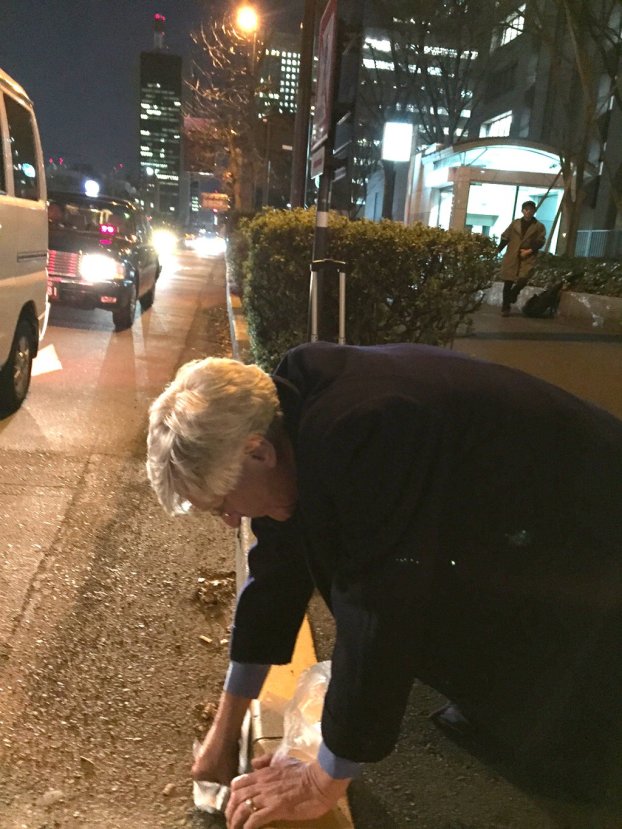
Arnie Gundersen measured 4,000 Bq/kg on a Tokyo street outside METI, Japan nuclear regulator…Olympics anyone?
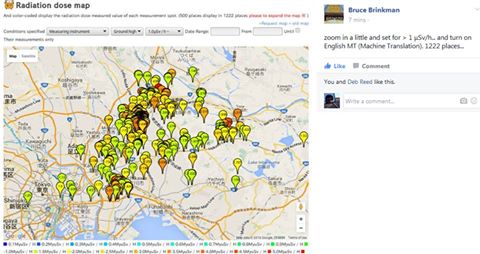
76 measurements that are over 5µS/h in the “Kashiwa hotspot”

Kashiwa city, Chiba prefecture, nearby Tokyo
Some screen caps of the new background radiation tests from Japan. Kashiwa hot spots. Thanks to Bruce Brinkman
Hakatte Geiger users have uploaded 76 measurements that are over 5µS/h in the “Kashiwa hotspot” area. You can see how they are distributed as the plume came over Kasumigaura and into eastern Tokyo. I travel through that on my way to and from work. I have to go through Matsudo and Kashiwa which are buried under the map pins.

Zoom in a little and set for > 1 μSv/h… 1222 places.
The ‘uncanny’ in Fukushima’s nuclear aftermath: anxiety-provoking attachment to home
Yohei Koyama, doctoral researcher in the Department of Languages and Cultures of Japan and Korea, SOAS, University of London, UK.
“I’m afraid to say it, but we love Chernobyl. It’s become the meaning of our lives. The meaning of our suffering” (Alexievich 1997, 215), says Natalya Roslova. She is one of the voices in Svetlana Alexievich’s Voices from Chernobyl. Her monologue continues:
On the way back, the sun is setting, I say, “Look at how beautiful this land is!” The sun is illuminating the forest and the fields, bidding us farewell. “Yes,” one of the Germans who speaks Russian answers, “it’s pretty, but it’s contaminated.” He has a dosimeter in his hand. And then I understand that the sunset is only for me. This is my land. I’m the one who lives here. (Alexievich 1997, 216)
The monologue reveals her strange affection to Chernobyl which awakens what Freud called the uncanny. In short, the Freudian uncanny is what evokes not only fear and dread but also affection – it is the ambivalence of fear and affection (Freud 1919, 123). And this ambivalence is something that Chernobyl shares with Fukushima.
In this piece, I will shed light on the strange affection of the uncanny. Particularly, I would like to present a story of Momoko who I met during my fieldwork in Fukushima in 2014. Although she was an ordinary 30-something woman in Fukushima, extraordinary was that she forfeited marriage with her fiancé to stay in Fukushima after the nuclear accident. Her story reveals not only her strong attachment to her hometown and willingness to stay there but also her fear of radiation and anxiety about health risks. It is a manifestation of the same kind of strange affection which belongs to the realms of the Freudian uncanny.
***
Ever since Momoko was born, she has always lived in her hometown located in the western part of Fukushima. There are always people who never leave their hometowns and continue to live with their family, and Momoko is one of them. On the contrary, her ex-fiancé is not from Fukushima – his family moved to Momoko’s town when he was a child due to work circumstances. He spent some years in Fukushima, but he left for good to go to a university in Tokyo. Despite the distance, she was happy in the relationship with him for a few years before the accident. Sometimes a rural life felt inconvenient to her, but she could go to Tokyo on some weekends and even travel abroad at least once a year. She said she was not always happy about her rural life, but she was not unhappy about it either. It was perhaps a simple pastoral life, but it was about to change on 11 March 2011.
The nuclear accident was a life-threating experience for Momoko, not to mention the preceding severe earthquake and continuous aftershocks. “I thought I could die by radiation! I guess I was oversentimental and naïve at that time,” she said with a laugh. She confessed that she was feeling her own death for the first time in her life after she saw the multiple explosions at Fukushima Daiichi Nuclear Power Plant on television and when everyone started talking about radiation. But after this initial oversentimental phase, she quickly learned radiation protection through study meetings on radiation and its health effects organized by the local government and online research. When I met her in 2014, she showed great familiarity with the terminologies such as different names of radioisotopes, units of radioactivity and radiation dosage, and with the particular situation of radiation contamination in her living environment. This very much resembles how people affected by the Chernobyl accident became heavily informed by bio-scientific knowledge – what Adriana Petryna (2002) described a biomedical subject.
In the meantime, the initial oversentimental phase never ended for her ex-fiancé. He was eager for her to evacuate not only from Fukushima but also from East Japan with his family. Although she knew she would leave her hometown to live with him once she gets married (and she was actually looking forward to the day to come), she could not leave her family and friends who were stuck in the middle of the nuclear crisis. She felt she was a part of them, and more importantly, she felt there was a growing affection for her hometown. Despite knowing the risks she was taking, she wanted to stay for one simple reason – because it was her home. So they were destined for a never-solving dispute about whether or not she should evacuate. She confessed that she had been yelled at and called “foolishly stubborn” by him over the phone. Even though she was trying to understand how much he cared about her, their relationship was falling apart. “After all,” she said, “he didn’t have a ‘home’ like I did. He would have never understood how I felt about my hometown.” A few months after the accident, she was single again.
Momoko expressed her strong affection for her hometown and self-determination to live there which eventually set her apart from her ex-fiancé, but it does not mean that she was not concerned about possible risks. Also, even though she formed her opinions of risk perception and decided to stay on her own terms, such decision making could be an art of balancing the fear with the available knowledge. Moreover, there are displays of real-time spatial radiation dose, everyday monitoring of locally-produced food, examination of human bodies and on-going decontamination works throughout the prefecture. They are all constant reminders of the presence of radiation in everyday life. In such situation, it seemed as if she was in a constant struggle with her fear. She mentioned that her willingness to learn radiation protection could be her fear of radiation just reversed. To use her own word, “I know the spatial dose is a lot lower now and radiation contamination is no longer detected in the food we eat, but it still weighs on my mind. And that’s probably why I keep checking the dose and screening results.”
Thus, Momoko’s affection for her hometown becomes extremely ambivalent which comprises her fear of radiation. In this way, it coincides with the Freudian sense of uncanny. Freud defines the particular state of feeling uncanny as “the frightening that goes back to what was once well known and had long been familiar” (Freud 1919, 123). In other words, the uncanny is something familiar that has long been repressed, and the uncanny effect arises when the repressed returns (Freud 1919, 150). To an extent, Freud’s intention here was to transgress conventional reality by this de-familiarization of the familiar. It is notable that what is de-familiarized overlaps with the excess of reality in Bataille’s sense. But for Freud, such excess could be associated with the attraction of death (1919,148). In fact, Freud (1919, 148) did not forget to mention that the uncanny could be represented by anything associated with death.
It should be noted that for many Japanese people, the word radiation is arguably the signifier of death because of its association with their collective memories of Hiroshima and Nagasaki. Although it was five years ago Momoko closely felt her own, radiation is still present in the everyday life in Fukushima today. In this sense, her life in Fukushima remains as something that brings her own death to her consciousness and her affection for her hometown becomes the uncanny.
…for many Japanese people, the word radiation is arguably the signifier of death because of its association with their collective memories of Hiroshima and Nagasaki.
***
I keep in touch with Momoko by email. In this April, she sent me pictures of cherry blossoms – sakura in Japanese – in full bloom. People eat and drink under fully bloomed sakura throughout Japan every spring, and it is called hanami. It looked like she had it for this year. “I think the sakura in my town is the best after all”, she said.
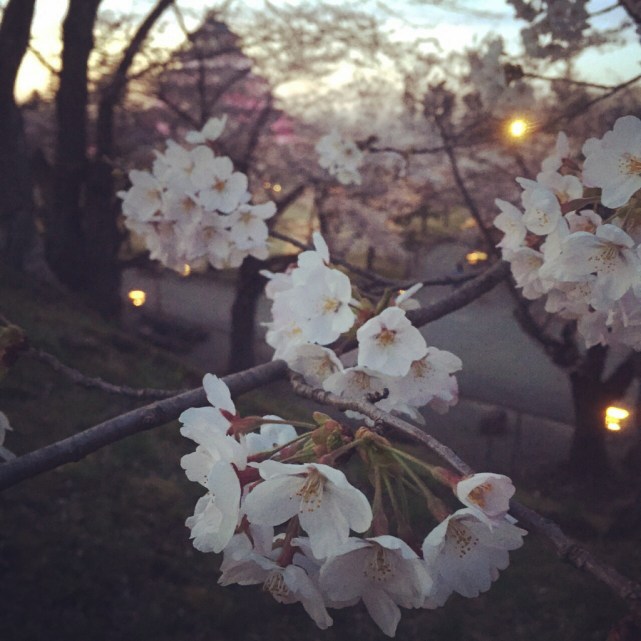
Cherry Blossoms [Sakura] photographed by Mokomo near where she lives in Western Fukushima Prefecture, Japan. ‘I think the sakura in my home town is the best after all’ says Mokomo.
The image of people having hamami in Fukushima could be simply horrific because of radiation contamination. But for her, such image is also a landscape of her home that she loves in spite of the contamination. It is uncanny, but perhaps, it is also a manifestation of her self-determination to live with radiation.
Yohei Koyama is currently undertaking doctoral research in Japan focussing on the aftermath of the Fukushima nuclear accident. His ongoing PhD research, supervised by Dr Griseldis Kirsch, is titled: ‘Life with Radiation: ethnography of the nuclear disaster in Fukushima’.
References:
Alexievich, S. 1997. Voices from Chernobyl. Normal; London: Dalkey Archive Press
Freud, S. 1919. “The uncanny”. In S. Freud. 2003. The uncanny. Translated by D. McLintock. New York: Penguin Books
Petryna. A. 2002. Life exposed: biological citizens after Chernobyl. Princeton, NJ; Oxford, UK: Princeton University Press
Fukushima and the Right NOT to Return: Nuclear Displacement in a System for “Hometown Recovery”
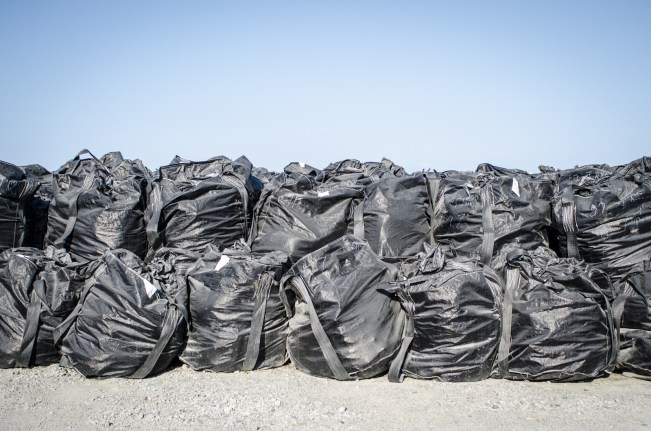
Bags of contaminated material seen near the town of Odaka on the edge of the Fukushima Exclusion Zone.
Dr Liz Maly, Assistant Professor in the International Research institute of Disaster Science (IRIDeS), Tohoku University
On March 11, 2011, the 9.0 magnitude Great East Japan Earthquake (GEJE) unleashed a massive tsunami devastating over 500 square kilometers of Japan’s northeast Tohoku coast. This region has experienced tsunamis every 30-40 years, but the size and impact of the waves of the 3.11 tsunami vastly exceeded any in recent memory or predictions. The tsunami swallowed buildings and places thought to be safe, killing more than 18,000 people and reducing entire communities to rubble. Damage to the Tokyo Electric Power Company (TEPCO) Fukushima Daiichi Nuclear Power Plant on the coastline of Fukushima Prefecture caused the most serious nuclear accident since Chernobyl—a nuclear meltdown which TEPCO and government officials did not publicly admit until almost 5 years later.
Over 1,000,000 house were destroyed or damaged. In the days that followed, 470,000 people evacuated to school gymnasiums or other facilities, as aftershocks and blackouts continued and cleanup efforts began. In the following months, disaster survivors moved into various temporary housing provided by government support. Five years later, 174,000 people are still displaced, living interim housing, including 99,000 from Fukushima.
For those fleeing nuclear radiation, evacuation and displacement is more complicated. In the days after 3.11, the evacuation zone around the NPP was increased to a 20km radius; people within 30km were ordered to stay inside and prepare to evacuate if necessary. However, the radioactive plume was carried further northwest by wind and rain on March 15th. Although information about the direction of the fallout was available from SPEEDI (the System for Prediction of Environment Emergency Dose Information), it was not made public until March 23, too late for people unaware they were in or evacuating directly into the path of the highest amounts of radiation.
People from areas near the NPP struggled with evacuation decisions amidst a lack of information. Some towns ordered evacuation following government directives; others outside designated areas ordered evacuation independently. Still areas were not evacuated until weeks later. Some towns’ residents evacuated collectively; others scattered to various locations inside and outside Fukushima Prefecture. Most moved multiple times. So-called “voluntary evacuees” made their own decisions to evacuate from areas officially deemed “safe.” Elderly people, especially those in nursing/care facilities, suffered severely; more people from Fukushima died as a result of physical and emotional stress related to evacuation and displacement than directly from earthquake or tsunami impact.
More people from Fukushima died as a result of physical and emotional stress related to evacuation and displacement than directly from earthquake or tsunami impact.
Restricted areas were later categorized into three zones based on contamination and possibility of residents’ return. Entry is forbidden to the most severely contaminated, euphemistically named “difficult to return” zone 1. In “residence restricted” zone 2, daytime visits are allowed. In zone 3, optimistically designated “preparing to lift evacuation orders,” daytime entry and business activities are allowed. Contamination levels are based on air samples from point sources; some municipalities include multiple zones, which have been revised several times.
Decontamination, the government’s primary measure for reducing the amount of radioactive material, involves cleaning house roofs, etc., and removing natural materials and a layer of topsoil, which is collected in black plastic bags, continuously piling up in growing storage areas.
While the promise of decontamination is every area can be made safe, there are limits.
For example, there is no way to decontaminate forested mountains; every rainfall carries material to nearby communities, in effect re-contaminating them. Government plans rely on the underlying logic of a one-track plan for the future of contaminated towns: decontamination leads to lifting evacuation orders, then residents will move back. Based on level of contamination and speed of decontamination, the progress on this timeline towards its singular goal is shortened or extended.
Lifted restrictions mean people are allowed to move back, not that they will. In September 2015 restrictions were lifted for Naraha Town; 4 months later, only 6% of former residents moved back. Long term impacts of radiation exposure in Fukushima will not be known for years. But regardless of decontamination efforts and assurances of “safety,” many people will chose not to return, especially parents unwilling to risk children’s health. Conclusions about what areas are actually safe, made on a household or individual basis, also cause rifts within families such as “atomic divorce.” However, some people desperately want to move back, primarily elderly residents less concerned about long term health effects. As Japan is already facing a national demographic crises of an aging, shrinking population, the long-term future of these towns is uncertain at best.
Japanese disaster recovery policies strongly support a one-track ‘hometown recovery’ approach. Local governments have the main responsibility for post-disaster recovery planning (and other disaster management activities). With national funding, Tohoku’s local municipalities have created and are implementing recovery plans. Varying by town, common goals include bringing residents back and helping rebuild homes and lives. Temporary housing, also government-supported, is intended as an interim support until people can go back to new houses in old hometowns; the timeline to move out of temporary housing for those in Fukushima is longer, and their future is unclear. For permanent housing reconstruction, support options include provision of access to lots for private housing reconstruction, and public housing for those unable to rebuild on their own. Fukushima Prefecture is building public housing within the prefecture for residents from contaminated area. However, the main projects supporting residential relocation for rebuilding private houses on individual lots away from coastal areas, happening throughout the tsunami-affected area at a scale never before seen in Japan, limit relocation within single municipalities.
For towns affected by the nuclear accident, the recovery planning process has a vast internal contradiction: recovery plans and policies focus exclusively on rebuilding hometowns, but some towns will not be inhabitable for many years, and in others the majority of residents don’t want to return. Existing recovery policies don’t have a way to deal with relocating partial or entire towns. Several contaminated municipalities have established temporary town halls within other towns. But it is difficult for towns to consider a recovery plan that dissolves the town itself.
How can you put a price on the loss of a house, livelihood, and community?
While displaced, “official” evacuees (those from designated evacuation areas) receive compensation payments from TEPCO (actually the Japanese government, since TEPCO was nationalized). Although these are large sums of money, the real question is not if the amount is enough, but how can you put a price on the loss of a house, livelihood, and community? Compensation payments to nuclear evacuees can’t bring back what was lost.
Japan has well-established disaster recovery policies based on social welfare support for survivors. Yet even with a sizable national disaster recovery budget and governance experience, current policies can not adequately address the actual challenges for recovering the lives of nuclear evacuees and their contaminated hometowns. Beyond the disruptions of lives and communities, the cleanup and full decommissioning of the NPP will take decades, and leave a site that will be contaminated for a very long time.
Even with highly developed disaster preparations, such as the case in Japan, it is impossible to reduce all risk from natural disasters. Yet even if a nuclear accident is caused because of a natural hazard, it is in fact a man-made disaster. Everything possible should be done to prevent another nuclear accident, including decommissioning reactors; in Japan many are located near earthquake faults or coastal areas.
Japan is the only county whose people have been victims of both an atomic bombing and a massive nuclear accident. Beyond horrendous experiences of bomb survivors in Hiroshima and Nagasaki, their children and grandchildren suffered stigma and discrimination (sadly, evacuees from Fukushima have also faced discrimination). The experience of having been attacked by atomic bombs did not stop development and promotion of nuclear power in Japan, strongly supported by government. After the Fukushima Daichi accident, there was a massive swell of popular anti-nuclear opposition, and operation of all 44 active nuclear reactors in Japan was stopped. However, in August 2015, despite residents’ strong opposition, the first nuclear reactor restarted operation at the Sendai Nuclear Power Plant in Japan’s southernmost island, Kyushu.
On April 14, 2016, a large earthquake struck Kumamoto City, in Kyushu, followed by a larger M7.3 quake in the early hours of April 16th; strong aftershocks continuing for a week.
As of April 20, 48 people had been confirmed dead, included several people who died during evacuation, and more than 100,000 people had evacuated from damaged homes or those in danger due to aftershocks. Heavy rains caused landslides, sections of highways were destroyed and operation of bullet trains were suspended, making it difficult to get supplies to evacuees, and any potential evacuation from a nuclear accident impossible. Despite predictions that large quakes will continue, potentially triggering more landslides, and vocal calls from inside and outside Japan, the Japanese Nuclear Authority refuses to stop the reactors, which continue to operate nearby. It seems not enough has changed since 3.11; not only do problems of Fukushima’s nuclear evacuees from remain unsolved, they are in real danger of being recreated.
Dr Liz Maly’s work centers on disaster recovery, housing reconstruction and community-based recovery planning. She has previously researched post-Katrina and post-Sandy housing recovery and land use policy in the USA, as well as the Central Java Earthquake in Indonesia. Dr Maly continues to work on long-term community recovery for groups impacted by the 2011 Great East Japan Earthquake. Her website ‘Recovering Tohoku’ is highly recommended, and you can follow her on twitter here.
Fukushima and the Right NOT to Return: Nuclear Displacement in a System for “Hometown Recovery”
Let Japanese Officials Eat Isotopes To Atone For Fukushima
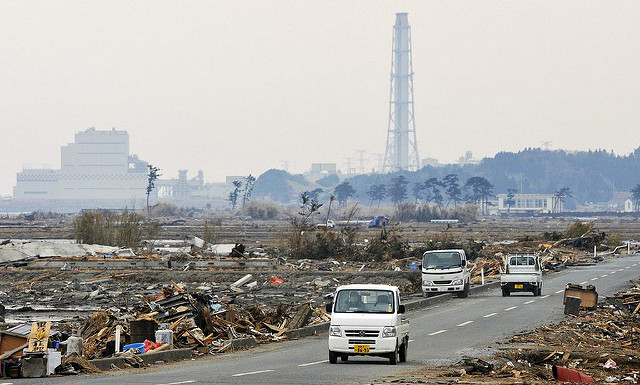
Despite the Fukushima and Chernobyl disasters, nuclear energy continues to thrive. Pictured: Fukushima shortly after the disaster.
How Japanese Officials Can Atone for Fukushima
Let them eat isotopes.
The meltdowns and release of radiation from the Fukushima Daaichi nuclear power plant has been an ongoing crisis for five years. Nuclear engineer Koide Hiroaki has been one of the most trenchant critics of how the Japanese government and power company TEPCO (mis)handled the disaster. In a wide-ranging interview at Counterpunch, he offered a way for officials, who have gone unpunished, to atone.
Right now the people of Fukushima have been abandoned in the areas of the highest levels of radiation. And abandoned people have to find a way to live. Farmers produce agricultural goods, dairy farmers produce dairy products, and ranchers produce meat; these people must do so in order to live. They are not the ones to be blamed at all.
As the Japanese state is absolutely unreliable in this matter, these people have no choice but to go on producing food in that place, all the while suffering further exposure. So I don’t think we can throw out the food they produce there under those conditions. Inevitably someone has to consume that food.
Certainly not the residents of the Fukushima area. Hiroaki has a better idea.
We should serve all of the most heavily contaminated food at say the employee cafeteria at TEPCO or in the cafeteria for Diet members [Japanese parliament] in the Diet building. But that isn’t nearly enough. We must carefully inspect the food, and once we’ve determined what foods have what levels of contamination, once that is fully measured and delineated, then those who have the corresponding levels of responsibility should eat it, should be given it.
He’s serious.
I am aware that this is a controversial proposal, but each one of us, especially those who built post-war Japan, bears responsibility for allowing our society to heavily dependent on nuclear energy without carefully reflecting on the risks and consequences of it. And more importantly, we have the responsibility for protecting children.
Even after Chernobyl and Fukushima, nuclear energy thrives. Especially in Russia and China, where they are planning to build floating nuclear energy plants. Huh? From CNN on April 28:
China is planning to build nuclear reactors that will take to the sea to provide power in remote locations. … These small power plants will be built in Chinese shipyards, mounted on large sea-going barges, towed to a remote place where power is needed and connected to the local power grid, or perhaps oil rig.
China has 20 planned; Russia seven. Never mind how much the costs would cascade if another disaster occurs. In January 2014, at Warscapes magazine, I wrote that it was difficult to understand how the advocates of nuclear power can continue to block out the risk of major accidents, especially when they are fresh in our memory.:
Fukushima has just occurred before the world has gotten over the last one, Chernobyl. What if another accident occurs while we’re still knee-deep in cleaning up and bearing the costs of Fukushima, and maybe even still Chernobyl? Casualties and damage to the environment aside for the moment, how can nations afford this? Come to think of it, how do nuclear-power companies afford it, yet continue to forge ahead?
To answer the last question: state subsidies to build nuclear energy plants. Also, of course, much of the cost of cleaning up after an accident is, as you would expect, offloaded to the state and its citizens. Bailing out the nuclear energy is of a piece with bailing out the banks.
http://fpif.org/japanese-officials-can-atone-fukushima/
How Can Japan Settle The Issue Of Fukushima Daiichi Tritium? Drink It.

Water tanks crowding the Fukushima Daichi nuclear plant site
Here’s the problem in a nutshell—or rather a thimbleful—facing the Japanese government and Tokyo Electric Power Company (TEPCO), the operator of the crippled Fukushima Daiichi nuclear plant.
There are over 1,100 large steel tanks brimming with filtered water—except for a low contaminant called tritium—clogging both the plant and an expanding area outside the site.
The water is a mix of tons of groundwater flowing into the plant’s basements and tons of contaminated water that have become radiated after draining down there through the three damaged reactors the water was injected into to keep the melted uranium cores cool. This lethal liquid mix is pumped out the basements and decontaminated before it overflows and seeps into the sea; some of it is recycled back as coolant into the reactors while the rest is pumped into the storage tanks.
This process continues hour after hour, day after day, year after year: a cunningly worthy punishment of the gods for the latter-day Sisyphus, TEPCO. Consequently, every week or two a new tank-full of treated water is added to the forest of steel now covering the area like giant alien mushrooms. The total amount of stored water exceeds 800,000 cubic tons and is inexorably heading for one million tons and more without an end in site.
The cost is enormous, and picking up the tab is the Japanese taxpayer—not TEPCO, which is undergoing a ten-year reconstruction since a government bail out saved it from bankruptcy.
So the million-ton-plus dilemma for the government has boiled down to three options: keep on with the endless and expensive tank building and filling; find a way to remove the tritium from the water; or have TEPCO discharge (dump) the water into the ocean.
The latter option is by far the easiest and least expensive method, except that the water is tritiated: that is the water has become radioactive.
Without context, that’s a scary word, until you remember that sunbathing and eating bananas are pleasant radioactive pastimes. The point being that the energy tritium gives off is so low as to be unmeasurable with a dosimeter. And the particles (not rays) tritium expels can be stopped by plastic wrap—as Shunichi Tanaka, head of Japan’s Nuclear Regulatory Authority, told the press recently.
That’s a fact, but it’s not the point, say environmentalist foes of the dumping method. Ingesting tritium is a concern for health they argue. And they have experts to back up such concerns, though they are mostly theoretical. Meanwhile, there are experts on the other side of the debate pooh-poohing such worries and asking to see some solid proof to back up the theory.
Conclusion: Those supportive of nuclear power tend to minimize the health risks of tritium, while those opposing the use of nuclear power tend to exaggerate its risks.
What is not debatable is the negative psychological impact releasing the water into the sea will have on Japan’s nervous neighbors, the suffering people of the northeast, the region’s fishing industry and the Japanese electorate.
Given such concerns and uncertainties, organizations like Greenpeace urge the government to err on the side of caution. The best option, says Greenpeace, is to continue storing the water while exploring all technical options for tritium separation.
On the face of it, that seems reasonable. But then experts opposing this stance, like Lake Barrett, a nuclear industry consultant advising TEPCO, point out that while it may be possible to create a method of separating the tritium, it hasn’t been found yet, despite much effort; and it would likely cost a couple of billion dollars to develop and perfect in any case. It’s no surprise that TEPCO and the government have reached the same conclusion.
“All that money could be better spent on schools, hospitals,” Barrett told me. “And you can’t go on building tanks forever.”
Besides, he adds, “The very low levels of tritium in the stored water are not a meaningful health risk. After verification that the radioactivity levels are within conservative Japanese health risks, I would not hesitate to drink it, bathe in it, or eat fish or shellfish harvested from it.”
Now there’s an idea. If the government is to discharge the tritiated water into the ocean without turning a large portion of the electorate against it, it needs to persuade a majority of citizens that it is safe within reason to do so. This will require a number of carefully thought out steps.
The government will have to clearly explain the pros and cons of its action and the reason for its decision; it must establish a mechanism to compensate the fisherman for the shortfall they will undergo following the release; an international panel of independent, knowledgeable people, including environmentalists of the non-hysterical variety, is required to verify the tritiated water does indeed fall well below internationally accepted standards for release; and the panel members must be granted access to monitor the process at any time they wish.
Then for the coup de grâce, Prime Minister Abe, his cabinet members along with TEPCO executives should visit Fukushima Daiichi, and while standing in front of one the giant tanks each drink a glass of the tritiated water. This won’t sway everyone, of course, but it would give the government the minimum moral authority required to make such a contentious decision.
Radioactive material from Fukushima plant coming back to Japan in the Pacific
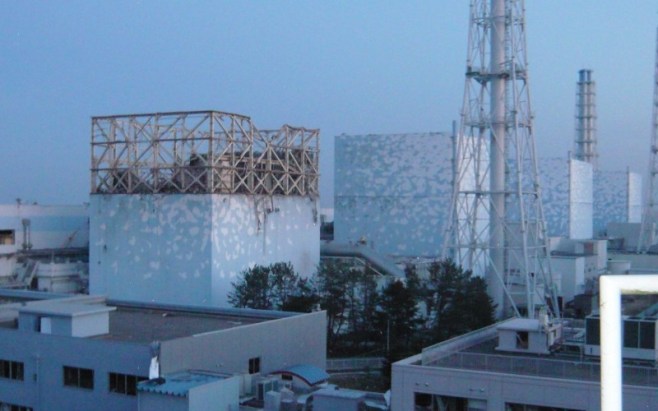
Prof. Aoyama from Institute of Environmental Radioactivity of Fukushima University reported that the radioactive material discharged from Fukushima plant circulated in the Pacific to come back to Japan offshore.
He implemented seawater analysis at 71 points from 11. 2015 to 2. 2016. The analysis is partially completed to show radioactive material has spread to the South West offshore of Japan. 2 Bq/m3 of Cs-137 was detected in seawater from South West offshore of Kyushu. 1.83 Bq/m3 was detected even offshore of the west coast of Japan.
0.38 Bq/m3 of Cs-134 was also measured to prove this is from Fukushima accident.
It is assumed that the discharged Cs-134/137 travelled to the east in the Northern Pacific. It was carried to the South and West to come back to Japan by taking 2 ~ 3 years.
He comments it is possible that the density of radioactive material increases from now.
http://www.asyura2.com/16/genpatu45/msg/611.html
Radioactive material from Fukushima plant coming back to Japan in the Pacific
Serious disadvantages of the Fukushima ‘ice wall’
Experts: Fukushima ‘ice wall’ could destroy reactor units, turn site into swamp — Risk of fractures, ground movement, building subsidence — Must be frozen for 200 years — Officials: High cliffs just behind plant may become unstable — Gov’t: “Observable heaving” and deformations possible (VIDEO) http://enenews.com/experts-fukushima-ice-wall-could-destroy-reactor-buildings-turn-site-swamp-concern-fractures-ground-movement-subsidence-around-structures-will-stay-frozen-200-year-period-govt-observable-heav?utm_source=feedburner&utm_medium=email&utm_campaign=Feed%3A+ENENews+%28Energy+News%29
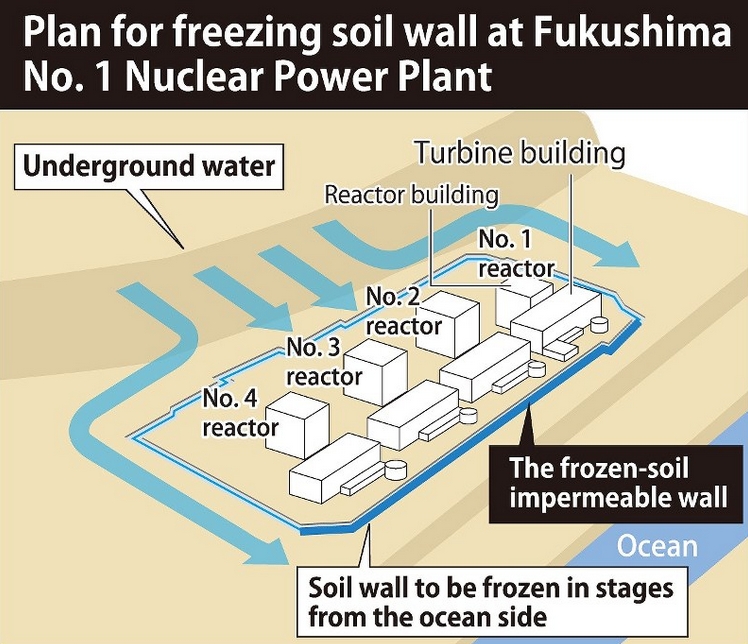
AP, Apr 29, 2016 (emphasis added): Fukushima No. 1 plant’s ice wall won’t be watertight, says chief architect… Even if the frozen barrier… works as envisioned, it will not completely block all water… because of gaps in the wall… said Yuichi Okamura, a chief architect… Tepco resorted to [this] after it became clear it had to do something drastic… [Okamura said,] “We have come up against many unexpected problems.” The water woes are just part of the many obstacles… No one has even seen the nuclear debris…
Huffington Post, Apr 1, 2016: ‘Ice Wall’ Is Japan’s Last-Ditch Effort To Contain Fukushima Radiation… [It’s] a desperate attempt to stop radiation that’s been leaking from the Fukushima Daiichi nuclear power plant for five years…
Kyodo, Mar 30, 2016: The NRA warned earlier that if the groundwater levels within the [ice] walls is reduced excessively by blocking the flow from outside, highly contaminated water within the buildings could seep out as a result.
Proposal for controlling ground water and radioactive leakage in Fukushima Daiichi Nuclear Power Station (by World Water and Climate Foundation): [TEPCO] has a plan to freeze soil around the plant… this idea may not be sustainable… over the 200-year period that will be required for the reactors to be decommissioned.… The problem with freezing… is that solutes may be expelled from the ice… This can result in extremely concentrated saline solutions that do not freeze even at low temperatures. It is likely that under these conditions radioactive materials could become highly concentrated in dense brines that could then flow as density currents… Also, heating and cooling during the four annual seasons in Japan may make the ground of the station site softer and wetter like a swamp, and it could create anotherrisk to the reactors, such as building destruction… The authors would like to express sincere thanks to Dr. W.F. Vincent, Dr. I. Ostrovsky, Dr. S. Kudoh and Dr. L. Legendre for their valuable comments and suggestions for strengthening this proposal.
Los Alamos National Laboratory: Integrated model of groundwater flow and radionuclide migration at Fukushima Daiichi… we will be able to answers critical questions such as… Will the cryogenic barrier lead to salt water intrusion at the site thereby mobilizing contaminantssuch as Cs and Sr that are mobile under high salinity conditions?
U.S. Department of Energy, 2015: Independent Technical Support for the Frozen Soil Barrier… several references discuss soil heave in the context of artificial ground freezing… It is possible that some observable heaving will occur directly above and directly adjacent to the frozen soil barrier… Monitoring of temperatures, heave pressures, and deformations… would provide information to assist in managing impacts from soil heave…
Geological Survey of Japan, 2015: [T]he sustainability of the ice wall remains doubtful… Furthermore, the ice lenses will grow irregularly as per the distribution of chiller pipes, and the sediment desaturation might lead to the aquitards’ compaction and subsidence around the buildings. In effect, a decrease in pore water pressure could increase the effective stress of the ground and result in movements and the formation of fractures in the superficial units.
IAEA, 2016: The IAEA group of experts reviewed the status of groundwater inflow, countermeasures and modelling… During the visit to Daiichi NPS on 18 February 2016, groundwater seepage on the slopes [i.e. cliffs over 100 feet high directly behind plant] that have been covered with facing was observed by the IAEA experts… seepage through the facing could create geotechnical instability on the slope if horizontal drains are not installed…
To cleanup some radioactive fallout!
There are two main problems in whatever decontamination techniques used: wash off and scrap up techniques, or phytoremediation:
80% of the Fukushima prefecture land surface is forested mountains, forested mountains which you can neither wash off and scrap up nor phytoremediate.
Forested mountains from which the accumulated contamination ruissels down or flies down with wind and rain to the low land living areas which had been previouly decontaminated, some places have already been decomtaminated up to five times, always the contamination coming back up to the pre-decontamination level.
To decontaminate well and forever you would have to cut down those mountain forests, which is a huge surface to be cut down, a gigantic impossible work, which would as an immediate effect spread a lot of the accumulated various radionuclides and make the radiation level jump high everywhere.
With either of those techniques you quickly end up with a huge quantity of contaminated waste, which accumulates quickly and for which there is no real valid solution for disposal. To reduce its volume by incineration is still re-scattering radionuclides into the environment, as there is no incinerator filter capable of blocking 100% of all radionuclides nanoparticles.


Obviously, the cleanup process is much more involved than this, but you can imagine how difficult it is to keep all that radioactive dust from getting into everything. Phil Broughton is a treasure trove of stories and information. But, if you follow his blog, you’ll learn that he takes the decontamination process very seriously. Something a graduate student learned the hard way when they made a poorly-thought out April Fool’s prank. Phil had this to say about the tremendous task of nuclear cleanup:
…everything exposed to air, everything that rain water might wash over, ALL SURFACE WATER, must be assumed to be contaminated. Want to use that car? Wash it down because it’s got a crust of radioactive crap on it, and if you try to drive it, you just climbed inside your own moving irradiator box.
This is the hard part of fallout decon[tamination] and radioactive waste in general. Nothing makes it stop being radioactive other than time, and human attention spans and lifespans are somewhat incompatible with this. Not living in the higher dose world its very hard to contemplate the “I accept this dose for me, my children, and generations to come” when planning reconstruction.
A while ago, I did a couple of comics about how plants (including tumbleweeds) were being used to help clean up radioactive material. Here’s Phil again:
Fungi, in fact, do amazing work sucking fallout products out of the soils. Instead of having roots, their hyphae draw nutrients out of a very shallow layer and do it quickly. This is also good because fallout actually doesn’t penetrate all that deep below the surface of the soil. One of the ways we monitor how much radioactive material is left in the environment is by sampling the mushrooms that grow and plotting it’s drop off following an event. You may discover that there are new sources contributing to the environment which is to say the event isn’t over yet as there’s clearly a continuing release. You can also do detoxification this way by planting, harvesting, repeat until whatever your crop is isn’t showing any uptake of materials anymore.
Of course other parts of the environment are running on different clocks. It will take quite a while for contamination to get to the ground water and then for the groundwater to be sampled by plants that can tap that deep. Annoyingly, fungi and grasses might detoxify the upper layer of soil within a decade only to have the deep tapping trees pull it up from the groundwater and recontaminate the upper layer a decade after that with their now radioactive falling leaves.
After I drew the phytoremediation comics, the number one question asked by readers was: “So, what happens with the plants after they’ve absorbed the radioactive elements?” Apparently, it’s a very real problem that cleanup crews have to work with. Here’s what Kathryn Higley said when I asked her about the sunflowers being planted at Fukushima:
I’ve looked at the discussions on sunflowers and other phytoremediation techniques. From what I’ve read, they are able to capture the ‘low hanging fruit’, but they lose effectiveness after a couple of croppings/harvesting. This is because the residual material is more strongly attached to soil particles (such as clay minerals). That being said, phytoremediation is a relatively low tech solution. The challenge is then what do you do with the contaminated biomass? When I went to Fukushima you could see large ‘super sacks’ of contaminated vegetation just sitting on the side of the road (see photo below). These large bags have a limited lifespan (~5 years) before they degrade due to UV exposure and all your stored material starts being blown around by wind.

3/11 Prime Minister Kan recognized for efforts to phase-out nuclear power

FRANKFURT – Former Prime Minister Naoto Kan was honored in Germany Saturday for his work to promote the phase-out of atomic power in Japan following the 2011 Fukushima nuclear crisis.
At a ceremony at Frankfurt City Hall, former German Environment Minister Juergen Trittin praised Kan as a “fighter” for his work on nuclear and renewable energy.
Kan, 69, pledged to continue his quest to rid Japan of atomic energy.
“The accident made a 180-degree shift in the perception that Japan’s nuclear power plants are safe,” Kan said in a speech.
Kan received a certificate from a representative of EWS, a power company in Schoenau, southern Germany, on the initiative of citizens against nuclear power.
Kan, who led the former Democratic Party of Japan, was prime minister from June 2010 to September 2011. He was the man who had the misfortune of being in office when the unprecedented March 11, 2011, Great East Japan Earthquake, tsunami and nuclear disasters struck.
Japan has battled criticism for resuming power generation at a handful of reactors that were taken offline after the Fukushima nuclear crisis. The reactors, which were restarted at the initiative of current Prime Minister Shinzo Abe’s Liberal Democratic Party, were subjected to stringent new safety standards.
The pro-nuclear Liberal Democratic Party returned to power after being overwhelming defeated by the less-experienced DPJ in 2012 on a mantra of change.
Defunct government agency exempted from indictment over Fukushima crisis
A panel has upheld a decision by prosecutors not to indict three former senior officials of the Nuclear and Industrial Safety Agency over the Fukushima crisis. The agency was responsible for nuclear safety at the time of the accident and has since been dissolved.
The decision by the Tokyo No. 1 Committee for the Inquest of Prosecution, dated April 14, means that the agency is effectively absolved of criminal responsibility for one of the world’s worst nuclear disasters.
The three were accused of professional negligence resulting in death and injury. They include Yoshinori Moriyama, NISA’s former deputy director general for nuclear accident measures.
Tsunami waves flooded the plant on March 11, 2011, knocking out power supplies and causing three reactors to melt down.
The 11-member panel concluded that it was impossible for Moriyama and the two others to foresee that 10-meter-high waves would strike.
Three former Tepco executives, including then Chairman Tsunehisa Katsumata, 76, were indicted in February based on a decision by another committee that examined a prior decision by prosecutors not to lay charges.
Under the revised inquest of prosecution law, which took effect in May 2009, criminal charges are filed if a minimum of eight members of the judicial panel vote in favor of indictment in two consecutive rulings.
NISA was scrapped in September 2012 as the nation revamped its nuclear regulatory setup following the Fukushima crisis. Critics accused the agency of lacking teeth because it was under the umbrella of the pro-nuclear Economy, Trade and Industry Ministry and therefore was seen as hand in glove with the nuclear industry.
What is True?
What is true about Chernobyl’s legacy? I offer two competing accounts.
The first account describes Chernobyl as a “wildlife wonderland”:
Karin Brulliard. April 26, 2016. 30 years after Chernobyl disaster, camera study captures a wildlife wonderland. The Washington Post https://www.washingtonpost.com/news/animalia/wp/2016/04/26/30-years-after-chernobyl-disaster-camera-study-captures-a-wildlife-wonderland/?wpmm=1&wpisrc=nl_evening
Anecdotal reports of wildlife doing well in the ruins of Chernobyl have been controversial. Some scientists argue that the disaster has taken a deleterious toll on fauna, causing genetic damage and population declines. A study published last fall, however, backed up the idea of the fallout zone-turned-enchanted forest with data from helicopter observation and animal tracks. They pointed to flourishing animal populations.
The big picture of these pictures? According to Beasley, it’s that radiation does not seem to have kept wildlife from self-sustaining and spreading out across the Belarus evacuation zone. He said he expects another camera trap study being carried out in the Ukraine half of the zone will find the same thing.
I wondered what study “published last fall” backed the idea that the “fallout zone-turned-enchanted forest” had a flourishing animal population. It was apparently Dr. James Beasley’s (from the University of Georgia). He has quite a record of funding from the US Departments of Energy and Defense and is currently a consultant for the IAEA on Fukushima. I recommend looking at his cv http://srel.uga.edu/facstaffpages/CVs/beasleyCV.pdf. There is no information available about his methodology in the publication, which is a “correspondence” here: http://dx.doi. org/10.1016/j.cub.2015.08.017.
In contrast to Dr. Beasley’s glowing account of “fallout zone-turned-enchanted forest” there is Dr. Tim Mousseau’s account of transgenerational effects that include reduced sperm count and smaller bird brains.
I had the opportunity to listen to Dr. Mousseau describe his research and his extensive field work capturing, sampling and releasing a range of animals in the Chernobyl and Fukushima zones. He is a very careful and methodical scientist who is not funded by US government agencies or the IAEA. He and his research partner have concluded that animals are not in fact adapting to radiation-contaminated zones ( see academic study here ). Dr. Mousseau describes his findings here:
Timothy Mousseau. April 25, 2016. At Chernobyl and Fukushima, radioactivity has seriously harmed wildlife. The Conversation, https://theconversation.com/at-chernobyl-and-fukushima-radioactivity-has-seriously-harmed-wildlife-57030
…in the past decade population biologists have made considerable progress in documenting how radioactivity affects plants, animals and microbes. My colleagues and I have analyzed these impacts at Chernobyl, Fukushima and naturally radioactive regions of the planet.
Our studies provide new fundamental insights about consequences of chronic, multigenerational exposure to low-dose ionizing radiation. Most importantly, we have found that individual organisms are injured by radiation in a variety of ways. The cumulative effects of these injuries result in lower population sizes and reduced biodiversity in high-radiation areas….
Radiation exposure has caused genetic damage and increased mutation rates in many organisms in the Chernobyl region. So far, we have found little convincing evidence that many organisms there are evolving to become more resistant to radiation. You decide what is true.
Ice wall designed to surround Fukushima wreckage
TOKYO (AP) – Coping with the vast amounts of ground water flowing into the broken Fukushima nuclear plant – which then becomes radiated and seeps back out – has become such a problem that Japan is building a 35 billion yen ($312 million) “ice wall” into the earth around it.
But even if the frozen barrier built with taxpayers’ money works as envisioned, it won’t completely block all water from reaching the damaged reactors because of gaps in the wall and rainfall, creating as much as 50 tons of contaminated water each day, said Yuichi Okamura, a chief architect of the massive project.
“It’s not zero,” Okamura said of the amount of water reaching the reactors in an interview with The Associated Press earlier this week. He is a general manager at Tokyo Electric Power Co., or TEPCO, which operates the facility that melted down after it was hit by a tsunami in 2011, prompting 150,000 people to evacuate.
Workers have rigged pipes that constantly spray water into the reactors to keep the nuclear debris inside from overheating, but coping with what to do with the resulting radiated water has been a major headache. So far, the company has stored the water in nearly 1,000 huge tanks around the plant, with more being built each week.
TEPCO resorted to devising the 1.5-kilometer (1-mile)-long ice wall around the facility after it became clear it had to do something drastic to stem the flow of groundwater into the facility’s basement and keep contaminated water from flowing back out.
“It’s a vicious cycle, like a cat-and-mouse game,” Okamura said of the water-related issues. “We have come up against many unexpected problems.”
The water woes are just part of the many obstacles involved in controlling and dismantling the Fukushima Dai-chi plant, a huge task that will take 40 years. No one has even seen the nuclear debris. Robots are being created to capture images of the debris. The radiation is so high no human being can do that job.
The ice wall, built by construction company Kajima Corp., is being turned on in sections for tests, and the entire freezing process will take eight months since it was first switched on in late March. The entire wall requires as much electricity as would power 13,000 Japanese households.
Edward Yarmak, president of Arctic Foundations, based in Anchorage, Alaska, which designs and installs ground freezing systems and made an ice wall for the Oak Ridge reactor site, says the solution should work at Fukushima.
“The refrigeration system has just been turned on, and it takes time to form the wall. First, the soil freezes concentrically around the pipes and when the frozen cylinders are large enough, they coalesce and form a continuous wall. After time, the wall increases in thickness,” he said in an email.
But critics say the problem of the groundwater reaching the reactors was a no-brainer that should have been projected.
Building a concrete wall into the hill near the plant right after the disaster would have minimized the contaminated water problem considerably, says Shigeaki Tsunoyama, honorary professor and former president of University of Aizu in Fukushima.
Even at the reduced amount of 50 tons a day, the contaminated water produced at Fukushima will equal what came out of Three Mile Island’s total in just eight months because of the prevalence of groundwater in Fukushima, he said.
Although TEPCO has set 2020 as the goal for ending the water problems, Tsunoyama believes that’s too optimistic.
“The groundwater coming up from below can never become zero,” he said in a telephone interview. “There is no perfect answer.”
Okamura acknowledged the option to build a barrier in the higher elevation near the plant was considered in the early days after the disaster. But he defended his company’s actions.
The priority was on preventing contaminated water from escaping into the Pacific Ocean, he said. Various walls were built along the coastline, and radiation monitors show leaks have tapered off over the last five years.
Opponents of nuclear power say the ice wall is a waste of taxpayers’ money and that it may not work.
“From the perspective of regular people, we have serious questions about this piece of research that’s awarded a construction giant,” says Kanna Mitsuta, director of ecology group Friends of the Earth Japan. “Our reaction is: Why an ice wall?”
Have you seen images from Japan showing mountains of black bags filled with radioactive soil?

Have you seen images from Japan showing mountains of black bags filled with radioactive soil? You probably wondered what they are going to do with them, right? The bags only last for a few years, and in fact, I’ve seen pictures of bags already broken with weeds sticking out from them.
Well, the mystery is solved. The government changed the law in secret meetings so that the radioactive waste is no longer radioactive. They raised the safety level from 100 becquerel per kg to 8000 becquerel per kg.
According to the secret meetings, the formerly radioactive material will be now safely used as construction material across the nation.
Now I wonder what they will do with the radio active water stored in already leaking giant tanks around the nuclear plants. They are right by the Pacific Ocean.
By the way, for those who can not grasp what all this oddity means, the simple way to understand is that instead of coming up with safe ways to take care of dangerous radioactive materials, the Japanese government decided to work with media and industry to make money off of people’s health. It is more profitable to spread radiation across Japan than taking care of people’s lives. And that way, those who take care of people’s health can make money too.
But if they are dead or surrounded by radiation everywhere, how do they appreciate money? I really think this whole capitalism thing is a huge fucking bullshit.
Japan to Recycle Waste Collected during Fukushima Decontamination:
http://www.laht.com/article.asp?ArticleId=2408901&CategoryId=12395
一億総被ばくの国家プロジェクト… 8,000ベクレル/kg以下の除染土を 全国の公共事業に!?: https://foejapan.wordpress.com/2016/04/15/8000bq_problem/
汚染土壌の再生利用は世界に前例の無い一大ナショナル・プロジェクト: http://oshidori-makoken.com/?p=2059
The picture is from: http://asama888.cocolog-nifty.com/blog/2015/11/post-5f2f.html
Court orders TEPCO to pay 31 million yen over deaths of Fukushima patients
The Tokyo District Court on April 27 ordered Tokyo Electric Power Co. (TEPCO) to pay a total of around 31 million yen to the families of two former patients at a local hospital who died following the 2011 crisis at the Fukushima No. 1 Nuclear Power Plant.
The families of the two elderly men had demanded the operator of the crippled nuclear plant pay a total of about 66 million yen, claiming that they died after being forced to evacuate from Futaba Hospital located approximately 4.6 kilometers from the power plant in the Fukushima Prefecture town of Okuma.
Of some 50 patients at Futaba Hospital who died following the nuclear disaster, the families of a then 98-year-old dementia patient and a then 73-year-old schizophrenia patient filed the lawsuit. While there have been two cases of settlement between the families of former Futaba Hospital patients and TEPCO at Chiba and Fukushima district courts, this is the first court ruling to have been delivered over deaths of patients at the hospital.
TEPCO had acknowledged the causal relationship between evacuation and the deaths of the two patients. The trial, therefore, had focused on the amount of damages.
According to the ruling, the conditions of the two patients had been severe and they required assistance with eating and other daily tasks. An evacuation order was issued on March 12, 2011, the following day of the disaster, and the patients left the hospital on March 14 and 16, respectively. However, unable to receive appropriate medical care, the pair died of dehydration and hypothermia.
The court determined the amount of damages at 20 million yen for each patient and judged that their existing conditions had affected the development of additional illnesses. It then reduced the amount demanded by the families by 40 percent for the dementia patient and by 20 percent for the schizophrenia patient.
An attorney representing the plaintiffs said it was unfortunate that circumstances particular to a nuclear plant disaster was not taken into consideration in the ruling.
Meanwhile, Tokyo Electric Power Company Holdings Inc. released a comment stating that the utility will go through the ruling and sincerely handle the situation.
http://mainichi.jp/english/articles/20160428/p2a/00m/0na/010000c
1 This Month



26 September – International Day for the Total Elimination of Nuclear Weapons


PLEASE OPPOSE HR 8255 AND S.3639 – bills would accelerate satellite deployment, with no environmental review or safeguards – https://ncstd5li.quorum.us/campaign/169331/
To see nuclear-related stories in greater depth and intensity – go to https://nuclearinformation.wordpress.com
-
Archives
- September 2026 (206)
- August 2026 (330)
- July 2026 (355)
- June 2026 (287)
- May 2026 (306)
- April 2026 (356)
- March 2026 (251)
- February 2026 (267)
- January 2026 (308)
- December 2025 (358)
- November 2025 (359)
- October 2025 (375)
-
Categories
- 1
- 1 NUCLEAR ISSUES
- business and costs
- climate change
- culture and arts
- ENERGY
- environment
- health
- history
- indigenous issues
- Legal
- marketing of nuclear
- media
- opposition to nuclear
- PERSONAL STORIES
- politics
- politics international
- Religion and ethics
- safety
- secrets,lies and civil liberties
- spinbuster
- technology
- Uranium
- wastes
- weapons and war
- Women
- 2 WORLD
- ACTION
- AFRICA
- Atrocities
- AUSTRALIA
- Christina's notes
- Christina's themes
- culture and arts
- Events
- Fuk 2022
- Fuk 2023
- Fukushima 2017
- Fukushima 2018
- fukushima 2019
- Fukushima 2020
- Fukushima 2021
- general
- global warming
- Humour (God we need it)
- Nuclear
- RARE EARTHS
- Reference
- resources – print
- Resources -audiovicual
- Weekly Newsletter
- World
- World Nuclear
- YouTube
-
RSS
Entries RSS
Comments RSS
 nuclear-news