Arctic marine life threatened as a result of Alaskan sea ice disappearing
Disappearing Alaskan sea ice is significant for Arctic marine ecosystem, Science Daily , April 22, 2020, University of Maryland Center for Environmental Science
- Summary:
- A new study shows that plant materials originating in Arctic sea ice are significantly incorporated into marine food webs that are used for subsistence in local communities of the greater Bering Strait region. The research has the potential to demonstrate the importance of sea ice ecosystems as a source of food in Arctic waters in Alaska and beyond.
-
A new study shows that plant materials originating in Arctic sea ice are significantly incorporated into marine food webs that are used for subsistence in local communities of the greater Bering Strait region.
The study led by scientists from the University of Maryland Center for Environmental Science traced persistent biological compounds that are uniquely generated by microscopic plants in sea ice and found that the compounds are present throughout the base of the food web. The research has the potential to demonstrate the importance of sea ice ecosystems as a source of food in Arctic waters in Alaska and beyond.
“It is widely thought that the loss of sea ice habitat will have far-reaching implications for Arctic ecosystems,” said lead author Chelsea Wegner Koch, a graduate research assistant and the University of Maryland Center for Environmental Science.
“As sea ice breakup occurs earlier and forms later each year, the open water period is expanding and the sources of food are shifting away from sea ice and towards greater proportions of open water production. This production in the absence of sea ice differs in the quality, quantity, and timing of delivery to the seafloor,” she said.
- Efforts to account for the proportional shifts in contributions of ice algae have been incomplete due to the lack of a specific tracer that can be definitively assigned to ice algae rather than open-water phytoplankton. The compounds reaching the seafloor that were studied are associated with food for a range of seafloor animals that in turn provide food for ecologically and culturally important organisms, such as the bearded seal, Pacific walrus, gray whale and spectacled eider that forage on the shallow sea floor. …… https://www.sciencedaily.com/releases/2020/04/200422151134.htm
North pole soon to be ice free in summer
|
North pole soon to be ice free in summer https://www.eurekalert.org/pub_releases/2020-04/uoh-nps042020.php
UNIVERSITY OF HAMBURG The Arctic Ocean in summer will very likely be ice free before 2050, at least temporally. The efficacy of climate-protection measures will determine how often and for how long. These are the results of a new research study involving 21 research institutes from around the world, coordinated by Dirk Notz from the University of Hamburg, Germany.The research team has analyzed recent results from 40 different climate models. Using these models, the researchers considered the future evolution of Arctic sea-ice cover in a scenario with high future CO2 emissions and little climate protection. As expected, Arctic sea ice disappeared quickly in summer in these simulations. However, the new study finds that Arctic summer sea ice also disappears occasionally if CO2 emissions are rapidly reduced. “If we reduce global emissions rapidly and substantially, and thus keep global warming below 2 °C relative to preindustrial levels, Arctic sea ice will nevertheless likely disappear occasionally in summer even before 2050. This really surprised us” said Dirk Notz, who leads the sea-ice research group at University of Hamburg, Germany. Currently, the North Pole is covered by sea ice year round. Each summer, the area of the sea ice cover decreases, in winter it grows again. In response to ongoing global warming, the overall area of the Arctic Ocean that is covered by sea ice has rapidly been reduced over the past few decades. This substantially affects the Arctic ecosystem and climate: The sea-ice cover is a hunting ground and habitat for polar bears and seals, and keeps the Arctic cool by reflecting sunlight. How often the Arctic will lose its sea-ice cover in the future critically depends on future CO2 emissions, the study shows. If emissions are reduced rapidly, ice-free years only occur occasionally. With higher emissions, the Arctic Ocean will become ice free in most years. Hence, humans still have an impact on how often the Arctic loses its year-round sea-ice cover. Technical details: The simulations used in this study are based on so-called SSP Scenarios (shared socio-economic pathways), which will also be used for the next IPCC report. Scenarios SSP1-1.9 and SSP1-2.6 are used to simulate a rapid reduction of future CO2 emissions, while scenario SSP5-8.5 is used to simulate largely unchanged future CO2 emissions. The study is based on simulations from the most recent generation of climate models, collected within the Coupled Model Intercomparison Project Phase 6 (CMIP6). Pictures Artic sea ice (free download): https://www.cen.uni-hamburg.de/en/about-cen/news/11-news-2020/2020-04-20-sea-ice-notz.html Contact: Continue reading |
Big European bank offers to help Russia retrieve 1000s of radioactive junk from the Arctic sea
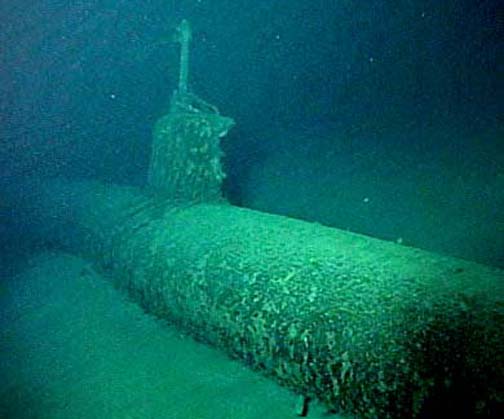
CTY Pisces – Photos of a Japanese midget submarine that was sunk off Pearl Harbor on the day of the attack. There’s a hole at the base of the conning tower where an artillery shell penetrated the hull, sinking the sub and killing the crew. Photos courtesy of Terry Kerby, Hawaii Undersea Research Laboratory. August 2003.
|
Major European bank could help Russia lift its sunken nuclear submarines https://bellona.org/news/nuclear-issues/2020-03-major-european-bank-could-help-russia-lift-its-sunken-nuclear-submarinesThe European Bank for Reconstruction and Development has signaled its readiness to help Russia raise Soviet-era radioactive debris, including two sunken nuclear submarines, from the bottom of Arctic seas. March 18, 2020 by Charles Digges charles@bellona.no While the deal is not yet final, it is thought that financial assistance would be allocated by the bank’s Northern Dimensions Environmental Partnership program – whose Nuclear Window fund has disbursed millions of dollars to help clean up radioactive hazards in Russia and Ukraine. Talks on funding the recovery of these Cold War artifacts have been underway since the end of last year, when the Russian government reinvigorated long-dormant discussions on retrieving the sunken radioactive cast offs. Alexander Nikitin, who heads Bellona’s St Petersburg offices, has been a part of these discussions. According to the Russian government’s official website on submarine decommissioning programs, the plan to raise the subs was presented at the EBRD’s assembly of donors in December, where the cost for the project was estimated at €300 million. It will now be up to Russia, the site reported, to furnish the bank with a comprehensive plan on raising the subs. While Moscow has considered various methods for raising the subs over the years, those who participated in the December discussions concluded a special ship might have to be built to get the job done. Beginning in the 1960s, the Soviet Navy used the waters east of the Novaya Zemlya atomic weapons testing range as a sort of watery nuclear waste dump. While the Soviet Union was hardly the only nuclear nation that resorted to dumping radioactive waste at sea, it was one of the most prolific. According to catalogues released by Russia in 2012, the military dumped some 18,000 separate objects in the Arctic that could be classified as radioactive waste. These included some 17,000 containers of radioactive waste; 19 ships containing radioactive waste; 14 nuclear reactors, including five still loaded with spent nuclear fuel; and 735 other piece of radioactively contaminated heavy machinery. Scientists at the Nuclear Safety Institute of the Russian Academy of Sciences, or IBRAE, say that time and corrosion have managed to decay thousands of these hazards and render them harmless. This leaves about 1,000 that continue to post a high risk of spreading radioactive contamination. Chief among these are two submarines, the K-159 and the K-27, both of which officials say pose the greatest threat to the environments in which they now lie. The K-159, which sank while it was being towed to decommissioning in 2003 and killed the nine sailors aboard, now lies in some of the most fertile fishing grounds of the Kara Sea. Raising this sub, say Russian experts, should be a priority. Its reactors hold some 800 kilograms of spent nuclear fuel, which they fear could contaminate the sea floor, leading to an economic crisis for the Russian and Norwegian fishing industries.
Like the K-159, the K-27 claimed its share of victims. Nine members of its crew of 144 died of radiation related illnesses shortly after returning to shore. Many more of the crew succumbed to similar illnesses in the years that followed. Too radioactive to be dismantled conventionally, the Soviet Navy towed the K-27 to the Arctic Novaya Zemlya nuclear testing range in 1982 and scuttled it in one of the archipelago’s fjords at a depth of about 30 meters. The sinking took some effort. The sub was weighed down by concrete and asphalt to secure its reactor and a hole was blown in its aft ballast tank to swamp it. But the fix won’t last forever. The asphalt was only meant to stave off contamination until 2032. Worse still is that the K-27’s reactors could be in danger of generating an uncontrolled nuclear chain reaction, prompting many experts to demand it be retrieved first. Raising these submarines from the depths will require technology Russia currently lacks. Even the lifting of the Kursk – perhaps the most famous sub recovery to date – required the assistance of the Dutch. But the K-159 lies at a depth much greater than the Kursk did, leading many experts to suggest building an new vessel for the purpose. From 1946 to 1993, more than 200,000 tons of waste, some of it highly radioactive, was dumped in the world’s oceans, mainly in metal drums, according to the International Atomic Energy Agency. The lion’s share of dumped nuclear waste came from Britain and the Soviet Union, figures from the IAEA show. By 1991, the US had dropped more than 90,000 barrels and at least 190,000 cubic meters of radioactive waste in the North Atlantic and Pacific. Other countries including Belgium, France, Switzerland and the Netherlands also disposed of tons of radioactive waste in the North Atlantic in the 1960s, 70s and 80s. |
|
|

Polar ice melting at an accelerating rate

Polar ice caps melting six times faster than in 1990s https://www.theguardian.com/environment/2020/mar/11/polar-ice-caps-melting-six-times-faster-than-in-1990s
Losses of ice from Greenland and Antarctica are tracking the worst-case climate scenario, scientists warn Damian Carrington Environment editor @dpcarrington,Thu 12 Mar 2020 The polar ice caps are melting six times faster than in the 1990s, according to the most complete analysis to date.
The ice loss from Greenland and Antarctica is tracking the worst-case climate warming scenario set out by the Intergovernmental Panel on Climate Change (IPCC), scientists say. Without rapid cuts to carbon emissions the analysis indicates there could be a rise in sea levels that would leave 400 million people exposed to coastal flooding each year by the end of the century.
Rising sea levels are the one of the most damaging long-term impacts of the climate crisis, and the contribution of Greenland and Antarctica is accelerating. The new analysis updates and combines recent studies of the ice masses and predicts that 2019 will prove to have been a record-breaking year when the most recent data is processed.
The previous peak year for Greenland and Antarctic ice melting was 2010, after a natural climate cycle led to a run of very hot summers. But the Arctic heatwave of 2019 means it is nearly certain that more ice was lost last year.
The average annual loss of ice from Greenland and Antarctica in the 2010s was 475bn tonnes – six times greater than the 81bn tonnes a year lost in the 1990s. In total the two ice caps lost 6.4tn tonnes of ice from 1992 to 2017, with melting in Greenland responsible for 60% of that figure.
The IPCC’s most recent mid-range prediction for global sea level rise in 2100 is 53cm. But the new analysis suggests that if current trends continue the oceans will rise by an additional 17cm.
“Every centimetre of sea level rise leads to coastal flooding and coastal erosion, disrupting people’s lives around the planet,” said Prof Andrew Shepherd, of the University of Leeds. He said the extra 17cm would mean the number of exposed to coastal flooding each year rising from 360 million to 400 million. “These are not unlikely events with small impacts,” he said. “They are already under way and will be devastating for coastal communities.”
Erik Ivins, of Nasa’s Jet Propulsion Laboratory, in California, who led the assessment with Shepherd, said the lost ice was a clear sign of global heating. “The satellite measurements provide prima facie, rather irrefutable, evidence,” he said.
Almost all the ice loss from Antarctica and half of that from Greenland arose from warming oceans melting the glaciers that flow from the ice caps. This causes glacial flow to speed up, dumping more icebergs into the ocean. The remainder of Greenland’s ice losses are caused by hotter air temperatures that melt the surface of the ice sheet.
The combined analysis was carried out by a team of 89 scientists from 50 international organisations, who combined the findings of 26 ice surveys. It included data from 11 satellite missions that tracked the ice sheets’ changing volume, speed of flow and mass.
About a third of the total sea level rise now comes from Greenland and Antarctic ice loss. Just under half comes from the thermal expansion of warming ocean water and a fifth from other smaller glaciers. But the latter sources are not accelerating, unlike in Greenland and Antarctica.
Shepherd said the ice caps had been slow to respond to human-caused global heating. Greenland and especially Antarctica were quite stable at the start of the 1990s despite decades of a warming climate.
Shepherd said it took about 30 years for the ice caps to react. Now that they had a further 30 years of melting was inevitable, even if emissions were halted today. Nonetheless, he said, urgent carbon emissions cuts were vital. “We can offset some of that [sea level rise] if we stop heating the planet.”
The IPCC is in the process of producing a new global climate report and its lead author, Prof Guðfinna Aðalgeirsdóttir, of the University of Iceland, said: “The reconciled estimate of Greenland and Antarctic ice loss is timely.”
She said she also saw increased losses from Iceland’s ice caps last year. “Summer 2019 was very warm in this region.”
Arctic ice melt is changing ocean currents

|
Arctic ice melt is changing ocean currents https://www.sciencedaily.com/releases/2020/02/200207095705.htm
|
Permafrost thawing -“fast and dramatic, affecting landscapes in unprecedented ways

|
Arctic permafrost thaw plays greater role in climate change than previously estimated, https://www.eurekalert.org/pub_releases/2020-02/uoca-apt020320.php UNIVERSITY OF COLORADO AT BOULDER ABRUPT THAWING OF PERMAFROST WILL DOUBLE PREVIOUS ESTIMATES OF POTENTIAL CARBON EMISSIONS FROM PERMAFROST THAW IN THE ARCTIC, AND IS ALREADY RAPIDLY CHANGING THE LANDSCAPE AND ECOLOGY OF THE CIRCUMPOLAR NORTH, A NEW CU BOULDER-LED STUDY FINDS. Permafrost, a perpetually frozen layer under the seasonally thawed surface layer of the ground, affects 18 million square kilometers at high latitudes or one quarter of all the exposed land in the Northern Hemisphere. Current estimates predict permafrost contains an estimated 1,500 petagrams of carbon, which is equivalent to 1.5 trillion metric tons of carbon. The new study distinguishes between gradual permafrost thaw, which affects permafrost and its carbon stores slowly, versus more abrupt types of permafrost thaw. Some 20% of the Arctic region has conditions conducive to abrupt thaw due to its ice-rich permafrost layer. Permafrost that abruptly thaws is a large emitter of carbon, including the release of carbon dioxide as well as methane, which is more potent as a greenhouse gas than carbon dioxide. That means that even though at any given time less than 5% of the Arctic permafrost region is likely to be experiencing abrupt thaw, their emissions will equal those of areas experiencing gradual thaw. This abrupt thawing is “fast and dramatic, affecting landscapes in unprecedented ways,” said Merritt Turetsky, director of the Institute of Arctic and Alpine Research (INSTAAR) at CU Boulder and lead author of the study published today in Nature Geoscience. “Forests can become lakes in the course of a month, landslides occur with no warning, and invisible methane seep holes can swallow snowmobiles whole.” Abrupt permafrost thaw can occur in a variety of ways, but it always represents a dramatic abrupt ecological shift, Turetsky added. “Systems that you could walk on with regular hiking boots and that were dry enough to support tree growth when frozen can thaw, and now all of a sudden these ecosystems turn into a soupy mess,” Turetsky said. Why thawing permafrost matters Permafrost contains rocks, soil, sand, and in some cases, pockets of pure ground ice. It stores on average twice as much carbon as is in the atmosphere because it stores the remains of life that once flourished in the Arctic, including dead plants, animal and microbes. This matter, which never fully decomposed, has been locked away in Earth’s refrigerator for thousands of years. As the climate warms, permafrost cannot remain frozen. Across 80 percent of the circumpolar Arctic’s north, a warming climate is likely to trigger gradual permafrost thaw that manifests over decades to centuries. But in the remaining parts of the Arctic, where ground ice content is high, abrupt thaw can happen in a matter of months – leading to extreme consequences on the landscape and the atmosphere, especially where there is ice-rich permafrost. This fast process is called “thermokarst” because a thermal change causes subsidence. This leads to a karst landscape, known for its erosion and sinkholes. Turetsky said this is the first paper to pull together the wide body of literature on past and current abrupt thaw across different types of landscapes. The authors then used this information along with a numerical model to project future abrupt thaw carbon losses. They found that thermokarst always involves flooding, inundation, or landslides. Intense rainfall events and the open, black landscapes that result from wildfires can speed up this dramatic process. The researchers compared abrupt permafrost thaw carbon release to that of gradual permafrost thaw, trying to quantify a “known unknown.” There are general estimates of gradual thaw contributing to carbon emissions, but they had no idea how much of that would be caused by thermokarst. They also wanted to find out how important this information would be to include in global climate models. At present, there are no climate models that incorporate thermokarst, and only a handful that consider permafrost thaw at all. While large-scale models over the past decade have tried to better account for feedback loops in the Arctic, the Intergovernmental Panel on Climate Change (IPCC)’s most recent report only includes estimates of gradual permafrost thaw as an unresolved Earth system feedback. “The impacts from abrupt thaw are not represented in any existing global model and our findings indicate that this could amplify the permafrost climate-carbon feedback by up to a factor of two, thereby exacerbating the problem of permissible emissions to stay below specific climate change targets,” said David Lawrence, of the National Center for Atmospheric Research (NCAR) and a coauthor of the study. The findings bring new urgency to including permafrost in all types of climate models, along with implementing strong climate policy and mitigation, Turetsky added. “We can definitely stave off the worst consequences of climate change if we act in the next decade,” said Turetsky. “We have clear evidence that policy is going to help the north and thus it’s going to help dictate our future climate.” Other coauthors on the paper include researchers from the University of Guelph, Brigham Young University, the United States Geological Survey, University of Alaska Fairbanks, University of Alberta, Northern Arizona University, Alfred Wegener Institute Helmholtz Centre for Polar and Marine Research, University of Potsdam, Stockholm University, Lawrence Berkeley National Laboratory, and the National Center for Atmospheric Research. |
|
Why Arctic glaciers are melting away at an accelerating rate
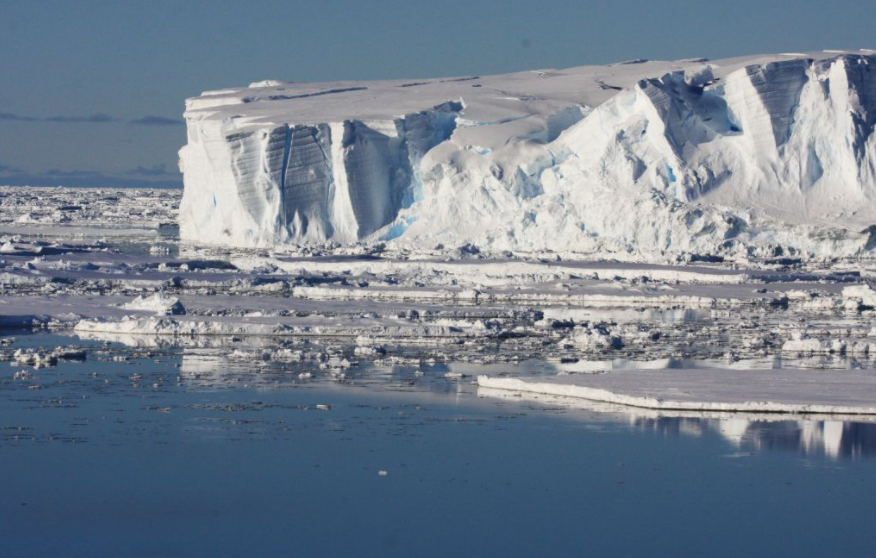
How the ocean is gnawing away at glaciers, https://www.sciencedaily.com/releases/2020/02/200203114350.htm
- Date:
- February 3, 2020
- Source:
- Alfred Wegener Institute, Helmholtz Centre for Polar and Marine Research
- Summary:
- The Greenland Ice Sheet is melting faster today than it did only a few years ago. The reason: it’s not just melting on the surface — but underwater, too. AWI researchers have now found an explanation for the intensive melting on the ice’s underside, and published their findings in the journal Nature Geoscience.
-
The glaciers are melting rapidly: Greenland’s ice is now melting seven times faster than in the 1990s — an alarming discovery, since climate change will likely intensify this melting in the future, causing the sea level to rise more rapidly.
Accordingly, researchers are now working to better understand the underlying mechanisms of this melting. Ice melts on the surface because it is exposed to the sun and rising temperatures. But it has now also begun melting from below — including in northeast Greenland, which is home to several ‘ice tongues’. Each tongue is a strip of ice that has slid down into the ocean and floats on the water — without breaking off from the land ice. The longest ice tongue, part of the ’79° North Glacier’, is an enormous 80 km long. Over the past 20 years, it has experienced a dramatic loss of mass and thickness, because it’s been melting not just on the surface, but also and especially from below.
-
Too much heat from the ocean
A team led by oceanographer Dr Janin Schaffer from the Alfred Wegener Institute, Helmholtz Centre for Polar and Marine Research (AWI) in Bremerhaven has now identified the source of this intense underwater melting. The conclusions of their study, which the experts have just released in the journal Nature Geoscience, are particularly unsettling because the melting phenomenon they discovered isn’t unique to the 79° North Glacier, which means it could produce similar effects elsewhere. For the purposes of the study, the researchers conducted the first extensive ship-based survey of the ocean floor near the glacier, which revealed the presence of a two-kilometre-wide trough, from the bottom of which comparatively warm water from the Atlantic is channelled directly toward the glacier. But that’s not all: in the course of a detailed analysis of the trough, Janin Schaffer spotted a bathymetric sill, a barrier that the water flowing over the seafloor has to overcome. Once over the hump, the water rushes down the back of the sill — and under the ice tongue. Thanks to this acceleration of the warm water mass, large amounts of heat from the ocean flow past the tongue every second, melting it from beneath. To make matters worse, the layer of warm water that flows toward the glacier has grown larger: measured from the seafloor, it now extends 15 metres higher than it did just a few years ago. “The reason for the intensified melting is now clear,” Schaffer says. “Because the warm water current is larger, substantially more warmth now makes its way under the ice tongue, second for second.”
Other regions are also affected
In order to determine whether the phenomenon only manifests at the 79° North Glacier or also at other sites, the team investigated a neighbouring region on Greenland’s eastern coast, where another glacier, the Zachariæ Isstrøm, juts out into the sea, and where a large ice tongue had recently broken off from the mainland. Working from the surface of an ice floe, the experts measured water temperatures near the ocean floor. According to Schaffer: “The readings indicate that here, too, a bathymetric sill near the seafloor accelerates warm water toward the glacier. Apparently, the intensive melting on the underside of the ice at several sites throughout Greenland is largely produced by the form of the seafloor.” These findings will ultimately help her more accurately gauge the total amount of meltwater that the Greenland Ice Sheet loses every year.
Story Source:
Materials provided by Alfred Wegener Institute, Helmholtz Centre for Polar and Marine Research. Note: Content may be edited for style and length.
America Almost Stockpiled Nuclear Weapons In Iceland
|
Secrets Revealed: America Almost Stockpiled Nuclear Weapons In Iceland
Why didn’t it happen? National Interest, by Michael Peck, 29 DEc 19, Key point: We still don’t officially know which nations had U.S. nuclear weapons on their soil.
If Miss Manners were a diplomat, she would tell us how rude it is to place nuclear bombs in the territory of our allies without being invited to.
But it turns out that in the 1950s, the United States considered deploying nuclear weapons in Iceland without telling the Icelanders, according to declassified documents published by the watchdog organization National Security Archive. “At the end of the 1950s the U.S. Navy ordered the construction of a facility for storing nuclear depth bombs, an Advanced Underseas Weapons (AUW) Shop at the outskirts of Keflavik airport,” the National Security Archive wrote. “The AUW facility was built by local Icelandic workers who thought its purpose was to store torpedoes.”…….. the problem is that Iceland didn’t want nukes on its soil, which would have made the little nation a big target in Soviet eyes. In fact, Iceland’s decision to join NATO in 1949 sparked riots in the normally placid country. In 1951 and in 1960, Icelandic officials asked whether the United States had deployed nuclear weapons at its bases in Iceland. The United States never did—or at least as has so far been revealed—store these weapons on Iceland, and told Icelandic officials so. However, National Security Archive researchers believe that in a still-classified letter, the State Department in 1960 told Tyler Thompson, U.S. ambassador to Iceland, that “the U.S. government was free to deploy nuclear weapons in Iceland without securing the agreement of Reykjavik.”
The evidence is in Thompson’s reply to the State Department, in which the name of the nation was redacted by the declassification censors, but whichalmost certainly refers to Iceland. If U.S. policy was never to store nuclear weapons on Canadian soil without Canadian permission, then why should Iceland be treated differently? Thompson asks. “The possibility of [Iceland’s] withdrawal from Nato in protest should not be overlooked,” he added……. we still don’t officially know which nations had U.S. nuclear weapons on their soil. “The U.S. government has not acknowledged the names of a number of other countries which directly participated in the NATO nuclear weapons stockpile program during the Cold War (and later): Belgium, Greece, Italy, the Netherlands, and Turkey (only West Germany and the United Kingdom have been officially disclosed),” according to the National Security Archive. Guaranteed that the Russians know, but we don’t. https://nationalinterest.org/blog/buzz/secrets-revealed-america-almost-stockpiled-nuclear-weapons-iceland-109321 |
|
Dangers of nuclear crises in the Arctic: countries prepare for emergencies.
Arctic Council creates new expert group on nuclear emergencies https://thebarentsobserver.com/en/arctic/2019/12/arctic-council-creates-new-expert-group-nuclear-emergencies
The Arctic countries take major steps to prepare strategies and share information to improve preparedness in case of radiological and nuclear incidents. By Thomas Nilsen, December 11, 2019
Two fatal accidents during the summer of 2019 was a wake-up call for radiation emergency authorities monitoring northern waters.
On July 1st, the nuclear-powered special purpose submarine Losharik catches fire when on mission outside the Kola Peninsula. Six weeks later, a nuclear-powered cruise missile explodes while being recovered from the seabed outside Nenoksa naval weapons testing site in the White Sea.
While Russia has been very reluctant to share information about what happened at the two accidents, the country is a team-player when the Arctic Council now has agreed to establish a dedicated expert group on radiation and nuclear incidents.
The formal decision was taken at the meeting of the Arctic Council’s Working Group on Emergency Prevention, Preparedness and Response (EPPR) in Reykyavik on December 4th.
All eight Arctic states will appoint experts and observer states are encouraged to participate. To strengthen the group’s role, the International Atomic Energy Agency (IAEA) is invited to join the meetings.
Inside the Arctic Circle, the number of nuclear-powered vessels has increased sharply over the last decade.
Tensions between Russia and NATO have led to more sailings with reactor-powered submarines, especially in the Norwegian, Barents- and White Seas, but also under the ice in the high Arctic. Northern Norway saw a record number of 12 visiting NATO nuclear-powered submarines in 2018. And while the Arctic Council members met in Reykjavik last week, Russia’s Northern Fleet still had a number of attack submarines sailing the Norwegian Sea. So did at least one American nuclear-powered submarine as reported by the Barents Observer.
Secondly, increased shipping and industrial activities along Russia’s Northern Sea Route are supported by more and larger nuclear-powered icebreakers.
Unfortunate, the history of operating reactors and deploying nuclear weapons to the Arctic has a bad record with radioactivity released to the environment and exposure to people; nuclear weapons testing at Novaya Zemlya, the crash of a U.S. bomber with plutonium warheads at Thule airbase on Greenland, sinking submarines like the Komsomolets, Kursk and K-259. Several other submarines have suffered serious reactor accidents and in the Kara Sea, thousands of containers wit radioactive waste is dumped together with 16 reactors.
The Arctic Council, though, can not engage in anything related to military activities.
The list of potential incidents with possible releases of radioactivity exposing people living or working in the Arctic is long. How to share knowledge and information about each countries’ preparedness capacities will certainly be on the agenda when the new expert group’s first formal meeting, likely to take place next spring on the Faroe Islands.
Chair of the expert group in the starting period, Øyvind Aas-Hansen with the Norwegian Radiation and Nuclear Safety Authority, tells the Barents Observer that one interesting topic that might be brought to table is defining the risk potential for emergencies due to nuclear and radiological material and activities that pose a threat in the Arctic.
«We aim at protecting Arctic inhabitants and their livelihoods and the Arctic environment,» Øyvind Aas-Hansen explains.
He said it is needed to «identify minimal preparedness and response arrangements and capabilities applicable to the Arctic region.»
Aas-Hansen said it could be special needs for coordinating emergency prevention and response that are «specific to the Arctic region.»
Both the United States and Russia have serious experiences from dealing with nuclear accidents in cold climate, like the US clean-up work after the Thule accident in 1968 and Soviet clean-up work after the leakages from Building No. 5 in Andreeva Bay in the early 1980s.
More reactors at sea
The Barents Observer has recently published an overview (pdf) listing the increasing number of reactors in the Russian Arctic. The paper is part of Barents Observer’s analytical popular science studies on developments in the Euro-Arctic Region.
According to the list there are 39 nuclear-powered vessels or installations in the Russian Arctic today with a total of 62 reactors. This includes 31 submarines, one surface warship, five icebreakers, two onshore and one floating nuclear power plants.
Looking 15 years ahead, the number of ships, including submarines, and installations powered by reactors is estimated to increase to 74 with a total of 94 reactors, maybe as many as 114. Additional to new icebreakers and submarines already under construction, Russia is brushing dust of older Soviet ideas of utilizing nuclear-power for different kind of Arctic shelf industrial developments, like oil- and gas exploration, mining and research. “By 2035, the Russian Arctic will be the most nuclearized waters on the planet,” the paper reads.
Also, existing icebreakers and submarines get life-time prolongation. The average age of the Northern Fleet’s nuclear-powered submarines has never been older than today. Several of the submarines built in the 1980s will continue to sail the Barents Sea and under the Arctic ice-cap until the late 2020s.
In August, Russia’s first floating nuclear power plant, “Akademik Lomonosov”, will be towed from Murmansk to Pevek, a port-town on the northeast coast of Siberia.
Other plans to use nuclear reactors in the Russian Arctic in the years to come include many first-of-a-kind technologies like sea-floor power reactors for gas exploration, civilian submarines for seismic surveys and cargo transportation, small-power reactors on ice-strengthen platforms.
In the military sphere, the Arctic could be used as testing sites for both Russia’s new nuclear-powered cruise-missile and nuclear-powered underwater weapons drone. Both weapons were displayed by President Vladimir Putin when he bragged about new nuclear weapons systems in his annual speech to the Federation Council last year.
An Arctic Council summary report, presented to the Ministerial Meeting in Rovaniemi in May as a deliverable by the Emergency Prevention, Preparedness and Response (EPPR) Working Group highlight the risks: “The presence of radiological and nuclear material in the Arctic poses a risk for serious incidents or accidents that may affect Arctic inhabitants and their communities, the Arctic environment, and Arctic industries, including traditional livelihoods such as fisheries and local food sources.”
For Norway, Russia and Iceland, a nuclear accident in the Barents Sea could be disastrous for sales of seafood. The three countries export of cod and other spices is worth billions of Euros annually.
Floating small nuclear reactors bring serious risks
nuclear experts have highlighted crucial negatives that cast doubt on the floating nuclear utopia.Jan Haverkamp, Greenpeace Netherlands senior expert nuclear energy and energy policy, sees the three main disadvantages of Akademin Lomonosov to be the big human factors risk, its problematic construction, and the pollution of the Arctic region with nuclear waste.
this project is reintroducing a major pollution risk in an area which functions as a climate regulator for the globe – “the Arctic pristine area, which is a very important natural area for the entire balance on the planet,”
Is floating nuclear power a good idea? Power Technology By Yoana Cholteeva, 9 Dec 19, Floating nuclear power promises to provide a steady source of energy at hard-to-reach locations, but at the same time the dangers inherent in nuclear power make some question whether it’s safe enough for areas where help is hard to find. Is floating nuclear power really a good idea? Yoana Cholteeva investigates.
Russian nuclear company Rosatom announced the arrival of the world’s first floating nuclear power plant, Akademik Lomonosov, in September 2019 when the technology was transported to the port of its permanent location in Russia’s Far East. The 144m-long and 30m-wide vessel has now docked at the port in Pevek, off the coast of Chukotka, where it will stay before its commissioning next year.
Akademik Lomonosov will use small modular reactor technology and is equipped with two KLT-40C reactor systems with 35MW capacity each. It has been designed to access hard-to-reach areas where it can operate for three to five years without the need for refuelling. It also has an overall life cycle of 40 years, which may be extended to 50 years Continue reading
New ship to handle all nuclear waste from Rosatom’s Arctic operations.
Barents Observer 5th Dec 2019, New ship to handle all nuclear waste from Rosatom’s Arctic operations.
The new special purpose vessel will serve the new icebreakers and the
floating nuclear power plants and possible other reactor installations.
In framing Julian Assange, The FBI tried to make Iceland a complicit
The FBI tried to make Iceland a complicit ally in framing Julian Assange https://independentaustralia.net/life/life-display/the-fbi-tried-to-make-iceland-a-complicit-ally-in-framing-julian-assange,13277
By Sara Chessa | 5 November 2019 Former Icelandic Interior Minister tells Independent Australia how he blocked U.S. interference in 2011 in order to defend WikiLeaks and its publisher Julian Assange. Sara Chessa reports.
Former Icelandic Interior Minister tells Independent Australia how he blocked U.S. interference in 2011 in order to defend WikiLeaks and its publisher Julian Assange. Sara Chessa reports.
A MINISTER OF THE INTERIOR wakes up one summer morning and finds out that a plane full of United States Federal Bureau of Investigation (FBI) agents has landed in his country, aiming to carry out police investigations without proper permission from the authorities.
How many statesmen would have the strength to say, “No, you can’t do this”, to the United States? Former Icelandic Interior Minister Ögmundur Jónasson, in fact, did this — and for the sake of investigative journalism. He understood that something wrong with the sudden FBI mission in Reykjavik, and that this had to do with the whistleblowing website WikiLeaks and its publisher Julian Assange. Continue reading
Frozen nuclear city to ‘seep radiation into environment’ as ice melts
CAMP CENTURY: CLIMATE AND ICE MONITORING
Next Chernobyl? Frozen nuclear city to ‘seep radiation into environment’ as ice melts
A FROZEN underground city could be threatening to seep radioactive materials into the environment as climate change forces the ice to melt. Express UK By CALLUM HOARE Nov 8, 2019
Project Icework was a top secret United States Army programme of the Cold War, aimed at building a network of mobile nuclear missile launch sites below the Greenland ice sheet due to its strategic location near the Soviet Union. To study the feasibility of working under the ice, a highly publicised “cover” project, known as Camp Century, was launched in 1960, but six years later it was cancelled due to unstable conditions. The nuclear reactor was removed before the site was abandoned, but hundreds of tonnes of toxic waste remain buried beneath the ice.
Now, climate change is threatening to expose it, as the ice melts at an alarming rate.
YouTube channel Seeker spoke to William Colgan, who is currently running The Camp Century Climate Monitoring Programme, in the hope of preventing the radioactive material from reaching the surface.
He said in 2018: “The people working at Camp Century did not have an understanding of climate change. “They didn’t have solid records, global climate models, these big data sets so you can see an overview of what’s happening to Earth’s climate.
The moving ice sheet started to destabilise the underground tunnels, prompting the US Army to abort Project Iceworm.
“When Camp Century was decommissioned, only the nuclear reactor was taken out for destructive testing, and the rest of the camp was left in place, and they closed the doors.
“It was abandoned on the assumption that climate wouldn’t change, and it would continue to snow at Camp Century forever and the perpetual snowfall would entomb all of the base infrastructures and eventually bury it.”
The narrator of the series explained why Dr Colgan is so invested in the project.
He said: “The climate has changed and temperatures have reached record highs in the Arctic and Greenland’s ice sheet is melting at an unprecedented rate, which could turn Camp Century’s abandoned waste into a major environmental risk.
So a team of scientists, including William, went back to the site.”
Dr Colgan explained what his team is doing.
He added: “In 2017, the government of Denmark, at the request of the government of Greenland, started the Camp Century Climate Monitoring Programme.
“We set up a bunch of instruments that are erected on the ice sheet surface and then we drill in and we put probes into the ice sheet.
“It keeps a real-time data stream coming from the Camp Century site where we monitor a bunch of things, mainly the temperature of the snow, the temperature of the ice and the air temperature…….https://www.express.co.uk/news/science/1201199/nuclear-warning-cold-war-camp-century-project-iceworm-radiation-climate-change-spt
Climate change: Permafrost is now becoming a carbon emitter
|
Climate change has turned permafrost into a carbon emitter, Tundra plants can’t absorb enough carbon in summer to make up for carbon released in winter, CBC, Bob Weber · The Canadian Press Oct 22, 2019 Research has found Arctic soil has warmed to the point where it releases more carbon in winter than northern plants can absorb during the summer.
The finding means the extensive belt of tundra around the globe — a vast reserve of carbon that dwarfs what’s held in the atmosphere — is becoming a source of greenhouse gas emissions responsible for climate change. “There’s a net loss,” said Dalhousie University’s Jocelyn Egan, one of 75 co-authors of a paper published in Nature Climate Change. “In a given year, more carbon is being lost than what is being taken in. It is happening already.” The research by scientists in 12 countries and from dozens of institutions is the latest warning that northern natural systems that once reliably kept carbon out of the atmosphere are starting to release it………. Emissions speeding upWhat’s more, the pace of the emissions is likely to increase. Under a business-as-usual scenario, emissions from northern soil would be likely to release 41 per cent more carbon by the end of the century. But the Arctic is already warming at three times the pace of the rest of the globe. Even if significant mitigation efforts are made, those emissions will increase by 17 per cent, said the report. Egan notes the research didn’t measure methane, a greenhouse gas about 30 times more potent than carbon dioxide that is also released from soil. Her findings echo previous studies. Last summer, research suggested that larger, hotter wildfires are turning boreal forests into carbon sources. Another paper found that instead of melting slowly and steadily, permafrost is subject to sudden collapses that speed up the rate of carbon release. Mitigation won’t stop the problem any more, said Egan, but it will help.https://www.cbc.ca/news/technology/permafrost-climate-change-1.5330144 |
|
|
Safety and security preparations for remote Prevek as floating nuclear power plant enters East Siberian Sea
As floating nuclear power plant enters East Siberian Sea, emergency services in Pevek make a last check Final preparations in the remote Arctic town that will host the floating nuclear installation. Barents Observer, By Atle Staalesen, September 06, 2019,
The «Akademik Lomonosov» on the 6th September passed the Sannikov Strait south of the New Siberian Islands and made it into the East Siberian Sea. The floating installation now has only about 3 days left of its extensive voyage across the Northern Sea Route.
The «Akademik Lomonosov» on 23rd August set out of the Kola Bay after more than a year of preparations in Murmansk. Towed by icebreaker «Dikson» and accompanied by support ships «Yasnyy» and «Kapitan Martyshkin», the floating power plant had course for the Barents Sea and subsequently made it through the Kara Sea and Laptev Sea.
Is Pevek ready?
According to the ministry, a special fire- and rescue department is under construction on site. When completed, the unit can ultimately serve as base for a bigger Arctic rescue center.
Outsourced security
Also law-enforcement authorities are on site preparing to keep an eye on the new strategic object. It is Rosgvardia, the Russian National Guard, that has been commissioned to protect the power plant and its surroundings.
According to the security service, the formation of guarding units were in late August about to be completed and training was ongoing in cooperation with representatives of Rosatom.
Big risks
The «Akademik Lomonosov» has two KLT40S reactors and will provide heat and electricity to Pevek for the next 12 years. After that, it will have to be towed back either to Rosatomflot’s base in Murmansk, or to a shipyard like in Severodvinsk for unloading the spent nuclear fuel and carry out other maintenance work.
Environmentalists have criticized the project and warned against possible major risks.
1 This Month
23-25 October – on Zoom – World BEYOND War’s annual global conferenc


Shut down the radiation-damaged Heysham nuclear reactors now
To see nuclear-related stories in greater depth and intensity – go to https://nuclearinformation.wordpress.com

Say No to NASA’s Reckless Nuclear Reactor on the Moon
Say No to NASA’s Reckless Nuclear Reactor on the Moon

-
Archives
- October 2026 (247)
- September 2026 (339)
- August 2026 (330)
- July 2026 (355)
- June 2026 (287)
- May 2026 (306)
- April 2026 (356)
- March 2026 (251)
- February 2026 (267)
- January 2026 (308)
- December 2025 (358)
- November 2025 (359)
-
Categories
- 1
- 1 NUCLEAR ISSUES
- business and costs
- climate change
- culture and arts
- ENERGY
- environment
- health
- history
- indigenous issues
- Legal
- marketing of nuclear
- media
- opposition to nuclear
- PERSONAL STORIES
- politics
- politics international
- Religion and ethics
- safety
- secrets,lies and civil liberties
- spinbuster
- technology
- Uranium
- wastes
- weapons and war
- Women
- 2 WORLD
- ACTION
- AFRICA
- Atrocities
- AUSTRALIA
- Christina's notes
- Christina's themes
- culture and arts
- Events
- Fuk 2022
- Fuk 2023
- Fukushima 2017
- Fukushima 2018
- fukushima 2019
- Fukushima 2020
- Fukushima 2021
- general
- global warming
- Humour (God we need it)
- Nuclear
- RARE EARTHS
- Reference
- resources – print
- Resources -audiovicual
- Weekly Newsletter
- World
- World Nuclear
- YouTube
-
RSS
Entries RSS
Comments RSS

