Centrica to cut 4,000 jobs and sell UK nuclear holdings Beleaguered British Gas owner, lost 1.4 million customers last year The Week, UK Feb 22, 2018
Centrica, the owner of British Gas, is cutting 4,000 jobs and sellings its nuclear holdings amid plummeting profits and customer numbers.
The energy supplier says group profits across operations in the UK, Ireland and North America fell by 17% to £1.25bn for the year ended December 2017. ……..
Centrica, which lost a total of 1.4 million customer accounts last year, is also looking to sell its stake in Britain’s nuclear power stations by 2020. The company bought a 20% share in Electricite de France SA’s UK nuclear operations in 2009 as an investment. This stake is to be divested, “subject to ensuring alignment with our partner and being sensitive to Government interests”, Centrica said in a statement. ……http://www.theweek.co.uk/centrica/91834/centrica-to-cut-4000-jobs-and-sell-uk-nuclear-holdings
The interior ministry announced the evacuation after it was underway, with scores of police in body armor moving in before daylight to evict activists occupying the zone, backed up by an earthmover.
The plan to store long-life nuclear waste 500 meters below ground in impermeable clay has not yet got government approval and is strongly opposed by local groups and environmentalists.
President Emmanuel Macron’s government is keen to prevent a proliferation of such protester-occupation movements following one that lasted year at a site earmarked for a new airport near Nantes in the west of France – a building plan it dropped last month.
Last month Cumbria Trust reported that the Swedish Environmental Court had blocked a licence application to construct a GDF for spent nuclear fuel after serious concerns were raised over the corrosion of the copper canisters used in the KBS-3 method. The same containment method is intended to be used in the UK. This court ruling was a success for MKG, the Swedish environmental organisation which receives government funding to act as a critical friend, scrutinising Sweden’s plan to bury nuclear waste.
MKG have now released some further details which show that the corrosion concerns are shared by experts within the Swedish regulator, SSM. While the nuclear industry, including the UK’s Radioactive Waste Management (RWM) seem keen to minimise the significance of this court ruling, by describing it as a delay and a request for more information, it appears the problem may be more fundamental, and could lead to this method of KBS-3 copper encapsulation being abandoned. This would damage the UK’s search process.
A key assumption with the KBS-3 method is that copper does not corrode in anoxic conditions, that is without the presence of oxygen. While there will be oxygen present at first, once the canisters are placed within the bentonite clay, bacteria and chemical processes consume the oxygen, creating the desired anoxic environment. However, it is becoming increasingly clear that even without oxygen, the copper begins to corrode by pitting. The heat generated by the spent fuel appears to be a significant factor in accelerating this pitting process. These capsules were intended to remain intact for a million years, but tests have suggested that they may well fail much sooner.
The significance of the problem goes well beyond this encapsulation method. There are lessons that should be learned, but the question is whether the nuclear industry will be open enough to do so. One key lesson is that funding a critical friend NGO such as MKG, can help to identify problems and reduce the impact of groupthink which leads to irrational decision-making. Another appears to be that we are prone to over-confidence in engineering. Isolating nuclear waste from the surface for a million years, particularly waste types which produce a great deal of heat, is complex. While we can test potential containment methods for around a generation, we need to be confident that these methods will continue to work for 30,000 generations.
“There is only one form of containment for liquids and gases which has been demonstrated to work for millions of years, even under great pressure, and that is geological formations. We have a vast quantity of evidence from the oil and gas industry of rock formations which have isolated hydrocarbons from the surface for many millions of years. So while Cumbria Trust continues to support the principle of geological disposal, as potentially the least bad solution to an existing problem, the key to its success must be the geology in which it is constructed.”
Any search process for a GDF site must begin with suitable geology and the failed attempts in Cumbria have concluded that the search should move to an area of simple geology and low groundwater flow. Cumbria Trust fears that the selective blindness which has led to the previous failures of the search process, will result in another attempt to target Cumbria despite its complex geology.
South Africa’s Electricity Choice, Part 4: The dangers of dealing with Russia, Daily Maverick, ANTON EBERHARD & AMORY LOVINS, SOUTH AFRICA, 19 FEB 2018
Read parts 1, 2 and 3 of this series here,here and here
.
Courts may have struck down the nuclear agreement between South Africa and Russia but ministers in the Zuma government have indicated they are not done discussing nuclear power and Russian involvement. This is of major concern to many – not only because of a possible compromise in SA’s national sovereignty and independence but also due to the ulterior motives Russia might have due to its economic troubles and the dubious need to build nuclear power plants despite lacking the capital to finance it.
Procurement and financial risks
South African officials have made a wide range of statements in the past few years about whether the government intends a “fair, transparent and competitive procurement process”, or a process with that form but not its substance (as vendors may expect), or an opaque direct negotiation between the South African government and another government, most likely that of the Russian Federation. During a series of private presidential meetingsover the past seven years, these two countries concluded an unusually strong and specific nuclear agreement. It gave Russia a veto over South Africa’s nuclear co-operation with any other country, enabled Russia to withhold any data it wishes from public scrutiny, exempted Russia from any accident liability and promised Russia favourable tax and financial treatment. While denying favouritism, South Africa did not appear to have offered similar terms to any other potential partner. Though the April 2017 decision of the Western Cape High Court set aside this agreement, officials have continued to imply that a nuclear deal with the Russians is likely……..
is Russia a credible and reliable financial partner?Its National Wealth Fund, estimated at $72-billion, is under pressure; by early 2015 it was already overextended by $24-billion pledged to finance nuclear exports to four countries. (Those included the Hungarian Paks nuclear deal, whose low-interest loan commitment helped crash Russia’s foreign-trade bank needing an $18-billion bailout.) About another $64-billion would be needed to fulfil other offers already extended. And even that couldn’t go far if more than a handful of deals were like the proposed Bangladeshi Rooppur plant mentioned above – 90% financed ($12-billion) at 2.55 percent annual interest with a 10-year grace period, then an 18-year repayment.
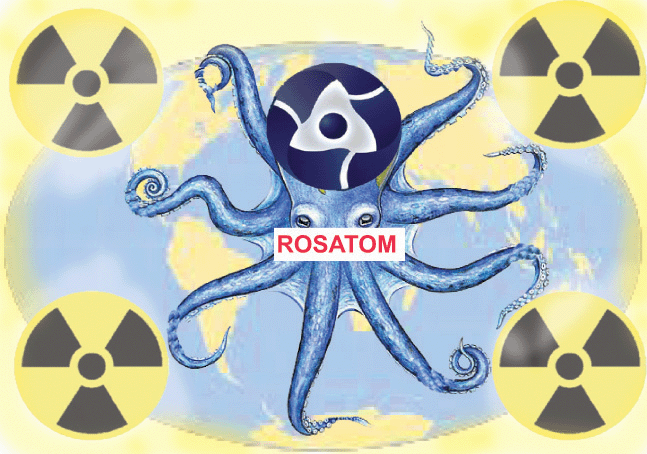
Rosatom, the self-regulated state nuclear enterprise, is led by a former prime minister reporting to President Vladimir Putin and exempted from all normal state controls. Independent experts agree that Rosatom (or any other state entity) would be lucky to build half the 30 additional nuclear projects it’s trying to sell for $300-billion to a dozen more countries including South Africa. Russia’s interest rate in early 2016 was twice (and in an earlier spike, over three times) what any coal-competitive nuclear project would require. The Russian state’s capacity to absorb the spread is quickly vanishing. Russia’s domestic reactor starts halved in 2015; all state nuclear subsidies are to halt in 2016. Yet without those subsidies, “Rosatom wouldn’t complete a single project anywhere”.
Russia needs huge amounts of outside capital to finance its nuclear commitments. …….
Not just Russian but any nuclear new-build is a poor choice for South Africa. It cannot compete with efficiency and renewables, by every relevant measure: cost, timeliness, financing, jobs, economic development, environmental and safety risk, independence, security, abundance of eternally free local energy sources, and the social good of “energy democracy”. These goals support and are advanced by the agenda of “an electricity sector that will deliver, transparently, competitively, reliably and sustainably, the electric services that will power economic growth and improve the welfare of all our people”.
It has come to this: ever more sales-starved nuclear vendors, seeking ever less solvent customers, now offer a risky project the seller can’t finance to a customer who can’t pay – a customer with no need, enchanted by the same nuclear devotees whose broken promises already cost the nation dearly, and with no apparent accountability.
Reporterrre 16th Feb 2018, Nuclear waste: the state must stop lying. Pointing out that the situation in which the nuclear industry has led France is particularly complicated.
Why ? Because, while the other countries exploiting nuclear energy have to manage only one type of waste, the spent fuels leaving highly radioactive reactors, France is engaged in the way of reprocessing, which leads to create five types of waste, as we explained in detail this week minor actinides; plutonium, the used MOx, reprocessed uranium, spent uranium
fuel.
The situation is further complicated because there are also graphite-gas fuels, depleted uranium, mine waste rock, and so on. But stay with these five types of waste, the most dangerous. As each has different radioactive and thermal characteristics, each calls for a particular solution.
In other words, while, for example, the United States or Sweden has to manage only one type of nuclear waste – and there is no solution to it – France has five headaches. instead of one. Honesty would be to recognize it, rather than make the public believe that there is ” nuclear waste ” and that it will be enough to bury it to solve the problem. https://reporterre.net/Dechets-nucleaires-il-faut-que-l-Etat-cesse-de-mentir
Reporterre 17th Feb 2018, The La Hague plant in the English Channel sees its nuclear waste storage
ponds approaching saturation. Concern is growing in the French nuclear industry, which is desperate for solutions to the different types of high-level radioactive waste it has accumulated for years. https://reporterre.net/Reporterre-sur-Radio-Suisse-A-La-Hague-rien-ne-va-plus
Reporterre 15th Feb 2018, The storage of radioactive waste in ” swimming pools ” is excessively dangerous: risk of breach, attack, dangerous transport, etc. France is one of the few countries that has not opted for dry storage, which is much safer. https://reporterre.net/Piscine-et-transport-de-dechets-nucleaires-ca-risque-gros
60 years ago, the Campaign for Nuclear Disarmament was founded. Here’s what we’ve achieved over the decades
Our core objective of UK nuclear disarmament remains as yet unfulfilled. But it is clear in retrospect how CND’s campaigning – and that of its international partners – has affected government policy and decision-making The Independent, UK, Kate Hudson@CNDuk 17 Feb 18, “………From its origins in local anti-testing groups – largely run by women concerned about hugely increased levels of radioactive strontium-90 in their children’s milk – CND burst onto the political scene 17 February 1958. Attempts to move Labour to an anti-nuclear position had failed in 1957, leading intellectuals and campaigners to take matters into their own hands, calling for a mass movement to defeat Britain’s bomb. The result was a meeting of thousands of people at Central Hall in Westminster, London, filled to overflowing………
The context of CND’s campaigns has changed continually: from the Cuban missile crisis to the war on Vietnam; from the height of the Cold War to détente; from the “evil empire” of Ronald Reagan to the end of the Cold War; from the aggression of Bush and Blair through to the great dangers presented by Trump and his plans for “usable” nuclear weapons.
Our work throughout has focused on changing government policy, using diverse – but always peaceful – methods: from the mass protests at Aldermaston and Greenham Common, to our central role in post 9/11 anti-war campaigning, to today’s struggle to prevent Trident replacement and win support for the United Nations’ global nuclear ban treaty.
Our core objective of UK nuclear disarmament remains as yet unfulfilled. But it is clear in retrospect how CND’s campaigning – and that of its international partners – has affected government policy and decision-making, both at home and internationally. Reading government documents and diaries years later, one can see how the pressure of public opinion and mass mobilisation really does have an impact, and each generation of CND has played a part in that. The banning of nuclear tests in the atmosphere is one very important example; another is the abandoning of the neutron bomb (designed to kill people while leaving property intact) or Nixon’s pulling back from using nukes on Vietnam.
Doctor Chris Busby dealing about the nuclear mud dumping issue in Wales, pointing the dangers of such project for the population’s health. The local politicians putting money over health.
Times 17th Feb 2018, EDF has claimed that a new nuclear reactor it is developing will be a
better and cheaper version of the two it is building in Britain. The
state-owned French energy group said that its “optimised” version of the
European Pressurised Reactor being installed at Hinkley Point in Somerset
would be unveiled in 2020 and was destined initially for the French market.
A spokeswoman said that the optimised reactor would be between 25 per cent
and 30 per cent cheaper than the existing version. It is scheduled to be
available for use from 2030. The newspaper Le Monde reported that the new
reactor could cost as little as 6 billion euros or £5.3 billion.
The cost of the two reactors due to come on stream at Hinkley Point in 2025 is
£19.6 billion. Any improvements in EDF’s reactors would raise more
questions about the sustainability of the Hinkley Point C project and
another power station at Sizewell, Suffolk.
However, British experts derided the announcement of an optimised and cheaper reactor as a sign of
the French company’s desperation. Paul Dorfman, founder of the Nuclear
Consulting Group, said EDF’s claim that costs could come down “goes against
all technological logic”. He dismissed the claim as a public relations
exercise to avert a plunge in EDF’s credit rating and as an attempt to woo
President Macron, who is strongly in favour of nuclear power. https://www.thetimes.co.uk/edition/business/edf-promises-nuclear-reactors-cheaper-than-hinkley-points-9nvq0crlq
Telegraph 16th Feb 2018, A rise in energy efficiency led to the biggest drop in UK electricity
consumption in three years for EDF. Both domestic and commercial customers
cut their electricity usage in 2017, leading to an overall drop of 1.9pc,
while gas consumption fell 2.6pc as milder weather meant customers used
their central heating less.
Domestic energy use has been in decline
nationally since 2010, despite a growing population and consumers using an
increasing number of electrical appliances. Successive regulations in
recent years, such as the phasing out of incandescent light bulbs, have
forced appliance manufacturers to make their products less wasteful.
Decades ago they witnessed nuclear weapons tests in the South Pacific. Now some veterans hope new DNA testing will prove it was responsible for their subsequent ill health, which they say ruined their lives.
“It was awe-inspiring, like another sun hanging in the sky. The blast bowled people over. A few men were on the ground screaming.”
(Picture is not of Bob Fleming. It is of Gomer Hickman)
Bob Fleming was wearing a T-shirt, khaki shorts and flip flops when the bomb went off.
At just 24, he had just witnessed one of the most powerful weapons on earth detonate on Christmas Island in the Pacific Ocean.
It was 1956 and the Cold War threat was growing.
The RAF serviceman was one of around 22,000 British service personnel who witnessed nuclear weapons tests on mainland Australia, the Montebello Islands off Western Australia and Christmas Island in the South Pacific between 1952 and 1958.
With their backs to the bomb, they felt the intense heat from the explosion first.
Then, after the countdown, they were ordered to turn round and look directly at the huge mushroom cloud in front of them.
“We had no protective clothing,” said Bob, who’s from Downham Market in Norfolk.
“We were guinea pigs. It was so bright I could see the bones in my hands with my eyes closed. It was like an X-ray.”
‘Genetic curse’
The veterans say the nuclear tests ruined their lives, causing cancers, fertility problems and birth defects passed down the generations.
Now 83, the great-grandfather believes that three generations of his family are living with the “genetic curse” of those explosions. Sixteen out of 21 of his descendants have had birth defects or health problems.
His youngest daughter, Susanne Ward, has thyroid problems and severe breathing difficulties, and her teeth fell out prematurely.
“It just gets worse as the next generation comes along. Our grandchildren have similar problems,” Suzanne said.
“My dad blames himself, but it isn’t his fault.”
The Fleming family now hope new DNA testing could end decades of uncertainty.Last week, the UK’s first Centre for Health Effects of Radiological and Chemical Agents was launched at Brunel University in London.One of its projects is a three-year genetic study looking for any possible damage to the veterans’ DNA caused by the tests.
Blood samples will be taken from 50 veterans who were stationed at nuclear test sites, and compared with a control group of 50 veterans who served elsewhere.
Blood will also be taken from their wives and any children they have together.
Dr Rhona Anderson, who is leading the study, said a major question to answer is whether “there is a genetic legacy of taking part at these nuclear tests”.
“If no differences (in the DNA) are seen between test and control groups then this will be reassuring for the nuclear community.”
‘No valid evidence link’
Fewer than 3,000 nuclear veterans are still alive today.
They cannot volunteer for the study, as that might lead to bias in the results.
Veterans will be selected using military service records and information available about those who were most at risk of exposure to radiation.
The Ministry of Defence says it is grateful to Britain’s nuclear test veterans for their service, but maintains there is no valid evidence to link participation in these tests to ill health.
The UK is the only nuclear power to deny special recognition and compensation to its bomb test veterans.
The veterans took their case for compensation to the highest court in the land and lost in 2012.
The Supreme Court Justices said the veterans would face great difficulty proving a link between their illnesses and the tests.
In 2015 the Aged Veterans’ Fund was set up by the government using bank industry fines. It will help to fund a series of social and scientific projects.
Doug Hern, who’s 81, and his wife Sandie, from Lincolnshire have been campaigning tirelessly for years.
When Doug was 21 he saw five nuclear explosions on Christmas Island and has suffered ill health ever since.
He said is skeleton is “crumbling”. He has skin problems and bone spurs.
His daughter died, aged 13, from a cancer so rare it did not have a name. He believes this was a consequence of her inheriting his “corrupted genes”.
Sandie Hern is vice-chair of the British Nuclear Test Veterans’ Association (BNTVA)
“The veterans have been treated abominably. They’ve been forgotten. We need this research to see if anything can be done to help their children,” she said.
The overall aim of the new centre at Brunel is to work closely with the veteran community to improve their health and well-being in the future.
After years of personal suffering, the Flemings want to have their DNA tested and are waiting to hear if they have been selected.
Six decades on, nuclear families are still living in the aftermath of the bomb tests, and searching for answers.
French energy major EDF has pledged to commence an “unprecedented acceleration” in renewable energy deployment having witnessed its UK nuclear revenues collapse in 2017.
This morning the firm published its annual results for 2017, announcing a 16% slide in core earnings before interest, tax, depreciation and amortisation (EBITDA) to €13.74 billion.
Starkest amongst EDF’s results is perhaps its performance in the UK. Earnings in the country fell by exactly one-third in organic terms, down to what EDF said was the “significant impact” of lower realised prices for its nuclear output.
While nuclear generation in the UK (63.9TWh) was only slightly down, a 12% slide in realised prices saw EDF’S UK earnings fall by almost £700 million.
Those results are unlikely to be well received by critics of EDF’s under-construction Hinkley Point C project, for which the government has entered into a 35-year Contracts for Difference at a strike price of £92.50/MWh. Including inflation, the current strike price for Hinkley Point C stands at £97.14/MWh.
But while nuclear might have encountered trouble in 2017, the same cannot be said for the group’s renewables outfit EDF Énergies Nouvelles. That division’s supply-based EBITDA climbed 8.5% to €741 million and Jean-Bernard Lévy, chairman and CEO at EDF, said the firm was beginning an “unprecedented acceleration in renewable energies”.
Similar to the UK, France is at a crucial juncture in its power generation. As many as 17 of its nuclear reactors are could switch off by 2025 and leader Emmanuel Macron has pledged to phase out coal-fired plants by 2021.
Late last year France announced plans to increase the solar capacity it tenders for annually from 1.45GW to 2.45GW as it looks to significantly increase its renewables stock.
NFLA 15th Feb 2018, NFLA report on UK National Policy Statement for new nuclear argues it is
‘not needed’ given existing energy efficiency measures and the growing
deployment of cheaper renewable energy alternatives are more effective. The
Nuclear Free Local Authorities (NFLA) publishes today its analysis of the
UK Government’s proposals to develop a new National Policy Statement
(NPS) for the deployment of new nuclear power stations. In its report NFLA
notes that changes in the electricity system have seen renewable energy
deployment rapidly taking place at the same time as its costs have come
down, and at the same time wider energy demand has significantly reduced
compared to government projections. http://www.nuclearpolicy.info/news/nfla-report-uk-national-policy-statement-new-nuclear-not-needed/
Radiation levels near this Siberian village were 1,000 times above normal last fall. But no one worried much, LA Times, By SABRA AYRES, FEB 16, 2018 sabra.ayres@latimes.com, KHUDAIBERDYNSK, RUSSIA “…. this Siberian landscape on the edge of the Ural Mountains bore the brunt of one of the world’s worst nuclear accidents. On Sept. 29, 1957, decades before Three Mile Island, Chernobyl and Fukushima entered the lexicon of landmark nuclear disasters, a buried cache of liquid radioactive waste from Mayak exploded. More than a quarter-million people were exposed to radiation, and nearly two dozen villages, home to more than 10,000 people, had to be vacated forever.
EDF UK profits hit by fall in sterling and nuclear prices https://www.theguardian.com/business/2018/feb/16/edf-uk-profits-hit-by-fall-in-sterling-and-nuclear-prices, Rob Davies, 17 Feb 18 Pound’s decline against euro costs French firm €608m as home energy usage also dropsFrench state-owned energy firm EDF reported falling profits, including a downturn in the UK due to falling prices for nuclear power, improved energy efficiency among its household customers and the slide in the value of sterling since the Brexit vote
Profits in the UK division, which includes EDF Energy, slumped by a third to €1.035 (£920m) as sales dwindled by €579m to €8.68bn, partly because UK customers pay their bills in pounds but the company reports its results in euros.
EDF said the decline of the pound against the euro had cost it €608m.
The company has faced criticism over delays and the cost of its £20bn Hinkley Point C nuclear power plant. However, it has blamed a 12% fall in nuclear energy prices in the UK, where it is the market leader.
Revenues were depressed by lower home energy consumption among customers, with usage falling 1.9% due to “milder weather and rising energy efficiency”.
EDF, which is majority-owned by the French government, reported a 2.2% decline in overall revenues to €69.6bn, with profits down 16% to €13.7bn, excluding the impact of asset sales.
It said group results had declined due to lower prices in almost all of the regions where it operates and an exodus of nearly 1 million customers.
It was also affected by lower nuclear and hydroelectric output in its domestic market, where it is the dominant supplier with more than 85% market share.
It lost 960,000 customers, shaving €341m off profits, blaming the exodus on heightened competition, including in the UK.
Chief executive and chairman Jean-Bernard Levy said the group’s profitability in the face of a “difficult market context” was evidence of EDF’s financial strength, adding that he expects a “rebound” in 2018.
He said the company would launch an “unprecedented” ramp-up of renewable energy this year, as France looks to reduce nuclear’s share of power generation from 75% to 50% by 2025.
WNN 17 Feb 18 US-based GE Hitachi Nuclear Energy (GEH) has been awarded a three-year contract to dismantle the reactor internals of units 1 and 2 at the Oskarshamn nuclear power plant in Sweden
Under a contract signed with plant operator OKG AB on 19 December, Wilmington, North Carolina-based GEH will segment the reactor pressure vessel internals of both units. The work includes dismantling, cutting and packing the reactor internals for final disposal.
Segmentation of the reactor internals of Oskarshamn 2 is scheduled to begin in January 2018, with that of unit 1 set for 2019. The segmentation project is expected to be completed by the beginning of 2020.
Lance Hall, executive vice president of GEH’s nuclear services business, said today: “This is a breakthrough project for us in the decommissioning space in Europe and we look forward to drawing upon the many resources of the ‘GE Store’, including the depth of the global supply chain of GE and the former Alstom power businesses to deliver superior safety and cost efficient performance for our customer.”…….http://www.world-nuclear-news.org/WR-GE-Hitachi-to-dismantle-Oskarshamn-units-0301174.html











 nuclear-news