The untold story of Algeria’s victims of French nuclear bomb tests
On February 13, 1960, France carried out its first nuclear test in Algeria’s southern Reggane region. According to official statistics, 17 nuclear tests were carried out in total over the next 6 years. The area remains affected, and local scientists say that radioactive contamination has caused genetic mutations and irreversibly changed the region.
There are no official statistics on the number of victims. The only figures can be found in the records kept by the French representative of the local church, which lists 42,000 victims of nuclear tests. Three years ago, the French Ministry of Defense issued a statement, putting the number at 27,000 people. The victims include French soldiers as well as local Algerians who lived in the surrounding areas.
However, these figures do not take into account the untimely deaths of the descendants of these people, who were affected by cancer and other nuclear radiation-related illnesses. To this day, the contaminated areas pose a danger to life and health.
A representative of the ‘Desert Detainees’ (a community of people who served sentences in prisons located in the desert regions of Algeria from 1992 to 1996), Nureddin Mauhub, said that many prisoners were exposed to radiation while serving their sentences in jails in the desert.
Nuclear engineer Ammar Mansuri told the newspaper Arabi al-Jadid, that in fact, there were more nuclear tests carried out in Algeria.
“France conducted 13 underground nuclear tests, 4 ground tests, 4 plutonium tests and 35 other tests,” he said.
According to him, the nuclear tests documentation was passed on to the Algerian government only 10 years ago.
Some of the documents are still classified. For these reasons, no systematic observations or studies have been conducted in the area in the past century. Therefore, no timely measures were taken to reduce the negative impact on the environment. It is difficult to say how the level of contamination has changed over the past decades and what to expect in the future.
The Algerian government claims that the contaminated area is more than 100 square km, according to the Al-Arabi al-Jadid website. However, problems aren’t limited to this exclusion zone. The desert winds carry contaminated particles to formally clean areas. There’s now a need to study the level of radiation in the desert to accurately determine the boundaries of the contaminated area.
A gigantic nuclear garbage pool for France: that is EDF’s dangerous plan

EDF plans to build a giant nuclear garbage pool in Belleville-sur-Loire instead of stopping producing unmanageable waste!http://www.sortirdunucleaire.org/EDF-projette-de-construire-une-piscine-poubelle February 13, 2018
On February 13, 2018, the Reporterre site revealed the new EDF project. In view of the prolongation of the operation of nuclear reactors and to unclog the four basins of the La Hague plant where used fuel is stored, the electrical firm wants to build a giant new “pool of deactivation” near the Belleville plant -sur-Loire (Cher). We strongly condemn this imposed, dangerous and expensive project. Rather than create a new trash, EDF must turn off the tap and dry up the production of unmanageable radioactive waste!
In France, spent fuel is stored in “deactivation pools” for the time needed to cool them (between 3 and 5 years). If each nuclear power plant has its own pool adjoining the reactor building, the La Hague plant (Manche) hosts 4 pools in which are immersed more than 10,000 tons of spent fuel, representing a hundred reactor cores waiting for a improbable “reprocessing”. Supposedly temporary, storage in these pools has been going on for 40 years. Consequences: the pools are full and the space is running out. Instead of starting a decline in spent fuel stocks by stopping the production of electricity from nuclear power, EDF is stubborn and plans to build an additional pool in Belleville-sur-Loire. But the experience of La Hague shows that the use of these pools goes hand in hand with disproportionate risks.
Vulnerable pools and potentially dramatic accidents The 4 cooling pools at the La Hague plant concentrate the largest volume of radioactivity in Europe. Belleville-sur-Loire could soon compete with this facility. Oversized, the giant basin that EDF plans to build in Belleville-sur-Loire could accommodate up to 8,000 tons of spent fuel, the equivalent of 93 cores of reactors.
This project is all the more worrying because EDF is never very concerned about the protection of the reactor deactivation pools it operates. Will the centralized Belleville pool be protected as recommended by nuclear safety authorities around the world since Fukushima? Nobody can say it. And the risk increases even if EDF chooses not to bunkerize the building that contains the pool, as is the case at the Orano factory in La Hague, where the basins are protected by a vulgar tin roof
… But even with a concrete hull, in the event of an accident, the amount of radioactivity released into the atmosphere would be incommensurate with the releases resulting from an accident in the core of a reactor: to concentrate in the same place such a quantity of radioactive material has intrinsic risks. And what about the dangers of transporting such large quantities of radioactive waste across France?
The Belleville-sur-Loire swimming pool project poses even more safety problems because it is supposed to house the assemblies of MOX – a mixture of uranium and plutonium oxides – a particular fuel that, when it is used, releases much more radioactivity than “normal” uranium assemblages. And since MOX can not be reprocessed or reused, temporary storage in this pool could well become permanent storage.
Finally, in normal operation, these pools are allowed to reject radioactivity. If a new bin of this kind were built, dangerous radioelements like tritium or krypton 85 would inevitably end up in the environment.
An opaque and expensive project EDF led this project with complete opacity. At the time Greenpeace submitted a report that points to the fragility and dangerousness of the 62 cooling pools scattered over the hex, EDF plans to build a 63rd, size XXL. Discussed on the sly, well protected from democratic choices and far from energy issues, the project was kept secret by EDF.
Once again, citizens and residents of the region are faced with a fait accompli. Still, the idea is in the pipes for a long time. Urged by ASN – which invited it in 2013 to “revise its spent fuel management and storage strategy, by proposing new storage methods” – EDF, to comply with the National Plan management of radioactive materials and waste, once again chose the worst option.For EDF and the promoters of the atom, the construction of such an installation is only one way of guaranteeing new outlets for a declining nuclear industry and of claiming to ensure the management of spent fuel for a new period.
The “Sortir du nucléaire” Network strongly denounces this project and, alongside the associations of the region, will resolutely oppose its implementation. In no case this pool is a “solution” to the problem of the accumulation of radioactive waste. In order not to generate new risks and to put the costs of a disproportionate installation on the citizens, the only solution is to dry up the production of this unmanageable waste. Press contacts: Martial CHATEAU: 06 45 30 74 66 Catherine FUMÉ: 06 62 84 13 88
USA’s B61 bombs in Europe serve no purpose, are a security liability, and cost $billions
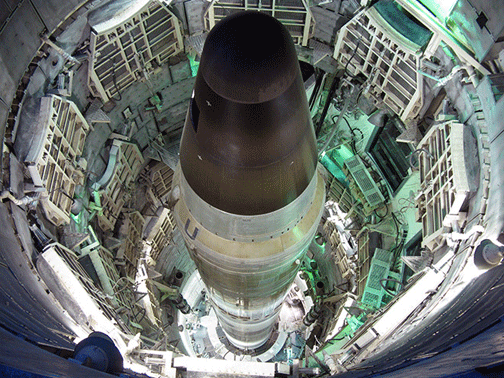 US wasting billions on nuclear bombs that serve no purpose and are security liability – experts https://www.theguardian.com/world/2018/feb/15/us-nuclear-bomb-risks-security-report
Washington to spend billions upgrading cold war era B61 bombs
NTI report says weapons are potentially catastrophic liability, Guardian. Julian Borger , 15 Feb 18,
A third of the B61 bombs in Europe under joint US and Nato control are thought to be kept at Incirlik base in Turkey, 70 miles from the Syrian border, which has been the subject of serious concerns.
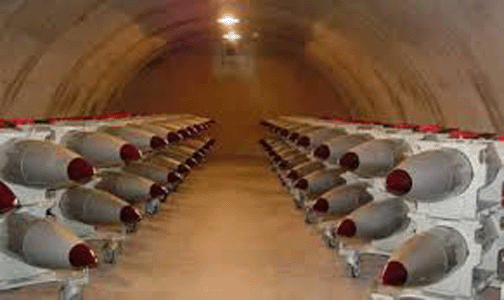
The threat to the base posed by Islamic State militants was considered serious enough in March 2016 to evacuate the families of military officers.During a coup attempt four months later, Turkish authorities locked down the base and cut its electricity. The Turkish commanding officer at Incirlik was arrested for his alleged role in the plot.
A report on the future of the B61 bombs by arms control advocacy group the Nuclear Threat Initiative (NTI) , and made available to the Guardian, said the 2016 events “shows just how quickly assumptions about the safety and security of US nuclear weapons stored abroad can change.”
Since then US-Turkish relations have soured further, largely over Washington’s support for Kurd forces in Syria. The national security adviser, HR McMaster, and secretary of state, Rex Tillerson, have both made trips to Turkey this week to try to heal the rift.
There have been reports that the bombs have been quietly moved out because of safety concerns, but that has not been confirmed.
The remaining B61 bombs are stored at five other locations in four countries: Italy, the Netherlands, Belgium and Germany, according to the Federation of American Scientists, which tracks the weapons. The NTI report said it “should be assumed that they are targets for terrorism and theft”.
The bombs are the remnants of a much larger cold war nuclear arsenal in Europe, and critics have said they serve no military purpose, as the nuclear deterrent against Russia relies largely on the overwhelming US strategic missile arsenal.
Using the B61s in any conflict would involve an agreement between the US and the host country in consultation with other Nato members.
“It is hard to envision the circumstances under which a US president would initiate nuclear use for the first time in more than 70 years with a Nato [dual-capable aircraft] flown by non-US pilots delivering a US B61 bomb,” said the NTI report, titled Building a Safe, Secure and Credible Nato Nuclear Posture.
Since the cold war, the B61 has played a symbolic role, as reassurance for some Nato members of US commitment to defending Europe. They are also considered potential bargaining chips against Russia’s much greater arsenal of nearly 2,000 tactical nuclear weapons.
However, the NTI report argues they are also serious liabilities, because of the threat of terrorism or accident, and because they could become targets in the early stages of any conflict with Russia.
“Forward-deployed US nuclear weapons in Europe increase the risk of accidents, blunders, or catastrophic terrorism and invite pre-emption. Given these added risks, it is past time to revisit whether these forward-based weapons are essential for military deterrence and political reassurance” the Obama administration’s energy secretary Ernest Moniz and former Democratic senator Sam Nunn, both NTI co-chairmen, argue in the preface to the report.
The Obama administration considered withdrawing the B61s from Europe as part of the president’s nuclear disarmament initiative but the idea lost support as relations with Russia deteriorated. Instead, the administration approved a Pentagon programme to upgrade the bombs over the next decade with a tailfin assembly to make them more accurate.
The plan has been embraced by the Trump administration’s nuclear posture review, despite the fact that the estimated cost of the 460 new model bombs, the B61-12, has doubled in recent years to $10bin, a part of a huge increase of overall defence spending.
Spent nuclear fuel processing at Mayak, Russia, may have caused radioactivity to spread across Europe
 Mishandling of spent nuclear fuel in Russia may have caused radioactivity to spread across Europe http://www.sciencemag.org/news/2018/02/mishandling-spent-nuclear-fuel-russia-may-have-caused-radioactivity-spread-across By Edwin Cartlidge
For 2 weeks in September and October last year, traces of the humanmade isotope ruthenium-106 wafted across Europe, triggering detectors from Norway to Greece and Ukraine to Switzerland. The radioactive cloud was too thin to be dangerous, containing no more than a few grams of material, but its origin posed an outsize mystery.
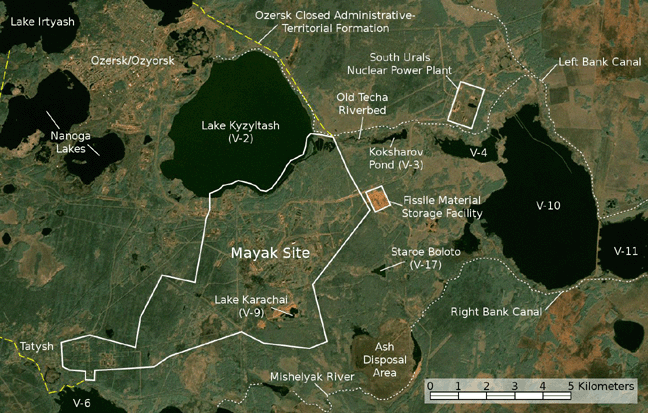
Now, scientists at the French Institute of Radioprotection and Nuclear Security (IRSN) in Paris say the isotope may have been released from the Mayak nuclear facility near Ozyorsk in southern Russia. IRSN argues that the leak could have taken place when Mayak technicians botched the fabrication of a highly radioactive component for a physics experiment at the Gran Sasso National Laboratory in L’Aquila, Italy.
The Russian government and state nuclear operator Rosatom have vehemently denied that an accident took place, however. Meanwhile, an international committee set up by the Russian Academy of Sciences’s Nuclear Safety Institute (IBRAE) in Moscow that met on 31 January is divided over the origins of the pollution.
Based on a computer model that used the air-sampling data and weather patterns, IRSN concluded in early October 2017 that the ruthenium most likely originated in the southern Urals; its German counterpart agreed. The French team went on to rule out a number of potential sources, including a mishap at a nuclear reactor. Such an incident would have spewed many other radioactive pollutants besides ruthenium.
The southern Urals are home to the secretive Mayak facility, the scene of one of the world’s worst nuclear accidents 60 years ago, and speculation soon turned to a possible accident at its reprocessing plant, which extracts isotopes from spent nuclear fuel. The IRSN report, made public on 6 February, says Mayak’s attempt to manufacture a capsule of cerium-144 destined for Gran Sasso “should be investigated” as a possible cause. Scientists at Gran Sasso needed the cerium for a search—now called off—for hypothetical particles called sterile neutrinos.
The estimated amount of radioactive ruthenium released could only have come from processing several tons of spent nuclear fuel, IRSN says. What’s more, the ratio of ruthenium-106 to the faster-decaying isotope ruthenium-103, detected in smaller amounts last autumn, reveals that the fuel must have been removed from its reactor only a year or two earlier. Spent fuel is normally cooled for up to a decade before it is reprocessed, so it seems the plant was preparing material for an application requiring high levels of radioactivity, IRSN says.
That fits the description of the sterile neutrino experiment at Gran Sasso, known as SOX and supported by Italy’s National Institute for Nuclear Physics (INFN) and the French Alternative Energies and Atomic Energy Commission. It required a source that was both extremely radioactive and very small, says SOX spokesperson Marco Pallavicini, a particle physicist at the University of Genoa in Italy. He says Mayak Production Association, the only company able to supply it, signed a contract in fall 2016 to produce a cerium capsule, expected to arrive in early 2018.
But in December 2017 the company stated it could not reach the desired radioactivity level. (“The Russians said absolutely nothing” about a radiation leak, Pallavicini says.) That meant SOX would lack the required sensitivity, and on 1 February, INFN announced it had axed the experiment, in what Pallavicini described as “a big blow” for scientists.
Jean-Christophe Gariel, IRSN’s director of health, says an uncontrolled temperature rise during the separation of cerium from the spent fuel at Mayak might have converted some of the ruthenium in the waste to gaseous ruthenium oxide. That gas would have escaped through the facility’s filters and solidified in the cool outside air, he says, turning into small solid oxide particles that could have wafted across Europe.
IBRAE Director Leonid Bolshov calls IRSN’s scenario “a good hypothesis,” but says it’s incorrect. For one thing, he says, the separation process never reached “the hot phase.” And in any case, he adds, “major operations” on the spent fuel at Mayak were done in late October 2017, after the ruthenium release. Bolshov says that a “rather rare meteorological event” might have transported the ruthenium from an as-yet-unidentified place to the southern Urals, from which it then appeared to spread.
Non-Russian members of IBRAE’s international panel, which is due to meet again in April, support IRSN’s conclusion that the southern Urals is the likely source of the leak, says IRSN physicist Jean-Luc Lachaume, a panel member, although some argue that the region is too large to pinpoint an exact location. Russian members claim the leak could have arisen “in the eastern part of the Russian federation,” Lachaume says. He says a representative of the Russian nuclear regulator Rostechnadzor who inspected Mayak in November 2017 told the panel that he saw no anomalies from a month earlier, but didn’t supply data to support that statement.
Princeton University physicist Frank von Hippel, a nonproliferation expert, says he doesn’t see “anything wrong with the IRSN analysis.” He notes that the amount of ruthenium-106 that the French team estimates was emitted—between 1 gram and 4 grams—matches the 30 grams of cerium-144 required for SOX, given that spent fuel contains the two isotopes in a ratio of about one to 14. And although the cloud over Europe was harmless, an accident at Mayak could mean that people living close by took in “potentially significant lung doses,” Von Hippel says.
How a nuclear submarine crashed into a tanker
Nuclear submarine commander ‘took eye off ball’ before collision
Justin Codd pleads guilty to negligently hazarding HMS Ambush during training course Guardian, 15 Feb 18, A senior naval officer in charge of teaching future submarine captains “took his eye off the ball”, leading his nuclear submarine to collide with a tanker, a court martial has heard.
Cdr Justin Codd, 45, was sentenced to forfeiting a year of seniority after pleading guilty at Portsmouth naval base to negligently hazarding the £1.1bn submarine HMS Ambush.
The Astute-class submarine was taken out of service for three months to undergo repairs costing £2.1m. ………https://www.theguardian.com/uk-news/2018/feb/15/nuclear-submarine-commander-admits-hazarding-ship-after-collision
Russia marketing nuclear power to Congo
 Russia and Congo to cooperate in nuclear power, WNN, 14 February 2018 Rosatom and the Ministry of Scientific Research and Technological Innovations of the Republic of Congo have signed a Memorandum of Understanding (MoU) on cooperation in the peaceful uses of nuclear energy.
The document was signed yesterday in Moscow by the Russian state nuclear corporation’s deputy director general for international relations, Nikolay Spassky, and the ambassador extraordinary and plenipotentiary of the Republic of the Congo in Russia, David Maduka.
The document establishes a legal basis for the implementation of bilateral cooperation in a wide range of areas, Rosatom said. These include the development of nuclear infrastructure in the Republic of Congo and programmes aimed at increased awareness of nuclear technologies and their applications…..http://www.world-nuclear-news.org/NP-Russia-and-Congo-to-cooperate-in-nuclear-power-14021801.html
Residents of Russia’s Yaroslavl region got a “false’ radiation alert scare
‘False’ Radiation Alert Causes Scare In Russia https://www.rferl.org/a/russia-yaroslavl-radiation-scare/29037176.html Residents of Russia’s Yaroslavl region got a scare when local TV and radio stations broadcast a radiation warning, but the Emergency Situations Ministry said the broadcast was a mistake.
The prerecorded warning, which aired at about 9 a.m., alerted residents to what it said were high levels of radiation in the atmosphere in the region 250 kilometers northeast of Moscow.
It advised people to protect themselves, tightly close their homes or offices and stay inside, and secure food and water from possible contamination by radiation.
In a statement, the regional branch of the Emergency Situations Ministry said that a technical glitch caused the “false” warning to be broadcast. It urged residents to “remain calm” and said radiation levels were “within the norm.”
In a short video statement, the senior regional emergency official, Yevgeny Shumilin, said the authorities were investigating what caused the message to be broadcast.
‘Men only’ attitude in decision-making is slowing Britain’s transition to clean energy
Lack of women in energy ‘holding back fight against climate change’
Gender imbalance at energy firms and industry events is slowing transition to greener power, claims expert, Guardian, Adam Vaughan, 13 Feb 18,
The lack of women in energy companies is holding back the sector’s efforts to tackle climate change, a leading industry watcher has warned.
Catherine Mitchell, a professor of energy policy at the University of Exeter, said poor gender diversity meant the industry was less open to new ideas, in particular the move to a lower-carbon energy system.
“I absolutely do think that the fact that the industry is so dominated by men and particularly older white men it is slowing down the energy transition,” said Mitchell, who has worked on energy issues for more than 30 years and advises the government, regulators and businesses.
An energy conference featuring women-only panels is being held next month to address the lack of visibility of female leaders in the sector……
The lack of women in energy companies is holding back the sector’s efforts to tackle climate change, a leading industry watcher has warned.
Catherine Mitchell, a professor of energy policy at the University of Exeter, said poor gender diversity meant the industry was less open to new ideas, in particular the move to a lower-carbon energy system.
“I absolutely do think that the fact that the industry is so dominated by men and particularly older white men it is slowing down the energy transition,” said Mitchell, who has worked on energy issues for more than 30 years and advises the government, regulators and businesses.
An energy conference featuring women-only panels is being held next month to address the lack of visibility of female leaders in the sector……. Some in the industry are making an effort to address the problem, such as the big six lobby group Energy UK, which has banned men-only panels at its events. “The energy sector is undergoing a huge period of transition, which brings with it a huge opportunity to increase gender balance,” said the group’s external affairs director, Abbie Sampson https://www.theguardian.com/business/2018/feb/11/the-energy-industrys-power-problem-too-few-women
Blow to Russia’s nuclear marketing ambitions – other investors back out of Turkey nuclear build
Bellona 12th Feb 2018, In a major blow to one of Russia’s most ambitious international nuclear
deals, three investors backed out of the Akkuyu Nuclear Power Plant,
leaving Russian state nuclear corporation Rosatom adrift on how to finish
the $20 billion station.
Russian President Vladimir Putin touted progress
on the plant as recently as November during a state visit to the Turkish
capital, and the Kremlin propaganda news network RT pushed the narrative
that the plant’s first reactor would be finished ahead of its scheduled
2023 launch date.
That was all thrown into doubt last week when a Turkish
consortium, representing 49 percent of the funding for the Akkuyu plant’s
construction, backed out of the deal, citing a failure to agree on a number
of project’s “commercial conditions,” Russian and Turkish news
outlets said. Rosatom is now in talks to secure other investors, but the
corporation wont’ say by how long the loss of half the project’s
financing will delay the station’s launch, or by how much the project’s
price tag is likely to increase as a result of the back out.
http://bellona.org/news/nuclear-issues/2018-02-investor-pullout-leaves-rosatom-at-sea-with-its-nuclear-project-in-turkey

France ‘s EDF plans for new central storage site for nuclear waste – no site chosen
 PARIS, Feb 13 (Reuters) – French EDF plans new central storage site for nuclear wast state-controlled utility EDF plans to build a new central storage pool for nuclear waste but has not yet decided on a site, the company said.
French environment news site Reporterre on Tuesday wrote that EDF plans to build a central spent-fuel pool on the grounds of its Belleville-sur-Loire nuclear plant, which could receive up to 8,000 tonnes of spent fuel, the equivalent of up to about 90 reactor cores.
Spent fuel from nuclear reactors remains highly radioactive for thousands of years and all countries using nuclear energy struggle with the question of where to store it safely…….
France has a project to store long-life nuclear waste 500 metres below ground in impermeable clay in Bure, eastern France, but the plan has not yet received government approval and is strongly opposed by local groups and environmentalists.
Meanwhile, the La Hague reprocessing site acts as a de facto nuclear waste storage site as France has no permanent solution for deep geological storage. (Reporting by Geert De Clercq and Benjamin Mallet; editing by Richard Lough)
West Somerset Council excluded from key Hinkley C nuclear meeting.
Bridgwater Mercury 12th Feb 2018, West Somerset Council not invited to key Hinkley C meeting. WSC was
‘unaware’ of a meeting in which the leader of Sedgemoor District
Council (SDC) travelled to Westminster to discuss uncertainty over Hinkley
C money with senior officials. Cllr Duncan McGinty met with MP Jake Berry,
parliamentary undersecretary for Housing, Communities and Local Government
to discuss the uncertainty surrounding ‘Community Benefit’ funding for
Sedgemoor and West Somerset from Hinkley C.
Councillor McGinty said: “It was a really positive meeting. Sedgemoor has taken the lead in raising this
issue at a national level. But while Hinkley C falls within West Somerset,
the district council was not invited to send a representative.
http://www.bridgwatermercury.co.uk/news/15988334.West_Somerset_Council_not_invited_to_key_Hinkley_C_meeting/
Swedish version of UK’s Radioactive Waste Management rejected by Swedish Environment Court

 Radiation Free Lakeland 10th Feb 2018, On the 23rd January 2018 the Swedish Environment Court gave the thumbs down
to the Swedish equivalent (SKB) of the UK’s quango Radioactive Waste Management (RWM previously Managing Radioactive Wastes Safely previously
NIREX) tasked with implementing Geological Dumping of nuclear wastes.
The Swedish court said it could not recommend that their Government agree the application for a Geological Disposal Facility (Nuclear Underground Dump) unless and until the industry can prove that the copper capsules that would contain the spent nuclear fuels would not leak.
Sweden and Finland are regularly put forward by RWM and the UK Government as the fore-runners of the ‘international consensus’ on deep waste repositories. Radiation Free Lakeland have sent a letter of thanks to the Swedish Court and a request to the Environment and Justice Ministers of Sweden that the Courts findings are upheld. We urge our own UK government to abandon the dishonest and dangerous plan for “Implementation” of Geological Disposal. https://mariannewildart.wordpress.com/2018/02/10/a-letter-of-thanks-to-the-swedish-environment-court-for-saying-no-to-geological-disposal-of-nuclear-wastes/
Lorraine Baldry new Chair of Advisory Council for UK’s Radioactive Waste Management (poisoned chalice to a woman?)
GDF Watch 10th Feb 2018, Radioactive Waste Management (RWM) have announced the appointment of
Lorraine Baldry OBE as Chair of their new Advisory Council. According to
RWM, “the Advisory Council will provide expertise, balanced perspective
and strategic support to RWM as it moves into a significant phase of its
programme to deliver a geological disposal facility. Its members, including
experienced leaders from a variety of business, engineering, infrastructure
and society backgrounds, will provide vital input to one of the most
complex and important long-term projects ever undertaken in the UK.”
Lorraine Baldry hails from the Financial Services sector, and is also
currently: Chair of the Central London Partnership, a non-profit
organisation that focuses on improving the working environment in central
London Chair of London & Continental Railways Limited, a property
development and land regeneration business within the railway and
infrastructure sectors Chair of Schroder Real Estate Investment Trust
Limited Independent Non-Executive Director at Thames Water She is an
Honorary Member of the Royal Institution of Chartered Surveyors (RICS), a
Past President of the British Property Federation, and was previously
Chairman of the London Thames Gateway Development Corporation.
http://www.gdfwatch.org.uk/2018/02/10/chair-announced-new-rwm-advisory-council/
Jeremy Corbyn commits to green energy, wants the national grid in public hands
 Times 11th Feb 2018, Bringing Britain’s energy system back under public ownership is the best
way of tackling climate change, according to Jeremy Corbyn. In his most
pro-green speech to date, the Labour leader said his government would sweep
away the “centralised system” of energy delivery by private firms in favour
of “new sources of energy large and small”.
Speaking yesterday at a conference in London on alternative models of ownership, Corbyn said: “The
greenest energy is usually the most local but people have been queuing up
to connect renewable energy to the national grid. “With the national grid
in public hands we can put tackling climate change at the heart of our
energy system, committing to renewable generation from tidal to onshore
wind.”
https://www.thetimes.co.uk/edition/news/nationalising-energy-grid-will-help-fight-climate-change-says-corbyn-z93xvqm50
What is Sellafield?
 Cumbria Trust 10th Feb 2018, Andrew Blowers OBE is Emeritus Professor of Social Sciences at The Open
University and is presently Co-Chair of the Department for Business, Energy and Industrial Strategy/NGO Nuclear Forum. This is one of a series of
articles drawn on his latest book, “The Legacy of Nuclear Power” (Earthscan from Routledge, 2017). The views expressed are personal.
What is Sellafield? Fundamentally, these days, it is the UK’s primary nuclear waste-processing, management and clean-up facility. Concentrated on a
compact site of 1.5 square miles is a jumble of buildings, pipes, roads, railways and waterways, randomly assembled over more than half a dozen decades, which together manage around two-thirds by radioactivity of all the radioactive wastes in the UK.
The Sellafield radioactive waste component includes all the high-level wastes (less than 1% by volume, over half the radioactivity) held in liquid form or stored in vitrified blocks, and half the volume of intermediate-level wastes (the other half being heldat various sites around the country). The nation’s radioactive waste is mainly held at Sellafield and there it must remain, at least until the programme of management and clean-up is concluded.
New production facilities such as for MOX or reprocessing are exceedingly improbable, theproposed new reactors at nearby Moorside are doubtful, and although a GDF, if one is ever developed, might yet be located in West Cumbria, Sellafield will for long be caretaker of the nation’s wastes. Where and when the undertaker will come to bury them remains unclear, and may remain so for the foreseeable future.
https://cumbriatrust.wordpress.com/2018/02/10/sellafield-britains-nuclear-heartland/
1 This Month

Cuba Is Not a Failed State – It Is a Besieged State
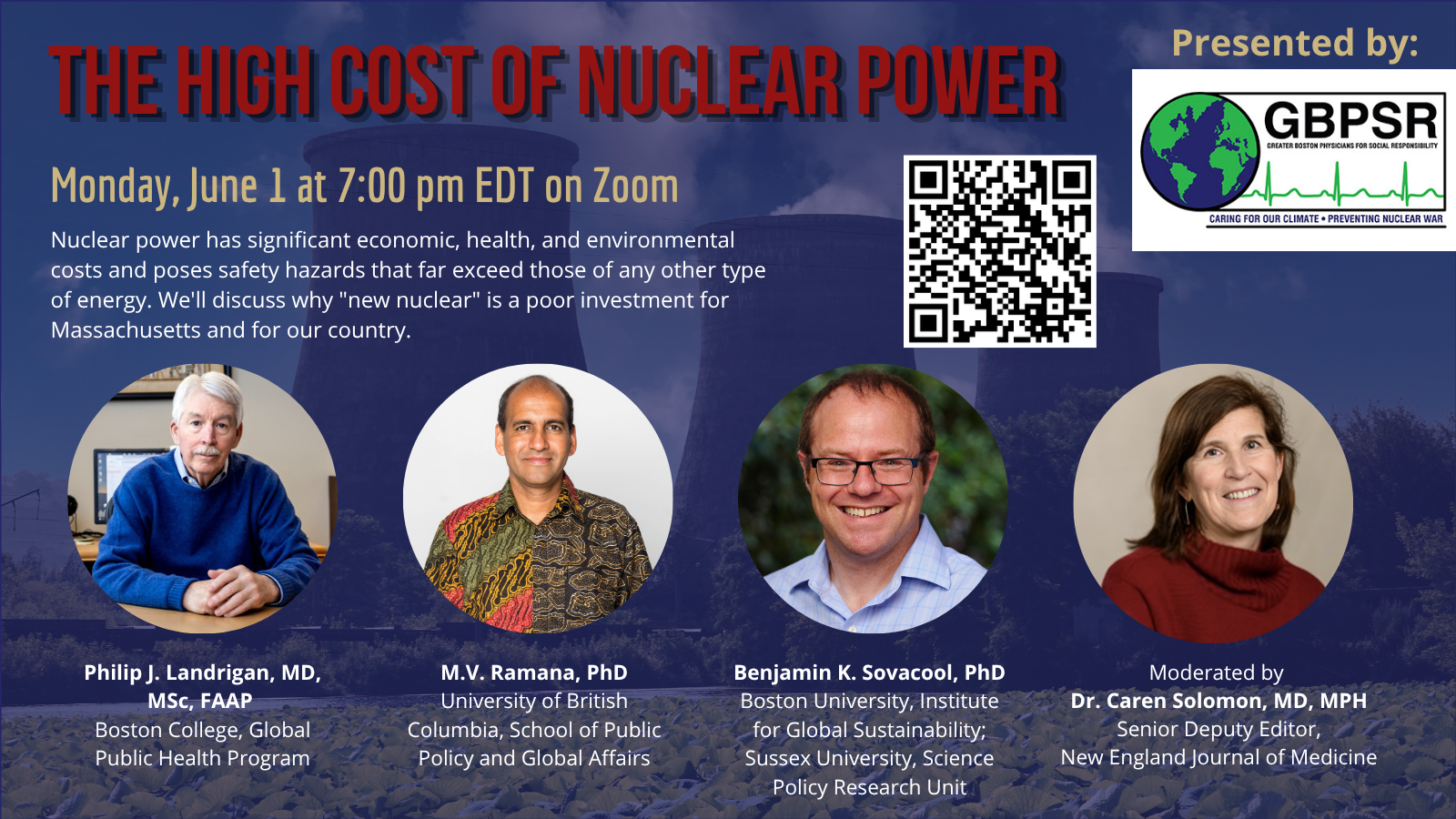
1 June Webinar – The High Cost of Nuclear Power – Register


of the week– Nuclear Reactor Information Task Force
To see nuclear-related stories in greater depth and intensity – go to https://nuclearinformation.wordpress.com
-
Archives
- May 2026 (272)
- April 2026 (356)
- March 2026 (251)
- February 2026 (268)
- January 2026 (308)
- December 2025 (358)
- November 2025 (359)
- October 2025 (376)
- September 2025 (257)
- August 2025 (319)
- July 2025 (230)
- June 2025 (348)
-
Categories
- 1
- 1 NUCLEAR ISSUES
- business and costs
- climate change
- culture and arts
- ENERGY
- environment
- health
- history
- indigenous issues
- Legal
- marketing of nuclear
- media
- opposition to nuclear
- PERSONAL STORIES
- politics
- politics international
- Religion and ethics
- safety
- secrets,lies and civil liberties
- spinbuster
- technology
- Uranium
- wastes
- weapons and war
- Women
- 2 WORLD
- ACTION
- AFRICA
- Atrocities
- AUSTRALIA
- Christina's notes
- Christina's themes
- culture and arts
- Events
- Fuk 2022
- Fuk 2023
- Fukushima 2017
- Fukushima 2018
- fukushima 2019
- Fukushima 2020
- Fukushima 2021
- general
- global warming
- Humour (God we need it)
- Nuclear
- RARE EARTHS
- Reference
- resources – print
- Resources -audiovicual
- Weekly Newsletter
- World
- World Nuclear
- YouTube
-
RSS
Entries RSS
Comments RSS
 nuclear-news