ASN 23rd Feb 2018 [Machine Translation] The ASN college questioned EDF and Framatome
(formerly Areva NP) about the deviations in the welding of the main steam
drainage pipes.
The first discrepancies were brought to the attention of
the ASN in early 2017. These pipes are affected by a so-called “rupture
exclusion” approach, which implies a strengthening of design, manufacturing
and service monitoring requirements. This reinforcement must be sufficient
to consider that the rupture of these pipes is extremely improbable.
It allows the operator not to fully study the consequences of a rupture of
these pipes in the safety demonstration of the installation. In order to
achieve the expected high quality of production, strengthened requirements
including mechanical properties were defined by the operator (EDF) and the
manufacturer (Framatome).
However, these reinforced requirements have not
been specified to the subcontractor in charge of producing the welds. The
controls carried out during manufacturing in the factory have shown that
they are not all compliant for certain welds. As a result of an ASN
inspection, this observation has been extended to other welds of these
pipelines made at the Flamanville site.
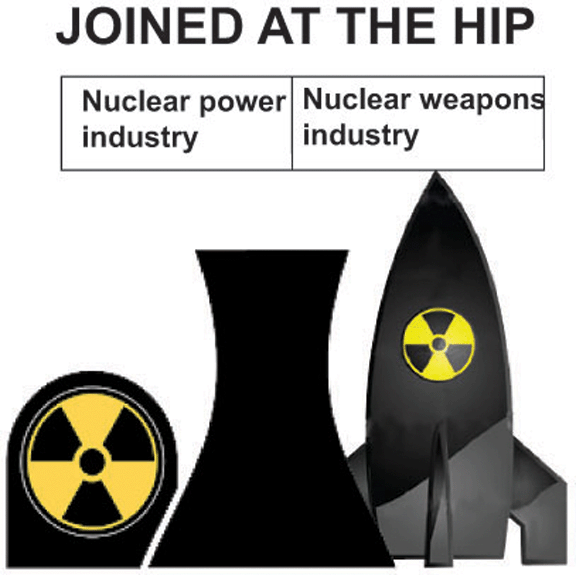
“MILITARY PLUTONIUM To be manufactured at Hinkley”
The charade of Atoms for Peace, Dr David Lowry , 23 Feb 18, “……Atoms for Peace ( in reality a cynical project promoting US global nuclear technology dominance launched by President Eisenhower at the UN in New York in December 1953) using a special atomic train taking nuclear scientists around the country promoting nuclear power.
But it was a charade. The first public hint came with a public announcement on 17 June 1958 by the Ministry of Defence, on: “the production of plutonium suitable for weapons in the new [nuclear ] power stations programme as an insurance against future defence needs…” in the UK’s first generation Magnox (after the fuel type, magnesium oxide) reactor.
A week later in the UK Parliament, Labour Roy Mason, who incidentally later became Defence Secretary, asked (HC Deb 24 June 1958 vol 590 cc246-8246) why Her Majesty’s Government had
“decided to modify atomic power stations, primarily planned for peaceful purposes, to produce high-grade plutonium for war weapons; to what extent this will interfere with the atomic power programme; and if he will make a statement.?” to be informed by the Paymaster General, Reginald Maudling
“At the request of the Government, the Central Electricity Generating Board has agreed to a small modification in the design of Hinkley Point and of the next two stations in its programme so as to enable plutonium suitable for military purposes to be extracted should the need arise.
The modifications will not in any way impair the efficiency of the stations. As the initial capital cost and any additional operating costs that may be incurred will be borne by the Government, the price of electricity will not be affected.
The Government made this request in order to provide the country, at comparatively small cost, with a most valuable insurance against possible future defence requirements. The cost of providing such insurance by any other means would be extremely heavy.”
The headline story in the Bridgwater Mercury, serving the community around Hinkley, on that day (24 June} was:
“MILITARY PLUTONIUM To be manufactured at Hinkley”
The article explained: “An ingenious method has been designed for changing the plant without reducing the output of electricity…”
CND was reported to be critical, describing this as a “distressing step” insisting
“The Government is obsessed with a nuclear militarism which seems insane.”
The then left wing Tribune magazine (on 27 June 1958) was very critical of the deal under the headline ‘Sabotage in the Atom Stations’:
“For the sake of making more nuclear weapons, the Government has dealt a heavy blow at the development of atomic power stations.
And warned:
“Unless this disastrous decision is reversed, we shall pay dearly in more ways than one for the sacrifice made on the grim alter of the H-bomb.”
Rosatom stakes out wind power to gird against blustery nuclear futures, Russia’s state nuclear corporation unveiled plans this week to build up to 600 megawatts of wind energy in the Krasnodar region in southern Russia in what appears to be part of the company’s tentative diversification within renewable energy. Bellona, by Charles Digges
“…….. the new wind farm and several battery production ventures the company is pursuing come as an evident bow to declining global demand for the nuclear power plant builds on which until recently the company had staked its future growth.
The new wind plant will be built by VetroOGK, a subsidiary of Rosatom, and will comprise a 150 megawatt park in the Shovgenovsky and Giaginsky districts of the southerly Republic of Adygea using equipment supplied by Dutch wind turbine maker Lagerwey, according to a Rosatom release. It expects to obtain construction permits for the project in March or April, while commissioning is scheduled for December 2018 or January 2019.
The VetroOGK had likewise inked a letter of intention to install another 200 megawatts of wind power in the Krasnodar Region at a wind park the company says it will open by the end of 2018. For the two parks Rosatom has invested $364 million, though its release also anticipates further funding for a 300 megawatt wind park in the Rostov Region, though the start date for that project remains unclear.
Though it would be a stretch to suggest that the wind projects could financially buoy the consolidated bulk of Russia’s monolithic nuclear monopoly, they nonetheless acknowledge sour facts about the company’s prospects for building its AES-2006, or VVER-1200, reactor package on the foreign market.
Speaking last summer at Novosibirsk’s Tekhnoprom-2017 technical trade conference, the company’s deputy director, Vyacheslav Pershukov said Rosatom’s international nuclear market was “exhausted” – the starkest acknowledgment yet from the company that its marquee product was selling poorly. …….
Czechs risk wrath of EU over nuclear power project, Prague is hoping Brussels will loosen its requirements for picking a nuclear project. Otherwise it may pursue a deal with Russia. Politico, By NICHOLAS WATSON, 2/23/18, PRAGUE — The Czech Republic looks set for a confrontation with the European Commission — and its anti-nuclear neighbors — over its ambitions to expand nuclear power.Prague wants to streamline a project to build a new reactor at the Dukovany nuclear power plant, 50 kilometers north of the Austrian border, to replace a Soviet-era reactor. That means persuading Brussels to exempt the project from strict EU rules on government bids.
If it fails, the Czech government is considering striking a nuclear deal with Russia along the same contentious lines as Hungary, which signed with Moscowlast year.
The second option would raise trouble for the Commission, which reluctantly approved Hungary’s Paks II nuclear project last year following long negotiations with Budapest. The decision was widely criticized for seeming to appeal to political interests over technical merits and is now being challenged by Austria for breaching EU state aid rules.
French nuclear watchdog raps EDF over Flamanville failings, Regulator says EDF must improve pre-startup testing, Orders EDF to send it report on weldings problems (Adds ASN comment on welding problems), By Geert De Clercq, PARIS, Feb 23 (Reuters) – French nuclear regulator ASN said it has told EDF to improve the running of the construction of the Flamanville nuclear reactor, which is years behind schedule and billions over budget.
The ASN has repeatedly said a schedule to load nuclear fuel at the EPR reactor in Flamanville, which is the same type as EDF is building in Britain’s Hinkley Point, by year-end is tight.
ASN said EDF must improve the follow-up of pre-startup test as well as the treatment of any flaws, and to improve the information flow to the regulator.
“EDF has promised to put in place an action plan to remedy these dysfunctions,” ASN said in a statement on Friday.
The ASN also said it had questioned EDF and Framatome, the company formerly called Areva, about flaws in the welding of the Flamanville reactor’s steam pipes.
………Any further delay to Flamanville would be another blow to the image of the EPR reactor. Three others have been under construction for years in Finland and China and are all over budget and schedule.
At the end of last year, Flemish nationalists spoke publicly against the withdrawal of nuclear power endorsed by the Energy Pact project that was designed by the country’s four ministers for energy on the basis of the cost for households and companies. The Plan Office and Professor Johan Albrecht have been asked to evaluate the cost evolution of power in Belgium in the years to come, taking various scenarios into consideration.
The extra cost for households would come to 15 euros plus VAT as of 2025, the planned date for the phasing-out of nuclear power. It includes the producers’ investment in gas power plants, the price of gas necessary for the production of electricity, as well as the federal government’s subsidies for plants. This figure, however, does not take into account the cost of the plants’ dismantlement or the nuclear waste reprocessing, and it only covers the expenses which fall within the federal competence. The support cost for the sustainable, therefore, is not included.
For the companies, the situation will be “slightly more complicated,” according to the minister. Discounts to be discussed with partners of the majority could be granted to companies competing with foreign offers, she indicated.
https://fr.reuters.com/article/africaTech/idAFL8N1QC7B5 Rédaction Reuters PARIS, Feb 22 (Reuters) – France has no need to build new nuclear reactors in addition to the one currently being assembled in Flamanville, in western France, Environment Minister Nicolas Hulot said on Thursday.
President Emmanuel Macron said last week he would not rule out France building new nuclear reactors to replace state-controlled utility EDF’s ageing reactors.
“For the moment, frankly, there is no need to consider building other nuclear reactors in addition to Flamanville,” Hulot told lawmakers.
Hulot said in November last year that reducing the share of nuclear energy in France’s power mix to 50 percent from 75 percent would probably take until 2030-35, dropping an initial 2025 target date.
Reporting by Simon Carraud; Writing by Matthias Blamont. Editing by Jane Merriman
New Power 22nd Feb 2018, The Office for Nuclear Regulation (ONR) has begun procuring a system to
track nuclear materials in the UK and ensure they are not diverted from
civilian uses, which will be required if, as planned, the UK exits the
Euratom treaty as it leaves the EU.
ONR said it has to develop and deliver a UK State System of Accountancy for and Control of Nuclear Material by 29
March 2019. It will include a Safeguards Information Management and
Reporting System that meets international reporting obligations. Without
the system, ONR said it will not be able to effectively deliver the
necessary nuclear materials accountancy.
It must be ready for parallel running by the end of December 2018 and go live by 29 March 2019. ONR has
published a procurement notice on the government’s digital marketplace
website. It says questions can be asked until 28 February and applications
must be made by midday on 7 March. The contract award is expected on 1 May
and by then the bidder must have security clearance for all personnel
involved. https://www.newpower.info/2018/02/onr-begins-procurement-to-replace-euratom-nuclear-safeguards-system/
Austria’s new government, an alliance between Chancellor Sebastian Kurz’s conservatives and the far-right Freedom Party, has pledged to continue Vienna’s decades-long policy of opposing nuclear power.
It said last month that it would file the legal challenge against the expansion of the Paks power plant situated near the border it shares with Hungary.
“We must take up this David-versus-Goliath struggle for the sake of our nature, our environment and our unique countryside,” the minister for sustainability and tourism, Elisabeth Koestinger, said in a statement on Thursday announcing the government had started the case.
“Nuclear energy has no place in Europe. We will not deviate from this line by even a centimeter.”
A spokesman for the EU executive said: “The Commission will defend its decision in Court.”
In March, EU state aid regulators approved Hungary’s plan to build two new reactors at its Paks nuclear site with the help of Russia’s Rosatom, saying Hungarian authorities had agreed to several measures to ensure fair competition.
The two new reactors will double the plant’s nominal capacity of 2,000 megawatts. Hungary aims to start construction on the reactors this year, with the first facility expected due to be completed in 2025.
In most complex cases of this kind, the Luxembourg-based European Court of Justice has found in favor of the Commission.
($1 = 0.7174 pounds)
Reporting by Francois Murphy; Additional reporting by Alissa de Carbonnel in Brussels; Editing by Alison Williams
MKG 20th Feb 2018,Translation into English of the Swedish Environmental Court’s opinion on
the final repository for spent nuclear fuel – as well as some comments onthe decision and the further process. The court said no to the application because it considered that there were problems with the copper canister that had to be resolved now and not later.
The translation shows the court’s judicial argumentation and why it decided not to accept the regulator
SSM’s opinion that the problems with the integrity of the copper canister were not serious and could likely be solved at a later stage in the decision-making process.
The main difference between the court’s and the regulator’s decision-making was that the court decided to rely on a multitude of scientific sources and information and not only on the material provided by SKB.
Irish Examiner 21st Feb 2018,Yesterday’s announcement of a public consultation on the UK’s planned
Hinkley Point C nuclear power station, less than 250km from Rosslare is, to
a degree, reassuring but entirely welcome.
It is a victory of sorts for campaigners who worked tirelessly to have Irish voices heard in the
process. Those groups insist our Government should have opened a
consultation five years ago as is required under international conventions.
The victory may seem facile as construction is under way at Hinkley, a
€23bn project expected to be operational in five years.
The real value of the decision is that it means Irish concerns may influence decisions around
the other five nuclear plants in Britain’s planning pipeline. This
recognition will be especially important in post-Brexit Britain as the writ
of EU nuclear administrators will no longer prevail. https://www.irishexaminer.com/breakingnews/views/ourview/nuclear-consultation-irish-concerns-will-be-heard-828994.html
An Taisce 20th Feb 2018,An Taisce Welcomes Public Consultation UK Hinkley Point C, Nuclear Power
Plant. The (Irish) Government has today launched public consultations on the UK’s Hinkley Point C, nuclear power station, 5 years after it should have under UN Conventions.
The UK Government is building a nuclear power station, Hinkley Point C, on the north coast of Somerset, some 150 miles
(~242 km) from Ireland’s East Coast. Charles Stanley-Smith, An Taisce’s Communication Officer stated “These consultations have been hard won through court cases and escalation to the compliance committees of two
UNECE conventions on consultation rights and obligations.
This is the hard work of An Taisce, The Environmental Pillar and Friends of the Irish Environment and German MEP Ms Sylivia Kotting-Uhl” He continued “The peoples’ rights to these consultations will become increasingly important
in our ability to address transboundary impacts of UK projects on our environment, health and economy, into the future.
Under UN Conventions, the peoples of neighbouring countries that could be affected by a project need
to be consulted. Post Brexit, we may not be able to rely on EU law to safeguard us, but these are UN conventions For instance, the Irish people will now need to be consulted in terms of any other 5 proposed nuclear
power station on the UK’s west coast” http://www.antaisce.org/articles/an-taisce-welcomes-public-consultation-uk-hinkley-point-c-nuclear-power-plant
Centrica to cut 4,000 jobs and sell UK nuclear holdings Beleaguered British Gas owner, lost 1.4 million customers last year The Week, UK Feb 22, 2018
Centrica, the owner of British Gas, is cutting 4,000 jobs and sellings its nuclear holdings amid plummeting profits and customer numbers.
The energy supplier says group profits across operations in the UK, Ireland and North America fell by 17% to £1.25bn for the year ended December 2017. ……..
Centrica, which lost a total of 1.4 million customer accounts last year, is also looking to sell its stake in Britain’s nuclear power stations by 2020. The company bought a 20% share in Electricite de France SA’s UK nuclear operations in 2009 as an investment. This stake is to be divested, “subject to ensuring alignment with our partner and being sensitive to Government interests”, Centrica said in a statement. ……http://www.theweek.co.uk/centrica/91834/centrica-to-cut-4000-jobs-and-sell-uk-nuclear-holdings
The interior ministry announced the evacuation after it was underway, with scores of police in body armor moving in before daylight to evict activists occupying the zone, backed up by an earthmover.
The plan to store long-life nuclear waste 500 meters below ground in impermeable clay has not yet got government approval and is strongly opposed by local groups and environmentalists.
President Emmanuel Macron’s government is keen to prevent a proliferation of such protester-occupation movements following one that lasted year at a site earmarked for a new airport near Nantes in the west of France – a building plan it dropped last month.
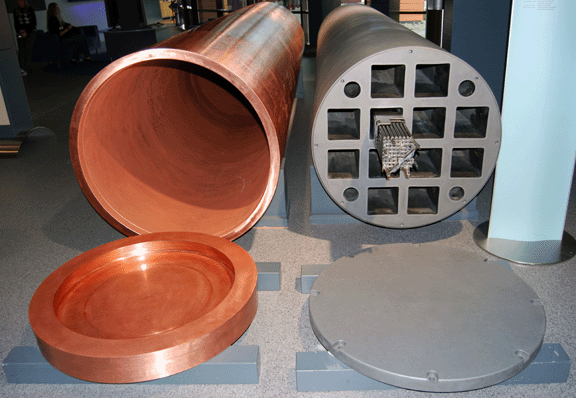
Last month Cumbria Trust reported that the Swedish Environmental Court had blocked a licence application to construct a GDF for spent nuclear fuel after serious concerns were raised over the corrosion of the copper canisters used in the KBS-3 method. The same containment method is intended to be used in the UK. This court ruling was a success for MKG, the Swedish environmental organisation which receives government funding to act as a critical friend, scrutinising Sweden’s plan to bury nuclear waste.
MKG have now released some further details which show that the corrosion concerns are shared by experts within the Swedish regulator, SSM. While the nuclear industry, including the UK’s Radioactive Waste Management (RWM) seem keen to minimise the significance of this court ruling, by describing it as a delay and a request for more information, it appears the problem may be more fundamental, and could lead to this method of KBS-3 copper encapsulation being abandoned. This would damage the UK’s search process.
A key assumption with the KBS-3 method is that copper does not corrode in anoxic conditions, that is without the presence of oxygen. While there will be oxygen present at first, once the canisters are placed within the bentonite clay, bacteria and chemical processes consume the oxygen, creating the desired anoxic environment. However, it is becoming increasingly clear that even without oxygen, the copper begins to corrode by pitting. The heat generated by the spent fuel appears to be a significant factor in accelerating this pitting process. These capsules were intended to remain intact for a million years, but tests have suggested that they may well fail much sooner.
The significance of the problem goes well beyond this encapsulation method. There are lessons that should be learned, but the question is whether the nuclear industry will be open enough to do so. One key lesson is that funding a critical friend NGO such as MKG, can help to identify problems and reduce the impact of groupthink which leads to irrational decision-making. Another appears to be that we are prone to over-confidence in engineering. Isolating nuclear waste from the surface for a million years, particularly waste types which produce a great deal of heat, is complex. While we can test potential containment methods for around a generation, we need to be confident that these methods will continue to work for 30,000 generations.
“There is only one form of containment for liquids and gases which has been demonstrated to work for millions of years, even under great pressure, and that is geological formations. We have a vast quantity of evidence from the oil and gas industry of rock formations which have isolated hydrocarbons from the surface for many millions of years. So while Cumbria Trust continues to support the principle of geological disposal, as potentially the least bad solution to an existing problem, the key to its success must be the geology in which it is constructed.”
Any search process for a GDF site must begin with suitable geology and the failed attempts in Cumbria have concluded that the search should move to an area of simple geology and low groundwater flow. Cumbria Trust fears that the selective blindness which has led to the previous failures of the search process, will result in another attempt to target Cumbria despite its complex geology.










 nuclear-news