nuclear-news

The News That Matters about the Nuclear Industry Fukushima Chernobyl Mayak Three Mile Island Atomic Testing Radiation Isotope

  • Home
  • 1 This Month
  • ACTION !
  • Disclaimer
  • Links
  • PAGES on NUCLEAR ISSUES

No climate change leadership at G20 summit, and Trump is a disruptive disaster

The Guardian view of the Osaka G20 summit: bad as he is, Trump is not the only problem, Editorial, Guardian 268 June 19 The climate crisis underlines the need for effective global economic leadership. The US president makes this harder, but so do China and several others.Ever since the G20 of leading global economies was founded, its summits have mostly been convergent occasions, marked by attempts to find common ground and remembered for nothing more unseemly than a bit of jostling among the heads of government to be on the front row of the group photograph. Japan’s prime minister Shinzō Abe clearly takes this traditional view about the G20 summi twhich he will host in Osaka on Friday and Saturday. “We want to make it a meeting that focuses on where we can agree and cooperate rather than highlighting differences,” he said recently.

But there is a balloon-puncturing problem with Mr Abe’s approach, and it answers to the name of Donald Trump. If there is one issue on which this year’s summit clearly ought to be showing global leadership, it is the climate crisis. The subject is indeed on the Osaka agenda but, in spite of efforts by countries including France, there is no prospect of serious or effective action. That is no surprise from a group of nations which almost tripled the subsidies they gave to coal-fired power plants between 2013 and 2017, with China, India and Japan itself leading the way. But it is Mr Trump’s decision to walk away from climate accords and to back fossil fuels that creates the wider permission for these other terrible derelictions.

Mr Trump’s disruptions do not end there. The US president uses these gatherings not to build alliances to solve common problems but to knock his adversaries – and sometimes his supposed allies – off their stride. He is not looking for general agreement, which he thinks is for wimps. He is looking for American advantage over friend and foe. That’s the reason why the summit is already overshadowed by the increasingly serious trade war between the United States and China (Mr Trump will have an all-smiles bilateral with Xi Jinping on Saturday). And it is certainly the reason why Mr Trump has used the run-up to Osaka to have a pop at his hosts, whom he claimed would respond to an attack on the US by watching it “on a Sony television”, attacking India for raising tariffs and then, inventing false figures, berating Germany as a “security freeloader”.

Since Mr Trump’s Friday schedule involves one-on-ones with Mr Abe, India’s Narendra Modi and Germany’s Angela Merkel, it seems these mind games are part of a deliberate strategy of disruption. This is not a novel conclusion. Mr Trump used the same approach before his recent visit to Britain, when he praised Boris Johnson and attacked Sadiq Khan and the Duchess of Sussex. If Mr Johnson becomes prime minister and Britain were to back off from supporting European opposition to the White House’s Iran strategy, Mr Trump would count this a job well done.

Mr Trump’s bullying is also selective. Among the world leaders whom Mr Trump has not attacked in advance – but with whom he will also be meeting in Osaka bilaterals – are Vladimir Putin of Russia, whose country systematically interfered in the 2016 US election, and Mohammed bin Salman of Saudi Arabia, who has just been accused by the United Nations of orchestrating the murder and dismemberment of the opposition journalist Jamal Khashoggi……… https://www.theguardian.com/commentisfree/2019/jun/27/the-guardian-view-of-the-osaka-g20-summit-bad-as-he-is-trump-is-not-the-only-problem

June 29, 2019 Posted by Christina Macpherson | climate change, Japan, politics international | Leave a comment

Get your fax right: Tepco workers accidentally spark Japan nuclear scare

b-tepco-a-20190621-870x569.jpg
The No. 6 reactor at Tokyo Electric Power Company Holdings Inc.’s Kashiwazaki-Kariwa nuclear plant, seen here, has remained shut for years amid a protracted safety vetting by the regulators.
June 20, 2019
Tokyo Electric Power Company Holdings Inc. (Tepco) employees sparked a nuclear scare after a violent, late-night earthquake by ticking the wrong box on a fax form — inadvertently advising authorities that an accident had occurred when it had not.
The workers at Tepco, operator of the Kashiwazaki-Kariwa nuclear plant in Niigata Prefecture where the strong quake struck, faxed a message to local authorities Tuesday night, seeking to allay any fears of damage.
But the Tepco employees accidentally ticked the wrong box on the form, mistakenly indicating there was an abnormality at the plant rather than that there was no problem.
One official filled out the form, and it was checked by a colleague before being sent.
Many government departments and companies in Japan still rely on fax machines for communication.
Tepco’s Tokyo headquarters noticed the mistake and a correction was published 17 minutes after the original release, the firm’s Tokyo-based spokesman said.
The mayor of Kashiwazaki city, Masahiro Sakurai, saw the incorrectly filled-out form and immediately directed staff to check what was happening.
The mayor hit out at Tepco, which also operates the Fukushima No 1 nuclear plant that suffered a catastrophic disaster when an earthquake and tsunami struck in 2011, the worst nuclear accident since Chernobyl.
“When a real earthquake is happening, not a drill, this is a massive error,” Sakurai told local reporters, according to the Mainichi Shimbun daily.
“It is extremely poor on their part to make errors in the most important and basic information at a time of crisis,” he said, according to the Asahi Shimbun newspaper.
Tepco apologized and vowed not to repeat the mistake.
The late-night quake prompted a tsunami advisory, but only small ripples of 10 centimeters (three inches) were recorded.
The government said up to 26 people were injured — two seriously, although their injuries were not life-threatening.
https://www.japantimes.co.jp/news/2019/06/20/business/corporate-business/get-fax-right-tepco-workers-accidentally-spark-japan-nuclear-scare/?fbclid=IwAR3dG4EqbDSyvaVngNjWsMJJ6XZY2JNwgiD5zhSjp5jod_zeuTA1jjsfx8Q#.XQ0HWMhKiUk

June 27, 2019 Posted by dunrenard | Japan | Kashiwazaki-Kariwa NPP, Scare | Leave a comment

Court rejects call to revoke approval for nuclear reactor restarts

_w850.jpg
Kyushu Electric Power’s Sendai nuclear power plant
June 18, 2019
FUKUOKA – A district court said Monday it had found no illegality in safety clearance granted for two nuclear reactors in southwestern Japan that restarted after the 2011 Fukushima crisis, dismissing a demand by local residents and others seeking retraction of the permission.
A total of 33 plaintiffs filed the lawsuit over a license issued by regulators for design changes to the Nos. 1 and 2 units at Kyushu Electric Power Co’s Sendai nuclear power plant in Kagoshima Prefecture, under tougher post-Fukushima safety regulations.
The two units were the first to restart among the commercial reactors that went offline in the wake of the nuclear disaster. The plaintiffs argued regulators gave the green light without sufficiently assessing the potential risk of eruptions at nearby Mt Aso in Kumamoto Prefecture and four other volcanoes.
But, in the first ruling of its kind, the Fukuoka District Court concluded the license issued by the Nuclear Regulation Authority was not illegal.
“Japanese laws on nuclear power do not go so far as requiring (regulators) to consider the impact of a catastrophic volcanic eruption that is impossible to predict and highly unlikely to occur,” Presiding Judge Moriharu Kurasawa said.
But Kurasawa acknowledged there were some “doubts” over the NRA’s volcanic risk assessment standard, given that methodology to accurately assess volcanic activity is yet to be established.
The plaintiffs, from a total of 10 prefectures, are considering appealing the ruling. Kyushu Electric said it viewed the ruling as “appropriate” and will continue to work to ensure the safety of the reactors.
During the trial, authorities said the rules were rational based on the latest analysis and there was nothing wrong with the approval process.
The plaintiffs, meanwhile, argued it is difficult to predict exactly when an eruption could occur and how big it could be, and the current safety standards on volcanoes underestimate their impact.
“It is regrettable,” Ryoko Torihara, a 70-year-old plaintiff from Kagoshima Prefecture, said after the ruling, adding, “The lessons of the nuclear accident (in Fukushima) have not been learned.”
Another plaintiff said, “The frequency of a catastrophic eruption may be low, but it could happen tomorrow. I’m very disappointed that the ruling appears to be just following (what) the state (wants to do).”
While the government is aiming to bring reactors back online after the triple reactor core meltdown at the Fukushima Daiichi complex led to a nationwide halt of nuclear plants, a number of lawsuits have been filed in the hope of stopping the drive.
The Nos. 1 and 2 reactors at the Sendai plant were rebooted in August and October 2015, respectively, after securing the license in September 2014.
A suit demanding an injunction to halt the Sendai reactors was rejected by the Kagoshima District Court in April 2015, a decision upheld by the Miyazaki branch of the Fukuoka High Court in April 2016.
Volcanic hazards have been a major concern in regard to nuclear plant operations, with similar injunction requests filed elsewhere.
The Hiroshima High Court in December 2017 halted the planned restart of the No. 3 unit at Shikoku Electric Power Co’s Ikata plant in Ehime Prefecture with a provisional injunction, citing the potential hazard from Mt Aso, around 130 kilometers away.
But the court later accepted an appeal by the utility to reactivate the reactor, saying worries over a volcanic eruption damaging the unit were “groundless.”
The Saga District Court in March 2018 rejected local residents’ demand to suspend the planned restart of two reactors at Kyushu Electric’s Genkai plant in Saga Prefecture due to the risk of a volcanic eruption in the region.
https://japantoday.com/category/national/court-rejects-call-to-revoke-approval-for-nuclear-reactor-restarts?

June 27, 2019 Posted by dunrenard | Japan | Safety Clearance, Sendai NPP | Leave a comment

Hundreds of evacuees and their children continue to suffer from effects of Fukushima nuclear meltdown

‘Fukushima suffering continues’  https://www.churchtimes.co.uk/articles/2019/21-june/news/world/fukushima-suffering-continues 
by HATTIE WILLIAMS, 21 JUNE 2019  Eight years since the disaster, NSKK calls for nuclear-free world   
EIGHT years after the Fukushima nuclear disaster, hundreds of evacuees and their children continue to suffer from debilitating conditions, Anglican priests told an International Forum for a Nuclear-Free World held in Sendai, Japan, last week.

The Tohoku earthquake, in 2011, triggered a tsunami which caused explosions at the Fukushima Daiichi Nuclear Power Plant, in Okuma, leading to widespread radioactive contamination and serious health and environmental effects (News, 25 March 2011).

The disaster is estimated to have caused the deaths of about 1600 people out of the 300,000 who were evacuated from the area

The forum was organised by the Nippon Sei Ko Kai (NSKK) — the Anglican Communion in Japan — whose General Synod passed a resolution in 2012 calling for an end to nuclear-power plants. A joint statement from the forum, due next month, is expected to encourage churches to join the call for a worldwide ban on nuclear energy, the Anglican News Service reports.

The chair of the forum’s organising committee, Kiyosumi Hasegawa, said: “We have yet to see an end to the damage done to the people and natural environment by the meltdown of TEPCO’s Fukushima Daiichi Nuclear Power Plant.

“This man-made disaster will haunt countless people for years to come. We still see numerous people who wish to go back to their home towns, but are unable to. We also have people who have given up on ever going home.”

The week-long conference at Christ Church Cathedral, Sendai, was attended by bishops, clergy, and lay representatives from each NSKK diocese, as well as representatives from the US Episcopal Church, USPG, the Episcopal Church of the Philippines, the diocese of Taiwan, and the Anglican Church of Korea.

The general secretary of the Sendai Christian relief network Touhoku HELP, Dr Naoya Kawakami, whose church was affected by the tsunami, said: “I have been more than 700 times to meet with more than 180 mothers and about 20 fathers, all of whom have seen abnormalities in their children since 2011. . . Thyroid cancer has been found in more than 273 children, and many mothers are in deep anxiety.”

An NSKK priest, the Revd John Makito Aizawa, said: “Both religiously and ethically, we cannot allow nuclear-power plants to continue running. They produce deadly waste, which we have no way of processing into something safe. More than 100,000 years are necessary for the radiation of such deadly waste to diminish to the level that it was in the original uranium. This alone is a strong enough reason to prohibit nuclear-power plants.”

The partners-in-mission secretary for NSKK, Paul Tolhurst, said: “Driving past the power station and seeing the ghost town around us as the Geiger-counter reading kept going up is something I won’t forget. It was like the town time forgot: they still seem to be living the incident, while the rest of Japan has moved on.”

The forum’s statement is expected to call for a goal of conversion to renewable sources of energy, and set out ways in which a network can be built to take forward denuclearisation.

June 24, 2019 Posted by Christina Macpherson | health, Japan, social effects | Leave a comment

No Damages to Nuclear Plants after 6.8 Magnitude Earthquake ‘according’ to TEPCO and Trade Ministry

11705323_10153168606128772_5226099635899106471_n.jpg
No Damages To Nuclear Power Plants Reported After Earthquake In Japan – Trade Ministry
June 18, 2019
No damages have been reported so far on Japan’s nuclear power plants after the north of the country got hit by a 6.8 magnitude earthquake on Tuesday, the Japanese Ministry of Economy, Trade and Industry said
MOSCOW (UrduPoint News / Sputnik – 18th June, 2019) No damages have been reported so far on Japan’s nuclear power plants after the north of the country got hit by a 6.8 magnitude earthquake on Tuesday, the Japanese Ministry of Economy, Trade and Industry said.
“There is no information of damage inflicted on the following Nuclear Power Stations (all in shutdown or in decommissioning). Tokyo Electric Power: Kashiwazaki-Kariwa Nuclear Power Plant / Fukushima Daiichi Nuclear Power Plant / Fukushima Daini Nuclear Power Plant, Tohoku Electric Power: Higashidori Nuclear Power Plant / Onagawa Nuclear Power Plant,” the ministry said on Twitter.
https://www.urdupoint.com/en/world/no-damages-to-nuclear-power-plants-reported-a-648020.html
 
No impact from the earthquake on primary TEPCO power facilities
June 19, 2019
At around 10:22 PM on June 18th, a 6.7 magnitude earthquake struck off the coast of Yamagata Prefecture, Japan.
Field patrols at the Kashiwazaki-Kariwa, Fukushima Daiichi and Fukushima Daini nuclear power stations did not find any abnormalities with equipment at any of the stations. And, no abnormalities were found in monitoring post or plant parameter data.
There was also no impact from this earthquake on other primary TEPCO power facilities, such as hydroelectric power facilities and transmission facilities in Niigata Prefecture.
https://www7.tepco.co.jp/newsroom/press/archives/2019/no-impact-from-the-earthquake-on-primary-tepco-power-facilities.html

June 20, 2019 Posted by dunrenard | Japan | Earthquake, nuclear plants | Leave a comment

Japan: 6.8 magnitude earthquake – bungled report causes unnecessary nuclear scare

QUAKE SHOCK Japan earthquake – Tsunami warning lifted after 6.8-magnitude tremor strikes near nuclear power plant and sparks power cuts, The Sun By Jon Lockett18 Jun 2019  JAPAN has lifted an emergency tsunami warning after a 6.8-magnitude undersea earthquake struck near a huge nuclear power plant.Thousands of families lost electrical power and bullet train services were suspended on Tuesday, but there were no reports of serious injuries or damage.

Initial reports of waves crashing against the shore held chilling echoes of the Fukushima nuclear plant disaster – sparked just 80 miles away after it was hit by monster waves.

Tsunami warnings were issued for the Yamagata, Niigata and Ishikawa regions.

But only a minor swelling of the sea was observed in several cities about half an hour after the earthquake struck, 53 miles northeast of the island of Honshu…….

Bullet train service was suspended in parts of the region because of power outages and for safety checks. About 9,000 households in Yamagata and Niigata lost power, according to Tohoku Electric Power Co.

All seven reactors at the Kashiwazaki-Kariwa nuclear plant in Niigata were off line and no abnormalities were reported. Two other nuclear power plants in the affected region were also intact, according to the Nuclear Regulation Authority…….https://www.thesun.co.uk/news/9318581/japan-earthquake-tsunami-warning/

Get your fax right: Bungling officials spark Japan nuclear scare,  https://phys.org/news/2019-06-bungling-japan-nuclear.html  Bungling Japanese officials sparked a nuclear scare after a violent, late-night earthquake by ticking the wrong box on a fax form—inadvertently alerting authorities to a potential accident.

Employees of the Tokyo Electric Power Company (TEPCO), operator of the Kashiwazaki-Kariwa nuclear plant in Niigata—where the 6.4-magnitude quake struck—faxed a message to local authoritiesseeking to allay any fears of damage.

But TEPCO workers accidentally ticked the wrong box on the form, mistakenly indicating there was an abnormality at the plant rather than there was no problem.

One official filled out the form, and it was checked by a colleague before being sent.

Many Japanese government departments and companies still rely on fax machines for communication.

TEPCO’s Tokyo headquarters noticed the mistake, and a correction was published 17 minutes after the original release, the firm’s Tokyo-based spokesman told AFP.

Kashiwazaki city mayor Masahiro Sakurai saw the incorrectly filled-out form and immediately directed staff to check what was happening.

The mayor hit out at TEPCO, which also operated the crippled Fukushima nuclear plant—site of the worst nuclear accident since Chernobyl—when an earthquake and tsunami struck in 2011.

“When a real earthquake is happening, not a drill, this is a massive error,” Sakurai told local reporters, according to the Mainichi Shimbun daily.

“It is extremely poor on their part to make errors in the most important and basic information at a time of crisis,” he said, according to the Asahi Shimbun newspaper.

TEPCO apologised and vowed not to make the same mistake.

The late-night quake prompted a tsunami advisory, but only small ripples of 10 centimetres (three inches) were recorded.

The government said up to 26 people were injured—two seriously, although not life-threatening.

June 20, 2019 Posted by Christina Macpherson | Japan, safety | Leave a comment

AECOM signs agreement with Toshiba to perform nuclear decommissioning services in Japan

2e06cfbce5e4a7082db0d1eafb5e1328.jpg
The signing of the collaboration agreement. From left to right: Dan Brouillette, Deputy Secretary, U.S. Department of Energy; Mark Whitney, Executive Vice President and General Manager for AECOM’s Nuclear & Environment strategic business unit; Goro Yanase, Chief Nuclear Officer, Toshiba ESS; and Taizo Takahashi, Commissioner, Agency for Natural Resources and Energy (ANRE).
June 17, 2019
LOS ANGELES–(BUSINESS WIRE)–
The partnership will expand access to the key Asian market that is valued at $50 billion and further underscores AECOM’s leading nuclear decontamination and decommissioning capabilities
AECOM (ACM), a premier, fully integrated global infrastructure firm, and Toshiba have signed an Alliance Agreement to work together on decommissioning nuclear reactors in Japan. This is a major step forward that combines AECOM’s 30 years of experience in nuclear decommissioning with Toshiba’s long history of supporting the nuclear industry. The alliance will offer comprehensive services to Japanese government organizations and commercial power utilities that plan to decommission their reactors and nuclear facilities.
This press release features multimedia. View the full release here: https://www.businesswire.com/news/home/20190617005844/en/
“We are proud to be in an Alliance with such a respected company and excited about marketing our collective capabilities to the Japanese government and utilities,” said Michael S. Burke, AECOM’s chairman and chief executive officer. “We believe this Alliance has the right experience, capabilities, skill mix and resources to meet the needs of this nuclear cleanup market. We have had tremendous success in nuclear decommissioning for the U.S. Department of Energy and the UK’s Nuclear Decommissioning Authority, as well as commercial clients around the world, and we look forward to supporting the Japanese utilities through this Alliance.”
AECOM is the market leader in the U.S. and U.K. for managing high-hazard, complex nuclear decommissioning programs. This includes work for the U.S. Department of Energy at key sites, such as Hanford, Savannah River, Oak Ridge and the Waste Isolation Pilot Plant. AECOM also is a leader in the U.K. decommissioning market with major contracts at the Nuclear Decommissioning Authority facilities at Dounreay and the Low Level Waste Repository. Including the Company’s work for commercial nuclear utilities, such as at the San Onofre Nuclear Generating Station in Southern California, AECOM is viewed as a world leader in this expanding clean-up market. Combining AECOM‘s expertise with the local knowledge and capabilities of Toshiba, the Company can expand the full range of required decommissioning services to Japan.
“We are excited to partner with Toshiba and further expand our expertise in the nuclear D&D market,” said John Vollmer, AECOM’s president of its Management Services group. “In addition to our ongoing work at key U.S. Department of Energy sites and our recent selection for the $400 million Dounreay decommissioning framework, our teams have demonstrated a high level of success as we continue to expand our share within this high-growth market.”
Within the nuclear decommissioning sector, AECOM provides program management; planning, design and engineering; systems engineering and technical assistance; construction and construction management; operations and maintenance; environmental remediation; waste management and decommissioning, dismantling and closure services to a broad range of clients.
About AECOM
AECOM (ACM) is built to deliver a better world. We design, build, finance and operate critical infrastructure assets for governments, businesses and organizations. As a fully integrated firm, we connect knowledge and experience across our global network of experts to help clients solve their most complex challenges. From high-performance buildings and infrastructure, to resilient communities and environments, to stable and secure nations, our work is transformative, differentiated and vital. A Fortune 500 firm, AECOM had revenue of approximately $20.2 billion during fiscal year 2018. See how we deliver what others can only imagine at aecom.com and @AECOM.
https://finance.yahoo.com/news/aecom-signs-agreement-toshiba-perform-200500799.html

June 19, 2019 Posted by dunrenard | Japan | decommissioning, Toshiba | Leave a comment

NRA safety license for Sendai reactors legal, Fukuoka court finds, dismissing volcano risk lawsuit

nader-258-slider.jpg
 
“The plaintiffs argued the Nuclear Regulation Authority gave the green light without sufficiently assessing the potential risk of eruptions at nearby Mount Aso in Kumamoto Prefecture and four other volcanoes.”
June 17, 2019
FUKUOKA – A district court said on Monday it found nothing illegal with a safety clearance granted to two reactors in Kyushu that were restarted after the 2011 Fukushima nuclear crisis, dismissing a demand for a retraction filed by plaintiffs who said it ignored the risk of volcanic eruptions.
The lawsuit was filed by 33 plaintiffs against a license authorizing design changes at reactors 1 and 2 at the Sendai nuclear power plant in Kagoshima Prefecture under tougher post-Fukushima safety regulations.
They were the first commercial reactors in the nation to be restarted after the crisis.
The plaintiffs argued the Nuclear Regulation Authority gave the green light without sufficiently assessing the potential risk of eruptions at nearby Mount Aso in Kumamoto Prefecture and four other volcanoes.
In the first ruling of its kind, the Fukuoka District Court concluded the license issued was not illegal.
“Japanese laws on nuclear power do not go so far as to require that regulators consider the impact of a catastrophic volcanic eruption that is impossible to predict and highly unlikely to occur,” Judge Moriharu Kurasawa said.
But Kurasawa acknowledged there were “doubts” over the NRA’s standard for volcanic risk assessment, given no methodology exists for accurately assessing volcanic activity.
Kyushu Electric Power Co. described the ruling as “appropriate,” but the plaintiffs, who came from 10 prefectures, said they might appeal.
During the trial, authorities said that the rules were rational based on the latest analysis and that there was nothing wrong with the approval process.
The plaintiffs argued it is difficult to predict exactly when an eruption could occur and how big it could be, and said current safety standards underestimate their impact.
“It is regrettable,” plaintiff Ryoko Torihara, 70, of Kagoshima Prefecture said after the ruling. “The lessons of the nuclear accident have not been learned.”
Another plaintiff said, “The frequency of a catastrophic eruption may be low, but it could happen tomorrow. I’m very disappointed that the ruling appears to be just following (what) the state (wants to do).”
While the government is aiming to bring dozens of reactors back online after the triple reactor core meltdown at the Fukushima No. 1 complex led to a nationwide suspension of nuclear power, a number of lawsuits have been filed to stop the drive.
The two reactors at the Sendai plant were rebooted in August and October 2015, respectively, after the license was issued in September 2014.
A suit demanding an injunction to halt them was rejected by the Kagoshima District Court in April 2015, a decision that was upheld by the Miyazaki branch of the Fukuoka High Court in April 2016.
Volcanic hazards have been a major concern in regard to nuclear plant operations, with similar injunction requests filed elsewhere.
The Hiroshima High Court in December 2017 halted the restart of the No. 3 unit at Shikoku Electric Power Co.’s Ikata plant in Ehime Prefecture with a provisional injunction, citing the potential hazard from Mount Aso, around 130 km away.
But the court later accepted an appeal by the utility to reactivate it, saying worries over a volcanic eruption damaging the unit were “groundless.”
In March 2018, the Saga District Court rejected a demand by residents to suspend the restart of two reactors at Kyushu Electric’s Genkai plant in Saga Prefecture due to the risk of a volcanic eruption in the region.
https://www.japantimes.co.jp/news/2019/06/17/national/nra-safety-license-sendai-reactors-legal-fukuoka-court-finds-dismissing-volcano-risk-lawsuit/?fbclid=IwAR1BnyDlrtlis4lvjLtCUlmGvvfdGln8xBlQdsUJ57DSDMTMlbghTrwr4_w

June 19, 2019 Posted by dunrenard | Japan | NRA, Sendai NPP | Leave a comment

G20: Japan proposes framework for nuclear waste,
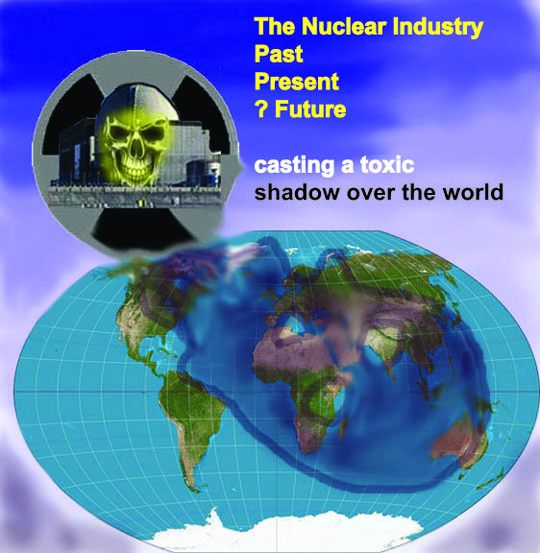
G20: Japan proposes framework for nuclear waste,   https://www3.nhk.or.jp/nhkworld/en/news/20190616_14/   Japan has used the G20 meeting to propose setting up an international framework for cooperative research into how to dispose of high-level radioactive waste from nuclear power plants.

The Group of 20 energy and environment ministers are in the town of Karuizawa, Nagano Prefecture, for the second and final day of their meeting.

Japan’s industry minister, Hiroshige Seko, chaired a session on energy in the morning. He brought up the idea of the international framework.

He said it is important to share experience and knowhow to accelerate efforts to solve a common issue for countries that use nuclear energy.

Many countries have found it difficult to draw up concrete plans for final waste disposal. Only Sweden and Finland have decided on disposal sites.

Many nations, including Japan, have not even begun studying potential sites.

The proposal calls for countries to share what they are doing regarding the selection of disposal sites and to promote cooperation and the exchange of human resources.

The first meeting on the framework is planned for October in France.

Ministers are expected to issue a joint statement on Sunday after the conclusion of the G20 meeting.

June 17, 2019 Posted by Christina Macpherson | Japan, wastes | Leave a comment

Japan’s restarted nuclear reactors could be forced to shut down for safety measures to be implemented

World Nuclear News 13th June 2019 Nuclear power reactors in Japan that have resumed operation could be forced
to temporarily shut down again if back-up safety measures are not in place
by specified deadlines under new rules approved by the country’s Nuclear
Regulation Authority (NRA). Operators of restarted units have already said
they expect delays in the completion of such facilities.

http://www.world-nuclear-news.org/Articles/Safety-upgrade-delays-could-take-Japanese-units-of

June 15, 2019 Posted by Christina Macpherson | Japan, politics, safety | Leave a comment

Prime Minister Shinzo Abe pretending that all is well at Fukushima, using this lie to promote Olympics.
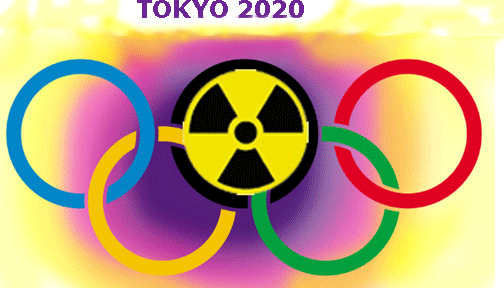
Abe pushing idea that Fukushima nuclear disaster is ‘under control’,  http://www.asahi.com/ajw/articles/AJ201906110001.html   THE ASAHI SHIMBUN, 10 June 19 Without special protection against radiation, Prime Minister Shinzo Abe stood on elevated ground about 100 meters from the three melted-down reactors at the Fukushima No. 1 nuclear power plant.

“I was finally able to see the view just wearing a normal suit without having to wear protective clothing and a mask (for radiation),” he said on April 14 after hearing explanations from Tokyo Electric Power Co. officials. “The decommissioning work has been making progress in earnest.”

An act of bravado, perhaps. But it was more likely one of the ways Abe and his government want to show that the Fukushima disaster is, as he famously said, “under control.”

Progress has been made, albeit slowly, for the monumental task of decommissioning TEPCO’s crippled nuclear plant.

But radiation levels in certain areas of the plant are still lethal with extended exposure. The problem of storing water contaminated in the reactors continues.

And only recently was TEPCO able to make contact with melted nuclear fuel in the reactors through a robot. The means to extract the fuel has yet to be decided.

However, the government keeps touting progress in the reconstruction effort, using evacuee statistics, which critics say are misleading, to underscore its message.

Abe’s previous visit to the nuclear plant was in September 2013.

“When I conducted an inspection five years ago, I was completely covered in protective gear,” he said at a meeting with decommissioning workers in April. “This time I was able to inspect wearing a normal suit.”

Officials in Abe’s circle acknowledged that they wanted to “appeal the progress of reconstruction” by letting the media cover the prime minister’s “unprotected” visit to the site.

His visit in a business suit was possible largely because the ground was covered in mortar and other materials that prevent the spread of radioactive substances, not because decommissioning work has lowered radiation levels as a whole.

The radiation level at the elevated inspection ground still exceeds 100 microsieverts per hour, making it dangerous for people who remain there for extended periods.

Abe’s inspection ended in six minutes.

The prime minister raised eyebrows, particularly in Fukushima Prefecture, in 2013 when he gave a speech to promote Tokyo’s bid to host the 2020 Summer Olympics.

Concerning the Fukushima nuclear plant, he told International Olympic Committee members, “Let me assure you, the situation is under control.”

An hour before he inspected the plant in April, Abe attended the opening ceremony of the new government building of Okuma, one of the two towns that host the nuclear plant.

The ceremony followed the lifting of an evacuation order for part of the town on April 10.

“We were able to take a step forward in reconstruction,” Abe said.

The central government uses the number of evacuees to show the degree of progress in reconstruction work.

In April 2018, Abe said in the Diet that the lifting of evacuation orders has reduced the number of evacuees to one-third of the peak.

According to the Reconstruction Agency, the number of people who evacuated in and outside of Fukushima Prefecture, including those who were under no orders to leave, peaked at about 160,000. But the initial evacuation orders for 11 municipalities in Fukushima Prefecture have been gradually lifted, and the agency now puts the total number at about 40,000.

About 71,000 people were officially registered as residents of areas that were ordered to evacuate. Now, only about 11,000 people live in those zones.

This means that about 60,000 people have not returned to the homes where they were living before the nuclear accident unfolded in March 2011.

The gap of 20,000 can be attributed to how the agency classifies or declassifies evacuees.

NOT COUNTED AS EVACUEES

The Reconstruction Agency sent a notice in August 2014 to all prefectures that have counted the number of evacuees.

It defined “evacuees” as people who moved to different places because of the nuclear disaster and have the “will” to return to their original homes.

The notice also said that if it is difficult to perceive their “will,” they can be regarded as people who have ended their evacuation if they bought new homes or made arrangements for new accommodations.

Based on the notice, people in Fukushima Prefecture who have bought new homes during their evacuation or settled down in public restoration housing or disaster public housing are regarded as living “stable” lives and are not counted as evacuees.

“It is not a problem because we continue supporting them even if they are removed from the evacuee statistics,” a prefectural government official said.

An official of the Reconstruction Agency said, “The judgment is made by each prefecture, so we are not in a position to say much.”

However, the prefecture has not confirmed all evacuees’ will to return to their homes. In addition, those who are removed from the list of evacuees are not informed of their new status.

Many people bought homes in new locations during their prolonged evacuations although they still hope to return to their hometowns in the disaster area.

Yumiko Yamazaki, 52, has a house in Okuma in a “difficult-to-return” zone.

But because she moved to public restoration housing outside of the town, she is not considered an evacuee by the agency and the prefecture.

“I had to leave my town although I didn’t want to,” Yamazaki said. “It is so obvious that the government wants to make the surface appearance look good by reducing the number of evacuees.”

“I can’t allow them to try to pretend the evacuation never happened,” Yamazaki said.

Critics say the central government’s emphasis of positive aspects and the downplaying of inconvenient truths in the evacuee statistics have much in common with its response to the suspected nepotism scandals involving school operator Moritomo Gakuen and the Kake Educational Institution.

June 11, 2019 Posted by Christina Macpherson | Japan, secrets,lies and civil liberties, spinbuster | Leave a comment

Japan’s government plans more nuclear energy, and of course increased pile of plutonium wastes

Japan plans carbon emission cuts, more nuclear energy   http://www.asahi.com/ajw/articles/AJ201906100044.html

THE ASSOCIATED PRESS, June 10, 2019  Japan is calling for further efforts to cut its carbon emissions by promoting renewable energy while also pushing nuclear power despite its 2011 Fukushima nuclear plant disaster.

An energy policy paper, adopted by the Cabinet on Friday, said Japan faces the urgent task of reducing carbon emissions by utilities that rely heavily on fossil fuel plants to make up for shortages of cleaner nuclear energy. The call comes as nuclear reactors around Japan are slowly being restarted–despite lingering anti-nuclear sentiment since the Fukushima crisis–after being shut down to meet tougher safety standards.

Japan wants renewable energy’s share in 2030 to grow to 22-24 percent of the country’s power supply from 16 percent, while pushing nuclear energy to 20-22 percent from just 3 percent in 2017. The report said the cost of renewables also needs to be reduced.

Japanese utilities rely more heavily on fossil fuel plants than those in the United States and Europe, the paper said. Coal and natural gas accounted for 74 percent of Japan’s energy supply.

Nuclear energy made up about one-third of Japan’s energy supply before 2011, when a massive earthquake and tsunami destroyed the Fukushima No. 1 nuclear power plant’s cooling systems, sending three of its reactors into meltdowns.

Despite the government’s renewed ambitions for nuclear power, reactor restarts are proceeding slowly as nuclear regulators spend more time on inspections under the stricter post-Fukushima standards, while utility companies have opted to scrap aged reactors instead of investing in additional safety measures.

Nearly half of the 54 reactors in Japan have been designated for decommissioning, and only nine have resumed operation since the accident.

The slow reactor restarts have added to Japan’s large plutonium stockpile from spent fuel. Japan has resorted to reducing the 47-ton stockpile by burning plutonium in conventional reactors after the country’s fuel recycling program stalled. The plutonium is currently enough to produce about 6,000 atomic bombs.

But the amount is not decreasing, and experts are now calling for more drastic steps to reduce the stockpile amid criticism that it makes Tokyo’s calls for nuclear non-proliferation less credible.

About 37 tons of spent Japanese fuel is being stored in France and Britain where it has been reprocessed since Japan lacks the capability to do it at home.

Japan’s main reprocessing plant at Rokkasho, where plutonium and spent fuel are stored but reprocessing has not started, says the 10 tons stored in Japan is under close monitoring by the International Atomic Energy Agency and there is no risk of proliferation.

In a recommendation to the government this week, the Sasakawa Peace Foundation, a Japanese policy research group, said Japan should drastically reduce the stockpile to the amount just enough for 2-3 years and keep it under IAEA oversight to ensure the international community of Tokyo’s commitment to peaceful atomic use.

The recommendation by a foundation panel goes far beyond government guidelines last year that put the cap at 47 tons, with a pledge to eventually reduce it at an unspecified rate.

June 11, 2019 Posted by Christina Macpherson | Japan, politics | Leave a comment

Pro-nuclear incumbent Shingo Mimura wins fifth term in Aomori gubernatorial election

Distance from Fukushima to Aomori is 342 kilometers northward. This air travel distance is equal to 213 miles. Those people haved learned nothing from their Fukushima neighbors.
n-aomori-a-20190603-870x662
Aomori Gov. Shingo Mimura (center) raises his hands in the city of Aomori on Sunday after being predicted to win Sunday’s gubernatorial election
June 3, 2019
AOMORI – Shingo Mimura, a pro-nuclear incumbent, won his fifth term in the Aomori gubernatorial election on Sunday, stressing his past achievements and focusing away from the area’s involvement in the country’s nuclear fuel recycling policy during campaigning.
 
Mimura, 63, backed by the local chapter of the ruling Liberal Democratic Party and its coalition partner, Komeito, defeated 65-year-old dentist Wakako Sahara, who was supported by opposition parties.
 
The incumbent garnered 329,048 votes, against 105,466 votes collected by Sahara. Voter turnout stood at 40.08 percent.
 
The prefecture hosts a cluster of nuclear facilities, including an incomplete plant in Rokkasho where spent uranium fuel will be reprocessed for recycling.
 
During the 17-day official campaigning, Mimura touted his role in having expanded agricultural exports and promoted administrative reforms, while mostly avoiding discussion of the controversial nuclear policy.
 
Aomori Prefecture received about ¥20 billion in nuclear fuel tax income from nuclear facility operators in fiscal 2017, accounting for about 11 percent of the prefecture’s annual tax revenue.
 
A person involved in Mimura’s campaign said there were many residents in Aomori Prefecture who did not want the nuclear issue to be the focus of the election as they financially benefit from having the fuel recycling facilities there.
 
Sahara, who opposes nuclear power generation, criticized Mimura for promoting the central government’s nuclear power policy, but was unable to gain broad support from voters.
https://www.japantimes.co.jp/news/2019/06/03/national/politics-diplomacy/pro-nuclear-incumbent-shingo-mimura-wins-fifth-term-aomori-gubernatorial-election/?fbclid=IwAR2afdceeYOges92c53masgWg_mM4AxWFlSB-WBY_48VLrbHYQ5t0VLeVQ4

June 10, 2019 Posted by dunrenard | Japan | Aomori Prefecture, Gubernatorial Elections | Leave a comment

Japan to toughen screenings of seafood imports from S. Korea

klkmùù.jpg
An intermediate wholesaler at the Toyosu fish market provides a wide range of seafood products.
May 31, 2019
In what even some government officials admit is a retaliatory move, the health ministry will tighten screening of seafood imports from South Korea starting in June.
Ministry officials, in announcing the new measure, said it was aimed at preventing food poisoning during the summer. However, some in the prime minister’s office admitted the measure was to hit back for South Korea’s continued ban on imports of Japanese seafood harvested in waters in eastern Japan.
Seoul has raised concerns about the safety of such seafood in the wake of the 2011 triple meltdown at the Fukushima No. 1 nuclear power plant.
Chief Cabinet Secretary Yoshihide Suga said the latest measure was intended to protect the public’s health and was not meant as a retaliatory measure.
The seafood to be covered are farm-raised flounder, “akagai” ark clams, “tairagigai” pen shellfish, “torigai” Japanese cockle and sea urchin roe.
The percentage of that seafood to be inspected at quarantine stations will be raised from 20 percent to 40 percent of reported imports for flounder and from 10 percent to 20 percent for the other items.
Except for sea urchin roe, most of the other seafood items covered by the new measure come mainly from South Korea.
While the tougher measures for flounder will continue until the end of March, the steps for the other seafood items will at first be implemented for about a month.
A health ministry official explained that last year cases of food poisoning caused by the parasite kudoa septempunctata and the bacteria vibrio parahaemolyticus were found. The parasite and bacteria were found in imported flounder and sea urchin roe.
The three other types of shellfish are refrigerated when shipped much like sea urchin roe so ministry officials judged there was also the risk of those shellfish being contaminated with vibrio parahaemolyticus.
Food poisoning from the parasite and bacteria can lead to vomiting and diarrhea, but normally the symptoms are not severe.
Ministry officials said if levels of the parasite and bacteria are found beyond established standards, all produce shipped out from the same farm where the fish was raised and the same plant the other seafood was processed would be stopped at the quarantine station until the seafood passed inspection.
That would lead to a decline in the freshness of the seafood and would make it more difficult to import those items to Japan.
According to health ministry officials, about 9,000 tons of flounder sold annually in Japan is raised domestically with about 2,000 tons coming from South Korea.
The ministry official said imports would be allowed to continue as long as no problems emerged at the quarantine station.
An official with the South Korean Foreign Ministry only said necessary measures would be considered after carefully observing the developments that emerge from the tougher inspection.
Lawmakers from the ruling Liberal Democratic Party had called for tougher retaliatory measures against South Korea after a World Trade Organization panel upheld Seoul’s ban on Japanese seafood imports because of the Fukushima nuclear disaster.
The timing of the latest measure is somewhat unusual because normally tougher quarantine inspections are announced after products are found to have exceeded safety standards.
So far, there have been no new cases of imported flounder from South Korea found with unacceptable levels of parasites or bacteria.
http://www.asahi.com/ajw/articles/AJ201905310036.html

June 10, 2019 Posted by dunrenard | Japan | Seafood imports, South Korea | 1 Comment

Not a single watt of electricity, but still 1 trillion yen in basic revenue
hkjhù.jpg
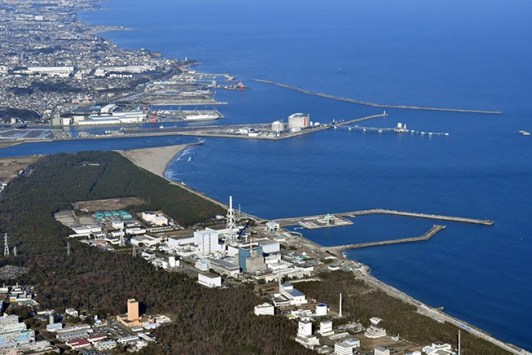
Japan Atomic Power Co.’s Tokai No. 2 nuclear power plant in Ibaraki Prefecture faces the Pacific Ocean.
May 25, 2019
Even though it hasn’t generated any electricity at its two nuclear power plants since May 2011, Japan Atomic Power Co. chalked up close to 1 trillion yen ($9.1 billion) in basic revenues in that time.
Under an arrangement with five electric power companies, Japan Atomic Power has received about 100 billion yen annually in basic charges for maintaining and managing its nuclear power plants.
Two of the four nuclear reactors owned by Japan Atomic Power are now being decommissioned. Of the two remaining, the Tokai No. 2 plant has not been in operation since the March 2011 earthquake and tsunami disaster.
The No. 2 reactor at the Tsuruga nuclear plant suspended operations in May 2011.
Since then, neither reactor has generated a single watt of electricity.
But Tokyo Electric Power Co. Holdings Inc., Kansai Electric Power Co., Chubu Electric Power Co., Hokuriku Electric Power Co. and Tohoku Electric Power Co. have continued to pay out basic electricity charges. In the fiscal year ended in March, the five companies provided Japan Atomic Power with a total of 109.1 billion yen in revenues.
Since the 2011 natural disaster, Japan Atomic Power has received between 100 billion and 150 billion yen annually, for a total of 988.5 billion yen.
The five utilities have since asked for a rate decrease in light of retail sales of electricity being completely liberalized in 2016, which has made their own corporate standing much more severe.
Mamoru Muramatsu, Japan Atomic Power president, said that for fiscal 2019, electricity revenues from the five utilities would likely fall under 100 billion yen.
But the company still faces a tough high-wire act in achieving financial stability because of problems it faces in resuming operations at its Tokai No. 2 plant.
Because the plant started operations close to 40 years ago, it asked for and received permission last November for a 20-year extension of operations.
An active fault has been found directly under the Tsuruga No. 2 reactor building in Fukui Prefecture, making resumption of operations there much more difficult.
So if the Tokai No. 2 plant cannot resume operations, Japan Atomic Power faces possible insolvency.
TEPCO and the four other utilities are now considering a plan to provide roughly 300 billion yen in financial assistance to Japan Atomic Power. Under the plan, the Tokai No. 2 plant is scheduled to resume operations in January 2023.
But local municipalities in the vicinity of the Tokai No. 2 plant remain at odds with Japan Atomic Power over what say they have over a resumption of operations. So it remains to be seen if those entities will come around to approving operation resumptions.
In addition, the Nuclear Regulation Authority in April decided not to allow an extension of deadlines for installing anti-terror facilities at nuclear plants. The deadline for the Tokai No. 2 plant is October 2023.
Muramatsu conceded that the company was only at the stage of considering specifications for the needed equipment and no discussions have been held on a construction timeline.
But even for nuclear plants that have already resumed operations, installation of the anti-terrorist measures are expected to take between five and a half and seven and a half years. Because no work has even begun at the Tokai No. 2 plant for such measures, the work period is expected to take even longer. Even if the plant resumed operations, the remaining operating period would likely become shorter.
TEPCO has said it was contemplating providing financial assistance to Japan Atomic Power because of the economic benefits that would accrue. But if the operating period is shorter, that would result in higher power generation costs, thereby weakening the rationale for providing the assistance.
http://www.asahi.com/ajw/articles/AJ201905250043.html?fbclid=IwAR18tOoPordb6byxvnVI8tfY5KhU-NA3T2h2sci3sQ50UkAhYQl2uuBRzf4

June 10, 2019 Posted by dunrenard | Japan | Tokai NPP | Leave a comment

« Previous Entries     Next Entries »

1 This Month

22 June – Virtual Event –Climate Change: New Data, New Debate


Monday, June 22, 2026 2:30 p.m. – 3:15 p.m. CT

YouTube. Register here
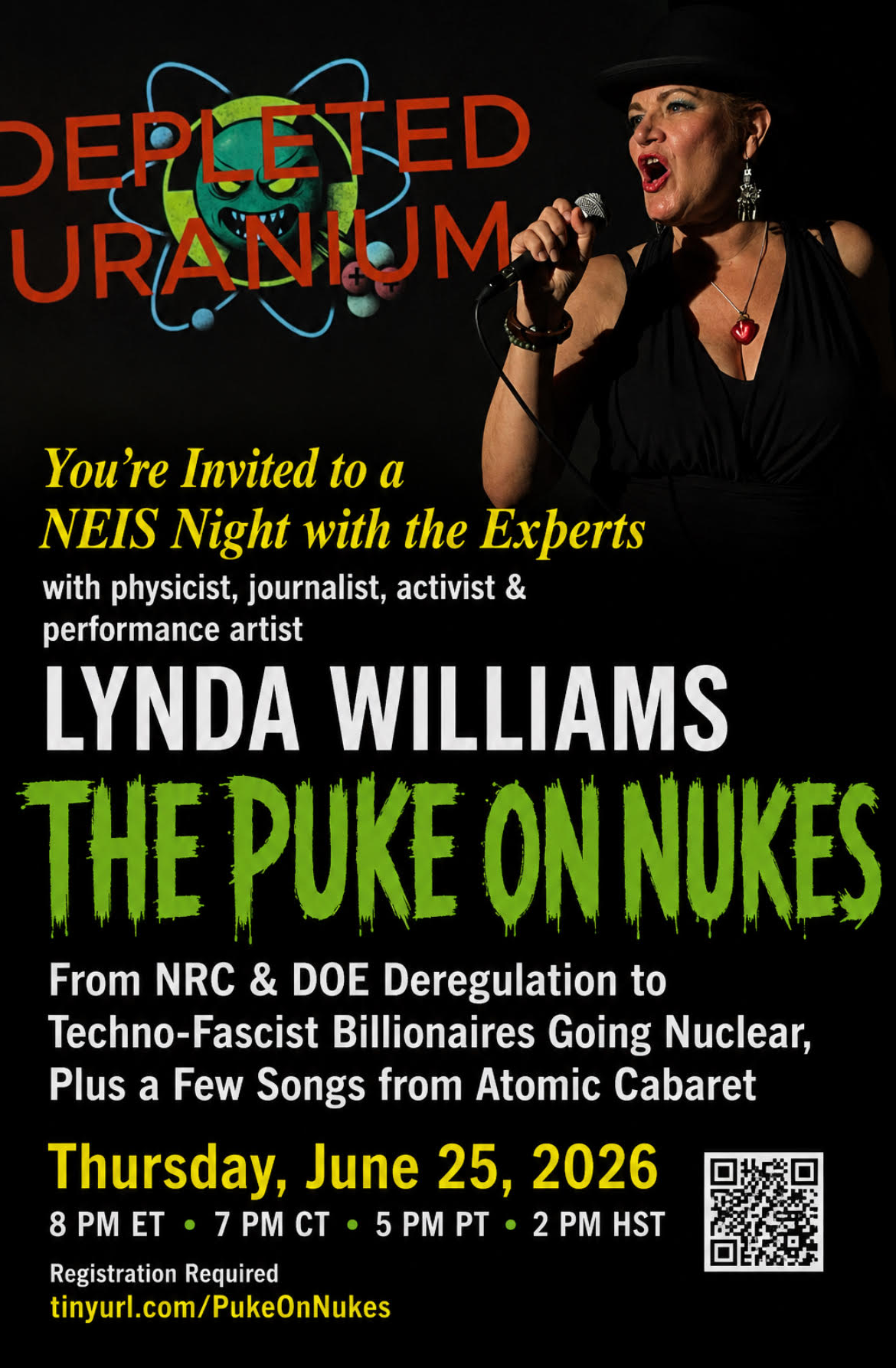
25 June- THE PUKE ON NUKES

Thursday, June 25, 2026

7pm Central Time (8pm ET, 6pm MT, 5pm PT) UTC – 5
From NRC & DOE Deregulation to Techno-Fascist Billionaires Going Nuclear, Plus a Few Songs from Atomic Cabaret REGISTER

26 June –  Radiation Trainwreck at the NRC / Join the Protect Better Campaign – https://us02web.zoom.us/meeting/register/4ZlZ5_qLSHGiLSCg8FF6Bg#/registration

1st July – Webinar Waste of Space: The Environmental Harm of Military and Civil Space Activity  st July, 7 pm

Report Launch Online: We are seeing an increasing exploitation of space for military and commercial purposes. This must change.

Protect Sazan Island from the Trump family! https://secure.avaaz.org/campaign/en/protect_sazan_island_from_the_trump_family_loc/?bqFCVab&v=174511&cl=22707147157&_checksum=5e9dde668860e8231c33699735e16a1fbf22ab2cb01da50c999fe8732b9775ef&utm_source=email&utm_medium=blast_email&utm_campaign=174511

Cuba Is Not a Failed State – It Is a Besieged State

PETITION: “Global Appeal to Endorse Palestinian Right of Return of Refugees” 

​To see nuclear-related stories in greater depth and intensity – go to https://nuclearinformation.wordpress.com

  • Categories

    • 1
      • Arclight's Vision
    • 1 NUCLEAR ISSUES
      • business and costs
        • employment
        • marketing
      • climate change
      • culture and arts
      • ENERGY
        • renewable
          • decentralised
          • energy storage
      • environment
        • oceans
        • water
      • health
        • children
        • psychology – mental health
        • radiation
        • social effects
        • women
      • history
      • indigenous issues
      • Legal
        • deaths by radiation
        • legal
      • marketing of nuclear
      • media
        • investigative journalism
        • Wikileaks
      • opposition to nuclear
      • PERSONAL STORIES
      • politics
        • psychology and culture
          • Trump – personality
        • public opinion
        • USA election 2024
        • USA elections 2016
      • politics international
      • Religion and ethics
      • safety
        • incidents
      • secrets,lies and civil liberties
        • civil liberties
      • spinbuster
        • Education
      • technology
        • reprocessing
        • Small Modular Nuclear Reactors
        • space travel
      • Uranium
      • wastes
        • – plutonium
        • decommission reactor
      • weapons and war
        • Atrocities
        • depleted uranium
      • Women
    • 2 WORLD
      • ANTARCTICA
      • ARCTIC
      • ASIA
        • Burma
        • China
        • India
        • Indonesia
        • Japan
          • – Fukushima 2011
          • Fukushima 2012
          • Fukushima 2013
          • Fukushima 2014
          • Fukushima 2015
          • Fukushima 2016
          • Fukushima continuing
        • Malaysia
        • Mongolia
        • North Korea
        • Pakistan
        • South Korea
        • Taiwan
        • Turkey
        • Vietnam
      • EUROPE
        • Belarus
        • Bulgaria
        • Denmark
        • Finland
        • France
        • Germany
        • Greece
        • Ireland
        • Italy
        • Kazakhstan
        • Kyrgyzstan
        • Russia
        • Spain
        • Sweden
        • Switzerland
        • UK
        • Ukraine
      • MIDDLE EAST
        • Afghanistan
        • Egypt
        • Gaza
        • Iran
        • Iraq
        • Israel
        • Jordan
        • Libya
        • Saudi Arabia
        • Syria
        • Turkey
        • United Arab Emirates
      • NORTH AMERICA
        • Canada
        • USA
          • election USA 2020
      • OCEANIA
        • New Zealand
        • Philippines
      • SOUTH AMERICA
        • Brazil
    • ACTION
    • AFRICA
      • Kenya
      • Malawi
      • Mali
      • Namibia
      • Niger
      • Nigeria
      • Somalia
      • South Africa
    • Atrocities
    • AUSTRALIA
    • Christina's notes
    • Christina's themes
    • culture and arts
    • Events
    • Fuk 2022
    • Fuk 2023
    • Fukushima 2017
    • Fukushima 2018
    • fukushima 2019
    • Fukushima 2020
    • Fukushima 2021
    • general
    • global warming
    • Humour (God we need it)
    • Nuclear
    • RARE EARTHS
      • thorium
    • Reference
      • Reference archives
    • resources – print
    • Resources -audiovicual
    • Weekly Newsletter
    • World
    • World Nuclear
    • YouTube
  • Pages

    • 1 This Month
    • ACTION !
    • Disclaimer
    • Links
    • PAGES on NUCLEAR ISSUES
      • audio-visual news
      • Anti Nuclear, Clean Energy Movement
        • Anti Nuclear movement – a success story
          • – 2013 – the struggle for a nuclear-free, liveable world
          • – 2013: the battle to expose nuclear lies about ionising radiation
            • Speakers at Fukushima Symposium March 2013
            • Symposium 2013 Ian Fairlie
      • Civil Liberties
        • – Civil liberties – China and USA
      • Climate change
      • Climate Change
      • Economics
        • – Employment
        • – Marketing nuclear power
        • – Marketing Nuclear Power Internationally
        • nuclear ‘renaissance’?
        • Nuclear energy – the sick man of the corporate world
      • Energy
        • – Solar energy
      • Environment
        • – Nuclear Power and the Tragedy of the Commons
        • – Water
      • Health
        • Birth Defects in the Chernobyl Radiation Affected Region.
      • History
        • Nuclear History – the forgotten disasters
      • Indigenous issues
      • Ionising radiation
        • – Ionising radiation – medical
        • Fukushima FACT SHEET
      • Media
        • Nuclear Power and Media 2012
      • Nuclear Power and the Consumer Society – theme for December 2012
      • Peace and nuclear disarmament
        • Peace on a Nuclear Free Earth
      • Politics
        • – Politics USA
      • Public opinion
      • Religion and ethics
        • -Ethics of nuclear power
      • Resources – print
      • Safety
      • Secrets and lies
        • – NUCLEAR LIES – theme for January 2012
        • – Nuclear Secrets and Lies
      • Spinbuster
        • 2013 nuclear spin – all about FEAR -theme for June
        • Spinbuster 1
      • Technology
        • TECHNOLOGY Challenges
      • Wastes
        • NUCLEAR WASTES – theme for October 2012
        • – Plutonium
      • Weapons and war
      • Women
  • Archives

    • June 2026 (227)
    • May 2026 (306)
    • April 2026 (356)
    • March 2026 (251)
    • February 2026 (268)
    • January 2026 (308)
    • December 2025 (358)
    • November 2025 (359)
    • October 2025 (376)
    • September 2025 (257)
    • August 2025 (319)
    • July 2025 (230)
  • Categories

    • 1
      • Arclight's Vision
    • 1 NUCLEAR ISSUES
      • business and costs
        • employment
        • marketing
      • climate change
      • culture and arts
      • ENERGY
        • renewable
          • decentralised
          • energy storage
      • environment
        • oceans
        • water
      • health
        • children
        • psychology – mental health
        • radiation
        • social effects
        • women
      • history
      • indigenous issues
      • Legal
        • deaths by radiation
        • legal
      • marketing of nuclear
      • media
        • investigative journalism
        • Wikileaks
      • opposition to nuclear
      • PERSONAL STORIES
      • politics
        • psychology and culture
          • Trump – personality
        • public opinion
        • USA election 2024
        • USA elections 2016
      • politics international
      • Religion and ethics
      • safety
        • incidents
      • secrets,lies and civil liberties
        • civil liberties
      • spinbuster
        • Education
      • technology
        • reprocessing
        • Small Modular Nuclear Reactors
        • space travel
      • Uranium
      • wastes
        • – plutonium
        • decommission reactor
      • weapons and war
        • Atrocities
        • depleted uranium
      • Women
    • 2 WORLD
      • ANTARCTICA
      • ARCTIC
      • ASIA
        • Burma
        • China
        • India
        • Indonesia
        • Japan
          • – Fukushima 2011
          • Fukushima 2012
          • Fukushima 2013
          • Fukushima 2014
          • Fukushima 2015
          • Fukushima 2016
          • Fukushima continuing
        • Malaysia
        • Mongolia
        • North Korea
        • Pakistan
        • South Korea
        • Taiwan
        • Turkey
        • Vietnam
      • EUROPE
        • Belarus
        • Bulgaria
        • Denmark
        • Finland
        • France
        • Germany
        • Greece
        • Ireland
        • Italy
        • Kazakhstan
        • Kyrgyzstan
        • Russia
        • Spain
        • Sweden
        • Switzerland
        • UK
        • Ukraine
      • MIDDLE EAST
        • Afghanistan
        • Egypt
        • Gaza
        • Iran
        • Iraq
        • Israel
        • Jordan
        • Libya
        • Saudi Arabia
        • Syria
        • Turkey
        • United Arab Emirates
      • NORTH AMERICA
        • Canada
        • USA
          • election USA 2020
      • OCEANIA
        • New Zealand
        • Philippines
      • SOUTH AMERICA
        • Brazil
    • ACTION
    • AFRICA
      • Kenya
      • Malawi
      • Mali
      • Namibia
      • Niger
      • Nigeria
      • Somalia
      • South Africa
    • Atrocities
    • AUSTRALIA
    • Christina's notes
    • Christina's themes
    • culture and arts
    • Events
    • Fuk 2022
    • Fuk 2023
    • Fukushima 2017
    • Fukushima 2018
    • fukushima 2019
    • Fukushima 2020
    • Fukushima 2021
    • general
    • global warming
    • Humour (God we need it)
    • Nuclear
    • RARE EARTHS
      • thorium
    • Reference
      • Reference archives
    • resources – print
    • Resources -audiovicual
    • Weekly Newsletter
    • World
    • World Nuclear
    • YouTube
  • RSS

    Entries RSS
    Comments RSS

Site info

nuclear-news
Create a free website or blog at WordPress.com.
Privacy & Cookies: This site uses cookies. By continuing to use this website, you agree to their use.
To find out more, including how to control cookies, see here: Cookie Policy
  • Subscribe Subscribed
    • nuclear-news
    • Join 2,102 other subscribers
    • Already have a WordPress.com account? Log in now.
    • nuclear-news
    • Subscribe Subscribed
    • Sign up
    • Log in
    • Report this content
    • View site in Reader
    • Manage subscriptions
    • Collapse this bar

Loading Comments...