The ghost towns in Fukushima Prefecture
Split-Screen Documentary: Nuclear Ghost Town – After 8 Years
Fukushima’s ghost towns https://www.cbsnews.com/news/fukushima-daiichi-nuclear-disaster-ghost-towns-60-minutes-2019-07-28/
More than eight years after one of the worst nuclear disasters in history, towns around Japan’s nuclear power plant struggle to rebuild,
Fukushima’s wrecked reactors: radioactive water is in no way under control
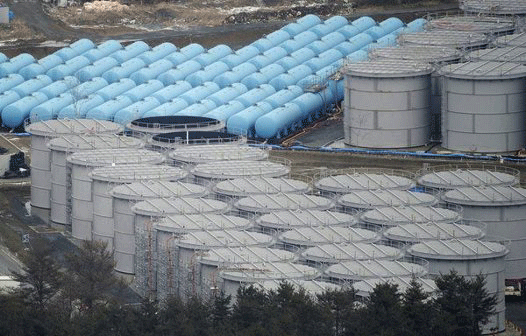
Toxic water level at Fukushima plant still not under control, THE ASAHI SHIMBUN, July 28, 2019 Almost six years after Prime Minister Shinzo Abe famously declared the contaminated water problem at the Fukushima No. 1 nuclear plant “under control,” today it remains anything but.
Tokyo Electric Power Co. (TEPCO) continues to face difficulties in dealing with water contaminated with radioactive substances at its crippled plant.
About 18,000 tons of highly contaminated water remain accumulated in reactor buildings and other places.
Abe made the declaration in September 2013 while Tokyo was bidding to win the 2020 Summer Games.
In reality, however, the situation is not under control even now.
In a meeting of the Nuclear Regulation Authority (NRA) in June, one of its members, Nobuhiko Ban, told TEPCO officials, “I want you to show whether you have a prospect (for the reduction of contaminated water) or you have given up.”
The water level did not fall as planned in an area of a basement floor at the No. 3 reactor building for two months. Asked why the level did not drop, TEPCO officials offered only vague explanations in the meeting. Ban made the remark out of irritation.
Highly contaminated water that has accumulated in reactor buildings and turbine buildings is a major concern at the Fukushima plant. In addition to water that was used to cool melted nuclear fuel at the No. 1, No. 2 and No. 3 reactors, groundwater also has flowed into those buildings through cracks.
The concentration of radioactive substances in the highly contaminated water is about 100 million times that of the contaminated water that has been processed and stored in tanks………
Eight years since the nuclear accident occurred, the volume of highly contaminated water in the buildings has fallen to 18,000 tons. TEPCO aims to reduce the volume further to 6,000 tons by the end of fiscal 2020.
However, work to decrease the water has not progressed as expected.
As for the area in the basement of the No. 3 reactor building, it is known that water used to cool melted nuclear fuel is flowing into the area. But why the water level does not drop only in that area is not known.
If the water level in the building remains high, highly contaminated water there could leak into the ground through cracks when the groundwater level outside the building drops. If the leaks occur, the entire effort to decrease the amount of highly contaminated water will be stalled.
The NRA is also requiring TEPCO to take anti-tsunami measures because if a huge tsunami engulfs the buildings again, it could send highly contaminated water pouring into the sea
However, anti-tsunami measures are also delayed…… http://www.asahi.com/ajw/articles/AJ201907280040.html
Nuclear reactors at Fukushima No 2 plant to be decommissioned
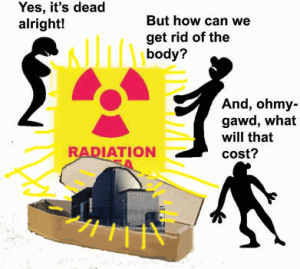
 Tepco says it will decommission nuclear reactors at Fukushima No. 2 plant https://www.japantimes.co.jp/news/2019/07/24/national/tepco-says-will-decommission-nuclear-reactors-fukushima-no-2-plant/#.XTjRFugzbIU, 24 July 19,
Tokyo Electric Power Company Holdings Inc. will decommission the Fukushima No. 2 nuclear plant, its president, Tomoaki Kobayakawa, told Fukushima Gov. Masao Ochibori at a meeting Wednesday.
The facility is the second nuclear plant that the utility company has decided to decommission after accepting it would need to shutter the nearby Fukushima No. 1 plant, which was crippled by the March 2011 earthquake and tsunami disaster in the world’s worst nuclear crisis since Chernobyl.
Tepco’s decision to scrap Fukushima No. 2, which is expected to cost some ¥280 billion ($2.6 billion), will be formally approved at the company’s board meeting later this month if local municipalities accept the plan.
The prefecture has demanded the utility scrap the reactors at Fukushima No. 2, saying their existence would hamper its reconstruction efforts. The plant has been offline since its operations were suspended due to the 2011 disaster.
If the plan goes ahead, all 10 nuclear reactors in the prefecture — four at the No. 2 plant and six at the No. 1 facility — will be scrapped.
It will also leave the utility company with only the Kashiwazaki-Kariwa nuclear plant in Niigata Prefecture and the planned Higashidori nuclear plant in Aomori Prefecture.
Kobayakawa said at the meeting, also attended by the mayors of the two towns — Naraha and Tomioka — that host the plant, that Tepco plans to build a new on-site storage facility for spent nuclear fuel from the reactors at the Fukushima No. 2 plant.
The fuel will be placed in metallic containers and cooled using a dry storage approach, according to the operator.
No decision has been made regarding final disposal of the spent fuel, raising concerns that the radioactive waste may remain on-site for a long time.
The Fukushima No.2 plant currently has around 10,000 assemblies of spent fuel cooling in pools.
40 years, $2.5bn costs for 4 Fukushima Daini nuclear reactors to be shut down

Tepco to retire remaining reactors in Fukushima https://asia.nikkei.com/Business/Companies/Tepco-to-retire-remaining-reactors-in-Fukushima Decommissioning is expected to take 40 years and cost $2.5bn TOKYO — Tokyo Electric Power Co. Holdings will scrap the four Fukushima Prefecture reactors that escaped damage in the 2011 earthquake and tsunami, moving to decommission all of the nuclear power plants the public utility owns in the disaster-stricken region.
The shutdown of the Fukushima Daini plant, which is located just 12km away from the Daiichi Plant crippled by fuel meltdowns, will be formally authorized at the company’s board meeting at the end of the month. This marks the first decision by the utility, known as Tepco, to decommission nuclear reactors apart from the Daiichi facilities.
Costs for decommissioning Fukushima Daini are estimated to exceed 270 billion yen ($2.5 billion). While Tepco’s reserves are not enough to cover them, the government adopted new accounting rules allowing operators to spread a large loss from decommissioning over multiple years. The company also believes it has secured enough people with necessary expertise to move forward.
Tepco soon will inform Fukushima Gov. Masao Uchibori of its decision. The utility intends to submit the decommissioning plan to Japan’s Nuclear Regulation Authority by March next year.
The decision means all 10 reactors in Fukushima will be scrapped. The Daini reactors will be decommissioned in roughly 40 years, sharing the same timetable as the Daiichi site. Tepco owns one other nuclear plant, the Kashiwazaki-Kariwa facility in Niigata Prefecture.
The Daini plant, where each reactor produced 1.1 gigawatts of power, served the Tokyo area for about three decades. Japan’s central government sought to restart the complex but faced withering opposition from local residents in Fukushima.
Including the Fukushima Daini facilities, a total of 21 reactors across Japan are now slated for decommissioning. Recent additions include two units at the Ikata plant in Ehime Prefecture and one reactor at the Onagawa facility in Miyagi Prefecture.
The Olympic Games and the second Tokai Nuclear Plant,
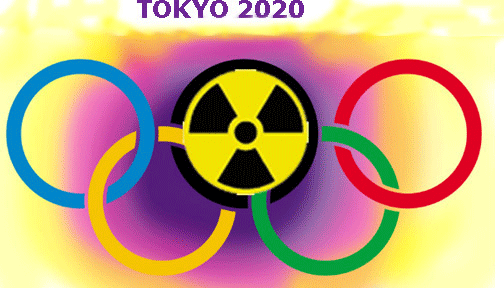 I am revealing some meaningful facts about Fukushima.
 3.On June 25,three days before the G 20 Summit in Osaka,white smoke was
The unpleasant reality behind the Tokyo Olympics’ shimmering curtain of propaganda

Is Tokyo Ready for the Olympic Juggernaut? Tokyo says that it’s ready to host the 2020 Olympics. The early numbers—and quality of Olympic leadership—are not encouraging. The Nation, By Dave Zirin and Jules Boykoff 18 July 19
Dave ZirinTWITTERDave Zirin is the sports editor of The Nation.
Tokyo Electric Power Company to close down Fukushima Daini nuclear plant
The decommissioning of all four nuclear reactors at Daini will likely require more than 40 years and some 280 billion yen ($2.6 billion) in costs, the source said. If realized, all 10 nuclear reactors in Fukushima Prefecture will be scrapped.
Closure of the Daiichi plant, which suffered core meltdowns at three of its six reactors, has already been decided.
After telling Fukushima Gov. Masao Uchibori about the policy, it may be formally approved at a TEPCO board meeting, scheduled at the end of this month, the source said.
The Daini complex was also hit by tsunami waves in the 2011 disaster and temporarily lost reactor cooling functions. But unlike the Daiichi plant, it escaped meltdowns.
Since the disaster, the decommissioning in Japan of 21 nuclear reactors, including those at Daini, has been decided.
For the Tokyo-headquartered power company, the Kashiwazaki-Kariwa plant in Niigata Prefecture will be its only nuclear complex.
In June last year, TEPCO President Tomoaki Kobayakawa told the governor that the company is leaning toward scrapping all four reactors at the Daini plant. A project team was later formed at the utility and looked into whether that is possible, according to the source.
The prefecture has demanded the utility scrap the reactors, saying their existence would hamper its reconstruction efforts.
Japan’s nuclear industry has a doubtful future
Is there a future for nuclear power in Japan?, Japan Times, BY SUMIKO TAKEUCHI, JUL 16, 2019, This is the third in a series of reports on Japan’s energy policy…….
the damage from nuclear accidents can be catastrophic, in addition to the challenges posed by nuclear waste disposal. The Fukushima disaster has led to strong opinions that Japan should denuclearize, and this is still the case.
…. ………The fact is that the economic benefits of nuclear power have been losing their shine. Because of the sharp hike in safety standards imposed by the Nuclear Regulation Authority after the Fukushima disaster, exorbitant safety upgrades nearly equal in cost to building a new reactor are being installed at each site. To get a return on investment, this intensive capital spending will require long-term operation and high utilization rates, but the need to get local consent to operate and to respond to dozens of lawsuits from anti-nuclear residents is making stable operations difficult. Reactor operations are also capped at 60 years. Nuclear power could potentially be a source of cheap electricity, depending on the utilization rate and other conditions, but there’s also a possibility it won’t. ……
The impact of the Fukushima disaster, however, was enough to completely overshadow the benefits. The majority of the public is still against nuclear power. In light of persistent public opinion, Japan’s nuclear power business has been surrounded by three big uncertainties.
The first is political uncertainty. The administration of Prime Minister Shinzo Abe, despite its long-term stability, has not provided enough support to the nuclear power business. In addition, the government has entrusted the utilities with the job of gaining local consent.
The safety agreements that stipulate the rules of the industry, such as disclosure of information to the host governments, are not legally binding. But running reactors would be next to impossible without local consent based on such agreements. Whenever there’s an election, the utilities are thrown into confusion, and if a new leader is elected, they will initiate communication from scratch.
The second is policy uncertainty. Japan has fully liberalized the retail power sector. In a liberalized market, reactors for which returns on investment have fully recovered could have high cost competitiveness, but there will likely be no companies that will take up the challenge of building new ones.
Since nuclear plants require huge capital, curbing fundraising costs to a low level would have a big impact on competitiveness, but cheap fundraising is something that cannot be expected in a liberalized market. …….
The third is regulatory uncertainty. It has become quite common for reactor safety reviews to take multiple years because of inadequate communication between utilities and regulators. The U.S. has a presidential executive order that stipulates regulation shall not be undertaken unless the potential benefits to society from regulation outweigh the potential costs of dealing with the regulation.
Though Japan has no such principles, appropriate oversight on regulatory activities is being called for to check whether the public is suffering from any disadvantages from unforeseeable regulatory activities. In the meantime, the finishing blow is the plethora of lawsuits that have been filed demanding the halt of nuclear power plants……..
When utilities are placed in such an uncertain environment, it is a foregone conclusion that the nuclear power business will become unsustainable and there will be no future for it in Japan…..https://www.japantimes.co.jp/news/2019/07/16/business/future-nuclear-power-japan/#.XS-PhOszbGg
Parties must close gap with reality in talks on nuclear power

Fukushima – a nuclear catastrophe that continues
Expert says 2020 Tokyo Olympics unsafe due to Fukushima | 60 Minutes
Fukushima Prefecture Council election: both candidates campaign on anti-nuclear platforms
 Fukushima Upper House candidates face cynical voters despite anti-nuclear platforms, Japan Times, 14 July 19, JIJI FUKUSHIMA – Rival candidates, both women, from the ruling Liberal Democratic Party and the opposition camp for next Sunday’s House of Councilors election in Fukushima Prefecture are campaigning on platforms to eliminate nuclear power from the prefecture.
But their calls are in conflict with the national energy policy of the LDP and the positions of some opposition supporters.
With campaigning in the single-seat prefectural constituency shaping up effectively as a one-on-one race, local voters who were affected by the March 2011 nuclear accident are casting a cynical eye at the race for the July 21 election.
“I’m determined to push ahead with reconstruction following your requests,” Masako Mori, the LDP’s candidate for Fukushima, said on July 4, the opening day of the official campaign period, in the prefectural capital of Fukushima.
“I’ll do my best to achieve the goal of decommissioning all nuclear reactors in the prefecture,” said Mori, 54, vice chair of the LDP’s Headquarters for Accelerating Reconstruction after the Great East Japan Earthquake.
Prime Minister Shinzo Abe, also president of the LDP, gave a speech in support of Mori.
Reflecting local voter concerns over nuclear power, the LDP’s Fukushima chapter has set goals of scrapping all reactors in the prefecture and building up knowledge and expertise related to decommissioning.
In contrast to the prefectural chapter’s position, however, the Abe government’s basic energy program regards nuclear power as an important base load electric power source, while the LDP’s policy pledges for the Upper House election include efforts to reactivate nuclear reactors.
The LDP suffered losses in recent national elections in Fukushima Prefecture, home to Tokyo Electric Power Company Holdings Inc.’s Fukushima No. 1 nuclear power plant, the site of the nation’s worst-ever nuclear accident, which resulted from the March 2011 earthquake and tsunami………
Hard to differentiate
Mori’s key opponent in the three-way race is Sachiko Mizuno, 57, who is running as the opposition camp’s unified candidate.
On June 30, standing in drizzling rain in front of a department store in the city of Fukushima, Mizuno told a small crowd, “Reconstruction of Fukushima is still only half done.”
Referring to the LDP’s policy pledge, she said the government “has not presented a road map for decommissioning all reactors (in the prefecture).”……..
With Mizuno calling for a society free of nuclear power, the policy differences with the LDP are blurred. “It’s difficult to differentiate ourselves (from the LDP) in the prefecture,” a senior official in Mizuno’s campaign office said.
Within her camp, there are differing levels of enthusiasm regarding the elimination of nuclear power…….
Unenthusiastic voters
After the triple meltdown accident, the government issued an evacuation advisory to 11 municipalities around the stricken nuclear plant. Since the advisory was lifted in the eastern part of the city of Tamura in April 2014, the size of the exclusion zone has been reduced in stages.
But the advisory remains in place in the town of Futaba, as well as in parts of six municipalities, including the towns of Okuma and Namie. More than 30,000 people still live as evacuees outside the prefecture…….
In Namie, more than two years after the evacuation advisory was lifted for most of the town in March 2017, just over 1,000 people have returned. Of people who are still registered as residents of areas for which the advisory was removed, only some 7 percent have returned. ……..https://www.japantimes.co.jp/news/2019/07/14/national/politics-diplomacy/fukushima-upper-house-candidates-face-cynical-voters-despite-anti-nuclear-platforms/#.XSucHD8zbGg
A Fukushima Ghost Town Seeks Rebirth Through Renewable Energy
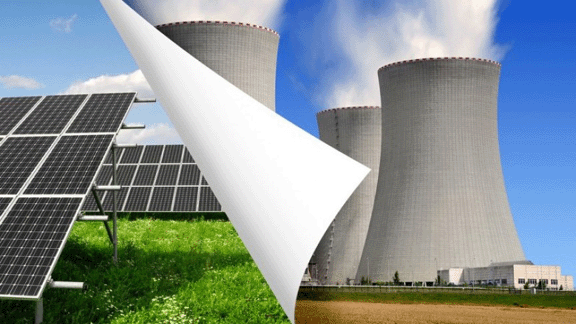 A Fukushima Ghost Town Seeks Rebirth Through Renewable Energy
Devastated by Japanese nuclear plant’s meltdown in 2011, Namie hopes a new hydrogen-fuel facility can generate a turnaround. WSJ, By River Davis, July 12, 2019
NAMIE, Japan—Fukushima prefecture, a place synonymous in many minds with nuclear meltdown, is trying to reinvent itself as a hub for renewable energy.
One symbol is just outside Namie, less than five miles from the nuclear-power plant devastated by an earthquake and tsunami in 2011. At the end of a winding road through miles of barren land, construction is nearing completion on one of the world’s largest hydrogen plants.
The government hopes to show that hydrogen, a hard-to-handle fuel that hasn’t been used for large-scale power generation, can supplement intermittent solar and wind power.
……….. By 2040, Fukushima aims to cover 100% of its energy demand with non-nuclear renewable energy. Since 2011, the prefecture’s generating capacity from renewable energy, excluding large-scale hydropower, has more than quadrupled. More than a gigawatt of solar-energy capacity has been added—the equivalent of more than three million solar panels—while other projects are under way in offshore wind power and geothermal energy……… https://www.wsj.com/articles/a-fukushima-ghost-town-seeks-rebirth-through-renewable-energy-11562923802
Circular flow of 2011 Fukushima cesium through Pacific, back to Japan
July 8, 2019 (Mainichi Japan) TOKYO — Radioactive cesium released into the Pacific Ocean due to the March 2011 meltdowns at Fukushima Daiichi Nuclear Power Station is returning to Japanese shores via a shorter route than expected, according to a joint research initiative.
The findings were revealed by a team from the University of Tsukuba, the Japan Agency for Marine-Earth Science and Technology (JAMSTEC) and Kanazawa University.
Until now, it was thought that cesium from the Tokyo Electric Power Co. (TEPCO)-operated plant would be circulated around the Pacific by subtropical gyre currents for several decades before returning to Japanese waters. But in 2012, a year after the reactor core meltdowns, tests on seawater samples collected by the team showed increased cesium concentrations in East China Sea waters off Japan. Researchers say that the concentrations observed are too low to impact sea life.
The rate increased, peaking in 2014, and a year later high concentrations were also reported in the Sea of Japan. The team believes the cesium is now flowing around the Pacific Ocean again.
It is thought that seawater sank deeply into the sea after its density increased due to cooling by winter winds, causing the cesium to travel on a western-flowing underwater route.
Michio Aoyama, a visiting professor at the University of Tsukuba, said, “That the cesium would come back in such a short time was unexpected. We’ve found a previously unknown route.”
Senior JAMSTEC research scientist Yuichiro Kumamoto said of the project’s potential benefits, “Because it has visualized ocean circulation, the results could be used in the future for predictions on issues such as climate change.”
(Japanese original by Mayumi Nobuta, Science & Environment News Department)
Should Fukushima exclusion zone be widened?
FUKUSHIMA investigators were left “worried” after recording radiation levels 100 times normal, leading them to suggest the exclusion zone should be increased.Express UK , By CALLUM HOARE Jul 4, 2019 | “………… when Chernobyl researcher Yevgen visited as part of Amazon Prime’s “Radioactive Detectives” series, he was left shocked.
The narrator revealed in 2017: “Have the Japanese authorities determined the correct exclusion zone?
“The first big surprise is a completely unguarded borderline.
“Yevgen wants to carry out his first measurements here.
“He has to tell Kenzo that the radiation level exceeds the natural radiation 100 times over.
“The men are worried.”
Kenzo Hashimoto, a Japanese journalist claimed the exclusion zone needed to be increased as a result.
He said: “If the radiation is that high, the authorities should extend the border line even further.
“I don’t know exactly how the survey has been made – it seems very strange to me…….https://www.express.co.uk/news/world/1149129/fukushima-nuclear-disaster-japan-radiation-exclusion-zone-investigation-spt
Tokyo monitoring USA-North Korea negotiations, hoping that there will be some real improvement
Japan hopes latest Trump-Kim meeting will help get nuclear, abduction talks moving again, Japan Times , 29 June
KYODO, Japan hopes the third meeting between U.S. President Donald Trump and North Korean leader Kim Jong Un on Sunday will reinvigorate stalled denuclearization talks and help resolve the issue of past abductions of Japanese citizens.
“The meeting could serve as an opportunity for North Korea to come out of its shell,” a senior Japanese Foreign Ministry official said.
Trump and Kim held talks in the Demilitarized Zone dividing the two Koreas and agreed to restart denuclearization talks within weeks following the rupture of their last summit in Hanoi in February.
Tokyo is closely monitoring whether the two countries will move forward negotiations on the denuclearization of North Korea and improve their ties, which could help the U.S. government set up a summit between Prime Minister Shinzo Abe and Kim, as the Japanese leader is hoping for……….https://www.japantimes.co.jp/news/2019/06/30/national/japan-hopes-latest-trump-kim-meeting-will-help-get-nuclear-abduction-talks-moving/#.XRkibT8zbGg
1 This Month

22 June – Virtual Event –Climate Change: New Data, New Debate

Monday, June 22, 2026 2:30 p.m. – 3:15 p.m. CT
YouTube. Register here

25 June- THE PUKE ON NUKES
Thursday, June 25, 2026
7pm Central Time (8pm ET, 6pm MT, 5pm PT) UTC – 5
From NRC & DOE Deregulation to Techno-Fascist Billionaires Going Nuclear, Plus a Few Songs from Atomic Cabaret REGISTER
26 June – Radiation Trainwreck at the NRC / Join the Protect Better Campaign – https://us02web.zoom.us/meeting/register/4ZlZ5_qLSHGiLSCg8FF6Bg#/registration
1st July – Webinar Waste of Space: The Environmental Harm of Military and Civil Space Activity st July, 7 pm

Report Launch Online: We are seeing an increasing exploitation of space for military and commercial purposes. This must change.

Protect Sazan Island from the Trump family! https://secure.avaaz.org/campaign/en/protect_sazan_island_from_the_trump_family_loc/?bqFCVab&v=174511&cl=22707147157&_checksum=5e9dde668860e8231c33699735e16a1fbf22ab2cb01da50c999fe8732b9775ef&utm_source=email&utm_medium=blast_email&utm_campaign=174511


Cuba Is Not a Failed State – It Is a Besieged State
PETITION: “Global Appeal to Endorse Palestinian Right of Return of Refugees”
To see nuclear-related stories in greater depth and intensity – go to https://nuclearinformation.wordpress.com
-
Archives
- June 2026 (227)
- May 2026 (306)
- April 2026 (356)
- March 2026 (251)
- February 2026 (268)
- January 2026 (308)
- December 2025 (358)
- November 2025 (359)
- October 2025 (376)
- September 2025 (257)
- August 2025 (319)
- July 2025 (230)
-
Categories
- 1
- 1 NUCLEAR ISSUES
- business and costs
- climate change
- culture and arts
- ENERGY
- environment
- health
- history
- indigenous issues
- Legal
- marketing of nuclear
- media
- opposition to nuclear
- PERSONAL STORIES
- politics
- politics international
- Religion and ethics
- safety
- secrets,lies and civil liberties
- spinbuster
- technology
- Uranium
- wastes
- weapons and war
- Women
- 2 WORLD
- ACTION
- AFRICA
- Atrocities
- AUSTRALIA
- Christina's notes
- Christina's themes
- culture and arts
- Events
- Fuk 2022
- Fuk 2023
- Fukushima 2017
- Fukushima 2018
- fukushima 2019
- Fukushima 2020
- Fukushima 2021
- general
- global warming
- Humour (God we need it)
- Nuclear
- RARE EARTHS
- Reference
- resources – print
- Resources -audiovicual
- Weekly Newsletter
- World
- World Nuclear
- YouTube
-
RSS
Entries RSS
Comments RSS
 nuclear-news