Japanese parish priests shared stories of suffering from victims of the Fukushima nuclear disaster
The forum, organised by the Nippon Sei Ko Kai (NSKK) – the Anglican Communion in Japan – follows the NSKKs General Synod resolution in 2012 calling for an end to nuclear power plants and activities to help the world go nuclear free.
The disaster in 2011 followed a massive earthquake and tsunami which caused a number of explosions in the town’s coastal nuclear power station and led to widespread radioactive contamination and serious health and environmental effects. The Chair of the forum’s organising committee, Kiyosumi Hasegawa, said: “We have yet to see an end to the damage done to the people and natural environment by the meltdown of TEPCO’s Fukushima Daiichi Nuclear Power Plant. I do think this man-made disaster will haunt countless people for years to come. We still see numerous people who wish to go back to their hometowns but are unable to. We also have people who have given up on ever going home.”
One pastor, Dr Naoya Kawakami, whose church was affected by the tsunami and is the General Secretary of the Sendai Christian Alliance Disaster Relief Network, Touhoku HELP, explained how he had supported sufferers in the aftermath and heard from priests supporting the survivors. He said: “I have been more than 700 times to meet with more than 180 mothers and about 20 fathers, all of whom have seen abnormalities in their children since 2011. . . Thyroid cancer has been found in more than 273 children and many mothers are in deep anxiety.
“The more the situation worsens, the more pastors become aware of their important role. The role is to witness . . . pastors who have stayed in Fukushima with the ‘voiceless survivors’ are showing us the church as the body of Jesus’s resurrection, with wounds and weakness . . . sufferers are usually in voiceless agony and most people never hear them.”
The forum was attended by bishops, clergy and lay representatives from each diocese, together with representatives from the US-based Episcopal Church, USPG, the Episcopal Church of the Philippines, the Diocese of Taiwan, the Anglican Church of Korea, and also ecumenical guests. International experts took part, along with local clergy who shared individual stories from those directly affected by the disaster……….https://www.anglicannews.org/news/2019/06/voices-of-fukushima-power-plant-explosion-victims-strengthens-call-to-ban-nuclear-energy.aspx
Japan’s Olympic torch relay to start in Fukushima – even children are invited to carry it
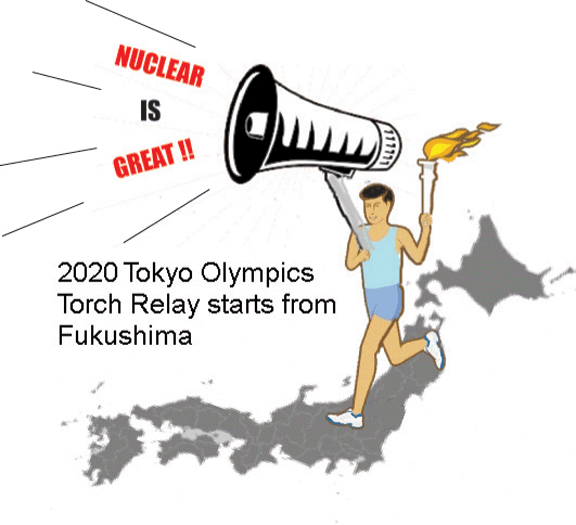
Tokyo 2020 reveals Olympic Torch route will begin in Fukushima, Inside the Games, By Matthew Smith, 1 June 2019
The Tokyo 2020 Organising Committee has revealed the Olympic Torch Relay route, which will take in many of Japan’s most historic and famous sites – and also areas touched by tragedy.
The Flame will be taken all over Japan inside 121 days, culminating in the Olympic Games next summer.
It will begin the final leg of its journey on March 26, 2020 from the J-Village National Training Centre in Fukushima, the training facility of the Japan football team.
The Flame will travel to all 47 prefectures of Japan, with the Organising Committee claiming around 98 per cent of Japan’s population live within one hour’s travel of the proposed route.
The route will take in World Heritage Sites such as Mount Fuji and Itsukushima Shrine, but will also visit areas affected by recent disasters.
Fukushima has been chosen as a start point after the Tohoku region was struck by an earthquake and tsunami in 2011, which also caused a nuclear incident at the Fukushima Daiichi Nuclear Power Plant.
As well as revealing the route, Tokyo 2020 also unveiled the Torchbearer uniforms and how members of the public could apply to take part in the Relay.
The uniform features the Relay emblem on the front and the Olympic symbol on the back.
The most notable design feature is a diagonal red stripe, echoing the sash used in place of batons in Ekiden, Japan’s historic long-distance relays…….
“In Japan, these Games are being referred to as ‘the Recovery Games’ and so the Olympic Flame will start its journey from an area affected by recent natural disasters……
Games organisers say the Olympic Torch Relay will feature around 10,000 Torchbearers including men, women and children of a wide range of nationalities and ages. People from all over the world are encouraged to apply and can do so here……..https://www.insidethegames.biz/articles/1079973/tokyo-2020-reveals-olympic-torch-route-will-begin-in-fukushima
Hiroshima and Nagasaki protest U.S. subcritical nuclear test
The United States conducted a subcritical nuclear test in Nevada on Feb. 13, according to a May 24 announcement by the U.S. Lawrence Livermore National Laboratory.
Yuzaki called the test “extremely regrettable.”
He said, “It destroys the hopes of Hiroshima residents who strongly wish the abolition of nuclear weapons.”
Trump arrived in Japan as state guest on May 25. He will wind up his visit on May 28.
Nagasaki Governor Hodo Nakamura, along with prefectural assembly chairman Mitsuyuki Segawa, also denounced the subcritical nuclear test.
They sent protest letters to U.S. Ambassador William Hagerty on May 26.
Tokyo 2020 Olympic Torch Relay set to visit Fukushima nuclear complex
Tokyo 2020 Olympic Torch Relay set to visit Fukushima nuclear complex, PACNEWS, 1 June, 2019,
A staff takes out a banner featuring Tokyo 2020 Olympics emblem from the wall after a news conference in Tokyo, Japan June 30, 2017. REUTERS/Kim Kyung-Hoon
TOKYO, 01 JUNE 2019 (INSIDE THE GAMES) – A town devastated by the nuclear meltdowns in the Fukushima Prefecture in the wake of the 2011 earthquake and tsunami in Japan is set to feature on the route of the Olympic Torch Relay for Tokyo 2020. The relay course will pass through the Fukushima Daiichi Nuclear…. (subscribers only ) https://www.fijitimes.com/tokyo-2020-olympic-torch-relay-set-to-visit-fukushima-nuclear-complex/
At June G20 meeting, Japan to push for international conference on nuclear waste disposal (but no talk on stopping making radioactive trash)
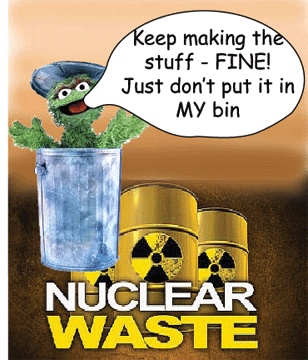 Japan to push for int’l conference on nuclear waste disposal at June G-20 meet https://mainichi.jp/english/articles/20190525/p2a/00m/0in/006000c TOKYO — The Japanese government announced May 24 that it plans to arrange an international meeting to consider how to dispose of highly radioactive nuclear waste.
Tokyo is set to get approval for the plan at the Group of 20 Ministerial Meeting on Energy Transitions and Global Environment for Sustainable Growth scheduled for mid-June in Karuizawa, Nagano Prefecture, and aims to launch the first roundtable this autumn.
High-level nuclear refuse is usually “vitrified” — mixed with melted glass and solidified — before being deposited in an underground storage facility. Japan’s own disposal plans call for holding the waste for 30 to 50 years to cool it before burying it in stable rock formations at least 300 meters below ground. Finland is already building a major underground disposal site, while its neighbor Sweden is conducting a safety evaluation at the location of its own planned facility. However, there is no precedent for actually operating such an installation, and Japan has not yet even begun the survey process to choose a site.
The Japanese government will thus use the June 15-16 G-20 environment and energy summit meeting to urge member nations to cooperate on realistic solutions. Specifically, Japan will press nations with advanced nuclear disposal technology including those in Europe to share their know-how, and also promote international collaboration among research facilities and staff exchanges. The international roundtable will put together a collection of proposals on a basic nuclear waste disposal cooperation strategy and how to explain the issue to the citizens of member nations.
240 shrines within 20 K of Fukushima reactor 1, so a move to build a new shrine
|
Damaged or inaccessible Fukushima shrines consider consolidation as way forward, Japan Times, KYODO, MAY 26, 2019, FUKUSHIMA – A plan has been forged to establish a new shrine in Fukushima Prefecture as a substitute for the many others that were damaged or made inaccessible by the 2011 quake-tsunami disaster and nuclear crisis, local authorities have said.
The local branch of the Association of Shinto Shrines said earlier this month they plan to build the new place of worship on the grounds of the tsunami-hit Hachiman Shrine by the end of March 2021. The shrine is located in the town of Futaba, one of the host communities of the crippled Fukushima No. 1 nuclear plant, but it is in an area where radiation levels are relatively low. At least 30 shrines in the prefecture remain badly damaged after the disasters and 44 are in areas where access is restricted due to high radiation levels. Representatives of each of the 74 affected shrines will decide whether to join the project or not……. All of Futaba’s residents continue to live outside the town following the nuclear crisis, one of the world’s worst ever, that resulted in three reactor core meltdowns. But the Hachiman Shrine, located in a coastal district of Nakano, was selected as a candidate site for the project because it experiences lower radiation levels and is located near the site of an envisioned memorial park Fukushima Prefecture is planning to build…… There are a total of 240 shrines within a 20-kilometer radius of the Fukushima No. 1 plant, which was designated as a no-go zone soon after the nuclear crisis began. Of the 74 struggling shrines, not all are within a radius of 20 kilometers. …… https://www.japantimes.co.jp/news/2019/05/26/national/damaged-inaccessible-fukushima-shrines-consider-consolidation-way-forward/#.XOsKOhYzbGg |
|
Comparing the radioactive pollution from Fukushima and Chernobyl nuclear accidents
|
Chernobyl vs. Fukushima: Which Nuclear Meltdown Was the Bigger Disaster? Live Science By | May 24, 2019 The new HBO series “Chernobyl” dramatizes the accident and horrific aftermath of a nuclear meltdown that rocked the Ukraine in 1986. Twenty-five years later, another nuclear catastrophe would unfold in Japan, after the magnitude 9.0 Tohoku earthquake and subsequent tsunami triggered a disastrous system failure at Fukushima Daiichi Nuclear Power Plant.Both of these accidents released radiation; their impacts were far-reaching and long-lasting. But how do the circumstances of Chernobyl and Fukushima compare to each other, and which event caused more damage? [5 Weird Things You Didn’t Know About Chernobyl] Only one reactor exploded at Chernobyl, while three reactors experienced meltdowns at Fukushima. Yet the accident at Chernobyl was far more dangerous, as damage to the reactor core unspooled very rapidly and violently, said Edwin Lyman, a senior scientist and acting director for the Union of Concerned Scientists Nuclear Safety Project. “As a result, more fission products were released from the single Chernobyl core,” Lyman told Live Science. “At Fukushima the cores overheated and melted but did not experience violent dispersal, so a much smaller amount of plutonium was released.” In both accidents, radioactive iodine-131 posed the most immediate threat, but with a half-life of eight days, meaning half of the radioactive material decayed within that time, its effects soon dissipated. In both meltdowns, the long-term hazards arose primarily from strontium-90 and cesium-137, radioactive isotopes with half-lives of 30 years. And Chernobyl released far more cesium-137 than Fukushima did, according to Lyman. “About 25 petabecquerels (PBq) of cesium-137 was released to the environment from the three damaged Fukushima reactors, compared to an estimate of 85 PBq for Chernobyl,” he said (PBq is a unit for measuring radioactivity that shows the decay of nuclei per second). What’s more, Chernobyl’s raging inferno created a towering plume of radioactivity that dispersed more widely than the radioactivity released by Fukushima, Lyman added. Sickness, cancer and deathAt Chernobyl, two plant workers were killed by the initial explosion and 29 more workers died from radiation poisoning over the next three months, Time reported in 2018. Many of those who died had knowingly exposed themselves to deadly radiation as they worked to secure the plant and prevent further leaks. Government officials relocated an estimated 200,000 people from the region, according to the International Atomic Energy Agency. In the years that followed, cancers in children skyrocketed in the Ukraine, up by more than 90%, according to Time. A report issued by United Nations agencies in 2005 approximated that 4,000 people could eventually die of radiation exposure from Chernobyl. Greenpeace International estimated, in 2006, that the number of fatalities in the Ukraine, Russia and Belarus could be as high as 93,000 people, with 270,000 people in those countries developing cancers who otherwise would not have done so…….. The extent of Fukushima’s environmental impact is still unknown, though there is already some evidence that genetic mutations are on the rise in butterflies from the Fukushima area, producing deformations in their wings, legs and eyes. [See Photos of Fukushima’s Deformed Butterflies] ……. radiation levels around Chernobyl can vary widely. Aerial drone surveys revealed in May that radiation in Ukraine’s Red Forest was concentrated in previously unknown “hotspots,” which scientists outlined in the region’s most accurate radiation maps to date. The Fukushima nuclear power plant is still open and active (though the reactors that exploded remain closed); nonetheless, ongoing concerns about safety linger. The Tokyo Electric Power Company (TEPCO) recently announced that it would not hire foreign workers coming to Japan under newly relaxed immigration rules……. https://www.livescience.com/65554-chernobyl-vs-fukushima.html |
|
|
Danger in foreign workers at Fukushim nuclear clean-up – Tepco abandons plans for them
|
The company noted that hiring foreign workers at the nuclear plant under a new specified skills visa category that took effect in April could result in work-related accidents and long-term health problems due to their lack of Japanese language skills and understanding of Japanese labor practices. The announcement followed a health ministry caution May 21 for TEPCO to carefully reconsider its policy of using foreign workers at the complex…….. The ministry had said that if TEPCO went ahead with hiring foreign workers, the company and its contractors involved in decommissioning had to take at least the same level of protective measures that apply to Japanese workers to ensure that they fully understand safety sanitation and avoid the health risk of excessive radiation exposure. Even though eight years have passed since the triple meltdown, radiation levels remain high in many areas of the Fukushima plant, especially around the reactor buildings. The decommissioning process that is expected to take years will involve a range of gargantuan tasks, one being the removal of melted nuclear fuel debris from the reactors. Under the recently revised immigration control law, foreign workers with specified skills are permitted to work at nuclear power plants. The ministry acknowledges that it is ultimately up to individual employers to decide whether or not to accept foreign workers on their payrolls. But experts in Japan and overseas who are keen for the new visa program to be a success have also voiced concerns about foreign workers at the Fukushima plant developing radiation-related health issues and being able to manage them after they return to their home countries….. Chief Cabinet Secretary Yoshihide Suga referred to the ministry’s caution at a May 21 news conference, saying that TEPCO should be prepared to fully address a range of health-related problems that may arise in the future. The utility notified dozens of its contractors at a meeting in late March that it will accept foreign workers at the Fukushima plant. Currently, about 4,000 people toil at the plant each day. Most areas of the complex are categorized as controlled areas to guard against radiation exposure. Under the law, workers at a nuclear facility must not be exposed to more than 100 millisieverts of radiation over five years and 50 millisieverts a year. http://www.asahi.com/ajw/articles/AJ201905220067.html |
|

Hibakusha: Nagasaki activist, 79, looks to entrust nuclear movement to next generation
|
https://mainichi.jp/english/articles/20190522/p2a/00m/0na/013000c May 22, 2019 (Mainichi Japan) NAGASAKI — On May 9, there was a sit-in hibakusha gathering in front of the Peace Statue at Nagasaki Peace Park. The meeting takes place on the ninth of every month, marking the Aug. 9, 1945, U.S. atomic bombing of Nagasaki. This month’s congregation marked the 444th time for such an event. Koichi Kawano, 79, took to the microphone to speak about the stand-off between the United States and Iran. “This is a crisis,” he said to the around 100 people in attendance, continuing, “Our hearts are one when wishing for the abolition of nuclear weapons.” Born in North Pyongan Province on the Korean Peninsula, now part of North Korea, Kawano was brought back to his parents’ hometown Nagasaki as a child. Aged 5 in August 1945, he was around 3.1 kilometers away from the atomic bomb’s hypocenter. Now a resident of the nearby town of Nagayo, he has been an activist for the end of nuclear weaponry in roles including his long tenure as chairman of the Hibakusha Liaison Council of the Nagasaki Prefectural Peace Movement Center. “While enduring untold misery, we have won our rights with our own strength,” he says, looking back on the messages their hibakusha meetings have sent against the government’s constitutional amendment policies and security legislation designed to allow Japan to exercise the right to collective self-defense in a limited manner. “Perseverance is power” has been Kawano’s guiding motto in engaging in the movement’s activities, but this spring he faced a difficult reality. Masanori Nakashima, president of the Nagasaki Prefecture A-bomb Health Handbook Friendship Society, died aged 89 on March 15. The two men were allies in peace activism. Representatives of five local hibakusha groups, including Nakashima and Kawano, announced a joint statement on peace issues and handed a written request to the prime minister on Aug. 9. Of the five hibakusha group representatives who were alive in 2015 on the 70th anniversary of the bombing, three including Nagasaki Atomic Bomb Survivors Council chair Sumiteru Taniguchi have passed away. Taniguchi died in 2017 at 88 years of age. “Even with his limp, he dragged himself to that office to hear other hibakusha speak,” Kawano reminisced, while looking ahead to an uncertain future, saying, “What will happen to these groups after we die?” Kawano himself underwent surgery for esophageal cancer in 2017. Due to ill health he was forced to pull out of a survey of hibakusha in North Korea as a member of the Japan Congress Against A- and H-Bombs in fall 2018. Despite setbacks, his drive for peace remains unchanged. Kawano confronted Prime Minister Shinzo Abe over the Japanese government’s disinclination to sign and ratify the United Nations Treaty on the Prohibition of Nuclear Weapons in a face-to-face meeting in 2017, asking, “What country’s prime minister are you?” As time marches on from the events of August 1945, Kawano is putting his faith in the next generation. “The increasingly quiet voices of the hibakusha must not be drowned out,” he says. At the monthly sit-ins in Nagasaki Peace Park, the number of high school age attendees has increased. As he welcomes the last summer of his 70s, Kawano’s resolve remains strong. “Peace activism is powered by people. I want the movement to continue, to carry on the wish never to see another generation of hibakusha in this world.” (Japanese original by Yuki Imano, Nagasaki Bureau) |
Highly radioactive chimney at Fukushima No 1 plant to be taken apart
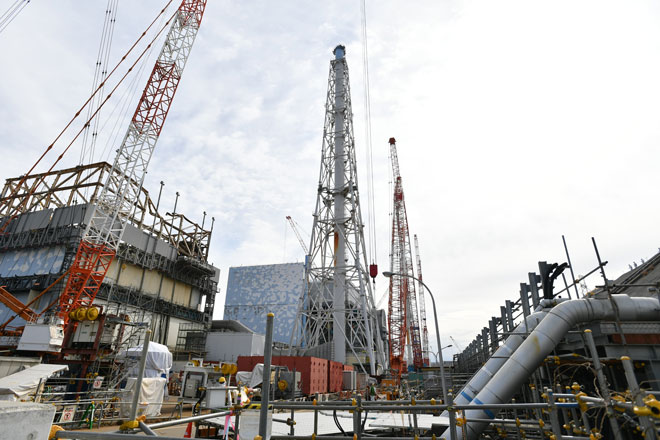
TEPCO to slice dangerous chimney at Fukushima plant http://www.asahi.com/ajw/articles/AJ201905100045.html, By CHIKAKO KAWAHARA/ Staff Writer, May 10, 2019 Tokyo Electric Power Co. plans to start work on May 20 to dismantle a 120-meter-tall, highly contaminated chimney that could collapse at the crippled Fukushima No. 1 nuclear power plant.
It will be the first highly radiated facility at the plant to be taken apart, the company said May 9.
The stack, with a diameter of 3.2 meters, was used for both the No. 1 and No. 2 reactors. TEPCO plans to remove the upper half of the chimney within this year to prevent the structure from collapsing.
The dismantling work will be conducted by remote control because the radiation level around the base of the chimney is the highest among all outdoor areas of the plant. Exposure to radiation at the base can cause death in several hours.
After the Great East Japan Earthquake and tsunami struck in March 2011, pressure increased in the containment vessel of the No. 1 reactor. Vapors with radioactive substances were sent through the chimney to the outside.
TEPCO also found fractures in steel poles supporting the chimney. The damage was likely caused by a hydrogen explosion at the No. 1 reactor building when the nuclear disaster was unfolding.
Since then, the chimney has been left unrepaired because of the high radiation levels.
Immediately after the nuclear accident, a radiation level exceeding 10 sieverts per hour was observed around the base of the chimney. In a survey conducted in 2015, a radiation level of 2 sieverts per hour was detected there.
TEPCO will use a large crane that will hold special equipment to cut the chimney in round slices from the top.
The company set up a remote control room in a large remodeled bus about 200 meters from the chimney. Workers will operate the special cutting equipment while watching footage from 160 video cameras.
Fukushima’s ghost towns
Nuclear wasteland Inside the ghost towns of Fukushima, Eight years on from the tsunami and nuclear meltdown, much of Japan’s Fukushima province remains derelict and deserted. Telegraph, 13 May 19
There was a chilling silence in the town of Tomioka in the days after the March 2011 Fukushima nuclear disaster.
Shoes were left in porches, half-read newspapers lay abandoned next to cups of tea, long gone cold. As night closed in on the seaside town, lights glared out from a few bare windows, while news of the ongoing crisis at the Fukushima No. 1 Nuclear Power Plant just six miles away drifted from a solitary radio.
Nobody was home.
Eight years on, little has changed. Before March 11, 2011 – the day the tsunami engulfed the nuclear facility, forcing the evacuation of more than 150,000 residents across the region – the town had a population of 15,960. Now, just a few hundred people have returned despite the lifting of the evacuation order in April 2017.
“Officially 835 have returned, but many are plant and other clean-up workers who are renting out abandoned houses,” says Takumi Takano, a local councillor who splits her time between Tomioka and temporary digs in Koriyama an hour’s drive away that she and her husband Kenichi have lived in since evacuating.
Of the remaining locals most are either elderly, or only return during the day, she says. Most worryingly, just 14 are children. When night falls, they return to “temporary” homes elsewhere, she says. “It’s like a ghost town.”
A similar situation is found throughout the entire evacuated region, where only 12,859 of the 100,510 residents who were living in the zone before the disasters have returned, a Cabinet Office official says. Like Tomioka, many of them are clean-up workers, local residents say.
…… After almost eight years, residents, especially those with young families, have settled elsewhere, securing new jobs and starting new schools or moving out of Fukushima entirely, says says Kenichi, a former worker at the devastated nuclear plant.. Many are put off returning by the severe shortage of medical facilities in the region.
Then there’s the radioactivity,” he says, as the couple sit outside their caravan, set up on the land of their recently demolished home, which backs on to a 130-square-mile “difficult-to-return-zone” that is still considered too highly contaminated to inhabit.
Eight years on, radioactivity levels have fallen in the reopened parts of Tomioka, though remain 20 times higher than before the disaster. “It’s much higher over there,” he says, pointing to the blockaded zone, where radiation levels exceed 3.8 microsieverts per hour – the designated threshold for issuing evacuation orders.
That zone is a legacy of the nuclear disaster, when multiple reactor meltdowns and explosions, triggered by a magnitude nine earthquake and towering tsunami, spread radioactive materials for hundreds of miles around……..
despite clean-up operations there to reduce radiation levels below the government-set target of 0.23 microsieverts (µSv) per hour, other legacies of the disaster – the crumbling houses and shops, corroding vehicles and overgrown fields, not to mention 16.5 million containers of contaminated earth collected at some 140,000 sites around the region – are impossible to avoid.
The 0.23 µSv figure is significant in that it adds up to an annual dosage level of one millisievert (mSv) (calculated on the premise that a resident spends eight hours a day outdoors), stipulated by the International Atomic Energy Agency as being safe for members of the public.
But while maintaining that level is complicated by recontamination from surrounding woodland, some experts argue the figure says little about the true dangers, or safety, of radiation exposure. That the Japanese government raised this to 20 mSv in the aftermath of the disasters adds weight to their argument…….
Misao Fujita, a doctor who performs thyroid scans at a clinic in Iwaki, about 30 miles south of the nuclear plant, says a connection between the cancers and radiation exposure cannot be ruled out and the screening effect is no reason to disregard the examinations.
“What we do know is that after Chernobyl, many children developed thyroid cancer, and if you take that into account and consider the high risk that Fukushima children were exposed to radiation then I think we should carry out such tests,” Dr Fujita says, adding that thyroid cancer normally occurs in one in one million children.
Noriko Tanaka, whose son is one of Dr Fujita’s patients, says exams revealing cysts in her son’s thyroid are a concern, not least because iodine-131 – a substance that causes thyroid cancer – was contained in the plume released by the Fukushima plant that landed on Iwaki after the disasters. At the time, she was pregnant with her son. “I worry because nobody knows for sure what the future holds,” she says……….
The issue of the one million tons of contaminated water being stored at the stricken nuclear plant is another worry for residents. After receiving assurances from Fukushima plant operator Tokyo Electric Power Company (TEPCO ) that the water had been successfully treated and stripped of all but one radioactive material, tritium, the government announced in 2017 it would start releasing the water into the ocean, despite protests, especially from local fisheries.
TEPCO released convoluted data to demonstrate the water’s safety, but was forced to backtrack last September when further tests showed the sums didn’t add up and 80 per cent of the water was in fact up to 20,000 times higher than the official safe threshold. Furthermore, it contained harmful radionuclides such as iodine, caesium and strontium.
Moreover, while the initial suggestion was that tritium was relatively harmless some studies have shown it to be a cause of infant leukaemia, says Ayumi Iida of NPO Tarachine, which independently analyses seawater samples taken from the ocean near Fukushima’s two nuclear plants.
“Tritiated water is easily absorbed and hazardous when inhaled or ingested via food or water,” she says. “There’s already data indicating infant leukaemia rates are higher near to nuclear plants, and tritium is known to cause DNA damage, so while there are claims that tritium is harmless, there are counterclaims it can adversely affect health, especially among young children.”…….
Shaun Burnie, a nuclear expert with Greenpeace says that discharging the water into the ocean is “the worst option” available, and one whose main consideration is economic.
“The only viable option, and it’s not without risks, is the long-term storage of the water in robust steel tanks over at least the next century, and the parallel development of water processing technology,” he says. ……….
“The reality is there is no end to the water crisis at Fukushima, a crisis compounded by poor decision-making by both TEPCO and the government,” says Mr Burnie.
Among more pressing issues, Mr Burnie says, is 400,000 cubic meters of sludge being stored within the Fukushima plant grounds that contains high concentrations of strontium – known as a “bone-seeker” because, if introduced into the body, it can accumulate in the bones in the same way as calcium does.
With the plant still generating waste, this sludge is expected to nearly double over the next 10 years, he adds.
Strontium releases into the environment from the plant were relatively small following the 2011 disaster, but significantly greater 30 months later, when in 2013 a large strontium-laced plume contaminated land as far away as Minamisoma – a city about 20 km from the plant, Mr Burnie says. Such an event could re-occur, he says.
“Is it a good idea to lift the evacuation orders? Absolutely not. The public are right to be concerned about the possibility of further offsite releases.”
They can also be forgiven for being sceptical over official reassurances that foodstuffs are safe, says Ms Iida of Tarachine, which also runs a produce-testing laboratory and has found “plenty” of items with levels of contamination exceeding the safe limits.
Meanwhile tests on samples of soil – which has no official safe threshold in Japan – have also revealed high levels of radiation in the area, she adds.
Namie’s Obori district, about six miles northwest of the nuclear plant and within the difficult-to-return-zone, is one place where soil radiation levels remain high. In woodland backing the pretty hamlet, which is famed for its pottery but has slowly surrendered to nature, the Telegraph recorded up to 127 µSv per hour – over 350 times the IAEA’s safe threshold……
Professor Kazuhiko Kobayashi at Sellafield, warns on nuclear radiation and danger to children
Radiation Free Lakeland 12th May 2019 Professor Kazuhiko Kobayashi has done ground breaking work with theUniversity of Tokyo on the impact of climate change on rice nutrition. This is important work and it has been widely featured in national and
international media.
Kazuhiko’s real passion however is to warn people
about the worst criminality against humankind: nuclear power and nuclear
weapons.
Kazuhiko organises respite for children and families who have been
impacted by the ongoing Fukushima disaster.
Members of Radiation Free Lakeland met up with Kazuhiko last autumn to show him the Sellafield area and he told us that there is money for climate research but not so much for
research into the impacts of radiation on our food and health. He is a kind
gentle man and he was visibly shocked to see the scale of Sellafield.
Kazuhiko broke down in tears within the shadow of Sellafield, at the
impacts the nuclear industry is having on our children’s health. His
passionate opposition to nuclear power and weapons, his work for change and
to help those impacted, is an inspiration.
Fukushima’s mothers became radiation experts to protect their children after nuclear meltdown
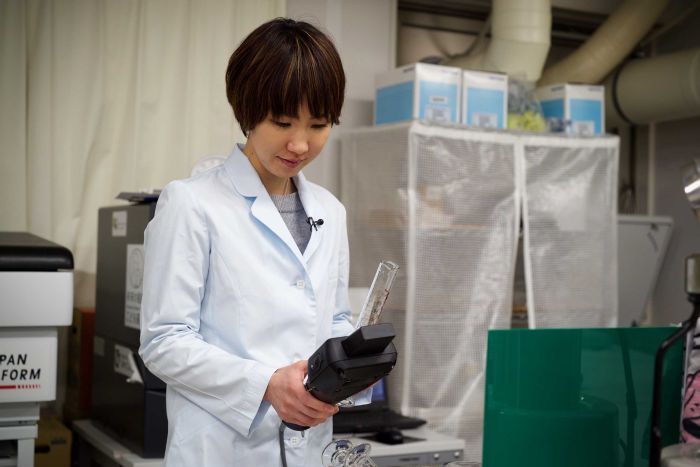
Key points:
- Mothers in Fukushima set up a radiation testing lab because they didn’t trust government results
- The women test food, water and soil and keep the public informed about radiation levels
- A major earthquake and tsunami caused a nuclear accident at the Fukushima power plant in 2011
They are testing everything — rice, vacuum cleaner dust, seafood, moss and soil — for toxic levels of radiation.
But these lab workers are not typical scientists.
They are ordinary mums who have built an extraordinary clinic.
“Our purpose is to protect children’s health and future,” says lab director Kaori Suzuki.
In March 2011, nuclear reactors catastrophically melted down at the Fukushima Daiichi plant, following an earthquake and tsunami.
Driven by a desperate need to keep their children safe, a group of mothers began testing food and water in the prefecture.
The women, who had no scientific background, built the lab from the ground up, learning everything on the job.
The lab is named Tarachine, a Japanese word which means “beautiful mother”.
“As mothers, we had to find out what we can feed our children and if the water was safe,” Ms Suzuki says.
“We had no choice but to measure the radiation and that’s why we started Tarachine.”
After the nuclear accident, Fukushima residents waited for radiation experts to arrive to help.
“No experts who knew about measuring radiation came to us. It was chaos,” she says.
In the days following the meltdown, a single decision by the Japanese Government triggered major distrust in official information which persists to this day.
The Government failed to quickly disclose the direction in which radioactive materials was drifting from the power plant.
Poor internal communications caused the delay, but the result was that thousands fled in the direction that radioactive materials were flying.
Former trade minister Banri Kaieda, who oversaw energy policy at the time, has said that he felt a “sense of shame” about the lack of disclosure.
But Kaori Suzuki said she still finds it difficult to trust the government.
“They lied and looked down on us, and a result, deceived the people,” Ms Suzuki says.
“So it’s hard for the people who experienced that to trust them.”
She and the other mothers who work part-time at the clinic feel great responsibility to protect the children of Fukushima.
But it hasn’t always been easy.
When they set up the lab, they relied on donated equipment, , and none of them had experience in radiation testing. There was nobody who could teach us and just the machines arrived,” Ms Suzuki says.
“At the time, the analysing software and the software with the machine was in English, so that made it even harder to understand.
“In the initial stage we struggled with English and started by listening to the explanation from the manufacturer. We finally got some Japanese software once we got started with using the machines.”
Radiation experts from top universities gave the mothers’ training, and their equipment is now among the most sophisticated in the country.
Food safety is still an issue
The Fukushima plant has now been stabilised and radiation has come down to levels considered safe in most areas.
But contamination of food from Japan remains a hotly contested issue.
Australia was one of the first countries to lift import restrictions on Japanese food imports after the disaster.
But more than 20 countries and trading blocs have kept their import ban or restrictions on Japanese fisheries and agricultural products.
At the clinic in Fukushima, Kaori Suzuki said she accepted that decision.
“It doesn’t mean it’s right or wrong. I feel that’s just the decision they have made for now,” she says.
Most results in their lab are comparatively low, but the mothers say it is important there is transparency so that people know what their children are consuming.
Fukushima’s children closely monitored after meltdown
Noriko Tanaka is one of many mothers in the region who felt that government officials were completely unprepared for the unfolding disaster.
She was three months pregnant with her son Haru when the disaster struck.
Ms Tanaka lived in Iwaki City, about 50 kilometres south of the power plant.
Amid an unfolding nuclear crisis, she panicked that the radioactive iodine released from the meltdown would harm her unborn child.
She fled on the night of the disaster.
When she returned home 10 days later, the fear of contamination from the invisible, odourless radioactive material weighed deeply on her mind.
“I wish I was able to breastfeed the baby,” she says.
“[Radioactive] caesium was detected in domestic powdered milk, so I had to buy powdered milk made overseas to feed him.”
Ms Tanaka now has two children —seven-year-old Haru and three-year-old Megu. She regularly takes them in for thyroid checks which are arranged free-of-charge by the mothers’ clinic.
Radiation exposure is a proven risk factor for thyroid cancer, but experts say it’s too early to tell what impact the nuclear meltdown will have on the children of Fukushima.
Noriko Tanaka is nervous as Haru’s thyroid is checked.
“In the last examination, the doctor said Haru had a lot of cysts, so I was very worried,” she says.
However this time, Haru’s results are better and he earns a high-five from Dr Yoshihiro Noso.
He said there was nothing to worry about, so I feel relieved after taking the test,” Ms Tanaka says.
“The doctor told me that the number of cysts will increase and decrease as he grows up.”
Doctor Noso has operated on only one child from Fukushima, but it is too early to tell if the number of thyroid cancers is increasing because of the meltdown.
“There isn’t a way to distinguish between cancers that were caused naturally and those by the accident,” he says.Dr Noso says his biggest concern is for children who were under five years old when the accident happened.The risk is particularly high for girls.
Even if I say there is nothing to worry medically, each mother is still worried,” he says.
“They feel this sense of responsibility because they let them play outside and drink the water. If they had proper knowledge of radiation, they would not have done that,” he said.
Mums and doctors fear for future of Fukushima’s children
After the Chernobyl nuclear disaster of 1986, the incidence of thyroid cancers increased suddenly after five years….
“In the case of Chernobyl, the thyroid cancer rate increased for about 10 years. It’s been eight years since the disaster and I would like to continue examinations for another two years.” …….
Some children, whose families fled Fukushima to other parts of Japan have faced relentless bullying.
“Some children who evacuated from Fukushima living in other prefectures are being bullied [so badly that they] can’t go to school,” Noriko Tanaka said.
“The radiation level is low in the area we live in and it’s about the same as Tokyo, but we will be treated the same as the people who live in high-level radiation areas.”
Noriko is particularly worried for little Megu because of prejudice against the children of Fukushima.
“For girls, there are concerns about marriage and having children because of the possibility of genetic issues.”
How Does the Olympics Clean Up? (Or, Is There an Olympics Without Cleaning Up?)
Under these circumstances, whether the unresolved issues of radiation, without appropriate treatment of nuclear power facilities, disaster victims lacking a place to reside, the forcible relocation of American army bases or the dispersal of the homeless, the Japanese media has relentlessly broadcast the Olympics.
“The Tokyo Olympics will take place in a state of nuclear emergency. Those countries and the people who participate will, on the one hand, themselves risk exposure, and, on the other, become accomplices to the crimes of this nation.”
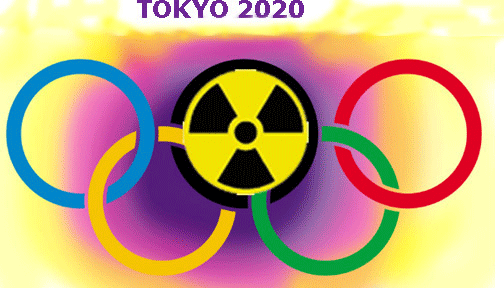
THE OLYMPICS CLEAN-UP: FUKUSHIMA, OKINAWA, HOMELESSNESS 陳黃金菊05/05/2019 ENGLISH INTERNATIONAL MAY 2019 How Does the Olympics Clean Up? (Or, Is There an Olympics Without Cleaning Up?)
Fukushima nuclear waste mess is by no means solved
THE OLYMPICS CLEAN-UP: FUKUSHIMA, OKINAWA, HOMELESSNESS 陳黃金菊05/05/2019 ENGLISH INTERNATIONAL MAY 2019 NUCLEAR PHYSICIST Hiroaki Koide has pointed out that although eight years have passed, there is still more than one million tons of irradiated water which still hasn’t been treated. The Tokyo Electric Power Company (TEPCO)’s “handling” method for this situation was to build a thousand sewage tanks to store the sewage. But as space was limited and the number of sewage tanks was also limited. As such, Koide asserts, “TEPCO will be compelled to release these waters into the sea in the near future.” [1] Moreover, with regards to the core meltdown of the reactor, the melted fuel rods remain unaccounted for.
As such, Koide has been staunch in advocating that the only solution to the Fukushima incident is a Chernobyl-style sarcophagus, covering the nuclear power plant. But he also admits, even in this case, “the containment of this disaster will not have been achieved even after all who are alive today have died.” [2]
Abe Shinzo issued an order for an end to an evacuation on April 1st, 2017, at the same time as he issued a compulsory repatriation policy. At this time, the town of Namie, 11.2 kilometers from the Fukushima nuclear power plant, has been described as a “ghost town.” As raised by now deceased mayor Baba Yushi before he died, after the end of the evacuation, 234 people—one percent of the population—returned to Namie to live. The majority of these were elderly, which is to say, the town lacked a working population. Without any means of transportation and open supermarkets. There was just one clinic. [3]
As a compensatory measure in line with the repatriation measure, TEPCO set a deadline, requesting that disaster victims assess their losses, and inform TEPCO of what kind of compensation they requested. Regarding this, the mayor of Namie stated that TEPCO never should have set this kind of deadline, but should account for the losses of disaster victims themselves.
What is even more incredible is that TEPCO could use “individual circumstances” as a way of avoiding the requests of disaster victims. For example, residents in twenty kilometers of the nuclear power plant were forcibly evacuated but TEPCO interpreted this instead as “voluntary evacuation”, and refused to pay compensation. [4] Even those who lost their real estate might not receive compensation, not to mention harms that could not be compensated for, such as those below the age of eighteen whose thyroids were inspected five years later, among them 172 were positive for or suspected of having thyroid cancer, and 131 had their thyroid glands removed by operation. [5]
At the same time, damages to the environment cannot be compensated. Who is it that would receive compensation? What kind of compensation would that be? Before the disaster, Fukushima’s agricultural industry and natural environment were comparatively famous. But after the disaster, farmers have been forced to the end of a rope, some of which have chosen death. [6] Completely clearing radiation from the land is also impossible, because in clearing remaining radiation in the forest, this would require cutting down all of the trees, and removing all of the topsoils. [7]
Protests by those who have developed thyroid cancer were criticized by the government, stating that their protests were causing “reputational damage”.[8] The government and TEPCO toss the ball to each other, and what is even stranger is that nobody seems to need to take responsibility. [9]…………..https://newbloommag.net/2019/05/05/olympics-fukushima-okinawa-eng/
1] See “The Fukushima Nuclear Disaster and the Tokyo Olympics”.
[2] Ibid.
[3] See “‘Save the Town’: Insolvable Dilemmas of Fukushima’s ‘Return Policy’”.
[4] Ibid.
[6] See the Green Citizen Action Alliance’s report “Environmental Front: Subscribing to 311 compensation” (〈環境前線:前仆後繼的311核災求償行動〉).
[7] See “Reconstruction Disaster: The human implications of Japan’s forced return policy in Fukushima”
[8] Ibid.
[9] See Tetsuya Takahashi’s book, Xisheng te tixi: Fudao ‧ Okinawa (2014, lit. The System of Sacrifice: Fukushima‧Okinawa), trans. Lee Yi-zhen.
[10] One can see the report “Decoding the US Military Bases in Japan with 9 Graphs” (九張圖解密日本美軍基地) in the News Lens and “Okinawa Government Sued by Japanese Government for ‘the Most Dangerous Military Bases’” (為了「全世界最危險的軍事基地」,沖繩縣政府被日本政府一狀告上法庭──觀光客看不到的美軍基地問題) in Crossing.
[11] One can see the report in UDN Global, “Okinawan Referendum: Say No to the US Military Again? The People Neglected by the Japanese Government” (沖繩基地公投:再次向美軍說NO?日美政府無視的43萬民意).
[12] See the editorial, “Henoko project clearly doomed; time to open talks with U.S” in Asahi and “US Military Base Threatens Biodiversity in Okinawa” in Truthout
1 This Month

25 June- THE PUKE ON NUKES
Thursday, June 25, 2026
7pm Central Time (8pm ET, 6pm MT, 5pm PT) UTC – 5
From NRC & DOE Deregulation to Techno-Fascist Billionaires Going Nuclear, Plus a Few Songs from Atomic Cabaret REGISTER
26 June – Radiation Trainwreck at the NRC / Join the Protect Better Campaign – https://us02web.zoom.us/meeting/register/4ZlZ5_qLSHGiLSCg8FF6Bg#/registration

1st July – Webinar Waste of Space: The Environmental Harm of Military and Civil Space Activity st July, 7 pm
Report Launch Online: We are seeing an increasing exploitation of space for military and commercial purposes. This must change.

Protect Sazan Island from the Trump family! https://secure.avaaz.org/campaign/en/protect_sazan_island_from_the_trump_family_loc/?bqFCVab&v=174511&cl=22707147157&_checksum=5e9dde668860e8231c33699735e16a1fbf22ab2cb01da50c999fe8732b9775ef&utm_source=email&utm_medium=blast_email&utm_campaign=174511


Cuba Is Not a Failed State – It Is a Besieged State
PETITION: “Global Appeal to Endorse Palestinian Right of Return of Refugees”
To see nuclear-related stories in greater depth and intensity – go to https://nuclearinformation.wordpress.com
-
Archives
- June 2026 (230)
- May 2026 (306)
- April 2026 (356)
- March 2026 (251)
- February 2026 (268)
- January 2026 (308)
- December 2025 (358)
- November 2025 (359)
- October 2025 (376)
- September 2025 (257)
- August 2025 (319)
- July 2025 (230)
-
Categories
- 1
- 1 NUCLEAR ISSUES
- business and costs
- climate change
- culture and arts
- ENERGY
- environment
- health
- history
- indigenous issues
- Legal
- marketing of nuclear
- media
- opposition to nuclear
- PERSONAL STORIES
- politics
- politics international
- Religion and ethics
- safety
- secrets,lies and civil liberties
- spinbuster
- technology
- Uranium
- wastes
- weapons and war
- Women
- 2 WORLD
- ACTION
- AFRICA
- Atrocities
- AUSTRALIA
- Christina's notes
- Christina's themes
- culture and arts
- Events
- Fuk 2022
- Fuk 2023
- Fukushima 2017
- Fukushima 2018
- fukushima 2019
- Fukushima 2020
- Fukushima 2021
- general
- global warming
- Humour (God we need it)
- Nuclear
- RARE EARTHS
- Reference
- resources – print
- Resources -audiovicual
- Weekly Newsletter
- World
- World Nuclear
- YouTube
-
RSS
Entries RSS
Comments RSS
 nuclear-news