Stop the Next President From Waging the Next War http://www.counterpunch.org/2016/10/18/stop-the-next-president-from-waging-the-next-war/ by ZOLTAN GROSSMAN 91 Oct 16 Hillary Clinton now says her “number one priority” in Syria is the removal of Bashar al-Assad, putting us on the path of war with Syria and Russia next year. Whether or not you are voting for her, you should commit yourself to stopping her from this insanity, which President Obama wisely averted in 2013. Syria and Russia are indeed committing war crimes in Aleppo, but if you’re tempted to buy in to a “no-fly zone” or “humanitarian intervention” against Syrian, Russian, and Iranian forces, consider these ten facts and observations:
1/ We never hear about the atrocities committed by the Sunni rebel forces backed by the U.S., including the Al Qaeda-aligned Islamists that are now tacitly included in the rebel ranks. A sudden regime change in Syria will result in these forces being in charge, and fighting each other for power. Some victorious rebels would commit ethnic/sectarian cleansing against Alawites, Christians, and Kurds, causing many of these and other minorities to fear the rebels as much as the Sunni majority fears Assad. Yes, the war can and will get even worse with more outside intervention.
2/ Any “no-fly zone” over Syria will certainly be followed by the shooting down of both Russian and U.S. jets, in an unpredictable escalation that could easily spread elsewhere in the region or world. Bombing Syrian/Russian forces would result in more civilian deaths, not fewer civilian deaths. In a leaked 2013 transcript, Hillary admitted, “To have a no-fly zone, you have to take out all of the air defense, many of which are located in populated areas. So our missiles, even if they are standoff missiles so we’re not putting our pilots at risk– you’re going to kill a lot of Syrians.”
3/ The U.S. is actively aiding Saudi bombing of Houthi rebels in Yemen, with devastation and civilian deaths that differs little from the Syrian/Russian bombing of Aleppo. The U.S. just directly launched missiles against the Houthis, embroiling us in a very dangerous part of the regional proxy war between Saudi Arabia and Iran. State Department spokesperson John Kirby became tongue-tied when reporters asked him to define the difference between the Russian in Syria and the Saudis in Yemen.
4/ The U.S. has around 800 foreign military bases around the world. Russia has exactly two bases outside former Soviet territory–both of them in Syria. Putin is trying to emulate what the U.S. did in Iraq and Afghanistan, by establishing Russia as a regional and global power. Russia is doing exactly what the U.S. did in Panama–brazenly intervene in the affairs of a country that hosts its bases. The U.S. has zero legitimacy to criticize an upstart in global imperialism, or to demonize Russia for committing the same atrocities that U.S. forces did in Fallujah and elsewhere.
5/ Russia will not back down if we start shooting down its aircraft. Putin was the “Butcher of Grozny” in Chechnya (as the West turned a blind eye), and has intervened against nationalist governments in Georgia and Ukraine. He will pivot to somewhere else in the world–arming Iran, establishing a naval base in Egypt, or threatening Latvia. One way to lessen his popular appeal is to stop feeding into his nationalist propaganda that NATO is encircling Russia and tacitly backing fascists and ultranationalists on its borders. He only thrives politically when the West’s military pressure increases, and he can portray himself as standing up to NATO. Both Russia and Iran also thrive when U.S. and Israeli saber-rattling drives up global oil prices.
6/ The practice of “humanitarian intervention” upholds double standards that only highlight atrocities by the other side and not by U.S. allies. Bill Clinton’s bombings in Bosnia and Kosovo stopped ethnic cleansing by Serbian forces, but actively enabled ethnic cleansing by Croatian and Albanian militias. Obama’s bombing of Libya to supposedly “save” Benghazi ended up turning Libya into a free-fire zone. It wasn’t stepping in as a neutral party, but taking sides in a civil war and prolonging it. A real “humanitarian intervention” would order all sides to freeze in place, not attack one human rights abuser in favor of another.
7/ The U.S. seems to want to rubberstamp the partition of Syria into ethnic/sectarian enclaves as part of a “settlement,” just as it did in Yugoslavia and to a large extent in Iraq. Partition does not bring lasting peace, as the examples of Palestine and India demonstrate. Regional autonomy is helpful to build peace, but communities and even families are too mixed together historically to allow for a “clean” territorial separation without massive violence and genocidal ethnic/sectarian cleansing. But it helps neoliberal capital to have large multiethnic states divided into more easily controllable mini-states.
8/ There have been many paths not followed in bringing peace to Syria since the genuine democratic revolution against Assad began in 2011. There has never been a choice between “doing something” and “doing nothing.” The U.S. and Israel could stop supporting Sunni Islamist rebels in return for Russia and Iran holding back the worst of Assad’s Alawite-led military atrocities, and vice versa. They could both support the Kurds’ valiant defense against ISIS, instead of selling them out (once more) to the Turkish military. They could engage with Syrian civil society that began the revolution, instead of only arming the militaries and militias. They could negotiate for a regional deescalation and coalition government that guarantees minority rights, and allows Syrians to focus on the real threats of ISIS and the economic ruin of war.
9/ The regime change in Iraq will look like small potatoes, if the new Administration tricks the American people into allowing a so-called “humanitarian intervention” in Syria. We could very quickly get involved in a full-blown regional war–with the U.S., Saudi Arabia, Israel, Gulf states, and Syrian, Iraqi, and Yemeni Sunnis on one side, and Russia, Iran, Syria, Iraqi Shi’as, Hezbollah, and Houthis on the other side. The region is a powder keg, with entangled alliances much like Europe on the eve of World War I. It wouldn’t take much for that nightmare to escalate into a nuclear confrontation. Russia is clearly mobilizing for a possible conflict, and signaling its warnings through state media and civil defense exercises, but we haven’t been told by our leaders how risky the situation has become.
10/ A lot more is at stake in Syria in 2017 than in Iraq in 2003.
The Iraq War never had the potential of escalating into a full-blown war with Russia and Iran, or triggering a nuclear confrontation. And since both Hillary Clinton and Donald Trump uncritically accept Benjamin Netanyahu’s view of Iran as the main enemy in the Middle East, Israel and the Gulf States will be unleashed next year to restart military brinkmanship with Iran, which could also bring us to the gates of hell.
It is possible to stand against Assad and Putin, and still oppose wars waged by Clinton or Trump that will inflame the Middle East. Whoever wins on November 8th, the names of the losing candidates will quickly fade. Our “number one priority” the next day should be to stop the new president from taking us down the path of a new major war.
October 19, 2016
Posted by Christina Macpherson |
2 WORLD, USA, weapons and war |
Leave a comment
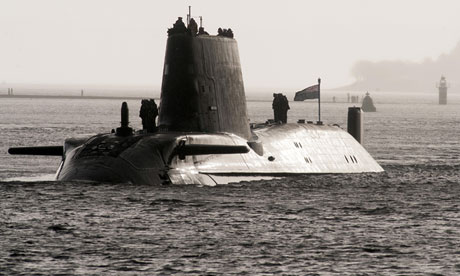
 Navy’s old nuclear submarines ‘will not be finally disposed of until after 2040’, Telegraph, Ben Farmer, defence correspondent 18 OCTOBER 2016
A lack of money, expertise and disposal sites mean derelict British nuclear submarines containing radioactive material will not be fully dismantled and disposed of for 25 years, officials have admitted.
The Royal Navy has 19 old nuclear-powered submarines stored in ports waiting to be dismantled, with another eight due to retire and join them in the coming years.
HMS Dreadnought, the Navy’s first nuclear-powered submarine, has been waiting to be dismantled since it retired 36 years ago. Ministry of Defence officials told MPs that radioactive parts on board could not be finally disposed of until an underground dump for all of the UK’s nuclear waste has been chosen and built. That site is not due to be ready until 2040.
The submarines are currently stored at Devonport, near Plymouth, and at Rosyth, on the Firth of Forth.
Stephen Lovegrove, permanent secretary at the MoD, told the Commons defence committee that a lack of money and skills meant it was impossible to speed up the process……..Ministry of Defence officials told MPs that radioactive parts on board could not be finally disposed of until an underground dump for all of the UK’s nuclear waste has been chosen and built. That site is not due to be ready until 2040.
The submarines are currently stored at Devonport, near Plymouth, and at Rosyth, on the Firth of Forth.
Stephen Lovegrove, permanent secretary at the MoD, told the Commons defence committee that a lack of money and skills meant it was impossible to speed up the process…..http://www.telegraph.co.uk/news/2016/10/18/navys-old-nuclear-submarines-will-not-be-finally-disposed-of-unt/
October 19, 2016
Posted by Christina Macpherson |
wastes, weapons and war |
Leave a comment
US Prepares For Nuclear War, Air Force Drops Two Faux Nukes, Popular Resistance, by Marcus Weisgerber, www.defenseone.com October 8th, 2016 The tests in the Nevada desert come as tensions rise with Russia and the Pentagon seeks to replace its aging nuclear arsenal.
A pair of U.S. Air Force B-2 bombers dropped two 700-pound faux nuclear bombs in the middle of the Nevada desert within the past few days. Now the Pentagon wants to tell you about it.
Conducted “earlier this month,” according to an Oct. 6 press release, the test involved two dummy variants of the B61, a nuclear bomb that has been in the U.S. arsenal since the 1960s. One was an “earth penetrator” made to strike underground targets, the other a tactical version of the B61. Neither carried an actual warhead.
“The primary objective of flight testing is to obtain reliability, accuracy, and performance data under operationally representative conditions,” said the statement from the National Nuclear Security Administration, the Energy Department arm that oversees such tests. “Such testing is part of the qualification process of current alterations and life extension programs for weapon systems.”
But why now? Perhaps it has to do with tensions with Russia, which are higher than they have been in decades, and which have sparked fears of a new nuclear arms race. Earlier this week, the Russian government announced it would conduct a massive drill to prepare its citizens for nuclear war.
But it may also have to do with the Pentagon’s quest to replace its decades-old nuclear arsenal with new bombs and delivery vehicles, an endeavor whose price tag tops several hundred billion dollars. The Air Force, for one, has been making its case for new intercontinental ballistic missiles and a nuclear cruise missile. At an Air Force Association conference in the Washington suburbs last, Boeing touted its work on the Minuteman III ICBM, mounting large-scale models of the long-range missiles front and center in its sprawling display area………
Last year, the Air Force inked a deal with Northrop Grumman to build a new long-range, stealth bomber — recently named the B-21 Raider — that will eventually be equipped to carry nuclear weapons. At the same time, the Navy is preparing to buy 12 newColumbia-Class submarines that will replace the Ohio-Class, which can launch nuclear missiles.
The total price tag for the all of the new nuclear weapons is projected to cost between $350 billion to $450 billion over the next two decades. https://www.popularresistance.org/us-prepares-for-nuclear-war-air-force-drops-two-faux-nukes/
October 19, 2016
Posted by Christina Macpherson |
USA, weapons and war |
Leave a comment
The Hidden Defect In U.S. Nuclear Strategy That Could Spell America’s Doom, The National Interest, 18 Oct 16
“………aside from a very minimal collection of radars and interceptors on the West Coast designed to deal with North Korea, America has no strategic defenses.
What it has is offenses — about 1,500 nuclear warheads distributed in hardened silos, stealthy submarines and long-range bombers. These forces are known as the nuclear “triad;” along with flying command centers, secure communications satellites and aerial-refueling tankers, the triad is designed to make any act of nuclear aggression potentially suicidal for the perpetrator. The plan is to respond proportionately to any level of nuclear aggression, and make that plan abundantly clear to any nation that might contemplate an attack.
The assumption is that no sane leader would deliberately launch an attack knowing the retribution that would follow. That seems logical enough, but think about the other ways a nuclear exchange might occur. What if we find ourselves facing an irrational adversary with nuclear weapons? What if the other side is rational, but suffers a mechanical failure in its command system? What if it misreads U.S. intentions in a crisis such as war in Eastern Europe? What if parts of its nuclear arsenal are seized by elements intent on fomenting war?
These are not just science-fiction scenarios. The Russian early-warning network of satellites and ground-based radars is so fragile that it could easily fail, or result in mis-interpretation of threat data. If Moscow seriously thought it was under attack, it would be strongly incentivized to launch quickly before its weapons were destroyed on the ground. That might well signal the end of American civilization,…….
If Washington had spent as much money over the last 15 years on protecting our homeland as it has spent on trying to fix Afghanistan, America would be well on its way to having defenses against nuclear attacks — no matter how or where they originated. Instead, the United States remains vulnerable to the one threat that could destroy our civilization before sunset. This may be the greatest strategic mis-calculation in history, and the next president needs to focus on correcting it.
Loren B. Thompson is Chief Operating Officer of the non-profit Lexington Institute and Chief Executive Officer of Source Associates, a for-profit consultancy. Prior to holding his present positions, he was Deputy Director of the Security Studies Program at Georgetown University and taught graduate-level courses in strategy, technology and media affairs at Georgetown. He has also taught at Harvard University’s Kennedy School of Government. http://nationalinterest.org/blog/the-buzz/the-hidden-defect-us-nuclear-strategy-could-spell-americas-18083?page=2
October 19, 2016
Posted by Christina Macpherson |
USA, weapons and war |
Leave a comment
 US citizens warned to prepare for NUCLEAR WAR over claims attack warning upgraded THE US could be edging ever closer to nuclear war with Russia after upgrading its attack defence readiness, it has been claimed. http://www.express.co.uk/news/world/721603/US-nuclear-attack-warning-upgraded-DEFCON-3-Vladimir-Putin-Russia-WW3 By VICKIIE OLIPHANT Oct 16, 2016 DEFCON is an alert system used by the US military to indicate the current threat of nuclear war.
The system has five states of alert, increasing in severity from DEFCON 5 – the least severe – to DEFCON 1 – the highest level. Currently, the levels is understood to be at 5.
But conspiracy theorists have warned the threat has secretly been upgraded two levels to DEFCON 3 – meaning the US could mobilise troops in as little as 15 minutes. The level was last upgraded to 3 in the aftermath of September 11, 2001 – with standby ordered for a potential rise to DEFCON 2.
Now website DEFCON warning system claim it has been upgraded again in a terrifying revelation.
While there are currently no imminent threats to the US, it claimed the situation is “fluid and can change rapidly.” However it also highlighted the dying relationship between the US and Russia, citing concerns of all-out warfare between the bitter rivals. A statement posted on its website read: “Tensions between Russia and the United States have reached levels beyond the cold war in the recent week.
“The situation between Russia and the United States is extremely fluid at the moment. In all likelihood as dynamic as at times during the Cuban Missile Crisis of 1962.
“At this time, the DEFCON Warning System feels that an increase to DEFCON 3 would be a prudent move.” Russian citizens have been encouraged to find bomb shelters and gas masks today, as state-sponsored infomercials on television gave out guidelines on how people should prepare for a nuclear attack.
President Vladimir Putin meanwhile has ordered the evacuation of 40 million people in a military drill.He also transferred nuclear-capable Iskander ballistic missiles to one of its strategic Baltic regions last week, in what officials claim was part of regular military manoeuvres.
However many world leaders fear the moves are being carried out in preparation for war. The conspiracy theory site warned citizens to prepare for any potential conflict, saying: “This is a very sensitive situation which has the potential to spiral out of control.
“It is recommended that all citizens learn the steps to be taken in the event of nuclear war.”
Theorists have even claimed a move to DEFCON 2 is being muted, based on Putin’s call for Russians to return home.
Though the threat of war seems to be rising, the DEFCON level indication reported by the website is only speculation. The US military do not share the actual DEFCON status with the public for obvious security reasons.
October 18, 2016
Posted by Christina Macpherson |
Russia, USA, weapons and war |
Leave a comment
North Korean Missile Reportedly Explodes Soon After Liftoff North Korea failed in attempt to launch a midrange Musudan missile, U.S. and South Korea Say Associated Press WSJ, Oct. 16, 2016 WASHINGTON—South Korea and the U.S. said Sunday that the latest missile launch by North Korea ended in failure after the projectile reportedly exploded soon after liftoff.
The South Korean Joint Chiefs of Staff said in a statement that the military believed the North unsuccessfully attempted to fire a midrange Musudan missile. It said the failed launch occurred near an airport in North Pyongan province.
South Korea’s Yonhap News Agency said that the missile was believed to have exploded soon after liftoff. Yonhap cited no source for this information.
South Korea strongly condemns the launch because it violates United Nations Security Council resolutions that ban any ballistic activities by North Korea, the statement said……….
North Korea has claimed technical breakthroughs in its goal of developing a long-range nuclear missile capable of reaching the continental U.S. However, South Korean defense officials have said the North doesn’t yet have such a weapon.
The failed launch was the latest in a series of moves by North Korea apparently aimed at displaying a show of force. As recently as last month, it fired three ballistic missiles off its east coast, timed to get the attention of world leaders including President Barack Obamawho were visiting the region for a series of summits. The U.N. Security Council subsequently condemned those North Korean launches and threatened “further significant measures” if it refused to stop its nuclear and missile tests.
North Korea also conducted its fifth nuclear test last month and in all has launched more than 20 ballistic missiles this year, part of its program aimed at improving the delivery system for nuclear weapons. Earlier this year, North Korea successfully launched a Musudan missile in June after several failed attempts…….. http://www.wsj.com/articles/u-s-detects-failed-north-korean-missile-launch-1476572239
October 18, 2016
Posted by Christina Macpherson |
North Korea, weapons and war |
Leave a comment
| Putin preps Russians for nuclear war; civilians advised to check bomb shelters and prepare gas masks. INQUSITR, John Thomas Didymus, 15 Oct 16 |
|
|
President Vladimir Putin of Russia is sending a clear signal to the U.S. and its Western allies that he is ready for a military showdown with the West over the ongoing clash of geostrategic interests in Syria. Following the spiraling of tensions between Moscow and Washington to their highest since the Cold War, the Russian government has been issuing instructions to civilians through the state-controlled media about what to do in the event that war breaks out with the West and the “Motherland” comes under direct attack.
The Russian authorities have directed civilians to check and familiarize themselves with the nearest bomb shelters and to prepare their gas masks, according to ABC News. Officials have also issued detailed instructions on how to prepare for a nuclear attack and what to do in the event of an attack.
The latest disquieting set of instructions to civilians and related actions in recent weeks by the Russian authorities ostensibly in preparation for war have grabbed the attention of global analysts who are scrutinizing them to decipher the underlying motives of the Kremlin.
Most analysts believe that despite Moscow’s elaborate and dramatic posturing to the rest of the world that it is preparing for a major global conflict that could involve deployment and use of nuclear arms, Putin is not actually preparing to launch a war against the U.S. and its allies. He is only engaging in tactical responses to ongoing speculation that Washington is considering seriously a plan to launch airstrikes against Syrian government forces.
The chain of events that led directly to the present situation was initiated after the U.S. suspended bilateral consultations with the Russians over Syria, with U.S. officials alleging that the Russians had failed to fulfill a commitment to curtail ongoing aerial and ground assaults on the eastern districts of Aleppo held by rebel forces.
The U.S. authorities also formally accused the Russian government of waging cyber warfare against U.S. institutions, including the Democratic National Committee (DNC) and the Hillary Clinton campaign, the Inquisitr reported.
U.S. intelligence officials later told NBC News that the CIA was preparing to launch a series of retaliatory cyber-attacks against the Russian government. The CIA sources said the attacks were being designed specifically to disable the capacity of the Russians to use cyber warfare to disrupt presidential voting in November.
According to NBC News, the CIA sources said the agency “has already begun opening cyber doors, selecting targets and making other preparations for an operation.”
“We are sending a message to Putin and that it will be at the time of our choosing, and under the circumstances that will have the greatest impact,” Vice President Joe Biden reportedly said.
Tensions rose further following speculation that Washington was planning to launch aerial strikes against the forces of President Bashar Al-Assad in an attempt to stop ongoing assault against Aleppo and force the Syrian government to consider resuming negotiations.
Russia reacted to the speculation, warning sternly that the U.S. should consider “the possible consequences” of launching airstrikes against government forces in Syria. The Russian defense ministry threatened that it would shoot down U.S. and coalition jets attempting to launch attacks against forces of Syria’s President Bashar Al-Assad.
The Russians warned that they had deployed S-300 VM air defense systems in Syria that have the capability to shoot down U.S. fighter jets. They warned that any airstrikes against Syrian government forces would be construed as an attack against Russian forces on the ground.
Russian S-300VM Antey-2500 missile system [Image by Vitaly V. Kuzmin/CC BY-SA 4.0/Resized/Wikimedia]
“Today, the Syrian army has effective S-200, BUK and other air defense systems, which have undergone technical renovation in the past year,” Major General Igor Konashenkov said. “I [also] remind US strategists that air cover for the Russian military bases in Tartus and Hmeymim includes S-400 and S-300 anti-aircraft missile systems, the range of which may come as a surprise to any unidentified flying objects.”
The Russian government followed up the stern warnings by stepping up preparations for war and issuing instructions to civilians about how to prepare for a nuclear attack, including what to do in the event of direct attack against the “Fatherland.”
“If that [nuclear attack] should one day happen, each of you must know where the nearest bomb shelter is,” the government instructed civilians in a broadcast by the state-controlled NTV.
The broadcast also took Russians on a familiarization tour of nuclear bunkers in Moscow and advised civilians to have their gas masks ready.
Earlier in the month the authorities had held a large-scale civil defense drill involving 40 million citizens. The authorities issued information about how government would operate in the event of a war and which government bodies would be in charge of different areas of public affairs.
image: data:image/svg+xml;base64,PHN2ZyB4bWxucz0naHR0cDovL3d3dy53My5vcmcvMjAwMC9zdmcnIHZpZXdCb3g9JzAgMCA2NzAgNDQzJz48L3N2Zz4=
Putin’s government has warned the U.S. that it will shoot down U.S. jets attempting to attack government forces in Syria [Image by Plavevski/Shutterstock]
In the midst of the drills, the authorities deployed nuclear-capable Iskander missiles to Kaliningrad on the Baltic Sea, close to the Lithuanian and Polish borders. The move, which rattled the Polish authorities, brought major Western European cities, including Berlin, within reach of Russian nuclear strike.
The Defense Minister of Poland Antoni Macierewicz said the Polish authorities were highly concerned about the development and were monitoring the situation.
The Russians had earlier conducted a series of ICBM tests in the Sea of Okhotsk and the Barents Sea, RIA Novosti reported.
The tensions escalated even further when Putin suddenly canceled a planned visit to France scheduled for October 19, following a row that flared after President Francois Hollande lashed out at Moscow over its role in Syria, the Inquisitr reported.
The French government reportedly said it was considering requesting that prosecutors with the International Criminal Court investigate alleged war crimes by Russia and the Syrian government in rebel-held parts of Aleppo.
There was widespread bemusement in Russia when news broke soon after the row with France that the Kremlin had issued a directive to state officials to bring home all relatives living abroad.
The authorities warned that officials who failed to heed the warning could be overlooked for promotion, the Inquisitr reported.
According to analysts, Moscow’s posturing to the rest of the world that it is preparing for war is designed to boost popular support for Putin at home as tensions rise and to signal to the West that Russia will stand its ground in Syria in the event of U.S. intervention.
Kremlin strategists apparently believe that sending a strong message that Russia will not back down with regard to its perceived geopolitical interests will dissuade the U.S. and its allies from trying to stop Russian bombing in Syria.
Other analysts believe that Russia’s apparent preparation for war, less than four weeks away from the U.S. presidential election, is not a coincidence.
It streamlines with the Kremlin’s overall subtle message to Americans to vote for change by electing the Republican presidential candidate Donald Trump rather than the Democratic presidential candidate Hillary Clinton.
The Kremlin intends to get the message across to American voters that “a vote for Clinton is a vote for war with Russia,” because Clinton is expected to continue and possibly even intensify the foreign policy drives of the Obama administration that Moscow is bitterly opposed to. http://www.inquisitr.com/3598031/putin-preps-russians-for-nuclear-war-civilians-advised-to-check-bomb-shelters-and-prepare-gas-masks/ |
October 18, 2016
Posted by Christina Macpherson |
Russia, weapons and war |
Leave a comment
 Cyber-attacks Against Nuclear Plants: A Disconcerting Threat INFOSEC Institute, Pierluigi Paganini OCTOBER 14, 2016 A cyber-attack against critical infrastructure could cause the paralysis of critical operations with serious consequences for a country and its population.
In a worst case scenario, a cyber-attack could affect processes that in case of fault could cause serious damages and consequent losses of human lives.
Let’s think for example to a refinery or a nuclear plant, in both cases; a cyber-attack represents a threat to the infrastructure, its processes, and people that work within.
Nuclear plants are critical components of any countries; critical functions depend on their operations, and an incident could have dramatic effects on the population.
Is a cyber-attack against a nuclear plant a possible event?
Unfortunately, the response is affirmative. Nuclear plants are composed of an impressive number of components such as SCADA/ICS, sensors and legacy systems that could be hit by a hacker.
The most popular case of a cyber-attack against a nuclear plant is Stuxnet, which was launched more than five years ago. Stuxnet is the malware developed by experts from the US and Israel with the intent of destroying the Iranian nuclear program. Nation state hackers hit the plant of Natanz in Iran in 2010 interfering with the nuclear program of the Government of Teheran.
The Stuxnet targeted a grid of 984 converters, the same industrial equipment that international inspectors found out of order when visited the Natanz enrichment facility in late 2009.
The cyber-attack against the Cascade Protection System infects Siemens S7-417 controllers with a matching configuration. The S7-417 is a top-of-the-line industrial controller for big automation tasks. In Natanz, it is used to control the valves and pressure sensors of up to six cascades (or 984 centrifuges) that share common feed, product, and tails stations” states “A Technical Analysis of What Stuxnet’s Creators Tried to Achieve” written by the expert Ralph Langner.
Stuxnet was designed with a number of features that allowed to evade detection; its source code was digitally signed, and the malware uses a man-in-the-middle attack to fool the operators into thinking everything is normal.
Stuxnet is the demonstration that it is possible to use a malicious code to destroy operations at a nuclear plant.
In the last years, security experts and authorities confirmed at least three cases of cyber-attacks against Nuclear plants.
Who are the threat actors that could hit a nuclear plant?
There are many actors, such as cyber criminals, hacktivists, nation-state actors, cyber terrorists and script kiddies, that are threatening critical infrastructure worldwide
Let’s see which are the principal incidents that affected nuclear plants in the last years.
The incidents
According to the Director of the International Atomic Energy Agency (IAEA), Yukiya Amano, a nuclear power plant in Germany suffered a “disruptive” cyber-attack two to three years ago……..
This isn’t the first time that we receive the news of cyber-attacks on nuclear plants. There are three publicly known attacks against nuclear plants:
It is likely that Amano was referring the cyber-attack against the Gundremmingen nuclear plant that occurred earlier this year. Security experts, in that case, discovered the presence of the Conficker and Ramnit malware in the target systems……
2014 – Malware based attack hit Japanese Monju Nuclear Power Plant
On January, 2nd 2014 one of the eight computers in the control room at Monju Nuclear Power Plant in Tsuruga, Japan, was compromised by a cyber-attack. The local IT staff discovered that the system in the reactor control room had been accessed over 30 times in a few days. The experts observed the intrusion started after an employee updated a free video playback application running on one of the computers in the plant…….
Cyber-attacks against the organizations operating in the Energy industry were already observed in the past, in 2012 the Japan Atomic Energy Agency was targeted by a cyber-attack that compromised a computer at the JAEA headquarters at Tokaimura by infecting it with malware.
2014 – Nuclear plant in South Korea hacked
In December 2014, the South Koran government revealed that a nuclear plant in the country was hacked. …..
2016 – A malware infected systems at the Gundremmingen nuclear plant in Germany
In April 2016, the German BR24 News Agency reported the news of a computer virus that was discovered at the Gundremmingen nuclear power plant in Germany……..The experts involved in the investigation discovered the presence of the Conficker and W32.Ramnit malware in unit B of the Gundremmingen. Conficker is worm with the ability of rapidly spreading through networks, while W32.Ramnit is a data stealer.
The RWE also added that malware had been found on 18 removable data drives, mainly USB sticks, in office computers maintained separately from the plant’s operating systems………
Conclusions
Cyber-attacks against nuclear power plants and industrial control systems are probably at the top of a long list of potential  disasters that can be caused by hackers.
Stuxnet, which targeted nuclear power plants in Iran, is still the most widely publicized threat against such systems.
Security experts are aware of the possibility that hackers could cause serious problems to these critical infrastructures worldwide, for this reason, several governments already launched internal assessments of their infrastructure.
This summer, the European Parliament has passed the new network and information security (NIS) directive that establishes minimum requirements for cyber-security on critical infrastructure operators. http://resources.infosecinstitute.com/cyber-attacks-against-nuclear-plants-a-disconcerting-threat/
October 18, 2016
Posted by Christina Macpherson |
secrets,lies and civil liberties, technology, weapons and war |
Leave a comment
US Pentagon detects a failed North Korean nuclear test launch, news.com.au 16 Oct 16 THE US military has detected a failed North Korean test launch of an intermediate ballistic missile near the northwestern city of Kusong, the Pentagon says.
“We strongly condemn this and North Korea’s other recent missile tests,” said US Navy Commander Gary Ross, a Pentagon spokesman.
“We intend to raise our concerns at the UN to bolster international resolve in holding the DPRK accountable for these actions.” Ross said the US commitment to the defence of its allies in the region, including South Korea and Japan, was “iron-clad” in the face of such North Korean actions.
The missile to be launched by North Korea was a Musadan intermediate-range ballistic missile. In August, North Korea said it would turn the US and South Korea into a ‘heap of ash’ if provoked………
The failed nuclear test launch followed the fifth and biggest launch of its kind in September by one of world’s most secretive societies, governed by communist dictator Kim Jong-un.
There had been speculation that Jong-un could mark the 10 October anniversary of the founding of its Workers’ party with a sixth detonation. http://www.news.com.au/world/asia/us-pentagon-detects-a-failed-north-korean-nuclear-test-launch/news-story/849a066713be509ffd775b0cc0462aff
October 18, 2016
Posted by Christina Macpherson |
North Korea, weapons and war |
Leave a comment
Going Beyond Propaganda. Nuclear Conflict, Deception or Real Threat? Pentagon: A “Preemptive” Nuclear Strike against Russia is still Valid By Federico Pieraccini Global Research, October 16, 2016 The events in the Middle East, Syria and Aleppo are the focus of global attention. Rarely has a battle been so decisive to the outcome of a war and the fate of hundreds of millions of people around the world
October 17, 2016
Posted by Christina Macpherson |
Russia, Syria, USA, weapons and war |
Leave a comment
 Seoul Questions Own Defense Strategy as North Korea Nuclear Threat Grows South Korean defense spending is up and a debate is growing over the nuclear option. WSJ, By ALASTAIR GALE Oct. 13, 2016 SEOUL—North Korea’s nuclear push is triggering a military buildup here and adding fuel to a hot debate over South Korea’s defense strategy—including whether the country should have its own nuclear option.
A few conservative politicians and a small majority in opinion polls have for years supported South Korea getting access to nuclear weapons. Lately, some prominent new voices have joined them, including Kim Jin-pyo, a four-term lawmaker from the main, left-of-center opposition party, who said Seoul needed a “balance of terror” to match North Korea’s threat.
Mr. Kim said nuclear weapons in South Korea would also pressure China and Russia to deal with North Korea more seriously……..
The government, however, strongly resists a nuclear option, citing the U.S. umbrella and the negative diplomatic and economic repercussions of opting out of the international nonproliferation regimen. Asked about the experts’ report, the president’s spokesman said: “Our government’s position remains unchanged and we are committed to a nuclear-free Korean Peninsula.”
Under a separate bilateral treaty renewed last year, South Korea is barred from creating nuclear material for weapons in return for U.S. fuel for its atomic-power reactors.
American officials say there has been no discussion about redeploying nuclear weapons here. One senior South Korean government official said privately that calls for Seoul to deploy them were “bullshit.”
But as North Korea advances toward a more-threatening arsenal, including nuclear-tipped missiles that could be fired from submarines, discussion in the South over how to respond has intensified. Talk from military officials of pre-emptive strikes if a nuclear attack appears imminent has become frequent.
Uncertainty over Pyongyang’s progress has amplified fears. “The South Koreans are so nervous because they don’t know what they’re looking at,” said Robert Kelly, a professor of political science at Pusan National University in South Korea………
Against the rising hawkish voices, some South Korean politicians question the effectiveness of nuclear weapons or shows of force in deterring Mr. Kim.
Joo Seung-young, a member of a minor opposition party, said this month that U.S. bomber flights “might just heighten nuclear tension” on the Korean Peninsula……. —Min Sun Lee contributed to this article.
Write to Alastair Gale at alastair.gale@wsj.com http://www.wsj.com/articles/seoul-questions-own-defense-strategy-as-north-korea-nuclear-threat-grows-1476350823
October 15, 2016
Posted by Christina Macpherson |
South Korea, weapons and war |
Leave a comment
A report posted to 38 North on Thursday estimates that North Korea could be in possession of roughly 20 atomic bombs by the end of the year. Its [DPRK] ability to field an ICBM fitted with a nuclear warhead capable of reaching the United States is still a long way off – perhaps 5 to 10 years, but likely doable if the program is unconstrained,” the report reads.
But as the global community reacts to Pyongyang, an analysis from IHS Jane’s reveals that Pakistan may also be increasing its nuclear stockpiles, building a new uranium enrichment complex. “The area of interest is approximately 1.2 hectares and is located within the secure area of the Khan Research Laboratories (KRL), in the southwestern part of the complex,” the analysis states.
“Roughly rectangular in shape and approximately 140 x 80 meters, the new structure is surrounded by scrubland and trees that provide an additional measure of security on the ground,” IHS Jane reports.
The report is based on satellite surveillance of the site, located in the town of Kahuta, roughly 30 kilometers east of Islamabad. “It is sited within an established centrifuge facility, has strong security and shows some of the structural features of a possible new uranium enrichment facility. This makes it a strong candidate for a new centrifuge facility,” said Karl Dewey, an analyst with IHS Jane’s, according to the Indian Express.
If true, this development could cause problems for Pakistan’s membership in the Nuclear Suppliers Group.
It is difficult to see how these actions are consistent with the principles of the Nuclear Suppliers Group, a group of responsible nuclear exporters which Pakistan is seeking to join,” Ian Stewart, head of Project Alpha at King’s College London, told the Indian Express.
Pakistan conducted its first nuclear test in 1998 and is believed to be in possession of roughly 120 nuclear weapons. The country relies on three commercial nuclear power plants and plans to construct 32 additional plants by 2050.
October 15, 2016
Posted by Christina Macpherson |
Pakistan, weapons and war |
Leave a comment
Yes, Japan Could Build Nuclear Weapons (But at What Cost?), National Interest, Nidhi Prasad October 12, 2016 “…….Japan and South Korea are American treaty allies. Both have given up the nuclear option in exchange for protection under the US nuclear umbrella. Despite possessing the technical capacity to go nuclear, Japan hasn’t displayed intent yet. …….
If Japan did decide to go nuclear, there are five critical calculations it must keep in mind.
First, Japan would have to overrule its institutional commitment to the ‘three non-nuclear principles’ declared in 1967 by then prime minister Eisaku Sato as a response to Chinese nuclear tests. This entails that Japan will not produce, possess or position nuclear weapons on its soil. A reinterpretation of Article 9 of the constitution would also be required, which currently does not allow for the maintenance of war potential and offensive weapons.
Japan’s constitution allows for a ‘minimum level of force’ necessary for self-defense. In the past, leaders from the Liberal Democratic Party of Japan have argued in favor of producing tactical nuclear weapons for self-defense purposes. But Japan is part of the Nuclear Non-Proliferation Treaty (NPT). To develop an independent deterrent capability, Japan would have to instigate Article 10 of the NPT to withdraw in light of “extraordinary events.” This path would severely damage Japan’s diplomatic capital, which hinges on a rigorous pursuit of disarmament diplomacy.
Second, a Japanese shift in nuclear policy would mean backtracking from its vigorous disarmament and non-proliferation strategies. As the only country to be the victim of an atomic bombing, Japan has developed a sense of nuclear aversion that stems from a moral and political rationale. …….
Third, Japan’s development of nuclear potential would significantly impact its security alliance with the United States. In 1968 Eisaku Sato defined Japanese nuclear policy based on four pillars, which included a reliance on US extended deterrence. Japan breaking out would mean undermining the foundations of the alliance which have become hardwired into the strategic landscape of the region. Japan’s own security policy would also have to be seriously modified.
Fourth, Japan would have to factor in the political ramifications of such a decision, particularly with respect to its relationships with China and South Korea. ………
Last, the domestic consensus on Japan’s nuclear policy would lose stability. During 1968–70 and 1995 Japan conducted domestic debates on the issue, but studies revealed the expensive trade-offs involved with such a pursuit (including the lack of strategic depth). …..
The political cost of going nuclear has become more complex in the 21st century. Japan has looked towards strengthening its insurance policies such as dependence on multilateral regimes and emphasis on US extension of its deterrent when dealing with nuclear threats. Japan’s nuclear insurance against North Korea lies in the strategic assurance of the US nuclear umbrella and the multilateral regimes currently in place. http://nationalinterest.org/blog/the-buzz/yes-japan-could-build-nuclear-weapons-what-cost-18019?page=2
October 15, 2016
Posted by Christina Macpherson |
Japan, weapons and war |
Leave a comment
Faith groups state nuclear weapons ‘incompatible with values of faith traditions’ at UN General Assembly First CommitteeFifth joint statement highlighting moral and humanitarian aspects of nuclear weapons,Religion News Service, 13 Oct 16 NEW YORK — On October 12, a joint statement by religious organizations calling for abolition of nuclear weapons was introduced during the civil society presentations at the UN General Assembly First Committee on Disarmament and International Security.
Dr. Emily Welty, Vice Moderator of the World Council of Churches Commission on International Affairs, introduced the Public Statement in Support of the Multilateral Negotiation of a Nuclear Weapons Ban in 2017, which reads in part: “Nuclear weapons are incompatible with the values upheld by our respective faith traditions which are also foundational elements in the development of international law—the right of people to live in security and dignity; the commands of conscience and justice; the duty to protect the vulnerable and to exercise the stewardship that will safeguard the planet for current and future generations… ”
This is the fifth time the group, calling itself “Faith Communities Concerned about the Humanitarian Consequences of Nuclear Weapons,” has issued such a statement. On this occasion, individuals representing 11 faith-based organizations from the Christian, Buddhist and Islamic traditions have signed the statement so far. The statement can be read in full here……….http://religionnews.com/2016/10/13/faith-groups-state-nuclear-weapons-incompatible-with-values-of-faith-traditions-at-un-general-assembly-first-committee/
October 14, 2016
Posted by Christina Macpherson |
2 WORLD, Religion and ethics, weapons and war |
Leave a comment
U.S.-South Korean joint naval drills kick off; nuclear-powered USS Ronald Reagan set to take part, Japan Times, BY JESSE JOHNSON, STAFF WRITER OCT 10, 2016
The large-scale naval drills, known as Invincible Spirit, kicked off Monday and are due to run for six days, the South’s navy said in a statement.
On Monday, the allies carried out exercises involving ship-to-ground and submarine-to-ground cruise missiles with average flight ranges of up to 1,000 km, the South Korean Defense Ministry said.
The exercises come just days after reports that the North may be making preparations for a sixth nuclear test or a long-range rocket launch…….
The reclusive nation [North Korea] also stoked concern in August when it claimed to have successfully test-fired a submarine-launched ballistic missile (SLBM). North Korean leader Kim Jong Un called that test “the greatest success” after the missile landed in Japan’s air defense identification zone, flying about 500 km — its longest test-flight by a weapon of that type.
The SLBM test has left the United States, South Korea and Japan worried that further developmental successes could give the North a difficult-to-detect weapon that would pose a serious security threat to all of them.
The U.S. and its Asian allies have responded to the North’s tests by showing off their own military muscle.
Late last month, the U.S. and South Korea conducted joint naval exercises in the Sea of Japan after Washington earlier in the month flew two supersonic bombers over the South — with one landing on the Korean Peninsula for the first time in 20 years.
One of the bombers also flew the closest a B-1B strategic bomber had ever flown to the border between the North and South. It was the second time in less than a month that the U.S., which has about 28,500 troops in South Korea, had flown bombers over the country. http://www.japantimes.co.jp/news/2016/10/10/asia-pacific/u-s-south-korean-joint-naval-drills-kick-off-nuclear-powered-uss-ronald-reagan-set-take-part/#.V__uQeV97Gg
October 14, 2016
Posted by Christina Macpherson |
South Korea, USA, weapons and war |
1 Comment