Nuclear-armed foes unite against a UN call to shed their weapons By Kambiz Foroohar | Bloomberg October 27, 2016
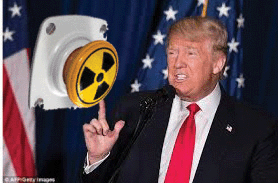
For all the divisions among world powers, one concern unites Russia and the U.S., India and Pakistan, North Korea and Israel at the United Nations: Keeping their nuclear weapons.
Those nuclear-armed states and the three others — China, France and the U.K. — are working to head off a resolution calling for a global conference to establish a binding “legal process” to ban the manufacture, possession, stockpiling and use of the weapons. They’re bucking a popular cause backed by 50 nations, from Ireland to Brazil, which say the measure could win as many as 120 votes in the 193-member General Assembly……
After international efforts to ban the use of biological and chemical weapons, land mines and cluster bombs, arms control advocates say it’s time to deal with nuclear bombs as the remaining weapons of mass destruction that aren’t prohibited. Sponsors of the resolution include Austria, Mexico, Nigeria and South Africa……http://www.stripes.com/news/us/nuclear-armed-foes-unite-against-a-un-call-to-shed-their-weapons-1.436090
German Foreign Minister Frank-Walter Steinmeier said on Oct. 8 that the situation between the U.S. and Russia today is more dangerous than it was during the Cold War. As he put it, “It’s a fallacy to think that this is like the Cold War. The current times are different and more dangerous.” Since most of us think of the Cold War as by far the most dangerous time we have known, Steinmeier’s view is startling. It is important to understand what he is saying, not simply because he is the foreign minister of an important country, but because he is a smart man.
On paper, the United States remains committed to the fall of Bashar al-Assad’s regime, while the Russians are protecting it. There is now combat in Aleppo, the largest city in Syria. Russian and Assad regime forces seem to be trying to take control of the city. The United States sees Aleppo as a bastion of anti-Assad forces and doesn’t want to see it fall. The U.S. has the option to try to block the Russian and Assad advance. Russia has to decide whether to stand and fight or withdraw. Neither side is confident it knows the other’s intentions, but both believe that Aleppo is a critical if not decisive battle. The chances of intentional conflict are real, as is the possibility of an unintended clash escalating.
At the same time, Syria is not essential to the national security of Russia or the United States. It is not without importance, but a defeat or capitulation there will not change the balance of power between them at all. It would of course affect psychological and political perception, but in the long run, perception ultimately comes down to substantial military and economic power. The United States can afford to back off. The Russians will find it more difficult, but can contrive reasons for slowing or halting the attacks.
In Ukraine, the issue is fundamental to Russia and secondary to the United States. Therefore, it is far more dangerous than Syria. For Russia, a Ukraine dominated by a third power, with forces deployed in Ukraine, represents a fundamental threat to its national security. For the United States, it is a secondary issue that can rise to a primary one.
As I have written, the foundation of U.S. foreign policy since World War I was preventing any single power from dominating Europe and Russia, as their combined strength in technology and resources would threaten American interests. Therefore, Russia returning to its prior position, with the potential to dominate the European Peninsula, would rise to a primary issue. If Russia invaded Ukraine and used it as a base to threaten its former satellite states, this would begin escalating to a primary level. But that is several steps from happening, and if it did, it would still not constitute a direct threat to the entire European Peninsula.
The Cold War focused on the center of Germany, and the possibility of a Soviet seizure of Western Europe did not appear far-fetched. Since the U.S. was defending Western Europe at a distance, its conventional forces facing the Soviets appeared to be inferior. Therefore, part of U.S. strategy, at least officially, was the use of nuclear weapons, both strategically and on the battlefield, to stop a Soviet offensive. That meant that should the Soviets have chosen to undertake an offensive, or if they detected a U.S. offensive, they had to go nuclear at the earliest possible moment.
This is what kept the Cold War from turning into a shooting war. The Soviets and the Americans, along with their allies or subordinates in Europe, saw themselves in an existential crisis. The deterrence against conventional war in Europe, as opposed to proxy wars elsewhere such as Vietnam or Afghanistan, was nuclear war. Wars that did not involve primary and overwhelming interests did not involve the risk of nuclear war. There was no military target worth a nuclear strike in either country, nor would either country risk immolation over Vietnam or Afghanistan. Therefore, these wars could take place.
I think this is Steinmeier’s point. The confluence of extremely critical fears and interests paradoxically reduced the chance of conflict, because it increased the chance of nuclear war. Today, none of the friction points between the United States and Russia are of primary interest to both countries. Syria is at best secondary to both, and Ukraine really matters only to Russia. This cannot result in nuclear war, and therefore, each side will take greater risks than they would have in Central Europe during the Cold War.
Therefore, the situation is more dangerous now precisely because the stakes are lower. In lowering the stakes, the risks decline and the possibility of serious conflict between U.S. and Russian forces rises. That direct clash did not occur during the Cold War, at least not on any significant scale. That means that the risk of nuclear war is diminished, but the risk of direct conflict is higher. This would not be proxy wars, but direct war. Undisciplined crises are the most dangerous.
Steinmeier’s observation seems valid. The mystery, of course, is what he is planning to do about that. Having made the declaration, it would seem reasonable that Germany would try to defuse the U.S.-Russian confrontation. Is Germany announcing that it is shifting its role in global politics to a more active role, albeit mediation? These crises raise the question of what Germany will do. That is a question with an ominous past. But if the German foreign minister is speaking for Germany, then this is exactly where his logic would lead him.
Cold war 2.0: how Russia and the west reheated a historic struggle
As chasm grows between a resurgent Russia and a divided US and Europe, diplomats say conflict is now more dangerous, with ‘no clear rules of the road’, Guardian, Patrick Wintour and Julian Borger Washington 25 October 20160
Gen Sir Richard Shirreff remembers the moment he realised Nato was facing a new and more dangerous Russia. It was 19 March 2014, the day after Russia annexed Crimea from Ukraine.
Shirreff, then deputy supreme allied commander Europe, was at Nato’s military HQ in Mons, Belgium, when an American two-star general came in with the transcript of Putin’s speech justifying the annexation. “He briefed us and said: ‘I think this just might be a paradigm-shifting speech’, and I think he might have been right,” Shirreff recalled.
The Russian president’s address aired a long list of grievances, with the west’s attempts to contain Russia in the 18th to 20th centuries right at the top.
The French foreign minister, Jean-Marc Ayrault, said: “The reality is that behind the appearance of consensus … a form of world disorder took hold. We are now paying the price for that error of assessment that gave westerners a feeling of comfort for two decades”.
In the UK, the foreign secretary, Boris Johnson, said in his party conference speech that the west had been mistaken in its belief that “the fall of the Berlin Wall meant the world had come to a moment of ideological resolution after seven frozen and sometimes terrifying decades of communist totalitarian rule”.
Others such as Sir John Sawers, the former head of MI6, warned: “We are moving into an era that is as dangerous, if not more dangerous, as the cold war because we do not have that focus on a strategic relationship between Moscow and Washington.” But unlike the cold war, there are now “no clear rules of the road” between the two countries.
The German foreign minister, Frank-Walter Steinmeier, an advocate of dialogue, made the same point: “It’s a fallacy to think that this is like the cold war. The current times are different and more dangerous.”………
Many acknowledge the west must take its share of the blame for the collapse of relations. The mistakes are real, notably the scale of Nato expansion to the east and in the Baltics. Russia also feels deeply that it was duped into accepting a UN resolution criticising Muammar Gaddafi in Libya in 2011, only to find it was used as cover for regime change. Hillary Clinton, then at the State Department, did little to mange the Russians. Russia has not voted for humanitarian action at the UN since……….
The issue in Europe and the US now is how to respond to Putin? Some believe Russian statehood requires a more aggressive foreign policy. The Kremlin, faced by an ailing economy and declining population, needs external threats of war and violence in the media because Putin “has no civilian project to offer to society”, said Dr Andrew Monaghan at Chatham House. Putin instead offers a mobilisation strategy. The answer is to confront and push back, acknowledging that Putin sees offers of dialogue as a sign of weakness.
Others insist the west must continue to engage and keep pressing the reset button because coexistence is the only option.
In the US and Europe, the question about what to do with Russia is far from settled, something Putin is likely to continue to exploit……
The German chancellor, who has probably devoted more hours to the Putin relationship than any other western politician, is exasperated. She is a dealmaker, but in 2014 – following a conversation with Putin on Ukraine’s annexation – she told Obama that the Russian president was “living in a different world”. But a second round of sanctions in an election year is not attractive.
In Britain, the pre-eminent home for anti-Russian rhetoric since Cameron’s failed attempt at detente in 2011, Johnson has warned Russia that if it continues on its path it could be deemed a rogue nation.
But there are British voices urging calm. Tony Brenton, Britain’s ambassador to Moscow from 2004 to 2008, calls for realism. He argues that the post-war international system – or “liberal hegemony” as he puts it – no longer works. “We have failed with Russia and we are failing with China,” he said.
Brenton’s answer is to accept the limits of 21st-century western influence. “We are going to have to moderate our own ambitions. We can defend ourselves. We can protect our interests. But telling other bad countries how they should behave is less and less possible,” he said.
What’s next? How the west could respond to Russian threatsThe EU, in search of a policy response, is reaching again for sanctions. They have been estimated to have cost the Russian economy $280bn in capital inflows and to be taking roughly 0.5% a year off the GDP. In a society devoid of internal political and institutional constraints on the behaviour of the elite, extended sanctions could weaken Putin’s grip on power………
ultimately the key decisions will be taken in the new White House. Anthony Cordesman, a strategic analyst at the Centre for Strategic and International Studies, said the new administration must confront three realities. “First, Russia is a now broad strategic rival and is likely to remain so at least as long as Putin is in power. Second, the US can’t rebalance to Asia away from Europe or the Middle East. And third, short of being chased off the stage, the United States will have to play out a weak hand in Syria to limit and contain Russian influence.”
“There are no easy answers to the Russians,” said a Washington-based European diplomat. “They are deploying such aggressive rhetoric and policy. During the cold war there was an accepted vocabulary between the sides. There was a game, there was an accepted game,” the diplomat said. “Now the danger is there is no order. There is no accepted language. We are not talking the same language”. https://www.theguardian.com/world/2016/oct/24/cold-war-20-how-russia-and-the-west-reheated-a-historic-struggle
South Korea’s March Toward a Strike-First Nuclear Policy An increasingly provocative North Korea and wavering U.S. support leave Seoul scrambling for more forceful defense options. WSJ By DONALD KIRKOct. 25, 2016 Seoul
After years of hesitation, South Korean defense officials and members of President Park Geun-hye’s ruling Saenuri Party are openly discussing the possibility of pre-emptive strikes on North Korean missile and nuclear facilities. Increasingly, political figures are urging both their own government and the U.S. to go beyond the level of study promised by U.S. Secretary of State John Kerry and enshrine the right to respond to North Korean threats at least with the heaviest conventional weapons in their arsenal as a formal tenet of U.S. and Korean policy.
Nor is “strike first” the only demand gaining common currency among conservative Koreans. While North Korea’s leader, Kim Jong Un, orders missile and nuclear tests, voices are rising within the Saenuri for South Korea to develop its own nuclear deterrent. The U.S. has opposed proliferation ever since physicists at the Korea Atomic Energy Research Institute were discovered looking into it during the presidency of Ms. Park’s father, Park Chung-hee………
Calls for a South Korean nuclear submarine are rising in tandem with North Korean missile testing. The North has a large submarine fleet—and has spread alarm by testing a ballistic missile fired from one of its subs.
One South Korean assembly member, Won Yoo-chul, derided longtime U.S. guarantees of a “nuclear umbrella” since the withdrawal of U.S. nuclear weapons from the South 25 years ago. “We cannot borrow an umbrella from a neighbor every time it rains,” he warned. “We need to have a raincoat and wear it ourselves.”
The North Koreans for their part vow to strike first—against a nuclear-armed U.S. “We will not step back,” said Lee Yong Pil, an official at the North Korean Foreign Ministry, as long as the U.S. “has nuclear weapons off our coast, targeting our country, our capital and our Dear Leader, Kim Jong Un.”
U.S. and South Korean officials are talking openly about “decapitation” of the North Korean leadership in a quick strike at Pyongyang. If the word seems hyperbolic to Americans, North and South Koreans alike take it seriously. North Korea has said the term clearly shows why the North has to have a nuclear program “for self-defense” while many South Korean officials see “decapitation” as the ultimate solution—with or without nuclear weapons.
“Korea Massive Punishment and Retaliation” was the name the Koreans gave a massive exercise this month in the Yellow Sea in which the aircraft carrier USS Ronald Reagan led a joint U.S.-South Korean strike force. Their mission was more sharply defined than in previous war games. This time, said a Korean defense official, ships and planes focused specifically on imaginary North Korean nuclear and missile facilities, command headquarters—and Kim Jong Un…..http://www.wsj.com/articles/south-koreas-march-toward-a-strike-first-nuclear-policy-1477414963
United States confirms that it has fired depleted uranium in Syria International Coalition to Ban Nuclear Weapons US admits that it fired DU on two occasions in November 2015, contrary to earlier claims; military justification for use unclear after target analysis; ICBUW and PAX call for full disclosure to facilitate harm reduction measures; Russia takes advantage of news to distract from its own conduct in the conflict. 21 October 2016 – ICBUW
The US has finally confirmed that it has fired DU ammunition Syria, after it had earlier stated that the weapons would not be used. US Central Command (CENTCOM) has acknowledged that DU was fired on two dates – the 18 and 23 November 2015. Between the strikes on the two dates, 5,100 rounds of 30mm DU ammunition were used by A-10 Thunderbolt II aircraft. This equates to 1,524kg of DU. CENTCOM said that the ammunition was selected because of the “nature of the targets”.
The news comes as governments are debating a UN General Assemblyresolution on DU weapons in New York. And, although DU use has only been admitted on two dates, ICBUW and PAX are concerned that this disclosure could be the sign that DU has, or will, be used more widely in the conflict.
In March 2015, and following the deployment of A-10s to the conflict, the US hadconfirmed to journalists that the aircraft would not be armed with DU, stating:“U.S. and Coalition aircraft have not been and will not be using depleted uranium munitions in Iraq or Syria during Operation Inherent Resolve.” Justifying the decision, CENTCOM public affairs explained that: “The ammunition is developed to destroy tanks on a conventional battlefield; Daesh does not possess large numbers of tanks.”
CENTCOM confirms DU use IRIN news finally extracted the confirmation that DU had been used from CENTCOM on October 20, and after weeks of denials. The revelations first came to light after an aide to Congresswoman Martha McSally (Rep, AZ) – herself a former A-10 combat pilot – responded to a question from DU activist, and constituent, Jack Cohen-Joppa. However a number of CENTCOM sources initially denied that the information was accurate. Confirming that the data were indeed accurate, a spokesperson for CENTCOM said earlier denials were due to “an error in reporting down range.”
“Without the chance disclosure from McSally’s office, and the dogged pursuit of CENTCOM by IRIN, the US would not have volunteered this data,” said ICBUW Coordinator Doug Weir. “Sadly this is typical of the poor transparency we have seen from the US and we urge CENTCOM and the Coalition to clarify their policy on DU use in Syria and explain how its use fits with its public claims that the ammunition is solely for use against armoured targets.”
Nuclear arms control in a globalized world OUP Blog BY JOHN BAYLIS OCTOBER 23RD 2016 Welive in a dangerous and uncertain world. While terrorism is the most immediate contemporary threat, the dangers of nuclear weapons remain an ever present concern. During the Cold War a series of nuclear arms control agreements helped to mitigate the worst excesses of the arms race and contributed to the easing of tensions between the United States and the Soviet Union, and their respective alliances. Since 1985, however, the salience of nuclear weapons in international relations has declined, even though the nine nuclear weapons states continue to possess in excess of 10,000 nuclear weapons between them. Many other states have the potential to develop nuclear arms, and fears exist that terrorist groups might acquire some form of nuclear capability. A key question in global security is whether nuclear arms control still has a future?
In 2010 the United States and Russia signed the New Strategic Arms Reduction Treaty (New START) which involved significant cuts to be made in strategic delivery vehicles (SDVs) and in nuclear warheads in the period up to February 2018. SDVs were to be cut to 700 and nuclear warheads to 1500. Despite the problems over the Ukraine and deteriorating US-Russian relations, both countries by 2016 are very close to these targets, and key provisions of the Treaty including data exchanges, notifications, and on-site inspections have all been met.
As well as New START, the Nuclear Security Summit (NSS) Process, initiated by President Obama has also resulted in some important improvements. Starting in 2010, 53 countries have participated in a series of meetings designed to reduce the amount of dangerous nuclear materials (enriched uranium and plutonium) and to improve security of these materials. 12 of 22 NSS participating states are now free of enriched uranium, and 35 states have signed up to a joint statement binding them to strengthen their nuclear security. These summits have helped to set the foundations for a global nuclear security regime.
Another major advance has come with the Joint Comprehensive Plan of Action (JCPOA) in July 2015. As result of this agreement Iran made a series of commitments to reduce its stockpile of low-enriched uranium for 15 years; to accept an enrichment cap of 5060 centrifuges; and to modify its Arak Reactor so that it could not produce plutonium. In return international sanctions were suspended. The result, according to many commentators, is that Iran has been prevented from becoming a nuclear armed state for at least 15 years.
These are important agreements, but major hurdles remain in controlling weapons of mass destruction……….
Despite these problems, the answer to the question: ‘Does nuclear arms control have a future?’, must be ‘yes.’ The New START Treaty continues to cut the numbers of US and Russian nuclear weapons. The NSS framework has helped to control dangerous nuclear materials and the JCPOS has prevented Iran from becoming a nuclear power for the next 15 years at least. Clearly there are many hurdles to overcome, exemplified by the North Korean nuclear programme, the dangers of terrorist groups acquiring weapons of mass destruction, and the continuing difficulties over ratifying the CTBT. The continuing distrust between the nuclear powers themselves, and between the nuclear powers and many non-nuclear states, as well as the effects of globalization on the continuing availability of nuclear materials and knowledge, means that arms control can only have a limited effect on reducing tensions and preventing the further proliferation of nuclear weapons in the years ahead. Rather than highlighting these difficulties, however, and adopting a fatalistic approach, it is important for the international community to focus on nuclear arms control measures and renew its efforts to work towards improving the various regimes designed to control all weapons of mass destruction.http://blog.oup.com/2016/10/nuclear-arms-control-globalized-world/
Why a military conflict between Russia and the US is unlikely, Russia Direct, Oct 21, 2016, Dmitry Polikanov The risk of a military conflict between Moscow and Washington has been overstated. However, both sides should think about prevention mechanisms to minimize the risk of accidents that could lead to an open conflict. The expert community has been crying wolf for a long time now: “War is at the doorstep!” The gloomy predictions indicate that Russia and the United States are at the brink of direct military clashes, as if they were trying to celebrate the 54th anniversary of the Cuban Missile Crisis in some perverse way. However, any conflict, if it happens, will most probably be accidental – the parties are not yet ready for full-scale military confrontation.
In the last few years, Russia has been modernizing its armed forces to replace the outdated Soviet-era materiel and structure. Numerous exercises, trillions of rubles spent, new equipment and combat vehicles emerging out of the blue, and a charismatic defense minister who changed the entire image of the Russian Army and brought back its popularity with society – all these steps provided for the fast (and real) growth of national military might.
However, it remains rather limited in comparison with the overall total potential of theNATO states. Some would say that the alliance is reluctant to take any serious decisions and is nothing more than a paper tiger. Nonetheless, the brainwashing of the last two years has significantly improved the decision-making capacity of NATO and the chances for achieving consensus over the “Russian threat.”
The ability to mobilize quickly strong conventional forces is still low, as NATO generals admit themselves. However, active recent revival of the nuclear sharing arrangements and the consolidation of U.S. troops in various countries of Central and Eastern Europe present enough deterrence against any light-minded action. It is clear that the war will not happen in Europe (and not even in Ukraine with its unpredictable leadership). However, wherever it occurs, NATO forces can eventually be mobilized to help their allies.
Moreover, Moscow has largely been pursuing a defensive policy over the past 16 years. Even now, when “the Russians are (seemingly) coming,” an independent observer would probably notice that the lion’s share of the activities of Moscow are reactive rather than proactive. …….
Two factors raise the probability of an armed clash between Russia and the U.S. One of them is rhetoric. There have been more words than action so far and there is a clear trend– nobody is responsible for their words any longer. Any of the statements of the last few months would mean immediate war in the 19th or even in the 20th century. Nowadays, politicians throw thousands of words against each other and the struggle is with the minds and hearts and not with bodies. However, such belligerent rhetoric creates the climate of antagonism and public anticipation of a conflict. As a result, such atmosphere may facilitate prompt steps “in response” to another accident.
The second factor is, paradoxically, the low importance of the regional conflicts. Syria is so far away from Moscow and Washington that the parties do not really care about its future, its population and even its militants. Both Russia and the United States can afford there much more than they could in Ukraine, for instance (where actually none of them cared about the fate of Ukraine, but the proximity of Europe made it more difficult to fight). And such lack of significance may lead to a dangerous neglect of dramatic consequences of any armed clash and make the decision-making process easier to go to war.
Nowadays, Russia and the United States demonstrate wisdom and restraint. Given the current leadership in both countries, the expectations of war will hopefully stay just that– expectations. However, the situation may change next year and it would be better for the parties to think about some minimal confidence-building measures and provide for the prevention of accidents, any of which may become fatal, just like an accidental missile launch during the Cold War era. http://www.russia-direct.org/opinion/why-military-conflict-between-russia-and-us-unlikely
Updated B61 Nuclear Bomb to Cost $8.25 Billion, Defense News, By: Aaron Mehta, October 19, 2016 WASHINGTON – The life-extension program for the B61-12 atomic bomb will cost just over $8.25 billion, according to a new estimate from the National Nuclear Security Administration (NNSA).
The new cost estimate was completed over the summer as the agency prepared to enter the production-engineering phase of the program. The baseline cost of the program is $7.605 billion, with an additional $648 million in “funds leveraged from other NNSA programs for technology and manufacturing readiness,” according to an agency statement – money that has common applications across multiple weapon systems.
That cost does not include the estimated $1.3 billion that the Department of Defense plans to spend on developing and procuring tailkits for the weapons. With that included, the total cost for the program sits at roughly $9.5 billion.
The NNSA is a semi-autonomous department within the Department of Energy. While the Defense Department manages the delivery systems of the nuclear force — ships, planes and missiles — NNSA has oversight over the development, maintenance and disposal of nuclear warheads.
The agency is perusing a modernization plan known as the “3+2 Strategy,” under which the NNSA is consolidating the American arsenal of warheads into five variants. The five ballistic-missile warheads now in service are being consolidated into three new interoperable warheads known as the IW-1, IW-2, and IW-3, while the five bomb and cruise-missile warhead types are being consolidated into two replacement warhead designs, the W80-4 and the B61-12. …….http://www.defensenews.com/articles/updated-b61-nuclear-bomb-to-cost-825-billion
Israel in secret deal with Germany to buy 3 nuclear subs, Big News Network.com, Saturday 22nd October, 2016, TEL AVIV, Israel – A deal negotiated in secret will see the Israel Navy take delivery of 3 nuclear-enabled submarines over the next decade.
Germany is to provide the Dolphin-class submarines as a result of secret negotiations which have spanned the last few months.
Israel will pay a substantially discounted price of $1.3 billion for the three submarines.
The deal is expected to be finalised in early November.
According to The Jerusalem Post, quoting foreign reports, the Israel Navy’s Dolphins ‘provide Israel with nuclear second-strike capabilities, as they can travel far from Israel’s territorial waters and are reportedly able to carry long-range cruise missiles tipped with nuclear warheads.’
Israel, which orchestrated the drive against Iran becoming a nuclear power, and has bombed emerging nuclear facilities in Iraq and Syria, has itself been developing nuclear weapons since the 1950s. The Dimona nuclear plant in the Negev desert had its origins in 1954, just six years after the birth of Israel. The late Shimon Peres as Director General of the Israeli Defense Ministry was responsible for the development of the facility. A pact with France was secretly negotiated and hundreds of French scientists were brought in to develop the facility, in absolute secrecy.
To offset the concerns of satellite surveilance, the Jewish state publicly touted the facility as a business park or textile factory. When U.S. President John Kennedy aroused suspicions in 1963, Israel maintained its denials. Kennedy applied so much pressure, David Ben-Gurion resigned as prime minister of Israel just months before Kennedy was assassinated. Some researchers implicate the Israeli inteligence agency Mossad among those considered responsible for the assassination.
Peres himself was asked point blank by Kennedy if Israel was building a nuclear facility. Summoned to the Oval Room in the White House on a 1963 visit to Washington, the young Peres was asked in his words, ’30 rapid-fire questions,’ before Kennedy asked: “Are you building a nuclear option?” Peres said he changed the subject.
To this day Israel has neither confirmed or denied publicly it has a nuclear facility. The only official statement on Dimona was made on December 21 1960 when Ben-Gurion, in response to an aricle in Time magazine which spawned a flurry of media coverage, announced to the Knesset his government was building “a 24 megawatt reactor which will serve the needs of industry, agriculture, health, and science,” and that it “is designed exclusively for peaceful purposes.”
The Israel Navy until last year had a fleet of four Dolphin-class submarines operating out of its naval base at Haifa. A fifth submarine ariived in late December last year after which it was expected to be fitted with Iraeli-built systems which took several months. It is believed it is operational now…….http://www.bignewsnetwork.com/news/248758981/israel-in-secret-deal-with-germany-to-buy-3-nuclear-subs
Depleted uranium once again on the UN’s agenda as a new resolution is tabled that serves to remind the international community of the absence of rules governing its post-conflict management.
19 October 2016 – ICBUW A resolution submitted to the United Nations General Assembly’s First Committee draws attention to the technical and financial barriers that countries affected by the use of depleted uranium face following conflicts when they seek to clear contamination. The resolution also reminds governments that states, communities, health experts and civil society organisations remain profoundly concerned about the health and environmental risks that the weapons can pose.
The resolution is the sixth on the topic to be tabled at the General Assembly since 2007. Shortly before the last resolution was debated in 2014, Iraq called for assistance from the international community in addressing the legacy of DU use in the country in 1991 and 2003. The 2014 resolution, which was supported by 150 states, called on member states to provide such assistance. Disappointingly, assistance has not been forthcoming in the interim and the appalling security situation in Iraq has hampered efforts to assess and clear sites.
“Managing DU contamination to internationally accepted standards is complex, time-consuming and costly,” said ICBUW Coordinator Doug Weir. “Research has repeatedly shown that most countries recovering from conflict are poorly placed to implement these vital risk reduction measures, which are recommended by UN agencies, and it is civilians who all too often pay the cost of inaction.” Part of the problem lies in the fact that unlike land mines and cluster munitions, there are no formal obligations, on either those countries that use the weapons, or are affected by them, to clear them after conflicts.
Previous resolutions have passed by huge majorities, with just four states consistently voting against and, while it is unlikely that the UK, US, France and Israel will vote in favour this year, overall the number of governments abstaining has been on a downward trend since 2007. As a result, there is increasing focus on the likes of Canada, Denmark and a number of EU governments who refuse to vote yes, often on extremely dubious grounds.
However, it is Germany that many will be watching. In 2014, the German government abstained on the DU resolution for the first time, triggering a backlash from German parliamentarians and civil society. A parliamentary question urging the government to vote yes was tabled in September by the Green Party. “Germany has got to accept that the potential hazards from DU contamination are widely accepted by the UN agencies that recommend remedial measures, and by their own military, who take a precautionary approach to DU in their own guidelines,” said PAX’s Wim Zwijnenburg. “Doubtless the German authorities would take steps to prevent civilian harm if DU were dispersed in Germany, why should it be different for other countries following conflicts?”
What will the resolution achieve?
The resolutions do not seek to ban DU weapons, however they do underscore the fact that the overwhelming majority of governments object to their use. Each resolution is also helping to define soft norms around some of the most problematic issues surrounding DU. One of these, the need for DU users to share data on where they fire the weapons, has featured since 2010, and its importance was highlighted by a recent report from PAX and ICBUW over DU use in the 2003 Iraq War. The report showed that more than half the DU fired by the US is still unaccounted for, and that the refusal of the US to release data to UN agencies hampered their post-conflict assessments.
Voting on the resolution will take place in early November. A second vote will take place in early December. You can follow the debate on social media using #FirstCommittee and by following @ICBUW
Amid Rising Tensions, Old Allegations Spark New Panic
by Jason Ditz, October 19, 2016 In 2008, Russia carried out a test of a cruise missile which US officials argued might conceivably violate the 1987 Intermediate-Range Nuclear Forces Treaty (INF). This was first brought up by US officials in 2014, during the anti-Russia hysteria surrounding the East Ukraine civil war.
Two and a half years later, tensions with Russia are on the rise again, so officials appear to have decided that the exact same 2008 test is suddenly a huge thing again, with a number of Congressional hawks issuing a letter claiming the Russian test was an “egregious” violation, and demanding that the Obama Administration “impose penalties” on Russia over it.
Russia had threatened to withdraw from the INF over NATO’s expansion into Eastern Europe, saying it changed the balance of power in the region. They were also riled by the Bush Administration’s threats to install missile defense along the Russian frontier.
The missiles in question are a multi-stage system Russia designed which are aimed to technically comply with the letter of the treaty, while expanding intermediate range capabilities in ways that the treaty was meant to forbid. The US has made similar developments over the years since 1987.
With US officials riled at Russia over Aleppo, and presenting the fighting in the city as a “holocaust,” they have also brought up several other grievances they have with Russia, accusing them of everything from treaty violations to supporting Donald Trump.
It’s interesting to note, however, that most of the grievances aren’t particularly new, and didn’t have a lot of meat to them the last time they brought them up. The effort seems to be to just keep Russia’s name out there, and always in a negative light.
U.S. Calls For Meeting With Russia Over Missile Treaty Dispute , Radio Free Europe, 20 Oct 16 WASHINGTON — The United States has called for a special meeting with Russia over alleged violations of a landmark Cold War-era arms-control treaty, a policy reversal that echoes deepening U.S. fears about Moscow’s intentions.
The planned meeting of the Special Verification Commission, scheduled in the near future, focuses new attention on concerns about the 1987 Intermediate-range Nuclear Forces treaty (INF).
The treaty, which bans testing, producing, and possessing ground-launched cruise missiles with ranges between 500 to 5,500 kilometers, eliminated an entire class of missiles from Europe, and set up an extensive system of verification and compliance. The agreement was considered crucial in the thaw between the Soviet Union and the United States.
Two years ago, the United States first asserted that Russia was in violation of the treaty, by developing a missile system that fell within the INF prohibitions. Moscow denied the allegations, and later charged that U.S.-led efforts to install elements of a missile-defense system in Europe were in fact prohibited by the INF.
Clues to the end of the world shared during final 2016 presidential debate, Mondoweiss, Wilson Dizard on October 20, 2016 “……Four minutes is what it takes between the president’s decision to fire nuclear missiles, Clinton claimed during the debate, and their launch………..Here is the most illuminating exchange on nuclear weapons, according to a transcript published by the Washington Post. Clinton gave a clinical description of how fast nuclear weapons can be fired away at a president’s command. That information was perhaps a subtle way of warning Russian president Vladimir Putin that we remain the fastest guns in the West.
CLINTON: “I — I find it ironic that he’s raising nuclear weapons. This is a person who has been very cavalier, even casual about the use of nuclear weapons. He’s advocated more countries getting them, Japan, Korea, even Saudi Arabia. He said, well, if we have them, why don’t we use them, which I think is terrifying.
But here’s the deal. The bottom line on nuclear weapons is that when the president gives the order, it must be followed. There’s about four minutes between the order being given and the people responsible for launching nuclear weapons to do so. And that’s why 10 people who have had that awesome responsibility have come out and, in an unprecedented way, said they would not trust Donald Trump with the nuclear codes or to have his finger on the nuclear button……..
What Trump doesn’t seem to understand that defending Saudi Arabia, Germany, Japan and South Korea means defending major trading partners and, in the case of Saudi Arabia, a sand seared ocean of oil. But if the American nuclear umbrella suddenly closed, all of those countries could have nuclear weapons ready within weeks or months. The details are unimportant. What’s nauseatingly disturbing is that we are discussing the possibility of nuclear war at all. After all, this is 2016, right? If the arc of history bends towards justice, a nuclear holocaust is the thing that would blow that arc to smithereens. The real end of history
Clinton, for her part, recommitted herself to a no-fly zone in Syria, a provocation to Russian air forces the U.S. blames for bombing civilians and Western-friendly rebels. She also said that the occupation of Iraq would “not be in our interest,” while not mentioning that the Iraqis also have their objections to American military occupation. Classic Clinton.
AP FACT CHECK: Donald Trump is wrong to say that only Russia can still create warheads under the New START treaty limiting nuclear weapons A claim from the final presidential debate and how it stacks up with the facts:
DONALD TRUMP: Referring to a 2010 U.S.-Russia treaty limiting both countries to 1,550 strategic nuclear warheads, Trump said, “They create warheads. We can’t.”
The FACTS: Incorrect. The New START treaty, which Trump called “Start Up,” does not prevent either the U.S. or Russia from building nuclear warheads. It restricts each country to a total of 1,550 warheads deployed on bombers, submarines and in underground silos and requires that this limit be reached by February 2018.
Trump also said that after the treaty was signed, “They expanded and we didn’t.”
It’s true that the Russians have increased the number of their deployed warheads to 1,796, and the U.S. warhead total has dropped to 1,367. But it also is true that their total was far below that of the U.S. when the treaty went into effect in 2010. New data published by the State Department this month showed that although Russia has added to its warhead total, its inventory of missile launchers, such as underground silos, has shrunk.
Hans Kristensen of the Federation of American Scientists, who closely tracks U.S. and Russian strategic forces, says the rise in Russian deployed warheads is temporary and is to be followed by the retirement of older nuclear weapons so that Moscow gets under the treaty limits. “Russian compliance with the treaty by 2018 is not in doubt,” he wrote recently.
An analysis of recently declassified military data shows that the United States military ignored its own guidelines for the use of depleted uranium ammunition in the 2003 Iraq War, firing the controversial weapons at unarmoured targets, buildings in populated areas and troops. It has also tripled the number of sites known to be contaminated in Iraq to more than 1,000; even as fears grow that the US has used depleted uranium in Syria.
The targeting data, which details the use of 30mm DU ammunition by USAF A-10 Thunderbolt II aircraft – or “Warthogs”, was released under FOIA and accounts for 54,000kg of the 118,000kg of DU ammunition that the US and UK have acknowledged firing in the conflict. Analysis by PAX and ICBUW of the 1,116 strikes, which took place during the first month of the 2003 invasion, and published in a new report Targets of Opportunity shows that DU use was widespread across Iraq.
For the first time, the data also reveal that the majority of targets attacked with the radioactive and chemically toxic weapons were not armoured. This runs counter to claims by the US that the A10’s ammunition is specifically for destroying tanks and other armoured vehicles. A significant number of the 182,000 30mm PGU-14/B rounds fired by the aircraft – each of which contains 298g of DU – were also fired in or near populated areas, increasing the likelihood that civilians would be exposed.
The need to destroy armour is central to the US’s ongoing military justification for the use of the weapons, which place civilians at risk of exposure and leave a complex and costly legacy for years after the end of conflicts. The US’s own legal guidelines, which were placed on the use of the armour-piercing incendiary weapons in 1975, restricts their use to armoured vehicles, a restriction that appears to have been ignored in the 2003 conflict.
Little transparency, even less assistance
While the UK released information to the UN on where it fired 1,900kg of DU, the US is still withholding data on where it fired 62,000kg of the weapons. This is hampering clearance work. PAX has reported that Iraq continues to struggle with the identification and remediation of DU contaminated sites, and the country has called for assistance in doing so from the international community.
“With the current burden of fighting the Islamic State, the Iraqi government’s capacity is already stretched. But people are worried about DU contamination, especially in southern Iraq,” says one of the report’s authors, PAX’s Wim Zwijnenburg. “The US did too little, too late, and now Iraq’s people are facing layer upon layer of toxic health risks as a result of the conflicts.”
“At present countries that use DU weapons, or are affected by them, are under no formal obligations to clear contamination after conflicts in order to minimise the risks it poses to civilians,” said co-author Doug Weir from ICBUW. “This is in stark contrast to land mines, cluster munitions and other explosive remnants of war. Governments must take steps to meaningfully address the legacy from DU and other toxic remnants of war that can harm civilians and their environment for years after the end of conflicts.”
New information suggests that A-10s have used DU in Syria n early 2015, the US stated – contrary to previous claims – that its A-10 aircraft had not and would not use DU in Iraq or Syria in operations against Islamic State. However information obtained by ICBUW suggests that US A-10s have used DU on at least two occasions in Syria.
ICBUW and PAX are calling for urgent clarification from the US authorities on both the incidents and its DU policy for the conflict, and for them to swiftly release the targeting data to ensure that the relevant authorities can conduct clearance and risk awareness efforts and to isolate and recover contaminated material.