US think tank warns North Korea could develop up to 100 nuclear weapons by 2020 http://www.ibtimes.co.uk/us-think-tank-warns-north-korea-could-develop-100-nuclear-weapons-by-2020-1585557 Rand Corporation says Pyongyang is testing nuclear missiles that can threaten targets across the Pacific Ocean. By Ananya Roy October 10, 2016 A US-based think tank has estimated that given the pace of North Korea’s nuclear programme, Pyongyang could have enough fissile material to develop up to 100 nuclear weapons by 2020. The organisation has warned ahead of the US presidential elections that the new administration would face major challenges from the East Asian country, highlighting the need to review its policy on Pyongyang.
In its latest report, Rand Corporation – an American nonprofit global policy think tank – said that Japan and South Korea are “losing faith in the US nuclear umbrella”. The think tank warned that it was upset as Washington failed to constrain North Korea’s nuclear programme, which has led to the two US allies to call for “independent nuclear arsenals”. Rand Corporation noted that the new administration that takes charge in Washington following the 8 November election would have to focus on tackling the growing security threats in the Korean peninsula.
“During the next four to six years, Pyongyang will possess a nuclear force of sufficient size, diversity, reliability, and survivability to invalidate our regional military posture and war plans by holding at risk key bases and amplifying the risk to allies.
“The most recent open-source estimates suggest North Korea may already have enough fissile material to build between 13 and 21 nuclear weapons; by 2020, it could possess enough for 50 to 100. The DPRK [Democratic People’s Republic of Korea or North Korea] can already deliver nuclear weapons by aircraft or ship and perhaps by theater ballistic missiles; it is now testing nuclear-capable missiles that could threaten targets across the Pacific Ocean, including the continental United States. “Current estimates suggest a number of these nuclear-tipped missiles—long-range, road-mobile, and submarine-launched—could be operational between 2020 and 2025,” the report warned.
It further stated: “A DPRK nuclear force approaching 100 weapons with multiple delivery means likely poses an unacceptable threat to US and South Korea [or the Republic of Korea, ROK] security, as well as a serious proliferation threat.”
The foreign policy think tank stressed that the incoming US administration will have to face “critical policy questions” involving what measures need to be taken to stop North Korea’s Kim Jong-un from pursuing their nuclear programme; what should the US do if provocation continues and what should be done if South Korea initiates a counterforce attack or begins developing its own nuclear force.
October 14, 2016
Posted by Christina Macpherson |
North Korea, weapons and war |
Leave a comment
WORLD WAR 3 THREATS LOOM AS PUTIN ORDERS ALL RUSSIAN OFFICIALS TO BRING FAMILY MEMBERS LIVING ABROAD BACK HOME, INQUISITR, 13 Oct 16 As threats of a global war rise, Russia is apparently ordering all its officials to bring their family members living abroad back home. According to local media in Russia, Several high-ranking officials and politicians have received a warning message from Vladimir Putin, urging them to bring their family members back to the “Fatherland.”
This news comes after Putin cancelled his previously planned visit to France following disagreements over Russia’s involvement in Syria.
And according to local media, all high ranking officials are now being told that it would be wise to bring their family members living abroad back home. The “recommendation” has been imposed upon officials of every level, including administration staff, regional administrators, lawmakers and even employees of public corporations. It has also been said that those that ignore this recommendation may lose their chance of being promoted in the public sector……..http://www.inquisitr.com/3589849/world-war-3-putin-russia-nuclear-war-officials-bring-family-living-abroad-home/
October 14, 2016
Posted by Christina Macpherson |
Russia, weapons and war |
Leave a comment
Britain’s Nuclear Cover-Up, NYT, By PETER WYNN KIRBYOCT. 10, 2016“………If the Hinkley plan seems outrageous, that’s because it only makes sense if one considers its connection to Britain’s military projects — especially Trident, a roving fleet of armed nuclear submarines, which is outdated and needs upgrading. Hawks and conservatives, in particular, see the Trident program as vital to preserving Britain’s international clout.
A painstaking study of obscure British military policy documents, released last month by the Science Policy Research Unit at the University of Sussex, demonstrates that the government and some of its partners in the defense industry, like Rolls-Royce and BAE Systems, think a robust civilian nuclear industry is essential to revamping Britain’s nuclear submarine program.
For proponents of Trident, civilian nuclear projects are a way of “masking” the high costs of developing a new fleet of nuclear submarines, according to the report. Merging programs like research and development or skills training across civilian and military sectors helps cut back on military spending. It also helps maintain the talent pool for nuclear specialists. And given the long lead times and life spans of most nuclear projects, connections between civilian and military programs give companies more incentives to make the major investments required.
One might say that with the Hinkley Point project, the British government is using billions of Chinese money to build stealth submarines designed to deter China.
One can certainly say that the British government is using an ill-advised civilian nuclear energy project as a convoluted means of financing a submarine program.
The British government must be more transparent about its military spending, if only so that those expenditures can be measured against the needs of other public programs. According to the Science Policy Research Unit study, the government itself estimated in 2015 that renewing the Trident deterrent force will cost nearly $38.5 billion. In comparison, the deficit of the National Health Services for the fiscal year 2015-6, a record, was about $3 billion.
Hiding the true costs of a project like Trident by promoting a questionable and ruinous project like Hinkley Point C distorts the economics of both the defense and the civilian energy sectors. It also skews energy policy itself.
If Britain’s energy policy were solely about energy, rather than also about defense, the nuclear sector would be forced to stand on its own two feet. And the government would have to acknowledge the growing benefits of renewable energy and make hard-nosed comparisons about cost, implementation, environmental benefits and safety.
October 12, 2016
Posted by Christina Macpherson |
secrets,lies and civil liberties, UK, weapons and war |
Leave a comment
End the Nuclear Insanity, The World Post, http://www.huffingtonpost.com/jose-ramoshorta/end-the-nuclear-insanity_b_12436344.html , 11 Oct 16
Muhammad Yunus Nobel Peace Prize winner; founder, Grameen Bank; Chairman, Yunus Centre
Kailash Satyarthi 2014 Nobel Peace Prize Laureate, Founder, Kailash Satyarthi Children’s Foundation
10/11/2016 This month the United Nations has the opportunity to take a major step toward the elimination of nuclear weapons. It is an opportunity that must not be lost.
More than four decades ago, the nations with nuclear arsenals and the world’s non-nuclear states entered into the Nuclear Non-Proliferation Treaty (NPT); the nuclear states — the US, Russia, UK, France and China — pledged that if the states that did not have nuclear weapons agreed not to develop them, they would enter into good-faith negotiations toward the elimination of their nuclear arsenals. During the ensuing years, the three nations that did not sign the NPT — namely India, Pakistan, and Israel — developed nuclear weapons. All of the non-nuclear weapons states that signed the treaty except North Korea have kept their pledge.
Unfortunately, the nuclear powers have not kept their part of the bargain. While the US and Russia have dismantled many of their nuclear weapons since the end of the Cold War, they retain thousands of them, enough to destroy the world many times over.
More importantly, they have made clear that, in defiance of their treaty obligations, they do not intend to eliminate their arsenals. Instead, all of the states that possess nuclear weapons today are engaged in massive upgrades of their nuclear arsenals. The US alone expects to spend $1 trillion on this modernization program over the next three decades.
While the nuclear powers claim that their arsenals only exist to deter the threat of attack from other nuclear states, their actual military doctrines tell a different story. The US refuses to rule out the first use of nuclear weapons, even against states that don’t possess them. Russia plans to use nuclear weapons early on in conventional conflict with NATO. Pakistan similarly threatens to use tactical nuclear weapons against Indian conventional forces. India threatens to retaliate with strategic nuclear forces.
In the face of this intransigence, most of the states that do not possess nuclear weapons have decided that they must act. They are not planning to build nuclear weapons of their own, but are demanding that the nuclear powers honor their obligations.
In 2013 and 2014, more than 150 countries came together — in Oslo, Vienna and Nayarit, Mexico — in a series of historic conferences on the humanitarian impact of nuclear weapons, to focus attention on the actual consequences of nuclear war. These conferences examined the latest scientific findings, that show that even a limited nuclear war, involving less than 0.05% of the world’s nuclear arsenals, would cause catastrophic climate disruption across the planet and lead to a global famine that could put up to 2 billion people at risk of starvation. Other data shows that a large scale war between the US and Russia would cause even more profound climate disruption, producing a nuclear winter that would kill the vast majority of the human race and could cause our extinction as a species.
n response to these warnings from the scientific and medical community, more than 100 nations have met in Geneva over the last five months at an Open Ended Working Group, convened by the UN General Assembly, to consider how to pressure the nuclear powers to disarm.
The recommendation of this OEWG will be presented to the General Assembly this month. A resolution sponsored by Austria, Brazil, Ireland, Mexico, Nigeria and South Africa calls for the UN to convene a formal negotiating conference in 2017 to conclude a new treaty that prohibits the possession of nuclear weapons.
This “Ban Treaty” will not take the place of an actual nuclear weapons convention negotiated by the nuclear powers, which would have to establish a firm timetable for dismantling nuclear weapons, with detailed mechanisms to verify and enforce compliance. But it will create a powerful new norm about nuclear weapons, defining them not as the status symbols of great nations, but as the badges of shame of rogue nations.
Much work will need to be done to use this new treaty to actually get the nuclear powers to disarm, but their fierce opposition to the treaty makes it clear that they are feeling the pressure already even before negotiations have begun.
The non-nuclear weapons states must resist that pressure, and continue their historic efforts to protect humanity from the grave threat posed by nuclear weapons. And the citizens of nuclear weapons states must hold their governments accountable for their unconscionable refusal to meet their treaty obligations and negotiate the elimination of these weapons, which are the greatest threat to the security of all peoples throughout the world.
October 12, 2016
Posted by Christina Macpherson |
2 WORLD, weapons and war |
Leave a comment
 Russia downplays moving nuclear-capable missiles to Kaliningrad Deployment of Iskander missiles to Baltic outpost alarms neighbours but Russia says move is part of regular drill, Guardian, Patrick Wintour, 9 Oct 16 Russia has played down the significance of the deployment of nuclear-capable Iskander missiles to the Russian outpost of Kaliningrad after the move led to protests from Estonia, Poland and Lithuania, underlining tensions about Russian intentions.
The deployment of the missiles was part of regular drills and was not a secret, the Russian defence ministry insisted.
“First of all, the authors behind the fuss should know that the Iskander missile system is a mobile one,” said a ministry spokesman, Gen Igor Konashenkov.
“As part of the combat training plan, units of the missile forces throughout the year improve their marching capabilities by covering great distances across the territory of the Russian Federation in various ways: by air, sea and on their own.”
Konashenkov said that Kaliningrad “is no exemption here” and that the system would be relocated to the exclave in the future “as part of the military training of the Russian armed forces.”
The Iskander-M, first introduced to the Russian military in 2013, is designed to target missile systems, rocket launchers, long-range artillery and command posts as well as aircraft and helicopters. It has a range of 500km (310 miles) and is capable of carrying nuclear warheads, and its deployment led to deep concern in Estonia.
Poland also voiced its concerns over the relocation of the weapons………https://www.theguardian.com/world/2016/oct/09/russia-downplays-moving-nuclear-capable-missiles-to-kaliningrad
October 10, 2016
Posted by Christina Macpherson |
Russia, weapons and war |
Leave a comment
Nuclear conflict with North Korea: a spiral of repeated failure, DW, 9 Oct 16
 North Korea carries out a nuclear test; the UN imposes sanctions; North Korea repeats its actions. This cycle has been repeated for 10 years now and has so far proved impossible to break. North Korea has carried out five nuclear tests in the past 10 years. Five times, the UN Security Council has imposed or tightened sanctions. For years now the West has issued similar words of condemnation after each new test. And time and again North Korea has demonstrated that the international community still has not found any way of resolving this nuclear confrontation in the long term. Meanwhile, the cycle of action and reaction continues.
Monday, 9 October 2006
Exactly ten years ago, then dictator Kim Jong Il shocked the world with the first North Korean nuclear test. It was the middle of the night in Europe when the earth shook in the northeast of the country at 10:36 local time. The South Korean secret service estimated that the bomb had an explosive force of 0.55 kilotons. This was considerably smaller than the first atomic bomb ever used in conflict, dropped on Hiroshima in Japan by the United States: That had an explosive force of around 12.5 kilotons. But the message is clear – and the rest of the world is outraged.
US President George W. Bush on 9 October 2006:
“The United States condemns this provocative act. Once again North Korea has defied the will of the international community, and the international community will respond.”
It was the start of a spiral that has continued ever since, with no resolution in sight.
Five days later, the 15 members of the UN Security Council vote unanimously to impose sanctions against North Korea.
UN Resolution 1718, passed on 14 October 2006 The resolution forbids North Korea from carrying out any further nuclear tests or firing any ballistic missiles. It calls upon the country to suspend its nuclear program and return to the negotiation table. Among other things, Resolution 1718 freezes the assets of people involved in the North Korean nuclear program and imposes travel bans on them. It also imposes a trade embargo covering items such as tanks, combat vehicles, large war materials, fighter planes, helicopters and battleships. And, of course, anything connected to the further development of North Korea’s nuclear program………
Friday, 9 September 2016
Just nine months after the fourth nuclear test, North Korea carries out a fifth – and last, to date – on its Punggye-ri test site. It is also the strongest. Foreign experts estimate that it had an explosive force of around 10 kilotons.
US President Barack Obama, 9 September 2016:
“To be clear, the United States does not, and never will, accept North Korea as a nuclear state. […] Today’s nuclear test, a flagrant violation of multiple UN Security Council Resolutions, makes clear North Korea’s disregard for international norms and standards for behavior and demonstrates it has no interest in being a responsible member of the international community.”
The UN Security Council has announced that further sanctions will be imposed. http://www.dw.com/en/nuclear-conflict-with-north-korea-a-spiral-of-repeated-failure/a-35999751
October 10, 2016
Posted by Christina Macpherson |
North Korea, politics international, weapons and war |
Leave a comment
Nuclear-armed drones? They may be closer than you think, Asia Times, By RICHARD A. BITZINGER and Christine M. Leah. OCTOBER 9, 2016 The US military increasingly relies on drones to carry out a multitude of tasks, usually those deemed too “dull, dirty, or dangerous” for manned missions. Most unmanned aerial vehicles (UAVs) carry out routine reconnaissance. They also act as decoys, serve as communication relays, and even deliver light cargoes. But a growing number of drones are armed, such as the US Predator and MQ-9 Reaper, which are used mostly in tactical situations, such as targeting terrorists or insurgents.
Now military strategists are considering acquiring longer-range drones, especially those capable of carrying out nuclear missions. In 2015 there were reports that Russia was attempting to build nuclear-armed drone submarines………..When the US decided to go ahead with a next-generation strategic bomber, the Long-Range Strike Bomber (LRS-B), the program included both manned and unmanned systems. The LRS-B, which replaces both B-52 and B-1 bombers, is intended to carry out a broad range of missions: nuclear attack, strategic and tactical conventional strike, surveillance, intelligence, and reconnaissance (ISR), and electronic attack. Initially, the US military plans to acquire 80 to 100 LRS-Bs, but the number could eventually rise to 200 bombers…….
..Conventional strike missions with precision-guided air-to-ground munitions is also something that could be considered for an unmanned system, as it would provide the US with the means for long-range, large-payload ground attacks. These types of missions can presently be carried out only by B-52 and B-1 bombers, which are becoming increasingly obsolete; shorter-range systems such as the F-35 Joint Strike Fighter, area very limited in their capacities for ground attack…….
Nevertheless, nuclear-armed drones still raise considerable hackles. What if such a drone could be hacked and forced to crash or be redirected to another target? How does the drone’s remote operator ensure near-total control of such a lethal weapons platform?
And nuclear drones could come in smaller packages, too. Thus far there have been limitations on the transportability by air of nuclear bombs with relatively high yields……..
Longer-range drones make a lot of sense for the US military, when it comes to projecting power into the far Western Pacific……..http://www.atimes.com/nuclear-armed-drones-not-just-yet-but-the-outlook-is-scary/
October 10, 2016
Posted by Christina Macpherson |
2 WORLD, weapons and war |
Leave a comment
The True Scale of Nuclear Bombs Is Totally Frightening http://sploid.gizmodo.com/the-true-scale-of-nuclear-bombs-is-totally-frightening-1787538060 Casey Chan, 8 Oct 16 Nuclear weapons are already scary enough, but when you dig deeper and find out how powerful the weapons truly are, they get even more terrifying. The weapons we’ve built after the first atomic bombs are so strong that you can basically use Hiroshima as a unit of measurement. The largest nuclear explosion in human history, the Tsar Bomba, detonated with a force of 50 megatons or the power of 3,333 Hiroshimas.
Discovery Channel – Ultimates – Explosions – Tsar bomb segment
October 8, 2016
Posted by Christina Macpherson |
2 WORLD, weapons and war |
Leave a comment
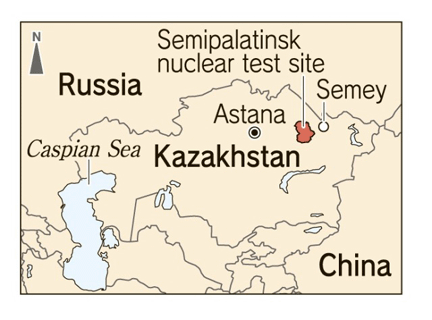
The Nazarbayev government, lacking financial resources, has done very little to address the security problems at Semipalatinsk and has not spent a penny to clean up the area.
 The continuing danger of Semipalatinsk http://thebulletin.org/continuing-danger-semipalatinsk9969 6 OCTOBER 2016 Magdalena Stawkowski
During the Cold War, the Semipalatinsk Nuclear Test Site in Kazakhstan was the Soviet Union’s primary nuclear weapons testing ground. Between 1949 and 1989, more than 450 nuclear bombs were exploded above and below ground on its once secret, 7,000-square-mile territory. In the post-Soviet period,
Kazakhstan has attracted much international praise for its “extraordinary leadership” and “courage” in closing Semipalatinsk, for giving up its nuclear weapons stockpile, and for helping to create a nuclear weapon free zone in Central Asia. Kazakhstan has also been celebrated for having an extraordinary record in advancing nuclear security and thus was judged to be perfectly suited to host an international fuel bank for low-enriched uranium. The Obama administration has described Kazakhstan’s president, Nursultan Nazarbayev, as “really one of the model leaders in the world” on
non-proliferation and nuclear safety issues.
These commendations are perhaps overly enthusiastic. They exaggerate Kazakhstan’s commitment to nuclear safety; actually, Kazakhstan’s leadership has done little to address pressing humanitarian issues at Semipalatinsk, failing to provide adequate funding for environmental clean up and adequate security for the site itself. How can the world talk about nuclear safety in Kazakhstan when it is the only place on Earth where thousands of people still live in and around an atomic test site? How can there be safety, when residual radioactivity and environmental damage are a normal part of life for people who live there? Nuclear security should mean more than the physical protection of nuclear materials. Nuclear security must also mean the physical protection of individual citizens from radioactivity.
Today, most of the abandoned Semipalatinsk territory is accessible to anyone who wishes to enter. Except for a 37-mile area “exclusion zone” at the Degelen Mountain complex, guarded by drones and other surveillance equipment, few signs indicate radiation danger. For the thousands living nearby, it is no secret that the former nuclear testing area is poorly secured. I have been conducting anthropological fieldwork in the region since 2009, living in Koyan, a remote village on the nuclear test site’s border. I know first hand the ease with which people make use of the territory. (“Koyan” and “Tursynbek,” the name of an ethnographic interlocutor mentioned later in this article, are pseudonyms, used to protect village residents and the interlocutor following the convention of confidentiality spelled out in the American Anthropological Association Code of Ethics on professional responsibility).
Koyaners, like most everyone else living in and around Semipalatinsk, use the test site in a number of ways: They drive across the dusty steppe during warmer months to visit relatives in nearby villages. In July and August, men, women, and children come back from the site, buckets brimming with wild strawberries they have picked from its shallow valleys. Many graze their herds of sheep, goats, horses, and cows on the Semipalatinsk pastures, sometimes near craters formed by underground explosions. Many of these places are known to contain radioactive “hot spots,” but since the area around Koyan is mostly unmarked, no one in the village is certain where the hot spots are. Koyaners are not privy to this information, because no one in the government shares it with them.
On a hot, sunny day in July 2015, Tursynbek, a burly stockbreeder and miner in his mid-50s, decided we should go out and measure radiation on our own. As we got in the car, he complained that when he has had a chance to ask scientists, who occasionally do research in the area, if there is radiation, they dismiss his concerns by saying, “There is nothing here; no radiation.” I made sure to bring my Geiger counter on this trip, and a short car ride later I was looking down from the rim of a nuclear crater, trying to hear the Geiger counter readings Tursynbek was shouting. His camouflage jacket was barely visible on the steep pitch, among the tall grasses; a rather sizeable water hole was beyond, inside the crater. He scanned the ground for radioactivity, his white paper sanitary mask pulled down under his chin, rather than over his mouth. The sanitary mask was meant to protect against small particles of plutonium or other radioisotopes that are dangerous when inhaled but can be stopped by a sheet of paper. But Tursynbek was not afraid. Tursybek knows this area well; he was born in Koyan and has decades of experience raising livestock, sheep, goats, cows, and horses, which includes grazing them on the test site.
Still, he had never been here on this kind of mission. As he climbed out, he eagerly used the Geiger counter to check the wreckage of the atomic landscape: trenches, mangled barbed wire enclosures, scattered cement blocks with clusters of electrical cables jutting from them. The frantic clicking of the Geiger counter disturbed the otherwise calm summer afternoon. Not far from us, Kazakhstan’s Institute of Radiation Safety and Ecology (IRSE) wazik (van) carrying “geologists,” as the scientists are known to Koyaners, passed by. “They have never shared any of this information with us,” Tursynbek said motioning to the van and pointing at the .700 milliRem per hour reading displayed by the counter.
Normal background is between .008-.015 milliRem/hr. According to the US Nuclear Regulatory Commission (NRC), Americans receive an average radiation dose of about 620 milliRem per year. Half of this dose comes from naturally occurring radiation found in soil, rocks (uranium), and air (radon). The other half comes from man-made sources, like radiation therapy, x-rays, and nuclear power plants. At the crater, five weeks is enough time to receive the average yearly dose of radiation described by the NRC. In one year that dose is equal to 6,136 milliRem.
Looking around the abandoned test site, it is almost never obvious what went on here, except at a few key experimental locations, which have decaying cement structures and other visible points of interest. The once high levels of security have long since disappeared. Yet for 40 years various technical sites at Semipalatinsk were used to experiment with different types of nuclear explosions. At “Ground Zero” for example, 116 aboveground tests were conducted, as part of a full-scale experiment designed to record damage done to animals (sheep, goats, cows, and pigs), plants and soil, building construction, military equipment, and people living in settlements found near the site. At other technical areas, more than 300 underground nuclear explosions were used to test their peaceful applications. Several of these high-yield tests produced nuclear craters and contaminated much of the area nearby.
Near the nuclear crater Tursynbek and I visited, only a small and badly faded radiation warning sign clung to a mangled barbed wire enclosure that once provided some level of protection. The plight of people who suffered from radiation exposure during the Soviet-era is well known in the country and abroad, even if the level of radioactive pollution and its impact on human health are hotly disputed, in local and international peer-reviewed scientific journals.
In an August 2015 editorial for the Bulletin of Atomic Scientists, Kazakhstan’s ambassador to the United States, Kairat Umarov, highlighted the fate of 1.5 million Kazakh citizens whose lives continue to be affected by nuclear testing. He wrote with the optimism of a man hoping to promote a nuclear-weapons-free world. But Umarov ignored an obvious fact: The Nazarbayev government, lacking financial resources, has done very little to address the security problems at Semipalatinsk and has not spent a penny to clean up the area. Praise of the nation’s leadership for making Kazakhstan a non-nuclear state has come at a price: It has overshadowed and limited conversations about lack of oversight of Semipalatinsk and the toxic mess that the Soviet nuclear testing program left behind and continues to endanger thousands of citizens living in the area. Given this unresolved and underreported situation at Semipalatinsk, the international community should offer financial help and expertise for the cleanup of Semipalatinsk, or at the very least help with cordoning off the most contaminated areas of the site.
October 8, 2016
Posted by Christina Macpherson |
environment, Kazakhstan, secrets,lies and civil liberties, weapons and war |
1 Comment
Top secret Chinese nuclear base opens to foreigners [good photos] , news.com.au , 6 Oct 15 IT’S A maze built to manufacture plutonium and house thousands of tonnes of explosives.
The 826 Nuclear Military Plant, a former top-secret Chinese base, is almost 20km wide, with 178 caves and more than 130 roads and tunnels.
The largest man-made cave in the world was commissioned in the 1960s, when Beijing feared an imminent nuclear attack from the Soviet Union.
More than 60,000 engineering soldiers participated in the construction, and at least 100 of them were reportedly killed during the process.
It’s hidden deep in the mountains of Fuling, in the Chongqing municipality of central China, and can reportedly withstand a magnitude 8.0 earthquake.
The largest cave is nearly 80m high, or roughly the height of a 20-storey building, and the tunnels are wide enough to drive through……..The huge undertaking took 17 years to build, and was nearly completed when it was abruptly cancelled due to changes in Cold War politics in 1984.
After lying dormant for many years, it was officially declassified in 2002.
It’s just undergone an extensive renovation, and is now open to foreign visitors for the first time…….http://www.news.com.au/travel/world-travel/asia/top-secret-chinese-nuclear-base-opens-to-foreigners/news-story/2ab679cdfd44e04a7fdf01b1b3a1a61d
October 6, 2016
Posted by Christina Macpherson |
China, history, Reference, weapons and war |
Leave a comment
What happens if India and Pakistan both fire nuclear warheads at each other? http://www.thenewsminute.com/article/what-happens-if-india-and-pakistan-both-fire-nuclear-warheads-each-other-50604
If India and Pakistan detonated 100 nuclear warheads, over 21 million people will die immediately, and half the world’s ozone layer would be destroyed, September 29, 2016 – By Abheet Singh Sethi, 30 Sept 16
If India and Pakistan fought a war detonating 100 nuclear warheads (around half of their combined arsenal), each equivalent to a 15-kiloton Hiroshima bomb, more than 21 million people will be directly killed, about half the world’s protective ozone layer would be destroyed, and a “nuclear winter” would cripple monsoons and agriculture worldwide.

As the Indian Army considers armed options, and a Bharatiya Janata Party (BJP) MP urges a nuclear attack, even as the Pakistan Defence Minister threatens to “annihilate” India in return, the following projections, made by researchers from three US universities in 2007, are a reminder of the costs of nuclear war.
According to the study by researchers from Rutgers University, University of Colorado-Boulder and University of California, Los Angeles, about 21 million people – half the death toll of World War II – would perish within the first week from blast effects, burns and acute radiation in India and Pakistan.
This death toll would be 2,221 times the number of civilians and security forces killed by terrorists in India over nine years to 2015, according to an IndiaSpend analysis of South Asia Terrorism Portal data.
Another two billion people worldwide would face risks of severe starvation due to the climatic effects of the nuclear-weapon use in the subcontinent, according to a 2013 assessment by the International Physicians for the Prevention of Nuclear War, a global federation of physicians. Continue reading →
October 1, 2016
Posted by Christina Macpherson |
climate change, India, Pakistan, weapons and war |
Leave a comment
Pakistan threatens to DESTROY India with nuclear bomb as atomic enemies edge to the brink of war https://www.thesun.co.uk/news/1883306/pakistan-threatens-to-destroy-india-with-nuclear-bomb-as-atomic-enemies-edge-to-the-brink-of-war/ Tensions have risen dramatically between the nuclear-armed neighbours BY SARA KAMOUNI 30th September 2016,
PAKISTAN’S Defence Minister has threatened to “destroy” India – after India said on Thursday it had carried out “surgical strikes” on suspected militants preparing to infiltrate from Pakistan-ruled Kashmir.
The strikes, which were a response to shots fired across the de facto border through the disputed Himalayan territory, could lead to a military escalation between the two nuclear-armed neighbours – risking a ceasefire agreed in 2003.
Tensions have been heightened since an attack on an Indian military base in Kashmir earlier this month, which left 18 soldiers dead.
Both countries claim Kashmir in full, but rule separate parts – and have fought three wars over Kashmir since gaining independence from Britain in 1947
Responding to India’s latest strikes, Defence Minister Khawaja Asif said: “We will destroy India if it dares to impose war on us.
“Pakistan army is fully prepared to answer any misadventure of India.
“We have not made atomic device to display in a showcase.
“If a such a situation arises we will use it and eliminate India.”
Meanwhile, US Defence Secretary Ashton Carter said: “Pakistan nuclear weapons are entangled in a history of tension, and while they are not a threat to the United States directly, we work with Pakistan to ensure stability.”
China, a traditional Pakistani ally, has also called for dialogue between the two nations.
October 1, 2016
Posted by Christina Macpherson |
Pakistan, weapons and war |
Leave a comment
 It’s time to cut America’s nuclear arsenal http://thebulletin.org/it%E2%80%99s-time-cut-america%E2%80%99s-nuclear-arsenal9942 Daryl G. KimballKingston Reif, 30 Sep 16, As he enters his final months in office, President Obama is still evaluating options to reduce the role and number of nuclear weapons in US strategy. His final decisions are expected before the end of October.
In a recent article in the Bulletin, we argued that the president should declare that the United States would not be the first to use nuclear weapons. In addition, he should direct a reduction in the size of the US nuclear arsenal. Not only could America make significant cuts to its nuclear forces without harming its security, but doing so would get the president closer to a major unmet goal while simultaneously freeing up federal money that could be much better used on other military priorities.
The United States could cut the size of its strategic nuclear forces on the basis of its own defense requirements alone. In 2013, a Pentagon reviewdetermined that America’s deployed strategic nuclear force is one-third larger than necessary to deter a nuclear attack. The president could direct the Pentagon to reduce the number of deployed strategic warheads from roughly 1,500 today to 1,000 within five years. He could also—and should—order the retirement and dismantling of a significant portion of our non-deployed “hedge” arsenal, estimated to be about 2,600 warheads. A thousand deployed warheads would still provide more than enough nuclear firepower to deter any current or potential nuclear adversary. Just one of our nuclear-armed submarines could devastate an entire country and kill millions. And if an enemy isn’t deterred by 1,000 deployed nuclear weapons, what logic presumes 1,500 would make a difference?
By cutting America’s excessive nuclear firepower, the president would also advance one of his key nuclear policy objectives. In his 2010 “Nuclear Posture Review Report,” Obama pledged that his administration would reduce the number, role, and salience of nuclear weapons in US defense strategy. He also called for maintaining and modernizing America’s remaining nuclear forces on a smaller triad of delivery systems.
Things have not gone as planned. In fact, not only has the reduction process stalled but the cost of sustaining our nuclear forces has skyrocketed.
The president’s posture review set the stage for the 2010 New Strategic Arms Reduction Treaty (New START), which established modestly lower limits for US and Russian deployed strategic arsenals (1,550 deployed strategic warheads each) and mandated a far-reaching verification regime. A follow-on study conducted by the US government in 2013 determined that future deterrence requirements could be met with one-third fewer deployed strategic nuclear forces.
Yet Obama did not immediately reduce the size of America’s nuclear force, despite the follow-on study’s conclusion that deterrence could be achieved by even a unilateral reduction. Instead, in a June 2013 speech in Berlin, he invited Russia to negotiate a further one-third reduction of each country’s strategic nuclear arms.
Russian leaders have rebuffed the offer for more than three years now, saying that they want to address other issues as well, such as the nuclear forces of other nations, America’s increasingly accurate conventional weapons, and missile defenses deployed in Europe, which Moscow believes could undercut its own nuclear retaliatory potential and disrupt strategic stability between itself and its old Cold War adversary.
As a result, US and Russian forces still far exceed deterrence requirements and many weapons deployed by both sides remain in “launch-under-attack” mode—ready to be fired within minutes of an order to do so. If used even in a “limited” way, the result would be a global humanitarian catastrophe.
Leading from ahead. Obama should not give Russian President Putin a veto over cuts of unnecessary and expensive US strategic nuclear weapons. Nor should he give Putin an easy excuse to maintain a similarly bloated arsenal of deployed strategic warheads aimed at the United States.
Now is the time to announce that the United States will reduce its strategic nuclear force to 1,000 (or fewer) strategic deployed warheads, invite Russia to do the same, and propose that the two sides agree to resume formal talks to regulate all types of strategic offensive and defensive weapons systems (nuclear and nonnuclear) that could affect strategic stability. Such a strategy could prompt Russia to rethink its expensive nuclear weapons modernization projects and possibly build-down its strategic nuclear arsenal.
In addition, more-rapid reductions of US and Russian nuclear forces, which comprise 95 percent of global stockpiles, would increase pressure on China and other nuclear-armed states to join the nuclear disarmament enterprise, an objective that leaders in Russia and the United States say they support.
Even if Russia is reluctant to immediately join the United States in reducing to 1,000 warheads, an American reduction would put Russia on the defensive and force Moscow to explain to a critical international community why it needs to maintain a larger deployed nuclear arsenal than the United States.
Such a move would not be unprecedented. Twenty-five years ago this week, George H.W. Bush announced a bold “Presidential Nuclear Initiative” as the Soviet Union began to break apart. It would unilaterally eliminate the US arsenal of land-based tactical nuclear weapons, withdraw tactical nukes from ships and submarines, and terminate certain nuclear weapons programs, including the development of the mobile Peacekeeper intercontinental ballistic missile.
A decade later, George W. Bush decided to unilaterally slash the size of the total US nuclear warhead stockpile (including those already deployed) in order to align American nuclear posture with changing national security needs. The cuts to the deployed force were later codified in a short bilateral treaty with Moscow known as the Strategic Offensive Reductions Treaty. But as Secretary of Defense Donald Rumsfeldtold the Senate Armed Services Committee in 2002: “We would have made these cuts regardless of what Russia did with its arsenal.”
Indeed, reductions to the US nuclear arsenal—which since the end of the Cold War has declined from about 22,000 warheads to roughly 4,600 as of September 30, 2015—have largely been the result of independent presidential discretion. While there isrough parity in the total size of each country’s total nuclear stockpile, the United States currently possesses hundreds more strategic nuclear delivery systems and warheads than does Russia, while Moscow maintains hundreds more non-strategic (or tactical) nuclear warheads than Washington.
Value for money. It is certainly true that Russia’s recent actions in Ukraine and irresponsible saber-rattling pose a challenge to European security. But every dollar Washington spends to maintain a bloated nuclear arsenal is a dollar that can’t be spent on military capabilities more relevant to countering Russia and assuring allies. It is not in the American interest to engage in a tit-for-tat race with the Russians to rebuild an excessively large nuclear force, especially if it comes at the expense of needed conventional improvements, such as programs to maintain America’s military technological edge.
By scaling back its nuclear force to 1,000 deployed strategic warheads and making associated reductions to the hedge stockpile, the United States could remove a big obstacle to trimming tens of billions of dollars from the Defense Department’s costly and excessive plan for new strategic submarines, missiles, and bombers over the next decade, which is premised on maintaining New START force levels in perpetuity.
The Pentagon estimates that the cost to replace nuclear delivery systems and their associated supporting infrastructure alone could cost half-a-trillion dollars over the next 20 years, a spending level that both the White House and Defense Department warn may not be sustainable and could force difficult trade-offs with other programs. This amounts to a multi-decade nuclear spending binge that promises to perpetuate excessive force levels and Cold War–era fighting capabilities for generations to come.
A more realistic, affordable, and sustainable course could include:
- reshaping or canceling the plan to spend at least $85 billion or more on roughly 650 new land-based missiles to support a deployed force of 400 missiles;
- halting the plan for roughly 1,000 new air-launched, nuclear-capable cruise missiles at a cost of some $20 billion to $25 billion;
- trimming back the plan for 12 new nuclear-armed ballistic missile submarines, which are estimated to cost $140 billion to develop.
Obama has it within his power to trim excess nuclear weapons and avoid spending tens of billions of defense dollars on redundant and unnecessary nuclear weapons systems. By doing so, he would open the way for further reductions in the role and size of not only America’s nuclear forces but Russia’s as well—and help build a future that’s a little more safe and secure.
October 1, 2016
Posted by Christina Macpherson |
USA, weapons and war |
Leave a comment
Nuclear threat not acceptable, US tells Pakistan, http://www.thehindu.com/news/international/nuclear-threat-not-acceptable-us-tells-pakistan/article9170042.ece VARGHESE K. GEORGE, 1 Oct 16 The United States has conveyed to Pakistan that nuclear threats are not acceptable, a senior State Department official who did not want to be named, said. The message was conveyed to Pakistan after its defence minister said twice in the span of a week that his country could use tactical nuclear weapons against India.
“We made that clear to them. Repeatedly,” the official said when asked whether the U.S has conveyed to Pakistan that no nuclear capable country is expected to threaten anyone with the use of nukes. “We haven’t kept the devices that we have just as showpieces. But if our safety is threatened, we will annihilate them (India),” the defence minister of Pakistan had said.
“It is very concerning, it is a serious thing,” the U.S official said, adding that the U.S has been urging both countries to “pull back and deescalate.” “At the same time we have made it very clear that what happened in the Indian arm base (Uri) is an act of cross border terrorism,” the official added.
The U.S is concerned about the safety of Pakistani nuclear weapons otherwise also, the official said. “The safety of these weapons is always a concern for us. So we are always monitoring it, regardless of what they said on this particular occasion,” he said.
October 1, 2016
Posted by Christina Macpherson |
Pakistan, politics international, USA, weapons and war |
Leave a comment
Nuclear War: Pakistan, China, Russia Vs India, America Nuclear Warheads USA Morning News 1 Oct 16 “……… Nuclear Warhead Assessment
So if it comes down to an all-out nuclear war between the US-India on one side and China-Russia-Pakistan on the other, here is an assessment of which side is likely to have an upper hand in the war:
- It has been estimated that China, India, and Pakistan all possess ballistic missile, cruise missile, and sea-based nuclear weapons.
- Even though China, Russia, and the U.S. possess nuclear weaponry, according to the NPT, they have been banned from building and maintaining such weapons in perpetuity.
- China has 260 approximate warheads, Russia has roughly 7300 and Pakistan has 120.
- The USA is lagging slightly behind Russia with 7100 warheads and India currently has 110.
Hence, with Russia currently ahead than all the rest in the nuclear race, both India and Pakistan are looking to Russia to build an alliance with. http://www.morningnewsusa.com/nuclear-war-pakistan-china-russia-vs-india-america-nuclear-warheads-23109179.html
October 1, 2016
Posted by Christina Macpherson |
India, Pakistan, politics international, Russia, weapons and war |
Leave a comment